Avvo Lawyer Reviews: How Ratings Work and How to Get More
Categories: Legal Marketing Strategies
 Abram Ninoyan
Founder & Senior Performance Marketer
Credentials: Google Partner, Google Ads Search Certified, Google Ads Display Certified, Google Ads Measurement Certified, Google Analytics (IQ) Certified, HubSpot Inbound Certified, HubSpot Social Media Marketing Certified, Conversion Optimization Certified
Expertise: Google Ads, Meta Ads, Conversion Rate Optimization, GA4 & Google Tag Manager, Lead Generation, Marketing Funnel Optimization, PPC Management
LinkedIn Profile
Avvo lawyer reviews are star ratings and written reviews from people who hired or consulted a lawyer, posted on that lawyer's Avvo profile. They sit beside, but don't feed into, the Avvo Rating, a...
Key Takeaways
- What Avvo lawyer reviews are
- How Avvo ratings and reviews work
- How to find and interpret Avvo lawyer reviews
- How clients leave an Avvo review
Avvo lawyer reviews are star ratings and written reviews from people who hired or consulted a lawyer, posted on that lawyer's Avvo profile. They sit beside, but don't feed into, the Avvo Rating, a 1-to-10 score Avvo calculates from a lawyer's profile and public-record information. For a firm, both are worth managing, because prospective clients check them before they call.
But here's the thing: most people, lawyers and clients alike, don't fully understand how Avvo's ratings actually work. The score you see on a profile isn't an average of client reviews at all. It's Avvo's own calculation from a lawyer's credentials and record, and that distinction matters whether you're choosing a lawyer or trying to manage your firm's online reputation.
This guide breaks down exactly how Avvo's rating system works, how clients leave a review, how attorneys can earn more of them within the rules, and how to judge whether a profile tells the full story. If you're a potential client researching lawyers, you'll learn what to trust and what to take with a grain of salt. If you're an attorney managing your profile, you'll understand what moves the needle and what doesn't.
What Avvo lawyer reviews are
Avvo is a legal directory and ratings platform, co-founded in Seattle in 2006 and launched publicly in 2007, that says it has profiles for more than 97% of licensed U.S. attorneys. Avvo lawyer reviews are user-submitted evaluations that appear on an attorney's public profile alongside a numerical Avvo Rating. The distinction most people miss is that the reviews and the rating are two separate things: clients write the reviews, while the rating comes from Avvo's own formula, which uses information such as years licensed, professional recognition, peer endorsements and disciplinary history. Understanding this separation is the starting point for using the platform accurately.
The two types of content on an Avvo profile
Every attorney profile on Avvo contains two distinct types of feedback, and mixing them up can send you to the wrong conclusion about a lawyer's actual track record.
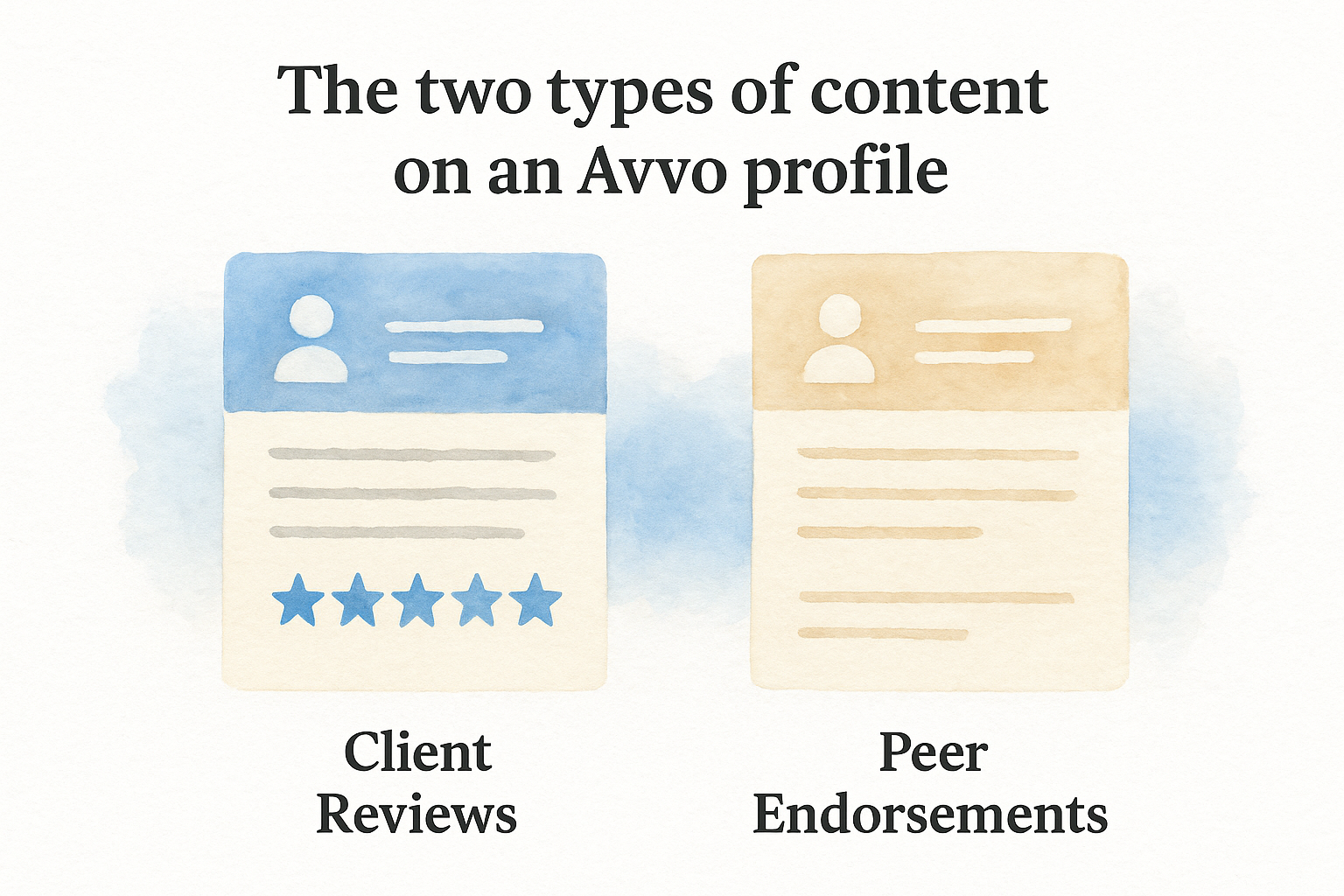
Avvo's numerical rating and its written reviews pull from completely different data sources, so a high score does not guarantee strong client feedback, and vice versa.
The first type is client reviews, written by people who hired or consulted the attorney. These are free-text responses paired with a star rating from 1 to 5, and they typically cover communication quality, results, and how responsive the attorney was throughout the case. The second type is peer endorsements, written by other licensed attorneys who vouch for a colleague's skills in a specific practice area. Peer endorsements carry no star rating and read more like professional references than consumer feedback. When you evaluate a lawyer's profile, treat these two content types separately because they measure entirely different dimensions of performance.
Who can leave a review on Avvo
Only people who hired or consulted the lawyer can leave a client review, and the review form asks which of the two applies. Opposing parties and their relatives aren't eligible, and Avvo removes reviews from staff, colleagues, family or friends who weren't clients. Other lawyers weigh in separately, through peer endorsements. You don't need an account to read reviews, but you do need a free Avvo account to submit one.
Reviews still deserve a critical read when you are researching a lawyer. Avvo moderates reviews against its Community Guidelines, and if a lawyer says a reviewer was never a client, Avvo contacts the reviewer and removes the review if the relationship can't be confirmed. Reading for specific details about practice area, case timeline and concrete outcomes, rather than vague praise, gives you a far more reliable signal than the star average alone. Specificity is usually a strong sign of authenticity, whether you are a potential client or an attorney assessing your own profile.
How Avvo ratings and reviews work
Avvo's system combines two separate inputs into a single profile: an algorithmic rating score and written feedback from clients or peers. Understanding how each piece works helps you decide how much weight to give any individual profile, whether you're choosing representation or managing your own firm's reputation on the platform.
The Avvo Rating score explained
The Avvo Rating runs from 1.0 to 10.0, with bands from Superb at 9.0 to 10.0 down to Extreme Caution at 1.0 to 1.9. Avvo bases it on information in the lawyer's profile and public records, such as years licensed, work history, education, awards, publications, professional recognition including peer endorsements, and discipline reported by state bars. Client reviews are not an input: Avvo says reviews never affect the rating, so an attorney with no reviews can still hold a high score. Unclaimed profiles show no numerical rating.
A high Avvo Rating reflects professional credentials and history, not client satisfaction, so always read the written reviews separately before drawing any conclusions.
How client reviews factor into a profile
Client reviews sit below the rating on a profile and use their own 1-to-5 star scale. Because they come from clients rather than Avvo's formula, a run of recent negative reviews can shape a visitor's impression even when the rating is high, which is worth keeping in mind if you manage a profile or are researching a firm.
Peer endorsements function differently from client reviews. They carry no star rating, appear in a dedicated section of the profile and, unlike client reviews, count toward the Avvo Rating, primarily signaling how other licensed attorneys view a colleague's legal competence and professional standing. When you're evaluating a firm for representation, peer endorsements tell you what lawyers think of a colleague, not what paying clients experienced during an actual case.
How to find and interpret Avvo lawyer reviews
Finding a lawyer's profile on Avvo takes less than a minute, but interpreting what you find accurately takes a bit more effort. Search results on Avvo pull from bar registration data, so nearly every licensed U.S. attorney already has a profile whether they actively manage it or not. That means you can research attorneys who have never even logged into the platform, which adds another layer of complexity when assessing how current or complete the profile information is.
Finding a lawyer's profile on Avvo
Go to Avvo.com and use the search bar at the top of the page. You can search by attorney name, practice area, or geographic location. If you already know the attorney's name, searching directly for it returns the fastest result. If you are still shopping for representation, filtering by practice area and city gives you a list of attorneys to compare. From any profile, scroll past the rating score to reach the client review section, which appears separately from peer endorsements lower on the page.
Reading reviews critically
When you read avvo lawyer reviews, focus on the substance of individual reviews rather than the aggregate star average. Look for reviews that mention a specific practice area, describe how the attorney handled communication during the case, and reference a concrete outcome. Vague five-star reviews that say nothing beyond "great lawyer" carry far less signal than a detailed four-star review that walks through the actual client experience.
Reviews with specific details about case type, timeline, and attorney responsiveness are more reliable indicators of real experience than short, generic praise.
Pay attention to response patterns from the attorney, too. Attorneys who respond professionally to critical reviews demonstrate accountability, while profiles with clusters of reviews all submitted within a short window deserve a second look before you commit.
How clients leave an Avvo review
Writing an Avvo review is a straightforward process, but doing it well takes a few minutes of preparation. Before you start, confirm that your experience with the attorney is recent enough to be relevant and that you have a valid email address ready to create or log into your Avvo account, since Avvo requires one to submit a review.
What you need before you start
Go to the attorney's Avvo profile and choose the option to write a review. You'll be asked to log in or create a free account, say whether you hired or consulted the attorney, and give an overall rating from 1 to 5 stars before the written portion. If you're an attorney, this is the path to walk clients through when you ask for a review.
Only clients who hired or consulted the attorney can leave a review; lawyers who want to vouch for a colleague use a peer endorsement instead.
Writing a review that actually helps
The most useful Avvo lawyer reviews go beyond a star rating and describe specific details about your case type, the attorney's communication style, and the final outcome. You do not need to share confidential information to write a meaningful review. Mentioning the practice area, how responsive the attorney was during the case, and whether the result met your expectations gives future clients a real basis for comparison.
Keep your review focused and factual. Reviewers who stick to their direct experience and avoid making unsupported legal claims are far less likely to have a review flagged or removed. Avvo checks reviews against its Community Guidelines, so a review may not appear the moment it's submitted.
Common issues and how to handle them
Even with a relatively straightforward platform, Avvo users on both sides of the attorney-client relationship run into predictable friction points. Knowing the most common problems before they happen saves time and prevents avoidable frustration when you are relying on Avvo lawyer reviews to make a real decision.
When a review gets removed
Avvo removes reviews that break its Community Guidelines, including reviews from people who never hired or consulted the lawyer. It will not remove a review that reflects a genuine client experience and follows the guidelines just because the lawyer disagrees with it, and lawyers can't pay to have a review taken down. If your review as a client disappears, the likely cause is language Avvo flagged under those guidelines, so rewrite it around your direct experience: the practice area, how communication went, and whether the outcome met your expectations.
Sticking to observable facts about your own experience is the single most reliable way to keep a review from being removed after moderation.
When you need to flag a fake review
Attorneys who spot a review they believe came from someone they never represented can dispute it through Avvo's Customer Care. Avvo then contacts the reviewer and removes the review if the client relationship can't be confirmed. Take a screenshot of the review before you report it, and if a public reply is warranted in the meantime, keep it calm and reveal nothing about any representation.
When your Avvo Rating looks lower than expected
A rating that seems low despite a strong career usually comes down to incomplete profile information, or to a profile that hasn't been claimed, since unclaimed profiles show no numerical rating at all. Claim the profile, then add the work history, education, awards, publications and other recognition Avvo can't find in public records. Peer endorsements also count toward the rating, so ask colleagues who know your work. Client reviews won't move it, because Avvo says reviews never affect the rating.
How lawyers can get more Avvo reviews without breaking the rules
More reviews come from asking more clients, consistently, and from handling the bad ones well. The rules here are stricter than most marketing advice admits.
- Ask every client. Build the request into how you close a matter, and send a direct link to your Avvo review page so clients don't have to hunt for it. Asking everyone, not just the clients you expect to be happy, keeps your reviews honest and your process defensible.
- Never pay for reviews. The FTC's rule on consumer reviews and testimonials (16 CFR Part 465), in effect since October 21, 2024, bans buying fake reviews and offering incentives conditioned on a review expressing a particular sentiment, with civil penalties of up to $53,088 per violation. ABA Model Rule 7.2(b) separately bars giving anything of value for a recommendation.
- Respond without revealing anything. ABA Formal Opinion 496 says a negative online review alone doesn't allow a lawyer to disclose information about the representation. A short reply that invites the reviewer to contact you directly, or says professional considerations prevent a response, is safe, and often the best response is none.
- Complete your profile. A claimed, complete profile gets a numerical Avvo Rating and gives prospective clients more to read beside the reviews, and peer endorsements from colleagues count toward the rating.
Next steps
Now that you understand how Avvo lawyer reviews work from both sides of the process, you have a clear framework for using the platform effectively. If you are a potential client, focus on reading individual reviews for specific details rather than relying on the numerical rating alone. If you are an attorney, complete your profile, respond professionally to client feedback, and treat Avvo as one piece of a broader reputation strategy, not your entire online presence.
Your online reputation influences how many consultations turn into signed retainers, and Avvo is only one channel in that pipeline. If you want to see where your firm's review process, intake and attribution stand, the free marketing scorecard asks 11 questions, including how you request and respond to reviews, and takes about two minutes.
Frequently asked questions about Avvo lawyer reviews
How does the Avvo Rating work?
The Avvo Rating is a score from 1.0 to 10.0 that Avvo calculates from a lawyer's profile and public records: years licensed, work history, education, awards, publications, professional recognition including peer endorsements, and discipline reported by state bars. Scores of 9.0 to 10.0 are labeled Superb, and 1.0 to 1.9 Extreme Caution. Client reviews are not part of it, since Avvo says reviews never affect the rating, and unclaimed profiles show no numerical rating at all.
Is Avvo legit?
Yes, Avvo is an established legal directory. It was co-founded in Seattle in 2006 by Mark Britton and Paul Bloom, launched publicly in 2007, and agreed in January 2018 to be acquired by Internet Brands. Avvo says it has profiles for more than 97% of licensed U.S. attorneys, built largely from public bar data, which is why lawyers who never signed up still have one. Treat its rating as a summary of credentials, and read the client reviews separately.
Can lawyers buy Avvo reviews?
No, and trying can cost far more than a bad review. The FTC's rule on consumer reviews and testimonials, in effect since October 21, 2024, bans buying fake reviews and offering incentives conditioned on a review expressing a particular sentiment, with civil penalties of up to $53,088 per violation. ABA Model Rule 7.2(b) also bars lawyers from giving anything of value for a recommendation, and Avvo says lawyers can't pay to have reviews removed. The safe route is asking every client for an honest review.
Can a lawyer get a negative Avvo review removed?
Only if it breaks Avvo's Community Guidelines. Avvo won't remove a review that reflects a genuine client experience just because the lawyer disagrees with it, but it does remove reviews from people who never hired or consulted the lawyer. If you dispute a review on that basis through Avvo's Customer Care, Avvo contacts the reviewer and removes the review if the relationship can't be confirmed. Otherwise, a measured public reply is usually the better use of your time.
How should a lawyer respond to a negative Avvo review?
Briefly, and without revealing anything about the representation. ABA Formal Opinion 496, issued in January 2021, says a negative online review alone doesn't permit a lawyer to disclose client information. A reply that invites the reviewer to contact you directly, or that says professional considerations prevent a response, is safe, and the opinion notes that not responding is often the best approach. Check your state's version of the confidentiality rule before posting anything.
Frequently Asked Questions
How does the Avvo Rating work?
The Avvo Rating is a score from 1.0 to 10.0 that Avvo calculates from a lawyer's profile and public records: years licensed, work history, education, awards, publications, professional recognition including peer endorsements, and discipline reported by state bars. Scores of 9.0 to 10.0 are labeled Superb, and 1.0 to 1.9 Extreme Caution. Client reviews are not part of it, since Avvo says reviews never affect the rating, and unclaimed profiles show no numerical rating at all.
Is Avvo legit?
Yes, Avvo is an established legal directory. It was co-founded in Seattle in 2006 by Mark Britton and Paul Bloom, launched publicly in 2007, and agreed in January 2018 to be acquired by Internet Brands. Avvo says it has profiles for more than 97% of licensed U.S. attorneys, built largely from public bar data, which is why lawyers who never signed up still have one. Treat its rating as a summary of credentials, and read the client reviews separately.
Can lawyers buy Avvo reviews?
No, and trying can cost far more than a bad review. The FTC's rule on consumer reviews and testimonials, in effect since October 21, 2024, bans buying fake reviews and offering incentives conditioned on a review expressing a particular sentiment, with civil penalties of up to $53,088 per violation. ABA Model Rule 7.2(b) also bars lawyers from giving anything of value for a recommendation, and Avvo says lawyers can't pay to have reviews removed. The safe route is asking every client for an honest review.
Can a lawyer get a negative Avvo review removed?
Only if it breaks Avvo's Community Guidelines. Avvo won't remove a review that reflects a genuine client experience just because the lawyer disagrees with it, but it does remove reviews from people who never hired or consulted the lawyer. If you dispute a review on that basis through Avvo's Customer Care, Avvo contacts the reviewer and removes the review if the relationship can't be confirmed. Otherwise, a measured public reply is usually the better use of your time.
How should a lawyer respond to a negative Avvo review?
Briefly, and without revealing anything about the representation. ABA Formal Opinion 496, issued in January 2021, says a negative online review alone doesn't permit a lawyer to disclose client information. A reply that invites the reviewer to contact you directly, or that says professional considerations prevent a response, is safe, and the opinion notes that not responding is often the best approach. Check your state's version of the confidentiality rule before posting anything.