What Is Attribution Modeling for Law Firms
Categories: Guide: Explainer
 Abram Ninoyan
Founder & Senior Performance Marketer
Credentials: Google Partner, Google Ads Search Certified, Google Ads Display Certified, Google Ads Measurement Certified, Google Analytics (IQ) Certified, HubSpot Inbound Certified, HubSpot Social Media Marketing Certified, Conversion Optimization Certified
Expertise: Google Ads, Meta Ads, Conversion Rate Optimization, GA4 & Google Tag Manager, Lead Generation, Marketing Funnel Optimization, PPC Management
LinkedIn Profile
Are you tired of guessing which marketing channels deliver your most valuable cases? This guide provides a clear answer to the question, "what is...
Key Takeaways
- The Marketing Mystery: Where Do Your Best Cases Come From?
- Defining Attribution in a Legal Context
- Comparing Attribution Models Using Legal Case Analogies
- Why Generic Attribution Fails Legal Marketing Firms
Attribution modeling is a framework for connecting the dots between your marketing spend and the new clients walking through your door. It's how you figure out exactly which ads, SEO efforts, or blog posts are bringing in valuable cases, so you can stop guessing where to invest your budget and start making decisions based on data.
The Marketing Mystery: Where Do Your Best Cases Come From?
Your firm is spending good money on marketing—you're investing in SEO for your practice area, running Google Ads, and maintaining a professional online presence. But when a high-value client signs a retainer, can you pinpoint the exact path they took to find you? For many firms, it's a frustrating mystery. You know the budget is being spent, but you can't confidently say which channel delivered the multi-million dollar corporate client versus the one-off consultation.
This gap between spending money and knowing what works is a major roadblock for law firms trying to scale predictably.
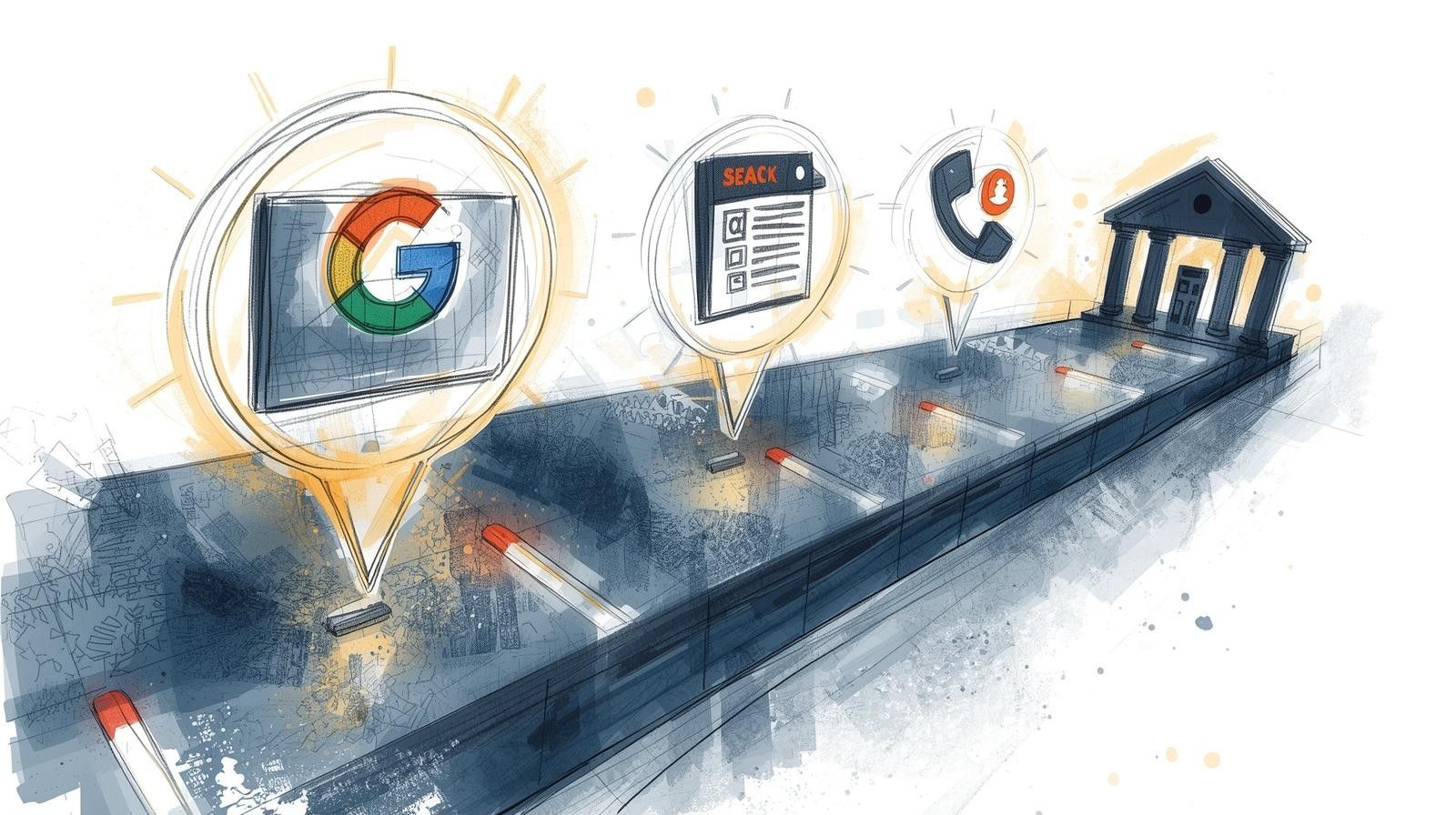
Think of a potential client's journey as the chain of evidence in a complex case. Each marketing interaction is a crucial piece. A prospect might first find your firm through a Google search for "estate planning attorney near me," read an article on your blog a few days later, see a retargeting ad on LinkedIn, and then finally click on your Google Business Profile to call your office. Which touchpoint gets the credit?
Attribution modeling is the methodology you use to analyze that evidence. It's the process of reviewing every interaction to understand the client's complete journey, giving you a clear picture of what influenced their decision to hire you. Instead of only seeing the final action—the phone call—you see the entire sequence of events that led to it.
By understanding this path, you can answer the most critical question in your firm's growth strategy: "Where should we invest our next marketing dollar for the highest return?"
To solve this puzzle, you need a solid method for how to measure advertising effectiveness across every channel. This approach shifts your firm from making decisions based on gut feelings to ones backed by hard data. Ultimately, this clarity turns your marketing from a cost center into a predictable engine for growth, proving how the right data is the fuel for effective lead generation for lawyers.
Defining Attribution in a Legal Context
Let's frame attribution modeling in terms a managing partner can appreciate. Think about a landmark case your firm won. Was it the brilliant initial complaint, that one critical deposition, or your powerful closing argument that secured the victory? The truth is, it was all of them. Each step built upon the last, creating the cumulative effect that led to the win.
Marketing attribution works the same way. It is the analytical process of dissecting the journey a new client takes and assigning credit to the marketing touchpoints that brought them to your firm. It's the difference between knowing you signed a new client and understanding precisely how it happened.
From First Search to Final Call
The heart of this process is tracking every single touchpoint—any interaction a potential client has with your firm online. These touchpoints create a digital breadcrumb trail, showing you exactly how they went from a stranger needing legal help to a signed client.
For someone seeking a family law attorney, that trail might look like this:
- Touchpoint 1: They search Google for "divorce attorney in my city" and click on your firm’s organic search result.
- Touchpoint 2: A few days later, they see a retargeting ad for your firm on a news website and click back to read your attorney bios.
- Touchpoint 3: They find and read a helpful blog post on your website about navigating child custody laws.
- Touchpoint 4: Finally, a week later, they search for your firm by name, find your Google Business Profile, and hit the "call" button.
Without proper attribution, you would likely give 100% of the credit to that final phone call from Google. You’d completely miss the fact that your SEO, paid ads, and content marketing all worked in concert to build the trust that made that call happen. For a more detailed breakdown, you can read our complete guide on what is marketing attribution.
The table below breaks down common client interactions and the critical questions attribution modeling helps your firm answer.
Common Law Firm Client Touchpoints and Key Attribution Questions
Client Touchpoint
Example Action
Key Attribution Question
Organic Search
Clicks on your firm’s website from a Google search result.
Which keywords are actually driving qualified case inquiries, not just website traffic?
Paid Ads (PPC)
Clicks a Google Ad for "personal injury lawyer."
Is our ad spend on this campaign generating a positive ROI in signed cases?
Social Media
Sees and engages with a post from your firm on LinkedIn or Facebook.
Does our social media presence influence potential clients, even if it's not the last click?
Content Marketing
Reads a blog post or downloads an eBook from your site.
How much value does our educational content contribute to the client's decision-making process?
Local SEO
Finds your firm on Google Maps and clicks to call.
Which local search queries are our most valuable for direct client contact?
Referral/Direct
Types your firm's URL directly into their browser or clicks a referral link.
What offline activities or brand recognition efforts are driving people to seek us out directly?
Each of these questions moves beyond simple vanity metrics like "clicks" and gets to the heart of what's actually growing your practice's revenue.
Why This Matters for Your Firm
Understanding this sequence isn't just a marketing exercise—it's about drawing a straight line from your marketing spend to a signed retainer agreement. It finally gives you a clear, data-driven answer to the question every managing partner asks: "Are we getting our money's worth from our marketing?"
By mapping these journeys, you stop spending money on channels you think work and start investing in the ones you know deliver high-value cases. Actionable E-E-A-T: Turning Data into Dollars To move beyond theory, a firm must connect the CAC and CLV calculated by attribution models directly to financial forecasting. For a quick snapshot of your firm’s current performance, tools like our legal marketing ROI calculator can help you instantly map your current marketing spend to potential case value. True expertise in attribution means not just identifying the channels that work, but accurately forecasting the revenue you can expect from your next marketing campaign. That data-backed confidence is how you build a truly scalable law firm.
Comparing Attribution Models Using Legal Case Analogies
Choosing the right attribution model is like deciding which part of a legal case truly secured the win. Was it the initial consultation that got the client in the door? The long hours spent on discovery? Or the killer closing argument that swayed the jury?
Each model provides a different lens to view your marketing success, and the best one for your firm depends on what you are trying to measure.
Getting this right is critical. Client journeys are no longer linear. Back in the 2010s, studies already showed that more than half of all customer journeys involved multiple touchpoints before a decision was made. This complexity makes old-school, single-touch models feel outdated. To get a real picture, firms need to look at the entire client journey, not just one isolated moment. You can learn more about the evolution of attribution modeling to see how far we've come.
When you have a clear attribution model in place, you can finally see a direct link between your efforts and your bottom line. It turns abstract data into tangible ROI, guiding where you should put your next dollar.
This is what it's all about: turning metrics into measurable growth and making smarter business decisions.
To help you choose the right model, let's break down the most common ones with a side-by-side comparison. Think of this table as your guide to assigning credit where it's due, just as you would for a winning case.
Comparing Attribution Models for Law Firms
Attribution Model
How It Works
Legal Analogy
Best For Law Firms That...
First-Touch
Gives 100% of the credit to the very first marketing channel a new client engaged with.
The Initial Consultation. The first meeting gets all the credit for winning the case.
Want to understand which channels are best at generating initial awareness and filling the top of their marketing funnel.
Last-Touch
Gives 100% of the credit to the final marketing channel a client used right before contacting you.
The Closing Argument. The final pitch gets all the credit, ignoring all prior work.
Need to know which marketing efforts are most effective at "sealing the deal" and driving immediate conversions.
Linear
Spreads credit evenly across every single touchpoint in the client's journey.
Equal Discovery Credit. Every piece of evidence, big or small, is valued equally.
Have long client journeys and want a simple, balanced view of all contributing channels without overcomplicating things.
Time-Decay
Gives more credit to touchpoints that happened closer in time to the conversion.
Recent Evidence is More Compelling. A "smoking gun" found right before trial is seen as more impactful than early clues.
Have longer consideration cycles (e.g., M&A, estate planning) and believe recent interactions have more influence.
Position-Based (U-Shaped)
Assigns 40% credit to the first touch, 40% to the last touch, and splits the remaining 20% among all the middle interactions.
Opening & Closing Arguments. Recognizes the critical importance of both the first impression and the final push.
Value both lead generation and conversion channels, making it a popular, well-rounded choice for most service-based firms.
As you can see, there's no single "best" model—only the one that best aligns with your firm's goals. The key is to understand what each model tells you (and what it leaves out).
Single-Touch Models: First vs. Last
The simplest way to look at attribution is through a single-touch model. These give 100% of the credit for a new client to just one interaction. They are easy to understand but often fail to tell the whole story.
- First-Touch Attribution (The Initial Consultation): This model credits the very first interaction a potential client had with your firm. It answers the question, "What brought this person into our world?" It’s great for figuring out which marketing efforts are your best lead generators.
- Last-Touch Attribution (The Closing Argument): Here, all the credit goes to the final touchpoint before a client signed on. This is the default setting in many analytics platforms like Google Analytics and helps you see which channels are most effective at closing deals.
But relying only on these can be misleading. A corporate law firm might learn that a detailed whitepaper (first touch) was essential for building credibility, even if a simple branded search on Google (last touch) was the final click before the client picked up the phone. Ignoring the whitepaper would be a major strategic mistake.
Multi-Touch Models: Seeing the Full Picture
This is where multi-touch models come in. They operate on the premise that, just like a complex case, many different moments contribute to a successful outcome. Credit is distributed across several interactions, giving you a much more balanced and realistic view.
Think of multi-touch attribution as giving credit to the entire legal team. The paralegal who found a key document, the associate who drafted the briefs, and the partner who negotiated the final settlement—they all played a vital role.
Let's look at how these models work in practice:
- Linear Model (Equal Discovery Credit): The simplest of the multi-touch models, this one divides credit equally among every touchpoint. It treats every piece of evidence as equally important. While fair, it can undervalue those truly pivotal moments in a client's journey.
- Time-Decay Model (Recent Evidence is More Compelling): This model gives more credit to the interactions that happen closer to the conversion. The logic is that the most recent touchpoints were the most persuasive, much like a key fact revealed just before trial can have a huge impact. This is a smart choice for firms with long client journeys.
- Position-Based Model (Opening and Closing Arguments): Often called the "U-Shaped" model, this is a fan favorite for a reason. It assigns 40% of the credit to the first interaction and 40% to the last, then divides the remaining 20% among all the steps in between. It rightly acknowledges how critical it is to both start the conversation and close the deal.
Why Generic Attribution Fails Legal Marketing Firms
A law firm is not an e-commerce store, and the path a client takes before hiring you reflects that reality. The problem with most off-the-shelf attribution models is they are built for quick, transactional sales—like buying a pair of shoes. They completely miss the mark for the high-stakes, trust-based decisions involved in retaining legal counsel. Applying a simple e-commerce model to your legal marketing strategy is like using small claims court rules for a complex corporate merger. The framework isn't built for the situation's nuances, leading directly to skewed data and poor marketing decisions.
The Trust-Based Sales Cycle
Think about practice areas like estate planning, corporate M&A, or serious personal injury. The consideration phase is long and layered. A potential client doesn't just "add to cart." They do their homework—conducting extensive research, reading articles, checking reviews, and asking for referrals.
This process can take weeks or even months, involving many different touchpoints designed to build your authority and earn their trust. A generic last-click model, for example, would give zero credit to the in-depth blog post that first established your firm’s expertise, all because it wasn't the final click before a conversion.
The challenge of assigning credit isn't new; it actually has roots in marketing mix modeling from the 1950s. An old anecdote from a 1990s bank revealed that, on average, every dollar of revenue was being claimed by seven different campaigns, which shows just how long this has been an issue. This historical struggle highlights why a more sophisticated approach is necessary for a complex client journey.
Connecting Online Research to Offline Intake
Another huge failure point for generic models is their inability to track offline conversions, which are the lifeblood of most law firms.
The most valuable action a potential client can take is often picking up the phone. A standard analytics setup will struggle to connect a specific Google Ad or organic search query to that phone call without specialized tools.
This digital-to-physical gap means many of your most important leads are misattributed or not tracked at all. On top of that, common issues like inaccurate or incomplete information can completely derail your attribution efforts. To ensure your insights are reliable, you have to focus on improving data quality across all your systems.
A successful system for a law firm must bridge this gap, connecting the dots between a prospect’s online research and their actual conversation with your intake team. Without that connection, you're only seeing half the picture.
The Future of Data-Driven Legal Marketing
The models we’ve walked through are a huge step up from last-click thinking, but the real game-changer is data-driven attribution. Think of it less as a fixed formula and more like the predictive analytics lawyers use for e-discovery.
Just as an algorithm sifts through a mountain of documents to find the crucial evidence, data-driven attribution examines every single touchpoint from your successful client conversions. It then uses machine learning to assign credit based on what actually influenced the final decision.
Uncovering Hidden Patterns
Instead of you telling the model what matters, it tells you. This is where you find the golden nuggets of insight that other models miss entirely.
A data-driven model might find that prospective clients for your personal injury practice who watch a specific case study video early on are 80% more likely to sign with you. That video might not be their first or last touchpoint, but the algorithm identifies it as a powerfully persuasive step in their journey.
The biggest win here is precision. The model learns what works for your firm and your clients, whether you're a family law practice getting leads from Google Maps or a corporate IP firm using LinkedIn content. This insight lets you allocate your marketing budget with much greater confidence.
This is where the industry is heading. Algorithmic models analyze your unique historical data to figure out which touchpoints have a statistically significant impact. They learn, adapt, and get smarter over time, a massive leap from the static, rule-based models. To see more on this trend, you can discover more insights on the evolution of attribution modeling.
Positioning Your Firm for Growth
Let's be clear: adopting a true data-driven model isn't a flip of a switch. It requires a significant amount of conversion data and the right technical setup to make sense of it all.
Even if it seems advanced for where you are today, understanding the principle is vital for any firm that's serious about growth. It’s about shifting from looking in the rearview mirror at past performance to predicting future success.
When you know which touchpoints have the highest statistical impact, you can proactively invest in the channels and content that bring in the best cases. This is fundamental to refining your strategy and getting a true picture of your marketing spend. For a deeper dive, check out our guide on how to measure marketing ROI at your law firm.
Putting Attribution Into Practice at Your Firm
All this theory is great, but how do you actually make it work for your firm? That's the most important part. Understanding attribution isn't just an academic exercise; it's about making sharp, evidence-based decisions that grow your bottom line. The goal is simple: stop guessing where your best cases are coming from and start knowing.
The good news is you don't need a team of data scientists to get started. You can begin with a few foundational steps to build momentum and see valuable insights almost immediately.
Your First Steps Toward Data-Driven Decisions
To get going, you just need to build a solid foundation for collecting and analyzing your marketing data. Here are three practical things you can do right now to put attribution to work.
- Get Your Tracking in Order: Before any model can tell you anything useful, you need clean, reliable data. This means getting the basics right. Make sure your Google Analytics conversion goals are set up to track every form submission. Even more importantly, you absolutely need dynamic call tracking to see which specific ads or pages are making the phone ring.
- Start with a Simple Model: Don't feel pressured to implement a complicated, multi-touch model from day one. It's perfectly fine to start with something straightforward, like the Last-Touch model. This will immediately show you which channels are driving the final action and help you get comfortable with the flow of your data.
- Connect Marketing to Intake: Your data is useless if it doesn't connect a marketing touchpoint to a signed client. Your intake process and CRM must be on the same page, consistently capturing how every lead found you. Finding the best CRM for law firms is key to making this link seamless, directly tying your marketing spend to actual revenue.
Understanding your performance data is the first step toward predictable growth. The next is turning that knowledge into a reliable client acquisition system.
Clear attribution is the bedrock of any smart law firm marketing strategy. By taking these first steps, you start to shift your marketing from a blind expense into a measurable, high-return investment. You'll finally see firsthand how proper attribution data fuels effective lawyer lead generation.
Frequently Asked Questions About Attribution Modeling
We get a lot of questions from managing partners and marketing directors trying to figure out what attribution modeling is and how it actually helps grow a law firm. Let's tackle some of the most common ones.
Which Attribution Model Is Best for a Personal Injury Firm?
There's no magic bullet here; the "best" model really depends on your firm's specific marketing strategy. That said, most personal injury firms find that Position-Based or Time-Decay models offer the most realistic insights.
Think about it: a potential client's journey is rarely a straight line. They might first hear about you from a blog post they found on Google, see a social media ad a week later, and finally click your Google Maps listing when they’re ready to call. These models rightly give credit to both that crucial first touchpoint and the final ones that sealed the deal, unlike a simple Last-Click model that would completely ignore all the early brand-building work.
Can Attribution Modeling Track Client Referrals or Phone Calls?
Absolutely, but it’s not automatic—you need the right tools in place. This is a huge deal for law firms, where a phone call is often the most valuable conversion. The key is implementing call tracking software.
This kind of software assigns a unique phone number to each of your marketing channels—one for your Google Business Profile, another for a specific PPC ad, and so on. When a potential client calls one of these numbers, the system automatically credits the right source.
For client referrals, the solution is more about process than technology. You have to make it a non-negotiable part of your intake to ask, "How did you hear about us?" and then diligently log that information in your CRM.
Is This Too Complex for a Small or Solo Law Practice?
Not at all. It's easy to get intimidated by the more advanced models, but you don't have to start there. Simply using the default models already available in Google Analytics 4 is a massive first step, and it costs you nothing but a little time.
The most important thing is just to start. Even a basic Last-Click analysis is a world better than having no data and just guessing. The goal is to make small, steady improvements over time.
Even a simple understanding of where your signed cases are coming from gives you a powerful advantage. It helps you stop wasting money and start investing your marketing budget where it will actually make a difference as your practice grows.
At GavelGrow, we build the data-driven systems that connect marketing spend directly to signed cases. If you're ready to stop guessing and start making evidence-based decisions to grow your firm, we can help.
Frequently Asked Questions
Which Attribution Model Is Best for a Personal Injury Firm?
There's no magic bullet here; the "best" model really depends on your firm's specific marketing strategy. That said, most personal injury firms find that Position-Based or Time-Decay models offer the most realistic insights. Think about it: a potential client's journey is rarely a straight line. They might first hear about you from a blog post they found on Google, see a social media ad a week later, and finally click your Google Maps listing when they’re ready to call. These models rightly give credit to both that crucial first touchpoint and the final ones that sealed the deal, unlike a simple Last-Click model that would completely ignore all the early brand-building work.
Can Attribution Modeling Track Client Referrals or Phone Calls?
Absolutely, but it’s not automatic—you need the right tools in place. This is a huge deal for law firms, where a phone call is often the most valuable conversion. The key is implementing call tracking software. This kind of software assigns a unique phone number to each of your marketing channels—one for your Google Business Profile , another for a specific PPC ad, and so on. When a potential client calls one of these numbers, the system automatically credits the right source. For client referrals, the solution is more about process than technology. You have to make it a non-negotiable part of your intake to ask, "How did you hear about us?" and then diligently log that information in your CRM.
Is This Too Complex for a Small or Solo Law Practice?
Not at all. It's easy to get intimidated by the more advanced models, but you don't have to start there. Simply using the default models already available in Google Analytics 4 is a massive first step, and it costs you nothing but a little time. The most important thing is just to start. Even a basic Last-Click analysis is a world better than having no data and just guessing. The goal is to make small, steady improvements over time. Even a simple understanding of where your signed cases are coming from gives you a powerful advantage. It helps you stop wasting money and start investing your marketing budget where it will actually make a difference as your practice grows. At GavelGrow , we build the data-driven systems that connect marketing spend directly to signed cases. If you're ready to stop guessing and start making evidence-based decisions to grow your firm, we can help. Book a No-Obligation Strategy Session Today