What Is Content Strategy? Definition, Frameworks & Steps
Categories: Legal Marketing Strategies
 Abram Ninoyan
Founder & Senior Performance Marketer
Credentials: Google Partner, Google Ads Search Certified, Google Ads Display Certified, Google Ads Measurement Certified, Google Analytics (IQ) Certified, HubSpot Inbound Certified, HubSpot Social Media Marketing Certified, Conversion Optimization Certified
Expertise: Google Ads, Meta Ads, Conversion Rate Optimization, GA4 & Google Tag Manager, Lead Generation, Marketing Funnel Optimization, PPC Management
LinkedIn Profile
Most law firms publish blog posts, create practice area pages, and maybe even run a newsletter. But without a plan connecting those pieces to actual business goals, it's just noise. That's why underst...
Key Takeaways
- What Is Content Strategy? Definition, Frameworks & Steps
- What content strategy is and is not
- Why content strategy matters
- The core parts of a strong content strategy
What Is Content Strategy? Definition, Frameworks & Steps
Most law firms publish blog posts, create practice area pages, and maybe even run a newsletter. But without a plan connecting those pieces to actual business goals, it's just noise. That's why understanding what is content strategy matters, it's the difference between content that fills a website and content that fills an intake pipeline.
A content strategy defines what you publish, why you publish it, who it's for, and how each piece moves a potential client closer to picking up the phone. For attorneys, this is especially critical. Your prospective clients are searching for answers to specific legal questions, and the firms that show up with clear, trustworthy content are the ones that earn the consultation.
At GavelGrow, we build content strategies for law firms every day, strategies designed not around vanity metrics but around signed cases and qualified leads. This article breaks down the full definition of content strategy, walks through proven frameworks, and gives you a step-by-step process to build one that actually drives growth for your firm.
What content strategy is and is not
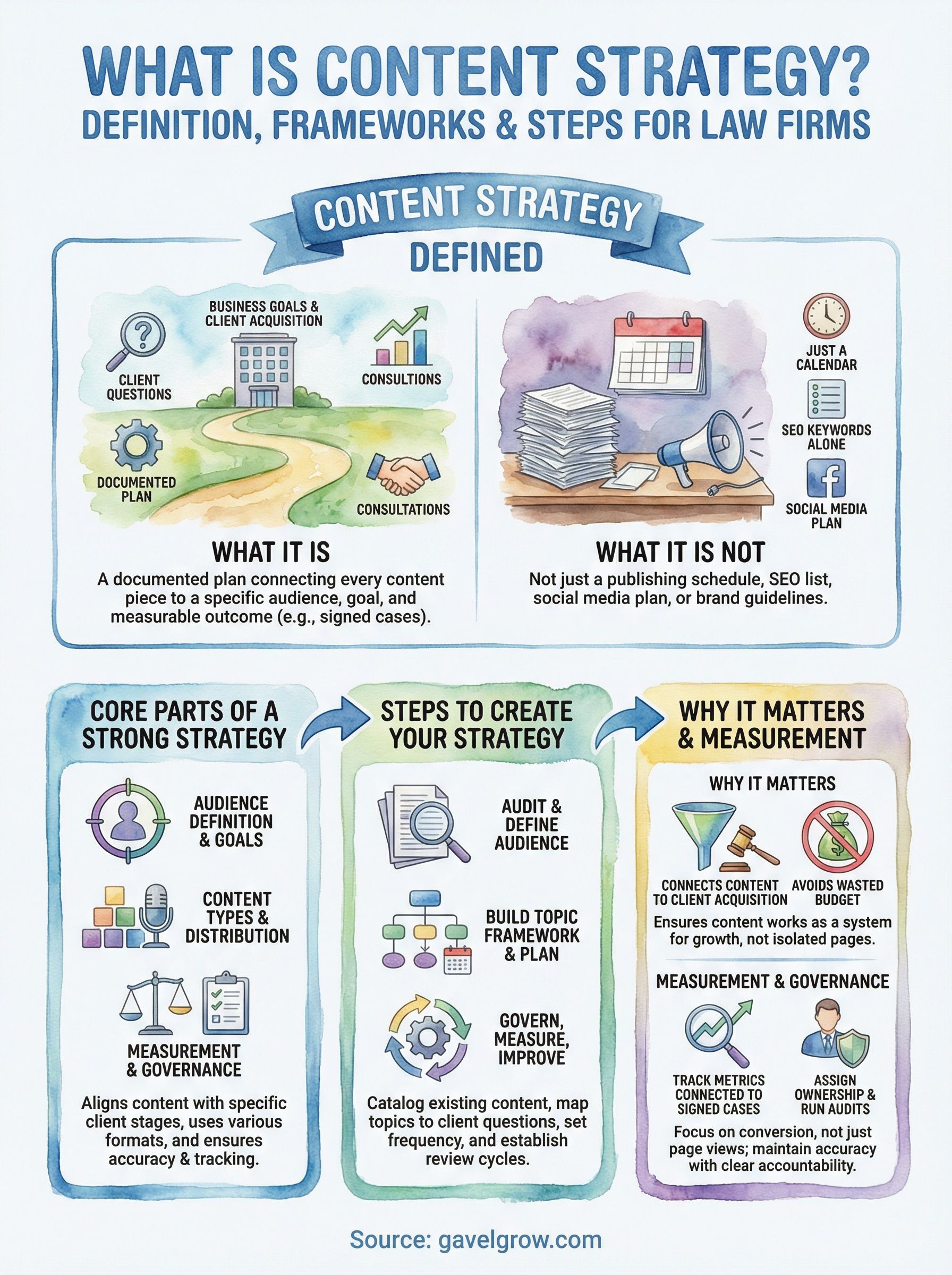
Understanding what is content strategy starts with separating it from the content itself. A content strategy is the documented plan that drives all content decisions, covering who you're creating content for, what problems that content solves, how it connects to your business goals, and where and when you publish it. For law firms, this means your strategy dictates which practice areas get blog coverage, what questions those posts answer, and how each piece funnels a reader toward booking a consultation rather than clicking away to a competitor's site.
What content strategy actually is
A content strategy ties every piece of content to a specific purpose. That purpose might be ranking for a keyword a potential client types into Google, building trust with someone who is undecided about hiring an attorney, or explaining a complex legal process in plain language. Each content decision flows from a clear set of goals, an audience profile, and a measurement framework that tells you whether the content is working.
A content strategy without defined goals is just a publishing schedule, and a publishing schedule alone will not grow your firm.
Strong strategies also address governance and maintenance, meaning who creates and updates content, what standards each piece must meet, and how often you audit older pages. This matters especially for legal content, where outdated statutes, procedural changes, or jurisdiction updates can make a page inaccurate overnight and damage the trust you worked to build with a prospective client.
What content strategy is not
Content strategy is not a content calendar. A calendar tells you when to post. A strategy tells you what to post and why. Many firms confuse the two and end up with a steady stream of content that attracts no traffic and converts no clients because there was no guiding logic behind the topics, the formats, or the calls to action.
Neither is content strategy SEO alone, social media planning, or a one-time document you file away after a kickoff meeting. These elements can support a strategy, but none of them replace it. Consider the difference:
Recognizing what content strategy is not helps you avoid the most common trap law firms fall into: producing a high volume of content that never earns a single consultation because it was built around a calendar instead of a client's actual questions and needs.
Why content strategy matters
For law firms, every piece of content you publish either earns a potential client's trust or loses it. Without a strategy guiding those decisions, you spend time and money producing pages that compete with each other, target the wrong audiences, or answer questions your prospective clients are not asking. Understanding what is content strategy helps you see why a plan is not optional; it is foundational to everything else you do online.
Content without strategy wastes budget
When you publish without a strategy, you make arbitrary decisions about topics, formats, and frequency. Those decisions might feel productive, but they rarely connect to the business outcomes you need. A personal injury firm that publishes ten blog posts on general legal history earns no qualified traffic from people searching for help after a car accident. The content exists, but it does not work.
Publishing content without a strategy is the fastest way to spend your marketing budget on pages that no one reads and no one acts on.
Without a documented plan, you also duplicate effort across your team and create content gaps in the practice areas that drive the most revenue for your firm.
Strategy connects content to client acquisition
A defined strategy gives every content decision a clear job to do. You know which topics to cover because you have mapped them to the questions your target clients type into Google. You know what each page should prompt a reader to do, whether that is calling your office, submitting a contact form, or reading a related guide that moves them further into the decision process.
This connection between content and client acquisition is what separates firms that grow consistently from those that publish inconsistently and wonder why their website produces no leads. A strategy makes your content work as a system, not a collection of isolated pages pulling in different directions.
The core parts of a strong content strategy
Understanding what is content strategy requires knowing which building blocks belong inside one. Every strong strategy includes a defined audience, clear goals, a content structure, distribution channels, and a system for measuring results. For law firms, these components work together to ensure that every piece of content earns its place by moving a potential client closer to booking a consultation.
Audience definition and goal alignment
Your audience profile documents who your ideal clients are, what questions they ask before hiring an attorney, and what fears or objections they bring to the process. Without this foundation, your content targets no one in particular and serves no one effectively. A family law firm targeting divorcing parents in Chicago has a very different audience than a mass tort firm recruiting nationwide plaintiffs.

Audience definition must tie directly to your business goals; otherwise it stays a research document that never influences a publishing decision.
Once you define the audience, align each content goal to a specific stage in the client journey: attracting new visitors through organic search, educating prospects who are weighing their options, and converting ready-to-hire clients into consultations.
Content types and distribution channels
Different formats serve different purposes in your strategy. Long-form practice area pages build the topical authority that organic search rewards, while concise FAQ posts capture high-intent question-based queries. Map each format to the audience stage it serves so you avoid publishing content that reaches the wrong person at the wrong moment.
Distribution matters just as much as format. Decide where each content type lives: your website, your Google Business Profile, or a targeted email sequence. Publishing the right content in the wrong place reduces its impact significantly.
Measurement and governance framework
Your strategy needs to specify which metrics prove the content is working, and those metrics should connect directly to signed cases rather than just page views. Assign ownership to each content type so someone is always accountable for accuracy and updates. For legal content, outdated information damages trust fast, so build review cycles into your governance plan from the start.
How to create a content strategy step by step
Knowing what is content strategy means little unless you can build one. The process below gives you a clear sequence to follow, whether you are starting from scratch or improving what your firm already has in place.
Start with an audit and define your audience
Begin by cataloging every existing page on your site and noting which ones drive organic traffic and consultation requests, which ones underperform, and where your competitors are filling gaps you have left open. This audit shows you exactly what to keep, what to update, and which practice areas lack the content coverage they need to compete in search results.
Your audit is not just a content count. It is a diagnostic tool that tells you where your current approach is failing your firm.
Once you complete the audit, document your target audience by practice area and location, listing the specific questions those clients search for before hiring an attorney. Then align each content goal to a measurable business outcome, such as increasing consultation bookings for a specific practice area in a defined market.
Build your topic framework and publishing plan
Use your audience research to build a topic cluster structure that groups related content around your core practice areas. Assign a format to each topic based on its purpose. Long-form pillar pages earn authority for broad practice area terms, while short FAQ posts capture high-intent queries from people who are already close to contacting an attorney.

From there, set a publishing frequency you can maintain with accurate, well-researched content. Two strong pages per month consistently outperform ten thin posts that fail to answer a real client question. Assign clear ownership for each piece so someone is always accountable for writing, reviewing, and publishing on schedule without letting quality slip.
How to govern, measure, and improve content
Knowing what is content strategy also means knowing how to keep it running after launch. A strategy that no one maintains becomes outdated quickly, especially in legal content where statutes change, procedural rules shift, and regulations affect how you must present information to potential clients. Governance is the system that keeps your content accurate, aligned with your goals, and working as a client acquisition tool instead of a liability.
Assign ownership and run regular audits
Assign a named owner to each content type on your site so someone is always responsible for accuracy and updates. Without clear ownership, pages go unreviewed for months and quietly lose rankings or mislead potential clients who rely on that information before hiring an attorney. Build review cycles into your workflow from the start so auditing becomes a routine task rather than an emergency response.
A quarterly audit should cover at minimum:
- Pages with declining organic traffic or dropping conversion rates
- Practice area content that references jurisdiction-specific statutes or procedures
- Any page where a competitor has recently published stronger, more detailed coverage
Track metrics that connect to signed cases
Measure what ties directly to client acquisition, not just traffic volume. Page views tell you how many people visited; they do not tell you how many booked a consultation. Set up conversion tracking through Google Analytics to capture form submissions, click-to-call events, and consultation requests by source page so you know exactly which content earns its place in your strategy.
The metric that matters most for your firm is not how many people read a page; it is how many people contacted you after reading it.
Use your data to prioritize rewrites over new content when the numbers reveal gaps. A high-traffic page with a low conversion rate needs a stronger call to action and clearer next steps. A low-traffic page in a high-value practice area needs a stronger keyword approach before you abandon the topic entirely.
Next steps
You now have a complete picture of what is content strategy: a documented plan that connects every piece of content you publish to a specific audience, goal, and measurable outcome. For law firms, this is not a nice-to-have; it is the foundation that separates a website that sits idle from one that books consultations consistently.
Start by running the audit outlined in this article. Identify which practice areas have genuine content coverage and which ones have gaps that a competitor is filling right now. From there, build your audience profiles, map your topics to client questions, and assign ownership before you publish a single new page.
If you want a custom content strategy built specifically for your firm's practice areas and market, GavelGrow's legal marketing specialists can audit your current content, identify your biggest growth opportunities, and build a plan designed to turn readers into signed cases.
Frequently Asked Questions
What is a content strategy for a law firm?
A content strategy is the documented plan that drives all content decisions: who you're creating content for, what problems it solves, how it connects to your business goals, and where and when you publish. For a law firm, it dictates which practice areas get blog coverage, what questions those posts answer, and how each piece funnels a reader toward booking a consultation instead of clicking to a competitor.
What is the difference between a content strategy and a content calendar?
A content calendar tells you when to post; a content strategy tells you what to post and why. Many firms confuse the two and end up with a steady stream of content that attracts no traffic and converts no clients because there was no guiding logic behind the topics, formats, or calls to action. A strategy without defined goals is just a publishing schedule.
What are the core parts of a strong content strategy?
Every strong content strategy includes a defined audience, clear goals, a content structure, distribution channels, and a system for measuring results. The audience profile documents who your ideal clients are and what questions they ask before hiring an attorney, and each content goal should map to a stage in the client journey: attracting visitors, educating prospects, and converting ready-to-hire clients into consultations.
How do you create a content strategy step by step?
Start by auditing every existing page to see what drives traffic and consultation requests, what underperforms, and where competitors fill gaps. Then document your target audience by practice area and location, build a topic cluster structure around your core practice areas, assign a format to each topic, and set a publishing frequency you can maintain with accurate, well-researched content.
Which metrics should law firms track for content strategy?
Measure what ties directly to client acquisition, not just traffic volume. Page views tell you how many people visited, not how many booked a consultation, so set up conversion tracking in Google Analytics to capture form submissions, click-to-call events, and consultation requests by source page. Run a quarterly audit and prioritize rewriting high-traffic, low-conversion pages before creating new content.
Frequently Asked Questions
What is a content strategy for a law firm?
A content strategy is the documented plan that drives all content decisions: who you're creating content for, what problems it solves, how it connects to your business goals, and where and when you publish. For a law firm, it dictates which practice areas get blog coverage, what questions those posts answer, and how each piece funnels a reader toward booking a consultation instead of clicking to a competitor.
What is the difference between a content strategy and a content calendar?
A content calendar tells you when to post; a content strategy tells you what to post and why. Many firms confuse the two and end up with a steady stream of content that attracts no traffic and converts no clients because there was no guiding logic behind the topics, formats, or calls to action. A strategy without defined goals is just a publishing schedule.
What are the core parts of a strong content strategy?
Every strong content strategy includes a defined audience, clear goals, a content structure, distribution channels, and a system for measuring results. The audience profile documents who your ideal clients are and what questions they ask before hiring an attorney, and each content goal should map to a stage in the client journey: attracting visitors, educating prospects, and converting ready-to-hire clients into consultations.
How do you create a content strategy step by step?
Start by auditing every existing page to see what drives traffic and consultation requests, what underperforms, and where competitors fill gaps. Then document your target audience by practice area and location, build a topic cluster structure around your core practice areas, assign a format to each topic, and set a publishing frequency you can maintain with accurate, well-researched content.
Which metrics should law firms track for content strategy?
Measure what ties directly to client acquisition, not just traffic volume. Page views tell you how many people visited, not how many booked a consultation, so set up conversion tracking in Google Analytics to capture form submissions, click-to-call events, and consultation requests by source page. Run a quarterly audit and prioritize rewriting high-traffic, low-conversion pages before creating new content.