Content Strategy For SEO: A Step-By-Step Plan That Ranks
Categories: Legal Marketing Strategies
 Abram Ninoyan
Founder & Senior Performance Marketer
Credentials: Google Partner, Google Ads Search Certified, Google Ads Display Certified, Google Ads Measurement Certified, Google Analytics (IQ) Certified, HubSpot Inbound Certified, HubSpot Social Media Marketing Certified, Conversion Optimization Certified
Expertise: Google Ads, Meta Ads, Conversion Rate Optimization, GA4 & Google Tag Manager, Lead Generation, Marketing Funnel Optimization, PPC Management
LinkedIn Profile
Most law firms treat content like a checkbox: publish a blog post, sprinkle in some keywords, hope Google notices. That's not a content strategy for SEO, that's a coin toss. And when you're spending $...
Key Takeaways
- Content Strategy For SEO: A Step-By-Step Plan That Ranks
- What an SEO content strategy includes now
- Step 1. Set goals, audience, and intent
- Step 2. Build your topic map and clusters
Content Strategy For SEO: A Step-By-Step Plan That Ranks
Most law firms treat content like a checkbox: publish a blog post, sprinkle in some keywords, hope Google notices. That's not a content strategy for SEO, that's a coin toss. And when you're spending $2K–$100K+ per month on client acquisition, coin tosses aren't a business model. Ranking on page one requires a deliberate, structured plan that connects what potential clients actually search for with content that earns Google's trust.
The problem is that generic advice doesn't account for how legal clients search. Someone facing a DUI charge, a custody battle, or a workplace injury researches differently than someone shopping for software. They need answers fast, they need credibility signals, and they need to find your firm before they find your competitor. A strong content strategy bridges that gap, matching your practice areas to the exact queries prospects type into Google, then organizing that content so search engines reward it.
At GavelGrow, we've helped over 500 U.S. law firms turn marketing spend into signed cases. One pattern we see repeatedly: firms that build content around a clear SEO framework outperform those spending twice as much on ads alone. This guide walks you through the exact step-by-step plan, from topic clusters and keyword prioritization to audience alignment and Google's helpful content standards, so you can build a content engine that compounds over time instead of burning budget month after month.
What an SEO content strategy includes now
An SEO content strategy is no longer just a list of target keywords mapped to blog posts. Google's ranking systems now evaluate whether your content genuinely helps the person reading it, whether the author has real expertise, and whether your site covers a subject with enough depth to be considered a reliable source. For law firms, this shift matters more than in most industries because legal content sits squarely in Google's "Your Money or Your Life" (YMYL) category, meaning the bar for trust and accuracy is substantially higher than it is for a lifestyle blog or product review site.
Beyond keywords: what Google actually evaluates
Google's helpful content guidance makes clear that ranking well requires demonstrating Experience, Expertise, Authoritativeness, and Trustworthiness (E-E-A-T). That means a page about "personal injury settlement timelines in Texas" needs to reflect real legal knowledge, cite accurate context, and be written or reviewed by someone with relevant background. Thin pages built to capture traffic without delivering real answers will pull your entire domain down, not just that individual URL.
If you publish content primarily to attract search engine visits rather than to genuinely help potential clients, Google's systems are designed to detect and deprioritize it.
Your content strategy for SEO needs to account for this directly. Every page you publish should answer three questions before you hit publish: who is this for, what specific question does it resolve, and what action do you want the reader to take afterward? Skipping this check produces content that ranks briefly and then stalls because it never earned real engagement.
The core components of a modern strategy
A complete strategy covers five interconnected areas. Missing any one of them creates gaps that competitors can step into, especially in competitive practice areas like personal injury or family law where dozens of firms target the same searches:
Each component builds on the previous one. Keyword research without audience mapping produces pages that rank but fail to convert visitors into consultations. Strong writing without on-page structure fails to communicate relevance to search crawlers. Publishing without maintenance means pages that performed well in year one quietly slip to page three by year two.
For law firms specifically, content maintenance is the most consistently neglected component. A post about "2023 workers' comp filing deadlines in California" that you haven't touched since it was published becomes a trust liability, not an asset, and Google treats it exactly that way.
Step 1. Set goals, audience, and intent
Before you write a single word, you need to know what winning looks like for your firm. A content strategy for SEO built without clear goals produces a lot of published pages and very little return. Start by anchoring your strategy to a specific, measurable outcome, whether that's ranking for a particular practice area, increasing consultation requests from organic search, or reducing your cost-per-signed-case over a 12-month window.
Define your SEO goals first
Your goals determine everything that follows. A firm trying to dominate personal injury searches in one city needs a very different content plan than a firm expanding into mass torts nationally. Write your primary goal as a single sentence: "We want to rank in the top three results for [practice area] + [city] searches and generate [X] consultations per month from organic traffic by [date]." That sentence becomes your filter for every content decision you make.
Vague goals like "rank better" or "get more traffic" are not goals. They are hopes. Tie every content initiative to a measurable outcome with a deadline.
Map your audience to search behavior
Audience intent shifts depending on where a potential client sits in their decision. Someone who just experienced a workplace injury searches differently three hours later than they do three weeks later. Early searches tend to be broad and emotional ("do I need a lawyer after a workplace injury"), while later searches become evaluative ("workers comp attorney vs filing alone"). Your content plan needs pages for both stages, not just the high-volume terms.

Use this intent matrix to map content to your practice areas before you start writing:
Step 2. Build your topic map and clusters
Once you know your audience and their intent, you need to organize your content so search engines recognize your firm as an authority on a subject, not just a site with scattered articles. Topic clusters are the structural engine of a modern content strategy for SEO. A cluster groups a broad pillar page with multiple supporting pages that link back to it, signaling to Google that your site covers a subject with real depth.
How to structure a pillar page and cluster
A pillar page targets a broad, high-level topic, for example "personal injury law in Texas." It covers the subject comprehensively at a high level and links out to cluster pages that go deeper on each subtopic. Each cluster page covers one specific angle and links back to the pillar. This internal linking structure distributes authority across your site rather than concentrating it on one isolated page.
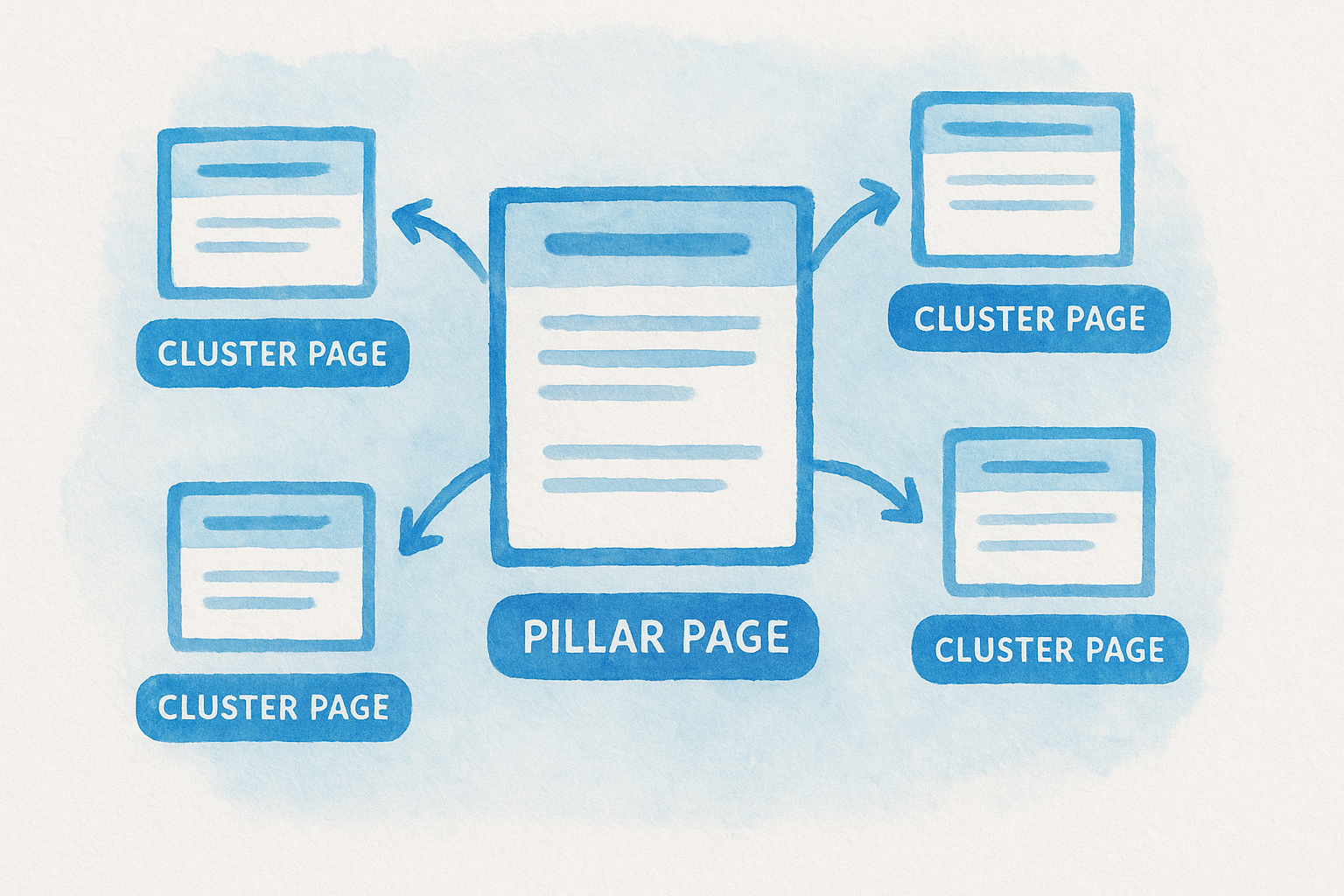
Here is how a complete cluster looks for a personal injury practice:
Mapping clusters to your practice areas
Start by listing every practice area your firm actively takes cases in. For each one, write down the single broadest question a potential client might ask, that becomes your pillar topic. Then brainstorm eight to twelve subtopics a client would research before hiring you, those become your cluster pages.
You do not need to publish every cluster page at once. Build the pillar page first, then publish cluster pages in order of search volume and business priority, linking each one back to the pillar as it goes live.
Work through one practice area completely before starting the next. Firms that spread effort across five half-built clusters consistently underperform firms with two fully built ones.
Step 3. Prioritize keywords and pages to win
A long keyword list with no prioritization framework is just noise. Your content strategy for SEO needs a clear method for deciding which keywords and pages to build first, because you have finite time and budget, and chasing every opportunity simultaneously guarantees mediocre results across the board. Prioritization means ranking your targets by a combination of search demand, competition level, and business value, then working down the list in order.
Choose keywords by opportunity, not just volume
High search volume alone is a poor reason to target a keyword. A term like "personal injury lawyer" gets enormous search volume nationally, but ranking for it as a regional firm is nearly impossible without years of domain authority and thousands of inbound links. Instead, focus on terms where business intent is high and competition is beatable, typically mid-tail phrases that combine a practice area with a geographic modifier or a specific situation.
The best keyword to target is not the one with the most searches. It is the one you can realistically rank for that brings in clients ready to hire.
Use this scoring approach to evaluate each keyword before you commit to building a page:
Add the scores. Pages scoring 10 or higher go to the top of your build queue. Pages scoring below 7 move to a later phase or get cut entirely.
Assign each keyword to a single page
Keyword cannibalization happens when two or more pages on your site compete for the same term, splitting authority and confusing search crawlers about which page to rank. Assign each keyword to exactly one URL and track the mapping in a spreadsheet using these columns:
- Keyword: the exact phrase you are targeting
- Target URL: the page that owns this keyword
- Page type: pillar, cluster, landing page, or blog post
- Cluster: which topic cluster this page belongs to
- Status: draft, published, or needs update
Keeping this document current prevents your team from building competing pages and ensures your internal link structure consistently points to the right URL for each topic.
Step 4. Publish, optimize, and keep it fresh
Publishing a page is the beginning of the work, not the end. Your content strategy for SEO only compounds over time if you treat every published page as a living asset that needs structure on day one and regular maintenance after that. Law firms that publish and forget will watch well-written pages slip from page one to page three within twelve months, simply because a competitor updated their version and earned more engagement signals.
Publish with structure from day one
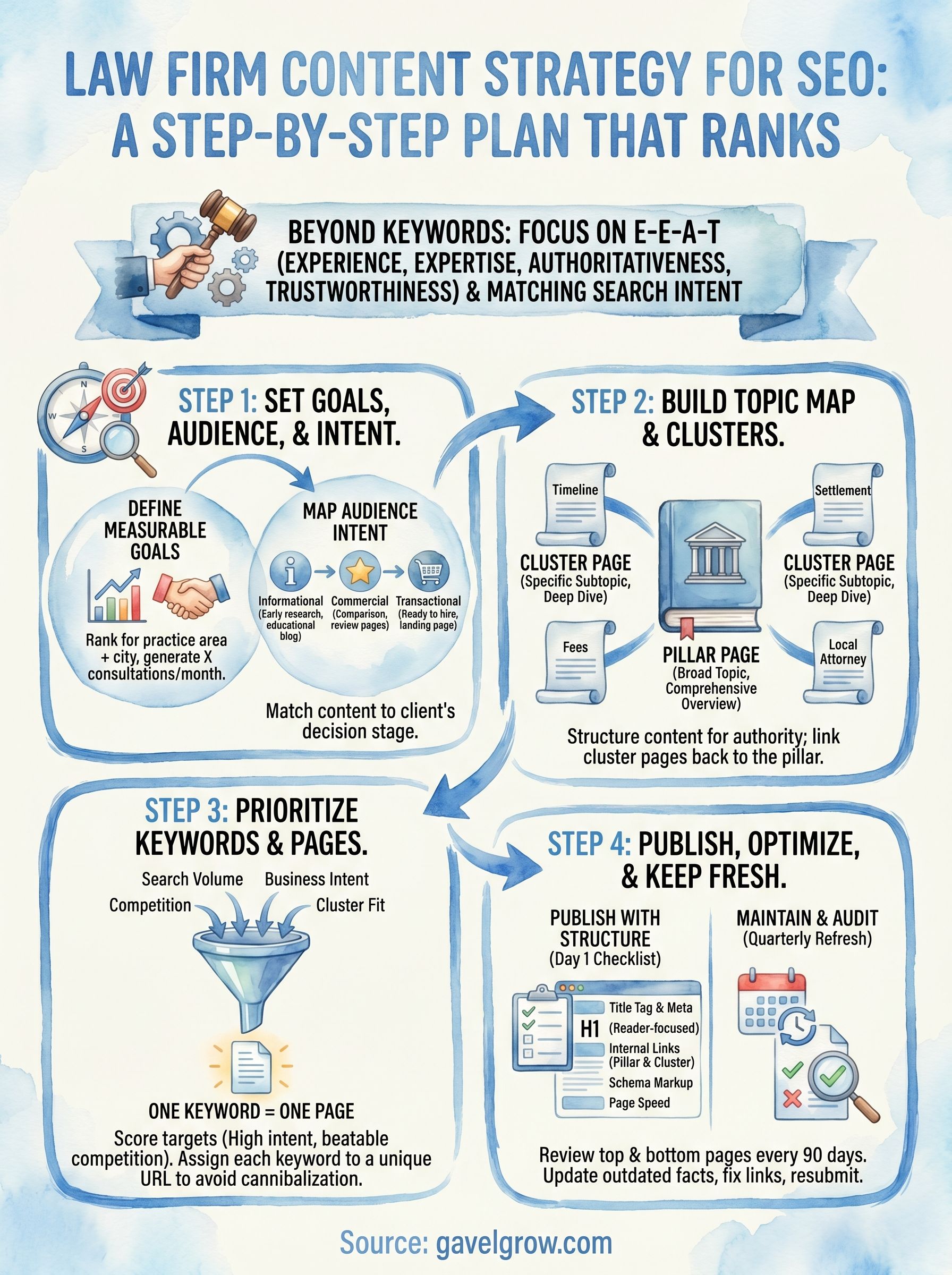
Every page you publish needs the same on-page fundamentals applied before it goes live. Skipping these on a single page costs you rankings that take months to recover. Use this checklist for every new page:
- Title tag: Include your target keyword within the first 60 characters
- Meta description: Write a specific, 150-character summary that reflects what the page delivers
- H1: Match it closely to your title tag but write it for the reader, not for crawlers
- Internal links: Add at least two links pointing to related cluster pages and one link pointing back to your pillar
- Schema markup: Use structured data for legal service pages to give Google clear entity signals
- Page speed: Compress images before upload and avoid render-blocking scripts
Run a content audit every quarter
Set a recurring calendar block every 90 days to review your top 20 performing pages alongside your bottom 20. For top performers, look for internal linking opportunities you missed on newer pages. For underperformers, check whether the search intent has shifted, whether a competitor published a more comprehensive version, or whether the content contains outdated information like superseded statutes or old fee structures.
A single outdated fact on a legal page, such as a filing deadline that changed, can erode the trust of both readers and Google's quality signals at the same time.
Pages that ranked well and dropped are almost always recoverable with a focused update rather than a full rewrite. Add a section answering a related question, refresh statistics, fix broken internal links, and resubmit the URL in Google Search Console for reindexing.
Put the plan to work this week
You now have a complete content strategy for SEO built around how legal clients actually search. Do not try to execute everything at once. This week, pick one practice area, build the pillar page outline, and list eight cluster topics in order of search volume and business intent. That single action gives you a publishable pillar page within two weeks and a full cluster within 60 days.
From there, audit your existing pages using the quarterly checklist, fix the on-page fundamentals on your five highest-traffic URLs, and assign every keyword you target to one URL in a tracking spreadsheet. Each step compounds the one before it, and firms that follow this sequence consistently reduce their cost-per-signed-case over time without doubling their ad spend. If you want a faster path to signed cases from organic search, explore how GavelGrow helps law firms build and measure content ROI.
Frequently Asked Questions
What does an SEO content strategy for law firms include today?
A modern SEO content strategy is no longer just keywords mapped to blog posts; it covers goals and audience intent, topic clusters, keyword prioritization, on-page structure, and ongoing maintenance. Google now evaluates whether content genuinely helps the reader and reflects real expertise. Because legal content sits in Google's Your Money or Your Life category, the bar for accuracy and trust is higher than for most industries, so every page must demonstrate genuine E-E-A-T.
What are topic clusters and why do they matter for legal SEO?
A topic cluster pairs a broad pillar page with multiple supporting pages that link back to it, signaling to Google that your site covers a subject in depth. The pillar targets a high-level topic like personal injury law in your state, while each cluster page goes deep on one subtopic and links back. This internal linking distributes authority across your site instead of isolating it on a single page.
How should a law firm prioritize which keywords to target?
Prioritize by a combination of search demand, competition level, and business value rather than search volume alone. High-volume head terms like "personal injury lawyer" are nearly impossible for a regional firm to rank for, so focus on mid-tail phrases that pair a practice area with a location or a specific situation, where intent is high and competition is beatable. Assign each keyword to exactly one URL to avoid cannibalization.
How often should law firm content be updated?
Plan a content audit roughly every 90 days, reviewing your top and bottom performing pages. For legal content, maintenance is the most neglected component: an outdated fact like a changed filing deadline or a superseded statute erodes trust with both readers and Google's quality signals. Pages that ranked and then slipped are usually recoverable with a focused update, adding a section, refreshing details, and fixing broken links, rather than a full rewrite.
Why do thin, keyword-stuffed pages hurt a law firm's whole site?
Google's helpful content systems are designed to detect pages built mainly to attract search visits rather than to genuinely help readers, and thin pages can drag down your entire domain, not just that URL. For legal topics in the Your Money or Your Life category, the trust bar is especially high. Before publishing, confirm each page answers who it is for, what specific question it resolves, and what action the reader should take.
Frequently Asked Questions
What does an SEO content strategy for law firms include today?
A modern SEO content strategy is no longer just keywords mapped to blog posts; it covers goals and audience intent, topic clusters, keyword prioritization, on-page structure, and ongoing maintenance. Google now evaluates whether content genuinely helps the reader and reflects real expertise. Because legal content sits in Google's Your Money or Your Life category, the bar for accuracy and trust is higher than for most industries, so every page must demonstrate genuine E-E-A-T.
What are topic clusters and why do they matter for legal SEO?
A topic cluster pairs a broad pillar page with multiple supporting pages that link back to it, signaling to Google that your site covers a subject in depth. The pillar targets a high-level topic like personal injury law in your state, while each cluster page goes deep on one subtopic and links back. This internal linking distributes authority across your site instead of isolating it on a single page.
How should a law firm prioritize which keywords to target?
Prioritize by a combination of search demand, competition level, and business value rather than search volume alone. High-volume head terms like "personal injury lawyer" are nearly impossible for a regional firm to rank for, so focus on mid-tail phrases that pair a practice area with a location or a specific situation, where intent is high and competition is beatable. Assign each keyword to exactly one URL to avoid cannibalization.
How often should law firm content be updated?
Plan a content audit roughly every 90 days, reviewing your top and bottom performing pages. For legal content, maintenance is the most neglected component: an outdated fact like a changed filing deadline or a superseded statute erodes trust with both readers and Google's quality signals. Pages that ranked and then slipped are usually recoverable with a focused update, adding a section, refreshing details, and fixing broken links, rather than a full rewrite.
Why do thin, keyword-stuffed pages hurt a law firm's whole site?
Google's helpful content systems are designed to detect pages built mainly to attract search visits rather than to genuinely help readers, and thin pages can drag down your entire domain, not just that URL. For legal topics in the Your Money or Your Life category, the trust bar is especially high. Before publishing, confirm each page answers who it is for, what specific question it resolves, and what action the reader should take.