How to Do a Competitive Analysis: Steps, Tools, Examples
Categories: Legal Marketing Strategies
 Abram Ninoyan
Founder & Senior Performance Marketer
Credentials: Google Partner, Google Ads Search Certified, Google Ads Display Certified, Google Ads Measurement Certified, Google Analytics (IQ) Certified, HubSpot Inbound Certified, HubSpot Social Media Marketing Certified, Conversion Optimization Certified
Expertise: Google Ads, Meta Ads, Conversion Rate Optimization, GA4 & Google Tag Manager, Lead Generation, Marketing Funnel Optimization, PPC Management
LinkedIn Profile
A competitive analysis is a structured process of identifying your competitors, evaluating their marketing strategies, and finding gaps you can exploit to win more cases. If you've been wondering how...
Key Takeaways
- How to Do a Competitive Analysis: Steps, Tools, Examples
- What is a competitive analysis and why do it?
- Step 1. Identify and group your competitors
- Step 2. Collect the right data without guessing
How to Do a Competitive Analysis: Steps, Tools, Examples
A competitive analysis is a structured process of identifying your competitors, evaluating their marketing strategies, and finding gaps you can exploit to win more cases. If you've been wondering how to do a competitive analysis, the short answer is: pick your real competitors, study what they do across specific channels, benchmark their performance against yours, and act on what you find.
Most law firms skip this work entirely. They assume they know who they're competing against because they see the same names in court. But the firms taking your cases aren't always the ones across the courtroom, they're the ones outbidding you on Google Ads, outranking you in local search, and responding to shared leads faster than your team picks up the phone.
At GavelGrow, our modelled practice-area benchmarks gives us a clear view of what separates firms that grow from firms that stall. One pattern holds across practice areas: firms that systematically study their competitors' spend, positioning, and intake process consistently lower their cost-per-signed-case over time. This guide walks you through the exact steps, tools, and examples you need to run a competitive analysis that actually changes how you market your firm.
What is a competitive analysis and why do it?
A competitive analysis is a structured review of the firms competing for the same clients you want to sign. You examine their marketing channels, messaging, intake experience, and online reputation, then compare those findings against your own firm's current performance. The goal isn't to copy what competitors do; it's to find where they're weak and where your firm can win by doing something meaningfully and measurably better.
Firms that know their competitors' ad angles, average review rating, and intake response time hold a structural advantage over firms operating on gut feel alone.
What a competitive analysis actually covers
Knowing how to do a competitive analysis means knowing which data points are worth collecting. Many attorneys think the work stops at Googling a rival firm's name and skimming their homepage. That misses the majority of useful signals. A thorough analysis covers five core areas: organic search presence, paid advertising activity, website and intake experience, pricing and positioning, and reputation signals like review volume and average star rating.
Here is what each area tells you:
Why skipping this step costs you signed cases
Most firms that underperform on marketing share one habit: they make budget decisions based on what worked last year rather than what competitors are doing right now. Markets shift fast. A rival firm might have launched aggressive Google Ads six months ago and is now capturing the leads you used to win through organic search alone. Without a regular competitive review, you won't catch that shift until your intake numbers have already dropped.
Running this analysis quarterly keeps your marketing assumptions grounded in current conditions rather than stale guesses. It also surfaces specific, fixable gaps, like a slow intake form or a missing practice area page, that directly affect your signed-case count.
Step 1. Identify and group your competitors
The biggest mistake firms make at this stage is treating every firm in their city as a competitor worth tracking. When you learn how to do a competitive analysis properly, you start by sorting rivals into two distinct tiers: firms competing for the exact same client type in your market, and firms competing through different channels for clients you could realistically sign.
How to Find Competitors Across Search Channels
Start with a fresh Google search using the terms a potential client would actually type. Search "[practice area] attorney [your city]" in an incognito browser window so your browsing history doesn't skew the results. Note the top five organic results and the top three Google Ads positions separately. These become your Tier 1 list because they're actively competing for the same search-intent traffic you want.

Your Google Maps pack results often reveal a completely different set of competitors than your organic or paid results, so check all three placements before you close the browser.
How to Group Competitors by Tier
Tier 2 competitors are firms you spot in directories, referral networks, or on billboards in your market. They're fighting for the same clients through different acquisition channels. Group them separately because your response strategy differs by tier: you out-rank Tier 1 through better ads and SEO content, and you out-position Tier 2 through stronger reputation signals like review volume and response rate.
Use this tracking template to organize every competitor you find before moving to data collection:
Step 2. Collect the right data without guessing
Once you have your competitor list, the next task is pulling structured data on each firm across the five areas from Step 1. Guessing based on surface-level impressions wastes time and leads to bad decisions. Learning how to do a competitive analysis means building a repeatable data collection process you can run every quarter without starting from scratch.
Where to Pull Organic and Paid Data
Start with Google Search Console for your own organic performance baseline. For competitor ad data, use Google's Ads Transparency Center, which shows active ads any firm currently runs, for free. Set a 30-minute time block per competitor so data collection stays focused and does not drag into a weeks-long project.
The Google Ads Transparency Center is free and updated in near real-time, making it the most reliable source for competitor ad copy without paying for third-party subscriptions.
Record the ad headlines and call-to-action phrases for each Tier 1 competitor alongside their landing page URL. These three data points tell you how rivals frame their offer and where they direct paid traffic.
How to Document Intake and Reputation Data
Call each competitor's intake line as a prospective client would, and note the response time, hold duration, and whether the firm follows up by SMS. Check their Google Business Profile for review count, average star rating, and how quickly they respond to negative feedback. Log every finding into this template before moving to your comparison step:
Step 3. Compare offers, pricing, and positioning
With your data collected, you now need to place competitor offers side by side so patterns become visible. This step in how to do a competitive analysis is where raw data turns into real decisions. You're looking for three specific signals: what each firm promises clients, how they frame fees, and the core positioning claim they repeat across every channel.
How to Spot Gaps in Competitor Positioning
Positioning gaps are the places where competitors make weak or generic claims that you can directly counter with something specific. Scan each competitor's homepage headline and Google Ads copy for vague value statements like "experienced attorneys" or "aggressive representation." Those phrases signal the firm hasn't differentiated on a concrete outcome, which gives you room to lead with a measurable promise instead, such as a no-fee guarantee, a stated response time, or a documented case result.
Look at how competitors handle pricing language as well. Firms that bury their fee structure force potential clients to call just to get basic information. If you display your fee model clearly, you reduce friction at the first touchpoint and separate your firm from every competitor making prospects work for that answer.
How to Build a Side-by-Side Comparison Table
Structured comparison forces you to evaluate each competitor on the same criteria rather than cherry-picking favorable data points. Use this template to map fee structure, core promise, and key differentiator for every Tier 1 firm from Step 1:
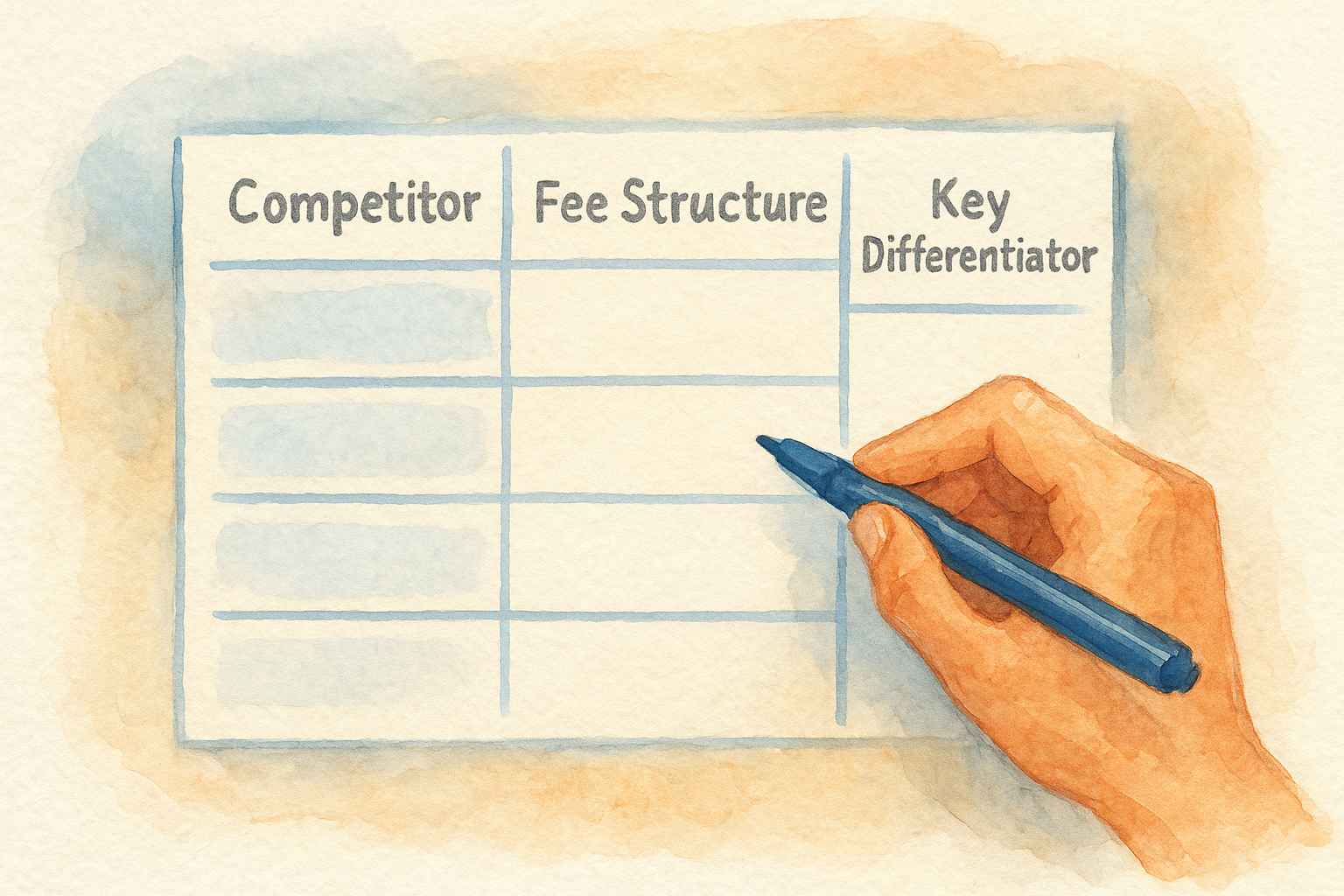
Once you see every firm's core promise in one table, you'll immediately spot which claims are overcrowded and which angles no competitor is owning.
Step 4. Turn insights into an action plan you can track
Collecting competitor data without acting on it is the most common place this process breaks down. The final step in how to do a competitive analysis is converting your comparison table into a prioritized action list tied to specific marketing levers your firm controls, like ad copy, intake speed, or review volume.
How to Prioritize Which Gaps to Fix First
Not every gap you find carries equal weight. Rank your action items by two factors: how much the gap affects signed-case volume, and how fast your team can close it. Intake response time, for example, is fixable within a week using automated SMS follow-up, while outranking a competitor in organic search takes months. Tackle fast, high-impact fixes first so you see measurable results before investing in longer-term plays.
Fixing a slow intake response often produces more signed cases in 30 days than a full website redesign producing results in six months.
Use this scoring approach to rank every action item before you assign owners:
How to Build a Tracking Template
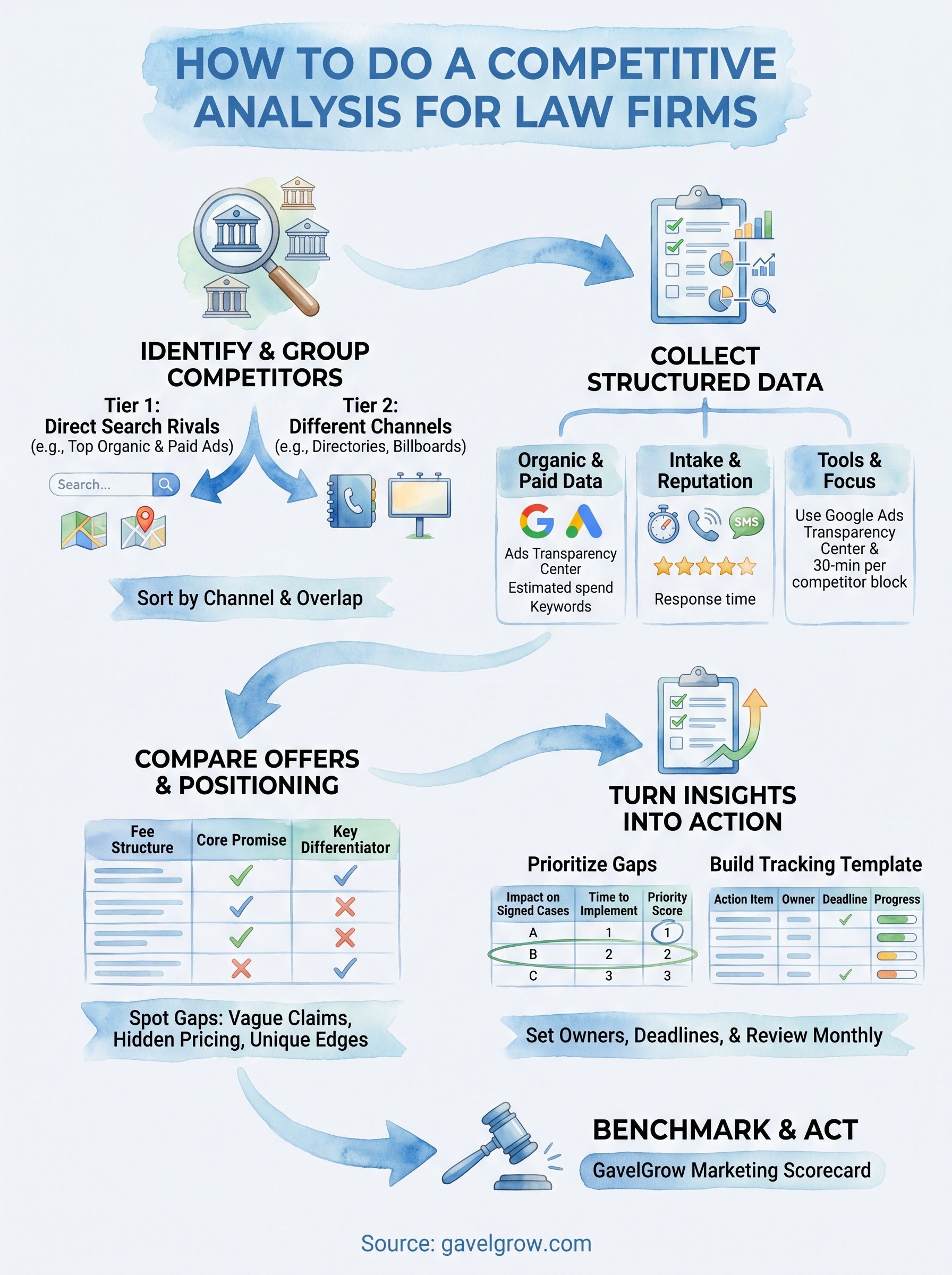
Assign one owner and one deadline to each action item so accountability is clear from day one. Review progress against this tracker every 30 days and compare your updated metrics to the competitor benchmarks you documented in Step 2. That monthly review keeps your competitive analysis from becoming a one-time exercise rather than a compounding advantage.
Next Steps
Now you know how to do a competitive analysis that produces real decisions, not just a spreadsheet you file away and forget. The four-step process covered here, identifying competitors, collecting structured data, comparing offers, and building a tracked action plan, gives your firm a repeatable system you can run every quarter without rebuilding it from scratch each time.
Your most valuable next move is benchmarking your own metrics before you compare them against rivals. GavelGrow's free law firm marketing scorecard gives you a clear baseline across intake speed, cost-per-lead, and review volume so the competitive gaps you found are grounded in real numbers rather than gut feel. Once you have that baseline, book a free 45-minute strategy call to walk through what your analysis reveals and where your firm holds the clearest path to signing more cases in your market.
Frequently Asked Questions
What is a competitive analysis for a law firm?
A competitive analysis is a structured review of the firms competing for the same clients you want to sign. You examine their marketing channels, messaging, intake experience, and online reputation, then compare those findings against your own firm's current performance. The goal is not to copy competitors but to find where they are weak and where your firm can win by doing something meaningfully better.
What should a law firm competitive analysis actually cover?
A thorough analysis covers five core areas: organic search presence, paid advertising activity, website and intake experience, pricing and positioning, and reputation signals like review volume and average star rating. Checking only a rival's homepage misses most of the useful signals. Covering all five gives you a complete picture of how competitors attract and convert the clients you want.
How do I find my law firm's real competitors online?
Search the terms a potential client would type, such as "[practice area] attorney [your city]," in an incognito browser window so your history does not skew results. Note the top organic results and the top Google Ads positions separately, and check your Google Maps pack too, since it often reveals a different set of competitors. Group these into Tier 1 rivals competing for the same search traffic and Tier 2 rivals competing through other channels.
How can I see what ads a competing law firm is running?
Use Google's Ads Transparency Center, which shows the active ads any firm currently runs for free and updates in near real-time. Record each Tier 1 competitor's ad headlines, call-to-action phrases, and landing page URL. These data points reveal how rivals frame their offer and where they send paid traffic, without paying for a third-party subscription.
How often should a law firm run a competitive analysis?
Running this analysis quarterly keeps your marketing assumptions grounded in current conditions rather than stale guesses. Markets shift fast, and a rival that launched aggressive ads six months ago may now be capturing leads you used to win organically. A regular review also surfaces specific, fixable gaps, like a slow intake form or a missing practice area page, that affect your signed-case count.
Sizing up your competitors is the natural first step in any broader plan, so pair this with our overview of how to market a law firm from foundation to full channel mix.
Smaller practices can't outspend the big firms they're analyzing, so the tactics that matter most are covered in our guide to marketing a small law firm on a lean budget.
Once you understand how rivals convert their leads, the follow-up system matters just as much, which is why choosing the best CRM for personal injury lawyers can be a real edge.
Frequently Asked Questions
What is a competitive analysis for a law firm?
A competitive analysis is a structured review of the firms competing for the same clients you want to sign. You examine their marketing channels, messaging, intake experience, and online reputation, then compare those findings against your own firm's current performance. The goal is not to copy competitors but to find where they are weak and where your firm can win by doing something meaningfully better.
What should a law firm competitive analysis actually cover?
A thorough analysis covers five core areas: organic search presence, paid advertising activity, website and intake experience, pricing and positioning, and reputation signals like review volume and average star rating. Checking only a rival's homepage misses most of the useful signals. Covering all five gives you a complete picture of how competitors attract and convert the clients you want.
How do I find my law firm's real competitors online?
Search the terms a potential client would type, such as "[practice area] attorney [your city]," in an incognito browser window so your history does not skew results. Note the top organic results and the top Google Ads positions separately, and check your Google Maps pack too, since it often reveals a different set of competitors. Group these into Tier 1 rivals competing for the same search traffic and Tier 2 rivals competing through other channels.
How can I see what ads a competing law firm is running?
Use Google's Ads Transparency Center, which shows the active ads any firm currently runs for free and updates in near real-time. Record each Tier 1 competitor's ad headlines, call-to-action phrases, and landing page URL. These data points reveal how rivals frame their offer and where they send paid traffic, without paying for a third-party subscription.
How often should a law firm run a competitive analysis?
Running this analysis quarterly keeps your marketing assumptions grounded in current conditions rather than stale guesses. Markets shift fast, and a rival that launched aggressive ads six months ago may now be capturing leads you used to win organically. A regular review also surfaces specific, fixable gaps, like a slow intake form or a missing practice area page, that affect your signed-case count. Sizing up your competitors is the natural first step in any broader plan, so pair this with our overview of how to market a law firm from foundation to full channel mix. Smaller practices can't outspend the big firms they're analyzing, so the tactics that matter most are covered in our guide to marketing a small law firm on a lean budget . Once you understand how rivals convert their leads, the follow-up system matters just as much, which is why choosing the best CRM for personal injury lawyers can be a real edge.