Marketing Automation For Law Firms: The Complete Guide
Categories: Guide: Explainer
 Abram Ninoyan
Founder & Senior Performance Marketer
Credentials: Google Partner, Google Ads Search Certified, Google Ads Display Certified, Google Ads Measurement Certified, Google Analytics (IQ) Certified, HubSpot Inbound Certified, HubSpot Social Media Marketing Certified, Conversion Optimization Certified
Expertise: Google Ads, Meta Ads, Conversion Rate Optimization, GA4 & Google Tag Manager, Lead Generation, Marketing Funnel Optimization, PPC Management
LinkedIn Profile
Stop losing leads to slow responses. Learn how marketing automation for law firms streamlines intake, nurtures prospects, and ensures ethical compliance.
Key Takeaways
- Why marketing automation matters for law firms
- What to automate across the legal marketing funnel
- How to set up marketing automation step by step
- Choosing the right marketing automation software
Most law firms run on a patchwork of manual follow-ups, scattered email threads, and intake processes held together by sheer willpower. It works, until it doesn't. Leads slip through the cracks, consultations go unbooked, and attorneys spend hours on tasks that have nothing to do with practicing law. Marketing automation for law firms solves this by replacing repetitive marketing tasks with systems that run on their own, so your team can focus on signing and serving clients.
At GavelGrow, we build these systems for law firms every day. After working with over 500 firms across personal injury, family law, criminal defense, and beyond, we've seen firsthand how the right automation stack transforms a firm's pipeline, and how the wrong one wastes budget fast. That hands-on experience is exactly what shaped this guide.
Below, we'll break down what marketing automation actually means for a law firm, which tasks you should automate first, and how to evaluate the tools worth your investment. Whether you're exploring automation for the first time or looking to replace a setup that isn't delivering, this guide gives you a clear path forward.
Why marketing automation matters for law firms
Running a law firm means competing for clients in a market where response speed determines who gets hired. Studies show leads contacted within five minutes convert at far higher rates than those who wait an hour or more. When your intake relies on staff manually sending follow-up emails, you will lose potential clients simply because no one got to them fast enough. Marketing automation for law firms solves this by triggering responses the moment a lead fills out a form, any time of day.
A slow follow-up is not just an inconvenience; it is the difference between signing a case and watching a potential client hire someone else.
The cost of manual processes
Manual marketing is expensive in ways that are easy to miss. Every hour your team spends copying leads into spreadsheets or chasing unbooked consultations is an hour not spent on client work. Without a system, your workload scales every time lead volume rises, putting a hard ceiling on firm growth.
Common manual tasks that drain firm time:
- Entering web form submissions into your CRM by hand
- Sending individual follow-up emails after consultation requests
- Tracking which leads responded and which went cold
- Setting reminders to call back prospects who did not book
Speed and consistency win more clients
Potential clients usually contact more than one firm at the same time, which means consistency and speed are your two biggest competitive advantages. Automation gives every lead the same follow-up sequence and response window, whether you receive two inquiries a day or twenty, without adding headcount or increasing workload.
Reliable follow-up also builds trust before a prospect speaks to an attorney. When someone fills out your contact form at 11 PM and receives a clear, professional response within minutes, they are far more likely to book a consultation than if they hear nothing until the next business day.
What to automate across the legal marketing funnel
Not every marketing task belongs in a workflow, but identifying the right ones at each funnel stage makes the difference between a system that saves time and one that creates noise. Marketing automation for law firms works best when you map it directly to funnel stages and assign clear triggers and outcomes for each.
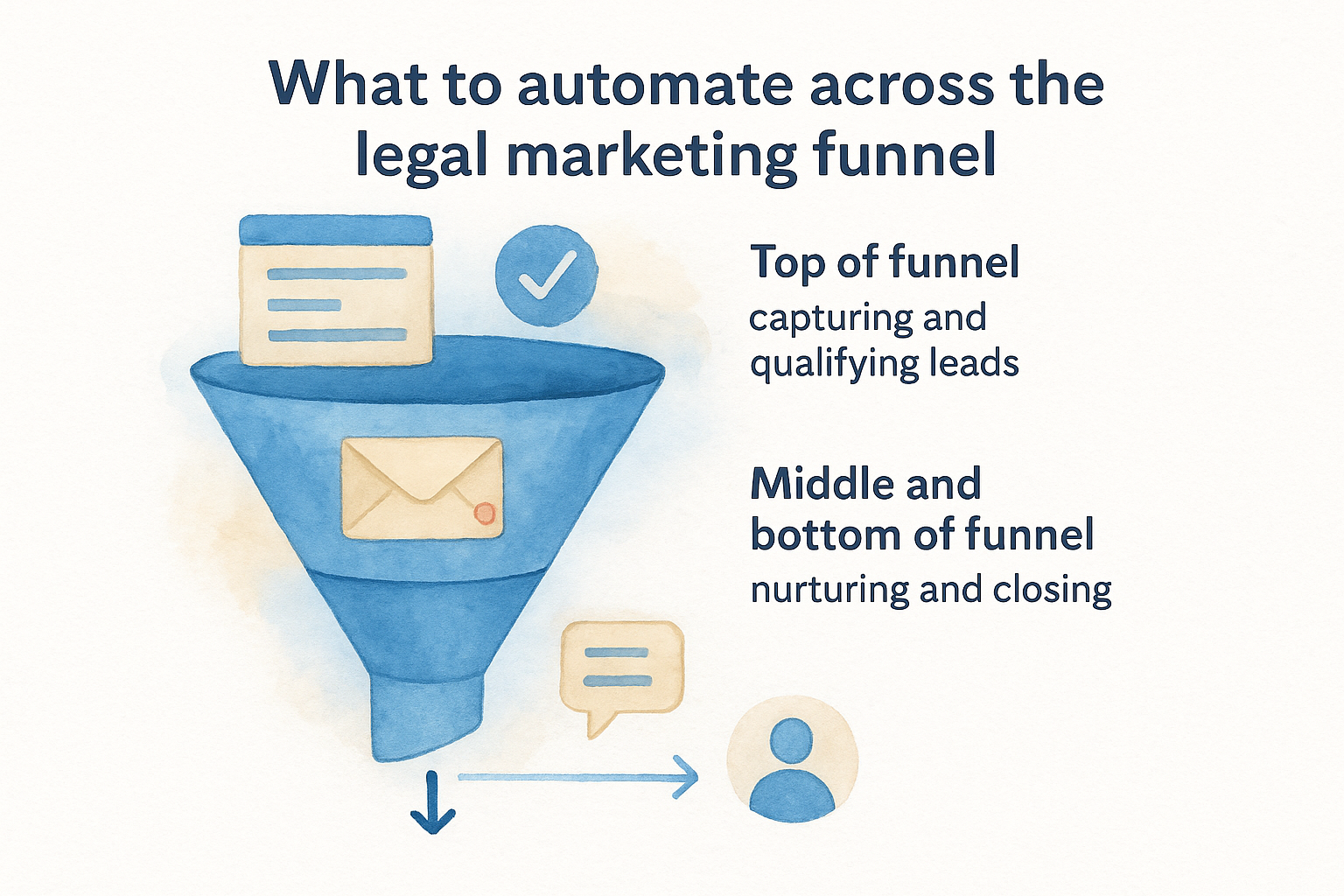
Top of funnel: capturing and qualifying leads
Lead capture and initial response are the highest-value starting points. When a prospect submits a form, your system should immediately confirm receipt, log the contact in your CRM, and launch a qualification sequence. Common top-of-funnel tasks worth automating:
- Form submission confirmations
- Lead routing to the right intake team member
- Retargeting audience updates based on site behavior
Middle and bottom of funnel: nurturing and closing
The leads you ignore between first contact and consultation will book with someone else.
Once a prospect enters your pipeline, automated follow-up sequences handle the heavy lifting. Schedule SMS and email touchpoints for cold leads, send reminders to prospects who never booked, and trigger post-consultation check-ins automatically.
Your team should focus on conversations that require legal judgment, not on manually tracking who opened an email or missed a callback.
How to set up marketing automation step by step
Before you build anything, map out exactly where leads currently enter your pipeline and where they drop off. Most firms discover that their biggest gaps sit between first contact and the first call. Understanding those gaps gives you a clear foundation for building marketing automation for law firms that fixes real problems rather than automating chaos.
Step 1: Audit your intake process
Start by listing every touchpoint a prospect hits before signing, from form submission to consultation booking. Identify which steps currently require manual effort and rank them by how often they cause delays. This audit does not need to be complicated; a simple document works fine.
Key questions to answer during your audit:
- Where do leads go cold most often?
- Which follow-up steps rely entirely on one staff member?
- How long does your average first response take?
Step 2: Build and test your sequences
Build around your real bottlenecks, not around what sounds impressive.
Once you know your gaps, set up one automation sequence at a time rather than launching everything at once. Begin with an immediate lead response workflow, confirm it works correctly, then layer in follow-up sequences. Test every trigger with a live submission before connecting it to real prospects, and review performance data after the first 30 days to refine timing and messaging.
Choosing the right marketing automation software
The software market for marketing automation for law firms is crowded, and most tools were built for e-commerce or SaaS companies, not legal intake. Before committing to any platform, evaluate whether it integrates with your existing CRM and intake forms. A tool that runs in isolation adds manual steps instead of removing them, which defeats the purpose entirely.
The best software is the one your team will actually use consistently, not the one with the longest feature list.
Features that matter most for law firms
Your automation platform needs to handle email and SMS sequences, lead routing, and CRM sync at minimum. Look for tools that support conditional logic in workflows, so leads route differently based on practice area or geographic location. Pricing structure matters too, since some platforms charge per contact, which gets expensive fast as your list grows. A platform without these core features will cap what your system can accomplish.
Prioritize these capabilities when comparing options:
- Two-way SMS and email automation
- Native CRM integration or a reliable API connection
- Intake form triggers and lead routing rules
- Reporting dashboards tied to lead and conversion data
- Role-based access controls for staff members
Compliance, privacy, and ethics for automated outreach
When you build marketing automation for law firms, you take on compliance obligations that go beyond most industries. Legal advertising rules are set at the state level by bar associations, and any automated message your firm sends falls under those regulations, whether a person wrote it or a workflow triggered it.
Treating compliance as an afterthought will cost you far more in bar complaints and reputational damage than it saves in setup time.
Know your outreach channel rules
The TCPA requires explicit written consent before you send automated text messages to any prospect. Email automation must comply with CAN-SPAM requirements, which mandate opt-out mechanisms and accurate sender identification in every message you send.
Key compliance checkpoints to build into your system:
- Log written consent before adding any contact to an SMS workflow
- Include a clear opt-out link in every automated email
- Store consent records where your team can retrieve them quickly
Follow state bar advertising rules
Most state bars classify automated follow-up messages as attorney advertising, which triggers specific disclaimer and language requirements. Review your jurisdiction's Rules of Professional Conduct before finalizing any sequence, and run the actual message templates through a compliance check, not just the overall campaign structure.
Some states also enforce a mandatory waiting period before contacting accident victims, which means your intake automation needs configurable delays built in from the start rather than patched in later.
Next steps
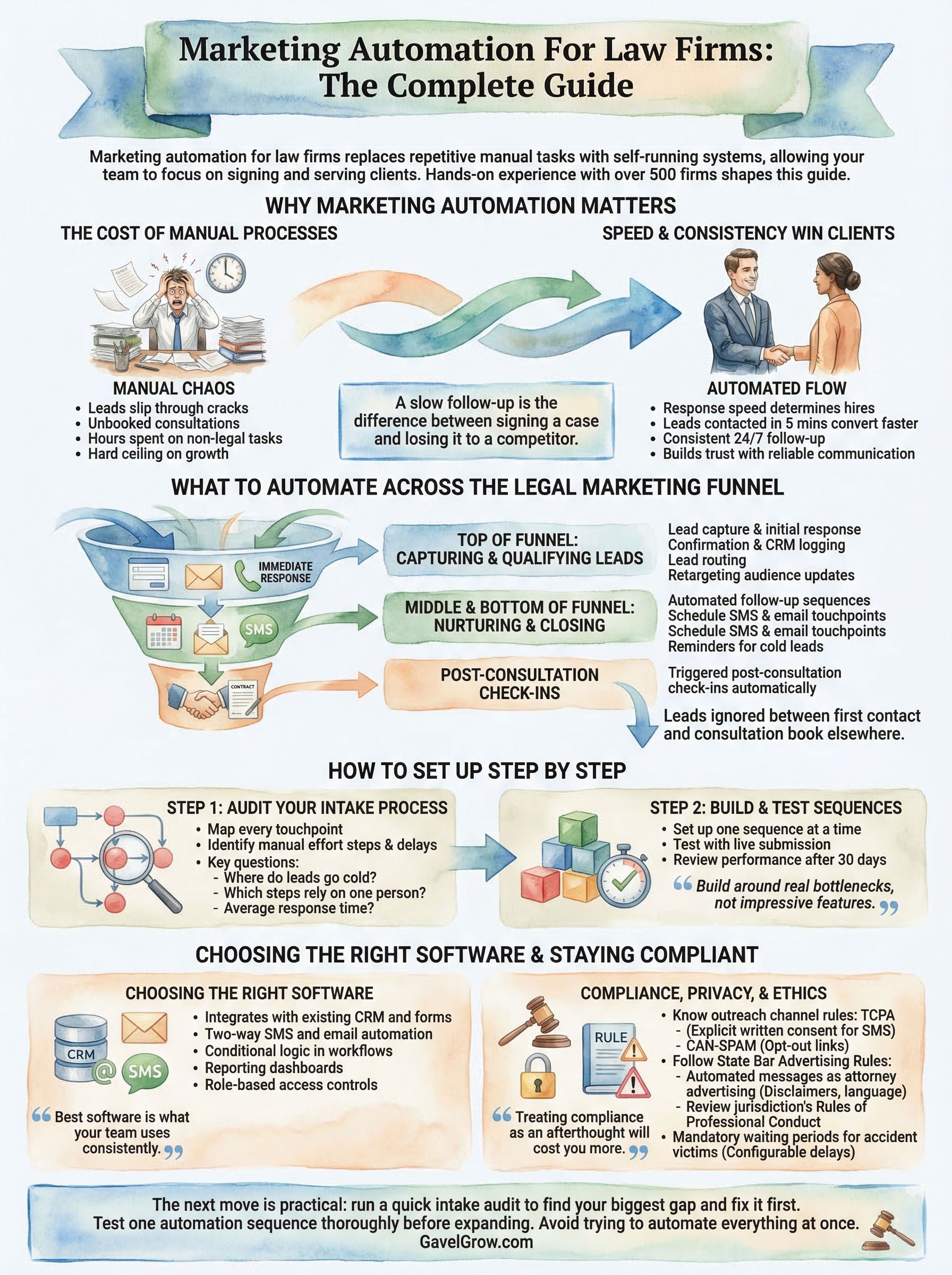
You now have a full picture of how marketing automation for law firms works, where it fits in your funnel, and what to watch for when choosing software and staying compliant. The next move is practical: run a quick audit of your intake process using the questions from the setup section and identify the single biggest gap where leads go cold. Fix that one point first before building anything else.
From there, pick one automation sequence, test it thoroughly, and measure results before expanding. Firms that try to automate everything at once usually end up with a system that no one maintains and results that are impossible to diagnose.
If you want a faster path, working with a team that has already built these systems for hundreds of law firms eliminates most of the guesswork. Book a free strategy consultation with GavelGrow to get a custom roadmap built around your practice area and market.
Frequently Asked Questions
What is marketing automation for law firms?
Marketing automation replaces repetitive marketing tasks with systems that run on their own, such as instant lead responses, follow-up sequences, and CRM logging triggered the moment a form is submitted. It lets your team focus on signing and serving clients instead of manual data entry and chasing unbooked consultations, and it delivers the same fast, consistent follow-up whether you get two inquiries a day or twenty.
Which tasks should a law firm automate first?
Start at the top of the funnel with lead capture and initial response: form-submission confirmations, logging the contact in your CRM, and routing the lead to the right intake person. From there, layer in nurture sequences for cold leads, reminders for prospects who never booked, and post-consultation check-ins. Map automation to funnel stages so it saves time rather than creating noise.
How do I set up marketing automation step by step?
First audit your intake process and identify where leads go cold, which is usually between first contact and the first call. Then build one sequence at a time, starting with an immediate lead-response workflow, test every trigger with a live submission, and review performance data after about 30 days to refine timing and messaging. Fix your single biggest gap before building anything else.
What features matter most in law firm automation software?
At minimum, look for two-way SMS and email automation, native CRM integration or a reliable API, intake-form triggers and lead-routing rules, reporting dashboards tied to lead and conversion data, and role-based access controls. Conditional logic that routes leads by practice area or location is valuable. Watch pricing models that charge per contact, since those get expensive as your list grows.
What compliance rules apply to automated legal outreach?
Automated messages are still subject to state bar advertising rules, and most bars treat automated follow-ups as attorney advertising with specific disclaimer requirements. The TCPA requires prior express written consent before automated texts, and email must meet CAN-SPAM opt-out and sender-identification rules. Log consent, include opt-outs, and note that some states impose waiting periods before contacting accident victims, so build configurable delays in from the start.
Frequently Asked Questions
What is marketing automation for law firms?
Marketing automation replaces repetitive marketing tasks with systems that run on their own, such as instant lead responses, follow-up sequences, and CRM logging triggered the moment a form is submitted. It lets your team focus on signing and serving clients instead of manual data entry and chasing unbooked consultations, and it delivers the same fast, consistent follow-up whether you get two inquiries a day or twenty.
Which tasks should a law firm automate first?
Start at the top of the funnel with lead capture and initial response: form-submission confirmations, logging the contact in your CRM, and routing the lead to the right intake person. From there, layer in nurture sequences for cold leads, reminders for prospects who never booked, and post-consultation check-ins. Map automation to funnel stages so it saves time rather than creating noise.
How do I set up marketing automation step by step?
First audit your intake process and identify where leads go cold, which is usually between first contact and the first call. Then build one sequence at a time, starting with an immediate lead-response workflow, test every trigger with a live submission, and review performance data after about 30 days to refine timing and messaging. Fix your single biggest gap before building anything else.
What features matter most in law firm automation software?
At minimum, look for two-way SMS and email automation, native CRM integration or a reliable API, intake-form triggers and lead-routing rules, reporting dashboards tied to lead and conversion data, and role-based access controls. Conditional logic that routes leads by practice area or location is valuable. Watch pricing models that charge per contact, since those get expensive as your list grows.
What compliance rules apply to automated legal outreach?
Automated messages are still subject to state bar advertising rules, and most bars treat automated follow-ups as attorney advertising with specific disclaimer requirements. The TCPA requires prior express written consent before automated texts, and email must meet CAN-SPAM opt-out and sender-identification rules. Log consent, include opt-outs, and note that some states impose waiting periods before contacting accident victims, so build configurable delays in from the start.