HARO Help A Reporter Out: What It Is + How It Works
Categories: Legal Marketing Strategies
 Abram Ninoyan
Founder & Senior Performance Marketer
Credentials: Google Partner, Google Ads Search Certified, Google Ads Display Certified, Google Ads Measurement Certified, Google Analytics (IQ) Certified, HubSpot Inbound Certified, HubSpot Social Media Marketing Certified, Conversion Optimization Certified
Expertise: Google Ads, Meta Ads, Conversion Rate Optimization, GA4 & Google Tag Manager, Lead Generation, Marketing Funnel Optimization, PPC Management
LinkedIn Profile
HARO (Help a Reporter Out) was one of the most popular free tools for earning media mentions and high-authority backlinks, until it wasn't. The platform shut down in late 2024, rebranded under Cision...
Key Takeaways
- HARO Help A Reporter Out: What It Is + How It Works In 2026
- Why HARO matters for PR and SEO in 2026
- How HARO works for journalists and sources
- How to use HARO to earn press mentions
HARO Help A Reporter Out: What It Is + How It Works In 2026
HARO (Help a Reporter Out) was one of the most popular free tools for earning media mentions and high-authority backlinks, until it wasn't. The platform shut down in late 2024, rebranded under Cision as Connectively, and then Connectively itself closed its doors. If you've searched for HARO expecting to sign up, you've probably hit a wall of outdated guides and dead links. This article breaks down exactly what happened, what replaced it, and how the service works in its current form (or doesn't).
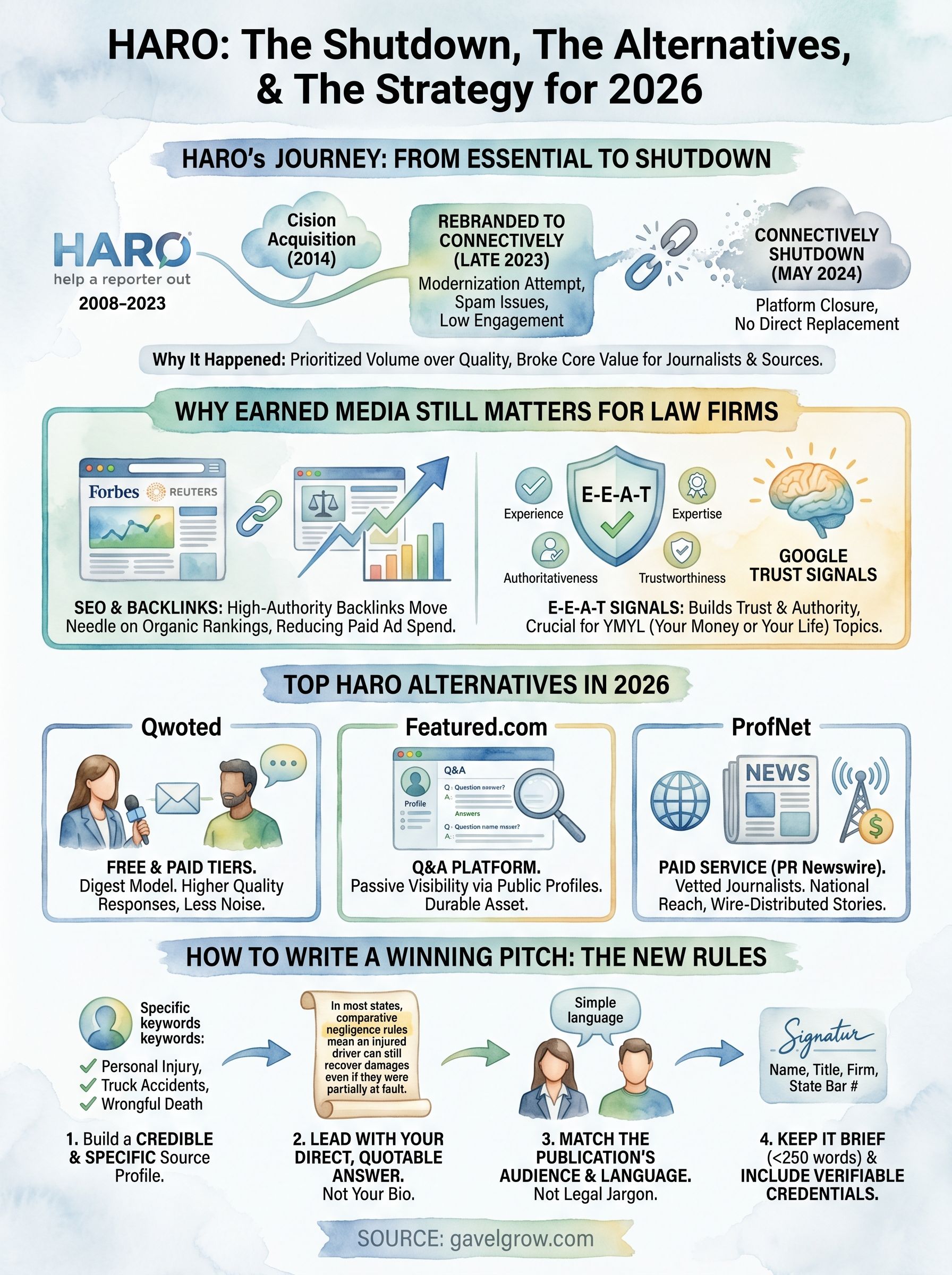
For law firms trying to build online authority, HARO was a legitimate shortcut. A single quote placed in Forbes or Reuters could generate the kind of backlink that moves the needle on local and organic search rankings for months. That matters when your cost-per-signed-case hinges on search visibility, and every ranking position translates to real revenue. At GavelGrow, we've helped over 500 U.S. law firms connect marketing spend to signed retainers, and earned media has always been part of that equation for firms investing in SEO.
Below, you'll get a clear picture of what HARO was, why it shut down, which alternatives actually work in 2026, and how to use journalist-sourcing platforms to build E-E-A-T signals that Google rewards. We'll also cover the practical steps so you can start pitching this week, whether you're a solo practitioner or running a 15-attorney firm.
Why HARO matters for PR and SEO in 2026
Even though the original HARO Help a Reporter Out platform no longer exists in its classic form, the strategy it enabled is more valuable than ever. Journalists, editors, and content teams at major outlets still need expert sources every day. If your firm's attorneys show up as the quoted voice in a Forbes piece on personal injury law or a Reuters article on employment disputes, that mention carries both brand credibility and a backlink from one of the highest-authority domains on the internet. Those two outcomes are precisely what drives long-term search visibility for law firms competing in crowded local markets.
The mechanics haven't changed just because the platform did. Source-based outreach remains one of the few link-building tactics that Google's guidelines explicitly reward rather than penalize. Every other shortcut, whether paid link schemes or guest post networks, risks a manual penalty. Earned media does the opposite: it builds the kind of trust signal that Google's systems are specifically designed to identify and reward.
The link equity argument
A single backlink from a publication like The New York Times or a major legal news outlet carries more ranking weight than dozens of directory listings or low-quality citation links. Domain authority flows from the linking page to yours, which means a reference in a high-traffic article can lift the organic rankings of your practice area pages for months without any additional action on your part. For a personal injury firm spending $10,000 a month on Google Ads, organic rank improvements directly reduce the share of cases that have to be bought through paid clicks.
One well-placed press mention on a high-authority domain can deliver more lasting SEO value than a year's worth of directory submissions combined.
Law firms in competitive metros like Los Angeles, Chicago, or New York often see cost-per-signed-case figures drop meaningfully when organic rankings improve, because the same budget captures more inbound intent from people who were already going to search for an attorney. Earned backlinks accelerate that process in a way that is both durable and compliant with how search engines evaluate trustworthiness.
How earned media builds E-E-A-T
Google's quality framework, known as E-E-A-T (Experience, Expertise, Authoritativeness, and Trustworthiness), treats third-party mentions as a strong signal that your firm and its attorneys are legitimate subject-matter authorities. When a journalist quotes one of your attorneys in a published piece, Google's systems can identify that reference and use it to inform how your site gets evaluated for relevant queries. This is especially true for YMYL (Your Money or Your Life) topics, which include legal services, financial guidance, and medical advice. Google holds these categories to a higher standard because poor information in these areas can cause real harm to readers.
Platforms like HARO helped attorneys build that external validation at scale. Responding to journalist queries in your practice area got your name and credentials in front of editors at national and regional outlets. Over time, a pattern of consistent expert citations across multiple publications tells both search engines and prospective clients that your firm is a trustworthy source, not just another website paying for visibility.
Your firm's long-term SEO performance depends on more than technical optimization and ad spend. Building genuine authority signals through earned media is the part of the equation that most law firms skip, which is exactly why those who do it consistently outrank firms with bigger ad budgets but thinner authority profiles. The good news is that the sourcing opportunity still exists, it just requires knowing where to look now that the original platform is gone.
How HARO works for journalists and sources
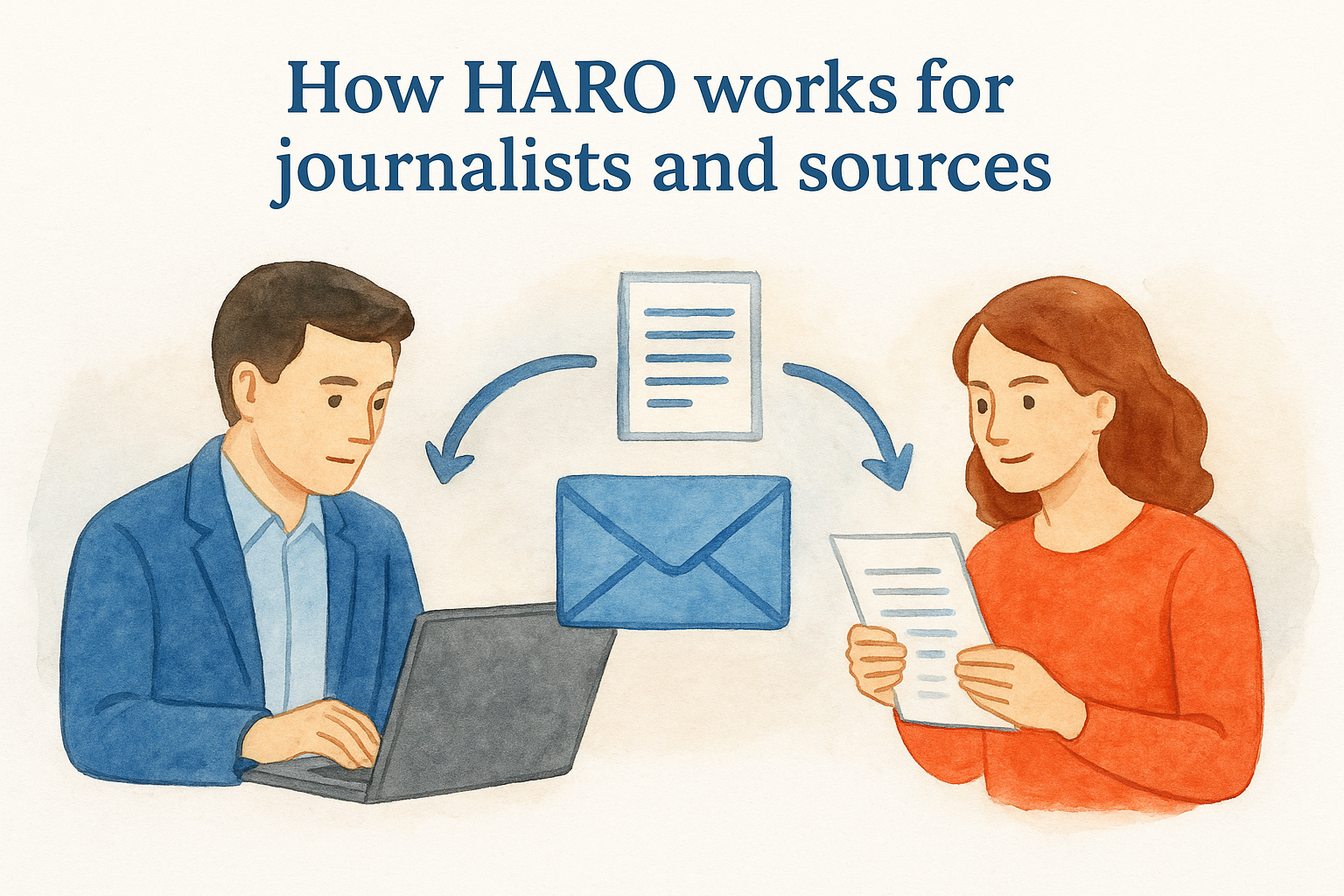
HARO Help a Reporter Out operated on a straightforward two-sided model: journalists posted queries requesting expert sources, and those sources submitted pitches in response. Cision acquired the platform in 2014 and ran it for a decade before migrating it into Connectively, which also shut down in 2024. Understanding the original mechanics matters because every current alternative uses the same fundamental structure, so learning how HARO worked gives you a clear framework for using its successors effectively.
The journalist side of the process
Reporters and editors at outlets ranging from small trade publications to major national media used HARO to fill sourcing gaps quickly. A journalist writing a piece on wrongful termination law, for instance, could post a query describing exactly what they needed: an employment attorney who could explain how courts evaluate hostile workplace claims. Queries went out three times daily via email digest, organized by category including business, legal, lifestyle, and technology. Journalists received responses directly through the platform and selected which sources, if any, fit their story.
The system gave journalists access to a large pool of vetted professionals without the time cost of cold outreach. For your firm, that meant the barrier to appearing in national media was reduced to writing a clear, credible response rather than cultivating an existing relationship with an editor or publicist.
Journalists used HARO because it saved them time, not because they were doing sources any favors. Your pitch had to be genuinely useful to get picked.
The source side of the process
Sources, including attorneys, financial advisors, and subject-matter experts, received the same daily digests and scanned queries for relevance to their practice area. When a query matched your expertise, you submitted a pitch through the platform with your credentials, a direct answer to the journalist's question, and your contact information. Response windows were tight, typically 24 to 72 hours from the time the query posted, so sources who monitored digests consistently had a real advantage over those who checked in only occasionally.
Law firms found this model particularly valuable because it matched inbound editorial demand with outbound expert supply without requiring any prior media relationship. An immigration attorney in Houston had the same shot at landing a quote in a national outlet as a partner at a large coastal firm, based purely on the quality and speed of the pitch submitted.
How to use HARO to earn press mentions
Whether you're using a current alternative or working with the legacy understanding of how HARO Help a Reporter Out operated, the process for earning press mentions follows a consistent pattern. You need to position your firm as a credible, ready source before queries even land in your inbox. Setting up your profile with precision and monitoring incoming requests with discipline separates firms that get quoted consistently from those that occasionally fire off a pitch and hear nothing back.
Build a credible source profile
Your profile is the first thing a journalist sees after your pitch lands. List specific practice areas rather than broad categories so your credentials align tightly with the queries you're answering. An attorney listed as "personal injury, truck accidents, wrongful death" will match journalist intent more precisely than one listed simply as "legal." Include your bar admission details, years of practice, and any published articles or speaking engagements that reinforce your standing as a subject-matter expert.
Journalists make fast decisions. A thin or generic profile reduces your chance of being selected even when your pitch is strong, because editors want to verify credibility quickly before a deadline closes in. Every field you fill out accurately is a small trust signal that adds up when an editor is choosing between two equally useful responses.
The more specific your listed expertise, the more often you'll see queries that match your actual knowledge rather than queries you're stretching to answer.
Set up category filters and check them daily
On current sourcing platforms that mirror the original HARO model, category filtering is the fastest way to cut through irrelevant queries. Most platforms let you select topic areas and receive targeted digests rather than scanning every request across every industry. For a law firm, filter for legal, business and finance, and occasionally health or lifestyle depending on your practice area and the types of media you want to appear in.
Response speed matters as much as response quality at this stage. Journalists operate on deadlines and frequently close queries within 24 to 48 hours of posting. Building a daily habit of checking your digest in the morning gives you the maximum window to craft a strong pitch. Firms that check only weekly are almost always too late, and the placement goes to a faster competitor.
Once you've identified a relevant query, confirm it matches your genuine experience before committing time to a response. Pitching outside your real expertise wastes your time and damages your credibility with editors who may remember your name the next time a legal query crosses their desk.
How to write a HARO pitch that gets picked up
Writing a pitch that a journalist actually uses requires a different mindset than writing for clients or courts. Editors are not looking for a resume - they're looking for a clear, quotable answer they can drop into a piece that's already half-written. Every principle that made the original HARO Help a Reporter Out platform effective still applies: give the journalist exactly what they asked for, prove you're qualified to say it, and make their job easier in every sentence you write.
Lead with your answer, not your bio
Your first sentence should answer the journalist's question directly. Most unsuccessful pitches open with credentials - "I am a board-certified personal injury attorney with 15 years of experience" - and bury the actual answer three paragraphs down. Journalists close those pitches fast. Instead, open with your substantive response and save the credential summary for the final two sentences.

Journalists are not grading your qualifications first - they're scanning for a usable quote, and your first line is either that quote or it isn't.
A strong opening for a query about car accident liability might read: "In most states, comparative negligence rules mean an injured driver can still recover damages even if they were partially at fault." That sentence is immediately useful. It tells the journalist you understood the question and can speak to it precisely.
Match your language to the publication's audience
Pitch to the reader the journalist is writing for, not to a legal audience. A Forbes piece on workplace discrimination is aimed at business professionals, not attorneys. If your pitch sounds like a legal brief, the journalist has to translate it before they can use it, and most won't bother when they have ten other responses in the inbox.
Read two or three recent articles from the outlet listed in the query before you write a single word. Identify the reading level, the typical quote style, and the level of technical detail the publication uses. Then match it. A two-sentence quote from a criminal defense attorney that a general reader can parse immediately beats a thorough legal analysis that requires a law degree to follow.
Keep your full pitch under 250 words. Include your name, title, firm name, and state bar number in a brief sign-off so the journalist can verify your credentials without emailing you back for basic information.
What happened to HARO and where it stands now
The original HARO Help a Reporter Out platform was founded by Peter Shankman in 2008 and quickly became the default tool for connecting journalists with expert sources. Cision, the PR software company, acquired HARO in 2014 and ran it largely unchanged for nearly a decade. It grew into a community of roughly 800,000 sources and 55,000 journalists before the shutdown sequence began.
Cision's rebrand to Connectively
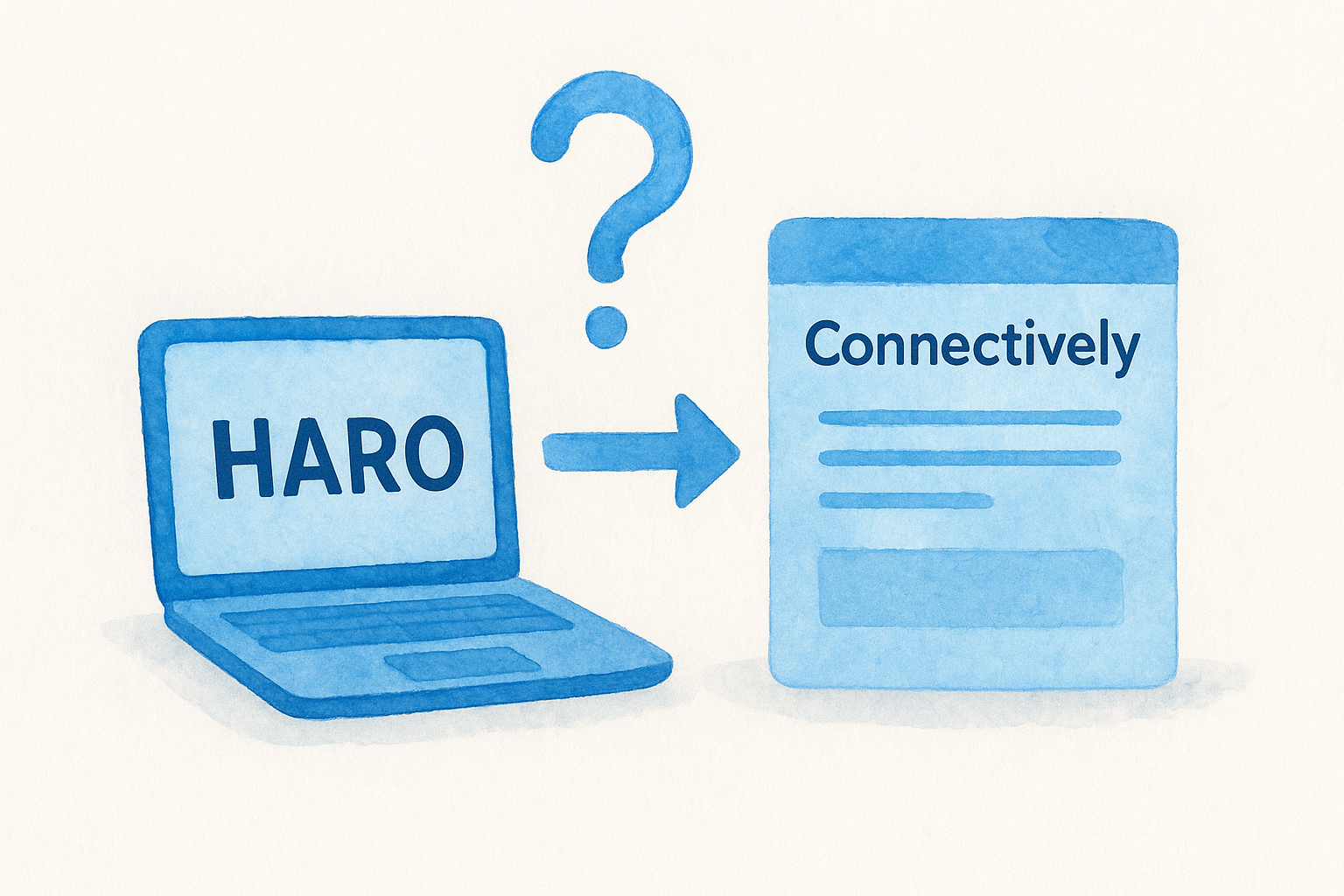
In late 2023, Cision announced it was retiring the HARO brand and migrating users to a new platform called Connectively. The stated goal was a modernized interface with better matching between journalists and sources. In practice, the transition frustrated long-term users. Response quality dropped sharply as spam pitches flooded the new system, and many journalists reported abandoning the platform within weeks of the migration because the signal-to-noise ratio made it unusable.
When the platform prioritized volume over quality, it broke the core value proposition for both sides of the market.
Connectively attempted several updates to address the spam problem, but the journalist side of the platform never recovered the engagement levels that made HARO worth using. Without active reporters posting quality queries, sources had no reason to stay either.
Why Connectively shut down
Cision shut down Connectively in May 2024, citing low platform engagement as the primary reason. The closure was announced with short notice, leaving thousands of PR professionals and subject-matter experts without a direct replacement. Cision redirected users toward its enterprise-tier paid products, which carry price points far above what a solo practitioner or small firm would justify. For most law firms that relied on the free HARO digest, the practical effect was an immediate gap in their earned media strategy.
What your firm can do with this information
The key takeaway is that no single platform now dominates journalist-source matching the way HARO did at its peak. The opportunity still exists, but it is distributed across several competing tools rather than concentrated in one inbox. This actually works in your favor if you move faster than competitors who are still waiting for a single dominant replacement to emerge. Firms that diversify across two or three active sourcing platforms today are capturing placements that competitors are missing entirely, and those placements are generating backlinks and brand mentions that compound over months.
HARO alternatives worth trying in 2026
The gap left by HARO Help a Reporter Out created real demand for replacements, and several platforms moved quickly to fill it. None of them have yet matched the original platform's scale, but three of them are generating consistent placements for firms that use them actively. The key is choosing platforms where journalists are still posting live queries rather than signing up for services where source supply has already outpaced editorial demand.
Qwoted
Qwoted operates on the same digest model that made HARO familiar: journalists post sourcing requests, and experts submit pitches in response. The platform has attracted a strong mix of trade publications and national outlets, and its free tier gives law firms access to a meaningful volume of legal and business queries without a subscription fee. Response quality on Qwoted tends to be higher than what flooded the Connectively platform during its final months, which means your pitch faces less noise and a better chance of reaching an editor who will actually read it.
The platforms with stricter source verification consistently produce better placements because journalists trust the responses they receive.
Featured.com
Featured.com functions as a question-and-answer sourcing platform where publications post specific questions and experts submit written responses. Unlike a traditional query digest, Featured aggregates your approved answers into a public profile that journalists can search directly, which gives your firm passive visibility between active pitch cycles. For attorneys with niche expertise in areas like immigration, workers' compensation, or mass torts, building out a complete Featured profile creates a durable asset that continues generating media interest without requiring daily monitoring.
ProfNet
ProfNet, operated by PR Newswire, is a paid sourcing service that connects journalists with expert sources across industries including law, finance, and healthcare. The cost is higher than free alternatives, but the journalist quality reflects that. Reporters at wire services, major newspapers, and broadcast outlets use ProfNet specifically because they want vetted, credentialed sources rather than open-submission inboxes. For a firm billing $500,000 or more annually in revenue, a single placement in a wire-distributed story can justify a full year of subscription fees through the organic ranking lift alone. If your firm targets national visibility rather than purely local search, ProfNet fills the top tier of the media landscape that free platforms rarely reach.
Next steps
The original haro help a reporter out platform is gone, but the earned media opportunity it created is still very much alive. Your firm can start building press placements and high-authority backlinks this week by signing up for Qwoted and Featured.com, completing your source profiles with specific practice area credentials, and checking your query digest every morning before your first client call. Consistency beats volume here. Two strong pitches per week over three months will generate more placements than 20 rushed responses sent in a single afternoon.
Earned media is one piece of a broader SEO and marketing strategy that compounds over time. If your firm is also trying to connect ad spend directly to signed retainers, track cost-per-signed-case across every channel, and compare your numbers with modelled practice-area benchmarks, the tools you need are already built. See how GavelGrow helps law firms measure what actually matters and start a free 7-day trial with no credit card required.
Frequently Asked Questions
Does HARO still exist in 2026?
No. The original Help a Reporter Out platform shut down in late 2024, rebranded under Cision as Connectively, and Connectively itself closed in May 2024, citing low engagement. No single platform now dominates journalist-source matching the way HARO did at its peak, so the opportunity is distributed across several competing tools rather than concentrated in one inbox.
What are the best HARO alternatives to use now?
The article recommends three active options: Qwoted, which uses the familiar digest model and has a free tier with meaningful legal and business queries; Featured.com, a question-and-answer platform that builds a searchable public profile of your approved answers; and ProfNet, a paid PR Newswire service whose journalists tend to come from wire services and major outlets. Diversifying across two or three captures placements competitors miss.
Why does earned media matter for law firm SEO?
A quote in a high-authority publication delivers both brand credibility and a strong backlink, and source-based outreach is one of the few link-building tactics Google's guidelines explicitly reward rather than penalize. For firms competing in crowded local markets, those mentions build the E-E-A-T signals Google looks for, which is especially important for legal topics treated as Your Money or Your Life content.
How do I write a HARO-style pitch that gets picked up?
Lead with your answer, not your bio. Your first sentence should directly answer the journalist's question, since editors are scanning for a usable quote, not grading your credentials. Match your language to the publication's audience rather than sounding like a legal brief, keep the pitch under about 250 words, and add your name, title, firm, and bar number in a brief sign-off so they can verify you quickly.
How quickly do I need to respond to journalist queries?
Fast. Journalists work on deadlines and frequently close queries within 24 to 48 hours of posting, so checking your digest every morning gives you the maximum window to craft a strong pitch. Firms that check only weekly are almost always too late, and the placement goes to a faster competitor. Consistency beats volume: a couple of strong pitches per week outperforms many rushed ones.
Frequently Asked Questions
Does HARO still exist in 2026?
No. The original Help a Reporter Out platform shut down in late 2024, rebranded under Cision as Connectively, and Connectively itself closed in May 2024, citing low engagement. No single platform now dominates journalist-source matching the way HARO did at its peak, so the opportunity is distributed across several competing tools rather than concentrated in one inbox.
What are the best HARO alternatives to use now?
The article recommends three active options: Qwoted, which uses the familiar digest model and has a free tier with meaningful legal and business queries; Featured.com, a question-and-answer platform that builds a searchable public profile of your approved answers; and ProfNet, a paid PR Newswire service whose journalists tend to come from wire services and major outlets. Diversifying across two or three captures placements competitors miss.
Why does earned media matter for law firm SEO?
A quote in a high-authority publication delivers both brand credibility and a strong backlink, and source-based outreach is one of the few link-building tactics Google's guidelines explicitly reward rather than penalize. For firms competing in crowded local markets, those mentions build the E-E-A-T signals Google looks for, which is especially important for legal topics treated as Your Money or Your Life content.
How do I write a HARO-style pitch that gets picked up?
Lead with your answer, not your bio. Your first sentence should directly answer the journalist's question, since editors are scanning for a usable quote, not grading your credentials. Match your language to the publication's audience rather than sounding like a legal brief, keep the pitch under about 250 words, and add your name, title, firm, and bar number in a brief sign-off so they can verify you quickly.
How quickly do I need to respond to journalist queries?
Fast. Journalists work on deadlines and frequently close queries within 24 to 48 hours of posting, so checking your digest every morning gives you the maximum window to craft a strong pitch. Firms that check only weekly are almost always too late, and the placement goes to a faster competitor. Consistency beats volume: a couple of strong pitches per week outperforms many rushed ones.