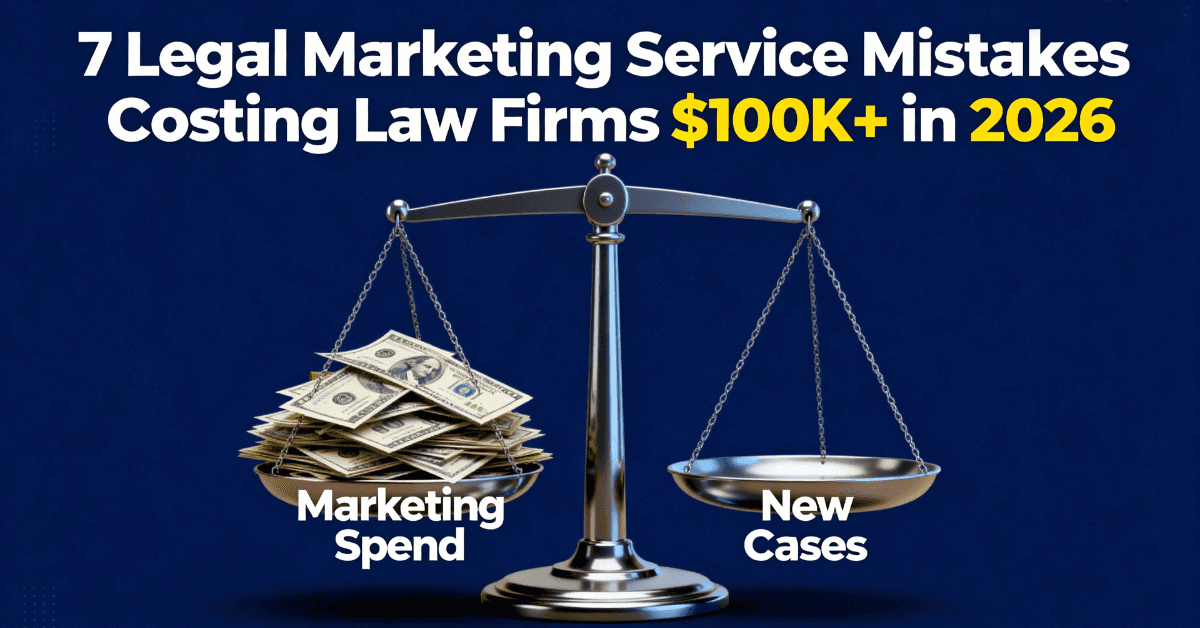
7 Legal Marketing Service Mistakes Costing Law Firms $100K+
Categories: Law Firm Marketing Services
 Abram Ninoyan
Founder & Senior Performance Marketer
Credentials: Google Partner, Google Ads Search Certified, Google Ads Display Certified, Google Ads Measurement Certified, Google Analytics (IQ) Certified, HubSpot Inbound Certified, HubSpot Social Media Marketing Certified, Conversion Optimization Certified
Expertise: Google Ads, Meta Ads, Conversion Rate Optimization, GA4 & Google Tag Manager, Lead Generation, Marketing Funnel Optimization, PPC Management
LinkedIn Profile
A shocking number of law firms are losing six figures on ineffective legal marketing services. The most common mistake is partnering with a generic...
Key Takeaways
- Hiring a One-Size-Fits-All Legal Marketing Firm
- Focusing on Vanity Metrics Instead of Business KPIs
- Using Black Hat SEO Tactics That Risk Penalties
- Failing to Align Marketing with Practice Area Goals
Legal marketing service mistakes can devastate your firm's growth potential. According to Thomson Reuters, 30% of small law firms cite marketing or advertising as one of their top three challenges. Despite this awareness, many legal practices continue to struggle with ineffective strategies that drain resources without delivering results.
In today's competitive legal landscape, a strong marketing strategy isn't optional — it's essential for attracting new clients and growing your practice. We've seen firsthand how the biggest mistake attorneys make is simply not marketing their practice effectively. With over 4.9 billion social media users globally, it's no surprise that 84% of legal firms are now generating leads on these platforms.
The stakes are incredibly high. The average three-year return on investment from strategic marketing activities is an impressive 526%, highlighting the enormous opportunity cost of getting it wrong. However, many firms still don't use the available data to improve their efforts, leading to low ROI despite significant digital marketing investments.
Recognizing common marketing mistakes and implementing the right solutions is key to achieving sustainable growth. Whether you're managing marketing in-house or working with an agency, understanding these pitfalls can save your firm hundreds of thousands of dollars in wasted spending and missed opportunities.
Hiring a One-Size-Fits-All Legal Marketing Firm
The most expensive marketing mistake law firms make is partnering with general marketing agencies that offer cookie-cutter solutions. Many small law firms and solo attorneys try to cut corners by hiring "full-service" agencies that claim to do everything from SEO to social media, video production, and website development. This approach might seem cost-effective initially, but often becomes the most expensive mistake in the long run.
What a generic legal marketing strategy looks like
Generic marketing strategies typically apply one-size-fits-all templates across multiple industries. For law firms, this approach manifests as:
- Proprietary website platforms that lock you into their ecosystem, making it impossible to take your website with you if you leave
- Marketing plans that ignore state bar advertising regulations and ethical guidelines
- Cookie-cutter content that fails to differentiate your firm in a crowded marketplace
- Broad strategies designed for general businesses that lack legal industry knowledge
- Focusing on vanity metrics rather than client acquisition and revenue growth
As one legal marketing expert notes, "Hiring a full-service agency that does everything is not how you'd hire a doctor. If you need an obstetrician, you wouldn't go to one who is also a podiatrist, psychiatrist, and plastic surgeon". Essentially, these agencies spread themselves thin across multiple specialties rather than excelling in areas crucial for legal marketing.
Why custom strategies outperform templates
Custom marketing strategies consistently outperform generic templates because they align with your firm's specific goals and practice areas. The legal industry is uniquely regulated with specific ethical considerations that general marketers often miss.
Firstly, specialized legal marketing partners understand the nuanced client journey. Potential legal clients are often in vulnerable situations, making their decision-making process vastly different from someone making a retail purchase. Their needs require tailored messaging that addresses specific pain points.
Additionally, law firms with customized marketing approaches benefit from:
- Marketing that complies with bar association rules and ethical advertising standards
- Strategies tailored to specific practice areas rather than generic legal content
- Full ownership of websites and digital assets
- Personalized attention from dedicated account managers who understand your firm's unique goals
Furthermore, specialized legal marketing agencies understand that different practice areas require completely different strategies. Marketing a personal injury firm requires a fundamentally different approach than marketing a corporate law practice.
How to find the best legal marketing service provider
When evaluating potential marketing partners, I recommend looking beyond flashy promises and focusing on substantive qualifications. The best legal marketing service providers demonstrate several key characteristics.
First, they have deep experience in the legal industry specifically. According to research, only 47% of law firms have an annual marketing budget, with most dedicating just 5% of their overall budget to marketing. A specialized marketing partner will help you maximize this limited investment.
Second, look for transparency in their business practices. Quality agencies provide regular communication, detailed reporting, and clear explanations of their work. They should operate as marketing fiduciaries, prioritizing your firm's interests above their own.
Consequently, before signing with any marketing firm, ask these critical questions:
- Do they understand legal advertising compliance and ethical requirements?
- Can they provide case studies showing specific results for law firms similar to yours?
- Will you maintain ownership of all content and digital assets created for your firm?
- Do they have a portfolio of successful law firm clients across multiple practice areas?
Importantly, avoid agencies that guarantee specific rankings within short timeframes or promise specific client numbers without understanding your practice. Additionally, be wary of agencies that claim to have "secret" algorithms or exclusive relationships with search engines.
Rather than choosing the cheapest option, look for the best value with the highest quality service. Remember that in legal marketing, the cheaper options almost always become the most expensive mistakes.
Focusing on Vanity Metrics Instead of Business KPIs
Many law firms waste thousands of dollars chasing impressive-looking marketing numbers that don't actually generate new clients or revenue. While these metrics might make monthly reports look good, they fail to translate into actual business growth, costing firms $100K+ in misallocated resources and missed opportunities.
What are vanity metrics in law firm marketing
Vanity metrics are data points that appear impressive in reports yet provide little insight into actual business performance. For law firms, these typically include:
- Website traffic without conversion context
- Social media followers, likes, and shares
- Email open rates without click-throughs
- Blog post views without lead generation
- Domain Authority (DA) scores
These metrics look impressive on paper albeit lacking direct correlation with revenue or client acquisition. They create a false sense of marketing success while your business development goals slip further away. Meanwhile, agencies love showcasing these numbers since they're easy to manipulate and make their work appear effective.
Why vanity metrics mislead your marketing decisions
Focusing on vanity metrics fundamentally misunderstands how potential legal clients actually behave. Without measuring how your marketing activities truly perform, you can't determine what's working.
Vanity metrics mislead for several reasons. Primarily, they don't differentiate between your ideal client profile and everyone else who might encounter your content online. For instance, a viral post about legal fees might attract 50,000 page views, yet most visitors could be other lawyers, marketing professionals, or students - not potential clients needing immediate legal assistance.
Furthermore, many law firms lack defined goals tied to revenue, operating in silos where marketing, business development, and finance work separately without integrated systems. Subsequently, this creates difficulty in tracking ROI effectively. Even with basic tracking systems, firms can save thousands by identifying which marketing channels truly deliver results versus those wasting resources.
Key KPIs to track for law firm marketing ROI
Instead of vanity metrics, focus on these business KPIs that directly impact your firm's bottom line:
Cost Per Qualified Lead (CPQL): This measures how much you spend to acquire leads fitting your ideal client profile.
Cost Per Signed Case (CPSC): The ultimate bottom-line metric showing exactly what you spend to acquire paying clients.
Marketing Return on Investment (ROI): This tells you how many dollars you generate for every dollar spent on marketing.
Client Conversion Rate: Not just lead volume, but the percentage of leads converting to signed clients.
Case Quality Metrics: Not all cases are equal – track the value of cases by practice area.
Branded Search Growth: When more people Google your firm by name, it indicates growing awareness and trust.
Without tracking these metrics, you're simply guessing which marketing activities work. As one expert notes, "If a channel isn't delivering ROI, it's time to re-allocate".
How to shift focus to meaningful metrics
To transition from vanity metrics to meaningful business KPIs, implement these strategies:
First, establish a baseline. Collect existing data on website visits, social media followers, and other available metrics. Next, build systems to track business outcomes, not just activities. Integrate your marketing and client intake systems to follow leads from first contact through signed retainers.
Particularly effective is focusing on the client journey – track which content drives actual consultations, not just views. Demand reports that connect marketing activities directly to case sign-ups rather than superficial engagement.
Ask potential marketing partners how they measure success. If they emphasize followers and traffic without mentioning client acquisition costs or revenue, that's a red flag. Tell your story with data that ties marketing performance directly to firm revenue and client acquisition.
In short, shift your focus from "looking good" to "doing good" for your firm's bottom line. The most successful law firms understand that impressive-looking metrics mean nothing if they don't translate into signed cases and revenue growth.
Using Black Hat SEO Tactics That Risk Penalties
Some law firm marketing services resort to deceptive SEO shortcuts that violate search engine guidelines. These risky practices might promise quick rankings but ultimately lead to devastating penalties that can erase years of marketing investments overnight.
What is black hat SEO in legal marketing
Black hat SEO refers to tactics that attempt to manipulate search engine rankings by violating established guidelines. In legal marketing, these unethical practices include:
- Keyword stuffing - Cramming excessive keywords into content, making it unreadable while attempting to trick search algorithms
- Cloaking - Showing different content to search engines than what actual visitors see
- Link schemes - Purchasing backlinks or participating in link exchanges solely to artificially boost rankings
- Hidden text - Using text invisible to users but detectable by search engines, often with white text on white backgrounds
- Doorway pages - Creating low-quality pages that exist solely to rank for specific keywords before redirecting users elsewhere
Moreover, these tactics become particularly problematic for attorneys, as they potentially violate Rule 8.4 of the American Bar Association's Model Rules of Professional Conduct, which prohibits "dishonest, fraudulent, deceitful, or misrepresentative conduct".
Why unethical SEO can cost your firm $100K+
Unethical SEO tactics create substantial financial risks through multiple channels. First, Google penalties can be either algorithmic (automated) or manual (applied by Google employees). The consequences typically include significant ranking drops of 30-50% or complete removal from search results—with over 90% of sites using deceptive tactics eventually being deindexed.
The financial impact multiplies through:
- Lost client acquisition - When your site disappears from search results, your primary lead generation channel vanishes
- Reputation damage - 77% of potential clients may avoid firms perceived as dishonest
- Recovery costs - Rebuilding after penalties typically requires completely revamping your website and marketing strategy
- Legal consequences - Beyond search penalties, these practices can lead to legal liability for trademark infringement, unfair trade practices, and defamation
Unfortunately, many law firms remain unaware their marketing agencies employ these tactics until it's too late. For instance, agencies may use competitor brand names in ads or meta tags to hijack traffic, as in the case of Lenskart, which faced legal action for using competitor names as keywords.
Ethical SEO practices for sustainable growth
To protect your firm while achieving sustainable growth, focus on these ethical SEO practices:
Focus on quality content - Create valuable, informative content that genuinely helps potential clients understand their legal issues. This builds credibility with both search engines and prospects.
Natural keyword usage - Incorporate relevant keywords organically within well-written content rather than forcing awkward phrases or stuffing.
Legitimate link building - Earn backlinks through valuable content, guest posting on reputable sites, and relationship building rather than purchasing links or participating in link schemes.
Local SEO optimization - Properly optimize your Google Business Profile with accurate information about your firm's location, hours, and practice areas.
Client-centric approach - Prioritize user experience over search engine manipulation by focusing on what potential clients actually need.
Importantly, while ethical SEO might take longer to show results, it creates lasting value without the catastrophic risks of black hat tactics. Firms employing ethical strategies not only avoid penalties but also build genuine authority and trust with potential clients.
To prevent working with agencies using black hat techniques, thoroughly vet potential partners by asking about their specific SEO practices and requesting detailed explanations of their methods. Significantly, be wary of any service that guarantees specific rankings or immediate results, as these are classic red flags of unethical approaches.
Failing to Align Marketing with Practice Area Goals
Practice area misalignment represents a fundamental failure in legal marketing that silently drains revenue from otherwise successful law firms. When marketing efforts don't connect directly to your specific legal services, you're essentially throwing money at strategies that attract the wrong clients—or no clients at all.
Why practice area alignment matters in legal marketing
Practice area alignment forms the cornerstone of effective legal marketing for several compelling reasons. Primarily, different practice areas serve entirely different client demographics with unique needs and decision-making processes. Criminal defense marketing requires completely different messaging than corporate compliance or family law.
According to a LinkedIn study, organizations with tightly aligned marketing and business development functions experienced 208% more revenue from their efforts. This dramatic difference occurs because alignment ensures your brand story resonates throughout the entire client journey—from awareness to signing.
Simultaneously, practice area alignment helps:
- Focus resources on highest-value client acquisition channels
- Prevent wasteful spending on irrelevant marketing efforts
- Create messaging that speaks directly to client pain points
- Build credibility through demonstrated expertise in specific legal niches
Essentially, when your marketing connects directly with your practice strengths, you transform generic legal advertising into targeted communication that reaches ideal clients at critical decision points.
Examples of misaligned law firm marketing strategies
Numerous law firms suffer from costly marketing misalignments. One common example involves personal injury firms that invest heavily in SEO targeting criminal defense keywords—attracting visitors who need completely different legal services than they offer. This mismatch wastes both marketing dollars and staff time handling inappropriate inquiries.
Another typical misalignment occurs when firms promote multiple practice areas with contradictory messaging. For instance, a firm handling both personal injury and criminal defense cases might confuse potential clients about their primary expertise, especially regarding DUI cases where these practice areas intersect.
Furthermore, many law firms fall into the trap of marketing to themselves rather than to prospective clients. They emphasize credentials and technical expertise when clients actually make decisions based on trust and perceived ability to solve their specific problems.
Generally speaking, practice area misalignment often stems from seeing industry teams simply as marketing programs rather than fundamental structural components of the firm. As noted in Thomson Reuters research, "too many law firm leaders see industry or client teams simply as a part of their marketing program or a cross-selling strategy, rather than a part of the fundamental structure of how they manage their law firms".
How to tailor campaigns to your legal niche
Customizing your marketing approach begins with understanding that each legal practice area has distinct characteristics and client expectations. Following this understanding, your marketing strategy should reflect these unique needs.
Start by identifying what keeps your lights on—your core practice area—and what you're passionate about. Thereafter, conduct thorough market research to validate demand in your chosen specialized field. Tools like Google Trends can help assess competition and search volume for your potential legal niche.
To effectively align marketing with practice goals:
- Establish clear communication channels between marketing and practice area leaders through regular meetings, shared project management tools, and open conversation channels.
- Set unified, measurable goals that require collaboration, such as "increasing website traffic by 25% and converting 15% of leads into consultations" for specific practice areas.
- Develop detailed client personas for each practice area, including client industries, pain points, preferred communication channels, and common legal challenges.
In contrast to generic approaches, personalized marketing solutions address the specific challenges inherent in different legal practice areas. As noted by legal marketing experts, "while a corporate law firm might focus on building authority and credibility, a family law practice might need to emphasize empathy and personal connection".
Not Owning Your Website, Ad Accounts, or Data
A shocking number of law firms discover too late they don't actually control their own digital infrastructure. Many legal marketing services operate on a business model where they maintain ownership of the very assets they create for you, essentially holding your firm's online presence hostage.
What digital assets law firms must own
Law firms must maintain complete ownership of several critical digital properties:
- Your domain name and website content
- Google Business Profile and other local listings
- Client data, analytics, and marketing performance metrics
- Ad accounts (Google Ads, Facebook, LinkedIn)
- Email marketing databases and templates
These assets represent your firm's digital infrastructure and intellectual property. Unlike physical assets that law firms typically protect carefully, digital assets often receive inadequate attention. Yet these digital properties hold tremendous value for your practice's long-term success and constitute a significant portion of your marketing investment.
Risks of letting agencies control your marketing infrastructure
Surrendering control of your digital assets creates substantial vulnerabilities. Primarily, many agencies lock firms into what industry experts call "roach motel" contracts—where "clients check in, but they don't check out". These agreements often require firms to buy out remaining contract terms to exit early, creating financial handcuffs.
Even more concerning, some marketing companies claim ownership of website content they create for your firm. FindLaw contracts, for example, historically claimed ownership rights to content, meaning firms could lose their entire website content upon termination.
Similarly, agencies using proprietary content management systems (CMS) make transitions nearly impossible. As one Reddit user described an agency, it "holds clients' accounts hostage via its proprietary platform". This creates a dangerous dependency where changing providers means rebuilding your entire online presence from scratch.
How to ensure full ownership and transparency
To protect your firm's digital assets, implement these crucial safeguards:
First, thoroughly review all contracts before signing. Demand explicit language confirming you maintain ownership of all content, data, and accounts created during the engagement. Ask potential marketing partners directly: "Will my firm retain complete ownership of all digital assets created?" Their response will reveal much about their business practices.
Second, ensure all accounts are created in your firm's name with your firm maintaining administrative access. This includes website hosting, domain registration, Google Ads, analytics, and social media accounts.
Third, maintain secure documentation of all passwords, access credentials, and account information in a centralized location accessible to key stakeholders within your firm.
Finally, conduct regular digital asset audits to verify ownership status of all marketing infrastructure. This practice helps identify potential vulnerabilities before they become crises during agency transitions.
Remember that genuine marketing partners want your firm to succeed long-term and will never build dependency through ownership control tactics. As digital assets increasingly define your firm's market position, protecting ownership of these assets becomes equally important as protecting your physical and financial resources.
Ignoring Local SEO and Google Business Optimization
Nearly 98% of potential legal clients use the internet to find nearby lawyers, making local SEO a critical component of any successful legal marketing strategy. Overlooking this crucial element is a $100K+ mistake that many law firms continue to make in 2026.
What is local SEO for law firms
Local SEO focuses specifically on search queries with local intent—when people search for legal services in their geographic area. Primarily, it optimizes your online presence to appear in location-based search results, particularly Google's Local Pack and Maps. Throughout the client journey, local searches trigger specific local results that connect attorneys with clients seeking legal help in their community.
When someone searches "family lawyer near me" or "immigration lawyer in [city]," the results display a Local Pack—the map and three business listings at the top of search results. This feature significantly influences how potential clients discover and select attorneys in their area.
Why local visibility drives high-value leads
Local search results generate exceptionally valuable leads because they connect you with clients actively seeking immediate legal assistance. Interestingly, 46% of all Google searches have local intent, with "near me" queries representing people in crisis who need help fast.
Furthermore, businesses with complete Google profiles are 2.7 times more likely to be considered reputable, building trust before clients even contact you. Additionally, listings with photos receive 42% more requests for directions and 35% more clicks to websites.
The financial impact is substantial—law firms ranking in the local pack see a 400% increase in views and a 113% increase in user clicks. Given that legal keywords are among the most expensive for PPC advertising, local SEO offers a more cost-effective approach to client acquisition.
Steps to optimize your Google Business Profile
To maximize your local visibility and avoid costly mistakes, optimize your Google Business Profile with these essential steps:
- Claim and verify your listing – This gives you control over how your firm appears in Google Search and Maps
- Complete your profile thoroughly – Include your business name with practice areas, accurate hours, address, phone number, and website link
- Choose the right categories – Set "law firm" as your primary category and add relevant secondary categories like "personal injury attorney"
- Add high-quality photos – Include office exterior (1024 x 575 pixels), team photos, and attorney headshots (720 x 720 pixels)
- Manage reviews proactively – 99% of people read online reviews when searching for local businesses, and 81% use them specifically when selecting an attorney
- Maintain NAP consistency – Ensure your Name, Address, and Phone number are identical across all online directories
Certainly, local SEO represents one of the most underutilized yet powerful tools for law firms seeking to connect with high-intent local clients.
Not Vetting Legal Marketing Agencies Properly
The process of selecting a legal marketing partner often receives insufficient scrutiny, despite representing a six-figure investment for most law firms. Proper vetting separates quality marketing partners from those who will drain your resources without delivering results.
What questions to ask before hiring a legal marketing firm
First and foremost, inquire about their specific strategy for your practice area: "How would your approach differ for a high-volume personal injury firm versus a corporate law firm?". This reveals their understanding of legal marketing nuances.
Next, ask about their legal ethics knowledge: "How do you handle attorney advertising regulations?". A quality agency demonstrates familiarity with state bar requirements.
Lastly, explore their reporting methodology: "What specific KPIs do you track, and how do you measure success?". The best partners focus on business outcomes rather than technical metrics.
Red flags to avoid in marketing firms for attorneys
Beware of agencies making unrealistic promises like "guaranteed first-page rankings within 30 days". No reputable agency guarantees specific search positions due to Google's constantly changing algorithms.
Be cautious of agencies claiming to be "full-service" marketing solutions. These one-stop-shops often create dependency relationships by weaving themselves throughout all areas of your marketing.
Additionally, avoid firms offering "link building" services. This outdated SEO tactic violates Google guidelines and can result in severe penalties.
How to evaluate the best law firm marketing companies
Look for demonstrated legal marketing expertise through case studies showing specific results for firms similar to yours. Request direct client references and verify claimed outcomes.
Assess their transparency regarding methods and reporting. Quality agencies provide regular communication, detailed reporting, and clear explanations of their work.
Whenever possible, prioritize agencies specializing in your specific practice area. Their familiarity with your target clients and competition provides valuable strategic advantages beyond generic marketing expertise.
Comparison Table
Marketing Mistake
Main Issue
Key Risks
Financial Impact
Recommended Solutions
Hiring One-Size-Fits-All Marketing Firm
Generic strategies that ignore legal industry specifics
Lock-in to proprietary platforms, non-compliant marketing
Most expensive mistake in long run (specific amount not mentioned)
Choose specialized legal marketing partners, verify industry experience, ensure full asset ownership
Focusing on Vanity Metrics
Tracking superficial numbers instead of business outcomes
Misallocation of resources, false sense of success
$100K+ in misallocated resources
Track CPQL, CPSC, ROI, client conversion rates, case quality metrics
Using Black Hat SEO
Deceptive practices violating search engine guidelines
Google penalties, deindexing, reputation damage
30-50% ranking drops, complete removal from search results
Focus on quality content, natural keyword usage, legitimate link building
Failing to Align Marketing with Practice Areas
Disconnect between marketing efforts and specific legal services
Wasted spending, wrong client attraction
208% less revenue compared to aligned firms
Create practice-specific strategies, develop detailed client personas, set unified goals
Not Owning Digital Assets
Lack of control over website, accounts, and data
Locked into contracts, loss of content ownership
Cost of rebuilding entire online presence
Maintain ownership of all digital assets, review contracts carefully, conduct regular audits
Ignoring Local SEO
Missing out on location-based searches
Reduced visibility to local clients
Missing 400% increase in views potential
Optimize Google Business Profile, maintain NAP consistency, manage reviews
Not Vetting Marketing Agencies
Insufficient scrutiny in partner selection
Poor results, wasted resources
Six-figure investment risk
Check references, verify case studies, assess legal industry expertise
Conclusion
These seven marketing mistakes demonstrate how easily law firms can waste substantial resources on ineffective strategies. Strategic marketing decisions require both legal industry knowledge and marketing expertise. Your firm must maintain ownership of all digital assets while focusing on metrics that actually drive growth. Black hat SEO tactics might promise quick results but ultimately risk devastating penalties that can erase years of progress overnight.
Law firms that align their marketing efforts with specific practice areas consistently outperform competitors by connecting with ideal clients at critical decision points. Local SEO optimization stands as one of the most underutilized yet powerful tools for generating high-quality leads. Careful vetting of potential marketing partners saves firms from wasted investments and disappointing results.
The difference between strategic marketing and costly mistakes often comes down to proper planning and implementation. Most successful firms avoid these pitfalls by developing comprehensive strategies tailored to their unique practice areas and growth objectives. Legal marketing requires specialized expertise, ethical compliance, and data-driven decision making to deliver meaningful returns.
Attorneys who recognize these warning signs can protect their firms from wasted marketing dollars while positioning themselves for sustainable growth. You can Build My Firm's Growth Plan today by implementing the solutions outlined above. The stakes remain incredibly high—with potential returns exceeding 500% from effective marketing investments versus six-figure losses from these common mistakes.
Therefore, take time to evaluate your current marketing approach against these costly errors. Your firm deserves marketing that delivers measurable results while maintaining ethical standards and professional integrity. The legal landscape continues to grow more competitive each year, making strategic marketing not just beneficial but essential for firms seeking long-term success.
FAQs
How can law firms avoid hiring the wrong marketing agency?
When selecting a marketing partner, look for agencies with specific legal industry experience, ask for case studies of similar firms they've worked with, and ensure they understand legal advertising regulations. Avoid agencies making unrealiztic promises or claiming to be "full-service" solutions for everything.
What are the most important metrics for measuring law firm marketing success?
Focus on business KPIs like Cost Per Qualified Lead (CPQL), Cost Per Signed Case (CPSC), Marketing Return on Investment (ROI), and Client Conversion Rate. These metrics directly tie marketing efforts to revenue and client acquisition, rather than vanity metrics like website traffic or social media followers.
Why does local SEO matter for law firms?
Someone looking for a lawyer nearby almost always starts online and rarely scrolls past the map pack. Keeping your Google Business Profile accurate and your details consistent across directories is what puts the firm in that pack when the search is local.
How can law firms protect their digital assets when working with marketing agencies?
Ensure all contracts explicitly state that your firm retains ownership of all content, data, and accounts created during the engagement. Create accounts in your firm's name, maintain administrative access, and regularly audit your digital assets to verify ownership status.
What are the risks of using unethical SEO tactics for law firm marketing?
Unethical or "black hat" SEO tactics can result in severe penalties from search engines, including significant ranking drops or complete removal from search results. These practices can also damage your firm's reputation and potentially violate legal advertising regulations, leading to both financial and ethical consequences.
Frequently Asked Questions
How can law firms avoid hiring the wrong marketing agency?
When selecting a marketing partner, look for agencies with specific legal industry experience, ask for case studies of similar firms they've worked with, and ensure they understand legal advertising regulations. Avoid agencies making unrealiztic promises or claiming to be "full-service" solutions for everything.
What are the most important metrics for measuring law firm marketing success?
Focus on business KPIs like Cost Per Qualified Lead (CPQL), Cost Per Signed Case (CPSC), Marketing Return on Investment (ROI), and Client Conversion Rate. These metrics directly tie marketing efforts to revenue and client acquisition, rather than vanity metrics like website traffic or social media followers.
Why does local SEO matter for law firms?
Someone looking for a lawyer nearby almost always starts online and rarely scrolls past the map pack. Keeping your Google Business Profile accurate and your details consistent across directories is what puts the firm in that pack when the search is local.
How can law firms protect their digital assets when working with marketing agencies?
Ensure all contracts explicitly state that your firm retains ownership of all content, data, and accounts created during the engagement. Create accounts in your firm's name, maintain administrative access, and regularly audit your digital assets to verify ownership status.
What are the risks of using unethical SEO tactics for law firm marketing?
Unethical or "black hat" SEO tactics can result in severe penalties from search engines, including significant ranking drops or complete removal from search results. These practices can also damage your firm's reputation and potentially violate legal advertising regulations, leading to both financial and ethical consequences.