Law Firm SEO: Why Your Old Playbook Is Now Obsolete
Categories: Guide: How-to
 Abram Ninoyan
Founder & Senior Performance Marketer
Credentials: Google Partner, Google Ads Search Certified, Google Ads Display Certified, Google Ads Measurement Certified, Google Analytics (IQ) Certified, HubSpot Inbound Certified, HubSpot Social Media Marketing Certified, Conversion Optimization Certified
Expertise: Google Ads, Meta Ads, Conversion Rate Optimization, GA4 & Google Tag Manager, Lead Generation, Marketing Funnel Optimization, PPC Management
LinkedIn Profile
Stop risking penalties with outdated SEO. This guide details modern, ethical SEO marketing for law firms, focusing on Google's E-E-A-T, avoiding black...
Key Takeaways
- Your Old SEO Playbook Is a Liability
- Exposing the Black Hat SEO That Can Erase Your Firm Online
- Building Authority with Google's E-E-A-T Framework
- Optimizing for AI and the Future of Search
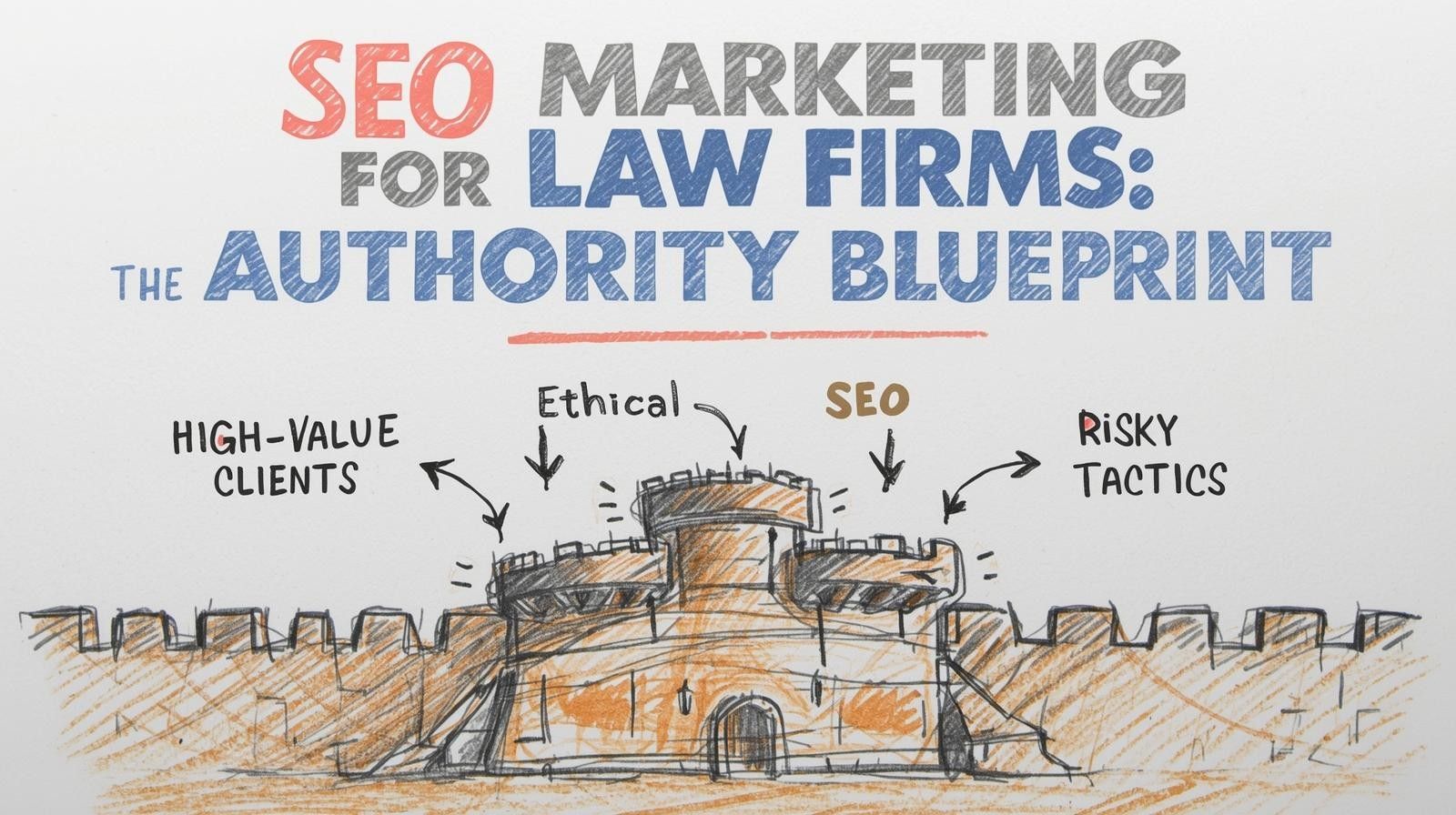
SEO marketing for law firms has moved far beyond a simple race to the #1 spot. Today, it’s about building a digital presence that stands on a rock-solid foundation of authority, one that’s immune to the risky shortcuts so common in the legal marketing world. A modern strategy is built on ethical tactics, demonstrating genuine expertise, and future-proofing your firm for an AI-driven search landscape.
This approach ensures your firm attracts high-value clients predictably and, most importantly, safely.
Your Old SEO Playbook Is a Liability
The ground is shifting under every law firm's feet. The SEO strategies that brought in calls just a few years ago are now fading in effectiveness or, worse, becoming a direct threat to your online visibility.
The playbook below is what GavelGrow's law firm SEO agency runs for clients; the service page has the scope, the timeline and how results are measured against signed cases.
Sticking with an outdated playbook isn't just stagnation; it's actively putting your most important channel for new cases at risk. This isn't about small adjustments. It’s about a fundamental overhaul in how your firm must build a defensible, long-term digital asset.
Two major forces are making old tactics obsolete. First, Google's constant algorithm updates are getting smarter at penalizing low-quality, manipulative efforts. Second, the rise of AI-powered search is fundamentally changing how potential clients find and choose a lawyer. The days of just stuffing pages with keywords and buying cheap, irrelevant links are long gone. Success now requires a much more sophisticated approach—one centered on authentic authority.
The Modern Client Journey Starts Online
Let's be clear: your potential clients live online. More than a third of people begin their search for a lawyer on Google, making a strong digital presence absolutely non-negotiable.
This reality is reflected in how firms are spending their money. Today, most law firms prioritize online channels in their marketing budgets. And the ones that adapt are seeing real results—a well-executed strategy can lead to a meaningful boost in organic traffic. Ignoring this shift is like making your firm invisible to the vast majority of potential clients.
This infographic breaks down the modern client's path, from their first Google search to the moment they contact your firm.
The key takeaway here is simple: if your firm isn't visible during that initial "Online Search" phase, you'll never even get the chance to receive an inquiry.
As a managing partner, your focus should be on building a digital asset, not just a website. Your online presence must be resilient enough to withstand algorithm changes and authoritative enough to be trusted by both search engines and prospective clients.
This new reality demands a sharp understanding of what actually constitutes high-quality, ethical SEO. Too many firms are still pouring money into agencies that rely on outdated methods, which is like setting their marketing budget on fire. You can learn more about how law firm marketing agencies waste money and what to look for in a real growth partner.
The following sections will give you the knowledge to tell the difference between tactics that build lasting value and those that put your firm’s future at risk.
Exposing the Black Hat SEO That Can Erase Your Firm Online
Many managing partners hand over the keys to their website's SEO and trust the provider implicitly. The assumption is that all activity is good activity. But that's a dangerous assumption. Some agencies resort to high-risk shortcuts—what we call "Black Hat" SEO—that can get your firm penalized or, worse, completely de-indexed from Google.
When that happens, your firm becomes invisible online.
This isn't about a minor dip in traffic. We're talking about your primary source for new cases vanishing overnight. Understanding these tactics is your first line of defense in protecting your firm's most valuable marketing asset.
What Is Black Hat SEO in a Legal Context?
At its core, black hat SEO is about trying to trick search engines. It's any practice that violates search engine guidelines in an attempt to manipulate rankings, rather than earning a top spot through quality and authority. For a law firm, where reputation is everything, it's an unacceptable gamble.
These methods often come with promises of lightning-fast results, which can be incredibly tempting. But the long-term damage is catastrophic. Google's algorithms are smarter than ever and are constantly updated to sniff out and punish sites using these deceptive practices.
Google's spam policies are not vague suggestions; they are explicit rules.
The message couldn't be clearer: any strategy designed to fool their system instead of helping a user is a direct violation that puts your entire online presence on the line.
Common Black Hat Tactics to Watch For
It's crucial for firm leadership to spot the red flags. If your SEO agency can't explain their strategy in a way that makes sense and aligns with ethical, value-driven marketing, you should be concerned.
Here are a few of the most common black hat techniques I've seen agencies try to get away with:
- Buying Spammy Links: This is when an agency pays for hundreds or thousands of low-quality links from completely irrelevant websites, often called "link farms." A healthy link profile is built by earning mentions from reputable legal directories, bar associations, and news outlets—not by buying links from a pet grooming blog in another country.
- Keyword Stuffing: This is the practice of shoving a target keyword into a page so many times that the text becomes unreadable and nonsensical. It also includes hiding white text on a white background or listing keywords in the code—tricks that haven't worked in years but are still attempted.
- Plagiarized or "Spun" Content: Some shady providers will lift content directly from another law firm's website or use software to "spin" it, which just rephrases the original text into gibberish. Google easily detects this duplicate and low-value content, and it will crush your site's authority.
- Cloaking: This is a classic bait-and-switch. An agency shows one version of a page to the search engine crawler (packed with keywords) and a completely different, more user-friendly version to a human visitor. Google despises this tactic and penalizes it heavily.
It's important to understand the difference between high-risk shortcuts and sustainable, ethical strategies that build real authority for your firm over time.
Black Hat vs White Hat SEO Tactics for Law Firms
Tactic Category
Black Hat Method (High Risk)
White Hat Alternative (Sustainable Growth)
Link Building
Buying links from private blog networks (PBNs) or irrelevant sites.
Earning high-quality links from legal directories, guest articles, and digital PR.
Content Creation
Using AI to "spin" or plagiarize content from competitor websites.
Writing original, expert-driven articles, guides, and case studies for your practice areas.
Keyword Usage
"Stuffing" pages with keywords to the point of being unreadable.
Strategically placing keywords in natural-sounding, user-focused copy.
Technical SEO
"Cloaking"—showing different content to Google than to users.
Ensuring your website is fast, mobile-friendly, and technically sound for all visitors.
The choice is clear. While black hat tactics might offer a brief, illusory spike in rankings, they inevitably lead to penalties. White hat SEO is a long-term investment in your firm's digital foundation.
A manual penalty from Google isn't an automated slap on the wrist. It means a human reviewer at Google has determined your site is violating their guidelines. The result can be a massive drop in rankings or complete removal from search results that takes months of painstaking work to fix—if it can be fixed at all.
The Consequences for Your Law Firm
The fallout from black hat SEO is devastating. Beyond a Google penalty, these tactics destroy the trust you need to build with potential clients. A website that looks spammy, is hard to read, or feels deceptive will send potential clients running to your competitors.
Even worse, a penalty can stain your firm's brand. Your online presence is a direct reflection of your professional reputation. Being associated with spammy online behavior can do lasting damage. This is precisely why lawyer reputation management must be baked into your digital strategy, ensuring every online touchpoint reflects your firm's integrity.
Protecting your practice starts with asking the right questions. Demand total transparency from your marketing partner and insist on a strategy that focuses on sustainable, ethical growth. The risk of disappearing from Google is far too great to leave it to chance.
Building Authority with Google's E-E-A-T Framework
When a potential client is staring down a life-altering legal problem, they aren't just browsing the internet. They’re looking for a lifeline. Google gets this. That's why it classifies legal services as a "Your Money or Your Life" (YMYL) topic, holding law firm websites to a much higher standard than, say, a recipe blog.
To win at SEO, you have to prove your website is a source of genuinely expert, trustworthy advice. This is where Google’s E-E-A-T framework comes into play. While it's not a direct ranking factor you can check off a list, it’s the conceptual model that underpins how Google’s algorithms and human raters judge the quality of your site. For law firms, it's non-negotiable.
E-E-A-T is an acronym for:
- Experience: Proving you've actually been in the trenches and handled cases like the ones you're discussing.
- Expertise: Showcasing your deep, specific knowledge of your practice areas.
- Authoritativeness: Demonstrating your firm is a recognized and respected voice in the legal field.
- Trust: Giving potential clients every reason to believe your firm is legitimate, secure, and has their best interests at heart.
Translating Experience into Digital Assets
Experience is the newest part of this framework, and Google added it for a reason: to separate true practitioners from content creators who are just good at summarizing what others have said. You can't just say you handle complex litigation; you have to show it.
For example, instead of a flat statement like "experienced in M&A," an attorney bio page could describe a specific (anonymized) deal structure the attorney navigated. A case results page should tell the story behind the win: What were the obstacles? What unique strategy led to the successful outcome? This is how you prove you have direct, hands-on experience solving the very problems your ideal clients are facing right now.
Showcasing True Legal Expertise
Expertise is all about depth. Generic, surface-level content is a red flag to both Google and discerning clients. Your practice area pages have to be more than digital brochures; they need to be comprehensive resources.
Think about a page on “SEO for estate planning attorneys.” A weak page just defines what a will is. A strong page signals real expertise by diving into nuance and answering specific questions:
- How do you properly structure a trust for a child with special needs?
- What are the specific tax implications of various asset protection strategies in our state?
- What does the probate process actually look like in our county?
When you create content that provides this level of genuine insight, you’re sending a powerful signal to Google that your firm has deep subject matter expertise. This is the foundation of any serious legal content strategy. For a closer look at this, our guide on content marketing and publishing strategies for law firms is a great resource.
Google’s entire mission is to connect users with the most helpful and reliable answers. For a legal question, a reliable answer can only come from a source that demonstrates clear, verifiable expertise. Your website has to be that source.
Building Authoritativeness and Trust
Authoritativeness and Trust are two sides of the same coin, built both on your website and across the web. It all boils down to your firm's reputation.
You can signal authoritativeness with things like:
- Media Mentions: Showcasing where your attorneys have been quoted as legal experts in the news.
- Speaking Engagements: Listing conferences or CLEs where your team has presented on legal topics.
- Bar Association Leadership: Highlighting any prominent roles in reputable legal organizations.
Trust signals, on the other hand, are more direct and client-facing:
- Client Reviews: A steady stream of positive reviews on your Google Business Profile, Avvo, and your own site is invaluable.
- Consistent Contact Info: Your firm’s name, address, and phone number (NAP) must be correct and identical everywhere online.
- Website Security: Using HTTPS isn't optional. It's a basic requirement for anyone to trust your site.
E-E-A-T isn't a one-and-done project. It's the ongoing work of building and burnishing your firm’s digital reputation. Every piece of content you publish and every online profile you create should be viewed through this lens. It’s how you build a powerful online presence that attracts the clients you want and stands the test of time.
Optimizing for AI and the Future of Search
The game of SEO marketing for law firms has changed. For years, the entire goal was climbing that list of blue links to hit the coveted #1 spot. But now, with AI search tools like Google's Gemini and ChatGPT entering the mainstream, the new goal is to become the definitive answer.
It’s a fundamental shift in how we need to think. When a potential client asks an AI, "What are the first steps after a car accident in Texas?" the engine doesn't just show them a list of links. It synthesizes information from what it deems the most trustworthy sources online and provides a direct answer. If your firm’s content isn't seen as that trusted source, you simply don't exist in this new reality.
From SEO to Generative Engine Optimization
This emerging discipline has a name: Generative Engine Optimization (GEO). It’s a different beast than traditional SEO. While classic SEO focuses on pleasing a crawling algorithm, GEO is all about structuring your firm’s expertise so that AI models can easily grab it, verify it, and present it as a factual answer.
You have to create content so clear, authoritative, and well-organized that an AI has no choice but to rely on it. Mastering AI search engine optimization is the next frontier for firms that want to stay visible. For managing partners, this means recognizing that your website content must be more than just persuasive marketing copy; it needs to be machine-readable data.
Structuring Your Content for AI Consumption
To win at GEO, you have to think beyond the standard blog post. AI models aren't looking for a narrative; they're hunting for direct answers to very specific questions.
Here’s how you can start structuring your content to be "citable" by AI:
- Answer First, Explain Later: Get straight to the point. On a page about the "statute of limitations for medical malpractice in Florida," the very first paragraph should state the timeframe. You can dive into the nuances and exceptions after you've given the direct answer.
- Use Headings as Questions: Frame your H2 and H3 subheadings to mirror the exact questions your potential clients are typing into search bars. Think "Who Can Be Held Liable in a Slip and Fall Case?" instead of a generic title like "Liability Issues."
- Embrace Schema Markup: This bit of code is like a translator for search engines. It tells them precisely what your content is about. Using
LegalServiceandFAQPageschema helps AI models contextualize your information, making it far more likely to be used in a generated response.
Taking this structured approach has a fantastic side effect: it dramatically improves the experience for human users, too, which can help boost your click-through rates from traditional search results.
The new objective isn't just to rank for "personal injury lawyer Miami." It's to be the cited authority when an AI answers, "I was injured in a slip and fall in Miami, what should I do?"
The Critical Role of Semantics and Local Signals
AI doesn't just match keywords; it understands intent. It gets the context behind a query. This means your content needs to reflect the natural, conversational language people use when they're stressed and looking for legal help. Instead of only targeting a sterile keyword like "corporate M&A attorney," create a resource that answers, "What are the legal steps in selling a small business?"
This focus on intent is deeply intertwined with local signals. AI-driven search is getting smarter about connecting users with local experts. Firms that create in-depth content tailored to their specific city or region are building the kind of authority that both clients and algorithms trust. Sprinkling in location-specific terms is no longer enough; you need to be the go-to resource for legal questions in your area.
By shifting your strategy to answer specific, conversational questions and packaging your expertise in a machine-readable format, your firm can make the leap from just being on the search results page to becoming the definitive answer.
The SEO Metrics That Matter to Managing Partners
Let's be blunt: high search rankings are often just a vanity metric. Seeing your firm at the top of Google looks great in a report, but it means absolutely nothing if it doesn't translate into signed cases and firm revenue. It's time to shift the conversation away from technical SEO jargon and focus on the business outcomes you actually care about.
The real measure of success for your firm's SEO marketing for law firms isn’t found in keyword positions. It’s measured in tangible growth. We need to look past the old-school metrics and zero in on the key performance indicators (KPIs) that directly impact your bottom line.
Moving Beyond Rankings to Revenue
First things first: we have to redefine what "success" looks like. Instead of obsessing over whether you're #1 for a broad, high-traffic keyword, we need to track the numbers that signal real client acquisition. This is all about connecting your marketing activity directly to the firm's financial health.
Start by focusing on these business-centric KPIs:
- Qualified Leads from Organic Search: How many real, potential clients found you on Google and actually reached out? This is the most important top-of-funnel metric you have.
- Consultation Conversion Rate: Look at a specific practice area page, like "commercial real estate litigation." Of all the leads that page generated, what percentage booked a consultation? This tells you if your content is hitting the mark with the right audience.
- Google Business Profile (GBP) Inbound Calls: How many people called your firm directly from your GBP listing? This is a huge indicator of your local SEO effectiveness.
For managing partners who want a more strategic view, understanding metrics like Share of Voice SEO offers far deeper insight than a simple ranking report. It shows your firm's total visibility across the entire search landscape for your key practice areas, painting a much more accurate picture of your true market dominance.
Calculating the True ROI of Your SEO
Connecting your SEO efforts to actual revenue isn't just a nice idea; it's essential for making smart decisions about your marketing budget. Having a simple framework to quantify the return on investment can completely change the conversations you have about growth.
This is especially critical when you consider how cost-effective SEO is. Sure, paid search ads can get you clicks, but their conversion rate is often disappointingly low. On the other hand, local and organic searches drive the vast majority of digital traffic for legal services, offering a much higher return—especially when the cost-per-click for competitive legal keywords can be astronomical.
The critical question isn't "How are we ranking?" It should be, "What is our Client Acquisition Cost from organic search, and how does it stack up against our other channels?" This is the number that should drive your strategy.
To get this number, you need a clear line of sight from an initial website visit all the way to a signed retainer. This involves meticulously tracking leads through your intake process and assigning a value to each new case that comes from your SEO efforts. With that data, you can prove the value of your investment without a shadow of a doubt. We've actually put together a detailed guide on how to measure your marketing ROI that you can start using right away.
Key Metrics to Monitor Monthly
To keep a firm grip on performance, your marketing partner should be reporting on a core set of business metrics every single month. More importantly, they should provide context and strategic recommendations based on what the data is telling you.
Here’s a look at what should be on your essential scorecard.
The Essential Law Firm SEO Scorecard
Metric Category
Key Performance Indicator (KPI)
Why It Matters to Managing Partners
Lead Generation
New Organic Leads
Measures the volume of potential new cases generated directly from search.
Conversion
Goal Completions (Form Fills, Calls)
Tracks how effectively your website turns visitors into actionable leads.
Local Visibility
Google Business Profile Actions
Shows how many people requested directions, called, or visited your site from local search.
Business Impact
Cost Per Acquired Case (from SEO)
The ultimate metric that defines the profitability and success of your SEO strategy.
By focusing on these numbers, you ensure your SEO is a powerful, predictable driver of firm growth, not just another line item on the expense report. The goal isn't a list of keywords; it's building a system that delivers a consistent flow of high-value cases.
Common Questions We Hear About Modern Law Firm SEO
Even with a solid game plan, I get it—the world of SEO marketing for law firms can feel like a maze. Let’s tackle some of the most common and pressing questions I hear from managing partners and marketing directors. No jargon, just straight answers.
How Long Does SEO Take to Actually Work for a Law Firm?
This is always the first question, and the honest answer is, "it depends." You'll see some quick wins from technical fixes in a matter of weeks, but building real authority that brings in a steady stream of qualified leads? That takes a sustained, high-quality effort for at least six to twelve months.
Think of it like building your reputation in the legal community. It doesn't happen overnight. The timeline really hinges on a few key factors:
- How competitive is your practice area? Personal injury SEO in a major city is a different beast than estate planning in a quiet suburb.
- What's the starting point? A brand-new website has a steeper climb than one with some existing authority.
- Are you consistent? The quality and frequency of your content and link-building are huge needle-movers.
A word of caution: if an agency promises you first-page rankings in 30 days, run. They're almost certainly using high-risk "Black Hat" tactics that will get you penalized by Google down the road. Sustainable growth is a marathon, not a sprint.
What's a Realistic SEO Budget for a Small or Mid-Sized Firm?
Your budget shouldn't be based on a random number. It needs to be tied directly to your firm's growth targets. The question isn't "how much does it cost?" but rather "what investment is needed to bring in our target of X new cases each month?"
For most small to mid-sized firms in competitive markets, you need to be prepared for a meaningful investment. This typically starts in the low-to-mid four figures per month. That kind of budget covers the non-negotiables: in-depth content created by writers who understand the law, strategic link-building outreach, and constant technical monitoring. Anything significantly lower just won't give you the resources to actually compete and see a positive return.
Can't We Just Use AI to Write All Our Content?
AI tools like ChatGPT are fantastic for brainstorming, creating outlines, and even getting a rough first draft on paper. But relying on them to produce your final, published content is a critical mistake.
Google’s entire quality system is built around E-E-A-T, which demands real-world Experience and Expertise. AI simply can't fake that. Your articles and practice area pages need to be infused with your firm's unique insights and case experience. Use AI to become more efficient, absolutely, but every single piece of content must be edited and polished by an actual attorney before it sees the light of day. This "human-in-the-loop" process is the only way to build trust with search engines and the clients you want to attract.
Is Local SEO Really That Important for My Practice Area?
For virtually every law firm out there, the answer is a resounding yes.
Even if your firm handles complex M&A or IP law with a national client base, a strong local signal builds a foundation of trust that Google uses to evaluate your entire site. For practices like family law, criminal defense, or estate planning, local SEO for family law practices is everything—it's the primary driver of new clients. Your Google Business Profile is often the single most valuable digital asset you have for attracting clients in your immediate area. It’s not an add-on; it's a fundamental pillar of your growth strategy.
Ready to stop guessing and start building a predictable client acquisition engine? The team at GavelGrow builds data-driven SEO strategies that deliver qualified leads, not just vanity rankings. Book a complimentary strategy session today to find out how we can help your firm hit its growth targets.
Frequently Asked Questions
Why are old law firm SEO tactics becoming a liability?
Two forces are making outdated SEO risky: Google's algorithm updates increasingly penalize low-quality, manipulative work, and AI-powered search is changing how clients find lawyers. Tactics like keyword stuffing and buying cheap irrelevant links can now actively hurt your visibility rather than help it. Modern law firm SEO relies on authentic authority and ethical, defensible methods instead.
What is black hat SEO in a legal context?
Black hat SEO refers to high-risk shortcuts that violate search engine guidelines, such as buying spammy backlinks, hidden or auto-generated content, and aggressive keyword stuffing. For a law firm, these tactics can trigger penalties that severely damage or erase your online visibility, jeopardizing your most important channel for new cases. Sustainable white hat alternatives build lasting value instead.
What is E-E-A-T and why does it matter for law firm SEO?
E-E-A-T stands for Experience, Expertise, Authoritativeness, and Trustworthiness, the qualities Google uses to assess content in high-stakes areas like legal advice. For law firms, this means demonstrating real attorney experience, showcasing genuine expertise through detailed content, and earning trust with credentials, reviews, and citations. Building strong E-E-A-T signals is central to ranking safely in a competitive legal market.
How do you optimize law firm content for AI search?
Optimizing for AI search, sometimes called generative engine optimization, means structuring content so AI systems can easily extract and cite it. That involves clear question-and-answer formatting, well-organized headings, concise direct answers, and strong semantic and local signals. Firms that make their expertise easy for AI to understand are better positioned as search shifts toward generated answers.
What SEO metrics should a managing partner track?
Managing partners should focus on revenue-connected metrics rather than rankings alone. The most meaningful include new organic leads, goal completions like form fills and calls, Google Business Profile actions for local visibility, and the cost per acquired case from SEO. These KPIs show business impact and tie your SEO investment directly to client acquisition.
The real test of a firm's SEO isn't rankings or traffic but what those organic clicks cost per case actually signed, which is exactly what our Law Firm Marketing Benchmark, aggregated from more than 500 firms, lets you measure your search channel against.
Prefer to hand it off? GavelGrow's law firm SEO services rank your firm for the buyer-intent searches that turn into signed cases — with every ranking tracked to a signed matter.
Frequently Asked Questions
Why are old law firm SEO tactics becoming a liability?
Two forces are making outdated SEO risky: Google's algorithm updates increasingly penalize low-quality, manipulative work, and AI-powered search is changing how clients find lawyers. Tactics like keyword stuffing and buying cheap irrelevant links can now actively hurt your visibility rather than help it. Modern law firm SEO relies on authentic authority and ethical, defensible methods instead.
What is black hat SEO in a legal context?
Black hat SEO refers to high-risk shortcuts that violate search engine guidelines, such as buying spammy backlinks, hidden or auto-generated content, and aggressive keyword stuffing. For a law firm, these tactics can trigger penalties that severely damage or erase your online visibility, jeopardizing your most important channel for new cases. Sustainable white hat alternatives build lasting value instead.
What is E-E-A-T and why does it matter for law firm SEO?
E-E-A-T stands for Experience, Expertise, Authoritativeness, and Trustworthiness, the qualities Google uses to assess content in high-stakes areas like legal advice. For law firms, this means demonstrating real attorney experience, showcasing genuine expertise through detailed content, and earning trust with credentials, reviews, and citations. Building strong E-E-A-T signals is central to ranking safely in a competitive legal market.
How do you optimize law firm content for AI search?
Optimizing for AI search, sometimes called generative engine optimization, means structuring content so AI systems can easily extract and cite it. That involves clear question-and-answer formatting, well-organized headings, concise direct answers, and strong semantic and local signals. Firms that make their expertise easy for AI to understand are better positioned as search shifts toward generated answers.
What SEO metrics should a managing partner track?
Managing partners should focus on revenue-connected metrics rather than rankings alone. The most meaningful include new organic leads, goal completions like form fills and calls, Google Business Profile actions for local visibility, and the cost per acquired case from SEO. These KPIs show business impact and tie your SEO investment directly to client acquisition. The real test of a firm's SEO isn't rankings or traffic but what those organic clicks cost per case actually signed, which is exactly what our Law Firm Marketing Benchmark, aggregated from more than 500 firms , lets you measure your search channel against. Prefer to hand it off? GavelGrow's law firm SEO services rank your firm for the buyer-intent searches that turn into signed cases — with every ranking tracked to a signed matter.