Competitive Analysis Definition: What It Is, Steps, Examples
Categories: Legal Marketing Strategies
 Abram Ninoyan
Founder & Senior Performance Marketer
Credentials: Google Partner, Google Ads Search Certified, Google Ads Display Certified, Google Ads Measurement Certified, Google Analytics (IQ) Certified, HubSpot Inbound Certified, HubSpot Social Media Marketing Certified, Conversion Optimization Certified
Expertise: Google Ads, Meta Ads, Conversion Rate Optimization, GA4 & Google Tag Manager, Lead Generation, Marketing Funnel Optimization, PPC Management
LinkedIn Profile
A competitive analysis definition in its simplest form: it's a structured process of identifying your direct competitors, evaluating their strengths and weaknesses, and comparing their strategies agai...
Key Takeaways
- Competitive Analysis Definition: What It Is, Steps, Examples
- What is a competitive analysis in business and marketing?
- Why does a competitive analysis matter for law firms?
- How to run a competitive analysis step by step
Competitive Analysis Definition: What It Is, Steps, Examples
A competitive analysis definition in its simplest form: it's a structured process of identifying your direct competitors, evaluating their strengths and weaknesses, and comparing their strategies against your own to find gaps you can exploit. For law firms spending thousands per month on client acquisition, that process isn't academic, it's the difference between burning budget on guesswork and making informed decisions about where to invest next.
Most firms have a general sense of who they're competing against for cases. They know the billboard names and the firms buying Google Ads for the same practice-area keywords. But gut-level awareness isn't analysis. A proper competitive analysis digs into specifics, ad spend patterns, intake processes, review profiles, content strategy, conversion paths, and turns those observations into actions. When a personal injury firm in Phoenix discovers that three competitors respond to web leads within five minutes while their own average is four hours, that single finding can reshape their entire intake workflow. At GavelGrow, our modelled practice-area benchmarks exists precisely for this reason: giving law firms hard performance comparisons against peers in the same practice area and market size, so competitive analysis starts with real numbers instead of assumptions.
This article breaks down exactly what competitive analysis involves, walks through the core steps to conduct one, and includes examples that apply directly to legal marketing. Whether you're a solo practitioner evaluating your first paid search campaign or a managing partner overseeing a six-figure annual marketing budget, you'll leave with a repeatable framework for sizing up the competition, and a clearer picture of where your firm actually stands.
What is a competitive analysis in business and marketing?
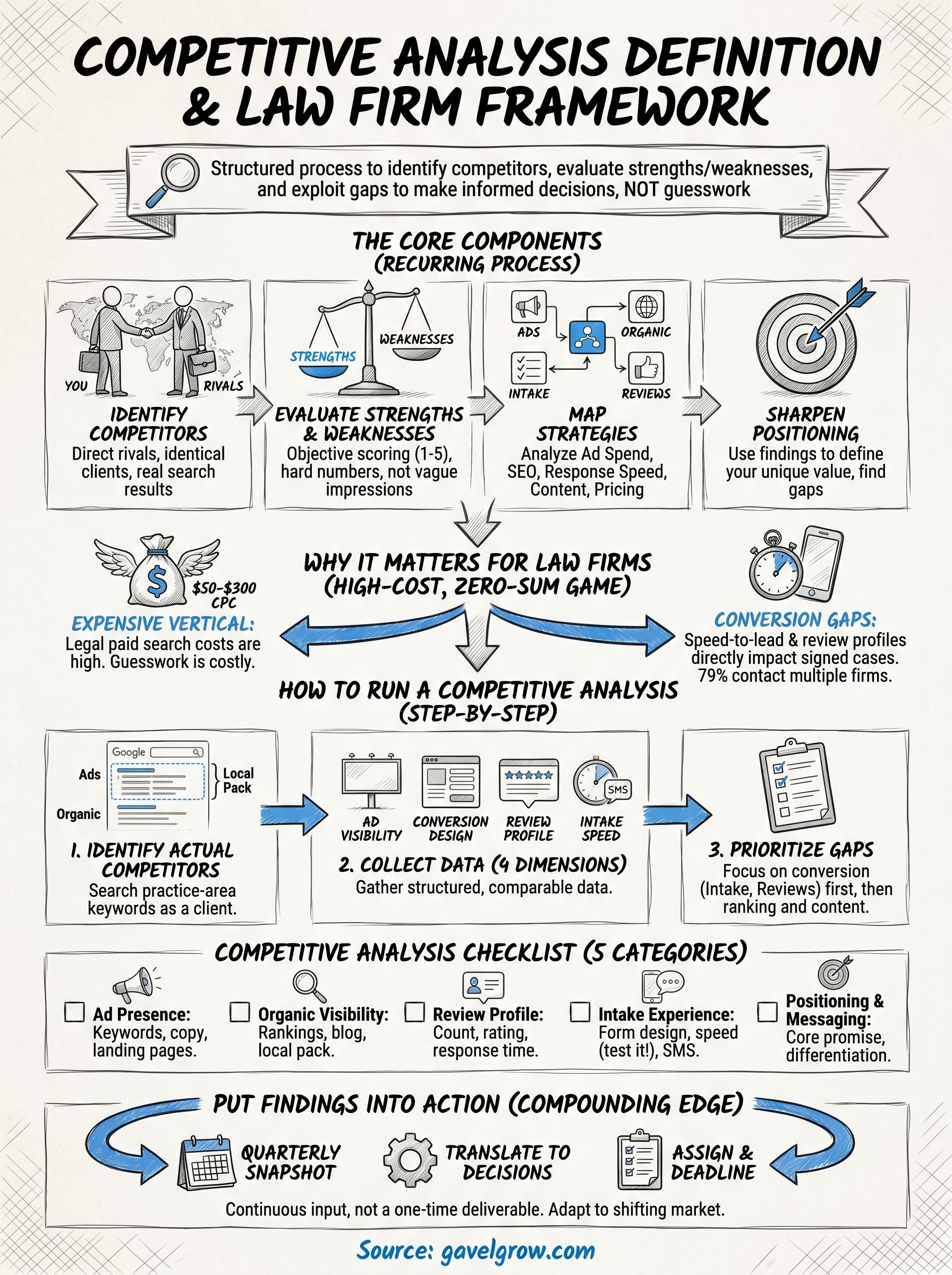
A competitive analysis is a systematic review of the businesses competing for the same customers, cases, or market share you're targeting. At its core, the competitive analysis definition covers four elements: identifying your competitors, evaluating their strengths and weaknesses, mapping their marketing and operational strategies, and using those findings to sharpen your own positioning. It's not a one-time exercise. Firms that treat it as a recurring process build a clearer, continuously updated picture of where they stand in a market that shifts around them constantly.
The core components of a competitive analysis
Every solid competitive analysis examines the same fundamental categories regardless of industry. You're looking at who your competitors are (direct rivals targeting identical customers), what products or services they offer, how they price and position those offerings, where they show up (search ads, organic rankings, social platforms, local packs), and how effectively they convert interest into paying clients. Each category gives you a different layer of intelligence, and skipping any one of them leaves blind spots in your strategy.
The goal isn't to copy what competitors do well. It's to find the gaps they're leaving open and build your approach around those.
A useful way to organize this data is a structured comparison table or scorecard. You assign attributes to each competitor, score them on dimensions like ad visibility, intake speed, review volume, and content depth, and then compare every competitor against your own baseline. This approach forces specificity: instead of noting "they have good reviews," you record "Competitor A holds 312 Google reviews at a 4.8 average versus your 89 at a 4.6 average," which immediately points to a measurable and actionable gap rather than a vague impression.
How competitive analysis fits into your marketing strategy
Your competitive analysis feeds directly into every major marketing decision you make. Budget allocation, keyword targeting, messaging, and intake design all sharpen considerably when you know what competitors are already doing and where they're falling short. Without this context, you're essentially bidding on keywords, writing ad copy, and designing landing pages in a vacuum, optimizing for performance benchmarks you invented rather than ones grounded in real market data.
Firms that consistently outperform competitors treat competitive intelligence as a continuous input, not a one-time deliverable. When market conditions shift, whether a new firm enters your metro, ad costs spike for your core keywords, or a competitor earns a high-profile verdict and starts advertising it heavily, your analysis updates and your strategy adjusts accordingly.
Why does a competitive analysis matter for law firms?
Law firm marketing runs on a zero-sum logic: every case your competitor signs is one your firm didn't. That reality makes the competitive analysis definition especially relevant for attorneys, because you're not just competing on price or convenience. You're competing on trust, visibility, speed, and reputation simultaneously, across Google Ads, organic search, local packs, and review platforms all at once. Without a structured view of how competitors perform across those dimensions, you're making budget decisions based on guesswork.
Legal marketing is one of the most expensive paid search verticals
Legal is consistently among the highest-cost paid search categories in the country. Personal injury keywords routinely cost $50 to $300 per click in major metros, and family law and criminal defense are not far behind. At those prices, running campaigns without knowing what competitors are bidding on, what their landing pages look like, or how fast their intake teams respond means you're absorbing serious losses from gaps you could close with better information.
Understanding what competitors do better than you is the fastest path to finding where your marketing budget is leaking.
What competitive gaps look like in practice
The gaps you surface through a competitive analysis often appear in response time and intake quality rather than ad spend alone. Clio's 2024 Legal Trends Report found that 79% of prospective clients contact more than one law firm. If a competitor answers a web inquiry in four minutes and your firm takes four hours, the case is already gone before your intake team picks up the phone. Identifying that gap through analysis gives you a specific, measurable target to close rather than a vague sense that your conversion rate needs improvement.
How to run a competitive analysis step by step
Running a full competitive analysis definition in practice follows a clear sequence. You start with identifying who your real competitors are, then collect data across specific dimensions, and finally translate that data into ranked priorities you can act on. Skipping steps or jumping straight to conclusions without evidence produces a list of opinions, not a strategy.
Identify who you're actually competing against
Your competitors are not always who you assume. Start by searching your core practice-area keywords in Google as a prospective client would. Note every firm appearing in ads, the local pack, and the first page of organic results. That search result page tells you who is actively fighting for the same attention you are, and it often surfaces firms your intake team hears about from prospects who called multiple attorneys before choosing one.
The firms showing up consistently across paid, local, and organic results deserve the deepest scrutiny in your analysis.
Collect data across four specific dimensions
Once you have your competitor list, gather structured data across four categories: ad visibility and messaging, website and landing page conversion design, review volume and average rating, and intake response speed. You can test response speed yourself by submitting a web lead form as a prospect and timing how long each firm takes to follow up. For ads and organic rankings, tools like Google's own search results and the Ads Transparency Center give you direct visibility into competitor campaigns without paid subscriptions.

Prioritize the gaps worth closing first
Not every gap deserves equal attention. Focus first on the gaps that directly affect conversion, specifically intake response time, review count, and landing page clarity. Ranking gaps in paid search come next, followed by content and brand-level differences.
What to include in your competitive analysis checklist
A competitive analysis definition only delivers value if you collect consistent data across every competitor you evaluate. Without a checklist, you end up with patchy notes that reflect whatever caught your attention rather than a structured comparison you can actually act on. The five categories below cover the core inputs every law firm needs to build a complete competitive picture.
Five categories every checklist needs
Your checklist should capture data in the same order for every competitor so comparison stays apples-to-apples. Structured collection habits matter as much as the categories themselves.
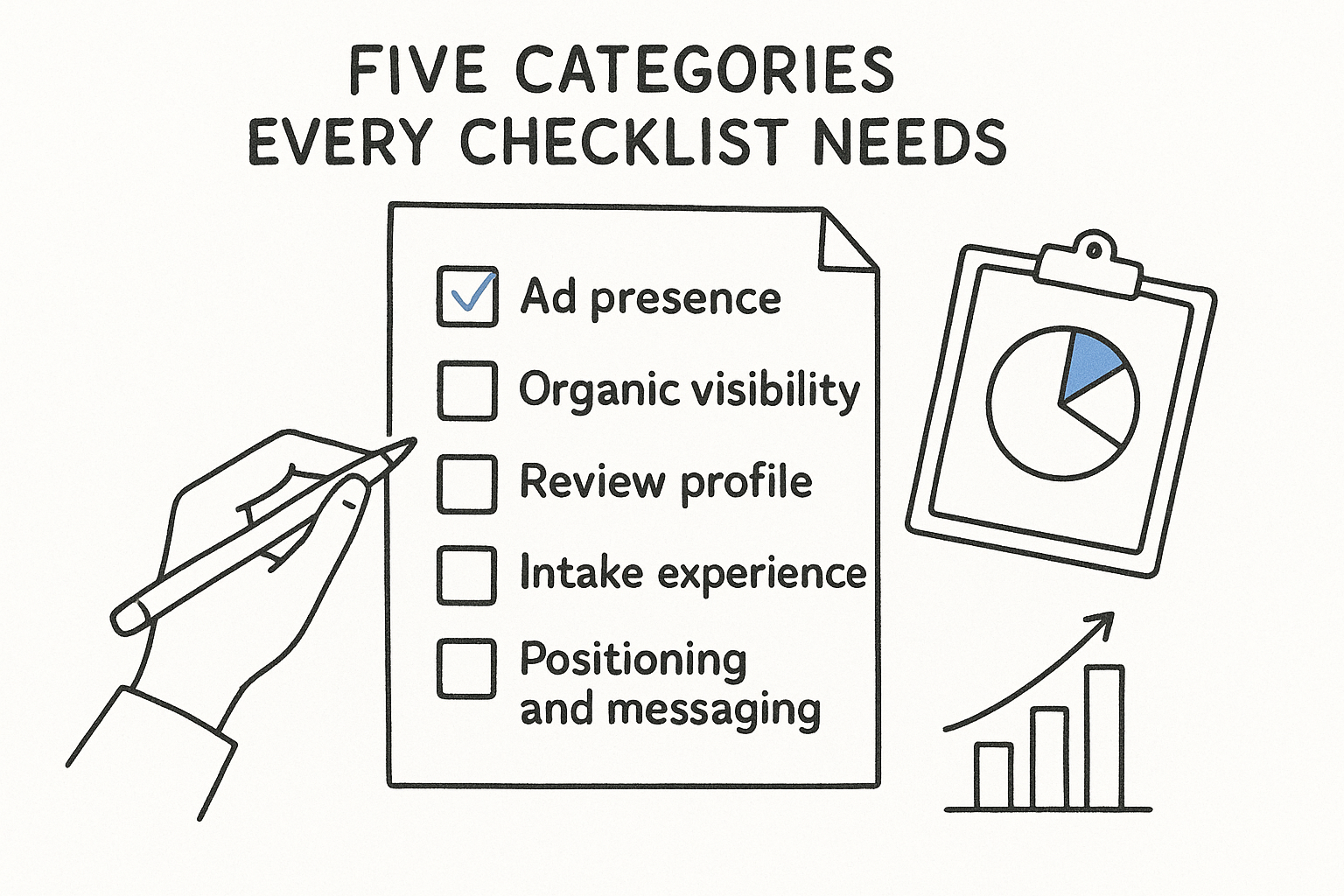
- Ad presence: keywords targeted, ad copy themes, landing page design, and call-to-action language
- Organic visibility: practice-area pages ranking, blog content depth, and local pack placement
- Review profile: total review count, average rating, and how fast the firm responds to negative reviews
- Intake experience: web form design, response time (test it yourself), and whether SMS follow-up fires automatically
- Positioning and messaging: the core promise each competitor leads with and how they differentiate on their homepage
If you can't score a competitor consistently on all five categories, your comparison will produce opinions instead of priorities.
How to score each competitor consistently
Rate each competitor on a simple 1 to 5 scale for every category, then add your own firm as the baseline row. This format forces honest self-assessment: if you score a competitor a 4 on intake speed and your own firm a 2, you now have a specific, ranked gap rather than a general sense that intake needs work. Run this scoring exercise quarterly so your checklist reflects the market as it currently stands, not as it looked six months ago.
Competitive analysis examples for law firm marketing
Abstract frameworks only go so far. Seeing how the competitive analysis definition plays out in real scenarios helps you recognize the same patterns in your own market and act on them faster. The two examples below reflect the kinds of gaps law firms consistently surface when they run structured analyses for the first time.
A personal injury firm uncovers an intake speed gap
A mid-size personal injury firm in Dallas submitted web inquiry forms to eight competing firms as a prospective client. Five of the eight competitors followed up by phone or SMS within ten minutes. The firm conducting the analysis averaged 3.5 hours for its own first response. That single finding, surfaced through a direct intake test rather than ad research, explained a persistent conversion rate problem that no amount of ad spend optimization had fixed. The firm restructured its intake automation sequence to fire an SMS within 60 seconds of form submission, which brought first-contact time under five minutes within two weeks.
Speed-to-lead is often the highest-value gap a competitive analysis surfaces, and it costs nothing to test.
A family law firm identifies a review volume deficit
A family law firm in Atlanta scored each competitor's Google Business Profile and found that the top three organic performers each held over 200 reviews, while the firm itself had 47. Competitor review pages showed recent responses to negative feedback within 24 hours, while the firm had left two negative reviews unanswered for months. Those two measurable gaps, volume and responsiveness, became specific quarterly targets rather than vague reputation concerns. Within six months of running a structured review request sequence, the firm crossed 130 reviews and moved up two positions in the local pack.
Put Your Findings Into Action
A competitive analysis definition only earns its value when you translate findings into concrete decisions. The gaps you identified in intake speed, review volume, ad positioning, and content depth each represent a specific and actionable improvement target, not a vague sense that marketing needs work. Pick the two or three gaps with the highest direct impact on signed case conversion and assign an owner and a firm deadline to each one.
Running this process once gives you a useful snapshot. Running it quarterly gives you a compounding competitive edge as you close gaps and new ones surface. Your firm stays calibrated to a market that shifts constantly around you. If you want a structured starting point for measuring where your firm actually stands right now, run GavelGrow's free law firm marketing scorecard and get a scored breakdown of your marketing health across the same dimensions this article covers.
Frequently Asked Questions
What is a competitive analysis?
A competitive analysis is a structured process of identifying your direct competitors, evaluating their strengths and weaknesses, mapping their marketing and operational strategies, and comparing them against your own to find gaps you can exploit. It covers four core elements: who your competitors are, what they offer, how they position it, and where and how effectively they convert. It works best as a recurring process, not a one-time exercise.
Why does competitive analysis matter for law firms specifically?
Competitive analysis matters for law firms because legal marketing runs on zero-sum logic: every case a competitor signs is one your firm didn't. Legal is also among the most expensive paid search verticals, so running campaigns without knowing what competitors bid on, how their landing pages look, or how fast their intake responds means absorbing losses you could close with better information. Structured analysis turns that guesswork into ranked, actionable priorities.
What data should a law firm collect in a competitive analysis?
A law firm should collect structured data across five categories for every competitor: ad presence, organic visibility, review profile, intake experience, and positioning. That includes the keywords and ad copy competitors run, which practice-area pages rank, their review count and rating, how fast their intake follows up, and the core promise they lead with. Scoring each competitor on a simple 1-to-5 scale keeps the comparison apples-to-apples.
How do you test a competitor's intake response time?
You test a competitor's intake speed by submitting a web lead form on their site as a prospective client and timing how long each firm takes to follow up by phone, text, or email. This costs nothing and often surfaces the highest-value gap in the entire analysis. Firms that discover competitors respond in minutes while their own average is hours have found a specific, measurable target that ad-spend tweaks alone would never fix.
How often should a law firm run a competitive analysis?
A law firm should run a competitive analysis quarterly. Running it once gives you a useful snapshot, but running it every quarter gives you a compounding edge as you close gaps and new ones surface, keeping your firm calibrated to a market that shifts constantly. New firms enter your metro, ad costs move, and competitors earn verdicts and start advertising them, so a stale analysis loses value fast.
Frequently Asked Questions
What is a competitive analysis?
A competitive analysis is a structured process of identifying your direct competitors, evaluating their strengths and weaknesses, mapping their marketing and operational strategies, and comparing them against your own to find gaps you can exploit. It covers four core elements: who your competitors are, what they offer, how they position it, and where and how effectively they convert. It works best as a recurring process, not a one-time exercise.
Why does competitive analysis matter for law firms specifically?
Competitive analysis matters for law firms because legal marketing runs on zero-sum logic: every case a competitor signs is one your firm didn't. Legal is also among the most expensive paid search verticals, so running campaigns without knowing what competitors bid on, how their landing pages look, or how fast their intake responds means absorbing losses you could close with better information. Structured analysis turns that guesswork into ranked, actionable priorities.
What data should a law firm collect in a competitive analysis?
A law firm should collect structured data across five categories for every competitor: ad presence, organic visibility, review profile, intake experience, and positioning. That includes the keywords and ad copy competitors run, which practice-area pages rank, their review count and rating, how fast their intake follows up, and the core promise they lead with. Scoring each competitor on a simple 1-to-5 scale keeps the comparison apples-to-apples.
How do you test a competitor's intake response time?
You test a competitor's intake speed by submitting a web lead form on their site as a prospective client and timing how long each firm takes to follow up by phone, text, or email. This costs nothing and often surfaces the highest-value gap in the entire analysis. Firms that discover competitors respond in minutes while their own average is hours have found a specific, measurable target that ad-spend tweaks alone would never fix.
How often should a law firm run a competitive analysis?
A law firm should run a competitive analysis quarterly. Running it once gives you a useful snapshot, but running it every quarter gives you a compounding edge as you close gaps and new ones surface, keeping your firm calibrated to a market that shifts constantly. New firms enter your metro, ad costs move, and competitors earn verdicts and start advertising them, so a stale analysis loses value fast.