What Is Local SEO? How It Works for Law Firms + ROI
Categories: Legal Marketing Strategies
 Abram Ninoyan
Founder & Senior Performance Marketer
Credentials: Google Partner, Google Ads Search Certified, Google Ads Display Certified, Google Ads Measurement Certified, Google Analytics (IQ) Certified, HubSpot Inbound Certified, HubSpot Social Media Marketing Certified, Conversion Optimization Certified
Expertise: Google Ads, Meta Ads, Conversion Rate Optimization, GA4 & Google Tag Manager, Lead Generation, Marketing Funnel Optimization, PPC Management
LinkedIn Profile
What is local SEO? It's the process of optimizing your law firm's online presence so it appears in geographically relevant search results, the Map Pack, local organic listings, and "near me"...
Key Takeaways
- What Is Local SEO? How It Works for Law Firms in 2026 + ROI
- Key Takeaways
- Why local SEO matters for law firms in 2026
- How Google ranks local results for attorneys
What Is Local SEO? How It Works for Law Firms in 2026 + ROI
What is local SEO? It's the process of optimizing your law firm's online presence so it appears in geographically relevant search results, the Map Pack, local organic listings, and "near me" queries where prospective clients are actively looking for legal help in your area.
Here's why it matters: 46% of all Google searches have local intent (Search Engine Roundtable, 2024), and BrightLocal's 2025 Consumer Survey found that 87% of consumers used Google to evaluate a local business in the past year. For law firms, those searches look like "personal injury lawyer in Dallas" or "divorce attorney near me", high-intent queries from people who need representation now, not next quarter. If your firm doesn't show up, a competitor two blocks away will.
Local SEO isn't a single tactic. It's a system, Google Business Profile optimization, localized content, citation management, review velocity, and on-page signals all working together. At GavelGrow, we've managed local SEO campaigns for over 500 U.S. law firms since 2015, and we consistently see it deliver the lowest cost-per-signed-case of any channel when done right.
This article breaks down exactly how local SEO works for law firms in 2026, what's changed from previous years, where the real ROI comes from, and how to measure results in signed retainers rather than vanity metrics like impressions or raw traffic.
Key Takeaways:
- Local SEO targets geographically relevant searches where prospective clients need a lawyer now
- Google Business Profile is the single most influential local ranking factor for firms
- Firms with 50+ reviews and a 4.5+ rating earn significantly more Map Pack clicks
- Local SEO typically produces a lower cost-per-signed-case than paid search alone
- Full-funnel attribution, click to signed retainer, is the only way to measure local SEO ROI accurately
Key Takeaways
Before diving into the full breakdown, here's a summary of what understanding what is local SEO means for your firm's growth in 2026. Each point below is expanded in its own section of this article, but these core ideas should shape how you think about local search before you read a single tactic.
Local SEO Targets Clients Who Are Ready to Hire Right Now
Local search queries carry purchase intent that most other channels simply don't match. When someone types "DUI attorney in Phoenix" into Google at 10 PM, they are not browsing. They need a lawyer, likely today. That intent gap is what makes local SEO so valuable for law firms: you're not interrupting someone mid-scroll; you're showing up precisely when they are actively looking for you.
Local SEO is not a brand awareness play. It's a client acquisition system that reaches people at the exact moment they need legal help.
Your Google Business Profile Controls the Map Pack
The Google Business Profile (GBP) is the single highest-leverage asset in local search. It determines whether your firm appears in the three-firm "Map Pack" that dominates the top of local search results, often above all organic links. Firms that treat GBP as an afterthought, uploading a phone number and forgetting it, consistently lose Map Pack visibility to competitors who actively manage categories, photos, hours, Q&A, and weekly posts.
Claiming and fully optimizing your GBP is not optional in 2026. It is the starting point for every other local SEO effort you make.
Reviews Affect Rankings and Conversion at the Same Time
Most attorneys think reviews only matter for reputation. They're wrong on two counts. First, Google's local ranking algorithm factors in review count, recency, and average rating as direct signals. Second, BrightLocal's 2025 Consumer Survey found that 75% of consumers won't contact a business with fewer than four stars. That means reviews influence whether you rank and whether a searcher contacts you after they find you.
A consistent review generation process, something systematic rather than ad hoc, is one of the highest-ROI activities your firm can invest in this year.
Local SEO Produces a Lower Cost-Per-Signed-Case Than Paid Search Alone
Paid search delivers immediate traffic, but you pay for every click whether the visitor converts or not. Local SEO, once your rankings stabilize, produces organic traffic at near-zero marginal cost per click. In GavelGrow's modelled benchmarks, firms running both paid and local SEO consistently show a lower blended cost-per-signed-case than firms relying on paid search alone.
This doesn't mean local SEO is free. It requires ongoing content, citation management, and GBP maintenance. But the unit economics improve significantly over a 12-to-18-month horizon compared to ad spend alone.
You Must Measure Results in Signed Cases, Not Just Traffic
Traffic reports, impression counts, and keyword rankings are indicators, not outcomes. The only metric that tells you whether your local SEO investment is working is signed retainers attributed back to organic local search. Without full-funnel attribution from first click to signed case, you are guessing at ROI rather than measuring it. Every section of this article is built around that principle.
Why local SEO matters for law firms in 2026
Understanding what is local SEO and why it matters starts with one fact: the legal services market is intensely local. A prospective client searching for a bankruptcy attorney in Chicago will not hire a firm based in Miami, no matter how strong that firm's national reputation is. Geographic relevance is the filter that determines which firms even get considered, and local SEO is the mechanism that puts your firm inside that filter.
The Client Search Journey Now Starts on Google
Before a prospective client calls anyone, they search. According to Google's 2024 Search Trends data, searches for legal help spike on weekends and evenings, exactly when someone has just experienced an accident, received divorce papers, or gotten arrested. Your firm either appears when that person searches, or you don't exist to them. No amount of billboard advertising or word-of-mouth referrals changes that dynamic if you're invisible in local search at the moment of need.
The firm that ranks in the Map Pack at 10 PM on a Saturday captures clients that paid search campaigns, running with weekday budgets, will never reach.
Competition for Local Visibility Has Intensified
Law is one of the most competitive local search categories on Google. Personal injury, family law, and criminal defense firms in most mid-size U.S. markets are all fighting for three Map Pack spots and the first page of organic results. BrightLocal's 2025 Local Search Industry Report confirmed that legal and financial services saw the steepest increase in local search competition from 2023 to 2025 among all tracked verticals.
Firms that built their local SEO foundation three to five years ago now hold a significant ranking advantage over newer entrants. That advantage compounds over time through accumulated reviews, citation authority, and content depth. If your firm hasn't invested in local SEO yet, the cost of catching up grows every quarter you wait.
Local SEO Fills the Gap That Paid Search Can't
Paid search stops the moment your budget runs out. Local SEO rankings persist through weekends, holidays, and budget freezes. For firms with inconsistent monthly ad spend or seasonal case volume, organic local visibility provides a baseline of inbound leads that keeps the pipeline moving even when campaigns pause.
How Google ranks local results for attorneys
Google's local ranking algorithm for the Map Pack uses three primary factors: proximity, relevance, and prominence. Understanding how these interact gives you a clear framework for where to invest your optimization effort, rather than guessing at what moves rankings. Knowing what is local SEO at a tactical level means knowing exactly how Google scores each of these signals.
Proximity, Relevance, and Prominence
Proximity is how close your firm's listed address is to the searcher's physical location at the time of the query. You cannot control where a potential client searches from, but you can ensure your primary office address is accurate and consistent across every online directory. Serving a broad metro area from a single office is fine, but publishing a P.O. box or a virtual address typically triggers a Google Business Profile suspension, which removes you from the Map Pack entirely.

Relevance measures how well your GBP and website match what the searcher is looking for. Google reads your primary business category, service keywords, website content, and the language used in your reviews to determine whether your firm is a strong match for a given query. A personal injury firm that lists itself under "Law Firm" instead of "Personal Injury Attorney" misses relevance signals that better-optimized competitors capture every single day.
Choosing the most specific GBP primary category available for your practice area is one of the fastest relevance improvements you can make today.
How Prominence Separates Top-Ranked Firms
Prominence is where most of the ongoing work in local SEO lives. Google defines it as how well-known your business is based on information across the web. For law firms, this translates into review count and rating on Google, the number of high-quality citations across legal and general directories, inbound links from local news outlets or bar association pages, and the overall authority of your website.
Firms with more five-star reviews, consistent NAP (Name, Address, Phone) data across directories, and stronger domain authority consistently outrank competitors with cleaner websites but weaker off-site signals. Prominence compounds over time: every new citation, every fresh review, and every earned backlink adds to a running total that Google weighs against every competing firm in your market.
How to build a local SEO foundation for a firm
Before you optimize anything specific, you need to establish the structural base that every other local SEO tactic builds on. Part of understanding what is local SEO is recognizing that it operates as a system, and a system with weak foundations produces weak results. Two areas demand your attention before anything else: NAP consistency and your website's on-page local signals.
Start With Consistent NAP Data
NAP stands for Name, Address, and Phone number, and Google cross-references these three data points across every directory, citation source, and website that mentions your firm. When the data matches everywhere, it reinforces your legitimacy and strengthens your local prominence score. When it conflicts, even minor variations like "Suite 400" versus "Ste. 400" introduce ambiguity that can suppress your Map Pack rankings.
Inconsistent NAP data is one of the most common and most damaging local SEO errors law firms make, and it is entirely preventable.
Start by auditing every place your firm's contact information appears online. Prioritize these citation sources first:
- Google Business Profile (the most important source)
- Avvo, FindLaw, Justia, and Martindale-Hubbell
- Yelp, Apple Maps, and Bing Places
- Your state and local bar association directory
- Your own website's contact page and footer
Fix every discrepancy you find. Your official NAP format, exactly as it appears on your GBP, becomes the canonical version you use everywhere else.
Audit Your Website's Local Signals
Your website and your GBP are connected ranking factors, not separate assets. Google reads your site to confirm that your content matches the services listed in your GBP and the searches you want to rank for. A personal injury firm whose homepage never mentions the city it serves is missing a basic relevance signal that competing firms in the same market almost certainly have in place.
Check that your city and state appear in your homepage title tag, meta description, H1 heading, and at least once in the body copy. Add a dedicated contact page with your full NAP, an embedded Google Map, and your primary service area clearly stated. These on-page signals cost nothing to implement and directly strengthen your local relevance scores.
How to optimize your Google Business Profile
Your Google Business Profile is the most direct lever you control in local search. When someone searches for an attorney in your city, Google pulls Map Pack listings almost entirely from GBP data, not your website. Getting this profile right is central to understanding what is local SEO in practice, because no amount of on-page optimization compensates for a neglected or incomplete listing.
Complete Every Field Google Gives You
Google rewards completeness. Firms that fill out every available GBP field, including primary and secondary categories, service descriptions, business hours, phone number, and attorney photos, consistently outperform firms with sparse profiles in comparable markets. Your primary category is the most critical selection you make: choose the most specific practice area available, such as "Personal Injury Attorney" rather than the generic "Law Firm," to capture stronger relevance signals for practice-area queries.

Add your services inside the profile's Services section. List each practice area as a separate entry with a short description using language that reflects how clients search, "car accident lawyer" or "child custody attorney" rather than internal firm terminology. This helps Google match your profile to the right queries and strengthens your relevance score across the specific searches that drive your highest-value cases.
The firms that dominate Map Pack results in competitive markets treat their GBP like a living document, not a one-time setup task.
Post, Update, and Monitor Consistently
Weekly Google Posts are one of the fastest ways to signal that your profile is actively managed. Posts can highlight case outcomes, legal tips, or firm news. Each post appears directly on your listing and adds fresh, indexed content tied to your location, which reinforces your relevance signals over time.
Monitor your Q&A section regularly because anyone, including competitors, can submit or answer a question on your behalf. Unanswered or incorrectly answered questions damage your credibility and local relevance. Respond to every question with a concise, accurate answer at least once a week.
Finally, keep your hours current. Google flags profiles with outdated holiday hours as less reliable, which suppresses your Map Pack placement during the exact periods when prospective clients need legal help most.
How to build citations, reviews, and authority
Citations and reviews are the off-site signals that tell Google your firm is legitimate, established, and trusted by real clients. This is where understanding what is local SEO moves from your own website and GBP into the broader web, and it's where many firms either build a durable ranking advantage or fall behind competitors who are more systematic about it.
Build Citations Across Legal and General Directories
A citation is any online mention of your firm's Name, Address, and Phone number, whether on a legal directory, a local chamber of commerce page, or a general business listing site. Google uses the volume and consistency of these citations as a prominence signal. Start with the highest-authority legal directories: Avvo, Justia, FindLaw, and Martindale-Hubbell. Then move to general directories like Yelp, Bing Places, and Apple Maps. Each listing you add and verify with your exact NAP format strengthens your overall authority score.
Prioritize directories that allow you to add a practice area description and a website link, because these listings pass both relevance signals and link authority back to your site. Check each listing quarterly to catch outdated phone numbers, address changes, or duplicate entries that could introduce NAP conflicts.
A single inconsistent citation can dilute the prominence signals you've built across dozens of other accurate listings.
Generate Reviews With a Repeatable Process
Reviews do two jobs at once: they directly influence your local ranking and they convert searchers into callers after they find you. BrightLocal's 2025 Consumer Survey found that 49% of consumers trust online reviews as much as personal recommendations from friends. That number makes a systematic review process one of the highest-ROI activities in your firm's marketing calendar.
Ask for a review at the moment of highest satisfaction, typically when a client receives a favorable outcome or signs their retainer. Send a direct link to your Google review page via SMS so the process takes under 30 seconds for the client. Respond to every review, positive and critical, because Google tracks owner response rate as an engagement signal that factors into your Map Pack placement.
How to create local pages that convert
Local pages, sometimes called location pages or practice area landing pages, are dedicated website pages built around a specific practice area and geographic market. A single homepage with your city name sprinkled in does not accomplish what these pages do. Understanding what is local SEO at the content level means recognizing that Google rewards geographic specificity, and purpose-built local pages give you the opportunity to rank for high-intent queries like "workers comp attorney in Sacramento" that a generic homepage will never capture.
Build One Page Per Practice Area Per City You Serve
If your firm handles personal injury, family law, and criminal defense across three cities, that's nine distinct local pages, not one. Each page targets a unique combination of practice area and location, which lets Google match your content precisely to the searcher's query rather than making an educated guess based on a catch-all page. Firms that consolidate everything onto one page miss the majority of practice-area-specific local queries in every city outside their primary office location.
One targeted local page consistently outperforms one generic firm page for practice-area queries in competitive markets.
Each page should carry its own title tag, H1, and meta description that includes both the practice area and the city name. Keep the URL structure clean and predictable, something like /personal-injury-attorney-austin/, so both Google and prospective clients immediately understand what the page covers.
What Every Local Page Needs to Convert Visitors Into Callers
Ranking is only half the job. Once a prospective client lands on your local page, the page itself must close the gap between curiosity and a phone call. Include your firm's phone number above the fold, a short intake form or click-to-call button on mobile, and a brief description of how your firm handles that specific practice area in that specific city. Mention local courts, local statutes, or locally relevant case scenarios to reinforce geographic credibility and signal to both Google and the reader that this page was written for their market, not copied from a template.

Adding attorney bios specific to that practice area, client testimonials mentioning the city by name, and a clear next step like "call for a free consultation" dramatically improves both time on page and conversion rate.
How to measure local SEO ROI in signed cases
Traffic reports feel satisfying, but they don't pay your overhead. If you want to know whether your local SEO investment is actually working, you need a measurement framework that connects organic search activity to signed retainers, not impressions or keyword positions. This is where a true answer to what is local SEO becomes operational: it's not just visibility; it's a client acquisition system you can hold accountable to revenue outcomes.
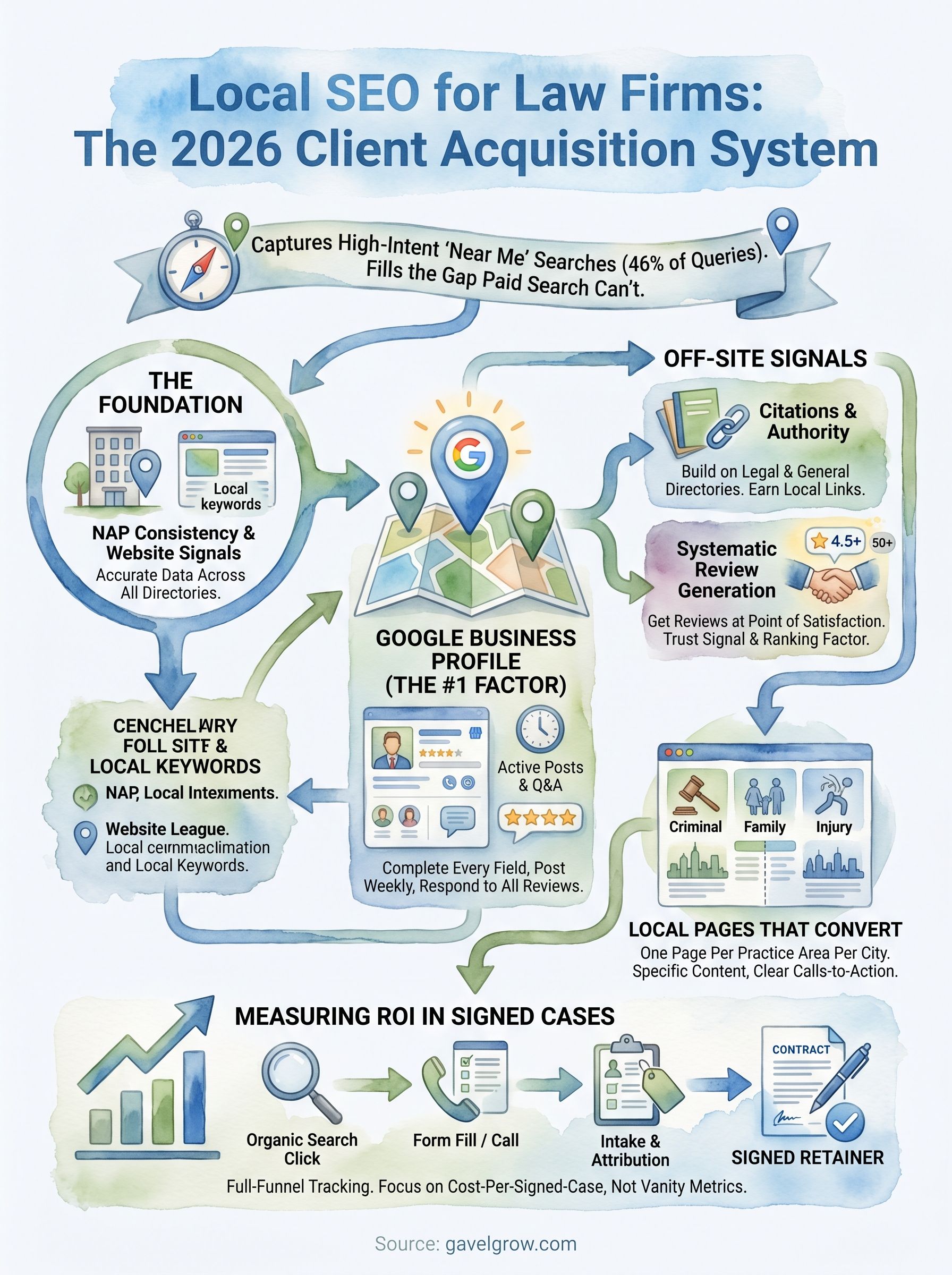
Track the Full Funnel from Search to Signed Retainer
Start by tagging every intake form submission and phone call that originates from organic local search. Google Analytics 4 lets you set up a generate_lead conversion event that fires on form completion, and you can filter that event by traffic source to isolate organic search leads. Pair that with call tracking numbers assigned specifically to your local pages, so every inbound call from organic traffic gets logged, recorded, and attributed to the correct source before it ever reaches your intake team.
The firms that measure cost-per-signed-case from organic local search consistently make smarter budget decisions than firms that track rankings alone.
Once you capture both form leads and calls, your pipeline data needs to carry source attribution through to the signed retainer stage. That means your intake team logs the lead source when they create a case file, not just when the lead first arrives. Without that handoff, you lose attribution the moment a lead enters your CRM, and your local SEO ROI calculation becomes a guess.
Which Metrics Actually Tell You What's Working
Skip vanity metrics and focus on three numbers: cost-per-lead from organic local search, lead-to-signed-case conversion rate by source, and total signed cases attributed to local SEO per month. Your cost-per-lead from organic local search should fall as your rankings stabilize, because you are not paying per click. Your conversion rate tells you whether your local pages and intake process are qualifying the right traffic, not just generating volume. If your lead count rises but your signed-case count stays flat, the attribution data will point exactly to where the breakdown occurs, whether in intake speed, page quality, or lead qualification.
Next Steps
Now you know what is local SEO and exactly how it creates a durable client acquisition system for your firm. The framework is clear: NAP consistency, a fully optimized Google Business Profile, systematic review generation, targeted local pages, and full-funnel attribution from search click to signed retainer. Every piece connects, and every piece compounds over time.
Your next move depends on where your firm stands today. If you haven't audited your current local presence, start with GavelGrow's free law firm marketing scorecard to identify the gaps costing you cases right now. If you already have the foundation in place and want a team that handles Google Ads, local SEO, and intake optimization under one roof, a 45-minute strategy call with GavelGrow gives you a concrete growth plan built around your market. Book your free strategy session and put your local SEO investment to work in signed cases, not just rankings.
Frequently Asked Questions
What is local SEO for a law firm?
Local SEO is the process of optimizing your firm's online presence so it appears in geographically relevant search results, including the Map Pack, local organic listings, and "near me" queries where prospective clients are actively looking for legal help in your area. It is a system rather than a single tactic, combining Google Business Profile optimization, localized content, citation management, review generation, and on-page signals working together.
How does Google rank local results for attorneys?
Google's local ranking algorithm for the Map Pack uses three primary factors: proximity, relevance, and prominence. Proximity is how close your office is to the searcher, relevance is how well your profile and website match the query, and prominence is how well-known your firm is based on reviews, citations, and links across the web. Prominence is where most of the ongoing work lives and compounds over time.
Why is the Google Business Profile so important for local SEO?
The Google Business Profile is the single highest-leverage asset in local search because Google pulls Map Pack listings almost entirely from GBP data, not your website. It determines whether your firm appears in the three-firm Map Pack that dominates the top of local results. Firms that complete every field, choose the most specific primary category, and post consistently outperform those that treat it as a one-time setup.
Do online reviews affect local search rankings for lawyers?
Yes. Google's local ranking algorithm factors in review count, recency, and average rating as direct signals, and Google also tracks your owner response rate as an engagement signal. Reviews do two jobs at once: they influence whether you rank and whether a searcher contacts you after finding you. A systematic, repeatable review-generation process is one of the highest-ROI local SEO activities a firm can invest in.
How do you measure local SEO ROI for a law firm?
Measure results in signed retainers attributed back to organic local search, not impressions or keyword positions. Tag every form submission and phone call from organic search, use call tracking numbers on your local pages, and carry that source attribution through to the signed-case stage in your CRM. The metrics that matter are cost-per-lead from organic local search, lead-to-signed-case conversion rate by source, and signed cases attributed to local SEO.
Directory and review profiles feed directly into local rankings, so it's worth understanding how Avvo reviews influence how prospects and search engines evaluate an attorney before you invest in any other local signal.
Local search behaves differently for urgent, high-stakes practice areas, a dynamic we unpack in our full criminal defense attorney marketing guide.
Local search is one of the strongest sources of new inquiries, but it helps to first ground yourself in what lead generation is and how it fits the wider funnel.
Frequently Asked Questions
What is local SEO for a law firm?
Local SEO is the process of optimizing your firm's online presence so it appears in geographically relevant search results, including the Map Pack, local organic listings, and "near me" queries where prospective clients are actively looking for legal help in your area. It is a system rather than a single tactic, combining Google Business Profile optimization, localized content, citation management, review generation, and on-page signals working together.
How does Google rank local results for attorneys?
Google's local ranking algorithm for the Map Pack uses three primary factors: proximity, relevance, and prominence. Proximity is how close your office is to the searcher, relevance is how well your profile and website match the query, and prominence is how well-known your firm is based on reviews, citations, and links across the web. Prominence is where most of the ongoing work lives and compounds over time.
Why is the Google Business Profile so important for local SEO?
The Google Business Profile is the single highest-leverage asset in local search because Google pulls Map Pack listings almost entirely from GBP data, not your website. It determines whether your firm appears in the three-firm Map Pack that dominates the top of local results. Firms that complete every field, choose the most specific primary category, and post consistently outperform those that treat it as a one-time setup.
Do online reviews affect local search rankings for lawyers?
Yes. Google's local ranking algorithm factors in review count, recency, and average rating as direct signals, and Google also tracks your owner response rate as an engagement signal. Reviews do two jobs at once: they influence whether you rank and whether a searcher contacts you after finding you. A systematic, repeatable review-generation process is one of the highest-ROI local SEO activities a firm can invest in.
How do you measure local SEO ROI for a law firm?
Measure results in signed retainers attributed back to organic local search, not impressions or keyword positions. Tag every form submission and phone call from organic search, use call tracking numbers on your local pages, and carry that source attribution through to the signed-case stage in your CRM. The metrics that matter are cost-per-lead from organic local search, lead-to-signed-case conversion rate by source, and signed cases attributed to local SEO. Directory and review profiles feed directly into local rankings, so it's worth understanding how Avvo reviews influence how prospects and search engines evaluate an attorney before you invest in any other local signal. Local search behaves differently for urgent, high-stakes practice areas, a dynamic we unpack in our full criminal defense attorney marketing guide . Local search is one of the strongest sources of new inquiries, but it helps to first ground yourself in what lead generation is and how it fits the wider funnel.