12 Best Link Building Packages: Pricing, Pros & Cons
Categories: Legal Marketing Strategies
 Abram Ninoyan
Founder & Senior Performance Marketer
Credentials: Google Partner, Google Ads Search Certified, Google Ads Display Certified, Google Ads Measurement Certified, Google Analytics (IQ) Certified, HubSpot Inbound Certified, HubSpot Social Media Marketing Certified, Conversion Optimization Certified
Expertise: Google Ads, Meta Ads, Conversion Rate Optimization, GA4 & Google Tag Manager, Lead Generation, Marketing Funnel Optimization, PPC Management
LinkedIn Profile
Most link building packages range from $500 to $10,000+ per month, and the gap between what you pay and what you actually get varies wildly across providers. For law firms specifically, backlinks carr...
Key Takeaways
- 12 Best Link Building Packages: Pricing, Pros & Cons (2026)
- 1. GavelGrow
- 2. Page One Power
- 3. Loganix
12 Best Link Building Packages: Pricing, Pros & Cons (2026)
Most link building packages range from $500 to $10,000+ per month, and the gap between what you pay and what you actually get varies wildly across providers.
For law firms specifically, backlinks carry extra weight. Google treats legal content as YMYL ("Your Money or Your Life"), which means E-E-A-T signals like authoritative backlinks directly influence whether your practice pages rank or sit buried on page three. A generic package stuffed with directory links won't move the needle the way a handful of relevant, high-DA placements from legal publications will.
At GavelGrow, we have served 500+ law firms since 2015, and link acquisition is one of the most common line items we evaluate, both when building strategies in-house and when vetting third-party providers on behalf of clients. That hands-on experience means we know which services deliver links that actually improve rankings and which ones sell inflated metrics wrapped in a polished sales deck.
This guide breaks down 12 link building packages available in 2026, covering pricing tiers, what's included, pros and cons, and the types of sites you can expect links from. Whether you're a solo practitioner spending $500/month on SEO or a managing partner overseeing a six-figure marketing budget, you'll walk away knowing exactly what to look for, and what to avoid, before signing a contract.
1. GavelGrow
GavelGrow is a legal-exclusive marketing platform that builds link acquisition into its managed SEO campaigns for U.S. law firms. Unlike general-purpose link building packages sold as standalone products, the approach here treats backlinks as one component of a broader full-funnel legal marketing strategy, which means every placement is evaluated against your specific practice area, jurisdiction, and competitive landscape.
Package types and deliverables
Link building at GavelGrow falls under its managed services tier, which covers Google Ads, SEO, conversion optimization, and reputation management as a combined engagement. Within the SEO scope, the team handles outreach, placement negotiation, and content production for guest posts and editorial inclusions on legal-relevant and high-authority domains.
Deliverables typically include a monthly link report with DR/DA metrics for each acquired placement, anchor text documentation, and live URLs. You also receive attribution data showing how organic traffic and rankings shift after each campaign cycle, pulling from the GavelGrow platform's built-in analytics.
Best fit
This service fits mid-market to large law firms that want to outsource their entire SEO and marketing operation rather than manage individual vendors. If you run a solo practice and need a $500/month standalone link package, this is not the right match. For a personal injury, mass tort, or family law firm that wants SEO and paid media handled without juggling separate agencies, GavelGrow consolidates everything under one roof.
Pricing and minimums
Managed services are scoped on a strategy call, with link building bundled into the SEO deliverables rather than priced as a line item. No standalone link building packages are sold separately. Before committing, you can book a free 45-minute strategy consultation to scope what a full campaign would look like for your firm.
Pros and cons
Pros: Legal-exclusive focus means every link gets evaluated against state bar advertising considerations, and full-funnel attribution runs from backlink through to signed retainer. GavelGrow also offers market exclusivity on managed engagements: GavelGrow does not run marketing for two direct competitors in the same market.
GavelGrow never works with two competing firms in the same market, keeping your link and content strategy entirely your own.
Cons: The managed-services minimum puts this out of reach for smaller firms; link building is bundled rather than itemized, so you cannot purchase it as a standalone deliverable.
Notes on link quality and risk
Every placement focuses on editorial inclusions in legal publications, regional news outlets, and authoritative industry sites rather than private blog networks or bulk directory submissions. Each site gets manually reviewed before a link goes live, and the team avoids domains with thin content, high ad density, or irregular link velocity, which are all signals that raise Google penalty risk for your domain.
2. Page One Power
Page One Power is a Boise-based agency founded in 2010 that focuses exclusively on manual, relationship-driven outreach. They do not run a full-service SEO operation, which means their entire team concentrates on link acquisition rather than splitting attention across paid ads, technical audits, or content strategy.
Package types and deliverables
Their link building packages center on three core tactics: guest posting on real editorial sites, resource page outreach, and broken link building. Each engagement starts with a discovery call and site review to match tactics to your domain's current authority and goals. Monthly reporting covers live placement URLs, DR scores, and anchor text documentation so you can track each link as it goes live.
Best fit
This service fits established brands in competitive niches that need a steady flow of editorial placements and already have technical SEO handled elsewhere. Law firms can work with them, but there is no legal-specific vertical filtering or state bar compliance review baked into the process.
Pricing and minimums
Page One Power does not list pricing publicly. Based on industry research and agency review data available through 2025, retainers typically start between $1,500 and $2,000 per month, scaling upward based on link volume and domain targets. You will need to contact them directly for a formal quote.
Most engagements require a minimum 3-month commitment, which is consistent with industry norms for manual outreach campaigns at this tier.
Pros and cons
Pros: 15+ years of operating history; fully manual outreach with no private blog networks; transparent post-placement reporting with live URLs.
Cons: No practice-area expertise in legal verticals; pricing requires a sales call to uncover; turnaround times often run 60 to 90 days before links appear.
Notes on link quality and risk
Their placements target real editorial domains with organic traffic, not link farms or thin-content sites built purely to sell backlinks. That approach lowers your algorithmic risk, though without legal-specific prospecting, some placements may land on broadly relevant domains rather than publications that directly reinforce legal E-E-A-T signals.
3. Loganix
Loganix is a Vancouver-based agency that runs a self-serve marketplace model for link building, making it one of the more accessible options when you want to order placements without going through a lengthy sales process. Their catalog spans guest posts, niche edits, and local citation building, and the interface lets you filter by domain authority, niche relevance, and price point before placing an order.
Package types and deliverables
Loganix structures its link building packages around individual placements you can bundle into monthly campaigns or purchase as one-off orders. Guest post packages come with content written by their team and placed on sites within their vetted publisher network. Niche edits insert your link into existing indexed content on relevant domains, which can produce faster indexing since the page already carries link equity.
Best fit
Loganix works well for agencies reselling SEO services and for in-house marketers at small to mid-size firms who want a predictable, itemized order process. If you run a law firm and want to supplement an existing SEO strategy with a handful of targeted placements each month, the self-serve model gives you direct control over which domains you target.
Pricing and minimums
Guest posts through Loganix start around $150 to $250 per placement at the entry tier, with higher-authority placements reaching $500 or more. There is no formal monthly minimum, so you can start with a small test order before scaling.
The no-minimum structure makes Loganix one of the lower-risk entry points for testing link quality before committing to a larger campaign budget.
Pros and cons
Pros: Transparent marketplace pricing with no sales call required; white-label reporting available for agencies; niche edit options provide faster turnaround than pure guest post outreach.
Cons: No legal-vertical specialization; quality consistency varies across publishers in the network, so you need to review each domain manually before ordering.
Notes on link quality and risk
Loganix vets publishers before adding them to the network, but the breadth of the catalog means not every site carries the topical authority that legal domains need for strong E-E-A-T signals. Review each prospective placement's traffic history and content quality before approving an order to avoid landing on sites with inflated DR scores and minimal organic reach.
4. LinkBuilder.io
LinkBuilder.io is a specialist outreach agency that focuses entirely on manual link building through personalized email outreach to real editorial websites. Rather than maintaining a fixed publisher network, their team builds fresh relationships with site owners on a per-campaign basis, which means each placement comes from live negotiation rather than a pre-approved roster.
Package types and deliverables
Their link building packages center on guest posting and niche edits secured through direct outreach. You receive a dedicated campaign manager who handles prospecting, vetting, outreach, and content creation. Monthly reports include live placement URLs, domain authority metrics, and anchor text logs so you can verify each link before it appears in your tracking tools.
Best fit
LinkBuilder.io suits SaaS companies, e-commerce brands, and marketing agencies that need reliable monthly link volume without building an in-house outreach team. Legal firms can engage them, but you should expect general-interest placements rather than law-specific editorial coverage.
If your SEO strategy relies on reinforcing legal E-E-A-T signals through authoritative legal publications, a generalist outreach agency will likely fall short of that bar.
Pricing and minimums
Published pricing starts at approximately $2,000 per month for a managed retainer, though exact figures depend on link volume targets and domain authority thresholds. Most engagements require a minimum three-month commitment to allow time for outreach pipelines to produce consistent placements.
Pros and cons
Pros: Fully manual outreach with no private blog networks; dedicated account management reduces the coordination burden on your team.
Cons: No legal vertical expertise; pricing sits mid-to-high relative to self-serve alternatives like Loganix.
Notes on link quality and risk
Their team manually reviews each target domain before outreach, prioritizing sites with real organic traffic and genuine editorial standards. That approach keeps penalty risk low, but without legal-specific prospecting filters, placements may land on broadly relevant sites that carry little topical weight for practice-area ranking pages.
5. Editorial.Link
Editorial.Link is a premium link building agency based in Europe that focuses on securing placements in genuine editorial publications with strong organic traffic and real readership. Their positioning sits at the higher-quality end of the market, prioritizing a smaller number of authoritative placements over high-volume, low-quality output.
Package types and deliverables
Editorial.Link builds its link building packages around outreach to established media outlets, industry blogs, and niche publications that maintain real editorial standards. Each campaign includes prospect research, personalized outreach, and content creation to meet the target site's guidelines. You receive a monthly report with live placement URLs, domain rating scores, and organic traffic estimates for each acquired link.
Best fit
This service suits B2B brands, SaaS companies, and marketing agencies that want editorial placements with genuine traffic rather than inflated DR numbers. Law firms can engage them, but there is no legal-specific vertical expertise built into their prospecting or outreach workflows.
Without practice-area filtering, placements may carry solid authority metrics but miss the topical relevance that legal YMYL pages need to strengthen E-E-A-T signals.
Pricing and minimums
Editorial.Link prices placements per link rather than as a flat monthly retainer. Individual placements typically range from $250 to $700 depending on the domain's authority and traffic profile. Most clients order in batches of five to ten links per month to maintain consistent velocity.
Pros and cons
Pros: Strong focus on real editorial standards with verified organic traffic on every placement; transparent per-link pricing with no locked-in retainer required.
Cons: No legal vertical specialization; per-link costs scale quickly once you factor in the volume most competitive practice areas require.
Notes on link quality and risk
Their vetting process filters out sites with thin content, suspicious link velocity, and no discernible organic audience, which keeps your domain's risk profile low. Each placed link comes from a site with a real editorial team making publishing decisions, reducing the chance that a future Google algorithm update flags the placement as manipulative.
6. Siege Media
Siege Media is a San Diego-based content marketing agency that builds links primarily through the creation of high-value content assets designed to earn editorial placements organically. Their model differs from traditional outreach shops because the content itself is the link acquisition vehicle, meaning they invest heavily in research, design, and writing before a single outreach email gets sent.
Package types and deliverables
Siege Media's link building packages center on producing linkable assets such as original research, visual guides, and data-driven content that naturally attracts citations from editorial publishers. Their team handles ideation, content production, outreach, and placement reporting within a single retainer. Each month you receive a report covering live placement URLs, referring domain authority, and estimated organic traffic for each piece earning links.
Best fit
This service fits content-driven brands in highly competitive verticals where a strong content library gives your domain sustained link equity beyond any single campaign. Legal firms can work with Siege Media, but there is no legal vertical specialization, and their content process requires significant lead time before placements accumulate.
If you need links within 30 days, Siege Media's content-first approach will feel slow compared to direct outreach agencies.
Pricing and minimums
Retainers at Siege Media typically start between $5,000 and $20,000 per month, reflecting the combined cost of content production and outreach. There is no standalone link-only option; you are paying for both the asset creation and the distribution effort as a bundled deliverable.
Pros and cons
Pros: High-quality content assets that attract links long after the initial campaign ends; editorial placements from real publishing relationships rather than paid insertions.
Cons: High price floor eliminates smaller firms; content-first timelines mean slower link velocity in the early months of a campaign.
Notes on link quality and risk
Siege Media targets legitimate editorial publishers with real audiences, avoiding any private blog networks or paid placement schemes. That approach keeps your domain's risk profile clean, but you need patience because their model prioritizes long-term link equity over quick wins.
7. FATJOE
FATJOE is a UK-based link building marketplace that has operated since 2012 and built its reputation on high-volume, self-serve ordering with fast turnaround times. Their platform lets you browse available link building packages by niche, domain authority tier, and price without speaking to a sales rep first.
Package types and deliverables
FATJOE offers blogger outreach placements as their core product, where their team writes the content and secures the placement on a site within their publisher network. Orders come with a live URL, domain authority score, and a PDF placement report once the link goes live. They also offer niche edits that insert your link into existing indexed content on relevant domains.
Best fit
This service suits agencies and in-house SEOs who need to place link orders quickly and in volume without managing outreach themselves. Law firms can order through FATJOE, but there is no legal-specific filtering in the publisher selection process, so placements land on broadly relevant sites rather than authoritative legal publications.
If topical authority for practice-area pages is your primary goal, a generalist marketplace will consistently underdeliver against that standard.
Pricing and minimums
FATJOE publishes pricing openly on their website. Blogger outreach packages start around $65 to $80 per link at the entry tier, with higher-authority placements running $200 or more. There is no monthly minimum, so you can place a single test order before scaling.
Pros and cons
Pros: Transparent self-serve pricing with no sales call required; fast order turnaround compared to manual outreach agencies.
Cons: No legal vertical expertise; publisher network quality varies, requiring manual domain review before approving each placement.
Notes on link quality and risk
FATJOE screens publishers before adding them to the network, but the sheer volume of sites in their catalog means inconsistency exists across tiers. Always verify organic traffic and content quality for each target domain before placing an order to minimize any Google penalty risk to your site.
8. Authority Builders
Authority Builders is a self-serve link building marketplace that lets you browse a vetted publisher network by niche, domain rating, organic traffic, and price before placing a single order. The platform gives buyers full visibility into each placement upfront, which separates it from agencies that reveal target domains only after you sign a contract.
Package types and deliverables
Authority Builders structures its link building packages around two core products: guest posts and niche edits. Guest post orders include content creation and placement on a publisher within their network, while niche edits insert your link into existing indexed content on relevant domains for faster indexing. Each order delivers a live URL and a placement confirmation report once the link goes live.
Best fit
This service suits agencies and independent SEOs who want to cherry-pick placements based on transparent metrics rather than commit to a managed retainer. Law firms can order through the platform, but there is no legal-specific vertical filtering, so placements tend to land on broadly relevant sites rather than authoritative legal publications.
Without practice-area prospecting filters, generalist placements often carry strong authority metrics but weak topical relevance for YMYL legal pages.
Pricing and minimums
Authority Builders publishes pricing openly on their platform. Guest posts start around $150 per placement at the entry tier, with premium placements on higher-traffic domains reaching $400 or more. There is no monthly minimum, so you can test a single order before scaling up.
Pros and cons
Pros: Fully transparent domain metrics before purchase; no sales call required to browse or order.
Cons: No legal vertical expertise; quality varies across DR tiers, requiring manual domain vetting before committing to each placement.
Notes on link quality and risk
Authority Builders screens each publisher before adding them to the network, checking for real organic traffic and genuine editorial content rather than inflated domain ratings. Even with that screening, the broad catalog means you should manually review each target domain's content and link velocity before ordering to protect your site from algorithmic penalty risk.
9. WhitePress
WhitePress is a European content marketing and link building marketplace founded in Poland in 2013 that connects advertisers with publishers across more than 40 countries. Their platform gives you direct access to a self-serve ordering interface where you can browse thousands of publisher sites by language, niche, domain authority, and price before placing a single order.
Package types and deliverables
WhitePress structures its link building packages around sponsored content placements where their team or your team writes an article and the publisher posts it to their site with your link included. You can also order native advertising placements on news portals and industry blogs within their network. Every completed order delivers a live URL, placement confirmation, and basic domain metrics.
Best fit
This service suits international brands and European-focused campaigns that need placements across multiple language markets from one platform. For U.S. law firms targeting domestic rankings, the publisher network skews heavily toward European domains, which limits topical relevance for American practice-area pages.
If your firm targets U.S. local search rankings, a marketplace built around European publishers will deliver limited ranking lift for the pages that matter most.
Pricing and minimums
WhitePress publishes pricing through its self-serve dashboard once you create an account. Individual placements start around $50 to $100 on lower-authority domains, with premium placements on high-traffic portals reaching several hundred dollars. There is no mandatory monthly minimum.
Pros and cons
Pros: Large publisher catalog spanning multiple countries; transparent per-placement pricing with no sales call required.
Cons: Limited U.S. publisher inventory; no legal vertical specialization anywhere in the platform's prospecting tools.
Notes on link quality and risk
WhitePress does not systematically filter out sponsored content labels or low-traffic publishers, so you need to manually vet each domain for genuine organic reach and content quality before finalizing an order to reduce algorithmic risk to your site.
10. Featured
Featured is a content-driven link building platform that connects subject-matter experts with journalists and publishers actively looking for quotes, insights, and data to include in their articles. Rather than cold outreach or a fixed publisher network, the model works by letting you respond to editorial requests from writers at real publications, earning backlinks when your contribution gets cited.
Package types and deliverables
Featured structures its link building packages around subscription plans that give you access to a queue of journalist requests filtered by topic and industry. You submit expert responses directly through the platform, and when a journalist accepts your contribution, the resulting article typically includes a link back to your website. There is no content creation service or outreach team handling placements on your behalf.
Best fit
This service suits individual practitioners and thought leaders who want to build authority links through expert commentary rather than paid placements. Law firm attorneys can participate by responding to legal questions, though coverage is inconsistent since publication depends entirely on whether a journalist selects your response.
Without guaranteed placement volume, Featured works better as a supplemental link source than a primary campaign driver.
Pricing and minimums
Featured offers subscription plans starting around $99 per month, with higher tiers unlocking priority request access and more monthly submissions. There is no per-link fee since placements depend on editorial selection rather than a guaranteed delivery model.
Pros and cons
Pros: Links come from genuine editorial decisions at real publications; no private blog networks or paid insertions involved.
Cons: No guaranteed placement volume per month; response-to-placement conversion rates vary significantly depending on niche and how competitive the journalist request is.
Notes on link quality and risk
Since every link originates from an editorial selection rather than a paid arrangement, the algorithmic risk to your domain is minimal. The tradeoff is unpredictability: some months you earn several strong placements, and other months zero responses get selected, which makes it difficult to plan around as a core link building strategy.
11. RhinoRank
RhinoRank is a UK-based link building agency that focuses on curated link placements through niche edits and guest posts on sites within their publisher network. Their positioning targets agencies and in-house SEOs who want reliable monthly link volume without running outreach themselves.
Package types and deliverables
RhinoRank offers two core link building packages: curated links (niche edits inserted into existing content) and guest posts written and placed by their team. Each order includes a live URL, domain metrics, and a confirmation report once the link goes live on the target site.
Best fit
This service suits marketing agencies and small-to-mid-size brands that need straightforward monthly link volume without building an internal outreach operation. Law firms can order through RhinoRank, but there is no legal vertical filtering, so placements land on broadly relevant domains rather than authoritative legal publications.
Without practice-area prospecting filters, generalist placements routinely miss the topical authority that legal YMYL pages require to strengthen E-E-A-T signals.
Pricing and minimums
RhinoRank publishes pricing on their website. Curated link packages start around $50 to $100 per placement, with guest posts ranging from $150 to $300 depending on domain authority tier. No mandatory monthly minimum exists, so you can place a small test order before scaling.
Pros and cons
Pros: Transparent published pricing with no sales call required; curated link turnaround times run faster than full guest post outreach campaigns.
Cons: No legal vertical expertise; publisher network breadth introduces quality inconsistency across lower-priced tiers.
Notes on link quality and risk
RhinoRank screens publishers before adding them to their network, checking for real organic traffic and genuine editorial content. Even with that screening, you should manually verify each target domain's traffic history and content quality before confirming an order to protect your site from algorithmic risk.
12. Searcharoo
Searcharoo is a UK-based link building agency that offers managed outreach campaigns and self-serve link packages targeting agencies, e-commerce brands, and in-house SEO teams. Their catalog covers guest posts and niche edits, with a tiered pricing structure designed to fit budgets across different domain authority targets.
Package types and deliverables
Searcharoo builds its link building packages around two core products: guest post placements written and placed by their team, and niche edits that insert your link into existing indexed content on relevant domains. Each completed order includes a live placement URL, domain authority score, and a basic confirmation report so you can verify the link before adding it to your tracking tools.
Best fit
Searcharoo suits marketing agencies and small-to-mid-size brands that want consistent monthly link volume without running outreach in-house. Law firms can order through their platform, but there is no legal vertical filtering in their prospecting process, so placements typically land on broadly relevant sites rather than authoritative legal publications.
Without practice-area prospecting built in, placements often carry acceptable authority metrics but miss the topical relevance that YMYL legal pages need to build strong E-E-A-T signals.
Pricing and minimums
Searcharoo publishes pricing openly on their website. Guest post placements start around $100 to $150 per link at the entry tier, with higher-authority placements reaching $300 or more. No mandatory monthly minimum exists, so you can test a single order before committing to volume.
Pros and cons
Pros: Transparent published pricing with no required sales call; turnaround times run fast relative to fully manual outreach agencies.
Cons: No legal vertical expertise; quality varies across publisher tiers, requiring manual domain review before confirming each order.
Notes on link quality and risk
Searcharoo reviews publishers before adding them to their network, checking for real organic traffic and genuine editorial content rather than inflated domain ratings. Even with that screening process in place, you should manually verify each target domain's content quality and link velocity history before finalizing an order to protect your domain from algorithmic penalty exposure.
Next steps for choosing a package
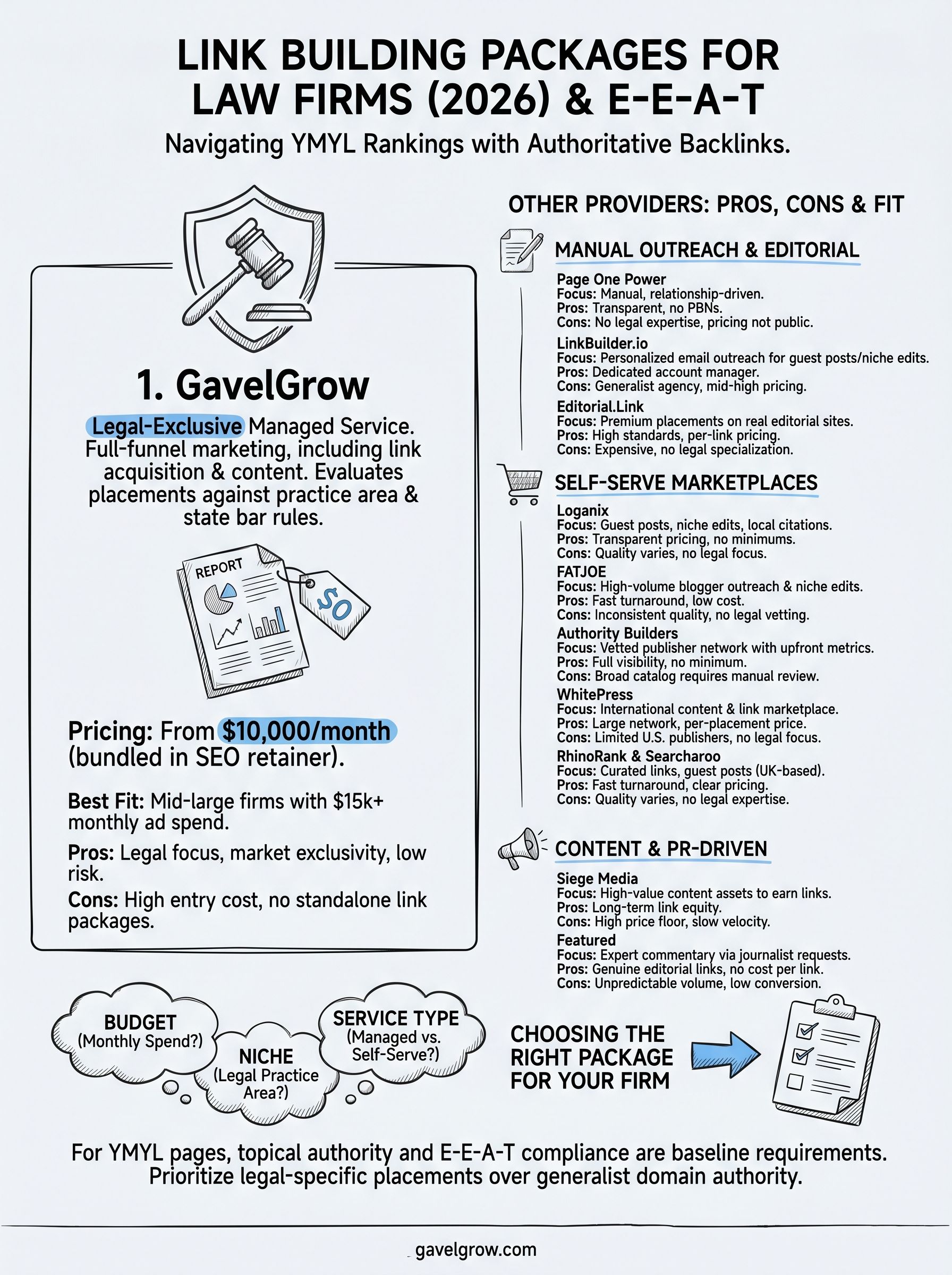
Picking the right link building package comes down to three things: your budget, your niche, and whether you want managed work or self-serve ordering. If you run a law firm, that third factor matters more than most buyers realize because topical authority and E-E-A-T compliance are not optional extras for YMYL pages - they are the baseline.
Use this article as a shortlist filter, not a final decision. Review each provider's publisher network against your practice area and target geography before committing to any retainer or per-link order. Generalist packages can build raw domain authority, but they rarely move the needle on competitive practice-area terms the way legal-specific placements do.
If you want a personalized breakdown of which approach fits your firm's current SEO position and marketing budget, book a free 45-minute strategy call with GavelGrow and get a clear picture before spending a dollar.
Frequently Asked Questions
How much do link building packages cost?
Link building packages generally range from a few hundred to several thousand dollars per month, and individual placements are often priced per link based on the domain's authority and traffic. The gap between what you pay and what you actually get varies widely across providers, so review each provider's publisher network against your practice area before committing to any retainer or per-link order.
Why do backlinks matter more for law firm websites?
Google treats legal content as YMYL ("Your Money or Your Life"), which means E-E-A-T signals like authoritative backlinks directly influence whether your practice-area pages rank or sit buried on later pages. A handful of relevant, high-authority placements from legal or news publications tends to move rankings more than a generic package stuffed with directory links.
Should a solo law practice buy a standalone link building package?
It depends on your budget and how you buy. Self-serve marketplaces with no monthly minimum let a solo firm test a single placement before scaling, while fully managed programs typically require a monthly commitment. Whichever route you choose, manually review each target domain's traffic and content quality first, since inflated domain-rating scores don't guarantee real organic reach.
How does GavelGrow handle link building for law firms?
GavelGrow builds link acquisition into its managed SEO campaigns rather than selling it as a standalone product, so every placement is evaluated against your practice area, jurisdiction, and competitive landscape. Managed services are scoped on a strategy call, with link building bundled into the SEO scope. Placements focus on editorial inclusions in legal publications and news outlets, not private blog networks or bulk directories.
What link-building practices raise Google penalty risk?
Domains with thin content, high ad density, and irregular link velocity all raise penalty risk, as do automated outreach schemes and bulk directory submissions. Before any placement goes live, review the target site's organic traffic history and content quality rather than trusting its domain-rating score alone. Legitimate link building takes months but produces results that are far more sustainable.
Frequently Asked Questions
How much do link building packages cost?
Link building packages generally range from a few hundred to several thousand dollars per month, and individual placements are often priced per link based on the domain's authority and traffic. The gap between what you pay and what you actually get varies widely across providers, so review each provider's publisher network against your practice area before committing to any retainer or per-link order.
Why do backlinks matter more for law firm websites?
Google treats legal content as YMYL ("Your Money or Your Life"), which means E-E-A-T signals like authoritative backlinks directly influence whether your practice-area pages rank or sit buried on later pages. A handful of relevant, high-authority placements from legal or news publications tends to move rankings more than a generic package stuffed with directory links.
Should a solo law practice buy a standalone link building package?
It depends on your budget and how you buy. Self-serve marketplaces with no monthly minimum let a solo firm test a single placement before scaling, while fully managed programs typically require a monthly commitment. Whichever route you choose, manually review each target domain's traffic and content quality first, since inflated domain-rating scores don't guarantee real organic reach.
How does GavelGrow handle link building for law firms?
GavelGrow builds link acquisition into its managed SEO campaigns rather than selling it as a standalone product, so every placement is evaluated against your practice area, jurisdiction, and competitive landscape. Managed services are scoped on a strategy call, with link building bundled into the SEO scope. Placements focus on editorial inclusions in legal publications and news outlets, not private blog networks or bulk directories.
What link-building practices raise Google penalty risk?
Domains with thin content, high ad density, and irregular link velocity all raise penalty risk, as do automated outreach schemes and bulk directory submissions. Before any placement goes live, review the target site's organic traffic history and content quality rather than trusting its domain-rating score alone. Legitimate link building takes months but produces results that are far more sustainable.