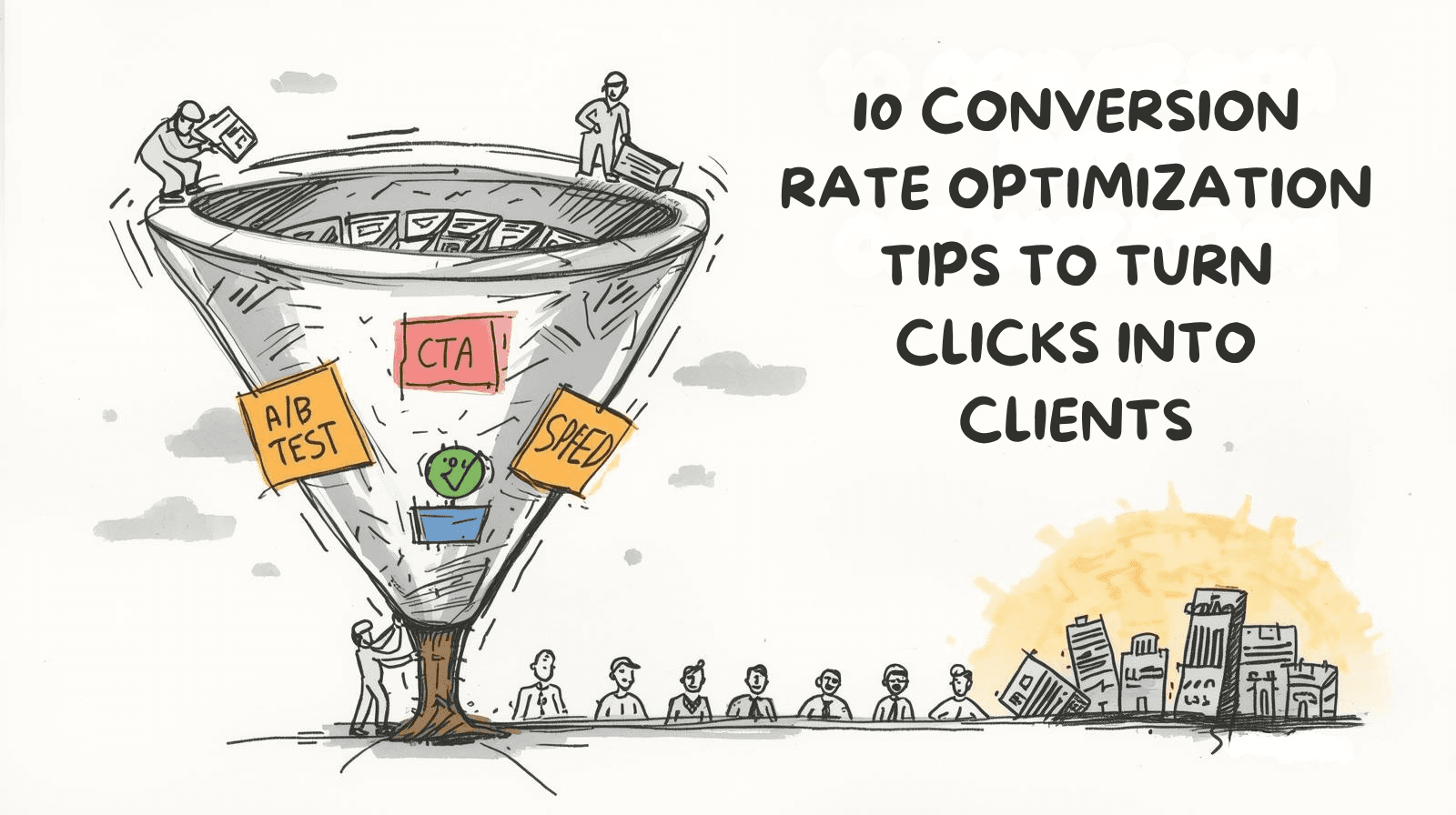
10 Conversion Rate Optimization Tips to Turn Clicks into Clients
Categories: Listicle: Round-up
 Abram Ninoyan
Founder & Senior Performance Marketer
Credentials: Google Partner, Google Ads Search Certified, Google Ads Display Certified, Google Ads Measurement Certified, Google Analytics (IQ) Certified, HubSpot Inbound Certified, HubSpot Social Media Marketing Certified, Conversion Optimization Certified
Expertise: Google Ads, Meta Ads, Conversion Rate Optimization, GA4 & Google Tag Manager, Lead Generation, Marketing Funnel Optimization, PPC Management
LinkedIn Profile
This guide delivers 10 conversion rate optimization tips designed for law firms. Learn how A/B testing, improving page speed, reducing form friction...
Key Takeaways
- 1. A/B Testing (Split Testing)
- 2. Improving Page Load Speed
- 3. Optimizing Call-to-Action (CTA) Buttons
- 4. Streamlining Your Consultation & Intake Process
Your law firm’s website traffic is a valuable, hard-earned asset. Yet, how many of those visitors are turning into actual consultations? Many practices invest heavily in driving traffic through SEO and paid ads but overlook the most critical step: converting that traffic into signed clients. A low conversion rate means your marketing budget is effectively leaking potential revenue with every click. For every 100 visitors, a site converting at 1% generates one lead, while a site converting at 4% generates four. This difference is the key to scalable growth for your practice.
This article provides a comprehensive list of actionable conversion rate optimization tips designed specifically for the legal industry. We move beyond generic advice to deliver practical strategies that help personal injury, corporate law, and estate planning firms systematically increase their case volume. You will find detailed frameworks for testing, optimizing every stage of the client journey from ad click to intake, and leveraging analytics to make data-driven decisions. The goal is to transform your website from a passive digital brochure into an efficient, predictable client acquisition engine.
We will cover everything from quick wins you can implement immediately to long-term strategies that build a sustainable competitive advantage. Whether you’re a solo attorney scaling your practice or a marketing director at a multi-partner firm, these insights will help you plug the leaks in your funnel. Let's begin turning your existing web traffic into measurable, profitable growth.
1. A/B Testing (Split Testing)
A/B testing, also known as split testing, is a systematic and controlled method for optimizing your law firm’s digital assets. It involves creating two versions of a single element, such as a landing page headline or call-to-action button, and showing them to different segments of your audience simultaneously. By measuring which version drives more conversions (e.g., form submissions or phone calls), you can make data-driven decisions that eliminate guesswork and incrementally improve performance.
This process is fundamental to conversion rate optimization because it provides statistically significant proof of what works for your target clients. For instance, an M&A law firm could test a button that says "Schedule a Confidential Consultation" against one that says "Contact Our M&A Team." The version that generates more qualified leads is the clear winner, directly impacting the firm's client acquisition funnel. This data-backed approach is essential for any law firm serious about lead generation for IP lawyers or marketing for criminal defense law firms.
Actionable Implementation Steps
To effectively implement A/B testing, your firm must adopt a structured approach. Random changes without proper measurement yield confusing results.
- Isolate One Variable: Test only one element at a time. If you change both the headline and the button text, you won't know which change caused the increase or decrease in conversions.
- Establish a Baseline: Run your original page (the "control") to understand its current conversion rate before launching a test.
- Ensure Statistical Significance: Use a sample size calculator to determine how much traffic you need to achieve a reliable result. Ending a test too early can lead to false conclusions. Most testing platforms like Optimizely or VWO will calculate this for you.
- Run for a Full Business Cycle: Let tests run for at least one to two weeks to account for daily and weekly fluctuations in user behavior.
By following these conversion rate optimization best practices, your firm can build a reliable system for continuous improvement. Documenting every test result, whether a win or loss, creates a valuable internal knowledge base for future marketing efforts.
2. Improving Page Load Speed
Page load speed is a critical, yet often overlooked, factor in conversion rate optimization for law firms. It directly impacts user experience and bottom-line results, as every moment a potential client waits for a page to load increases the chance they will leave. Data from major tech companies like Google confirms that even a 100-millisecond delay can reduce conversions. For a law firm, a slow website means fewer consultations booked and more advertising dollars wasted.
This performance metric is fundamental because it sets the first impression. A fast, responsive site signals professionalism and efficiency, while a slow one creates frustration and damages credibility before a visitor even reads your content. For example, Pinterest reduced its load times by 40% and saw a corresponding 15% increase in sign-ups. Similarly, a corporate law firm that optimizes its site speed ensures that high-value M&A or securities clients using mobile devices have a seamless experience, preventing them from abandoning the site for a competitor. This is a crucial element of effective SEO for estate planning attorneys and all other practice areas.
Actionable Implementation Steps
To improve your firm's page speed, you must systematically diagnose and address the elements slowing your site down. This technical optimization is a key part of any modern conversion rate optimization tips.
- Diagnose Performance: Use free tools like Google PageSpeed Insights and GTmetrix to analyze your website. These platforms provide a detailed report card and specific recommendations for improvement.
- Optimize Visual Media: Large, uncompressed images are a common cause of slow load times. Use tools like TinyPNG or ImageOptim to reduce file sizes without sacrificing quality. Implement lazy loading so images "below the fold" only load as the user scrolls down.
- Leverage Caching and CDNs: Enable browser caching so repeat visitors' browsers don't have to reload the entire site. Use a Content Delivery Network (CDN) like Cloudflare to store copies of your site on servers worldwide, delivering content faster to users regardless of their location.
- Minimize Code and Requests: Minify your site’s CSS, JavaScript, and HTML files to remove unnecessary characters and reduce file size. Combine files where possible to minimize the number of HTTP requests a browser needs to make to load the page. Speed is also a major factor in bounce rates, and you can learn more about how to reduce bounce rate on gavelgrow.com.
3. Optimizing Call-to-Action (CTA) Buttons
A call-to-action (CTA) is a prompt on your website that tells the user to take some specified action. In a law firm context, these are often buttons designed to guide potential clients toward a conversion goal, such as scheduling a consultation or downloading a resource. Optimizing these CTAs involves a strategic combination of compelling copy, contrasting colors, prominent placement, and psychological triggers to create a clear, friction-free path for users. A well-designed CTA can dramatically impact click-through rates and overall conversion performance.
For instance, a corporate law firm might find that a button with benefit-driven copy like "Protect My Business Now" converts better than a generic "Submit" button. This small change shifts the focus from the user's action to the value they receive, making it a crucial element in your conversion rate optimization tips toolkit. The goal is to make the desired next step both obvious and appealing, directly influencing a visitor's decision to engage with your firm.
Actionable Implementation Steps
Effective CTA optimization requires a data-informed approach rather than relying on design trends. Each element should be tested to see what resonates most with your specific audience of potential clients.
- Use Action-Oriented Language: Replace passive words like "Submit" with strong, benefit-driven verbs. Use phrases like "Get Your Free Case Evaluation," "Download My Estate Planning Guide," or "Schedule a Confidential Call." This clarifies the outcome for the user.
- Make Buttons Visually Distinct: Your CTA button should stand out from other page elements using a contrasting color that draws the eye but still aligns with your firm's branding. It shouldn't blend into the background.
- Prioritize Strategic Placement: Position CTAs where users naturally look and pause, such as after a compelling value proposition, below a service description, or within a testimonial block. Ensure a CTA is visible "above the fold" without requiring scrolling.
- Test and Measure: Isolate one variable at a time when testing your CTAs. Test the button's color, size, text, and placement individually to determine which change drives an uplift in conversions. Documenting these results builds an internal playbook for what works for your firm. You can learn more about how small tweaks can deliver significant results by reading our guide to improving click-through rates.
4. Streamlining Your Consultation & Intake Process
While a traditional e-commerce "checkout" might not seem directly applicable to a law firm, the principles behind it are crucial for converting interested leads into scheduled consultations. Every form field a potential client must fill out is a point of friction, and a complicated intake process is the digital equivalent of a long, slow-moving queue. Streamlining your intake or payment process removes barriers, making it easier for qualified prospects to take the final step and engage your firm.
This concept is one of the most vital conversion rate optimization tips because it directly addresses the final, most critical stage of the conversion funnel. For a law firm, this could be simplifying the "Schedule a Consultation" form or making an online payment portal for retainers as frictionless as possible. For instance, just as Target increased sales by reducing checkout steps, a family law firm can increase qualified consultations by reducing the number of required fields on its intake form from ten down to four essential ones.
Actionable Implementation Steps
To effectively streamline your firm’s conversion points, your goal is to minimize user effort and build trust. Every unnecessary click or confusing step increases the likelihood of abandonment.
- Request Only Essential Information: Does your initial contact form truly need a potential client’s full address? Limit fields to the absolute minimum needed to qualify and contact the lead, such as name, email, phone, and a brief description of their legal matter.
- Enable Smart Form Features: Use tools that auto-populate information where possible. For scheduling, integrate a calendar tool like Calendly that shows your real-time availability, eliminating the back-and-forth emails required to find a meeting time.
- Be Transparent with Next Steps: Clearly state what happens after a form is submitted or a payment is made. For example, "Thank you. Our intake specialist will contact you within two business hours to schedule your confidential consultation."
- Display Trust Signals: Just like e-commerce sites use trust badges, your firm’s forms should be accompanied by security seals (SSL certificates), attorney association logos, client testimonials, or award badges to reassure prospects that their sensitive information is secure.
5. Creating Compelling Landing Pages for Legal Services
A landing page is a standalone web page created specifically for a marketing or advertising campaign. Unlike your homepage, which has multiple goals and navigation options, a landing page is designed with a single, focused objective: to convert visitors into leads. For a law firm, this could mean getting a potential client to download a free guide, sign up for a webinar, or schedule a consultation. By eliminating distractions, a dedicated landing page streamlines the user journey and guides them directly toward your desired action.
This laser-focus is why optimized landing pages are a cornerstone of conversion rate optimization tips. Instead of sending valuable paid traffic from a Google Ad for "M&A advisory services" to a generic corporate law homepage, you send them to a page that speaks directly to that specific need. This alignment between ad copy and page content creates a seamless experience, dramatically increasing the likelihood of a conversion. This strategy is key to effective SEO for personal injury law firms and any practice running paid ad campaigns.
Actionable Implementation Steps
Building a high-converting landing page requires a disciplined, formulaic approach. Every element must serve the primary conversion goal without exception. For a deeper dive into the specifics of creating high-performing pages, learn how to optimize landing pages for conversions.
- Maintain Message Match: Ensure your landing page headline and content directly reflect the ad or link the visitor clicked. If your ad promises a "free probate checklist," the page must prominently feature that offer.
- Remove Distractions: Eliminate the main website navigation menu, footer links, and any other outbound links that could pull a visitor away from the conversion goal. The form or CTA button should be the only clear next step.
- Use a Clear and Compelling CTA: Your call-to-action button should use action-oriented text (e.g., "Get Your Free Case Evaluation") and stand out visually with a contrasting color.
- Incorporate Social Proof: Add client testimonials, case results, or logos of publications where your firm has been featured. This builds trust and credibility, assuring visitors they are making the right choice. A strong client onboarding process often begins with the trust established on the landing page.
6. Leveraging Social Proof and Trust Signals
Leveraging social proof and trust signals is a psychological strategy to build credibility and reduce a potential client's hesitation. It operates on the principle that people are more likely to take an action if they see that others have done so successfully. For a law firm, this means showcasing evidence of your expertise, client satisfaction, and legitimacy to overcome the inherent skepticism visitors have when seeking legal counsel online.
This method is a cornerstone of conversion rate optimization because it directly addresses a user's primary concerns: "Can I trust this firm?" and "Can they solve my specific problem?" A corporate law firm displaying logos of well-known companies it has advised or a personal injury firm featuring a powerful video testimonial from a former client immediately answers these questions, significantly increasing the likelihood that a visitor will initiate contact.
Actionable Implementation Steps
To effectively integrate social proof, your firm must strategically place authentic and relevant signals throughout your digital presence, from your homepage to your landing pages.
- Display Authentic Testimonials: Feature reviews from real clients, including their full name and a professional headshot if possible. Vague, anonymous praise is far less convincing than a specific, attributable quote.
- Showcase Case Results and Awards: Quantify your success with specific outcomes, like "Secured a $2.1M verdict in a commercial dispute" or "Successfully defended 50+ patent infringement cases." Badges from Avvo, Super Lawyers, or Martindale-Hubbell also act as powerful third-party endorsements.
- Use Trust Badges Prominently: Place security seals (like SSL certificates) and professional affiliations (such as Bar Association memberships) near contact forms and in the website footer to reassure visitors that their information is safe and your firm is credible.
- Incorporate Video Content: A video testimonial is one of the most impactful forms of social proof. Hearing a client describe their positive experience in their own words creates a strong emotional connection that text alone cannot replicate.
7. Personalization and Segmentation
Personalization and segmentation move your law firm away from a one-size-fits-all marketing approach toward a more tailored, client-centric strategy. This involves dividing your audience into distinct groups based on shared characteristics (segmentation) and then customizing the user experience for each group (personalization). By delivering content and messaging that directly addresses a potential client’s specific legal needs, location, or past behavior, you increase relevance and significantly boost the likelihood of conversion.
A generic website experience treats a potential M&A client from a Fortune 500 company the same as a local startup founder seeking intellectual property advice. Personalization ensures the former sees case studies about large-scale corporate restructuring, while the latter is shown a guide on patent registration. This targeted approach, a cornerstone of how estate planning firms get clients online, makes potential clients feel understood from their very first interaction with your firm.
Actionable Implementation Steps
To leverage personalization, your firm must collect and act on user data ethically and strategically. This creates a more compelling journey for prospects.
- Start with Basic Segmentation: Begin by creating simple audience segments. Group users by traffic source (e.g., Google Ads, organic search, social media), geographic location, or whether they are a new vs. returning visitor.
- Use Dynamic Content: Implement tools that can change website content based on the user's segment. For instance, a firm with offices in New York and Los Angeles can dynamically display the address and phone number of the nearest office based on the visitor's IP address. This is a powerful tactic for local SEO for family law practices.
- Personalize Calls-to-Action (CTAs): Tailor your CTAs to the visitor’s stage in the client journey. A first-time visitor might see a CTA to "Download Our Free Guide," while a returning visitor who has already engaged with content could be shown a CTA to "Schedule a Consultation."
- Leverage First-Party Data: Collect data through your intake forms and website analytics to build more sophisticated segments. For example, you can tag users who visit pages related to "divorce" and later target them with content about child custody mediation, demonstrating a deep understanding of their potential needs. You can learn more about how personalization fuels effective follow-up in our guide to lead nurturing best practices.
8. Effective Use of Value Propositions and Benefit-Focused Messaging
A strong value proposition is a concise, powerful statement that communicates exactly why a potential client should choose your law firm over all others. It's not just a description of your services; it’s a promise of the outcome or solution you deliver. By shifting from feature-based language (e.g., "We are corporate law attorneys") to benefit-focused messaging (e.g., "We help startups navigate complex regulations to secure funding faster"), you directly address a client's core needs and motivations.
This approach is fundamental to conversion rate optimization because it immediately answers the visitor's crucial question: "What's in it for me?" For instance, a family law firm could state, "Guiding you toward a secure future with compassionate divorce counsel," which resonates far more deeply than "Experienced divorce lawyers." This benefit-centric messaging builds an instant connection, justifying the visitor's decision to fill out a contact form or schedule a consultation. It frames your legal expertise as the solution to their pressing problem.
Actionable Implementation Steps
To craft a value proposition that converts, you must move beyond generic claims and focus on tangible, client-centered outcomes.
- Identify Core Pain Points: Conduct client interviews or surveys to understand the primary challenges and anxieties your target audience faces. What problem are they truly trying to solve by hiring a lawyer?
- Focus Headlines on Outcomes: Your landing page and homepage headlines should immediately communicate a clear benefit. Instead of "Intellectual Property Law," try "Protect Your Innovations and Secure Your Market Advantage."
- Highlight Your Differentiator: What makes your firm unique? Is it a proprietary process, a specific track record, or a unique service model? Weave this into your value proposition to stand out from competitors.
- Test and Refine Your Message: Use A/B testing on your headlines and calls-to-action to see which value propositions generate the most engagement and leads. Data will reveal the messaging that truly resonates with your ideal clients.
9. Reducing Form Field Friction
Your contact form is the final barrier between a potential client and a consultation. Reducing form field friction involves simplifying this crucial step to minimize user effort and prevent abandonment. Every additional field you require a visitor to complete introduces a small amount of resistance, and studies show that even minor changes, like removing a few non-essential fields, can significantly boost submission rates. The goal is to collect only the most critical information needed to qualify and contact the lead.
This method is a core component of conversion rate optimization because it directly addresses user hesitation at the point of conversion. For a family law firm, a long, intimidating intake form asking for sensitive details upfront might deter a visitor. By contrast, a simple form asking only for a name, email, and a brief message feels less invasive and is far more likely to be completed, initiating the client relationship. The rest of the information can be gathered during the initial consultation.
Actionable Implementation Steps
To streamline your firm's contact forms, you must prioritize the user experience and eliminate any unnecessary steps that could cause a potential client to leave.
- Audit and Minimize Fields: Critically evaluate every field on your form. Is the "How did you hear about us?" field truly essential at this stage? Remove anything that isn't absolutely necessary for the initial contact and qualification.
- Use a Single-Column Layout: Multi-column layouts can disrupt the natural top-to-bottom reading flow, making the form feel more complex. A single-column design is mobile-friendly and cognitively easier for users to process.
- Enable Autofill and Smart Defaults: Leverage browser autofill capabilities for common fields like name, email, and phone number. Use clear, descriptive labels positioned above the fields, not as placeholder text that disappears when the user starts typing.
- Provide Real-Time Validation: Use inline validation to instantly tell users if a field is completed correctly (a green checkmark) or incorrectly (a red error message explaining the issue). This prevents the frustration of submitting the form only to find out there was an error.
10. Creating Urgency and Scarcity
Urgency and scarcity are psychological principles that motivate potential clients to act immediately rather than procrastinating. By introducing time-based limitations (urgency) or quantity-based constraints (scarcity), you can leverage loss aversion, the human tendency to strongly prefer avoiding losses over acquiring equivalent gains. For law firms, this translates into prompting a prospect to schedule a consultation now instead of weeks from now, significantly shortening the client acquisition cycle.
This tactic is one of the most effective conversion rate optimization tips because it directly addresses user indecision. For instance, a family law practice could offer a "free 15-minute case evaluation for the first 10 callers this week." This limited availability creates a compelling reason for an individual considering divorce to pick up the phone. Similarly, countdown timers for an early-bird discount on a business formation package can drive immediate sign-ups from entrepreneurs.
Actionable Implementation Steps
To leverage these principles without appearing disingenuous, your firm's approach must be authentic and strategically applied. Fabricated scarcity can quickly damage your brand's credibility.
- Use Authentic Scarcity: Base your claims on genuine limitations. If you offer a limited number of strategy sessions per month, state that clearly: "Only 3 new client spots open for June."
- Display Countdown Timers: For time-sensitive offers, such as a webinar on new tax laws for corporations or a reduced consultation fee, add a visible countdown timer to the landing page. This visually reinforces the deadline.
- Create Exclusive Offers: Use scarcity to reward engagement. Offer a specific benefit, like a detailed contract review checklist, exclusively to your email subscribers for a limited time.
- Leverage Language: Use direct and compelling copy. Phrases like "Offer ends Friday," "Limited slots available," or "Secure your consultation before rates increase" communicate the need for immediate action.
Top 10 CRO Tips Comparison
Item
Implementation Complexity 🔄
Resource Requirements ⚡
Expected Outcomes ⭐📊
Ideal Use Cases 💡
Key Advantages
A/B Testing (Split Testing)
Medium 🔄 — experiment setup, stats knowledge
Moderate ⚡ — traffic, A/B tool, analyst
Reliable measurable uplifts when significant ⭐📊
Validating design/copy changes, feature rollouts
Data-driven decisions; clear attribution
Improving Page Load Speed
Medium–High 🔄 — cross-stack optimizations
High ⚡ — dev effort, CDN, monitoring
Strong SEO & conversion improvements; lower bounce ⭐📊
Mobile-first sites, high-traffic pages, SEO-critical pages
Broad UX gains; long-term performance benefits
Optimizing Call-to-Action (CTA) Buttons
Low 🔄 — simple design/copy changes
Low ⚡ — designer/PM, quick testing
Quick CTR and conversion increases ⭐📊
Any conversion page with clear goal (signup, buy)
Fast wins; low cost; easy to iterate
Streamlining Checkout Process
Medium 🔄 — integration across systems
Medium–High ⚡ — dev, payment integrations, UX
Direct revenue uplift; lower cart abandonment ⭐📊
E‑commerce with high abandonment rates
Increases completed purchases; improves satisfaction
Creating Compelling Landing Pages
Medium 🔄 — copy + design + targeting
Moderate ⚡ — designers, copywriters, landing tools
Higher campaign conversion and better attribution ⭐📊
Paid campaigns, lead-gen, product launches
Focused messaging; easy to test and optimize
Leveraging Social Proof & Trust Signals
Low 🔄 — content collection and placement
Low ⚡ — testimonials, review widgets
Increased trust and conversions when authentic ⭐📊
New visitors, high‑consideration purchases, checkout
Builds credibility; cost-effective
Personalization and Segmentation
High 🔄 — data pipelines and rules/ML
High ⚡ — analytics, personalization platform, engineers
Significant conversion and engagement uplift when accurate ⭐📊
Large user bases, repeat visitors, targeted campaigns
Higher relevancy; increases AOV and retention
Value Propositions & Benefit-Focused Messaging
Low–Medium 🔄 — research + copy iteration
Moderate ⚡ — user research, copywriting, testing
Clearer messaging leads to better engagement and conversions ⭐📊
Homepages, product pages, landing pages
Quickly communicates value; transferable across channels
Reducing Form Field Friction
Low 🔄 — form design and validation
Low ⚡ — dev/UX time
Improved completion rates; immediate measurable lift ⭐📊
Signups, lead forms, checkout inputs
Quick conversion gains; simple to implement
Creating Urgency and Scarcity
Low 🔄 — UI elements and messaging
Low ⚡ — timers, inventory tags, copy
Immediate short‑term lift; risk of lower-quality leads ⭐📊
Flash sales, limited offers, event registrations
Drives immediate action; high impact if genuine
From Clicks to Clients: Implementing Your Conversion Strategy
The journey from a prospective client's initial click to a signed retainer agreement is paved with countless micro-decisions and potential friction points. This comprehensive exploration of conversion rate optimization tips has demonstrated that increasing your law firm's client acquisition is not a matter of chance, but a product of deliberate, data-driven strategy. We've moved beyond generic advice, dissecting the precise mechanisms that transform passive website visitors into active, engaged leads.
From the foundational urgency of improving page load speed to the psychological nuance of crafting compelling call-to-action buttons, each tactic serves a singular purpose: to make the decision to contact your firm as seamless and logical as possible. The strategies detailed here are not isolated tricks; they form an interconnected ecosystem of persuasion and user experience.
Synthesizing Your CRO Master Plan
To truly leverage these insights, your firm must transition from ad-hoc changes to a structured, iterative process. The core takeaway is this: Conversion rate optimization is a continuous feedback loop, not a one-time project.
Here is a summary of the critical pillars we covered:
- Technical Foundations: A fast, responsive website is non-negotiable. Slow load times are the single greatest conversion killer before a user even sees your value proposition.
- Psychological Triggers: Leveraging principles like urgency, scarcity, and social proof (testimonials, case results) speaks directly to a potential client's emotional and logical needs, building the trust necessary for them to take action.
- Friction Reduction: Every unnecessary form field, confusing navigation element, or ambiguous step in your intake process creates an opportunity for a high-value lead to abandon their inquiry. Streamlining forms and clarifying next steps are among the highest-impact conversion rate optimization tips you can implement.
- Data-Driven Decision Making: The power of A/B testing cannot be overstated. It removes guesswork from your marketing strategy, allowing you to validate hypotheses about everything from headline messaging on your landing pages to the color of a "Request a Consultation" button.
Actionable Next Steps for Your Firm
Mastering these concepts transforms your firm's website from a digital brochure into a predictable client generation engine. It provides a competitive advantage in a crowded legal market by ensuring you capitalize on every dollar spent on advertising and every minute invested in SEO. A higher conversion rate means a lower cost-per-acquisition, leading to more profitable growth and a stronger market position.
To begin implementing these changes, start with the lowest-hanging fruit. Optimizing your CTAs and reducing form fields can often be done quickly and yield immediate results. From there, build a simple testing roadmap. Identify the single most important page on your site, perhaps a high-traffic practice area page, and formulate a hypothesis for improvement. Run a controlled A/B test and let the data guide your next move. For a comprehensive guide on implementing a full conversion strategy, consider exploring further insights on maximizing your website's conversion rate with Webflow CRO.
Ultimately, a commitment to conversion optimization is a commitment to understanding and serving your potential clients better. It's about building a digital experience that reflects the professionalism, expertise, and client-centric approach of your practice. By systematically applying these conversion rate optimization tips, you are not just improving a metric; you are building a more efficient, resilient, and successful law firm.
Ready to turn your firm's website into a powerful client acquisition machine but lack the in-house resources? The team at GavelGrow specializes in building and managing conversion-focused digital marketing systems exclusively for law firms like yours. Schedule your complimentary, no-obligation strategy session today to see how our law firm SEO services can implement a professional CRO framework to drive predictable growth for your practice.
Frequently Asked Questions
What is conversion rate optimization for a law firm website?
Conversion rate optimization (CRO) is the systematic process of turning more of your existing website visitors into consultations and signed clients, rather than just driving more traffic. It covers everything from page speed and call-to-action design to form simplification and A/B testing, treating your site as a client acquisition engine instead of a passive digital brochure.
How does A/B testing improve law firm conversions?
A/B testing shows two versions of a single element, like a headline or call-to-action button, to different visitors at the same time and measures which drives more conversions. This replaces guesswork with data. To keep results reliable, isolate one variable at a time, establish a baseline, use a sample-size calculator for statistical significance, and run each test through a full business cycle.
Why does page load speed matter for converting legal clients?
A fast site protects both first impressions and conversions, since every extra second of load time increases the chance a potential client leaves before ever reading your value proposition. Slow pages waste ad spend and can undercut credibility. Common fixes include compressing images, enabling caching and a CDN, minifying code, and using tools like Google PageSpeed Insights to diagnose bottlenecks.
How can a firm reduce intake form abandonment?
Ask only for the essential information needed to qualify and contact the lead, typically name, email, phone, and a brief description of the legal matter. Save deeper questions for the consultation. A single-column layout, autofill support, real-time inline validation, and a clear statement of what happens next all reduce friction and improve completion rates.
What makes a high-converting landing page for legal services?
A focused landing page pursues one objective and removes distractions like site navigation and outbound links. Keep a strong message match between the ad and the page, use a clear action-oriented call to action, and include authentic trust signals. Sending paid traffic to a dedicated, relevant page instead of a generic homepage typically improves conversion.
Frequently Asked Questions
What is conversion rate optimization for a law firm website?
Conversion rate optimization (CRO) is the systematic process of turning more of your existing website visitors into consultations and signed clients, rather than just driving more traffic. It covers everything from page speed and call-to-action design to form simplification and A/B testing, treating your site as a client acquisition engine instead of a passive digital brochure.
How does A/B testing improve law firm conversions?
A/B testing shows two versions of a single element, like a headline or call-to-action button, to different visitors at the same time and measures which drives more conversions. This replaces guesswork with data. To keep results reliable, isolate one variable at a time, establish a baseline, use a sample-size calculator for statistical significance, and run each test through a full business cycle.
Why does page load speed matter for converting legal clients?
A fast site protects both first impressions and conversions, since every extra second of load time increases the chance a potential client leaves before ever reading your value proposition. Slow pages waste ad spend and can undercut credibility. Common fixes include compressing images, enabling caching and a CDN, minifying code, and using tools like Google PageSpeed Insights to diagnose bottlenecks.
How can a firm reduce intake form abandonment?
Ask only for the essential information needed to qualify and contact the lead, typically name, email, phone, and a brief description of the legal matter. Save deeper questions for the consultation. A single-column layout, autofill support, real-time inline validation, and a clear statement of what happens next all reduce friction and improve completion rates.
What makes a high-converting landing page for legal services?
A focused landing page pursues one objective and removes distractions like site navigation and outbound links. Keep a strong message match between the ad and the page, use a clear action-oriented call to action, and include authentic trust signals. Sending paid traffic to a dedicated, relevant page instead of a generic homepage typically improves conversion.