9 Facebook Ads Best Practices for Law Firms
Categories: Listicle: Round-up
 Abram Ninoyan
Founder & Senior Performance Marketer
Credentials: Google Partner, Google Ads Search Certified, Google Ads Display Certified, Google Ads Measurement Certified, Google Analytics (IQ) Certified, HubSpot Inbound Certified, HubSpot Social Media Marketing Certified, Conversion Optimization Certified
Expertise: Google Ads, Meta Ads, Conversion Rate Optimization, GA4 & Google Tag Manager, Lead Generation, Marketing Funnel Optimization, PPC Management
LinkedIn Profile
Effective Facebook advertising for law firms isn’t about boosting posts—it’s about precision, proof, and professionalism.
Key Takeaways
- 1. Master Hyper-Targeting for High-Value Legal Clients
- 2. A/B Testing Ad Creative and Copy Elements
- 3. Implement Facebook Pixel and Conversion Tracking
- 4. Use High-Quality, Mobile-Optimized Visual Content
Running Facebook Ads for a law firm isn't like selling consumer products. The stakes are higher, the client journey is longer, and ethical compliance is non-negotiable. While generic advice circulates online, it often misses the critical nuances of legal marketing: confidentiality, professionalism, and the need to build deep trust before a single click happens. Most "facebook ads best practices" are designed for e-commerce, not for attracting a high-value client facing a complex personal injury case or navigating a multi-million dollar corporate merger.
This guide cuts through that noise. We're breaking down nine battle-tested Facebook Ads best practices specifically tailored for law firms, from personal injury and estate planning to corporate and family law. You will learn precisely how to move beyond basic post boosting and build a predictable client acquisition system that respects your firm's reputation and delivers a measurable return on investment. Whether you're a solo attorney scaling your practice or a marketing director at a multi-partner firm, these actionable strategies will help you attract qualified leads without compromising professional standards. We'll cover everything from advanced audience targeting for legal niches to creating ad creative that converts potential clients.
1. Master Hyper-Targeting for High-Value Legal Clients
For law firms, broad, shotgun-style advertising on Facebook is a guaranteed way to waste your marketing budget. Unlike consumer brands, your ideal client pool is extremely specific and often defined by sensitive life events. Hyper-targeting is one of the most crucial Facebook ads best practices for lawyers because it focuses your ad spend exclusively on users who demonstrate a clear, immediate, or near-future need for your legal services.
This strategy moves beyond basic demographics like age and location. For law firms, it involves layering detailed targeting options to build a highly qualified audience. By combining behaviors, life events, and interests, you can pinpoint users who are actively seeking legal guidance. To do this effectively, you must first have a deep understanding of who your ideal clients are. The initial step is to create buyer personas that map out the specific attributes, challenges, and online behaviors of the people you want to attract for each practice area.
Actionable Targeting Examples for Law Firms:
- Family Law: Target users with a "Relationship Status" of Engaged for prenuptial agreement services. For divorce cases, layer interests like "divorce" or "child custody" with behaviors like visiting related legal websites.
- Estate Planning: Target users aged 55+ who also have interests in "investing," "real estate," and "financial planning." You can further refine this by targeting job titles like "CEO," "Physician," or "Business Owner" to reach high-net-worth individuals for complex trust services. This is a core part of effective marketing for estate planning attorneys.
- Business Law: Target users listed as "Facebook Page Admins" of business or finance pages, or those with job titles like "Founder" or "Managing Director." Combine this with interests related to "venture capital," "startups," or "small business" to drive lead generation for IP lawyers or M&A advisors.
This precision ensures your ads are not just seen, but seen by the right potential clients at the right time, dramatically improving lead quality and maximizing your firm's return on ad spend.
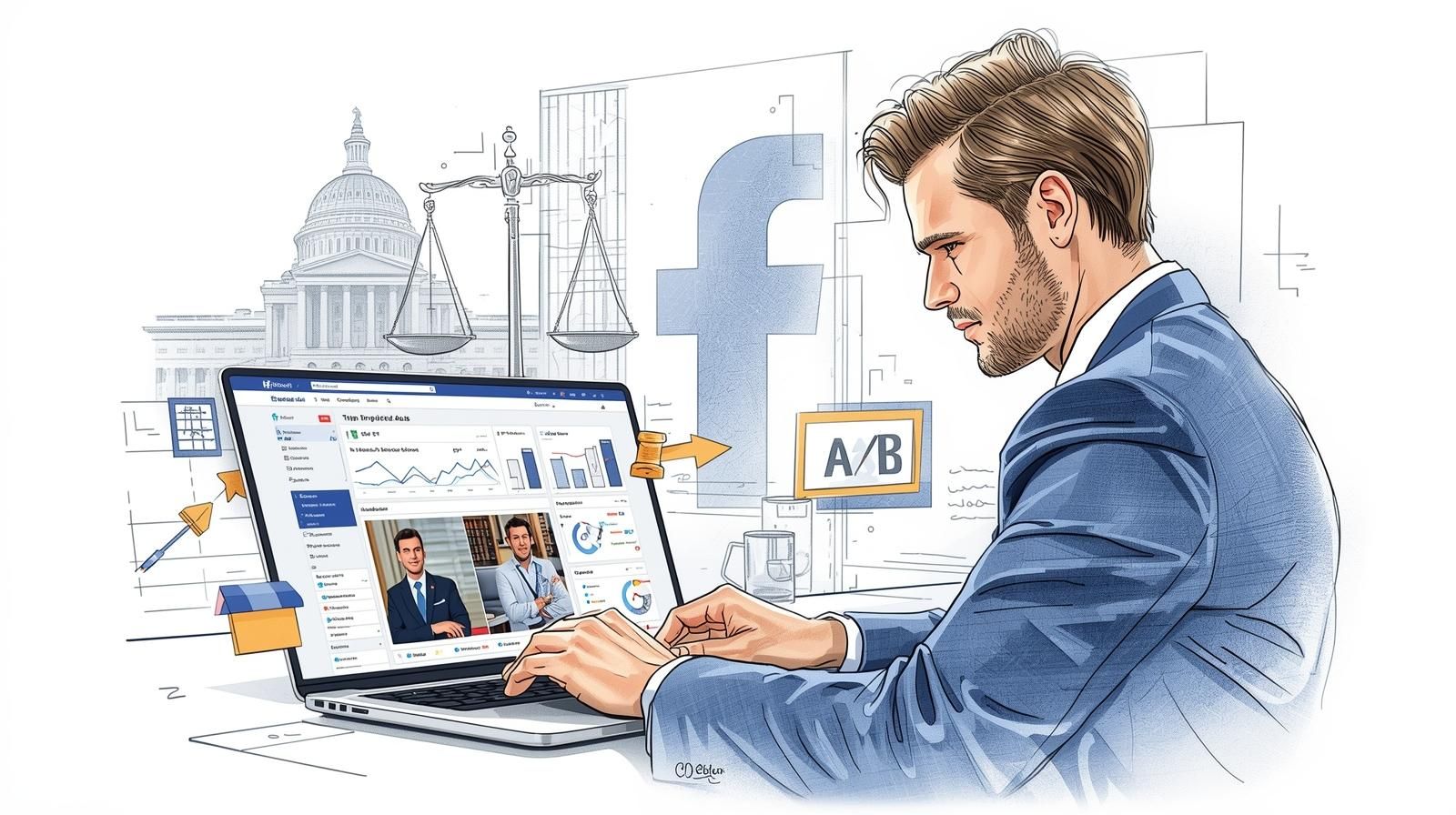
2. A/B Testing Ad Creative and Copy Elements
Guessing which ad creative or headline will resonate with a potential legal client is an inefficient use of your marketing budget. For a law firm, where trust and professionalism are paramount, the wrong message can actively deter qualified leads. A/B testing is one of the most fundamental Facebook ads best practices because it replaces assumptions with data, allowing you to systematically identify the exact images, videos, headlines, and calls-to-action that drive the highest-quality inquiries for your specific practice area.
This method involves creating multiple versions of your ad where only one element is changed. By running these variations simultaneously, you can compare performance metrics like click-through rate (CTR), cost per lead (CPL), and conversion rate to determine a clear winner. For example, a business law firm might discover that a video explaining a complex M&A issue outperforms a static image, or that a headline focused on risk mitigation generates more consultations than one focused on growth opportunities. This data-driven approach is essential for optimizing campaigns and achieving a lower cost per client acquisition.
Actionable A/B Testing Examples for Law Firms:
- Personal Injury Law: Test a video testimonial from a satisfied client against a static, professional image of your legal team. This helps determine if social proof or professional authority is a stronger motivator for your target audience.
- Corporate Law: Compare ad copy with a feature-focused headline like "Comprehensive Contract Review Services" against a benefit-focused one like "Protect Your Business from Costly Legal Disputes." This reveals whether your audience responds better to direct service descriptions or to outcome-oriented messaging.
- Estate Planning: Test a call-to-action (CTA) button that says "Download Our Free Estate Planning Guide" against one that says "Book a Complimentary Consultation." This test identifies whether a low-commitment educational offer or a direct consultation offer is more effective at generating initial leads.
By methodically testing one variable at a time, you build a library of proven insights about what your ideal clients respond to, ensuring every dollar spent on Facebook ads is optimized for maximum impact.
3. Implement Facebook Pixel and Conversion Tracking
Running Facebook ads without the Pixel is like practicing law with no access to case history or legal precedents; you’re operating blind. Installing the Facebook Pixel, a small snippet of code on your law firm’s website, is one of the most fundamental Facebook ads best practices for any serious campaign. It allows you to track visitor actions, measure campaign results, and unlock powerful features like retargeting and conversion optimization that are essential for proving ROI.
This tool is the engine behind performance marketing, enabling you to prove the direct value of your ad spend to managing partners. When a potential client clicks your ad and then fills out a contact form, downloads a guide, or schedules a consultation, the Pixel records that event. This data feeds back into Facebook’s algorithm, which then works to find more users likely to take the same valuable action, thus optimizing your ad delivery for actual case inquiries, not just clicks. Understanding this data is key; you can learn more about marketing attribution to see how each touchpoint contributes to a new client.
Actionable Tracking Examples for Law Firms:
- Personal Injury Law: Track "SubmitLeadForm" events for users requesting a free case evaluation. This allows you to directly measure your cost-per-lead and optimize campaigns to attract more qualified inquiries for high-value cases.
- Estate Planning: Implement a custom conversion for downloads of an "Estate Planning Checklist." This identifies high-intent prospects you can then retarget with ads for a free initial consultation, nurturing them down the funnel.
- Business Law: Set up a tracking event for "Schedule" when a user books a call through a Calendly or Acuity integration on your site. This measures bottom-of-the-funnel conversions and provides clear ROI data for your firm's partners.
Properly configured conversion tracking transforms your advertising from a speculative expense into a predictable, data-driven system for client acquisition.
4. Use High-Quality, Mobile-Optimized Visual Content
In a crowded, fast-scrolling digital environment, generic or low-quality visuals are ignored. For law firms, where trust and professionalism are the currency of your brand, compelling visual content is a non-negotiable part of any successful ad campaign. With the vast majority of Facebook usage occurring on mobile devices, one of the most critical Facebook ads best practices is ensuring every image and video is designed to capture attention on a small screen. This means your creative must be clear, professional, and instantly communicate value.
High-quality, mobile-first design goes beyond just using a high-resolution image. It involves strategic composition, correct aspect ratios (e.g., vertical for Stories), and messaging that is legible without needing to zoom. The goal is to create a "thumb-stopping" experience that makes a user pause their scroll and engage with your firm's message, whether it's for a complex corporate litigation service or a sensitive family law matter.
Actionable Tips for Law Firm Ad Creative:
- Prioritize Vertical Formats: Design ads specifically for vertical viewing (9:16 aspect ratio) to fill the entire mobile screen in Stories and Reels placements. Use a 1:1 square ratio for the main feed.
- Add Captions to All Videos: The vast majority of users watch videos with the sound off. Burned-in captions are essential to ensure your message is delivered. Effective video marketing for legal practices always accounts for silent viewing.
- Use High-Contrast and Bold Elements: Choose on-brand colors and clear, bold fonts that stand out. A professional photo of an attorney with a high-contrast background is far more effective than a generic stock photo of a gavel.
- Keep Text on Images Minimal: While Facebook removed the strict 20% text rule, ads with less text on the image still perform better. Place your primary message in the headline and ad copy, not all over the visual.
By investing in mobile-optimized creative, your law firm's ads will not only look more professional but will also achieve better engagement, higher click-through rates, and ultimately, a stronger return on your advertising investment.
5. Optimize Ad Frequency and Budget Distribution
Simply reaching your target audience isn't enough; you must reach them the right number of times. Overexposing users to the same ad leads to fatigue and diminishing returns, while underexposure means missed opportunities. Optimizing your ad frequency is a crucial Facebook ads best practice because it ensures your message stays effective without annoying high-value legal prospects. For law firms, where trust and credibility are paramount, ad fatigue can damage your brand's perception.
Strategic budget distribution means allocating funds to the campaigns, ad sets, and specific practice areas that are delivering the best results, rather than spreading your budget too thinly across underperforming assets. This requires a dynamic approach to campaign management, not a "set it and forget it" mindset. You must actively monitor performance and shift spend towards what's proven to generate qualified consultations.
Actionable Budget & Frequency Tips for Law Firms:
- Personal Injury & Mass Torts: These campaigns often require higher frequency to build name recognition and trust over a longer consideration period. However, you should still monitor frequency and refresh creative to avoid becoming background noise in a competitive local market.
- Corporate & B2B Law: For high-intent audiences (e.g., retargeting website visitors who viewed your M&A practice page), a slightly higher frequency over a short period can be effective. For broader awareness campaigns targeting C-suite executives, keep the frequency low to maintain a professional and non-intrusive presence.
- Estate Planning: The client journey here is often slower. Maintain a low, consistent frequency to stay top-of-mind as prospects move from consideration to decision. Refresh your ad creative quarterly to prevent your ads from becoming stale to this long-term audience.
Proactive management of these two elements prevents wasted ad spend and protects your firm’s reputation, ensuring your budget is always working to generate qualified leads.
6. Create Compelling, Action-Oriented Ad Copy
Even the most precisely targeted ad will fail if its message doesn't resonate. For law firms, compelling, action-oriented ad copy is a non-negotiable component of a successful campaign. This is one of the most critical Facebook ads best practices because your copy is what translates a user's attention into a qualified lead. It must immediately address the prospect's legal pain point, clearly articulate your firm's value, and guide them toward taking the next step.
Effective legal ad copy moves beyond listing practice areas. It uses persuasive language to build trust and demonstrate an understanding of the client's situation. Instead of just stating "We handle business litigation," a stronger approach is "Protect your business from costly disputes with our proven litigation strategies." This shifts the focus from your service (the feature) to the client's desired outcome (the benefit), which is far more powerful in motivating action and generating high-quality inquiries.
Actionable Ad Copy Examples for Law Firms:
- Criminal Defense: For an ad targeting individuals facing specific charges, lead with a pain point: "Facing a DUI charge? Your next steps are critical. Learn your rights and options now." The CTA would be Request a Confidential Consultation. This is a key part of marketing for criminal defense law firms.
- Personal Injury: Focus on empathy and a clear path forward: "Injured in an accident? Don't navigate the insurance maze alone. Get a free, no-obligation case review from our dedicated team." The CTA button should be Get a Free Case Review.
- Intellectual Property: Target startup founders with benefit-driven language: "Your innovative idea is your most valuable asset. Secure your patents and trademarks before it's too late. Schedule a consultation today." A direct CTA like Book Now works well here.
This strategic approach to copywriting ensures your ads speak directly to the needs of your ideal clients, compelling them to engage with your firm instead of scrolling past.
7. Leverage Retargeting and Custom Audience Strategies
It's a common scenario: a potential client visits your law firm's website, reads about your services, but leaves without contacting you. Retargeting is how you bring them back. This strategy is one of the most powerful Facebook ads best practices for law firms because it allows you to reconnect with a warm audience of users who have already shown interest. Instead of marketing to cold prospects, you focus your ad spend on individuals who are already familiar with your brand and legal expertise.
By installing the Facebook Pixel on your website, you can create Custom Audiences based on specific actions, like visiting your "divorce law services" page or watching a video about estate planning. This allows you to serve highly relevant ads that address their specific legal needs and guide them back toward a consultation. This approach transforms your website from a static brochure into a dynamic tool for nurturing leads. The goal is to stay top-of-mind, so when they are finally ready to act, your firm is the first one they call.
Actionable Retargeting Examples for Law Firms:
- Personal Injury Law: Create a Custom Audience of users who visited a blog post titled "What to Do After a Car Accident." Retarget them with a video testimonial ad from a satisfied client who won a similar case.
- Corporate Law: Target users who spent time on your "Business Formation Packages" page but didn't fill out the contact form. Serve them an ad offering a downloadable guide on the "Top 10 Legal Mistakes Startups Make."
- Family Law: Build an audience of people who visited your child custody service page. Retarget this group with an ad that emphasizes your firm's compassionate approach and includes a clear call to action to book a confidential consultation. This is crucial for effective local SEO for family law practices, as it reinforces your brand to local searchers.
This targeted follow-up dramatically increases conversion rates by delivering the right message to the right person at a crucial point in their journey. For more detailed client acquisition tactics, explore these advanced marketing strategies for attorneys to build a robust pipeline.
8. Monitor and Analyze Key Performance Metrics
Launching a Facebook campaign without tracking key performance indicators (KPIs) is like going to trial without evidence. One of the most critical Facebook ads best practices is establishing a rigorous system for monitoring and analyzing metrics. This data-driven approach allows your firm to move beyond guesswork and make strategic optimizations that directly impact your bottom line, ensuring every dollar spent is working to generate qualified client inquiries.
This process involves identifying the metrics that truly matter for your specific campaign objectives. By setting up clear reporting dashboards within Facebook Ads Manager, you can consistently evaluate performance. This ongoing analysis reveals which ads, audiences, and strategies are delivering the highest return, and which need to be refined or paused. Ultimately, this transforms your advertising from a cost center into a predictable client acquisition engine.
Actionable Metric Examples for Law Firms:
- Lead Generation (Family Law, PI): Focus on Cost Per Lead (CPL) and Lead-to-Consultation Rate. It's not just about getting cheap leads; it's about getting leads that turn into actual, paying clients. A low CPL with a zero conversion rate is a wasted expense.
- Brand Awareness (Corporate/M&A Firms): Track Reach, Frequency, and Video ThruPlay Rate. The goal here is to stay top-of-mind with high-value corporate decision-makers, so engagement and repeated exposure are more important than direct clicks.
- Website Conversions (Estate Planning): Monitor Cost Per Landing Page View, Conversion Rate, and Return on Ad Spend (ROAS). Beyond just ad creatives, effectively conducting A/B testing for landing pages is crucial for maximizing your conversion rates once a user clicks.
By tying your ad metrics directly to your firm's growth objectives, you can make informed decisions that consistently improve results. To dive deeper into this, you can learn more about how to measure marketing ROI and apply those principles to your paid campaigns.
9. Optimize Campaign Structure and Organization
A disorganized Facebook Ads account is inefficient and costly. Without a logical structure, it becomes nearly impossible to analyze performance, allocate budgets effectively, or scale your client acquisition efforts. A clean, organized campaign structure is one of the most fundamental Facebook ads best practices because it provides the framework for efficient management, clear reporting, and strategic growth. It ensures every dollar spent can be traced back to a specific objective and audience.
This strategy is about creating a scalable architecture that reflects your law firm’s business goals. By implementing consistent naming conventions and segmenting audiences logically, you can quickly diagnose issues and identify opportunities. This methodical approach allows you to manage complexity, whether you're targeting different practice areas, geographic locations, or stages of the client journey. It turns a chaotic dashboard into a clear, actionable roadmap for growth.
Actionable Structuring Examples for Law Firms:
- By Practice Area: Structure campaigns based on your firm’s primary services. For example, create separate campaigns for "Family Law - Divorce Leads" and "Estate Planning - Will & Trust Consultations." This allows you to tailor messaging and budgets specifically to the value of each case type.
- By Funnel Stage: Organize campaigns around the client journey. Use a "Top of Funnel - Brand Awareness" campaign with video content for cold audiences, a "Middle of Funnel - Retargeting" campaign for website visitors, and a "Bottom of Funnel - Lead Generation" campaign for highly engaged prospects.
- By Geographic Target: For multi-location firms, create campaigns for each city or state, such as "Personal Injury - Miami" and "Personal Injury - Orlando." This allows you to customize ad copy with local details and allocate budget based on market-specific performance.
A well-organized account is easier to manage, optimize, and scale, ensuring long-term success for your firm's marketing efforts.
Facebook Ads Best Practices Comparison Table
Strategy / Practice
Implementation Complexity 🔄
Resource Requirements ⚡
Expected Outcomes 📊
Ideal Use Cases 💡
Key Advantages ⭐
Define Clear Target Audiences with Facebook's Audience Insights
Medium - requires ongoing maintenance and data volume
Moderate - data for custom audiences, tools usage
Increased ad relevance, lower CPA, precise targeting
E-commerce retargeting, B2B job targeting, local biz
Improves engagement & budget allocation
A/B Testing Ad Creative and Copy Elements
High - managing multiple variations, analysis needed
High - budget & traffic for significance
Optimized creative performance, better ROI
All advertisers seeking performance gains
Removes guesswork, continuous improvement
Implement Facebook Pixel and Conversion Tracking
Medium-High - technical setup & config
Moderate - technical skills or developer support
Accurate conversion tracking and retargeting
E-commerce, lead gen, SaaS tracking
Enables algorithmic optimization & customer insights
Use High-Quality, Mobile-Optimized Visual Content
Medium - creative production & optimization
High - ongoing design & video production
Higher engagement, better ad delivery & brand perception
Brands focusing on mobile users & visual appeal
Improves UX, click-through, and brand recognition
Optimize Ad Frequency and Budget Distribution
Medium - requires constant monitoring & adjustment
Moderate - analytics and budget management
Prevents ad fatigue, maximizes budget efficiency
Seasonal sales, awareness, e-commerce cycles
Maintains ad performance and user experience
Create Compelling, Action-Oriented Ad Copy
Medium - needs understanding of audience & psychology
Low-Moderate - copywriting effort
Higher CTR and conversions
Competitive markets, direct response campaigns
Drives conversions with persuasive messaging
Leverage Retargeting and Custom Audience Strategies
Medium - needs audience size & frequent updating
Moderate - audience building and creative tailoring
Higher conversion, lower CPA
Brands with existing traffic and engagement
Personalized messaging & maximizes traffic value
Monitor and Analyze Key Performance Metrics
Medium - requires analytics skills and setup
Moderate - tools & reporting time
Data-driven decisions, improved budget allocation
All advertisers focusing on optimization
Identifies success & informs scaling strategies
Optimize Campaign Structure and Organization
Medium - upfront strategic planning
Low-Moderate - initial setup & ongoing audits
Efficient management, clear insights, better scaling
Multi-product lines, complex portfolios
Simplifies reporting & enables systematic testing
Turn Your Firm's Facebook Ads Into a Growth Engine
Navigating paid social media can feel like a minefield for law firms, where professional standards and ROI demands collide. However, a systematic and data-driven approach transforms Facebook from a simple social network into a powerful client acquisition channel. The journey from scattered, unpredictable results to a consistent stream of qualified leads is paved with the diligent application of these Facebook ads best practices.
The core takeaway is this: success is not about a single "magic bullet" ad, but about building an integrated system. It begins with a deep, analytical understanding of your ideal client, which you translate into hyper-specific audiences. It continues with the meticulous implementation of the Facebook Pixel, ensuring every dollar spent is tracked, measured, and justified. From there, you must commit to a rigorous process of A/B testing, allowing empirical data, not assumptions, to guide your creative and copy decisions. This disciplined methodology is what separates firms that simply "boost posts" from those that generate measurable growth.
Key Pillars for Sustainable Success
To truly master Facebook advertising, your law firm must internalize three fundamental principles:
- Precision Over Reach: It's far more valuable to reach 1,000 ideal potential clients for your M&A practice than 100,000 disinterested users. Your primary focus should always be on refining your audience targeting to maximize relevance and minimize wasted ad spend.
- Data-Driven Optimization: Your campaign's key performance metrics are not just numbers; they are direct feedback from your target market. Regularly analyzing metrics like Cost Per Lead (CPL) and Return on Ad Spend (ROAS) is non-negotiable for sustainable campaign performance.
- Trust-Centric Creative: In the legal field, trust is your most valuable asset. Your ad visuals and copy must reflect the professionalism and authority of your firm. Avoid clickbait in favor of clear, value-driven messaging that speaks directly to a potential client's needs and offers a credible solution.
By weaving these Facebook ads best practices into your firm's marketing DNA, you create a scalable, predictable engine for growth. This is how modern law firms move beyond referrals to build a dominant presence in their market. The strategies outlined here provide the blueprint; the next step is implementation.
Ready to implement these advanced strategies but lack the time or in-house expertise? GavelGrow specializes in managing high-performance paid ad campaigns exclusively for law firms, ensuring your marketing is both effective and ethically compliant. Schedule a complimentary strategy session with our team today to learn how we can turn your firm's advertising into a predictable source of high-value cases.
Frequently Asked Questions
Do Facebook ads work for law firms?
Yes, when approached as a system built for legal marketing rather than e-commerce. Because a law firm's ideal clients are narrow and often defined by sensitive life events, hyper-targeted audiences, conversion tracking, and trust-focused creative make Facebook a viable client-acquisition channel. Broad, unfocused campaigns waste budget, so precision and disciplined testing are what separate results from boosted posts.
How do you target the right legal clients on Facebook?
Use hyper-targeting that layers behaviors, life events, interests, and job titles instead of relying on age and location alone. For example, estate planning firms can reach users 55+ with financial-planning interests, while business-law firms can target page admins or founders in relevant industries. Building detailed buyer personas first ensures your ad spend reaches users with a genuine, near-term legal need.
Why does a law firm need the Facebook Pixel?
The Facebook Pixel is a snippet of code on your website that tracks visitor actions so you can measure results, retarget, and optimize toward real inquiries. When someone submits a case-evaluation form or books a consultation, the Pixel records it and feeds that signal back to Facebook to find similar prospects. Without it, you are optimizing for clicks rather than actual client inquiries.
What is retargeting and why does it matter for attorneys?
Retargeting reconnects with people who already visited your website but left without contacting you, focusing spend on a warm, familiar audience. Using the Pixel, you can build custom audiences from specific pages, such as visitors to your divorce or business-formation services, and serve them relevant follow-up ads. This keeps your firm top-of-mind so you are the first call when a prospect is ready to act.
How do you write compelling Facebook ad copy for a law firm?
Lead with the prospect's pain point, then shift from listing services to the outcome they want. Instead of 'We handle business litigation,' a stronger line is 'Protect your business from costly disputes,' paired with a clear call to action like 'Request a confidential consultation.' Keep the copy trust-centric and professional, avoiding clickbait or any language that implies a guaranteed result.
Frequently Asked Questions
Do Facebook ads work for law firms?
Yes, when approached as a system built for legal marketing rather than e-commerce. Because a law firm's ideal clients are narrow and often defined by sensitive life events, hyper-targeted audiences, conversion tracking, and trust-focused creative make Facebook a viable client-acquisition channel. Broad, unfocused campaigns waste budget, so precision and disciplined testing are what separate results from boosted posts.
How do you target the right legal clients on Facebook?
Use hyper-targeting that layers behaviors, life events, interests, and job titles instead of relying on age and location alone. For example, estate planning firms can reach users 55+ with financial-planning interests, while business-law firms can target page admins or founders in relevant industries. Building detailed buyer personas first ensures your ad spend reaches users with a genuine, near-term legal need.
Why does a law firm need the Facebook Pixel?
The Facebook Pixel is a snippet of code on your website that tracks visitor actions so you can measure results, retarget, and optimize toward real inquiries. When someone submits a case-evaluation form or books a consultation, the Pixel records it and feeds that signal back to Facebook to find similar prospects. Without it, you are optimizing for clicks rather than actual client inquiries.
What is retargeting and why does it matter for attorneys?
Retargeting reconnects with people who already visited your website but left without contacting you, focusing spend on a warm, familiar audience. Using the Pixel, you can build custom audiences from specific pages, such as visitors to your divorce or business-formation services, and serve them relevant follow-up ads. This keeps your firm top-of-mind so you are the first call when a prospect is ready to act.
How do you write compelling Facebook ad copy for a law firm?
Lead with the prospect's pain point, then shift from listing services to the outcome they want. Instead of 'We handle business litigation,' a stronger line is 'Protect your business from costly disputes,' paired with a clear call to action like 'Request a confidential consultation.' Keep the copy trust-centric and professional, avoiding clickbait or any language that implies a guaranteed result.