How to Build an Attorney Lead Generation Funnel That Converts
Categories: Guide: How-to
 Abram Ninoyan
Founder & Senior Performance Marketer
Credentials: Google Partner, Google Ads Search Certified, Google Ads Display Certified, Google Ads Measurement Certified, Google Analytics (IQ) Certified, HubSpot Inbound Certified, HubSpot Social Media Marketing Certified, Conversion Optimization Certified
Expertise: Google Ads, Meta Ads, Conversion Rate Optimization, GA4 & Google Tag Manager, Lead Generation, Marketing Funnel Optimization, PPC Management
LinkedIn Profile
Stop relying on inconsistent referrals and start building a predictable client acquisition system. This in-depth guide provides a complete, 4-stage...
Key Takeaways
- Stage 1: Awareness - Getting on Your Ideal Client's Radar
- Stage 2: Engagement - Turning Cold Prospects Into Warm Leads
- Stage 3: Consultation - Converting Leads into Signed Clients
- Stage 4: Retention - Turning Clients into Your Best Marketers
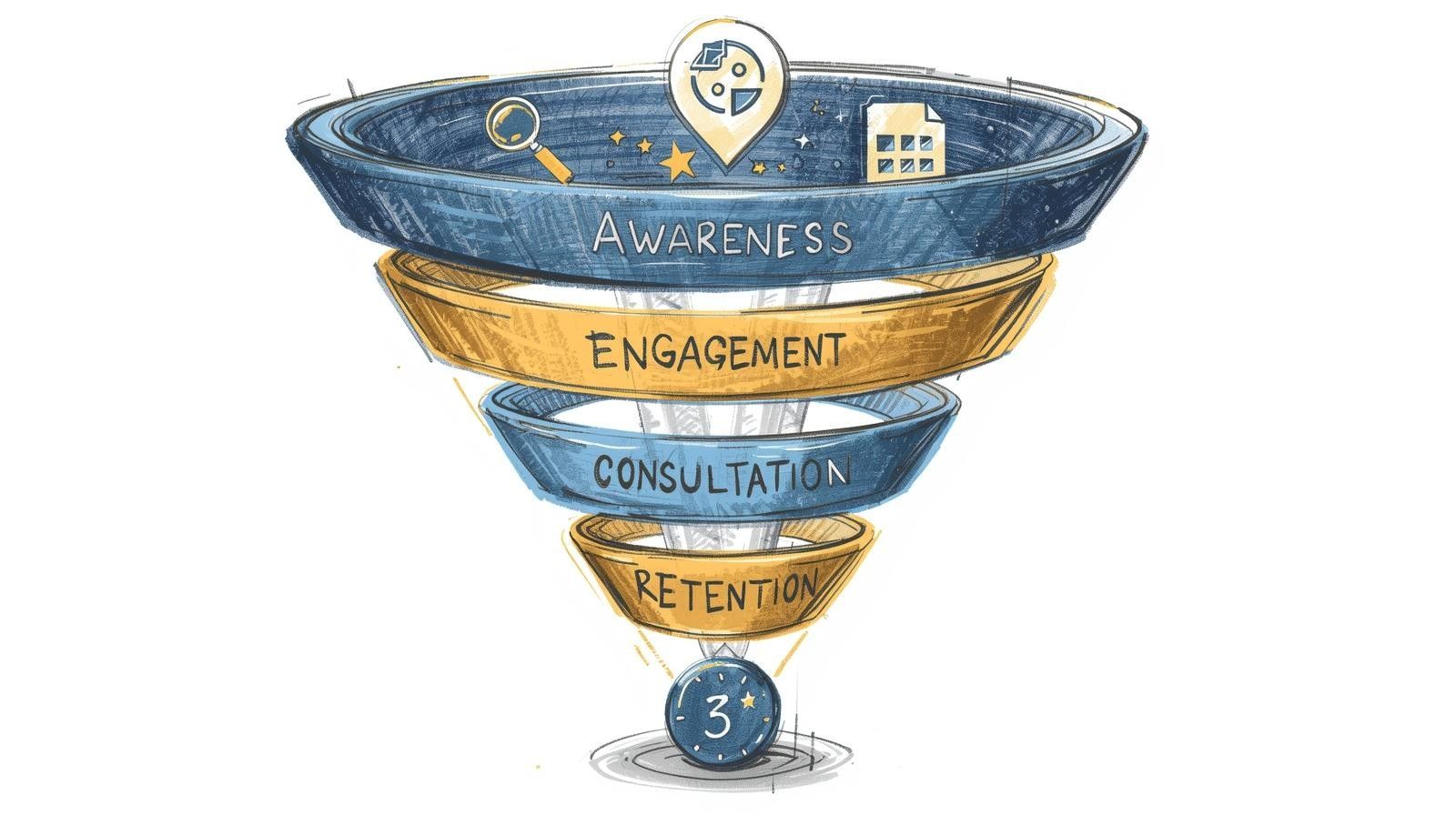
Tired of relying on the unpredictable ebb and flow of referrals? The most successful modern law firms aren't just waiting for the phone to ring; they're running on a predictable system designed to attract, engage, and sign new clients. This system is a lead generation funnel, and it's built around a four-stage journey: Awareness, Engagement, Consultation, and Retention.
This isn't just a marketing concept; it's a strategic framework for turning complete strangers into paying clients, and eventually, into your firm's biggest advocates. This guide provides a granular, 4-stage breakdown.
Stage 1: Awareness - Getting on Your Ideal Client's Radar
The first part of any successful lead generation funnel is all about getting the right people to notice you. We're not just casting a wide, expensive net and hoping for the best. The goal is much more precise: to be the first and best answer that pops into a potential client's head right when they’re facing an urgent legal problem.
Success here really comes down to getting inside your ideal client's head. You have to understand what they're thinking and how they search for help. Someone Googling "local SEO for family law practices" is in a completely different headspace than a corporate counsel researching "lead generation for IP lawyers." Your entire strategy needs to account for that difference, speaking directly to their specific pain points and showing them you can help right now.
Targeting High-Value, Niche Traffic (The IP Example)
Success in the awareness stage hinges on precision, especially for niche practices. For example, a firm specializing in Intellectual Property must recognize that a corporate counsel researching lead generation for IP lawyers has a fundamentally different and more complex need than a local personal injury client. The content must reflect this. Your IP content should be distributed on professional networks like LinkedIn and target trade publications, positioning the firm as a thought leader in patent litigation or trademark defense, rather than relying solely on local Google searches. This deliberate strategy ensures every dollar spent on attracting traffic is highly qualified.
Be Where They Are Actively Looking
To attract the right clients, you have to show up where they are already searching for a solution. This means focusing your energy on channels that capture people who are ready to act—not just passively browsing, but actively trying to hire a lawyer.
For the vast majority of law firms, especially those fighting for local clients in areas like family law or personal injury, two platforms are absolutely essential:
- Google Search: When someone types "divorce lawyer near me" or "what to do after a car accident" into that search bar, they have an immediate, pressing need. Being visible there, whether through organic SEO or paid ads, puts your firm directly in their path at the crucial moment.
- Google Business Profile (GBP): Your GBP is often the very first impression a local client will have of your firm. It's your digital front door, putting your location, hours, reviews, and phone number front and center in local search results and on Google Maps.
Getting these two channels dialed in is the foundation of this entire attraction stage. A well-managed GBP, for instance, can generate phone calls and website visits before a prospect even clicks through to your homepage. It’s one of the most powerful—and often overlooked—tools in your arsenal.
Content That Builds Trust on Sight
Being seen is only half the battle. You need to be seen as an authority, as someone who can be trusted. This is where high-value content comes in. Forget the hard sales pitch; your content should be all about providing solutions and clarity.
Think about it from the client's perspective. An estate planning firm could publish a detailed blog post like "A Simple Guide to Avoiding Probate in Texas." This does more than just help with SEO for estate planning attorneys. It provides genuine value to the reader, instantly establishing the firm as a knowledgeable, helpful resource. That reader, now feeling more informed and confident in your expertise, is far more likely to pick up the phone and book a consultation.
The secret to the awareness stage is to give away your expertise freely. When you answer a potential client's biggest questions before they even have to ask, you drastically shorten their journey from stranger to qualified lead.
This approach works no matter your practice area. A corporate law firm could create a downloadable "Startup Legal Checklist." A criminal defense attorney might publish an article clearly explaining the arraignment process. This flips the script entirely—instead of you chasing clients, they start seeking you out because you've already proven you know your stuff.
Jumpstart Your Leads with Strategic Paid Ads
While SEO and content are fantastic long-term plays, sometimes you need leads now. Paid advertising is the way to get immediate visibility and start the phone ringing. Targeted Google Ads can put your law firm right at the very top of the search results for your most profitable keywords, generating calls and form fills from day one.
The trick to making paid ads work is precision. A personal injury lawyer shouldn't just bid on broad keywords. They need ad copy that speaks directly to a potential client's pain and offers reassurance. An ad that says, "Injured in a Truck Accident on I-35? We Fight for Maximum Compensation. No Fee Unless We Win," will always outperform a generic "Austin Personal Injury Lawyer."
If you want to dig deeper into building killer campaigns, our guide on how to run profitable Google Ads for lawyers is a great place to start.
A highly targeted campaign can deliver incredible results, fast. We've seen a small firm focusing on motor vehicle accidents and disability claims implement a super-specific Google Ads strategy. By zeroing in on keywords directly tied to their core services and constantly tweaking their ad copy, they started generating a steady stream of high-quality leads within a couple of months. It just goes to show how a focused approach can cut through the noise, even in a crowded market.
The Bedrock of Your Local Dominance
For any practice that serves a specific city or region, mastering local SEO isn't optional. It's the engine that gets you into that coveted "map pack" when someone in your town searches for legal help.
Here’s what a rock-solid local SEO strategy is built on:
- A Flawless Google Business Profile: Your profile needs to be 100% complete and accurate. We’re talking high-quality photos, consistent business info across the web, and a steady stream of new, positive client reviews.
- Location-Specific Website Pages: Don't just list the areas you serve. Create dedicated pages on your site for each major city or neighborhood. These pages should be rich with location-specific keywords and content (e.g., "Houston Estate Planning Attorney").
- Local Link Building: Getting links from other local businesses, legal directories, and community organizations sends a powerful signal to Google that your firm is a recognized authority in the local area.
When you nail these foundational elements, you ensure that when a potential client needs help nearby, your firm isn’t just one of the options—it’s the most visible and credible choice. This sets you up perfectly to guide them into the next stage of your funnel.
Stage 2: Engagement - Turning Cold Prospects Into Warm Leads
So, you’ve grabbed a potential client's attention. Now what? This is where the real work begins—the critical middle stage of your funnel where you go from just another name they found online to the go-to expert they actually want to hire.
High-value, complex cases—especially those in corporate, IP, or mass tort law—often require a higher level of trust than a simple PDF can provide. This is where using webinars or seminars to generate leads for law firms becomes a potent strategy. Unlike a simple download, a live or on-demand webinar demands a significant time commitment from the prospect, indicating extremely high interest.
Actionable Steps for Webinar Success:
- Topic Focus: Topics must address specific, acute pain points (e.g., "Navigating the Final GDPR Compliance Deadline" or "Protecting Your Assets in a High-Net-Worth Divorce").
- Conversion: The webinar itself acts as the lead magnet. At the end, the CTA must be direct: a 15-minute follow-up call, not just a general consultation.
- Follow-Up: Segment attendees immediately. Those who attended the full session are your warmest leads and should receive a personalized email from an attorney, not a generic auto-responder.
This approach shifts your firm from content provider to interactive expert, drastically accelerating the trust-building necessary for complex engagements.
The goal here isn't a hard sell. It’s about building trust and demonstrating your value. You’re guiding them, not pushing them, toward that initial consultation. This is your chance to prove you’re the definitive solution to their problem long before they ever pick up the phone.
As you can see, the anatomy of a high-converting page is all about focus. Every element, from the headline to the button, has one job: to make it incredibly easy for your prospect to take that next step.
Create Lead Magnets That Actually Get Clicks
A lead magnet is simply a valuable resource you offer in exchange for an email address. The key word here is valuable. A generic "sign up for our newsletter" just won't cut it anymore. People are protective of their inboxes.
You need to create something so specific and helpful that your ideal client feels like they have to download it. Think about the most urgent questions your clients have right at the beginning of their journey.
To get your gears turning, here are a few real-world examples that work.
Lead Magnet Ideas by Legal Practice Area
This table breaks down some effective lead magnet ideas tailored to different legal niches. The goal is always to provide an immediate solution to a pressing problem, which positions you as the expert from the very first interaction.
Practice Area
Lead Magnet Idea
Goal
Corporate Law
A "10-Point Legal Checklist for Starting a New Business"
Provide actionable guidance for entrepreneurs navigating complex startup requirements.
Family Law
An on-demand webinar: "Understanding the Divorce Process in [Your State]"
Offer clarity and peace of mind during a stressful and confusing time.
IP Law
A guide: "5 Common Trademark Application Mistakes to Avoid"
Help founders prevent costly errors and protect their intellectual property.
Estate Planning
An "Essential Documents for Your Will" worksheet
Give potential clients a tangible starting point for a process they often procrastinate on.
Personal Injury
A calculator: "Estimate Your Potential Accident Claim Value"
Engage users with an interactive tool that provides instant, personalized insight.
These resources do more than just collect contact info. They start the nurturing process immediately by delivering real, tangible value and showcasing your expertise.
Design Landing Pages That Convert
Your lead magnet needs a home, and that home is a landing page. This is a standalone web page with one single, solitary purpose: to get a visitor to download your guide, sign up for your webinar, or take whatever specific action you want.
Unlike your main website, a good landing page is free of distractions. There are no navigation menus, no links to your blog, no "About Us" section. It's a dead end with only one way out: through the offer.
A landing page is a focused conversation. Every single element—the headline, the bullet points, the form, the button—must work in perfect harmony to convince the visitor that your offer is worth their contact information.
Great landing pages are built on clarity and simplicity. The headline needs to grab attention and match the ad or post that brought them there. The body copy should use bullet points to quickly spell out the benefits. And the form? It should ask for the absolute bare minimum. Often, a name and email are all you need to get the ball rolling.
Put Your Follow-Up on Autopilot with Email Nurturing
Once someone downloads your lead magnet, the clock starts ticking. This is where email automation becomes your best friend. You can set up a pre-written sequence of emails that automatically goes out to every new lead over a few days or weeks. This lets you build relationships at scale, without having to personally email every single person who downloads your checklist.
Remember, timely engagement is everything in the legal world. Research consistently shows that potential legal clients expect a prompt response and will simply move on to the next attorney if they don't get one. An automated follow-up system makes this a non-issue.
A simple, effective nurture sequence could look something like this:
- Email 1 (Immediately): Delivers the promised lead magnet and says thank you.
- Email 2 (2 Days Later): Shares a related blog post or a powerful client success story.
- Email 3 (4 Days Later): Addresses a common myth or misconception related to their legal issue.
- Email 4 (7 Days Later): Makes the ask—an invitation to schedule a free, no-obligation consultation.
Each email adds another layer of value and gently moves the prospect down the path to becoming a client. For a much deeper dive, check out our guide on lead nurturing best practices for law firms.
Segment Your Leads for Smarter Communication
Not all leads are the same, so why would you talk to them the same way? A business owner who downloaded your "Startup Legal Checklist" is in a completely different world than someone who watched your webinar on estate planning.
Segmentation is just a fancy word for grouping your leads based on their interests and actions. This allows you to send them far more relevant and personalized communication.
When you tailor your follow-up messages, you speak directly to each person's specific challenges. This level of personalization makes prospects feel seen and understood—a massive step toward earning their trust and getting them to book that consultation.
Stage 3: Consultation - Converting Leads into Signed Clients
This is where the rubber meets the road. You’ve done all the hard work to attract and nurture potential clients, and now it’s time to turn that interest into a signed retainer. Your intake process is the bridge between marketing and revenue, and any crack in that bridge—a clunky form, a slow response, a scheduling nightmare—can send a great lead right to your competitor.
This transition from a warm prospect to a paying client needs to feel seamless and reassuring. A polished intake system doesn't just collect information; it reinforces the client's decision that they’ve found the right firm. It's their very first taste of your professionalism.
Design Intake Forms That Don't Scare People Away
Your intake form is your first chance to get case details, but it's a delicate balancing act. Ask for too much, and you'll overwhelm them. They'll just click away. Ask for too little, and you're walking into the initial consultation blind.
The trick is to keep it simple and stick to the essentials. At this stage, you just need enough to qualify the lead and get ready for a conversation.
- Bare-Bones Fields: Just get the basics: name, phone, email, and a simple text box for them to briefly describe their issue. "How can we help?" is perfect.
- Think Mobile-First: Most people are going to find you on their phone. Your forms absolutely must be easy to fill out on a small screen, with big fields and obvious buttons.
- Tell Them What's Next: Don't leave them hanging after they hit "submit." Send them to a thank you page that clearly explains the next step, like, "Our team will call you within 2 business hours to schedule your free consultation." We dig much deeper into this on our guide to how to improve website conversion rates for law firms.
Eliminate the Scheduling Headache
Email tag is a huge conversion killer. The endless back-and-forth trying to find a time to talk creates delays and frustration right when a prospect is most motivated to act. Thankfully, technology has completely solved this problem.
Using a scheduling tool like Calendly or Acuity Scheduling isn't optional anymore. Integrate one right into your website and thank you pages. This lets qualified leads book a consultation directly on your calendar, whenever it's convenient for them. It automates a tedious task, speeds up the entire process, and makes your firm look modern and client-focused.
Track Every Interaction with a Legal CRM
Once consultations start getting booked, you have to manage the follow-up. This is where a legal-specific CRM (Client Relationship Management) system like Clio Grow or Lawmatics becomes the brain of your client intake operation.
A good CRM helps you:
- Automate Reminders: Send out automatic email and text reminders before a consultation. This one thing will slash your no-show rate.
- Centralize Communications: Every email, call, and note about a prospect lives in one place. Anyone at your firm can jump in and know exactly what's going on.
- See Your Pipeline: Visually track every lead as they move from initial contact to signed client. You'll instantly spot bottlenecks and be able to forecast revenue more accurately.
Ace the Consultation and Get the Retainer Signed
The consultation is your closing room. The lead is qualified, they’re interested, and now it’s your chance to show them you’re the solution to their problem.
The goal of the first consultation isn't just to give legal advice; it's to sell confidence. The client needs to leave feeling understood, relieved, and absolutely certain that you are the one person who can fix this for them.
Start by listening. Let the potential client do most of the talking at first. You need to truly understand their pain points, fears, and what a "win" looks like for them before you ever mention strategy or fees. This builds instant trust. It shows you're focused on their problem, not just on opening a new file.
To really elevate how you turn these conversations into clients, check out these advanced ideas on video lead generation mastery. When you combine a smooth intake system with a consultation that builds real confidence, you create a powerful engine for turning great leads into profitable, long-term clients.
Stage 4: Retention - Turning Clients into Your Best Marketers
Thinking your lead generation funnel stops once a client signs the retainer? That’s a common mistake. In reality, the most profitable part of the whole process is just getting started. This final stage is all about transforming a new client into a long-term asset—someone who brings in repeat business, leaves glowing reviews, and sends high-quality referrals your way.
This is how you break the cycle of constantly paying for new leads. You build a growth engine that starts to run on its own. The strategies are straightforward but incredibly powerful, all designed to maximize the lifetime value of every single relationship your firm builds.
From a Signed Retainer to Powerful Social Proof
Right after you’ve successfully closed a case, there’s a small but critical window of opportunity. Your client is at their happiest and most grateful—this is the perfect time to ask for a review. Don’t just hope it happens; make it an official step in your client offboarding process.
Set up a simple, automated email that goes out thanking them for their trust. Crucially, include direct links to your Google Business Profile, Avvo profile, or any other review site that matters to you. The easier you make it, the higher your response rate will be. This consistent flow of positive reviews is absolute gold for convincing future prospects who are doing their research.
For a deeper dive into creating a seamless journey from the very beginning, check out our guide on client onboarding best practices.
Building a Referral System That Actually Works
Referrals shouldn't be a happy accident; they need to be a deliberate part of your strategy. The most successful referral programs I've seen are always proactive and well-structured.
You can get a simple system up and running with just a few steps:
- Find Your Champions: Think back to past clients who were especially happy with your work. These are the people most likely to sing your praises.
- Make a Personal Connection: A few months after their case wraps up, send a personal email or even make a quick call. Just check in, see how things are going, and then gently ask if they know anyone else who might need your help.
- Give Them the Tools: Make it easy for people to refer you. Give past clients and professional contacts (like accountants or financial advisors) a few business cards or a simple digital one-pager they can easily forward.
This approach turns a single case into a potential source of ongoing business, which dramatically lowers your client acquisition cost over time.
Measure What Matters to Keep Growing
You can't improve what you don't measure. If you want to really understand how your funnel is performing and what your ROI looks like, you have to track a few key metrics without fail.
The goal isn't just to get leads; it's to acquire profitable cases. Tracking your cost per lead and client lifetime value tells you if your marketing spend is an expense or a high-return investment.
Get intimately familiar with these numbers:
- Cost Per Lead (CPL): Your total marketing spend divided by the number of leads you generated.
- Cost Per Acquisition (CPA): Your total marketing spend divided by the number of new clients you actually signed.
- Client Lifetime Value (CLV): The total revenue an average client brings to your firm over their entire relationship with you.
These metrics tell the real story. For example, attorney lead generation is a tough game, with an average lead cost hovering around $649. But the good news is that the legal industry also enjoys a solid 4.6% conversion rate. When you have an optimized intake process, that can jump to as high as 18%, making that initial cost a very smart investment. You can explore more of these attorney lead generation benchmarks on MyCase.com.
When your CLV is way higher than your CPA, you've found a winning formula. That's when you know you can confidently scale your efforts and build a truly sustainable, profitable law firm.
Answering Your Top Questions About Building a Client Funnel
When managing partners and marketing directors start mapping out a real client acquisition system, a few key questions always come up. Let's tackle the practical side of things—from what you should expect to spend to how quickly you can see a return.
How Much Should We Really Budget for This?
There's no single magic number, and anyone who gives you one isn't being honest. Your budget is a direct reflection of your practice area's competitiveness and how aggressively you want to grow. A PI firm in downtown Miami is playing a different game than an estate planning lawyer in a smaller town.
For a competitive practice area, a good starting point for ad spend is often in the $1,500-$5,000 per month range. On top of that, budget another $200-$500/month for the essential software—your CRM, email platform, and so on.
The most important metric isn't what you spend; it's your cost-per-acquisition (CPA). Track it obsessively. Once you can prove that every dollar you put in brings back several more in case value, you can scale with confidence.
What are the "Can't-Live-Without" Tools for a Legal Funnel?
It’s easy to get lost in a sea of software promising the world. Don't overcomplicate it, especially at the beginning. You just need a few core pieces working in harmony.
Here’s your essential tech stack:
- A Professional Website: This is your digital storefront. It needs to be polished and include a blog where you can demonstrate your authority.
- Landing Page Builder: You absolutely need a tool like Leadpages or Unbounce to create distraction-free pages for your ad campaigns.
- Email Marketing Platform: A system like ActiveCampaign is perfect for setting up those automated follow-up sequences that nurture leads for you.
- Legal-Specific CRM: Don't try to jury-rig a generic CRM. Something like Clio Grow or Lawmatics is built from the ground up to manage your pipeline from initial inquiry to signed retainer.
- Online Scheduling Tool: Make booking a consultation frictionless. Calendly is the gold standard here and is basically non-negotiable.
Think of these tools as the automated engine that will power your firm's growth around the clock.
Honestly, How Long Until We See Results?
This all comes down to your strategy. If you're running paid ad campaigns on platforms like Google Ads, you can see the phone start ringing and consultations getting booked within the first 30-60 days. That initial period is all about gathering data and fine-tuning your campaigns for better performance.
Organic strategies, on the other hand, are a long game. Building a real presence through SEO and content marketing is more of a 4-6 month journey before you see a steady, predictable stream of high-quality leads.
The smartest play is often a hybrid approach. Use paid ads to get clients in the door now while you simultaneously build your long-term organic foundation for sustainable growth.
Ready to stop guessing and start building a predictable system that brings in clients like clockwork? The team at GavelGrow specializes in creating done-for-you lead generation funnels exclusively for law firms. We blend battle-tested digital strategy with an insider's understanding of the legal market to drive real, measurable growth.
Book a free, no-obligation strategy session with our team today.
Frequently Asked Questions
What are the stages of an attorney lead generation funnel?
A lead generation funnel guides strangers into paying clients across four stages: Awareness, Engagement, Consultation, and Retention. Awareness gets you on your ideal client's radar through SEO, content, and paid ads. Engagement turns cold prospects into warm leads with lead magnets and email nurturing. Consultation converts leads into signed clients through smooth intake, and Retention transforms clients into reviewers and referral sources.
What makes a good lead magnet for a law firm?
A strong lead magnet offers something specific and genuinely valuable in exchange for contact information, solving an immediate problem so a prospect feels they have to download it. Effective examples vary by practice area, such as a 10-point legal checklist for starting a business, an on-demand divorce process webinar, or an estate planning documents worksheet. A generic newsletter sign-up no longer works.
How should a law firm design a lead magnet landing page?
Build a standalone page with one single purpose and no distractions, such as navigation menus, blog links, or an About section. The headline should match the ad or post that brought the visitor there, the body copy should use bullet points to spell out benefits, and the form should ask for the bare minimum, often just a name and email to get started.
What does an effective email nurturing sequence look like for law firms?
A simple sequence delivers value over several days without manual effort. For example, email one immediately provides the promised lead magnet and thanks the subscriber, email two shares a related blog post or success story, email three addresses a common myth about their legal issue, and email four invites them to schedule a free, no-obligation consultation. Timely follow-up matters because prospects move on quickly.
What tools does a law firm need to build a lead generation funnel?
Keep the tech stack simple, especially at the start. The essentials are a professional website with a blog, a landing page builder for distraction-free campaign pages, an email marketing platform for automated follow-up, a legal-specific CRM to manage the pipeline from inquiry to retainer, and an online scheduling tool to make booking a consultation frictionless. Together these form the automated engine behind your growth.
Frequently Asked Questions
What are the stages of an attorney lead generation funnel?
A lead generation funnel guides strangers into paying clients across four stages: Awareness, Engagement, Consultation, and Retention. Awareness gets you on your ideal client's radar through SEO, content, and paid ads. Engagement turns cold prospects into warm leads with lead magnets and email nurturing. Consultation converts leads into signed clients through smooth intake, and Retention transforms clients into reviewers and referral sources.
What makes a good lead magnet for a law firm?
A strong lead magnet offers something specific and genuinely valuable in exchange for contact information, solving an immediate problem so a prospect feels they have to download it. Effective examples vary by practice area, such as a 10-point legal checklist for starting a business, an on-demand divorce process webinar, or an estate planning documents worksheet. A generic newsletter sign-up no longer works.
How should a law firm design a lead magnet landing page?
Build a standalone page with one single purpose and no distractions, such as navigation menus, blog links, or an About section. The headline should match the ad or post that brought the visitor there, the body copy should use bullet points to spell out benefits, and the form should ask for the bare minimum, often just a name and email to get started.
What does an effective email nurturing sequence look like for law firms?
A simple sequence delivers value over several days without manual effort. For example, email one immediately provides the promised lead magnet and thanks the subscriber, email two shares a related blog post or success story, email three addresses a common myth about their legal issue, and email four invites them to schedule a free, no-obligation consultation. Timely follow-up matters because prospects move on quickly.
What tools does a law firm need to build a lead generation funnel?
Keep the tech stack simple, especially at the start. The essentials are a professional website with a blog, a landing page builder for distraction-free campaign pages, an email marketing platform for automated follow-up, a legal-specific CRM to manage the pipeline from inquiry to retainer, and an online scheduling tool to make booking a consultation frictionless. Together these form the automated engine behind your growth.