Social Media Marketing Strategy: Step-By-Step For Law Firms
Categories: Legal Marketing Strategies
 Abram Ninoyan
Founder & Senior Performance Marketer
Credentials: Google Partner, Google Ads Search Certified, Google Ads Display Certified, Google Ads Measurement Certified, Google Analytics (IQ) Certified, HubSpot Inbound Certified, HubSpot Social Media Marketing Certified, Conversion Optimization Certified
Expertise: Google Ads, Meta Ads, Conversion Rate Optimization, GA4 & Google Tag Manager, Lead Generation, Marketing Funnel Optimization, PPC Management
LinkedIn Profile
Most law firms treat social media like an afterthought, a random post here, a firm headshot there, maybe a holiday graphic that nobody engages with. That's not a social media marketing strategy. That'...
Key Takeaways
- Social Media Marketing Strategy: Step-By-Step For Law Firms
- How social media works for law firms in 2026
- Step 1. Set goals that tie to signed cases
- Step 2. Define your audience by case type and intent
Social Media Marketing Strategy: Step-By-Step For Law Firms
Most law firms treat social media like an afterthought, a random post here, a firm headshot there, maybe a holiday graphic that nobody engages with. That's not a social media marketing strategy. That's just noise. And noise doesn't sign cases.
The truth is, your potential clients are scrolling through Instagram, LinkedIn, Facebook, and TikTok right now, looking for answers to legal questions they're too nervous to ask out loud. A structured strategy puts your firm in front of those people at exactly the right moment, before they ever type a query into Google. Done right, social media becomes a consistent source of qualified consultations, not just a vanity metric on a dashboard.
At GavelGrow, we've helped over 500 law firms build marketing systems that actually convert. We've seen firsthand how firms that approach social media with a real plan, clear goals, defined audiences, platform-specific content, outperform competitors who spend twice their budget on scattered tactics. That experience is baked into every recommendation in this guide.
Below, you'll find a step-by-step framework covering everything from goal setting and audience research to platform selection, content planning, and performance tracking. Each step is built specifically for law firms, accounting for bar advertising rules, practice area nuances, and the reality that your end goal isn't likes, it's signed cases on your desk.
How social media works for law firms in 2026
Social media in 2026 operates on fundamentally different mechanics than it did even a few years ago. Platforms have become discovery engines, not just communication tools, and the way people find legal help has shifted accordingly. Your potential clients are not only searching for attorneys on Google. They are watching short videos about their legal rights, following attorneys who explain complex topics in plain language, and forming opinions about who to trust based on what they see in their feeds. Understanding these mechanics is essential before you build any content plan, advertising campaign, or broader social media marketing strategy.
The platform landscape has changed significantly
Each major platform now serves a distinct function in the legal client journey, and the right choice for your firm depends entirely on your practice area and target client demographic. Here is how the major platforms break down for law firms specifically:
Facebook still holds the largest active adult user base in the United States, which makes it the most consistent performer for high-value personal injury and family law campaigns. LinkedIn places your content directly in front of business owners and HR professionals, the exact people who make decisions about employment law and corporate legal services.
The biggest mistake most firms make is spreading their attention thin across every platform. Pick two platforms based on where your specific clients actually spend time, and build real presence there before you consider expanding.
Trying to maintain six platforms simultaneously is the fastest way to produce mediocre content on all of them and strong content on none.
How the algorithms actually reward content
Platform algorithms in 2026 share one primary objective: keep users on the platform as long as possible. They achieve this by surfacing content that drives genuine interaction, specifically saves, shares, and substantive comments, rather than content that only generates passive scrolling. For law firms, this means educational content consistently outperforms promotional content by a wide margin. A short video explaining what to do in the 24 hours after a car accident will earn far more saves and shares than a graphic announcing your firm's founding anniversary.
Facebook and Instagram both measure engagement velocity, meaning content that receives meaningful interaction within the first 60 to 90 minutes of posting gets distributed to additional feeds automatically. LinkedIn rewards content published from individual attorney profiles more heavily than content from company pages. Knowing these mechanics lets you schedule posts strategically and format them in ways that trigger the specific signals each algorithm is designed to reward.
Why legal clients behave differently on social than on search
Someone who types "personal injury attorney Chicago" into Google has already decided they need legal help. Someone scrolling their Facebook feed has not made that decision yet. Social media captures potential clients at the awareness and consideration stages, often weeks or months before they are ready to call your office. That timeline shapes everything about how you create content and what you ask people to do next.
Your posts should answer the questions people ask before they realize they need an attorney: What happens if I get hurt at my job? Can my landlord legally do this? How do I know if I even have a case worth pursuing? By answering these questions clearly and consistently, you build credibility with an audience that will remember your firm when the moment of need arrives. This is the core mechanism that makes social media worth your attention as a law firm, and it works on a completely different timeline than paid search or organic SEO.
Step 1. Set goals that tie to signed cases
Before you build a single piece of content or spend a dollar on paid ads, you need to know exactly what you are measuring. Most law firms set social media goals that have no connection to revenue, things like follower counts, post reach, or page likes. These numbers feel good on a monthly report, but they will never tell you whether your social media marketing strategy is actually growing your firm. Every goal you set should trace a direct line back to one outcome: a signed client agreement.
Move beyond vanity metrics
Vanity metrics are numbers that look impressive in a presentation but tell you nothing about case volume. A post that reaches 10,000 people means little if none of those people ever contact your office or submit an intake form. Your focus should shift entirely from how many people saw a post to how many people took a specific action because of it. The actions worth tracking are the ones that move a potential client closer to sitting across from one of your attorneys.
Here are the metrics that actually connect to signed cases:
- Consultation form submissions driven by social traffic, tracked with UTM parameters on every link you share
- Direct messages that convert into phone calls or scheduled intakes
- Click-through rate on links to your intake page from bio, posts, and paid campaigns
- Cost per consultation across each social platform you run ads on
Your social media success metric should always be: how many consultations did this generate this month?
Build your goal framework around case acquisition
Set your goals using a structure that connects social activity directly to business outcomes. Each goal should specify a platform, a target action, a number, and a deadline so your team always knows exactly what you are working toward. Use this template and fill it in for each platform you plan to use:
Work backward from your firm's actual case acquisition target. If you need five new personal injury cases per month and your intake team closes roughly one in four consultations, you need at least 20 qualified consultations across all channels. Decide what share should realistically come from social media based on your current traffic data, and set your platform goal to match that number.
Review your goals every 30 days without exception. If a platform consistently delivers no consultations after 90 days of structured effort, reallocate that time and budget to the channel that is actually producing results. Goal-setting is a monthly discipline, not a one-time exercise you complete at the start of the year and forget.
Step 2. Define your audience by case type and intent
Knowing your audience is not a soft, feel-good exercise. It is the single factor that determines whether your social media marketing strategy generates qualified consultations or wastes hours producing content nobody responds to. Law firms consistently make the mistake of targeting "anyone who needs a lawyer," which is no target at all. Different case types attract completely different people, with different demographics, different emotional states, and very different questions running through their minds when they first encounter your content in their feeds.
Map audience intent to practice area
Every practice area you serve has a distinct audience with a specific reason for seeking legal help, and that reason shapes everything about how you communicate on social media. A personal injury prospect is often in crisis mode, dealing with medical bills, missed work, and insurance adjusters calling before they have had a chance to think clearly. A business owner considering a contract dispute is in a far more calculated, analytical frame of mind. Matching your message to the intent behind the need is what separates content that moves people toward a consultation from content that gets scrolled past in two seconds.
The more precisely you define who you are speaking to, the less content you need to produce, because every post actually lands.
Use this table to map your key practice areas to the audience characteristics that should shape your content:
Build a written audience profile for each case type
Once you map the intent behind your target case types, write a short profile for each one and keep it somewhere your whole team can access it. This profile keeps every piece of content grounded in a real person's situation rather than a vague legal topic. Use this template for each practice area your firm actively wants to grow:
Practice Area: [e.g., Personal Injury]
Who they are: [Age range, life situation, income bracket]
What triggered their concern: [Specific event or circumstance]
Their biggest fear: [What keeps them up at night]
What they need to hear from you: [The message that earns their trust]
Platform where they spend time: [Facebook / Instagram / TikTok / LinkedIn]
Complete one profile per practice area before you write a single post. Revisit each profile every quarter and update it based on the intake data your team is actually seeing, because your real clients will tell you more about your audience than any assumption will.
Step 3. Pick the right platforms for your practice areas
Platform selection is where most law firm social media marketing strategies fall apart. Firms try to be everywhere at once, end up producing thin content on six platforms, and generate results on none of them. Your job here is to make a deliberate, defensible choice about which two platforms deserve your attention, and then commit fully before you consider adding a third.
Match platform strengths to how your clients think
Each platform attracts a different user mindset, and that mindset determines whether your content feels relevant or out of place. Facebook users scroll in a passive, community-oriented state, making it ideal for practice areas where emotional trust drives the decision, such as personal injury, family law, and estate planning. LinkedIn users are in a professional headspace, so business law and employment content lands naturally there. Instagram rewards visual storytelling, which works well for immigration and criminal defense firms that want to humanize their attorneys. TikTok captures younger audiences who want fast, direct answers to rights-related questions before they ever call anyone.
The platform that holds your client's attention is always more valuable than the platform with the largest total user count.
Use this table to make your selection concrete:
Commit to two platforms before you expand
Spreading your team across too many channels guarantees mediocre output everywhere. Select your top two platforms from the table above, then block out dedicated time each week for content creation, community management, and performance review on those two channels only. Do not add a third platform until your first two are producing at least five qualified consultation inquiries per month consistently.
Run your platform audit using this quick checklist before you finalize your choice:
- Where does your current client base say they spend time online? (Ask at intake.)
- Which platform do your top three local competitors appear most active on?
- Does your firm have the visual assets or video capability to meet that platform's content format?
- Can your team realistically post three to four times per week on this platform without sacrificing quality?
Answer those four questions honestly before you commit. Choosing based on where you already have confidence in creating content, rather than where you assume clients live, produces better results in the first 90 days and keeps your team from burning out on a format that does not suit your firm.
Step 4. Set ethics and compliance guardrails
Legal advertising carries obligations that no other industry faces, and social media does not exempt you from them. Every state bar association publishes its own rules governing attorney advertising, covering everything from testimonial restrictions to how you describe results. Before you build your content calendar or run a single paid promotion, you need to understand exactly where your state draws the line. Skipping this step does not just put your content at risk; it puts your license at risk.
Know which rules apply to your state bar
Your first action is to pull the advertising rules published by your state bar association directly, not a summary from a legal blog. Most state bar rules follow the ABA Model Rules of Professional Conduct, particularly Rules 7.1 through 7.5, which govern communications about legal services, advertising, and solicitation. Your state may have adopted those rules exactly, modified them, or written its own version entirely. The only way to know is to read the source.
Treating bar compliance as an optional review at the end of your process is the fastest way to publish content that creates a disciplinary complaint.
Four specific areas tend to generate the most compliance issues on social media:
- Testimonials and endorsements: Many states restrict or prohibit client testimonials, or require specific disclaimers alongside them. Check whether your state requires language like "prior results do not guarantee a similar outcome."
- Claim accuracy: You cannot state or imply you are a specialist in a practice area unless your state bar has formally certified you in that area.
- Response to public comments: Responding to a negative review by revealing case details, even vague ones, can violate attorney-client confidentiality.
- Jurisdiction disclosure: Some states require that all advertising clearly identify which states you are licensed to practice in.
Apply a pre-publish compliance checklist
Build a short checklist and require every team member to complete it before any post goes live. This removes the compliance decision from individual judgment and makes the standard consistent across your entire content operation. Use this template for every piece of content your firm publishes on social media:
Pre-Publish Compliance Check
1. Does this post make any claim about case results?
If yes: Add required disclaimer per [your state bar rule citation]
2. Does this post include a client quote or testimonial?
If yes: Verify state bar rules on testimonials and add required language
3. Does this post describe a specialty or certification?
If yes: Confirm formal bar certification exists for that designation
4. Does this post respond to a specific client situation?
If yes: Legal review required before publishing
5. Does this post require a jurisdiction disclosure?
If yes: Add licensed states disclosure in caption
Run this checklist inside your social media marketing strategy workflow, not as a separate afterthought. Firms that embed compliance into the publishing process eliminate the scramble of reactive takedowns and protect their reputation with clients and the bar simultaneously.
Step 5. Build a content system that stays consistent
Consistency is the single most important variable in any social media marketing strategy that actually produces results over time. The reason most law firms go quiet on social media after a strong start is not a lack of good ideas. It is the absence of a system that removes the daily decision of what to post. When you have to invent new content from scratch every time, publishing becomes the first thing to skip when your week gets busy. A repeatable system fixes that completely.
Build your content calendar before you write anything
Your content calendar is not a creative document. It is a production schedule that your whole team follows regardless of who is in the office that week. Before you write a single caption or film a single video, map out a full month of content at one time. Assign post types to specific days, rotate formats on a fixed cycle, and never leave a publishing slot blank without assigning it to someone responsible for filling it.

A calendar that assigns responsibility by name, not just by role, is the only kind that actually gets followed.
Use this four-slot weekly structure as your starting template:
Weekly Content Schedule Template
Monday: Educational post (answers a specific legal question)
Wednesday: Attorney spotlight or behind-the-scenes post
Friday: Client-facing FAQ or myth-busting content
Saturday: Community or trust-building post (local news tie-in, firm value)
Rotate this structure across your chosen platforms, adjusting the format for each one, short video for TikTok and Instagram, longer text post or article link for LinkedIn, and image or carousel for Facebook. The topics change weekly, but the structure stays identical every month.
Apply a repeatable content format for every post type
Each content type in your calendar should have a fixed format your team fills in rather than writes from scratch. This cuts production time dramatically and keeps your messaging consistent even when junior staff or outside contractors are handling the work. Use this template for your most common post type, the educational legal answer:
Educational Post Template
Hook (Line 1): [State the fear or question your client has]
Bridge (Line 2): [Acknowledge why this is confusing or scary]
Answer (Lines 3-5): [Give the actual answer in plain language]
CTA (Final line): [One specific action: "Message us," "Link in bio," "Call today"]
Disclaimer: [Required by your state bar if applicable]
Fill in this template for every educational post on your calendar before the publishing week begins. You will spend one focused hour batch-creating content rather than scrambling to post something acceptable at 9 a.m. on a Monday.
Step 6. Turn engagement into consultations with intake
Engagement on social media means nothing if it stops at a comment or a DM that nobody follows up on. The purpose of your social media marketing strategy is to move people from passive interest into an active consultation, and that transition only happens when you have a deliberate intake process connected directly to your social channels. Most law firms invest in content creation and then let potential clients disappear into an inbox that nobody monitors. That is where signed cases go to die.
Create a clear path from comment to consultation
Your audience will signal interest in multiple ways: direct messages asking about their situation, comments asking follow-up questions on your posts, or clicks to the link in your bio. Each of these signals needs a specific response protocol attached to it, not a vague plan to "get back to them." Define exactly what happens the moment someone engages, who responds, within what timeframe, and what the next step is. A response that arrives four hours after a DM loses the client to the competitor who replied in 20 minutes.

Speed of response is your intake team's single most important competitive advantage on social media.
Build your response path using this structure:
Set up your intake response system
Once your response path exists on paper, you need to build the actual system behind it. Designate one person as the social inbox owner for each platform your firm uses, and give that person authority to initiate the intake process without waiting for approval. Response delays almost always trace back to unclear ownership, not lack of availability. Pair that role with a scripted DM template so the first message your team sends is always on-brand, compliant, and moves toward a scheduled call.
Use this template for initial DM responses:
- Initial DM Response Template
- "Hi [First Name], thank you for reaching out.
- We'd love to help you understand your options.
- Can I ask you a few quick questions to point
- you in the right direction?
- [Intake question 1: What happened?]
- [Intake question 2: When did this occur?]
- [Intake question 3: What state are you located in?]
- From there, we can set up a free
- consultation with one of our attorneys."
Review your intake response data monthly, tracking how many DMs or comments converted into scheduled consultations. That number tells you whether your social engagement is producing real business or just content that performs well on a metrics dashboard.
Step 7. Add paid social without wasting spend
Organic content builds trust over time, but paid social accelerates your reach to exactly the right audience the moment you need it. Adding paid campaigns to your social media marketing strategy does not require a massive budget; it requires a disciplined approach to targeting, testing, and measurement. Law firms that waste money on paid social do so because they boost posts randomly, target audiences that are too broad, and measure results in clicks rather than consultations.
Target audiences by life event and intent signal
Facebook and Instagram give you targeting options that go far beyond basic demographics. You can reach users who have recently experienced a life event such as a job change, a move, or a relationship status change. These signals align closely with the moments people need legal help: a job change triggers employment law questions, a divorce filing sits behind a family law need. Build each ad set around one practice area and one specific audience signal, never a general "legal services" campaign that spreads your budget across people with no active legal need.
The narrower your initial audience, the faster you learn whether your offer actually converts.
Use this targeting structure for your first paid campaign:
Set a test budget before you scale
Start every new paid campaign with a fixed 30-day test budget of $500 to $1,000 per practice area, and measure only one outcome: consultation form submissions. Do not judge a campaign on reach, impressions, or link clicks. Those numbers tell you nothing about whether the ad is generating actual business. Run two ad variations with different headlines against the same audience, let the data run for at least two weeks before you adjust anything, and then cut the weaker performer without hesitation.
Use this structure for every ad your firm runs:
- Paid Social Ad Template
- Headline: [Specific outcome your client wants]
- Body Line 1: [The problem they are facing right now]
- Body Line 2: [Why your firm is the right choice]
- CTA Button: "Get a Free Consultation"
- Destination: Intake form page (not your homepage)
- Disclaimer: [State bar required language if applicable]
Double your budget on the winning ad only after it produces at least three consultations in the test window, and keep the losing variation off permanently. Scale based on verified results, not on how good the creative looks inside the platform dashboard.
Step 8. Track ROI and improve your strategy monthly
Tracking is the step that separates law firms that grow from those that spend money on their social media marketing strategy indefinitely without knowing whether it works. Without a consistent measurement process, you are making decisions based on instinct rather than data, and instinct rarely explains why consultation volume dropped in March or which platform drove your best cases last quarter. Every tactic in this guide requires monthly review against real numbers, not gut feelings about whether the content felt good to produce.
Build a monthly ROI report that connects to cases
Your monthly report should take no more than 30 minutes to complete if your tracking is set up correctly from the start. Use UTM parameters on every link you publish across all social platforms so your analytics system can identify exactly which post, which platform, and which campaign sent each visitor to your intake form. Connect that data to your CRM so you can see which social-sourced consultations turned into signed cases and what revenue those cases represent.
The only number that justifies your social media budget is the cost per signed case, not the cost per click.
Track these metrics in one shared document that your whole team can access:
Run a monthly strategy review session
Set a fixed 60-minute meeting on the same day every month with whoever owns your social media workflow, whether that is an internal team member, an outside agency, or both. This meeting has one purpose: decide what you are keeping, what you are cutting, and what you are testing next. Do not let this become a general marketing update. Keep the agenda locked to the five metrics above and the decisions that follow from them.
Use this agenda template for every monthly review:
Monthly Social Media Review Agenda
1. Review last month's consultation and case numbers by platform (15 min)
2. Identify the top-performing post type and why it worked (10 min)
3. Identify the lowest-performing platform or format and cut or adjust (10 min)
4. Confirm next month's paid ad test parameters (10 min)
5. Assign ownership for next month's content calendar (15 min)
Run this session every month without skipping it, even when results are strong. The firms that maintain consistent case volume from social media treat monthly review as non-negotiable, because the data always surfaces an opportunity or a problem before it becomes obvious on its own.
Next steps
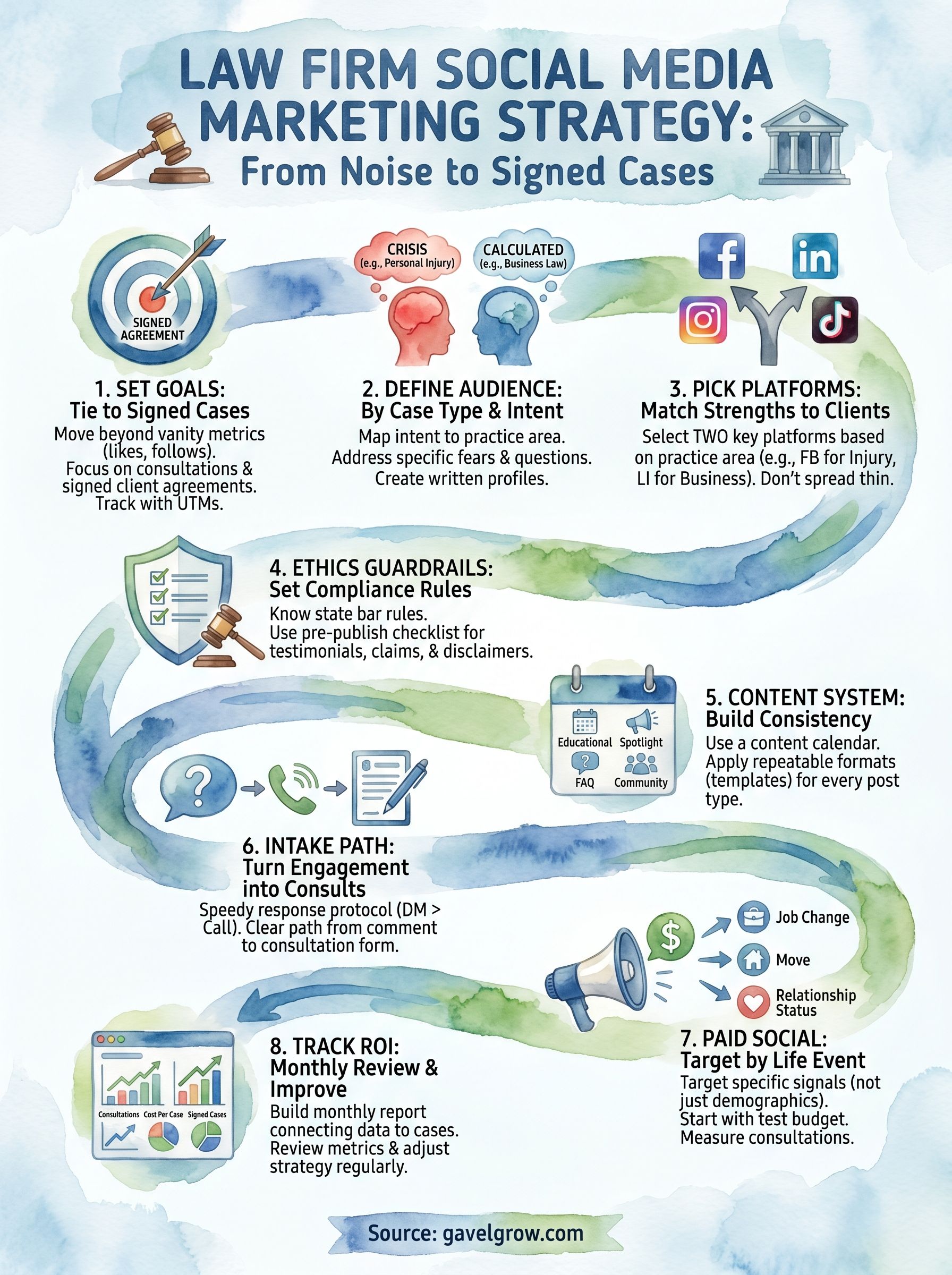
You now have a complete social media marketing strategy built specifically for law firms, from goal setting and audience research to paid campaigns and monthly ROI review. The framework works, but only if you actually implement it. Start with Steps 1 and 2 this week: write your case-acquisition goals and build one audience profile per practice area. Get those two pieces locked in before you touch a content calendar or ad account.
Every step in this guide connects to one outcome: signed cases on your desk, not vanity metrics on a dashboard. Firms that follow this process consistently outperform competitors who spend more but plan less. If you want a team that handles the execution for you, including platform selection, compliance review, content production, and intake optimization, talk to the legal marketing specialists at GavelGrow and get a free 45-minute strategy audit built around your specific practice areas and market.
Frequently Asked Questions
How should a law firm set social media goals that matter?
Tie every goal to a signed client agreement rather than vanity metrics like follower counts, reach, or likes. Track actions that move a prospect closer to your attorneys, such as consultation form submissions from social traffic (using UTM parameters), direct messages that convert to scheduled intakes, click-through rate to your intake page, and cost per consultation by platform. Work backward from your firm's actual case-acquisition target and review goals every 30 days.
Which social media platforms should a law firm focus on?
Pick two platforms based on where your specific clients actually spend time, then build real presence there before expanding. Facebook holds a large adult user base and suits emotionally driven areas like personal injury and family law, LinkedIn reaches business owners and HR decision-makers for employment and corporate work, Instagram favors visual storytelling, and TikTok reaches younger audiences seeking quick answers. Spreading thin across every platform is the fastest way to produce mediocre content everywhere.
What are the bar advertising compliance rules for law firm social media?
Social media does not exempt attorneys from advertising rules. Pull your own state bar's rules directly rather than relying on a summary; most follow ABA Model Rules 7.1 through 7.5. Pay particular attention to testimonial restrictions and required disclaimers, claims of specialty or certification, revealing case details in responses to public comments, and any required jurisdiction disclosure. Build a pre-publish compliance checklist into your workflow so the standard is consistent across every post.
Why does educational content outperform promotional posts for law firms?
Platform algorithms surface content that drives genuine interaction, such as saves, shares, and substantive comments, and educational content earns those signals far more than promotional posts. A short video explaining what to do in the 24 hours after a car accident tends to generate more engagement than a graphic announcing a firm anniversary. Social media also reaches people at the awareness and consideration stages, so answering the questions they ask before they realize they need an attorney builds credibility over time.
How do you turn social media engagement into actual consultations?
Connect a deliberate intake process directly to your social channels so interest doesn't die in an unmonitored inbox. Define a response protocol for each signal, a DM, a comment, or a bio-link click, specifying who responds, within what timeframe, and the next step. Designate one owner per platform with authority to start intake, pair them with a compliant scripted DM template, and review monthly how many conversations converted to scheduled consultations. Speed of response is a major competitive advantage.
Frequently Asked Questions
How should a law firm set social media goals that matter?
Tie every goal to a signed client agreement rather than vanity metrics like follower counts, reach, or likes. Track actions that move a prospect closer to your attorneys, such as consultation form submissions from social traffic (using UTM parameters), direct messages that convert to scheduled intakes, click-through rate to your intake page, and cost per consultation by platform. Work backward from your firm's actual case-acquisition target and review goals every 30 days.
Which social media platforms should a law firm focus on?
Pick two platforms based on where your specific clients actually spend time, then build real presence there before expanding. Facebook holds a large adult user base and suits emotionally driven areas like personal injury and family law, LinkedIn reaches business owners and HR decision-makers for employment and corporate work, Instagram favors visual storytelling, and TikTok reaches younger audiences seeking quick answers. Spreading thin across every platform is the fastest way to produce mediocre content everywhere.
What are the bar advertising compliance rules for law firm social media?
Social media does not exempt attorneys from advertising rules. Pull your own state bar's rules directly rather than relying on a summary; most follow ABA Model Rules 7.1 through 7.5. Pay particular attention to testimonial restrictions and required disclaimers, claims of specialty or certification, revealing case details in responses to public comments, and any required jurisdiction disclosure. Build a pre-publish compliance checklist into your workflow so the standard is consistent across every post.
Why does educational content outperform promotional posts for law firms?
Platform algorithms surface content that drives genuine interaction, such as saves, shares, and substantive comments, and educational content earns those signals far more than promotional posts. A short video explaining what to do in the 24 hours after a car accident tends to generate more engagement than a graphic announcing a firm anniversary. Social media also reaches people at the awareness and consideration stages, so answering the questions they ask before they realize they need an attorney builds credibility over time.
How do you turn social media engagement into actual consultations?
Connect a deliberate intake process directly to your social channels so interest doesn't die in an unmonitored inbox. Define a response protocol for each signal, a DM, a comment, or a bio-link click, specifying who responds, within what timeframe, and the next step. Designate one owner per platform with authority to start intake, pair them with a compliant scripted DM template, and review monthly how many conversations converted to scheduled consultations. Speed of response is a major competitive advantage.