What Is Social Media Marketing? Definition, Benefits, Basics
Categories: Legal Marketing Strategies
 Abram Ninoyan
Founder & Senior Performance Marketer
Credentials: Google Partner, Google Ads Search Certified, Google Ads Display Certified, Google Ads Measurement Certified, Google Analytics (IQ) Certified, HubSpot Inbound Certified, HubSpot Social Media Marketing Certified, Conversion Optimization Certified
Expertise: Google Ads, Meta Ads, Conversion Rate Optimization, GA4 & Google Tag Manager, Lead Generation, Marketing Funnel Optimization, PPC Management
LinkedIn Profile
What is social media marketing? It's the practice of using platforms like Facebook, Instagram, LinkedIn, and others to promote a business, build relationships with potential clients, and drive measura...
Key Takeaways
- What Is Social Media Marketing? Definition, Benefits, Basics
- Key Takeaways
- What Is Social Media Marketing and What Is Not?
- Why Does Social Media Marketing Matter for Law Firms?
What Is Social Media Marketing? Definition, Benefits, Basics
What is social media marketing? It's the practice of using platforms like Facebook, Instagram, LinkedIn, and others to promote a business, build relationships with potential clients, and drive measurable actions, whether that's a form submission, a phone call, or a signed retainer. For law firms specifically, it's one of the most misunderstood and underused channels in the client acquisition mix, even though more than 84% of U.S. adults use at least one social media platform daily (Pew Research Center, 2025).
Most attorneys hear "social media marketing" and picture dance videos or meme accounts. That's a narrow view. When done right, paid and organic social campaigns generate real leads at a predictable cost per case, the same metric we track across every channel inside the GavelGrow platform. The firms we work with don't treat social as a vanity play; they treat it as a measurable acquisition channel that feeds directly into their intake pipeline alongside Google Ads and SEO.
This article breaks down the core definition, the pillars that make social media marketing work, the concrete benefits for law firms, and the foundational strategies you need to build a program that actually moves your caseload. Whether you're running campaigns yourself through a self-serve platform or considering a fully managed approach, you'll walk away with a clear understanding of how social fits into a broader legal marketing strategy, and where most firms leave money on the table.
Key Takeaways
Understanding what is social media marketing at a surface level is straightforward. Building a program that delivers signed cases requires knowing the mechanics, the platform logic, and the intake infrastructure behind every click. Before diving into the full breakdown below, here are the five things every law firm owner should know.
- Social media marketing includes both paid ads and organic content: posts, videos, community engagement, and promoted campaigns all fall under the umbrella.
- Platform choice depends on your practice area: Facebook and Instagram dominate for personal injury and family law; LinkedIn fits business and employment law better.
- Vanity metrics do not equal ROI: track cost-per-lead and cost-per-signed-case, not likes or follower counts.
- Speed-to-lead is just as critical on social as it is on Google: leads contacted within 5 minutes convert 21x higher than leads reached after 30 minutes (Harvard Business Review).
- Social media performs best when it feeds a structured intake system that captures, qualifies, and follows up automatically, not a generic contact form that sits idle.
Social Media Marketing Spans Multiple Content Types
Most firms think social media marketing means running Facebook ads. Paid advertising is one component, but the discipline also includes organic posts, short-form video, client education content, reputation-building content, and comment engagement. Each type serves a different function: ads drive new traffic, organic content builds credibility with people already considering your firm, and engagement signals to platforms that your content deserves broader distribution.
The firms that get the most from social treat paid and organic as a unified strategy rather than separate line items. A prospective client might see your ad, visit your profile, read three posts, and then submit a form. If your organic presence looks abandoned, that sequence breaks before the lead ever reaches your intake pipeline.
Why the Right Platform Multiplies Your Budget
Choosing the wrong platform for your practice area burns budget fast. Facebook and Instagram remain the highest-volume channels for personal injury, mass torts, family law, and criminal defense because the audiences are large, the targeting is granular, and the visual ad formats support emotional storytelling. LinkedIn, by contrast, works for employment law, business litigation, and estate planning because decision-makers at companies are actively present there.
Picking your platform based on where your ideal client already spends time is more important than picking the platform you personally prefer.
YouTube is worth considering for any practice area where client education matters. A two-minute explainer video answering a common question can generate warm leads for months without additional spend, and it transfers authority to your firm before the first phone call happens.
Why Intake Infrastructure Determines Whether Social Pays Off
Getting someone to click your ad is only half the work. What happens in the next five minutes determines whether that click becomes a signed retainer or a wasted impression. The Harvard Business Review data on speed-to-lead is not specific to legal, but the principle applies directly: the faster your firm responds to a new inquiry, the higher your conversion rate.
Social media traffic, in particular, tends to come from people earlier in their decision-making process than Google search traffic. They saw your ad while scrolling, not while actively searching for an attorney. That means your intake system needs to move faster and nurture longer to convert those leads. Automated SMS follow-up within 60 seconds of a form submission is not optional at this level; it's the baseline for any firm spending real money on social campaigns.
What Is Social Media Marketing and What Is Not?
Understanding what is social media marketing means drawing a clear boundary around what belongs in that category and what doesn't. Social media marketing is any deliberate activity you run on a social platform to reach, attract, or convert your target audience. That includes paid ad campaigns, organic content publishing, direct message outreach, video production, and community engagement. The common thread is intent: every action ties back to a business objective, whether that's building awareness, generating leads, or converting prospects into signed clients.
What Counts as Social Media Marketing
Paid social advertising covers sponsored posts, lead generation ads, and retargeting campaigns on platforms like Facebook, Instagram, LinkedIn, and YouTube. Organic content includes the posts, videos, client education threads, and testimonials your firm publishes without paying to boost them. Both categories require strategy, targeting decisions, and consistent measurement to produce results. Even responding to comments on a post can count as social media marketing when you're doing it to build trust with people evaluating your firm.
Social media marketing is not something that happens by accident; every piece of content you publish represents a deliberate signal to your potential clients.
A useful way to think about what falls inside the definition is to ask whether the activity has a measurable business goal attached to it. If you're posting a photo because it seemed interesting, that's not marketing. If you're posting a client education video to drive form submissions, that's marketing, and you should track whether it works.
What Social Media Marketing Is Not
Social media marketing is not the same as social media management, even though the two overlap. Management refers to the operational work of scheduling and responding. Marketing refers to the strategic work of deciding what to publish, who to target, and how to convert attention into action. Many firms hire someone to "handle social media" and end up with a well-maintained profile that generates no leads, because management without marketing strategy produces no client acquisition results.
Posting without a goal, inflating follower counts with non-targeted audiences, and broadcasting press releases without calls to action are all activities that look like social media marketing but don't move your caseload or your revenue.
Why Does Social Media Marketing Matter for Law Firms?
Social media marketing matters for law firms because your potential clients are making decisions about who to hire before they ever call anyone. Facebook alone reaches more than 240 million U.S. users monthly (Meta, 2025), and a significant portion of those users will face a legal issue this year. If your firm has no presence on the platforms where those people spend their time, a competing firm that does will get the call instead of you.
Your Clients Research You on Social Before They Contact You
Most people who find your firm through a Google search or a referral will check your social profiles before they pick up the phone. What they find, or don't find, shapes whether they trust you enough to reach out. An active, credible profile with recent posts and client education content signals that your firm is current and competent. A profile with nothing posted since 2022 sends the opposite signal, even if your courtroom record is excellent.
Your social media presence is often the final trust checkpoint before a potential client decides to contact you.
Understanding what is social media marketing in this context means recognizing it as a credibility layer that sits on top of every other acquisition channel you already run. Paid search, referrals, and directory listings all send traffic to people who will evaluate your firm partly through your social footprint.
How Social Media Closes the Gap Between Awareness and a Signed Case
Personal injury and family law cases rarely convert on the first touchpoint. A potential client might see your ad, leave, and return two weeks later after thinking through their situation. Social media lets you stay visible during that consideration window through retargeting ads and organic content, without paying for a new click every time that person re-engages with your brand.
The combination of paid campaigns and organic presence also gives you two separate paths into the same audience. Someone who ignores your ad might read your post about what to do after a car accident, decide you know what you're talking about, and submit a form that same day. That kind of multi-touch conversion is only possible when both components are running together.
What Are the 5 Pillars of Social Media Marketing?
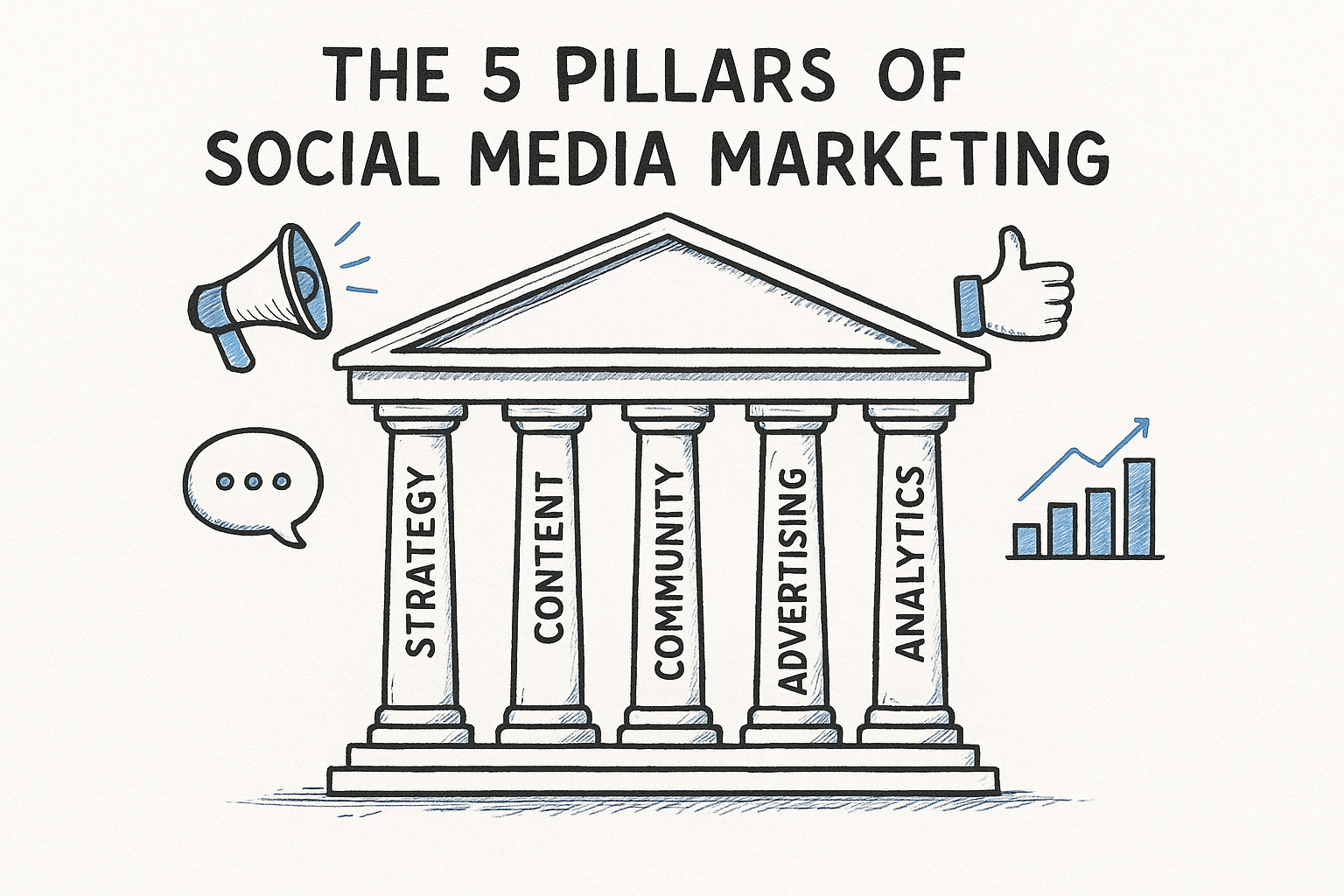
When people ask what is social media marketing, they often expect a single answer. The reality is that social media marketing operates across five distinct pillars, and ignoring any one of them limits what the other four can accomplish. Think of each pillar as a load-bearing wall: remove one and the structure weakens for your entire client acquisition program.
Strategy, Content, and Community
Strategy is the foundation. Before you publish a single post or launch a single ad, you need to define which platform matches your practice area, which audience segment you're targeting, and what specific action you want that audience to take. Without a clear strategy, you're spending time and money on activity with no measurable direction.
Content is what you put in front of that audience. For law firms, this means client education videos, case outcome stories within bar advertising rules, FAQs, and trust-building posts that answer questions your ideal clients are already searching. Your content needs to reflect your firm's specific expertise, not generic legal information anyone could find elsewhere.
The firms that generate the most leads from social treat content as a client education tool, not a broadcasting channel.
Community engagement is the third pillar and the one most firms skip. Responding to comments, answering direct messages promptly, and participating in conversations signals to both platform algorithms and real people that your firm is accessible and responsive, two qualities clients weigh heavily when choosing an attorney.
Paid Advertising and Analytics
Paid advertising is the acceleration lever. Organic content builds credibility over time, but paid campaigns compress that timeline by putting your message in front of targeted audiences immediately. For law firms, Facebook and Instagram lead generation ads allow you to target by geography, life event, and demonstrated interest, which makes them significantly more precise than a general awareness campaign.
Analytics closes the loop. Tracking which campaigns produce qualified leads and which produce clicks that never convert tells you where to increase spend and where to cut it. The only metric that matters at the end of the month is cost-per-signed-case, and your analytics setup needs to trace every lead from the originating ad through to a signed retainer.
How Do Beginners Start Social Media Marketing?
Most firms that fail at social start by doing too many things at once. Before you understand what is social media marketing in your specific practice area, the most important move you can make is to narrow your focus: one platform, one audience segment, one measurable goal. Trying to run Facebook ads, post daily on LinkedIn, and build a YouTube channel simultaneously with no infrastructure behind them produces weak results across all three.
Pick One Platform and One Goal First
Your practice area determines your platform. Personal injury, family law, and criminal defense firms get the highest volume from Facebook and Instagram because the audiences are large and the targeting options let you reach people by geography and life event. Business and employment law firms find more qualified prospects on LinkedIn. Start by choosing the platform where your ideal client already spends time, not the one you personally use most.
Once you choose a platform, define a single conversion goal before you publish anything: form submissions, phone calls, or consultation bookings. Everything you post or run as an ad should point toward that one action. Beginners who skip this step end up with engagement metrics they can't connect to revenue.
Picking one platform and one goal is not limiting; it is how you build a repeatable process before you scale.
Set Up Your Intake Before You Launch Any Campaign
Running ads before your intake system is ready wastes every dollar you spend. A lead that submits a form at 9 PM and doesn't hear back until the next morning has already called three other firms by then. Before your first paid campaign goes live, confirm that you have automated SMS and email follow-up firing within 60 seconds of a form submission, a dedicated tracking number for each campaign, and a way to log outcomes against each lead source.

GavelGrow's intake automation and built-in call tracking handle exactly this infrastructure, so you can tie every social lead back to a specific campaign and know your cost-per-signed-case from day one. Launching without that attribution layer means you're guessing at what works, and guessing is expensive when you're running paid campaigns.
How Do You Measure Social Media Marketing ROI?
Measuring what is social media marketing ROI starts with rejecting vanity metrics as performance indicators. Follower counts, post likes, and impressions tell you nothing about whether your campaigns are generating revenue. The only numbers that matter are the ones you can trace directly to new signed clients: cost-per-lead, cost-per-consultation, and cost-per-signed-case.
Track the Metrics That Connect to Revenue
Every social campaign you run should have at least one conversion event tied to a real business action, either a form submission, an inbound call, or a booked consultation. Platform dashboards like Facebook Ads Manager will report on reach and engagement, but those figures don't tell you whether your ad spend is producing cases. You need a tracking layer that bridges the platform data and your intake pipeline.
The metric that tells you whether social media is working is cost-per-signed-case, not cost-per-click or cost-per-like.
A practical measurement framework for law firms includes three tiers. Awareness metrics (reach and impressions) tell you how many people saw your content. Engagement metrics (clicks, video views, form opens) tell you how many responded to it. Conversion metrics (form submissions, calls, consultations, retained clients) tell you whether that attention produced revenue. Most firms track the first two tiers and skip the third, which is exactly why most firms can't explain what their social budget actually bought.
Build Attribution From Ad Click to Signed Case
Full-funnel attribution means you can look at any signed client and identify which ad, which platform, and which campaign first reached them. Without this, you're making budget decisions based on incomplete data. Assign a dedicated tracking number to each campaign so calls route correctly, and use campaign-specific form UTM parameters so every submission carries the originating source through to your intake system.
GavelGrow's platform syncs campaign spend with lead outcomes automatically, so your cost-per-signed-case updates in real time rather than requiring a manual spreadsheet review at the end of each month. That attribution clarity tells you which social campaigns to scale and which ones to cut before they drain your budget further.
Putting It Into Practice
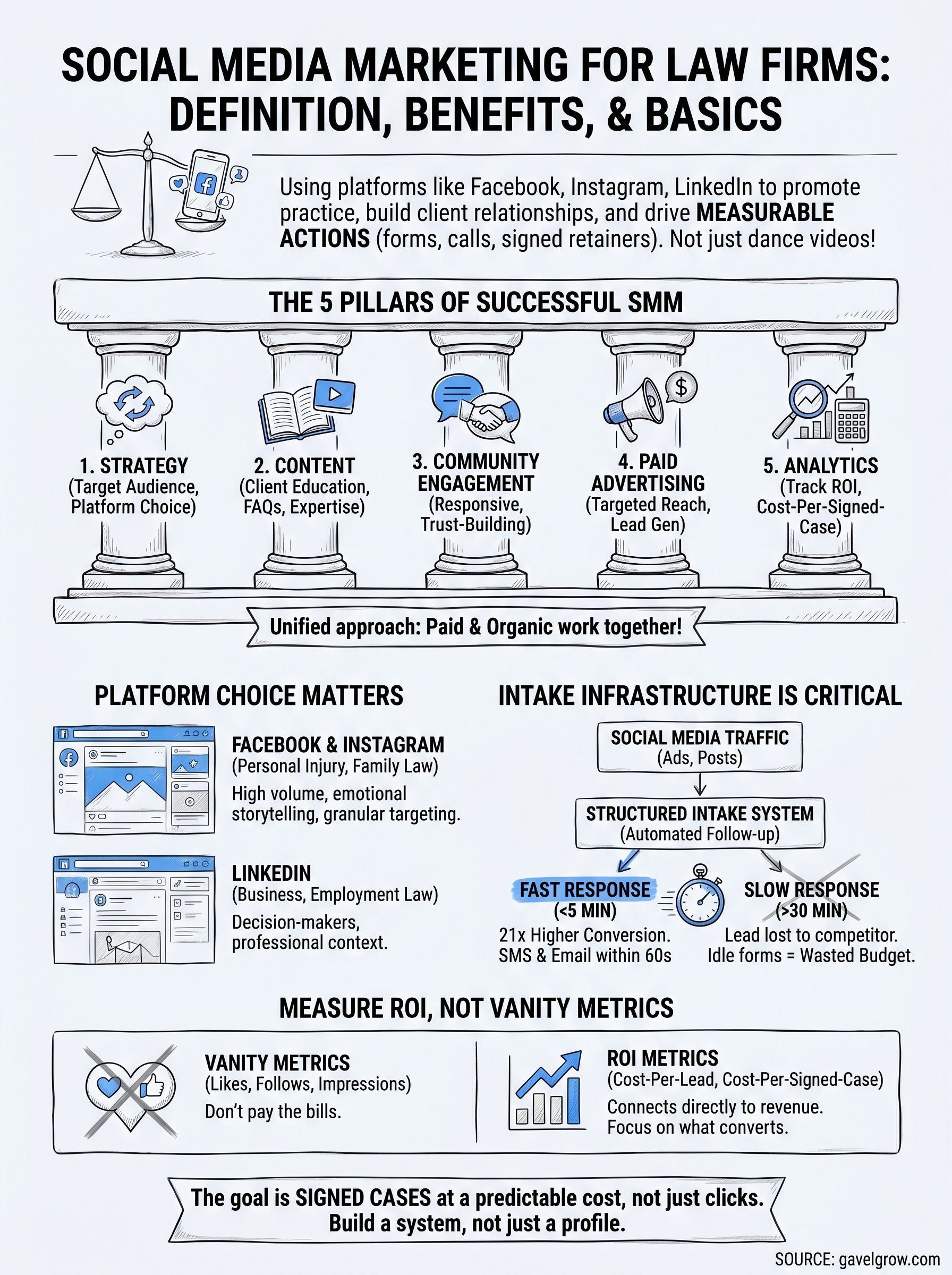
Now you understand what is social media marketing beyond the surface definition: it's a structured, measurable system that runs from platform selection and content strategy through paid campaigns, community engagement, and full-funnel attribution. Every pillar reinforces the others, and every click you generate is only as valuable as the intake infrastructure waiting behind it.
The firms that win on social aren't the ones with the biggest ad budgets. They're the ones that respond fastest, track the right metrics, and connect every lead back to a signed retainer. That process requires the right tools from day one, not a patchwork of disconnected platforms you reconcile manually at month-end.
If you want to see how your current marketing measures up before you scale anything, run your numbers through the GavelGrow cost-per-acquisition calculator to identify exactly where your budget is working and where it isn't.
Frequently Asked Questions
What is social media marketing?
Social media marketing is the practice of using platforms like Facebook, Instagram, LinkedIn, and YouTube to promote a business, build relationships with potential clients, and drive measurable actions such as a form submission, phone call, or signed retainer. It spans both paid advertising and organic content, including posts, video, community engagement, and promoted campaigns. The common thread is intent: every action ties back to a specific business objective.
Which social media platform is best for a law firm?
The best platform depends on your practice area, not personal preference. Facebook and Instagram tend to drive the highest volume for personal injury, mass torts, family law, and criminal defense because the audiences are large and the visual formats support storytelling. LinkedIn fits employment law, business litigation, and estate planning better, and YouTube suits any practice area where client-education video builds trust before the first call.
How do you measure social media marketing ROI for a law firm?
You measure social media ROI by tracking metrics that connect to revenue, not vanity metrics. Follower counts, likes, and impressions tell you nothing about whether campaigns produce cases; the numbers that matter are cost-per-lead, cost-per-consultation, and ultimately cost-per-signed-case. That requires an attribution layer that traces each lead from the originating ad through your intake pipeline to a signed retainer.
Is social media marketing the same as social media management?
No. Social media management is the operational work of scheduling posts and responding to messages, while social media marketing is the strategic work of deciding what to publish, who to target, and how to convert attention into signed clients. The two overlap, but management without marketing strategy often produces a well-maintained profile that generates no leads. Both matter, but only marketing is designed to move your caseload.
How should a beginner law firm start with social media marketing?
A beginner should narrow focus to one platform, one audience segment, and one measurable goal before running anything. Choose the platform where your ideal client already spends time and define a single conversion goal, such as form submissions or booked consultations. Just as importantly, set up your intake first: automated follow-up, a dedicated tracking number per campaign, and outcome logging should be live before your first paid dollar.
Frequently Asked Questions
What is social media marketing?
Social media marketing is the practice of using platforms like Facebook, Instagram, LinkedIn, and YouTube to promote a business, build relationships with potential clients, and drive measurable actions such as a form submission, phone call, or signed retainer. It spans both paid advertising and organic content, including posts, video, community engagement, and promoted campaigns. The common thread is intent: every action ties back to a specific business objective.
Which social media platform is best for a law firm?
The best platform depends on your practice area, not personal preference. Facebook and Instagram tend to drive the highest volume for personal injury, mass torts, family law, and criminal defense because the audiences are large and the visual formats support storytelling. LinkedIn fits employment law, business litigation, and estate planning better, and YouTube suits any practice area where client-education video builds trust before the first call.
How do you measure social media marketing ROI for a law firm?
You measure social media ROI by tracking metrics that connect to revenue, not vanity metrics. Follower counts, likes, and impressions tell you nothing about whether campaigns produce cases; the numbers that matter are cost-per-lead, cost-per-consultation, and ultimately cost-per-signed-case. That requires an attribution layer that traces each lead from the originating ad through your intake pipeline to a signed retainer.
Is social media marketing the same as social media management?
No. Social media management is the operational work of scheduling posts and responding to messages, while social media marketing is the strategic work of deciding what to publish, who to target, and how to convert attention into signed clients. The two overlap, but management without marketing strategy often produces a well-maintained profile that generates no leads. Both matter, but only marketing is designed to move your caseload.
How should a beginner law firm start with social media marketing?
A beginner should narrow focus to one platform, one audience segment, and one measurable goal before running anything. Choose the platform where your ideal client already spends time and define a single conversion goal, such as form submissions or booked consultations. Just as importantly, set up your intake first: automated follow-up, a dedicated tracking number per campaign, and outcome logging should be live before your first paid dollar.