Digital Marketing for Law Firms: What It Is & How It Works
Categories: Legal Marketing Strategies
 Abram Ninoyan
Founder & Senior Performance Marketer
Credentials: Google Partner, Google Ads Search Certified, Google Ads Display Certified, Google Ads Measurement Certified, Google Analytics (IQ) Certified, HubSpot Inbound Certified, HubSpot Social Media Marketing Certified, Conversion Optimization Certified
Expertise: Google Ads, Meta Ads, Conversion Rate Optimization, GA4 & Google Tag Manager, Lead Generation, Marketing Funnel Optimization, PPC Management
LinkedIn Profile
Digital marketing for law firms is the combination of paid ads, SEO, content, and lead-conversion systems that turns online searches into signed retainers, not just phone calls or form fills. Clio's 2...
Key Takeaways
- Digital Marketing for Law Firms: What It Is & How It Works
- Why does digital marketing matter for law firms today?
- How does digital marketing for law firms actually work?
- What channels make up a law firm's digital marketing mix?
Digital Marketing for Law Firms: What It Is & How It Works
Digital marketing for law firms is the combination of paid ads, SEO, content, and lead-conversion systems that turns online searches into signed retainers, not just phone calls or form fills. Many consumers now start their attorney search online, which means your firm's visibility (and what happens after someone clicks) determines whether you grow or stall.
Most explanations of this topic stop at "run some Google Ads and post on social media." That answer misses the part that actually decides revenue: what happens between the click and the signed case. A firm can spend $20,000 a month on ads and still lose money if intake forms take four minutes to load on mobile or nobody calls the lead back within five minutes. Real digital marketing for law firms treats every channel as one connected system, from first ad click to case attribution.
This guide breaks down what digital marketing for law firms actually includes, how the channels work together, what a realistic budget looks like by practice area, and how to measure results using cost-per-signed-case instead of vanity metrics like clicks or form fills.
Why does digital marketing matter for law firms today?
Ask any managing partner from ten years ago how they got new clients, and the answer was probably referrals, bar association directories, or a billboard on the interstate. That world is gone. Search behavior has replaced the old referral pipeline as the primary way people find a lawyer, and firms that haven't rebuilt their client acquisition around that shift are quietly losing market share to firms that have. This isn't a trend piece; it's a budget problem. Every month you delay building a real digital marketing for law firms strategy, a competitor down the street is capturing the searches you're leaving on the table.
Referrals alone don't fill your pipeline anymore
Word-of-mouth still matters, especially in family law and estate planning, but it can't scale a firm past a handful of attorneys. Many consumers now begin their attorney search online rather than asking a friend or colleague first. That means your Google Business Profile, your website, and your paid ad presence now function as your referral network. If a prospective client can't find you, or finds a competitor's better-optimized page first, the referral never happens because the search happened instead.
Your competitors are already bidding on your practice area
Personal injury, mass tort, and criminal defense are some of the most expensive keyword categories in all of Google Ads, with legal terms regularly landing among the highest cost-per-click categories tracked in WordStream's 2024 Google Ads industry benchmarks. That's not an accident. Firms with deep pockets have already figured out that paid search visibility converts, and they're bidding accordingly. Sitting out of digital marketing doesn't protect your budget; it just means you're not competing for cases that are already being decided.
Slow response times cost you the case before you know it exists
Winning the click is only half the battle. The Lead Response Management study, still one of the most-cited benchmarks in legal marketing circles, found that leads contacted within 5 minutes are 21 times more likely to qualify than leads contacted after 30 minutes. A lot of firms spend heavily on ads and SEO, then let a lead sit in a generic inbox for hours because nobody owns intake.
The click doesn't win you the case. What happens in the next five minutes does.
This is exactly why GavelGrow built intake automation directly into the platform rather than as an afterthought. When SMS and email sequences fire within 60 seconds of a lead landing, you're not relying on someone checking their email between meetings. Digital marketing without a fast, compliant intake system is just an expensive way to generate leads for your competitors' follow-up teams.
How does digital marketing for law firms actually work?
Digital marketing for law firms works as a funnel, not a single tactic. Someone searches for "car accident lawyer near me," clicks an ad or organic result, lands on your site, fills out a form or calls, and then either becomes a signed case or disappears into a missed follow-up. Every stage in that chain either adds friction or removes it, and your conversion rate at each step compounds into the final number that matters: cost per signed case, not cost per click.
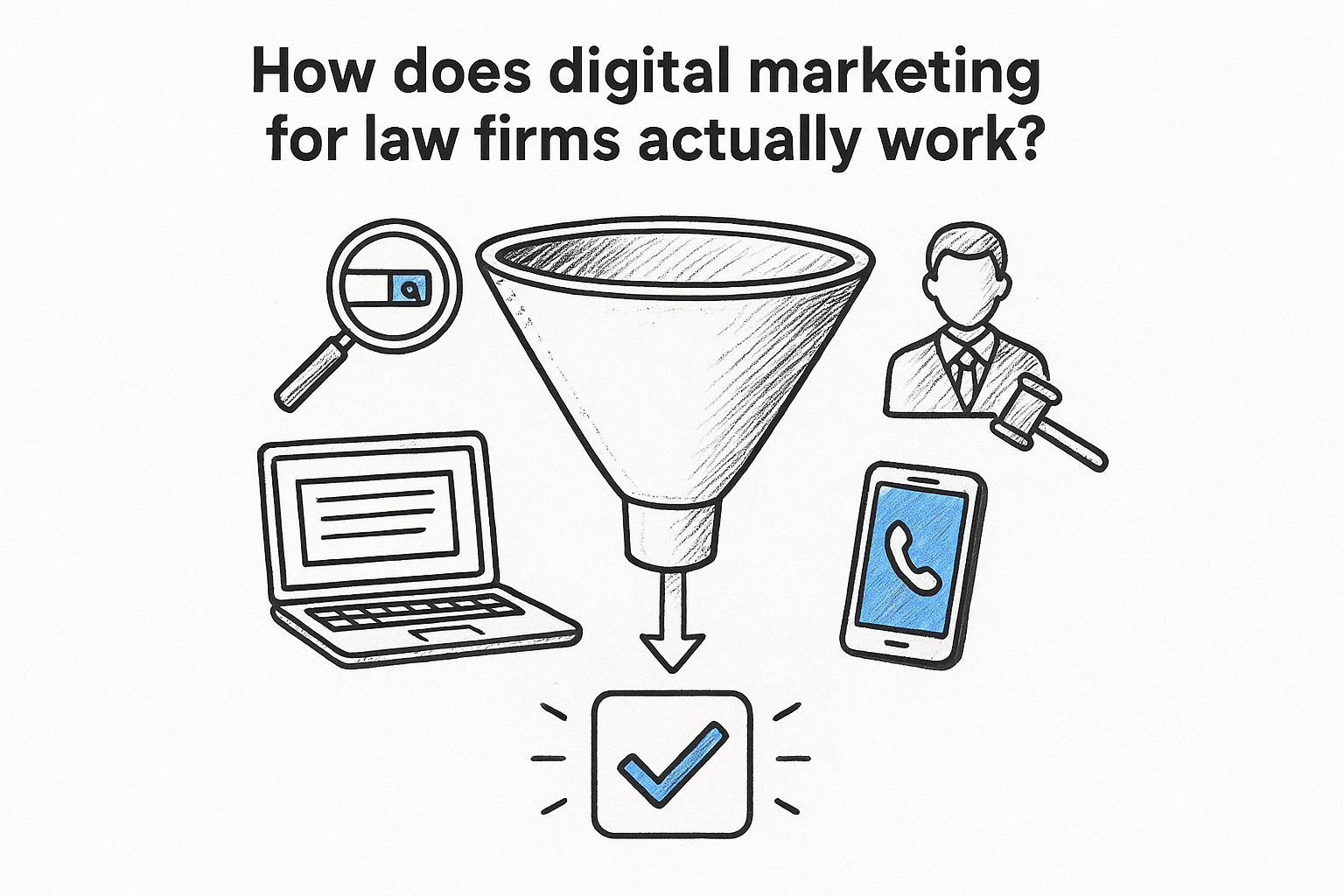
The four stages every firm's funnel moves through
Breaking the funnel down into stages makes it easier to see where leads actually get lost:
- Attraction: paid ads, SEO, and content bring someone to your site
- Capture: an intake form, click-to-call button, or chat widget collects their info
- Conversion: your team contacts them fast enough and qualifies them into a client
- Attribution: you track which channel and campaign produced the signed case
Most firms invest heavily in attraction and almost nothing in the other three stages, which is why marketing spend so often underperforms.
Capture and conversion decide whether attraction pays off
A firm-branded, mobile-first intake form with carrier-level phone validation converts noticeably better than a generic contact form built for desktop users, because most legal searches now happen on a phone. Bot protection and duplicate detection matter here too. Without them, you pay for clicks that never turn into real leads. This is where GavelGrow's hosted and embeddable intake forms earn their place in the stack instead of treating forms as an afterthought.
A funnel is only as strong as its weakest stage, and for most firms that's intake, not ad spend.
Attribution is what turns activity into strategy
Without attribution tying a signed case back to its originating ad, keyword, or campaign, you're guessing which channels deserve more budget next month. Full-funnel tracking, from first click through signed retainer, is what separates firms that scale their spend confidently from firms that keep reallocating budget based on gut feel.
What channels make up a law firm's digital marketing mix?
A healthy digital marketing for law firms mix rarely relies on one channel. Most firms that consistently sign cases blend paid search, local SEO, content, and reputation management, then route everything through the same intake system so leads don't fall through the cracks between channels. Channel diversification protects you when one platform's costs spike or its algorithm shifts.
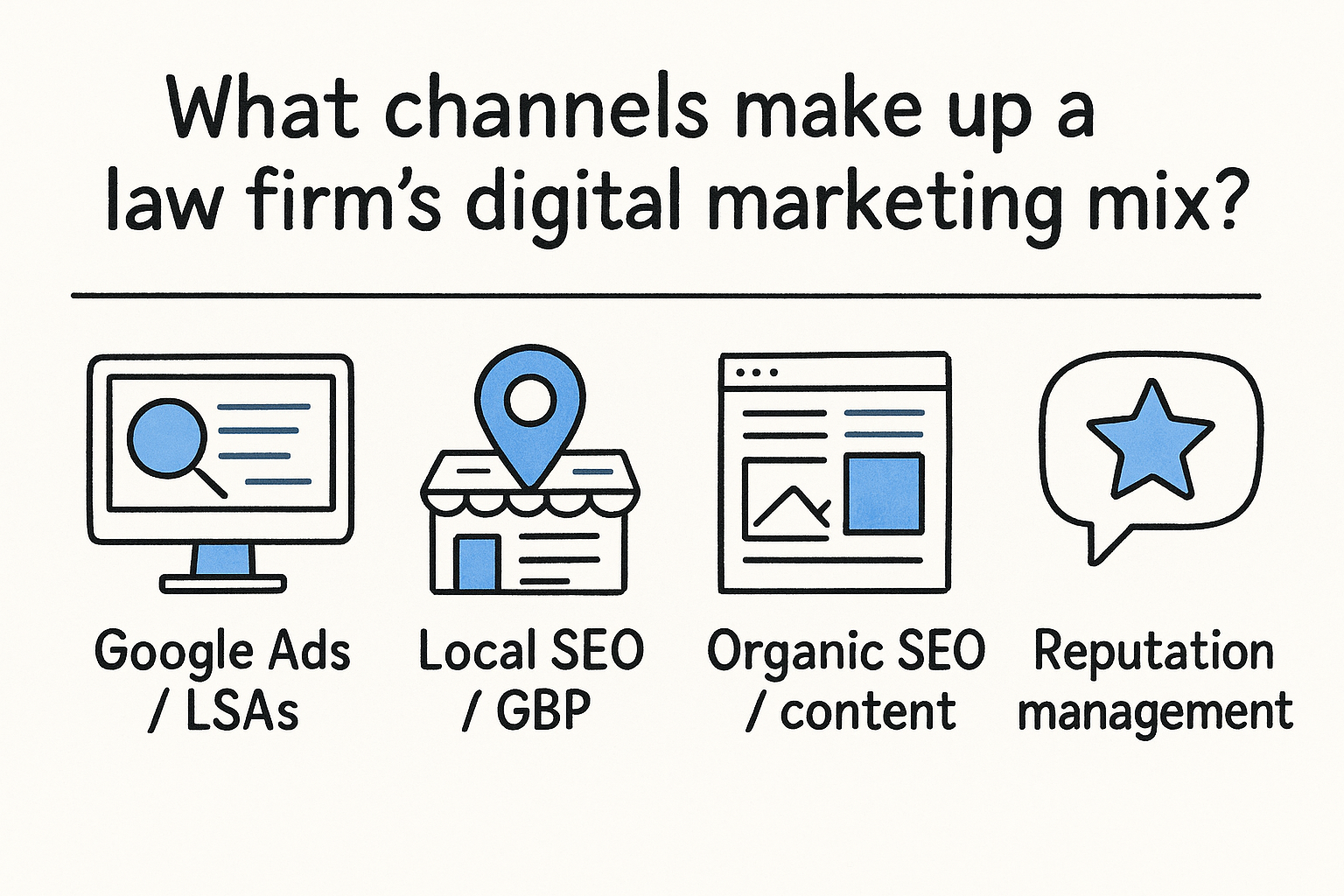
Paid search and Local Services Ads move fastest
Google Ads and Local Services Ads put your firm in front of someone actively searching for representation right now, which makes them the fastest lever for lead volume when a practice area needs cases this quarter. LSAs also carry a Google-verified badge that builds trust before the click even happens, something Google's own guidance on Local Services Ads explains in more detail.
SEO and Google Business Profile build compounding visibility
Organic rankings and a well-maintained Google Business Profile cost less per lead over time than paid channels, but they take months to build. Firms that treat SEO as a one-time project instead of ongoing work usually watch rankings slip within a year as competitors keep publishing and earning links.
No single channel replaces the others; each one covers a gap the rest leave open.
Reputation and content nurture the leads you already have
Five-star reviews and consistent content, from blog posts to case-result pages, don't just attract new searches; they reassure prospects mid-decision and shorten the sales cycle. Reviewing GavelGrow's managed services for reputation and content shows how firms combine these with paid channels instead of running them separately.
How do you measure ROI from your marketing spend?
Real ROI in digital marketing for law firms isn't clicks, impressions, or even leads. It's cost-per-signed-case, the dollar amount you spend to produce one client who actually retains your firm. Anything short of that number is a proxy metric that can mislead you into scaling the wrong campaign.
Cost-per-lead hides the real story
Comparing campaigns by cost-per-lead alone rewards whichever channel produces the cheapest, lowest-quality leads. A $40 lead that never answers the phone is worthless next to a $200 lead that signs a $15,000 case. Practice-area context matters here too, since a personal injury lead and an estate planning lead carry very different lifetime values, so blending them into one average number tells you almost nothing useful.
If you're not measuring cost-per-signed-case, you're optimizing for the wrong number.
Track the full path, not just the first click
Getting to cost-per-signed-case means connecting four data points for every lead:
- Which campaign, ad, or keyword generated the click
- Which form or call captured the lead
- Whether intake contacted them fast enough to convert
- Whether the lead became a signed, retained case
Missing any one of these links breaks the chain, and you're back to guessing which channels deserve more budget.
Benchmarks tell you if your number is actually good
Say your cost per signed case is $900. That might sound high, until a comparison suggests firms like yours typically land closer to $1,400. Without a comparison point, every number looks either fine or alarming depending on your mood that month. GavelGrow's modelled practice-area benchmarks exist so firms can see where their cost per signed case sits against modelled ranges for comparable firms, instead of guessing in a vacuum.
What mistakes cause law firms to waste marketing budget?
Budgets leak in predictable places, and most firms repeat the same handful of mistakes year after year. Wasted ad spend almost never comes from a bad keyword strategy alone; it comes from what happens after the click, or from measuring the wrong thing entirely. Spotting these patterns early saves you months of throwing money at a campaign that was never going to work.
Chasing lead volume instead of signed cases
Switching budget toward whichever channel produces the cheapest leads feels productive, but it usually rewards volume over quality. A campaign generating 200 leads at $30 each looks great until you realize only 4 ever answered a follow-up call. Lead quality matters more than lead count, and firms that don't track cost-per-signed-case keep funding the wrong campaigns month after month.
A cheap lead that never signs costs more than an expensive one that does.
Letting intake lag behind ad spend
Firms routinely scale ad budgets without touching intake capacity, and the math falls apart fast. Doubling ad spend without doubling your ability to respond within minutes just means more leads sit unanswered. Speed-to-lead failures are the single most common reason a well-targeted campaign underperforms on paper.
Copying generic templates that ignore legal's sales cycle
Many firms hire agencies that apply the same playbook used for restaurants or roofers, ignoring that legal often runs a 6 to 12 month sales cycle. That mismatch shows up as impatience, cutting a campaign after 60 days when it needed 6 months to mature, or as compliance gaps around state-bar advertising rules.
Common budget-wasters worth auditing this quarter:
- No fast, TCPA-compliant follow-up sequence after form submission
- Mobile intake forms that take longer than 30 seconds to complete
- No campaign-level attribution tying spend to signed retainers
- Judging campaigns by cost-per-lead instead of cost-per-signed-case
- Running the same messaging across practice areas with different sales cycles
GavelGrow's managed services exist partly to catch these gaps for firms that would rather have a strategist audit the funnel than discover the leak themselves six months in.
Turning clicks into signed cases
Digital marketing for law firms only works when you treat it as one connected system, not a pile of separate tactics. Attraction gets someone to click, but capture, conversion, and attribution decide whether that click ever becomes a retainer. Firms that win consistently aren't necessarily outspending everyone else; they're closing the gaps between ad spend and intake, and they're measuring cost-per-signed-case instead of chasing cheap leads that never answer the phone.
If you've read this far, you probably already suspect where your funnel is leaking. The fastest way to find out for certain is to get a second set of eyes on it. Book a free strategy call with GavelGrow, and we'll walk through your current funnel, compare it with modelled benchmarks for your practice area, and show you where budget is slipping through the cracks before you spend another dollar guessing.
Frequently Asked Questions
What is digital marketing for law firms?
Digital marketing for law firms is the combination of paid ads, SEO, content, and lead-conversion systems that turns online searches into signed retainers — not just website visits or phone calls. It spans attraction (getting found), capture (turning visitors into leads), conversion (turning leads into clients), and attribution (knowing which spend produced which case), managed as one connected system.
Why do law firms need digital marketing?
Because referrals alone no longer fill the pipeline, and prospects overwhelmingly start their search for a lawyer online. Competitors are already bidding on your practice-area keywords, and slow response times lose cases before you know they exist. Digital marketing puts your firm where clients are looking and, done right, converts that visibility into signed cases faster than word-of-mouth alone.
What channels are part of law firm digital marketing?
The core mix is paid search and Local Services Ads (fastest to produce leads), SEO and a strong Google Business Profile (compounding, lower-cost visibility over time), and reputation plus content marketing (which nurture and convert the leads you already have). Most firms combine all three — ads for speed, SEO for durability, and reviews and content for trust.
How much does digital marketing cost for a law firm?
It varies widely by practice area, market competitiveness, and channel mix — from a few thousand a month for a solo practice to much more in fields like personal injury. Rather than a flat figure, work backward from case value: estimate what a signed case is worth and your cost to acquire one, then budget to produce cases profitably. Judge it by cost per signed case, not traffic.
How do you measure digital marketing ROI for a law firm?
Track the full path from click to signed case, not surface metrics like traffic or impressions. The numbers that matter are cost per lead, lead-to-consultation rate, intake-to-retainer conversion, and cost per signed case by channel. Attribution — connecting each lead source through intake to a retained client — is what turns marketing activity into a measurable strategy.
How long does digital marketing take to work for a law firm?
It depends on the channel. Paid ads and Local Services Ads can generate leads within days; SEO, content, and reputation-building typically take three to twelve months to compound into steady case flow. The firms that grow fastest run paid channels for immediate leads while investing in SEO and reviews for durable, lower-cost pipeline over time.
Should a law firm handle digital marketing in-house or hire an agency?
Small firms with a marketing-minded partner can start in-house on the basics — Google Business Profile, reviews, and a few practice-area pages. But paid ads, technical SEO, and full-funnel attribution take specialized time and tools, so firms that want faster results or lack the bandwidth usually get more from an agency — ideally one that reports on signed cases, not just clicks.
Frequently Asked Questions
What is digital marketing for law firms?
Digital marketing for law firms is the combination of paid ads, SEO, content, and lead-conversion systems that turns online searches into signed retainers — not just website visits or phone calls. It spans attraction (getting found), capture (turning visitors into leads), conversion (turning leads into clients), and attribution (knowing which spend produced which case), managed as one connected system.
Why do law firms need digital marketing?
Because referrals alone no longer fill the pipeline, and prospects overwhelmingly start their search for a lawyer online. Competitors are already bidding on your practice-area keywords, and slow response times lose cases before you know they exist. Digital marketing puts your firm where clients are looking and, done right, converts that visibility into signed cases faster than word-of-mouth alone.
What channels are part of law firm digital marketing?
The core mix is paid search and Local Services Ads (fastest to produce leads), SEO and a strong Google Business Profile (compounding, lower-cost visibility over time), and reputation plus content marketing (which nurture and convert the leads you already have). Most firms combine all three — ads for speed, SEO for durability, and reviews and content for trust.
How much does digital marketing cost for a law firm?
It varies widely by practice area, market competitiveness, and channel mix — from a few thousand a month for a solo practice to much more in fields like personal injury. Rather than a flat figure, work backward from case value: estimate what a signed case is worth and your cost to acquire one, then budget to produce cases profitably. Judge it by cost per signed case, not traffic.
How do you measure digital marketing ROI for a law firm?
Track the full path from click to signed case, not surface metrics like traffic or impressions. The numbers that matter are cost per lead, lead-to-consultation rate, intake-to-retainer conversion, and cost per signed case by channel. Attribution — connecting each lead source through intake to a retained client — is what turns marketing activity into a measurable strategy.
How long does digital marketing take to work for a law firm?
It depends on the channel. Paid ads and Local Services Ads can generate leads within days; SEO, content, and reputation-building typically take three to twelve months to compound into steady case flow. The firms that grow fastest run paid channels for immediate leads while investing in SEO and reviews for durable, lower-cost pipeline over time.
Should a law firm handle digital marketing in-house or hire an agency?
Small firms with a marketing-minded partner can start in-house on the basics — Google Business Profile, reviews, and a few practice-area pages. But paid ads, technical SEO, and full-funnel attribution take specialized time and tools, so firms that want faster results or lack the bandwidth usually get more from an agency — ideally one that reports on signed cases, not just clicks.