Marketing for Attorneys: 12 Strategies to Win More Clients
Categories: Legal Marketing Strategies
 Abram Ninoyan
Founder & Senior Performance Marketer
Credentials: Google Partner, Google Ads Search Certified, Google Ads Display Certified, Google Ads Measurement Certified, Google Analytics (IQ) Certified, HubSpot Inbound Certified, HubSpot Social Media Marketing Certified, Conversion Optimization Certified
Expertise: Google Ads, Meta Ads, Conversion Rate Optimization, GA4 & Google Tag Manager, Lead Generation, Marketing Funnel Optimization, PPC Management
LinkedIn Profile
Most law firms treat marketing for attorneys like a checklist: get a website, run some ads, post on LinkedIn, hope the phone rings. That approach burns budget without moving the number that actually m...
Key Takeaways
- Marketing for Attorneys: 12 Strategies to Win More Clients
- 1. Centralize your marketing data in one legal platform
- 2. Optimize your Google Business Profile for local search
- 3. Run targeted Google Ads and Local Services Ads
Marketing for Attorneys: 12 Strategies to Win More Clients
Most law firms treat marketing for attorneys like a checklist: get a website, run some ads, post on LinkedIn, hope the phone rings. That approach burns budget without moving the number that actually matters, signed cases. The Lead Response Management Study found that leads contacted within five minutes were 21 times more likely to qualify than those first reached at thirty minutes, which tells you the problem usually isn't visibility. It's what happens after someone finds you.
This article gives you a practical plan, not vague advice about "building your brand." You'll get 12 tested strategies covering paid search, local SEO, referral systems, review generation, and the intake mechanics that turn clicks into retainers. Each one is something you can implement this quarter, whether you're a solo practitioner or running marketing for a 15-attorney firm.
We'll walk through what to prioritize first, how to measure whether a tactic is working past vanity metrics like lead volume, and where most firms leave money on the table between ad click and signed case. If you're tired of agencies pitching generic tactics that ignore how long legal sales cycles actually run, this is the list built for how your practice really wins clients.
1. Centralize your marketing data in one legal platform
Before you spend another dollar on ads, fix the plumbing. Most firms run Google Ads in one tab, CallRail in another, and a spreadsheet to track which leads actually signed. Marketing for attorneys falls apart at exactly this seam, because nobody can see which campaign produced a signed case versus which one just produced a phone call that went nowhere. A centralized platform closes that gap by tying every lead to its originating ad, its call recording, and its final case status in one view.
How it works
GavelGrow's dashboard pulls in Google Ads spend daily through a native sync, tracks every inbound call with per-campaign tracking numbers, and follows each lead through the pipeline to a signed retainer or a closed-lost tag. That means you get cost-per-signed-case instead of cost-per-lead, which is the number that actually tells you whether a campaign is profitable. The platform also shows your numbers next to modelled benchmark ranges for your practice area and market size, so you can judge whether a cost per case looks competitive or bloated.
If you can't trace a signed case back to the ad that produced it, you're guessing, not marketing.
Who it's for
This fits any firm currently juggling three or more disconnected tools, CallRail for calls, a generic CRM for intake, and a spreadsheet or agency report for attribution. Solo practitioners get the biggest relief here because they don't have staff time to manually reconcile data across systems every week. Mid-size firms with 5 to 15 attorneys benefit just as much, since managing partners need one dashboard instead of asking three vendors for three different reports that never agree.
Cost and expected timeline
GavelGrow's platform runs $199 to $599 a month depending on tier, with a 7-day free trial that requires no credit card. Most firms replace CallRail, a separate intake tool, and manual reporting spreadsheets within the first billing cycle, which alone often covers the subscription cost.
Expect a working setup within a week: connect your Google Ads account, port your phone numbers, and you'll have full-funnel attribution live before your next ad spend cycle starts. Check the platform overview for the full feature breakdown by tier.
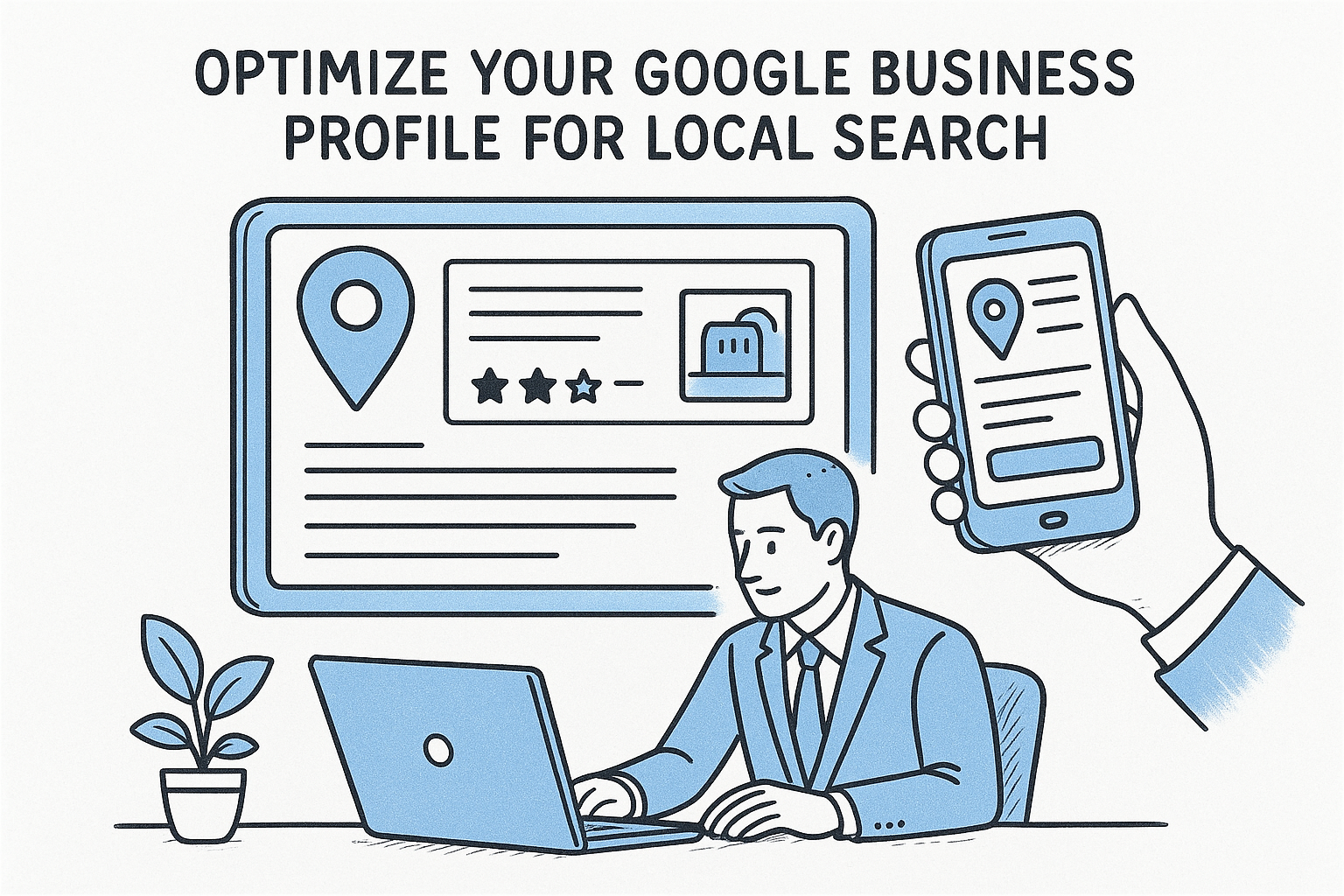
2. Optimize your Google Business Profile for local search
When someone searches "personal injury lawyer near me," Google pulls answers from your Google Business Profile before it ever looks at your website. This is free real estate that most firms half-fill and forget, which is a mistake for any marketing for attorneys strategy focused on local clients. A complete, active profile shows up in the map pack, the three-listing block that sits above organic results, and that's where most local searches actually convert.
How it works
Claim your profile, fill every field, categories, hours, service areas, attorney bios, and add photos of your office and team. Post updates weekly, respond to every review within 48 hours, and keep your practice areas listed as services so Google can match you to specific searches like "DUI attorney" or "estate planning lawyer."
A half-finished Google Business Profile hands local clients straight to competitors who bothered to finish theirs.
Who it's for
This matters most for firms serving a single metro area or county, personal injury, family law, criminal defense, and immigration practices especially. If you compete on local visibility rather than national mass-tort reach, this is one of the highest-return tactics available and it costs nothing but time.
Cost and expected timeline
Optimization itself is free. Budget two to three hours for setup, then 30 minutes weekly for posts and review responses. Expect ranking movement in the map pack within 4 to 8 weeks, faster in less competitive markets. Pair this with the managed local SEO services if you don't have staff time to maintain it.
3. Run targeted Google Ads and Local Services Ads
Google Ads and Local Services Ads (LSAs) put your firm in front of someone the moment they search "car accident lawyer" or "divorce attorney near me." These are the two paid channels that dominate marketing for attorneys because legal searches carry high intent and clients rarely browse past the first few results. LSAs run on a pay-per-lead model and display a Google Screened badge, which builds trust before the click even happens.
How it works
Google Ads targets specific keywords and geographies with text ads that link to a landing page or intake form. LSAs work differently: Google vets your license and insurance, then charges you per qualified lead rather than per click, and ranks you based on responsiveness and reviews. Run both together and you cover intent-based search traffic plus the trust-badge placement LSAs offer. Feed both channels into a call tracking system so you know which platform actually produces signed cases, not just phone calls.
Paid search only pays off if you can trace the click all the way to a signed retainer.
Who it's for
Firms in competitive practice areas, personal injury, mass torts, and criminal defense, see the fastest returns because search volume is high and case values justify the spend. Solo and small firms should start with LSAs since the per-lead pricing caps downside risk better than open-ended Google Ads budgets.
Cost and expected timeline
Budget $2,000 to $25,000 a month depending on market size and competition, plus either a self-managed setup or a managed Google Ads service starting at $10,000 a month. Expect qualified leads within the first week and a stable cost-per-signed-case within 60 to 90 days.
4. Build a content engine around client questions
Every client who calls your firm typed a question into Google first. "What happens if I get rear-ended in a no-fault state?" "Can I file for custody without a lawyer?" A content engine answers those exact questions on your site before a competitor does, and it compounds over time instead of shutting off the moment you stop paying for ads. This is the slowest strategy on this list to show results, but it's also the one that keeps working after you've stopped writing new pages.
How it works
Pull real questions from your intake calls, past client emails, and the unified inbox if you're already running leads through a platform like GavelGrow. Write a page or post that answers each one directly, in plain language, with your firm's actual experience handling that situation. Publish consistently, one to two pieces a week is realistic for most firms, and link related pages together so Google understands the topic cluster.
Content built from real client questions outranks generic blog posts because it answers what people actually type into Google.
Who it's for
This fits firms with a long sales cycle and high case values, estate planning, immigration, business law, and family law especially, where prospects research for weeks before calling. It also suits firms willing to commit to a schedule rather than publishing in bursts and abandoning it after three months.
Cost and expected timeline
DIY costs only time, roughly 3 to 5 hours per piece including research and editing. Outsourced content production through a managed content marketing service typically runs $2,000 to $6,000 a month depending on volume. Expect meaningful organic traffic in 4 to 6 months, not weeks.
5. Use social media to build trust and referrals
Social media rarely closes a case on its own, but it does something ads and SEO can't: it shows prospects and referral sources what you're like before they ever call. For marketing for attorneys, platforms like Facebook, Instagram, and LinkedIn work best as a trust layer, proof that you're active, responsive, and actually practicing the law you claim to know. Firms that treat social as a referral channel, not a lead-gen channel, get more out of it than those chasing viral posts.
How it works
Post consistently, three to five times a week, mixing case results (anonymized and compliant with your state bar's rules), client testimonials, staff introductions, and short explainers on common legal questions. LinkedIn works best for referral relationships with other attorneys and professionals; Facebook and Instagram work best for consumer-facing practice areas like family law and personal injury. Respond to every comment and message within a few hours, since slow replies undercut the responsiveness you're trying to demonstrate.
Social media sells trust, not cases, and trust is what turns a stranger into a referral.
Who it's for
This suits firms building a referral network among other attorneys, financial advisors, and past clients, and consumer-facing practices where prospects check a firm's page before calling. Mass-tort and B2B-heavy practices see less direct return here.
Cost and expected timeline
DIY social costs mostly time, 3 to 5 hours a week for posting and engagement. A managed social strategy runs alongside broader retention and referral programs for firms without in-house staff. Expect visible trust-building and referral upticks within 3 to 6 months of consistent posting.
6. Send email newsletters that keep clients engaged
A signed retainer isn't the finish line. Past clients refer new business, leave reviews, and come back for future legal needs, but only if they remember you exist. Email newsletters keep your firm visible between cases without costing much or requiring daily attention, and they're one of the most overlooked pieces of marketing for attorneys because firms treat email as an afterthought instead of a retention tool.
How it works
Send a monthly or biweekly newsletter mixing legal updates relevant to your practice area, firm news, case result highlights, and a direct ask for reviews or referrals. Segment your list by practice area and case status so a closed personal injury client gets different content than an active family law client. Keep it short, one useful update and one call to action beats a five-topic digest nobody finishes reading.
A newsletter that keeps ex-clients thinking of you is cheaper than any ad campaign built to find new ones.
Who it's for
This fits firms with practice areas that generate repeat or referral business, estate planning, family law, business law, and personal injury especially. Firms sitting on a large list of past clients they haven't emailed in over a year should start here before spending more on new-lead channels, since reactivating dormant relationships is far cheaper than acquiring strangers.
Cost and expected timeline
A basic email platform runs $20 to $100 a month depending on list size. Budget 2 to 3 hours monthly for writing and sending. Expect a steady trickle of referrals and repeat inquiries within 2 to 3 months of consistent sending, and better results once you pair it with the review-request timing covered next.
7. Manage reviews to boost reputation and rankings
Reviews decide two things at once: whether a prospect trusts you enough to call, and whether Google ranks your Google Business Profile above the firm down the street. BrightLocal's 2024 Local Consumer Review Survey found 91% of consumers read reviews before choosing a local business, and legal buyers weigh them even more heavily given how high the stakes feel. Review management isn't a one-time push after a good case, it's an ongoing system built into how your firm closes matters. Skip it and you're leaving your reputation to whoever happens to feel strongly enough to leave a review unprompted, usually an unhappy client.
How it works
Build the ask into your case-closing checklist so every satisfied client gets a review request within days of settlement or resolution, not months later when the memory has faded. Send the request by text and email, since text messages get opened faster, and link directly to your Google profile to cut friction. Respond to every review, good or bad, within 48 hours; a thoughtful reply to a negative review often does more for trust than another five-star post.
A firm that asks for reviews systematically outranks one that hopes clients remember to leave them.
Who it's for
Every firm needs this, but it matters most where local search competition is fierce, personal injury, family law, and criminal defense in dense metro markets.
Cost and expected timeline
DIY review requests cost nothing but staff time to send consistently. GavelGrow's managed reputation management service automates the ask and monitors responses for firms without spare staff hours. Expect a visible uptick in review volume within 30 days and ranking movement within 2 to 3 months.
8. Grow referral relationships and professional networks
Some of your best cases never touch a Google ad. They come from another attorney who doesn't handle your practice area, a financial advisor whose client just got divorced, or a past client who trusts you enough to mention your name at dinner. Referral relationships compound the way content does, quietly, over years, and they cost far less per signed case than most paid channels once they're established. Firms serious about marketing for attorneys treat referral development as a system, not a lucky byproduct of doing good work.
How it works
Start with attorneys practicing adjacent areas: a family law attorney refers estate planning work, an immigration attorney refers business formation, a criminal defense attorney refers civil claims tied to the same incident. Build the relationship first, coffee, shared CLE events, actual case collaboration, before ever asking for a referral. Track every referral source in your case management system so you know who sends real business and who's just friendly, then reciprocate to the ones who deliver.
Referral relationships built on genuine trust outlast any ad campaign and cost a fraction as much per case.
Who it's for
This fits nearly every practice area, but it's especially strong for estate planning, family law, business law, and personal injury, where cross-referrals between specialties happen naturally. Solo practitioners without ad budgets should prioritize this over paid channels early on.
Cost and expected timeline
Expect to spend time, not money: a few hours a month on networking events, lunches, and follow-up calls. Formal referral programs with tracked incentives may cost a few hundred dollars in gifts or events annually. Meaningful referral flow typically takes 6 to 12 months to build, since trust between professionals doesn't form overnight, but it holds steady far longer than any single ad campaign once established.
9. Optimize your website and intake forms for conversions
Traffic without conversion just burns your ad budget. Your website might rank well and your ads might drive clicks, but if the intake form takes four minutes to fill out on a phone screen, most prospects bail before they hit submit. This is the leak most firms never see because they're watching lead volume instead of the drop-off between click and completed form, and it's one of the costliest gaps in marketing for attorneys today.

How it works
Strip your intake form down to the fields you actually need on the first step: name, phone, and case type. Mobile-first, multi-step forms convert far better than long single-page ones, since desktop conversion typically outpaces generic mobile forms by a wide margin. Add instant email and SMS auto-replies so the prospect knows their submission went through, and layer in bot protection and duplicate detection so your team isn't wading through spam. GavelGrow's hosted and embeddable forms handle all of this out of the box, with a TCPA consent audit log built in.
A slow, clunky intake form loses more clients than a weak ad ever will.
Who it's for
Any firm running paid traffic or organic search needs this, but it matters most for firms with mobile traffic above 60%, which is most personal injury and family law sites.
Cost and expected timeline
A rebuild or embed typically takes one to two weeks. GavelGrow's forms are included in every platform tier starting at $199 a month. Expect conversion lift within 30 days of launch.
10. Create video and podcast content to show expertise
Text answers a question, but video and podcast content let a prospect hear how you explain things before they ever sit across from you in a consultation. That matters in legal marketing more than most industries, because clients are hiring a person, not just a firm name, and video shows judgment and tone in a way a blog post can't. A short video answering "what should I do after a car accident" builds more trust in 90 seconds than a page of text does in five minutes.

How it works
Record short videos, three to five minutes, answering the same client questions driving your content engine, then repurpose them as podcast episodes, social clips, and embedded video on your practice-area pages. Keep production simple: a decent phone camera, natural light, and a lapel mic beat a scripted studio setup that feels stiff. Publish on YouTube first since it doubles as a search engine, then distribute clips to social and your newsletter list.
A prospect who's already watched you explain a legal issue calls you already trusting your judgment.
Who it's for
This fits attorneys comfortable on camera and practices where trust and personality drive the hiring decision, personal injury, family law, criminal defense, and estate planning especially. Mass-tort intake operations see less benefit since volume matters more than personal connection there.
Cost and expected timeline
DIY setup costs under $300 in equipment and a few hours weekly for filming and editing. A managed video and podcast strategy runs alongside broader content services for firms without in-house production time. Expect early traction in 2 to 3 months, with compounding search and referral value building over 6 months or longer.
11. Niche down to become the go-to attorney in your market
General practice firms compete against every other general practice firm in town, and prospects have no reason to pick one over another. Niching down flips that problem: when you become the DUI attorney or the trucking-accident lawyer in your metro area, you stop competing on price and start competing on reputation. Search engines reward this too, since a site built entirely around one practice area signals topical authority that a scattered generalist page can't match. This is one of the simplest shifts in marketing for attorneys, and one of the hardest for firms to actually commit to.
How it works
Pick a practice area where you already win cases well and where demand is steady in your market, then rebuild your website, ads, and content around that specialty first. Rename service pages, retarget your Google Ads campaigns to specialty keywords like "motorcycle accident lawyer" instead of generic "personal injury lawyer," and mention the niche in every bio, review request, and referral conversation. Keep other practice areas on the site, but stop leading with them.
The attorney known for one thing beats ten attorneys known for nothing in particular.
Who it's for
This fits firms in crowded metro markets where generic personal injury or family law positioning gets drowned out, and solo practitioners who need a wedge against firms with bigger ad budgets.
Cost and expected timeline
Repositioning costs mostly time: a few weeks to rewrite pages and retarget campaigns, plus ongoing content aimed at the niche. Expect referral and search visibility gains within 3 to 6 months as the market starts associating your name with that specialty.
Building a marketing plan that fits your firm
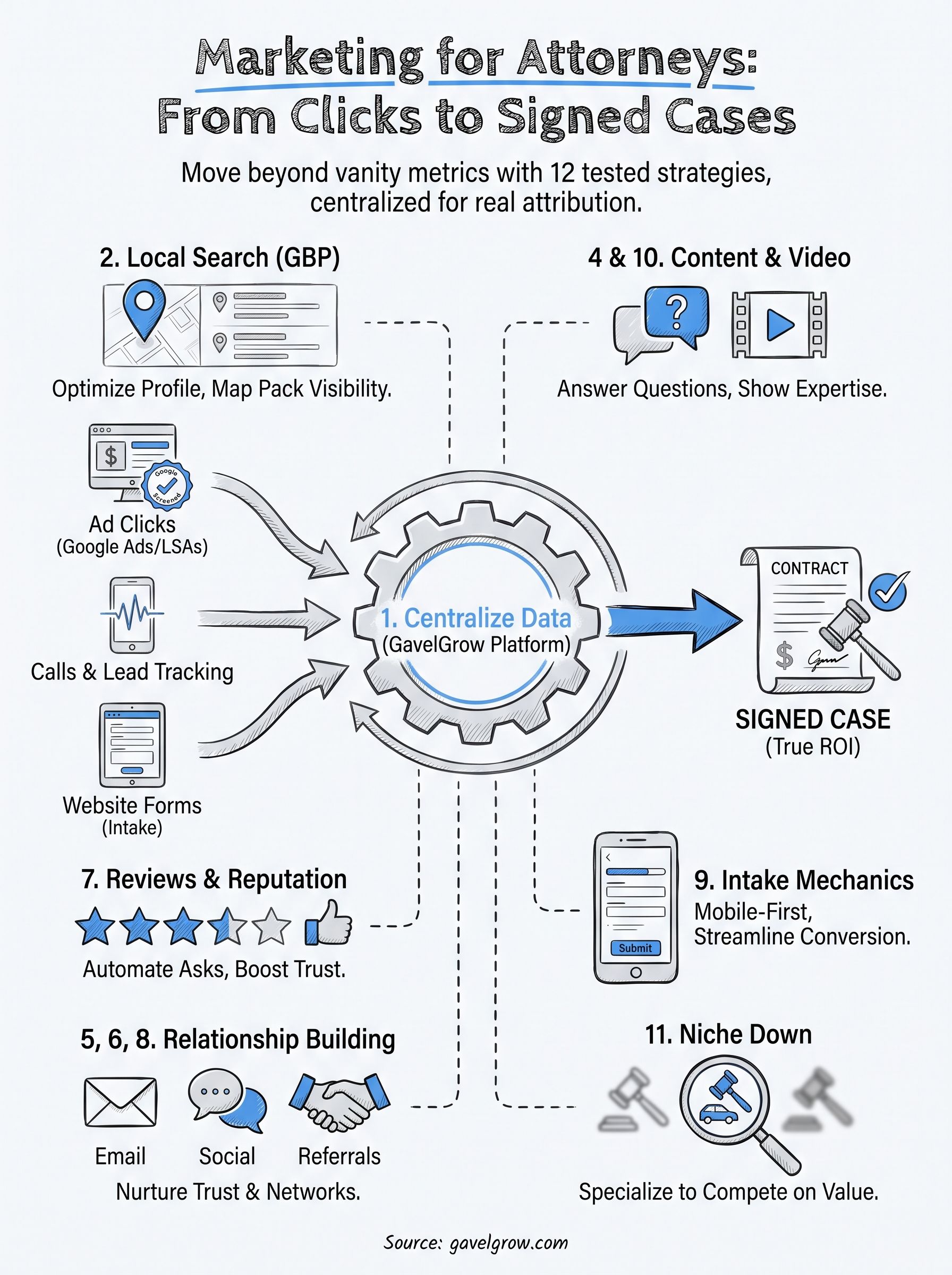
You don't need all 12 strategies running at once. Pick two or three that match your practice area and budget, fix your intake mechanics first, then layer in content, reviews, and referrals as you have bandwidth. Marketing for attorneys works best as a system where each piece feeds the next, not a pile of disconnected tactics competing for attention.
Start with whatever's leaking the most cases right now. If you can't tell which campaigns produce signed retainers, that's your first fix. If your intake form loses mobile visitors before they submit, fix that before spending another dollar on ads. Centralized attribution is what makes every other strategy on this list measurable instead of guesswork.
If you want a second opinion on where your firm should focus first, book a free strategy call and we'll walk through your current setup together.
Frequently Asked Questions
What is the most effective marketing for attorneys?
The most effective attorney marketing treats channels as a connected system rather than a checklist: local SEO and a strong Google Business Profile to capture high-intent searches, targeted Google and Local Services Ads for immediate leads, content that answers real client questions, and fast intake to convert them. The firms that win tie every channel back to signed cases, not vanity metrics like clicks or impressions.
How much should an attorney spend on marketing?
There is no universal figure — it depends on your practice area, market competitiveness, and growth goals, and can range from a few thousand a month for a solo practice to much more in competitive fields like personal injury. Rather than a flat percentage, work backward from case value: estimate what a signed case is worth and your cost to acquire one, then budget to produce cases profitably.
How do attorneys get more clients?
Primarily by being visible where clients search and converting that visibility fast. That means ranking in local and organic search, running targeted ads for high-intent queries, collecting reviews for social proof, and responding to inquiries in minutes rather than hours. Getting found matters, but a fast, organized intake process is what turns attention into signed cases.
What is the best marketing strategy for a small law firm or solo attorney?
Focus beats breadth. A small firm or solo attorney gets the most from dominating local search in its market, systematically collecting reviews, and building referral relationships — all lower-cost than broad paid campaigns. Pick two or three channels you can execute consistently and measure, instead of spreading a limited budget thin across everything.
Is marketing for attorneys different from other industries?
Yes, in two important ways. Legal advertising is governed by state bar rules on claims, testimonials, and disclaimers, so compliance matters more than in most industries. And legal decisions are high-stakes and trust-driven, which is why reputation, reviews, and educational content tend to outperform hard-sell tactics. Attorney marketing rewards credibility over volume.
How do you measure the ROI of attorney marketing?
Track the full path from click to signed case, not surface metrics like traffic or impressions. The numbers that matter are cost per lead, lead-to-consultation rate, intake-to-retainer conversion, and cost per signed case by channel. Full-funnel attribution — connecting each lead source through intake to a retained client — is the only way to know which marketing actually pays for itself.
How long does attorney marketing take to produce results?
It depends on the channel. Paid ads and Local Services Ads can generate leads within days; SEO, content, and reputation-building typically take three to twelve months to compound into steady case flow. The firms that grow fastest run paid channels for immediate leads while investing in SEO and reviews for durable, lower-cost pipeline over time.
Frequently Asked Questions
What is the most effective marketing for attorneys?
The most effective attorney marketing treats channels as a connected system rather than a checklist: local SEO and a strong Google Business Profile to capture high-intent searches, targeted Google and Local Services Ads for immediate leads, content that answers real client questions, and fast intake to convert them. The firms that win tie every channel back to signed cases, not vanity metrics like clicks or impressions.
How much should an attorney spend on marketing?
There is no universal figure — it depends on your practice area, market competitiveness, and growth goals, and can range from a few thousand a month for a solo practice to much more in competitive fields like personal injury. Rather than a flat percentage, work backward from case value: estimate what a signed case is worth and your cost to acquire one, then budget to produce cases profitably.
How do attorneys get more clients?
Primarily by being visible where clients search and converting that visibility fast. That means ranking in local and organic search, running targeted ads for high-intent queries, collecting reviews for social proof, and responding to inquiries in minutes rather than hours. Getting found matters, but a fast, organized intake process is what turns attention into signed cases.
What is the best marketing strategy for a small law firm or solo attorney?
Focus beats breadth. A small firm or solo attorney gets the most from dominating local search in its market, systematically collecting reviews, and building referral relationships — all lower-cost than broad paid campaigns. Pick two or three channels you can execute consistently and measure, instead of spreading a limited budget thin across everything.
Is marketing for attorneys different from other industries?
Yes, in two important ways. Legal advertising is governed by state bar rules on claims, testimonials, and disclaimers, so compliance matters more than in most industries. And legal decisions are high-stakes and trust-driven, which is why reputation, reviews, and educational content tend to outperform hard-sell tactics. Attorney marketing rewards credibility over volume.
How do you measure the ROI of attorney marketing?
Track the full path from click to signed case, not surface metrics like traffic or impressions. The numbers that matter are cost per lead, lead-to-consultation rate, intake-to-retainer conversion, and cost per signed case by channel. Full-funnel attribution — connecting each lead source through intake to a retained client — is the only way to know which marketing actually pays for itself.
How long does attorney marketing take to produce results?
It depends on the channel. Paid ads and Local Services Ads can generate leads within days; SEO, content, and reputation-building typically take three to twelve months to compound into steady case flow. The firms that grow fastest run paid channels for immediate leads while investing in SEO and reviews for durable, lower-cost pipeline over time.