Divorce Lawyer Marketing: Strategies To Sign More Cases
Categories: Legal Marketing Strategies
 Abram Ninoyan
Founder & Senior Performance Marketer
Credentials: Google Partner, Google Ads Search Certified, Google Ads Display Certified, Google Ads Measurement Certified, Google Analytics (IQ) Certified, HubSpot Inbound Certified, HubSpot Social Media Marketing Certified, Conversion Optimization Certified
Expertise: Google Ads, Meta Ads, Conversion Rate Optimization, GA4 & Google Tag Manager, Lead Generation, Marketing Funnel Optimization, PPC Management
LinkedIn Profile
Effective divorce lawyer marketing starts with reaching people during one of the most stressful decisions of their lives, and giving them a clear reason to call your firm instead of the three others t...
Key Takeaways
- Divorce Lawyer Marketing: Strategies To Sign More Cases
- What makes divorce lawyer marketing work
- Step 1. Build a conversion-ready website and tracking
- Step 2. Win local search with SEO and Google Business Profile
Divorce Lawyer Marketing: Strategies To Sign More Cases
Effective divorce lawyer marketing starts with reaching people during one of the most stressful decisions of their lives, and giving them a clear reason to call your firm instead of the three others they found on the same search results page. The firms winning family law cases consistently aren't spending the most; they're converting more of what they already spend by fixing intake speed, ad targeting, and follow-up sequences.
Here's the problem most divorce attorneys run into: generic marketing agencies treat family law the same way they treat personal injury or criminal defense. But divorce prospects behave differently. They research longer, compare more firms, and often reach out after hours or on weekends when no one at your office picks up the phone. Clio's 2024 Legal Trends Report found that 42% of firms don't return prospective client calls within three days, a gap that costs family law practices thousands in lost retainers every month. The firms that respond within five minutes convert at dramatically higher rates than those that wait even 30.
This guide breaks down the specific strategies that drive signed divorce cases, from Google Ads structure and local SEO to intake automation and reputation building. Every tactic ties back to a single metric that actually matters: cost per signed case, not clicks or impressions. Where relevant, we'll show how GavelGrow's platform and managed services help family law firms track attribution from first ad click through signed retainer, replacing disconnected tools with one legal-specific system built for exactly this kind of work.
What makes divorce lawyer marketing work
Divorce clients don't search the same way personal injury clients do. They typically spend weeks or even months researching before contacting any single firm, comparing reviews, asking friends for referrals, and running new searches each time they feel ready to move forward. Effective divorce lawyer marketing accounts for this extended decision cycle rather than assuming a single ad click produces a signed retainer. Your entire marketing system needs to stay visible, credible, and responsive across every touchpoint in that journey.
The emotional timing that sets divorce apart
Your potential clients are making a decision that affects their finances, their children, and their daily lives for years to come. That means trust signals matter more in family law than in almost any other practice area. A firm with 47 five-star reviews that emphasizes compassion and clear communication will convert at a higher rate than a firm with superior credentials buried behind a generic homepage. Timing is equally critical: many people reach out after business hours, triggered by an argument or a new development in their situation.
Responding to a new divorce inquiry within five minutes makes you 21 times more likely to convert that lead than if you wait 30 minutes, according to research cited in Harvard Business Review.
The practical implication here is that your marketing doesn't stop at getting someone to fill out a form. It extends through the first response, the first consultation, and every follow-up touchpoint in between. Firms that build automated intake sequences capture cases that manually-run practices simply miss.
Why most firms track the wrong metrics
Most family law firms measure clicks, impressions, and phone call volume as their primary success indicators. None of those numbers tell you whether you actually signed the case. A campaign that drives 200 calls but produces two retainers performs far worse than one that drives 40 calls and produces eight retainers at the same average case value. Shifting your reporting to cost per signed case changes which campaigns you scale, which ones you cut, and how much budget you allocate to each channel.
The five factors that determine whether your marketing signs cases
Consistent divorce case acquisition comes down to five controllable variables. Each one has a measurable impact on your cost per signed retainer:
Improving any single factor by 20% compounds with the others. A firm converting 3% of website visitors to leads, booking 60% of those into consultations, and closing 40% of consultations will sign substantially more cases than a firm spending twice as much on ads with a weaker intake process. Build your marketing strategy around all five variables from the start, not just the top of the funnel where most attorneys focus their attention.
Step 1. Build a conversion-ready website and tracking
Your website is the first place most divorce prospects evaluate your firm before they ever speak to anyone. Most family law sites fail because they're built to look credible rather than to convert visitors into leads. A conversion-ready website for divorce lawyer marketing eliminates friction, loads fast on mobile, and places intake forms where prospects actually look: above the fold on the homepage, on every practice area page, and at the bottom of every blog post.
What your intake form needs to convert visitors
Your intake form should ask only what you need to qualify a lead, not everything your case management system eventually wants. A long form kills conversion rates, especially on mobile where most divorce prospects are searching. [Multi-step forms](https://gavelgrow.com/blog/marketing-tips-for-lawyers) that ask one or two questions per screen consistently outperform single-page forms because they feel less overwhelming to someone in a stressful situation.
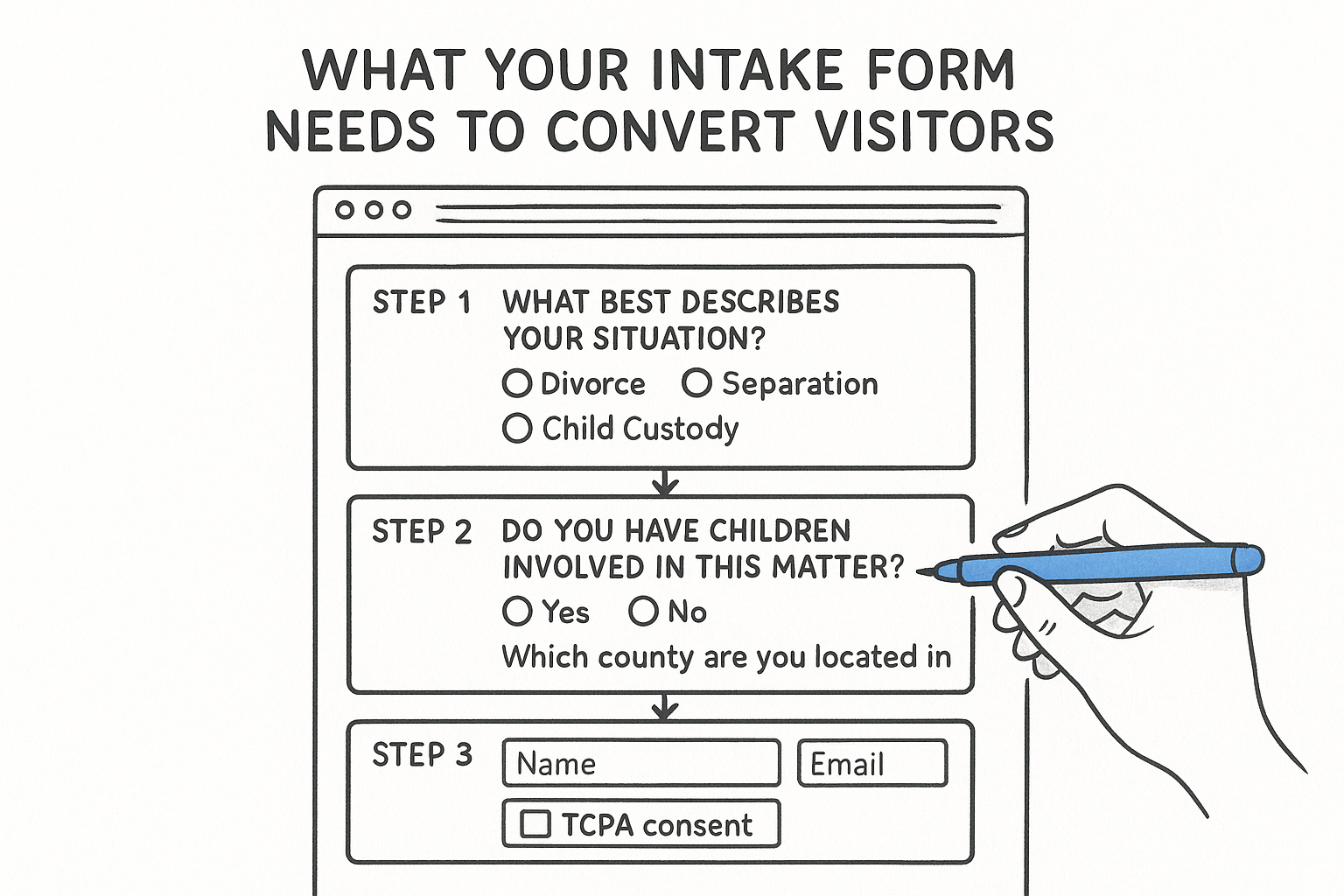
Here is a proven three-step intake form structure for divorce cases:
- Step 1: "What best describes your situation?" (Divorce, Separation, Child Custody, Other)
- Step 2: "Do you have children involved in this matter?" (Yes / No) + "Which county are you located in?"
- Step 3: Name, phone number, email, and TCPA consent checkbox
The TCPA consent checkbox is not optional. Without a documented, timestamped opt-in record, any SMS follow-up you send puts your firm at legal risk.
How to set up conversion tracking before you run a single ad
Running paid campaigns without conversion tracking in place is the fastest way to waste budget. Before you launch any Google Ads or Meta campaigns, install GA4 and configure a generate_lead event that fires when a form submits. Then link that event to your Google Ads account so campaigns optimize toward actual leads, not page visits.
Your tracking setup should cover three destinations: GA4 for web analytics, your ad platform for bid optimization, and your CRM or intake tool for revenue attribution. GavelGrow's platform fires GA4, Meta Pixel, and GTM custom events automatically on every form submission, so your ad accounts receive conversion data without manual tag configuration.
Step 2. Win local search with SEO and Google Business Profile
Local search is where most divorce lawyer marketing converts, not at the national level. When someone types "divorce attorney near me" or "family law firm in [city]," Google serves three local results before any organic listings. Capturing one of those three spots consistently requires work in two places: your Google Business Profile and the on-page SEO signals your website sends to confirm local relevance.
How to optimize your Google Business Profile for divorce cases
Your Google Business Profile is often the first thing a prospective client reads before they ever land on your website. Most firms claim their profile and stop there, leaving the most visible piece of real estate in local search half-finished. Complete every field, select "Family Law Attorney" as your primary category, and write a business description that names the specific cities and counties you serve.
Beyond the basics, three actions move your profile from mediocre to competitive:
- Post weekly updates using the "Add update" feature to share recent case results (without identifying information), firm news, or helpful tips for people going through divorce
- Respond to every review within 48 hours, including negative ones, because Google treats review engagement as an activity signal
- Upload photos monthly, including photos of your office, your team, and any community events your firm participates in
Google's own documentation confirms that complete and accurate Business Profiles are more likely to appear in local search results and Google Maps.
What on-page SEO signals actually move the needle
Your website needs a dedicated page for every city or county you serve, not a single homepage trying to rank for all of them. Each location page should include the city name in the H1 tag, a unique paragraph describing why your firm serves that community well, and an embedded Google Map pointing to your office address.
Schema markup also gives your firm a measurable edge. Add LocalBusiness schema to your homepage and each location page so Google can confirm your address, phone number, and practice area without guessing. Use Google's own Rich Results Test to verify your markup before publishing.
Step 3. Run paid campaigns that attract qualified cases
Paid search is the fastest channel for divorce lawyer marketing, but most firms lose money on it by targeting broad keywords and sending traffic to a generic homepage. Qualified divorce cases come from campaigns built around high-intent search terms, landing pages matched to each ad group, and conversion tracking that tells you which campaigns actually produce signed retainers, not just clicks.
How to structure Google Ads for divorce cases
Your Google Ads account should be organized into tightly grouped ad groups by service type, not lumped into one broad family law campaign. This structure lets you match ad copy precisely to what someone searched, which raises your Quality Score and lowers your cost per click.
Use this campaign structure as your starting point:
Each ad group should link to a dedicated landing page that mirrors the ad's headline and includes one clear call to action: fill out the intake form. Never send paid traffic to your homepage.
What negative keywords save you the most wasted spend
Negative keywords do more to protect your budget than any bidding adjustment. Without them, your ads appear for searches like "how to file for divorce yourself" or "free divorce forms," which attract self-represented filers, not paying clients. Add these as phrase-match negatives before your campaigns go live:
- "free divorce"
- "DIY divorce"
- "divorce forms"
- "how to file divorce"
- "divorce papers download"
According to Google's own Smart Bidding guidance, campaigns with clean negative keyword lists and conversion tracking enabled consistently achieve lower cost per acquisition than those relying on manual CPC alone.
Set your campaigns to Target CPA bidding only after you have accumulated at least 30 conversions in a 30-day window. Before that threshold, use Maximize Conversions and let Google gather the data it needs to optimize effectively.
Step 4. Turn leads into signed retainers with intake
Getting someone to submit a form is the midpoint of divorce lawyer marketing, not the finish line. Most firms lose cases not because their ads performed poorly but because no one followed up fast enough after a lead came in. A structured intake process that fires within 60 seconds of a form submission and moves prospects toward a scheduled consultation is the single highest-ROI improvement most family law firms can make.
Why speed-to-lead determines whether you sign the case
Divorce prospects submit forms to multiple firms at the same time, especially when they are actively comparing options on a Sunday evening. The firm that responds first sets the frame for every conversation that follows. Waiting until Monday morning means you are already third or fourth in a prospect's inbox, and the other firms have already scheduled consultations.
Research cited in Harvard Business Review found that responding to a lead within five minutes makes you 21 times more likely to convert compared to waiting 30 minutes.
How to build an automated intake sequence
Your intake sequence should start the moment a form submits and run on a preset schedule until the prospect either books a consultation or opts out. Here is a proven timeline that works for family law firms:

GavelGrow's intake automation fires the first SMS within 60 seconds of every form submission, handles CTIA opt-out keywords automatically, and logs a timestamped TCPA consent record for every contact, so your follow-up sequence stays compliant without any manual setup.
What your consultation confirmation should include
Once a prospect books a consultation, send an immediate confirmation via both email and SMS that includes the date, time, attorney name, and a one-click reschedule link. Add an automated reminder one hour before the appointment to cut no-show rates. Firms using calendar reminders typically see no-show rates drop from 30% to under 10%, which directly improves the number of retainers signed per month.
Wrap Up and Next Steps
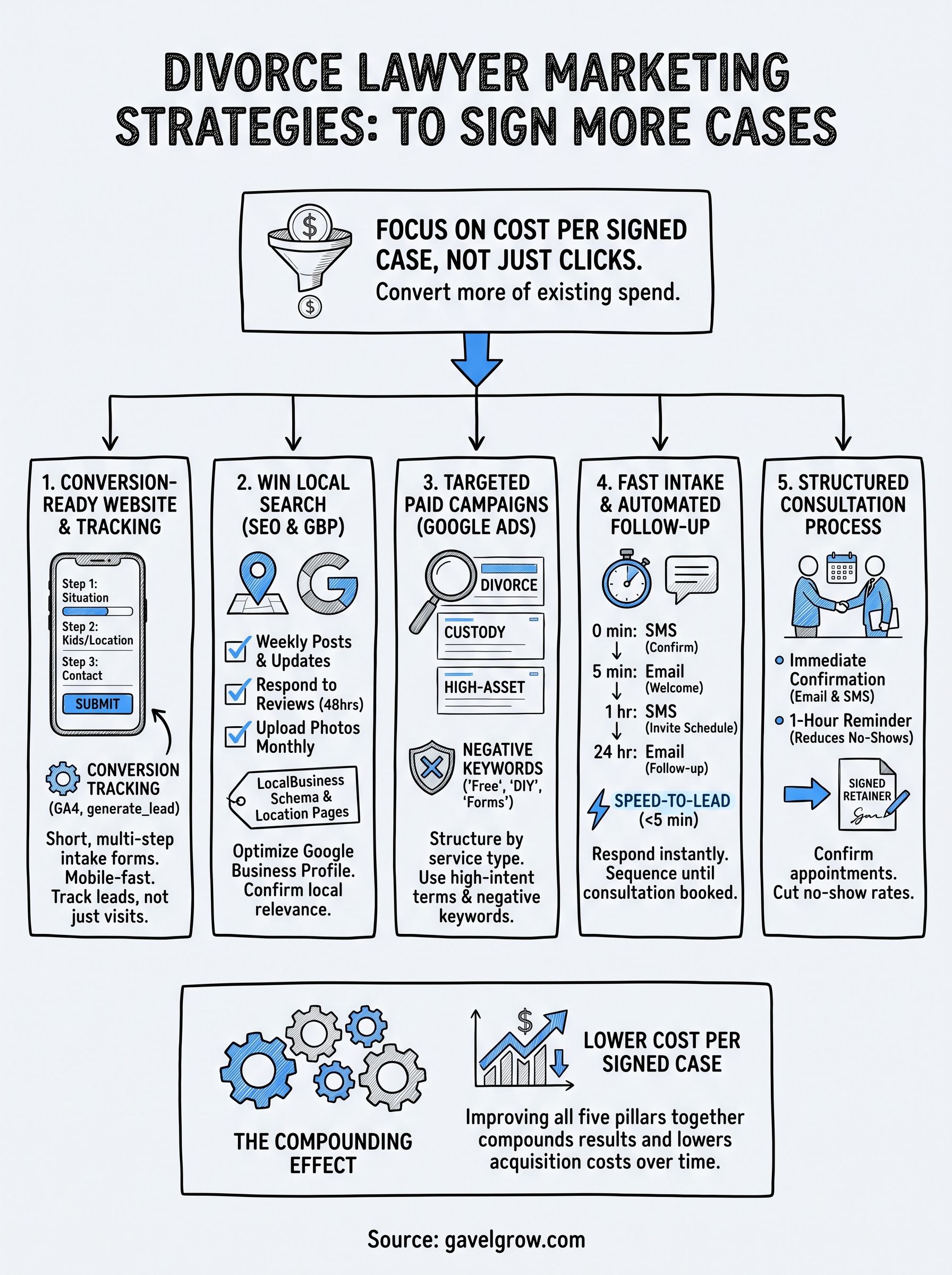
The five pillars covered in this guide (a conversion-ready website, local SEO, paid campaigns, fast intake, and structured follow-up) work as a system, not as isolated tactics. Improving one piece in isolation moves the needle; improving all five compounds your results and lowers your cost per signed case month over month.
Firms winning at divorce lawyer marketing right now aren't necessarily spending more than their competitors. They're measuring what actually matters, responding faster, and running intake processes that book consultations while other firms are still checking voicemail on Monday morning.
Your next step is to benchmark where your firm stands today across each of these variables. Run GavelGrow's free law firm marketing scorecard to get a practice-specific assessment of where your biggest gaps are and which fixes will produce the fastest improvement in signed cases per month.
Frequently Asked Questions
What makes divorce lawyer marketing different from other practice areas?
Divorce prospects research longer, compare more firms, and often reach out after hours or on weekends, triggered by an argument or new development. Trust signals matter more than in almost any other practice area because the decision affects finances and children for years. Effective marketing accounts for this extended, emotional decision cycle rather than assuming a single ad click produces a signed retainer.
Why does speed-to-lead matter so much for divorce cases?
Divorce prospects often submit forms to several firms at once, especially on evenings and weekends, and the firm that responds first sets the frame for every conversation that follows. Waiting until the next business day means you're already third or fourth in the inbox while competitors have scheduled consultations. Building an automated intake sequence that responds within about a minute is one of the highest-ROI improvements a family law firm can make.
How should I structure Google Ads for a divorce practice?
Organize the account into tightly themed ad groups by service type rather than one broad family law campaign, so ad copy can mirror exactly what someone searched, which raises Quality Score and lowers cost-per-click. Send each ad group to a dedicated landing page matching the ad headline, never your homepage, and add negative keywords like "free divorce" and "DIY divorce" to avoid self-represented filers.
What metric should family law firms actually track?
Cost per signed case, not clicks, impressions, or call volume. A campaign that drives many calls but few retainers performs worse than one that drives fewer calls and more retainers at the same case value. Shifting reporting to cost per signed case changes which campaigns you scale and which you cut. Install GA4 with a generate_lead event and link it to your ad account before running any campaign.
How do I optimize my Google Business Profile for divorce clients?
Complete every field, select "Family Law Attorney" as your primary category, and write a description naming the cities and counties you serve. Post weekly updates, respond to every review within about 48 hours since Google treats engagement as an activity signal, and upload photos monthly. Google's own documentation confirms complete, accurate profiles are more likely to appear in local search and Maps.
Frequently Asked Questions
What makes divorce lawyer marketing different from other practice areas?
Divorce prospects research longer, compare more firms, and often reach out after hours or on weekends, triggered by an argument or new development. Trust signals matter more than in almost any other practice area because the decision affects finances and children for years. Effective marketing accounts for this extended, emotional decision cycle rather than assuming a single ad click produces a signed retainer.
Why does speed-to-lead matter so much for divorce cases?
Divorce prospects often submit forms to several firms at once, especially on evenings and weekends, and the firm that responds first sets the frame for every conversation that follows. Waiting until the next business day means you're already third or fourth in the inbox while competitors have scheduled consultations. Building an automated intake sequence that responds within about a minute is one of the highest-ROI improvements a family law firm can make.
How should I structure Google Ads for a divorce practice?
Organize the account into tightly themed ad groups by service type rather than one broad family law campaign, so ad copy can mirror exactly what someone searched, which raises Quality Score and lowers cost-per-click. Send each ad group to a dedicated landing page matching the ad headline, never your homepage, and add negative keywords like "free divorce" and "DIY divorce" to avoid self-represented filers.
What metric should family law firms actually track?
Cost per signed case, not clicks, impressions, or call volume. A campaign that drives many calls but few retainers performs worse than one that drives fewer calls and more retainers at the same case value. Shifting reporting to cost per signed case changes which campaigns you scale and which you cut. Install GA4 with a generate_lead event and link it to your ad account before running any campaign.
How do I optimize my Google Business Profile for divorce clients?
Complete every field, select "Family Law Attorney" as your primary category, and write a description naming the cities and counties you serve. Post weekly updates, respond to every review within about 48 hours since Google treats engagement as an activity signal, and upload photos monthly. Google's own documentation confirms complete, accurate profiles are more likely to appear in local search and Maps.