10 Personal Injury Law Firm Advertising Ideas That Win Clients
Categories: Legal Marketing Strategies
 Abram Ninoyan
Founder & Senior Performance Marketer
Credentials: Google Partner, Google Ads Search Certified, Google Ads Display Certified, Google Ads Measurement Certified, Google Analytics (IQ) Certified, HubSpot Inbound Certified, HubSpot Social Media Marketing Certified, Conversion Optimization Certified
Expertise: Google Ads, Meta Ads, Conversion Rate Optimization, GA4 & Google Tag Manager, Lead Generation, Marketing Funnel Optimization, PPC Management
LinkedIn Profile
Every personal injury attorney in your market is bidding on the same Google Ads keywords and running the same billboard-and-bus-bench playbook. Personal injury law firm advertising only works when it...
Key Takeaways
- 10 Personal Injury Law Firm Advertising Ideas That Win Clients
- 1. Track every lead with a legal-specific marketing platform
- 2. Run Google Local Services Ads for pay-per-lead visibility
- 3. Invest in Google Search ads for high-intent injury cases
10 Personal Injury Law Firm Advertising Ideas That Win Clients
Every personal injury attorney in your market is bidding on the same Google Ads keywords and running the same billboard-and-bus-bench playbook. Personal injury law firm advertising only works when it does something different: reaching injured people at the exact moment they're searching, and then converting that click into a signed retainer instead of a wasted form fill.
The strategies that actually move the needle in 2026 combine paid channels built for high-intent searches (Google Ads, Local Services Ads, geo-targeted social) with conversion infrastructure that stops leads from leaking out before intake. A widely cited Lead Response Management study found firms that contact a new lead within 5 minutes are far more likely to qualify it than those that wait even 30 minutes, which means your advertising ideas are only as good as the intake system behind them.
This list covers 10 advertising ideas working right now for personal injury firms, from mass-tort campaign structuring to reputation-driven referral loops, plus where most firms lose leads between the ad click and the signed case. Each idea includes what it costs, who it fits, and how to measure whether it's actually generating cases rather than just clicks.
1. Track every lead with a legal-specific marketing platform
Before you spend another dollar on ads, fix the plumbing that tells you whether those ads work. Most personal injury firms run Google Ads, social campaigns, and referral programs side by side, then try to piece together results from four disconnected tools: a call tracking app, a spreadsheet, their case management system, and whatever the ad platform reports. That gap is where personal injury law firm advertising budgets quietly disappear, because cost-per-lead numbers look fine while cost-per-signed-case numbers stay hidden.
How it works
A legal-specific marketing platform sits underneath every other channel on this list and ties ad spend to signed retainers, not just form fills. GavelGrow's marketing dashboard attaches campaign-level attribution to each lead from the first ad click through intake, built-in call tracking with per-campaign tracking numbers, and a pipeline view that flags which leads are aging without a follow-up call. Instead of guessing whether your Facebook spend or your Google Ads spend produced more retained cases, you see cost-per-signed-case broken out by campaign, source, and even attorney.
If you can't trace a signed case back to the ad that generated it, you're not measuring your marketing, you're guessing at it.
Best for
This fits solo practitioners running their own campaigns just as well as 15-attorney firms managing multiple intake staff and several concurrent ad channels. It's also the right layer for firms currently juggling CallRail, Clio Grow, and a separate reporting tool like AgencyAnalytics, since consolidating those into one system removes the manual reconciliation work that eats up a marketing manager's week. If your firm runs mass-tort campaigns alongside single-event personal injury cases, the benchmark database also lets you compare your conversion rate against 500+ peer firms in similar practice areas and markets.
Typical cost
All tiers start with a 7-day free trial with no credit card required, so you can pressure-test attribution reporting against a live campaign before committing.
Compliance considerations
Every lead your ads generate needs a documented, auditable trail of consent before you call or text them, especially for personal injury and mass-tort intake where TCPA exposure runs high. Look for platforms that log TCPA consent automatically, validate phone numbers at the carrier level before dialing, and handle CTIA opt-out keywords like STOP and HELP without manual intervention. State bar advertising rules add another layer, since several states require specific disclaimers on case-outcome claims, and a legal-built platform should ship with those compliance defaults rather than leaving you to configure them from scratch.
2. Run Google Local Services Ads for pay-per-lead visibility
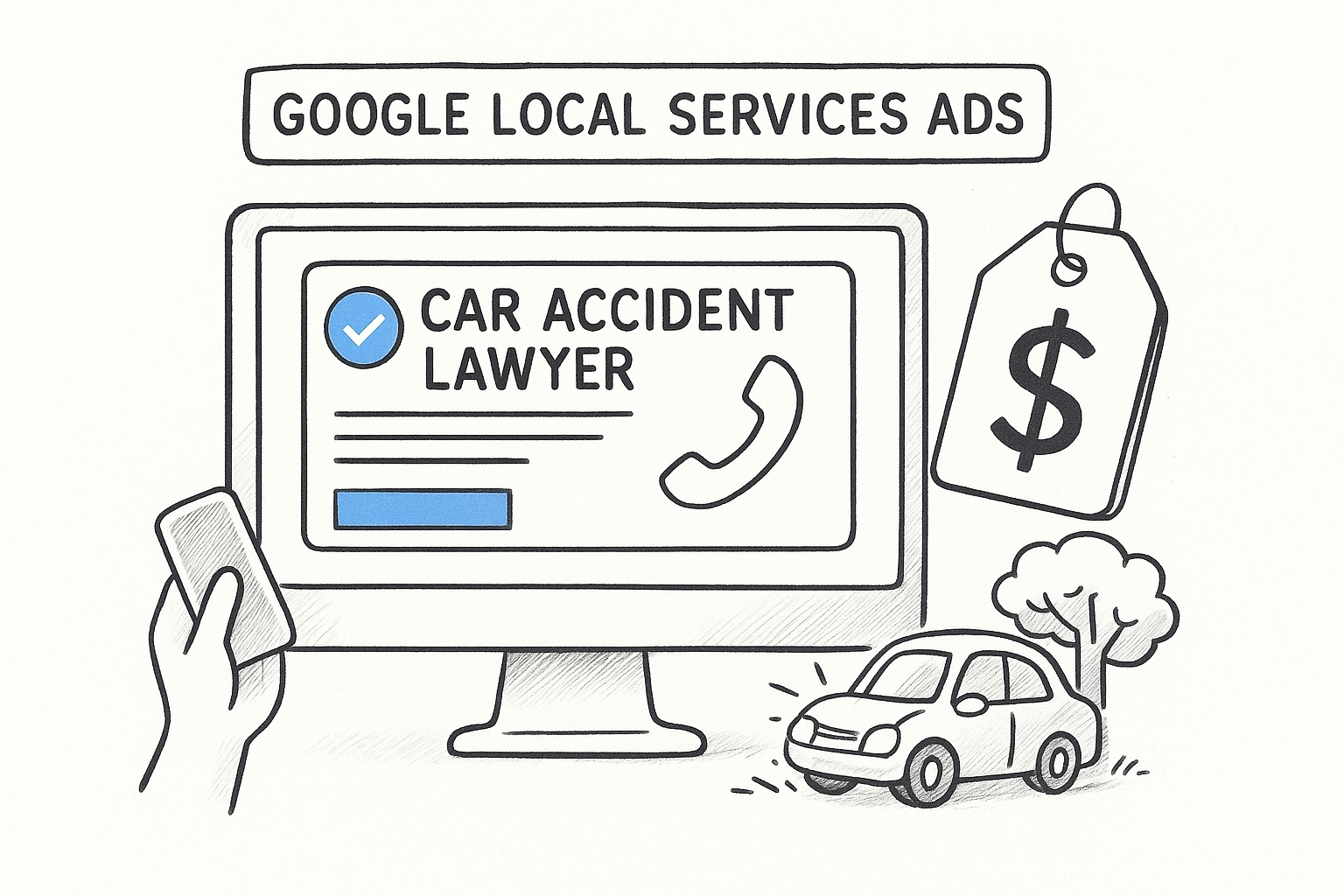
Google puts a small batch of Local Services Ads above every organic and paid search result, tagged with a green "Google Screened" badge that most searchers trust more than a standard text ad. For personal injury law firm advertising, that placement matters because injured people searching "car accident lawyer near me" are usually ready to call within minutes, not researching for weeks.
How it works
Local Services Ads run on a pay-per-lead model rather than pay-per-click, so you only pay when someone calls or messages your firm through the ad, not every time someone clicks and bounces. Google verifies your license and runs a background check before granting the badge, per its Local Services Ads requirements, and ranks your listing using proximity, reviews, and responsiveness. That last factor rewards firms that answer or return calls fast, which loops back to the intake speed problem most firms underestimate.
A missed call on a Local Services Ads lead doesn't just lose that case, it drags down your ranking for every future lead.
Best for
Solo and small-firm practitioners see the fastest return here, since budget efficiency matters more when you're not running six channels at once. Firms without a large existing ad account also benefit, because Local Services Ads requires less keyword and bidding expertise than standard Search campaigns.
Typical cost
Leads for personal injury cases typically run $50 to $150 depending on your metro and competition, billed only for calls Google's system deems valid. Weekly budgets scale from a few hundred dollars for a single practice area up to several thousand for firms targeting multiple case types across a metro.
Compliance considerations
Google requires proof of your bar license and active malpractice insurance before approving the badge, and disputed leads (wrong number, spam, out-of-area) need to be flagged for credit inside Google's dashboard, not ignored. Route every call into a tracking system so you can prove call quality if Google ever questions your account standing.
3. Invest in Google Search ads for high-intent injury cases
Search ads still win the top slots on Google for keywords like "personal injury attorney" or "truck accident lawyer," and for personal injury law firm advertising, that placement captures people actively typing their emergency into a search bar. Unlike Local Services Ads, standard Search campaigns give you full control over keyword targeting, ad copy, and landing pages, which matters when you're running distinct campaigns for car accidents, slip-and-falls, and mass-tort intake side by side.
How it works
Google Search ads run on a cost-per-click auction, where your bid, ad relevance, and landing page quality determine placement above organic results. Building tightly themed ad groups around specific injury types, then sending each click to a matching landing page with a short intake form, keeps your Quality Score high and your cost per click down. Google Ads' own account structure guidance recommends this kind of granular grouping over broad, catch-all campaigns, because relevance between keyword, ad, and landing page drives both ranking and cost.
A generic "contact us" landing page kills more Search ad budgets than any bidding mistake ever will.
Best for
Firms with existing marketing budget and at least one dedicated staffer or agency to manage bids weekly get the most from Search ads. It also suits multi-practice-area firms that want granular control over which case types get the most spend, something Local Services Ads can't offer.
Typical cost
Cost per click for competitive injury keywords ranges from $50 to over $300 in major metros, with monthly budgets commonly starting at $3,000 to $5,000 for a single-location firm and climbing well past $25,000 for mass-tort campaigns.
Compliance considerations
Google restricts ad copy that guarantees case outcomes or implies a specific settlement value, and several state bars require disclaimers on any results-based claims. Send every click to a mobile-optimized landing page with clear consent language, since a slow or non-compliant form undoes the value of an expensive click before it ever reaches intake.
4. Strengthen local SEO and your Google Business Profile
When someone searches "personal injury lawyer" without typing a city name, Google still shows local results first, ranked by proximity, relevance, and review signals. Local SEO is the slow-build counterpart to paid ads on this list, and for personal injury law firm advertising, it's the channel that keeps generating cases long after you've paused a Google Ads campaign.
How it works
Google Business Profile optimization sits at the center of local SEO for law firms: accurate practice-area categories, updated hours, real office photos, and a steady stream of client reviews all feed the local ranking algorithm. Beyond your profile, on-site SEO means building dedicated pages for each practice area and city you serve, rather than one generic "personal injury" page trying to rank for everything. Firms that pair this with genuine local backlinks, from bar associations, local news mentions, or community sponsorships, tend to outrank competitors relying on directory listings alone.
A firm that ranks organically for "car accident lawyer [city]" gets that lead for free, every month, long after a competitor's ad budget runs dry.
Best for
Local SEO suits firms planning past next quarter, since results typically take four to six months to show up meaningfully in rankings. Single-location practices and firms with limited ad budgets get outsized value here, because organic visibility compounds instead of shutting off the moment spend stops.
Typical cost
DIY local SEO costs mostly time; agency-managed local SEO for a single-location firm typically runs $1,500 to $5,000 a month, with mass-tort or multi-location firms paying more for expanded content and citation work. Compare that against GavelGrow's managed services, which folds SEO into a broader acquisition strategy alongside paid ads.
Compliance considerations
State bar rules govern how you describe results and credentials on practice-area pages, so avoid superlative claims like "best" or "top" without required disclaimers. Keep your Google Business Profile name matching your actual registered firm name exactly, since Google suspends profiles for name-stuffing keywords like "Best Injury Lawyer."
5. Publish authoritative content that answers client questions
Injured people search specific questions long before they search "personal injury lawyer," things like "what happens if I'm partially at fault in a car accident" or "how long do I have to file a slip and fall claim in Texas." Content marketing built around those questions puts your firm in front of prospects during the research phase, months before they're ready to call, and builds the trust that shortens the sales cycle once they do.
How it works
Building out a content library means writing detailed, practice-area-specific pages that answer real client questions with actual legal accuracy, not thin 300-word posts stuffed with keywords. Google's own guidance on helpful content rewards pages that demonstrate first-hand expertise, so attorney-reviewed articles with named authors and case examples outperform generic blog posts every time. Pairing written content with a video FAQ series or a downloadable claims-process guide extends the same expertise across formats, and each piece should link back to a relevant practice-area landing page to capture the reader once they're ready to act.
Content doesn't replace your ads, it lowers the cost of every ad by warming up the people who eventually click one.
Best for
This strategy fits firms with an attorney or marketing manager willing to write or review content regularly, since the compliance and accuracy bar for legal content is higher than most industries. Personal injury firms handling mass torts also benefit heavily, since prospective plaintiffs research eligibility criteria extensively before contacting a firm.
Typical cost
In-house content production costs mostly staff time; hiring a legal content writer or agency typically runs $500 to $2,000 per month for a steady publishing cadence of two to four pieces monthly.
Compliance considerations
Every claim about case outcomes, settlement amounts, or timelines needs a disclaimer, and content implying guaranteed results violates most state bar advertising rules. Have a licensed attorney review published content periodically, since outdated statutes or misstated deadlines create liability beyond just a compliance flag.
6. Advertise on social media where injured clients scroll
Facebook and Instagram feel like an odd fit for personal injury law firm advertising until you remember who's actually scrolling: family members researching a loved one's accident, people posting about a fender bender an hour ago, and friends tagging each other under local news stories about a bad crash. Social ads reach people before they've typed a single search query, which makes this channel a complement to Search and Local Services Ads rather than a replacement.
How it works
Meta's ad platform lets you target by location radius, age, and interest signals like local news pages or nearby hospitals, then serve video or carousel ads directly into the feed. Retargeting matters most here: visitors who land on your site from a Google ad but don't fill out a form can see a follow-up Instagram or Facebook ad within days, keeping your firm visible while they decide. Pairing this with GavelGrow's conversion tracking means every Meta Pixel event fires with a deduplicated ID, so you know which social impressions actually turned into signed cases instead of just link clicks.
A social ad that gets ignored on day one often gets clicked on day five, which is exactly what retargeting is built to catch.
Best for
Firms building brand awareness in a specific metro or running mass-tort campaigns that need broad reach beyond search intent see the strongest results. It also suits firms with existing video or testimonial content, since social feeds reward motion and faces over static text ads.
Typical cost
Cost per click on Meta platforms for legal audiences typically runs $3 to $10, with monthly budgets starting around $1,500 for local awareness campaigns and scaling higher for statewide mass-tort pushes.
Compliance considerations
Meta's ad review process flags language implying guaranteed settlements or specific dollar amounts, and several state bars require the same disclaimers on social ads that apply to print or broadcast advertising. Keep consent language visible on any linked landing page, since a social click still counts as a lead requiring documented TCPA consent before you call or text.
7. Create video testimonials and case story commercials
A client describing, in their own words, how your firm got them through surgery bills and a settlement while an insurance adjuster stonewalled them does more for trust than any billboard headline. Video testimonials work because injured prospects want proof that a firm handles cases like theirs, not just a slogan about aggressive representation, and this format has become one of the most shared pieces of personal injury law firm advertising on YouTube pre-roll and Connected TV.

How it works
Production starts with identifying settled clients willing to go on camera, ideally ones covering different case types like car accidents, slip-and-falls, or workplace injuries so you have footage matching whichever campaign you're running. Short 15 to 30-second cuts work best for social and YouTube pre-roll ads, while a longer 90-second version fits your website and Google Business Profile. Pair testimonials with case story commercials that walk through the timeline of a real case, since that narrative format performs well on Connected TV and YouTube, where viewers can't skip as easily as they can scroll past a static ad.
A single strong testimonial, reused across YouTube, social, and your homepage, often outperforms a dozen new ad variations.
Best for
Firms with a backlog of satisfied clients and at least a modest production budget get the most value here. It also suits firms already running social ads, since video testimonials give that channel the motion and faces that static text ads lack.
Typical cost
Professional video production for a batch of 3 to 5 testimonials typically runs $3,000 to $8,000, while YouTube and Connected TV ad placement adds $2,000 to $10,000 monthly depending on market size.
Compliance considerations
Every testimonial needs a signed release covering both usage rights and case-outcome disclosure, since several state bars require a disclaimer that results don't guarantee similar outcomes for future clients. Avoid editing quotes in ways that misstate settlement details, and keep a documented consent trail for each client featured.
8. Use billboards and out-of-home ads strategically
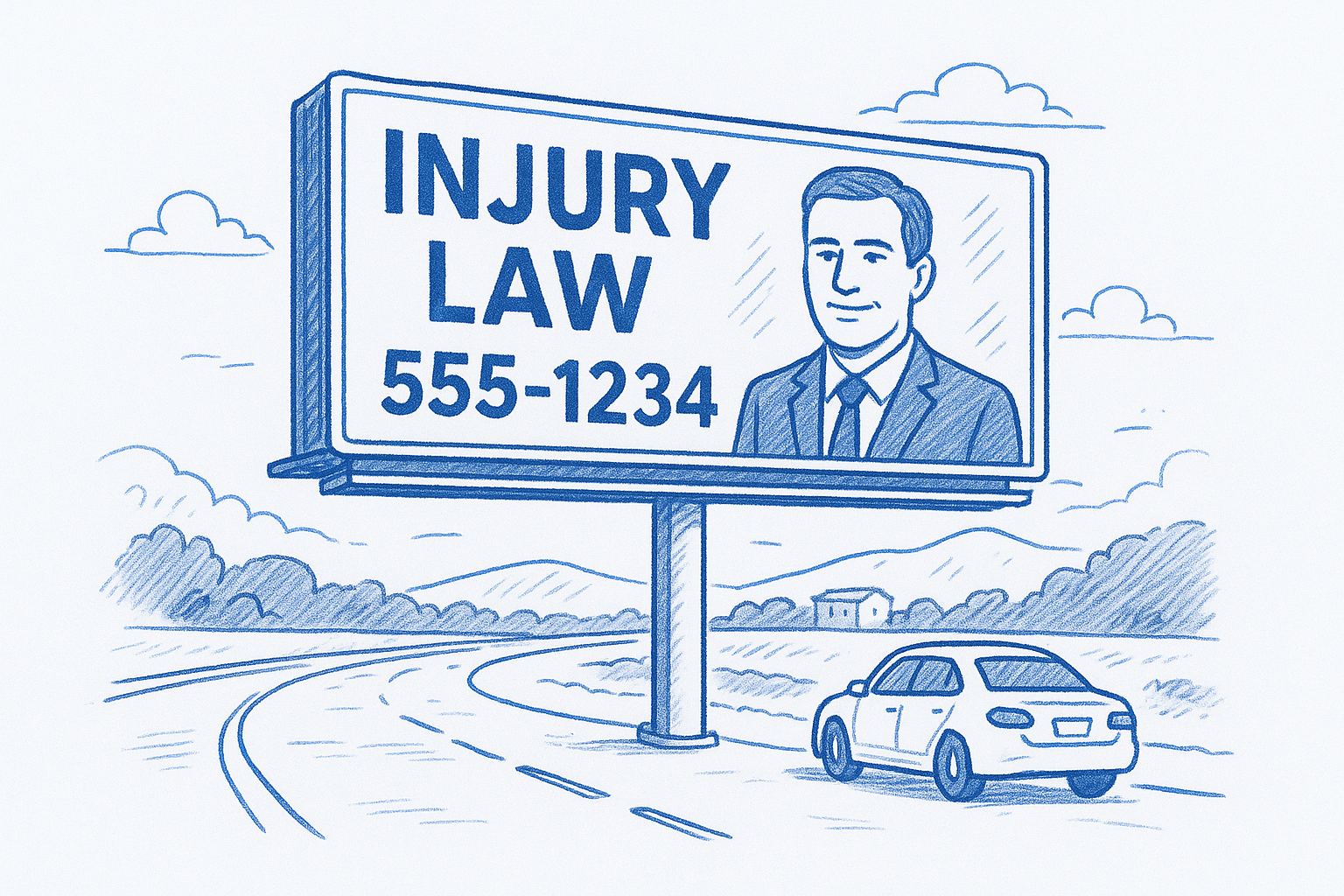
Drive past any interstate exit in a mid-size metro and you'll spot at least one personal injury attorney's face on a billboard, usually next to a phone number in 40-point font. Out-of-home advertising still works for personal injury law firm advertising because it builds the brand recognition that makes someone choose your firm over a stranger from a Google search, especially in markets where injured people ask friends and family for a recommendation before they search online.
How it works
Billboard and transit advertising trades targeting precision for sheer repetition, putting your name in front of thousands of daily commuters until it sticks. Placement along highways near hospitals, courthouses, or high-accident intersections tends to outperform generic high-traffic spots, since the audience skews toward people who've dealt with an accident or know someone who has. Pairing a billboard campaign with a dedicated, trackable phone number lets you measure calls generated by that specific placement instead of guessing whether the spend moved the needle.
A billboard without a tracking number is a brand expense, not a measurable marketing channel.
Best for
Established firms with budget beyond digital channels and a brand they want reinforced across a whole metro get the most value here. It also suits firms competing in markets where a handful of names dominate local recall, since billboards compete on visibility more than message sophistication.
Typical cost
A single highway billboard typically runs $1,500 to $4,000 per month depending on traffic count and market size, while bus benches and transit wraps run lower, often $500 to $2,000 monthly per placement.
Compliance considerations
State bar rules govern attorney advertising on physical media the same way they do digital ads, so results-based claims and superlatives like "biggest verdict" need documented backup and disclaimers. Some states also require attorney advertising to include a responsible-attorney name directly on the billboard, so check your bar's specific outdoor advertising rules before printing.
9. Build a 5-star review and reputation management engine
A prospective client comparing three law firm websites almost always checks reviews before picking up the phone, and a firm sitting at 3.8 stars loses that comparison before the call ever happens. Reputation management turns your past clients into your best advertising asset, and for personal injury attorney marketing, star ratings now function as a ranking signal for both Google Business Profile and paid ad Quality Score.
How it works
Building this engine means automating the ask, not hoping satisfied clients remember to leave a review on their own. Firing an SMS or email review request within a day or two of a case closing, timed to when gratitude is highest, produces far better response rates than a generic follow-up months later. GavelGrow's intake automation can trigger these sequences from a case-status change, and reaching out directly when a client is unhappy lets you resolve the complaint, while every client still gets the same review request.
A firm with 150 five-star reviews wins the click before a competitor's ad even loads.
Best for
Every firm on this list benefits from reputation management, but it matters most for solo practitioners and small firms competing against established names with decades of review history. Firms running Local Services Ads see an especially direct payoff, since Google's ranking algorithm weighs review volume and recency heavily.
Typical cost
Managing reviews in-house costs mostly staff time to send requests and respond publicly; dedicated reputation software or a managed service typically runs $200 to $800 monthly, often bundled into a broader marketing platform rather than billed separately.
Compliance considerations
Several state bars restrict incentivizing reviews with discounts or gifts, so keep requests neutral and voluntary. Never ask a client to remove a negative review in exchange for anything of value, and document your outreach process in case a bar complaint ever questions how reviews were solicited.
10. Sponsor community events and grow referral networks
Sponsoring a youth sports league, a local 5K, or a community health fair puts your firm's name in front of the same neighborhoods you want calling after an accident, without asking anyone to click an ad first. For personal injury law firm advertising, this channel works on a longer timeline than paid search, but it builds the kind of local trust that turns into referrals from doctors, chiropractors, and past clients who already vouch for you at dinner tables.
How it works
Sponsorships range from a banner at a youth soccer field to a named scholarship at a local high school, and the strongest versions pair visibility with actual community involvement, not just a logo. Building a referral network alongside sponsorships means reaching out directly to chiropractors, physical therapists, and body shops who regularly meet accident victims, then formalizing that relationship with a simple referral-tracking process so you know which partnerships actually produce cases. A dedicated intake line for referral sources, tied into your call tracking, tells you within weeks which sponsorships and partners are worth renewing.
A banner at a Little League field won't close a case by itself, but it's often the reason a parent calls you first when their kid gets hurt in a car accident.
Best for
Established firms with a local reputation to protect and long-term growth goals get the most value here, especially in mid-size metros where community visibility still drives word-of-mouth referrals.
Typical cost
Community sponsorships typically run $500 to $5,000 per event or season, while ongoing referral partnerships cost mostly relationship-building time rather than direct spend.
Compliance considerations
Most states allow referral relationships with other professionals but prohibit paying for referrals outright, so structure any partnership as reciprocal visibility, not compensation. Document sponsorship agreements in writing, since bar associations sometimes review these arrangements during advertising audits.
Building your firm's advertising mix
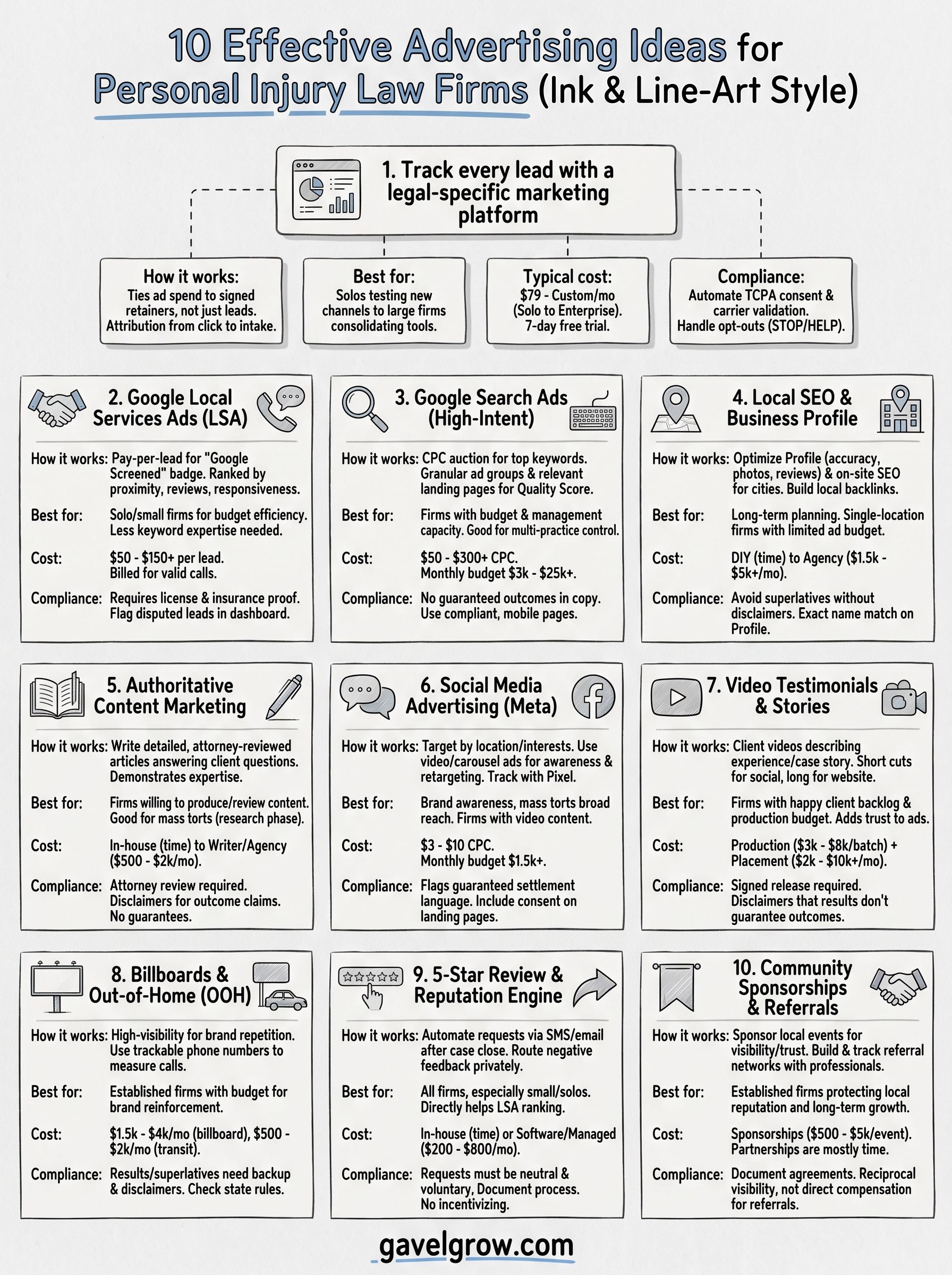
No single channel on this list wins cases by itself. The firms that grow fastest layer high-intent paid search with local SEO and reviews for compounding organic visibility, then back everything with content and community presence that builds trust before the phone ever rings. Mixing channels only pays off if you can see which ones actually produce signed retainers, not just cheap leads that stall out in intake.
Start by auditing what you're running today against what's actually converting. Every idea here works better once you can trace a case back to its source, which is exactly the gap a legal-specific platform closes. If you're ready to see your own cost-per-signed-case broken out by channel instead of guessing, book a free 45-minute strategy call and walk through your current mix with someone who's built this for 500+ law firms.
Frequently Asked Questions
How much should a personal injury firm spend on advertising?
There is no universal number, but personal injury is one of the most expensive practice areas to advertise in, so most competitive firms budget as a percentage of revenue and concentrate it where intent is highest. What matters more than the total is the mix and the measurement: a smaller budget tracked to cost per signed case usually beats a larger one spread across channels you cannot attribute. Start with Local Services Ads and Search, prove the return, then expand into SEO, social, and brand channels.
Which advertising channel gives a new PI firm the fastest return?
For most new firms, Google Local Services Ads deliver the fastest return: they charge per lead rather than per click, carry the Google Screened badge that builds instant trust, and require less bidding expertise than Search. Search ads come next for control and volume. The slower-compounding channels, SEO, reviews, content, and community presence, build the base that lowers your paid cost over time, but they take months to pay off.
How do you keep personal injury advertising compliant with state bar rules?
Personal injury advertising is heavily scrutinized. The recurring rules: no guaranteeing outcomes or implying a specific settlement value, disclaimers on any results-based claim (many states require a "prior results do not guarantee a similar outcome" line), a responsible-attorney name on some formats, no incentivized reviews, and no paying for referrals. Before running any campaign, check your state bar’s advertising rules and keep documented records of what you ran and the consent behind every lead you contact.
How do you know if your PI advertising is producing signed cases, not just leads?
Track past clicks and calls to cost per signed case by channel, not just cost per lead. A campaign that produces cheap leads that never sign is more expensive than a pricier one that delivers retained clients. That requires connecting every lead, including phone calls, back to the campaign that produced it and following it through intake to a signed retainer, which is exactly where most firms lose visibility: cost-per-lead looks fine while cost-per-signed-case stays hidden.
Are Local Services Ads or Google Search Ads better for a personal injury firm?
They solve different problems and most firms run both. Local Services Ads charge per lead, sit above the search results with a Google Screened badge, and need less setup, ideal for high-intent local calls. Search ads charge per click but give you full control over keywords, ad copy, and landing pages, which matters when you run separate campaigns for car accidents, slip-and-falls, and mass tort. Start with LSAs for efficient local leads, add Search for control and reach, and track each to signed cases.
How long does personal injury advertising take to generate cases?
It depends on the channel. Paid channels, Local Services Ads and Search, can generate calls within days of launch, though it takes a few weeks to tune bidding and intake. Local SEO, reviews, and content compound more slowly, usually four to six months to move rankings meaningfully. Community sponsorships and referral networks work on the longest timeline. The firms that grow fastest run fast-return paid channels while the slower organic channels build underneath them.
Third-party product names, including CallRail, Clio Grow, and AgencyAnalytics, and all company names and trademarks are the property of their respective owners, referenced here for identification only and not affiliated with or endorsing GavelGrow. Advertising cost figures throughout are general market estimates as of August 2026, not quotes; verify current pricing directly with each platform or provider.
Frequently Asked Questions
How much should a personal injury firm spend on advertising?
There is no universal number, but personal injury is one of the most expensive practice areas to advertise in, so most competitive firms budget as a percentage of revenue and concentrate it where intent is highest. What matters more than the total is the mix and the measurement: a smaller budget tracked to cost per signed case usually beats a larger one spread across channels you cannot attribute. Start with Local Services Ads and Search, prove the return, then expand into SEO, social, and brand channels.
Which advertising channel gives a new PI firm the fastest return?
For most new firms, Google Local Services Ads deliver the fastest return: they charge per lead rather than per click, carry the Google Screened badge that builds instant trust, and require less bidding expertise than Search. Search ads come next for control and volume. The slower-compounding channels, SEO, reviews, content, and community presence, build the base that lowers your paid cost over time, but they take months to pay off.
How do you keep personal injury advertising compliant with state bar rules?
Personal injury advertising is heavily scrutinized. The recurring rules: no guaranteeing outcomes or implying a specific settlement value, disclaimers on any results-based claim (many states require a "prior results do not guarantee a similar outcome" line), a responsible-attorney name on some formats, no incentivized reviews, and no paying for referrals. Before running any campaign, check your state bar’s advertising rules and keep documented records of what you ran and the consent behind every lead you contact.
How do you know if your PI advertising is producing signed cases, not just leads?
Track past clicks and calls to cost per signed case by channel, not just cost per lead. A campaign that produces cheap leads that never sign is more expensive than a pricier one that delivers retained clients. That requires connecting every lead, including phone calls, back to the campaign that produced it and following it through intake to a signed retainer, which is exactly where most firms lose visibility: cost-per-lead looks fine while cost-per-signed-case stays hidden.
Are Local Services Ads or Google Search Ads better for a personal injury firm?
They solve different problems and most firms run both. Local Services Ads charge per lead, sit above the search results with a Google Screened badge, and need less setup, ideal for high-intent local calls. Search ads charge per click but give you full control over keywords, ad copy, and landing pages, which matters when you run separate campaigns for car accidents, slip-and-falls, and mass tort. Start with LSAs for efficient local leads, add Search for control and reach, and track each to signed cases.
How long does personal injury advertising take to generate cases?
It depends on the channel. Paid channels, Local Services Ads and Search, can generate calls within days of launch, though it takes a few weeks to tune bidding and intake. Local SEO, reviews, and content compound more slowly, usually four to six months to move rankings meaningfully. Community sponsorships and referral networks work on the longest timeline. The firms that grow fastest run fast-return paid channels while the slower organic channels build underneath them. Third-party product names, including CallRail, Clio Grow, and AgencyAnalytics, and all company names and trademarks are the property of their respective owners, referenced here for identification only and not affiliated with or endorsing GavelGrow. Advertising cost figures throughout are general market estimates as of August 2026, not quotes; verify current pricing directly with each platform or provider.