Local SEO for Attorneys: How to Rank in the Map Pack
Categories: Legal Marketing Strategies
 Abram Ninoyan
Founder & Senior Performance Marketer
Credentials: Google Partner, Google Ads Search Certified, Google Ads Display Certified, Google Ads Measurement Certified, Google Analytics (IQ) Certified, HubSpot Inbound Certified, HubSpot Social Media Marketing Certified, Conversion Optimization Certified
Expertise: Google Ads, Meta Ads, Conversion Rate Optimization, GA4 & Google Tag Manager, Lead Generation, Marketing Funnel Optimization, PPC Management
LinkedIn Profile
If your firm doesn't show up in Google's Map Pack when someone searches "car accident lawyer near me," you're losing cases to the three firms that do. BrightLocal's 2024 Local Consumer Revie...
Key Takeaways
- Local SEO for Attorneys: How to Rank in the Map Pack
- What determines your law firm's map pack ranking?
- Step 1. Claim and optimize your Google Business Profile
- Step 2. Build consistent NAP citations and directory listings
Local SEO for Attorneys: How to Rank in the Map Pack
If your firm doesn't show up in Google's Map Pack when someone searches "car accident lawyer near me," you're losing cases to the three firms that do. BrightLocal's 2024 Local Consumer Review Survey found 87% of consumers used Google to evaluate local businesses, and for law firms that search almost always starts local. Local SEO for attorneys means optimizing your Google Business Profile, citations, and on-page signals so you rank in that top-three map result before a prospect ever scrolls to organic listings.
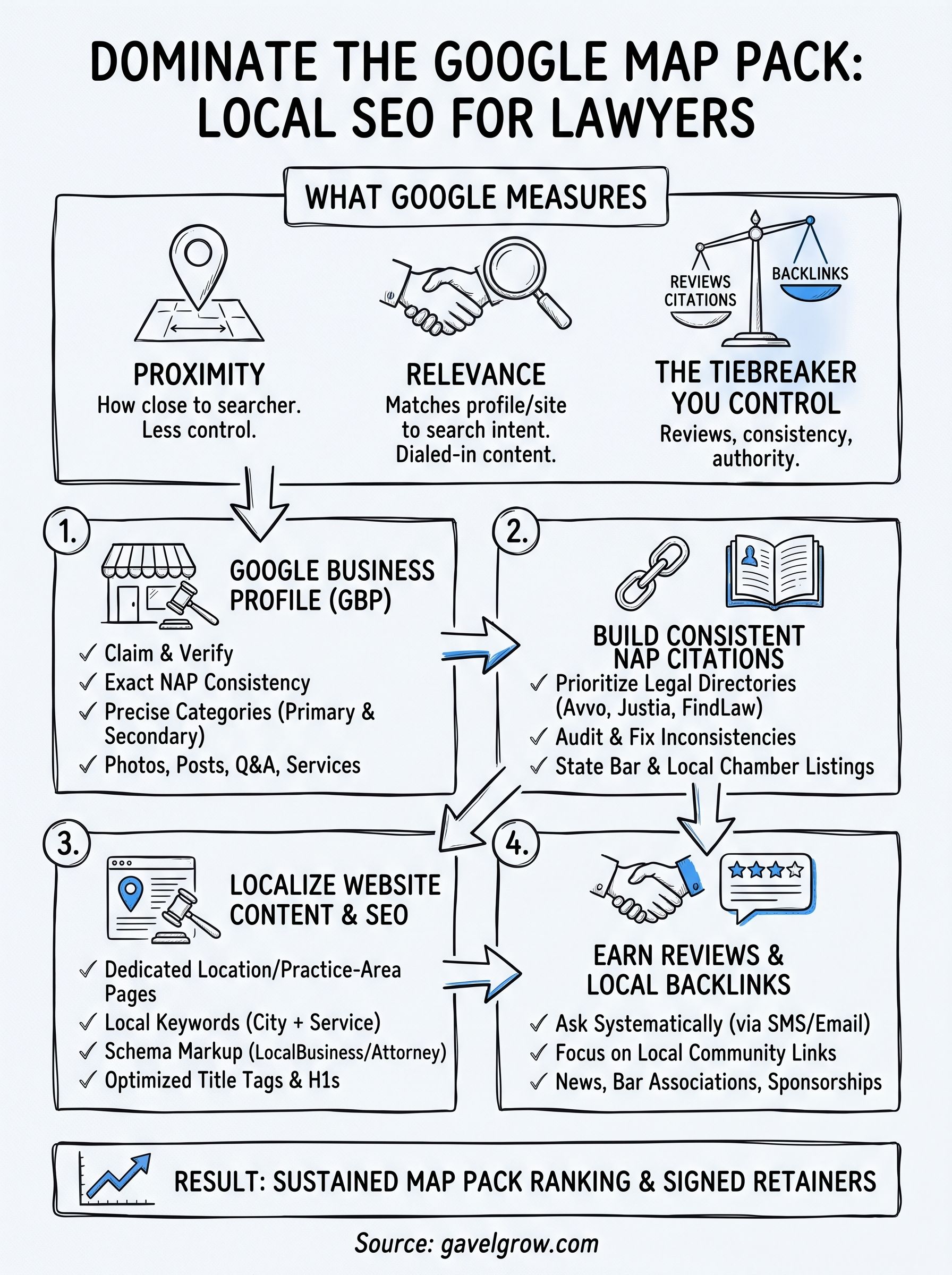
Ranking in the Map Pack comes down to three factors Google weighs directly: proximity, relevance, and prominence, which includes review volume, citation consistency, and website authority. Get those three right and you outrank bigger firms with bigger ad budgets in your own zip code.
This guide walks through the specific local seo tips for lawyers that move the needle: claiming and optimizing your Google Business Profile, building consistent NAP citations, earning attorney-specific reviews, and structuring location pages that convert. We'll also cover how tracking which local searches actually turn into signed retainers, not just calls, tells you where to keep investing.
What determines your law firm's map pack ranking?
Google openly states that local ranking depends on three signals: proximity, relevance, and prominence. Google's own guide to improving local ranking confirms these three factors work together, not in isolation, which is why a firm three miles from a prospect but loaded with reviews and citations often beats a firm two blocks away with a thin profile. Understanding how each factor works lets you focus your effort where it actually moves your ranking instead of guessing.
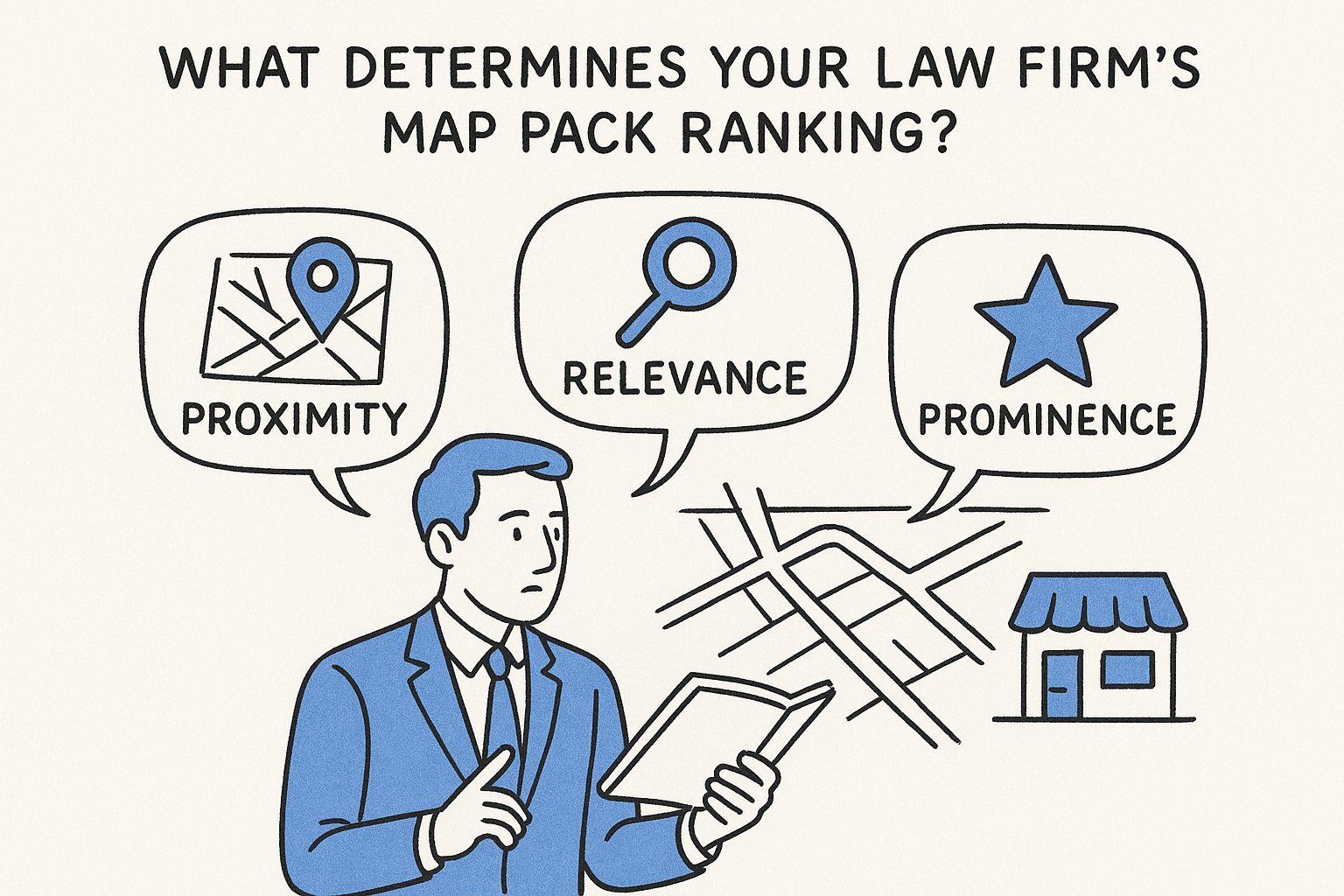
Proximity: the factor you can't fully control
Proximity measures how close your Google Business Profile address is to the searcher, or to the location implied in their search ("personal injury lawyer Dallas" behaves differently than "personal injury lawyer near me"). You can't move your office to sit next to every prospect, but you can influence proximity signals by verifying a physical, staffed address (not a virtual office or PO box, which Google's guidelines explicitly prohibit for service-area businesses) and by running location-specific landing pages if you serve multiple cities from satellite offices. Firms with a single downtown office competing against suburban searches often lose on proximity no matter what else they do right, which is exactly why the other two factors matter so much.
Relevance: matching your profile to what people actually search
Relevance is how well your Business Profile and website match the searcher's intent. A generalist "law firm" category loses to a firm categorized specifically as "Personal Injury Attorney" or "Criminal Justice Attorney" when someone searches by practice area, which is most of the time. Google pulls relevance signals from your primary and secondary GBP categories, your business description, the services you list, and the content on the website linked from your profile. If your homepage talks about "comprehensive legal services" without naming practice areas and cities, you're handing relevance to competitors who spell it out.
Prominence: the tiebreaker that favors firms that do the work
Prominence is where most law firms lose ground, and it's also the factor most within your control. It includes your review count and average rating, the number and consistency of citations across legal directories, your website's overall authority and backlink profile, and even offline reputation signals Google can detect, like press mentions or bar association listings. A firm with 150 reviews at 4.8 stars and consistent citations across Avvo, FindLaw, and Justia will consistently outrank a firm with 12 reviews, even in a closer zip code.
Prominence, not proximity, is the one ranking factor a smaller firm can fully control and use to beat bigger competitors.
Here's the practical takeaway: you can't win proximity against a firm literally next door to your best prospects, and relevance has a ceiling once your categories and content are dialed in correctly. Prominence is the factor with no ceiling. Every review you earn, every clean citation you build, and every quality backlink you pick up compounds over time. That's also the factor GavelGrow's platform is built to support, since review requests, citation-worthy intake data, and call tracking all feed the signals Google uses to judge prominence, not just the vanity metrics that make a dashboard look busy without moving your map pack position.
The next four sections walk through exactly how to act on each of these factors, starting with the single highest-leverage move for any firm still ranking outside the top three: getting your Google Business Profile fully claimed and optimized.
Step 1. Claim and optimize your Google Business Profile
Claiming your Google Business Profile is the single fastest way to start showing up for local searches, yet Google's 2023 data shows a huge share of small business profiles sit unclaimed or half-finished for months. Start by verifying ownership through Google's video or postcard verification, then lock down your NAP (name, address, phone) exactly as it appears on your website and letterhead. Even small inconsistencies, like "Ave" versus "Avenue," chip away at the relevance and trust signals Google uses to rank you.
Pick precise categories and complete every field
Category selection is where most firms leave ranking power on the table. Choosing "Lawyer" as your only category is technically accurate but far too broad; Google rewards specificity, so set your primary category to match your dominant practice area, like "Personal Injury Attorney" or "Divorce Lawyer," and add secondary categories for every other practice area you handle. Fill in every available field: business hours, service areas, attorney bios in the "from the business" section, and a keyword-rich but natural description that names your practice areas and the cities you serve.
A fully completed profile with precise categories often outranks a bigger firm's half-finished listing within weeks.
Optimizations that keep paying off
Photos, posts, and the Q&A section aren't decoration, they're ranking signals Google reads for relevance and engagement. Run through this checklist monthly, not just once at setup:
- Upload at least 10 photos: office exterior, interior, team, and courtroom-adjacent shots (never staged stock photos)
- Publish a Google Post every 1-2 weeks highlighting a case result, practice-area update, or firm news
- Seed the Q&A section with 5-8 questions real clients actually ask, then answer them yourself before someone else does with bad information
- Add every service you offer under the "Services" tab, not just a generic list
- Enable messaging so mobile searchers can text your firm directly from the profile
Understanding these levers matters, but consistency matters more. Profiles that get updated regularly and respond to reviews and messages within hours signal to Google that the business is active, which factors into prominence just as much as review count does. Once your profile is dialed in, the next lever is making sure every directory and citation source across the web says the exact same thing about your firm, which is where inconsistent NAP data quietly costs firms their ranking.
Step 2. Build consistent NAP citations and directory listings
Citations are simply mentions of your firm's name, address, and phone number on other websites, and Google cross-checks them against your Google Business Profile to decide whether it can trust your listing. Legal directories carry extra weight because Google recognizes them as industry-specific authorities, so a citation on Avvo or Justia does more for your ranking than one on a generic business directory nobody in your practice area actually uses. Skipping this step is one of the most common local seo tips for lawyers that gets overlooked because it feels administrative rather than strategic, but inconsistent citations are one of the fastest ways to cap your prominence score before it even gets going.
Prioritize legal-specific directories first
General directories still help, but legal directories should come first because they combine citation value with direct referral traffic. Work through this list before spending time anywhere else:
- Avvo (attorney profile, ratings, and peer endorsements)
- Justia (free listing plus blog syndication)
- FindLaw (paid, but high domain authority)
- Martindale-Hubbell (peer review ratings carry weight with prospects)
- Lawyers.com and Nolo (owned by the same network as Martindale)
- Your state bar association's public attorney directory
- Local chamber of commerce and city business directories
One wrong suite number across ten directories can quietly cap your map pack ranking no matter how good your reviews look.
Audit and fix inconsistencies before adding new listings
Before chasing new citations, audit what already exists. Search your firm name plus old addresses or phone numbers you've since dropped, since firms that moved offices or changed numbers years ago often still have the old details live on directories nobody remembers claiming. Fixing these takes longer than building new citations, but Google weighs consistency across your entire footprint, not just the sites you actively manage.
Managing this manually across dozens of listings gets tedious fast, especially for firms running multiple offices, which is why GavelGrow's platform keeps your intake data and location details centralized so the address, phone, and hours feeding your marketing stay accurate everywhere they're published. Consistency across directories sets up the next layer of local SEO cleanly: making sure your website itself reinforces the exact same signals your citations already send.
Step 3. Localize your website content and on-page SEO
Your Google Business Profile gets a prospect to click, but your website is what convinces Google, and the searcher, that you're the right firm for their specific problem in their specific city. On-page SEO for a law firm means every practice-area page names the city and county it serves, not just "our firm handles personal injury cases" buried on a single services page. Google's John Mueller has repeatedly said location-specific content only helps when it reads naturally and serves the visitor, not when it's stuffed with city names for the sake of it, so write for the person searching first and let the geographic relevance follow from genuinely useful content.
Build dedicated location and practice-area pages
A firm handling five practice areas across three offices needs more than one contact page mentioning all of them in passing. Structure your site so each combination gets its own page:
- One page per practice area ("Car Accident Lawyer" separate from "Wrongful Death Attorney")
- One page per office location if you serve multiple cities or counties
- A combined page for high-volume searches like "[Practice Area] Lawyer in [City]" when search volume supports it
- Each page includes a local phone number, embedded map, and staff attorney bio tied to that office
This structure directly supports the relevance signal we covered earlier, and it gives you a clean home for the location-specific keywords prospects actually type, which is a big part of any solid local seo tips for lawyers checklist.
Technical and structured data basics you can't skip
Beyond the copy itself, a handful of technical elements tell Google exactly who you are and where you operate. Add LocalBusiness and Attorney schema markup to your homepage and location pages so search engines can parse your NAP, hours, and practice areas programmatically instead of guessing from prose. Make sure your title tags and H1s include both the practice area and city ("Personal Injury Lawyer in Fort Worth" beats "Personal Injury Services"), and confirm your site loads fast and renders cleanly on mobile, since Google's own page experience guidance ties mobile usability directly to ranking.
A page that never mentions your city by name is invisible to the exact searches your map pack ranking depends on.
Once your site itself reinforces the same location and practice-area signals your citations already send, the remaining lever is proof: reviews and backlinks that tell Google real clients and other trusted sites vouch for your firm.
Step 4. Earn reviews and build local backlinks
Reviews are the fastest-moving prominence signal you control, and they compound faster than citations or backlinks because clients generate them constantly if you ask at the right moment. Google's own guidance on managing reviews confirms that both review count and recency factor into local ranking, so a firm with 200 reviews from three years ago loses ground to a competitor adding five fresh reviews every month. Local SEO for attorneys lives or dies on this habit more than almost any other single tactic, because it's the one signal prospects see directly in the map pack before they even click through.
Ask for reviews systematically, not sporadically
Stop relying on memory to ask happy clients for a review. Build the request into your intake and closing workflow so it fires automatically at the moment a client is most satisfied, typically right after a case resolves or a settlement clears. A simple SMS template sent through your intake automation works better than a generic email buried in someone's inbox:
Hi [Client First Name], this is [Attorney/Staff Name] at [Firm Name].
Thank you for trusting us with your case. If you have two minutes,
a Google review helps other people in [City] find real legal help:
[Google Review Link]
GavelGrow's intake automation can trigger this sequence within minutes of a case status change, which matters because timing drives response rate far more than the wording does.
Build local backlinks that signal prominence
Backlinks from sites your local community actually trusts carry more weight than a stack of generic directory links. Focus your outreach on sources tied to your geography and practice area rather than chasing volume:
- Local news outlets covering case results or community involvement
- Bar association and law school alumni pages
- Sponsorships of local youth sports teams, charity 5Ks, or bar events with a website credit
- Guest posts on local business or community blogs (not paid link farms)
- Chamber of commerce and business association member pages
A single link from your local news site or bar association often outweighs a dozen links from directories nobody in your market reads.
These two levers, reviews and backlinks, work together: a firm with strong reviews and a handful of genuine local links consistently outranks a firm chasing either one alone. Once you're stacking both month over month, you've covered all three ranking factors Google weighs, proximity, relevance, and prominence, and the map pack position follows from the work rather than from guesswork.
What comes after you rank in the map pack
Ranking is the milestone, but it's not the finish line. Once you're sitting in the top three, your job shifts from earning visibility to protecting it: keep the review requests firing, keep citations clean as you add offices or attorneys, and keep publishing location content as your practice areas evolve. Competitors watch the map pack too, and a firm that stops working prominence after hitting position one usually slides back within a few months.
Getting there takes proximity, relevance, and prominence working together, and prominence is the lever you control every single day through reviews, citations, and content. Track which local searches actually turn into signed retainers, not just calls, so you know where to keep investing.
If you'd rather have a strategist map this out for your specific practice areas and market, book a free 45-minute strategy call with GavelGrow and we'll show you exactly where your rankings stand.
Frequently Asked Questions
How long does local SEO take to work for an attorney?
Most firms see early map-pack movement within three to six months, with competitive metros taking six to twelve months of consistent work. Google Business Profile and review improvements can show up faster, while citations and backlinks compound over time. Local SEO is ongoing maintenance, not a one-time project, so be skeptical of anyone promising top-three map-pack rankings in a few weeks.
What is the Google Map Pack, and why does it matter for law firms?
The Map Pack is the block of three local business listings Google shows above the regular results for searches like "car accident lawyer near me." For law firms it is prime real estate, because most local searchers contact one of those three before scrolling. Ranking there depends on proximity, relevance, and prominence — your Google Business Profile, categories, review volume and recency, and citation consistency.
How many Google reviews does a law firm need to rank in the map pack?
There is no fixed number, and volume alone is not the goal. Google weighs review count, average rating, and recency together, so a steady flow of recent, detailed reviews usually beats a large pile of old ones. Focus on a systematic request process that fires at the moment a case resolves, when clients are most willing to leave one, rather than chasing a target count.
Can a small law firm outrank bigger competitors in local search?
Yes, and prominence is how. You cannot beat a firm literally next door on proximity, and relevance has a ceiling once your categories and content are dialed in, but prominence — reviews, clean citations, and local backlinks — has no ceiling and is fully within your control. A fully optimized profile with strong reviews routinely outranks a bigger firm’s half-finished listing.
What are NAP citations, and why do they matter for attorney SEO?
NAP stands for name, address, and phone number, and a citation is any mention of those details on another site — legal directories, your state bar listing, chambers of commerce. Google cross-checks citations against your Google Business Profile to decide whether it can trust your listing, so one wrong suite number or an old phone number across several directories can quietly cap your map-pack ranking no matter how good your reviews are.
How do you know if local SEO is actually producing signed cases?
Look past rankings and calls to whether local SEO produces signed retainers. Rankings and map-pack visibility are leading indicators, but the number that matters is cost per signed case by page and search. That requires connecting each local lead, including phone calls, back to the search that produced it and following it through intake to a signed case, which is where most firms lose visibility.
Frequently Asked Questions
How long does local SEO take to work for an attorney?
Most firms see early map-pack movement within three to six months, with competitive metros taking six to twelve months of consistent work. Google Business Profile and review improvements can show up faster, while citations and backlinks compound over time. Local SEO is ongoing maintenance, not a one-time project, so be skeptical of anyone promising top-three map-pack rankings in a few weeks.
What is the Google Map Pack, and why does it matter for law firms?
The Map Pack is the block of three local business listings Google shows above the regular results for searches like "car accident lawyer near me." For law firms it is prime real estate, because most local searchers contact one of those three before scrolling. Ranking there depends on proximity, relevance, and prominence — your Google Business Profile, categories, review volume and recency, and citation consistency.
How many Google reviews does a law firm need to rank in the map pack?
There is no fixed number, and volume alone is not the goal. Google weighs review count, average rating, and recency together, so a steady flow of recent, detailed reviews usually beats a large pile of old ones. Focus on a systematic request process that fires at the moment a case resolves, when clients are most willing to leave one, rather than chasing a target count.
Can a small law firm outrank bigger competitors in local search?
Yes, and prominence is how. You cannot beat a firm literally next door on proximity, and relevance has a ceiling once your categories and content are dialed in, but prominence — reviews, clean citations, and local backlinks — has no ceiling and is fully within your control. A fully optimized profile with strong reviews routinely outranks a bigger firm’s half-finished listing.
What are NAP citations, and why do they matter for attorney SEO?
NAP stands for name, address, and phone number, and a citation is any mention of those details on another site — legal directories, your state bar listing, chambers of commerce. Google cross-checks citations against your Google Business Profile to decide whether it can trust your listing, so one wrong suite number or an old phone number across several directories can quietly cap your map-pack ranking no matter how good your reviews are.
How do you know if local SEO is actually producing signed cases?
Look past rankings and calls to whether local SEO produces signed retainers. Rankings and map-pack visibility are leading indicators, but the number that matters is cost per signed case by page and search. That requires connecting each local lead, including phone calls, back to the search that produced it and following it through intake to a signed case, which is where most firms lose visibility.