How Much Should A Law Firm Spend On Marketing?
Categories: Legal Marketing Strategies
 Abram Ninoyan
Founder & Senior Performance Marketer
Credentials: Google Partner, Google Ads Search Certified, Google Ads Display Certified, Google Ads Measurement Certified, Google Analytics (IQ) Certified, HubSpot Inbound Certified, HubSpot Social Media Marketing Certified, Conversion Optimization Certified
Expertise: Google Ads, Meta Ads, Conversion Rate Optimization, GA4 & Google Tag Manager, Lead Generation, Marketing Funnel Optimization, PPC Management
LinkedIn Profile
Most law firms should allocate 7–10% of gross revenue to marketing, though firms chasing aggressive growth regularly push that number to 15% or higher. That's the short answer to how much should a law...
Key Takeaways
- How Much Should A Law Firm Spend On Marketing? (2026)
- Key Takeaways
- What Is a Reasonable Marketing Budget Range in 2026?
- How to Calculate Your Budget from Revenue and Goals
How Much Should A Law Firm Spend On Marketing? (2026)
Most law firms should allocate 7–10% of gross revenue to marketing, though firms chasing aggressive growth regularly push that number to 15% or higher. That's the short answer to how much should a law firm spend on marketing, but the useful answer depends on your practice area, market size, growth targets, and how efficiently your current spend converts to signed retainers.
The problem is that most firms set a budget based on gut feel or whatever a generic agency recommends, then never connect that spend back to actual revenue. Many firms don't track their marketing ROI at all, which means they can't tell you whether their last $10,000 in ad spend produced $100,000 in fees or $0, they're just hoping the phone keeps ringing.
This is exactly the gap GavelGrow was built to close. Our platform tracks every dollar from the first ad click through the signed retainer, giving firms a true cost-per-signed-case rather than vanity metrics like impressions or raw lead counts. Having worked with over 500 U.S. law firms since 2015, we've seen firsthand what separates firms that waste budget from firms that scale profitably.
This guide breaks down the real numbers behind law firm marketing budgets in 2026, industry benchmarks by practice area, how firm size and geography shift the math, where to allocate spend for the highest return, and how to tell whether your current budget is actually working. Whether you're a solo practitioner weighing a $2,000/month Google Ads test or a mid-market firm managing six figures in monthly spend, you'll walk away with a framework grounded in data, not guesswork.
Key Takeaways
Here is how much a law firm should spend on marketing, and why getting the number right matters.
- Most law firms should budget 7-10% of gross revenue for marketing as a baseline.
- High-growth or new firms often need 15% or more to build market share quickly.
- Personal injury and mass tort firms typically spend the most; estate planning firms spend the least.
- Cost-per-signed-case, not cost-per-lead, is the only metric that tells you whether your budget is working.
- Speed-to-lead and intake quality determine whether your marketing spend converts at all.
The 7-10% Rule Is a Starting Point, Not a Hard Ceiling
The 7-10% of gross revenue guideline comes from decades of professional services research and legal industry benchmarks. For a firm generating $1 million annually, that translates to a $70,000-$100,000 marketing budget, which is reasonable if you're already profitable, operating in a moderately competitive market, and mainly trying to hold position rather than grow aggressively.
Newer firms and those entering new practice areas need to treat marketing more like a capital investment than an operating expense. Spending 15-20% of gross revenue in your first two to three years isn't reckless; it's often the only realistic path to building enough brand presence and case volume to reach the baseline where the 7-10% rule applies at all.
Why Your Practice Area Changes the Math Completely
Not every practice area carries the same cost-per-click or conversion rate in paid search. A personal injury firm competing in Los Angeles might pay $80-$150 per Google Ads click for keywords like "car accident attorney." That same budget in estate planning or immigration law stretches significantly further because competition is lower and click costs are a fraction of PI rates.
Your marketing budget isn't just about how much you spend; it's about which channels and practice areas give you the strongest return on each dollar.
High-volume, high-competition areas like personal injury, mass torts, and criminal defense demand larger budgets simply to stay visible. Lower-competition areas like estate planning or business law allow firms to hit strong results at 5-7% of revenue, sometimes less. Knowing where your practice area falls on this spectrum is the first step before committing to any number.
Measurement Determines Whether Your Budget Actually Works
Setting a budget without tracking outcomes is the fastest way to waste money. The most common mistake firms make is measuring leads rather than signed cases. A campaign generating 100 leads at $50 each looks efficient on paper, but if only 2 of those leads convert to signed retainers, your real cost-per-case is $2,500, not $50.
Track these five metrics at minimum:
Firms that track all five can optimize each stage of the funnel independently. GavelGrow's platform surfaces all five automatically across every campaign, so you're not manually piecing together data from disconnected tools at the end of each month.
What Is a Reasonable Marketing Budget Range in 2026?
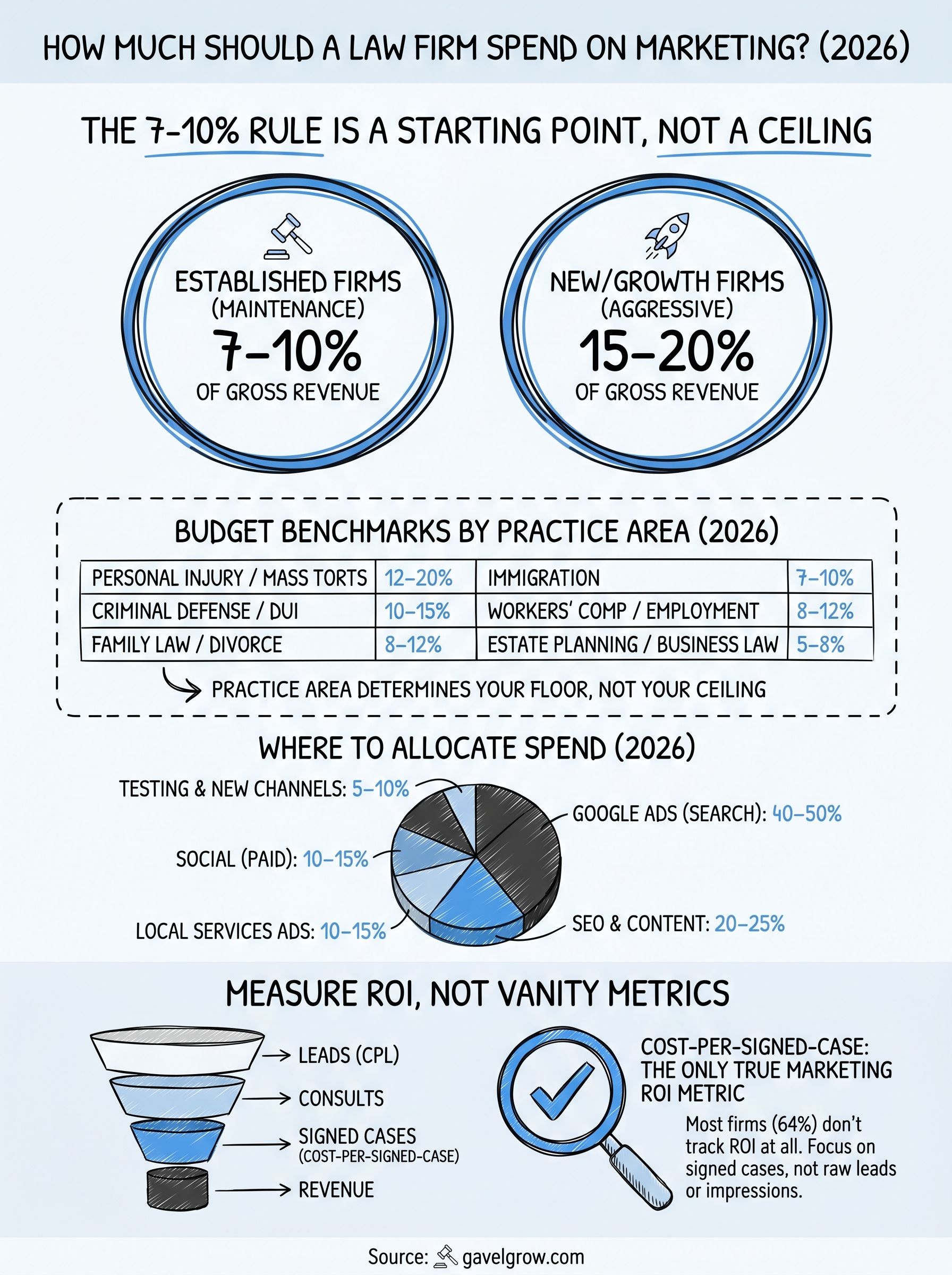
A reasonable baseline for how much should a law firm spend on marketing in 2026 is 7-10% of gross revenue for established firms and 15-20% for firms in their first three years or entering a new practice area. Those ranges hold across most of the legal industry, but two factors compress or expand them significantly: your practice area and your geography.
Budget Benchmarks by Practice Area
Practice area is the single biggest variable in your budget calculation. High-competition areas like personal injury, mass torts, and criminal defense require more spend to achieve visibility because dozens of competitors are bidding on the same keywords and buying the same TV slots. Lower-competition areas allow you to hit strong case volume at the lower end of the range.
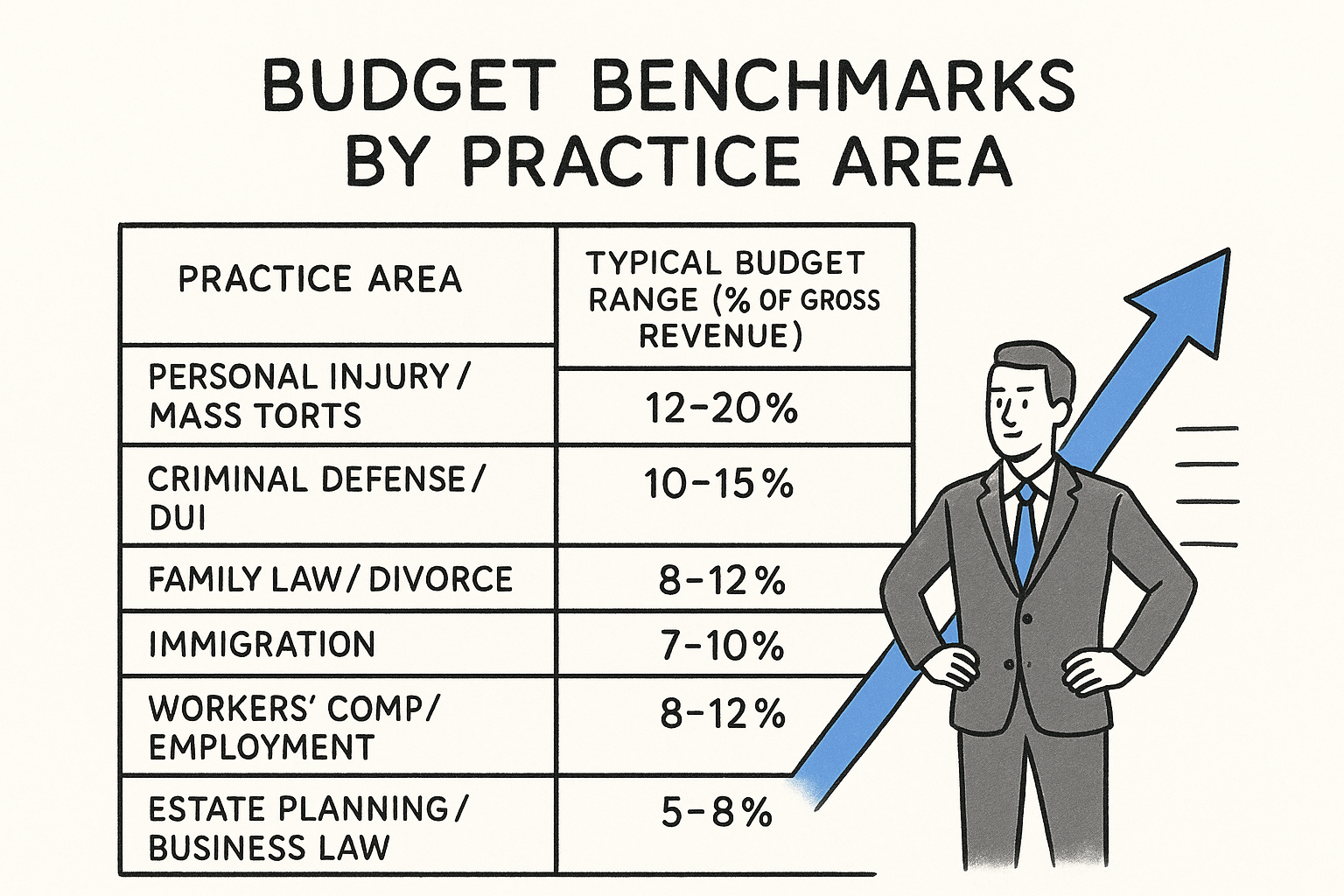
Your practice area determines your floor, not your ceiling. A personal injury firm in a major metro often can't survive at 7%; an estate planning firm in a mid-size market often thrives there.
Here is how the ranges typically break down by practice area in 2026:
These ranges reflect competitive ad market conditions and the average case value in each area. Higher average case values, like in mass tort litigation, justify larger upfront acquisition costs.
How Firm Age and Geography Shift the Range
A two-year-old personal injury firm in Houston competes against firms that have spent decades building brand recognition, referral networks, and review volume. Matching that visibility requires front-loading your budget well above the 10% baseline until your firm earns enough organic presence to reduce paid spend.
Geography adds another layer. Firms in large metros like Los Angeles, Chicago, or New York face Google Ads click costs two to four times higher than firms in mid-size markets. A $5,000 monthly ad budget in Boise performs very differently than the same budget in Miami. Adjusting your percentage target based on your local cost-per-click environment is not optional; it is the only way to set a number that reflects your actual market.
How to Calculate Your Budget from Revenue and Goals
Knowing the percentage benchmarks is useful, but you need a concrete number tied to your firm's actual revenue and targets. The calculation is straightforward, and running it takes less than ten minutes with the right inputs.
Step 1: Anchor the Calculation to Your Gross Revenue
Start with your trailing 12-month gross revenue, not projections. If your firm collected $800,000 last year, that is your baseline. Apply the appropriate percentage for your practice area and firm stage from the ranges covered earlier. A family law firm at that revenue level operating in a competitive market should target 8-12%, which lands between $64,000 and $96,000 annually, or roughly $5,300-$8,000 per month. Use this formula as your starting point:
- Annual Marketing Budget = Gross Revenue x Target Percentage
- Monthly Budget = Annual Marketing Budget / 12
For example:
- $500,000 revenue x 10% = $50,000/year = $4,167/month
- $1,000,000 revenue x 8% = $80,000/year = $6,667/month
- $2,000,000 revenue x 12% = $240,000/year = $20,000/month
Run all three columns even if you only use one. Seeing the range across percentages makes it easier to spot where a modest increase in budget allocation produces a meaningful jump in monthly spend capacity.
Step 2: Adjust the Percentage Based on Your Growth Goal
The revenue-based formula gives you a maintenance budget, meaning the spend needed to hold your current position. If you want to grow case volume by 30% or more, treat that growth target as a separate line item rather than a rounding error added to your baseline.
A firm targeting aggressive growth should calculate two numbers: the maintenance budget to protect existing revenue, and a growth premium on top of it to fund expansion into new channels or markets.
A practical way to set the growth premium is to work backward from your case goal. If you want 20 additional signed cases per year and your current cost-per-signed-case is $1,500, you need $30,000 in additional budget to hit that number. Add that figure to your baseline to get your total annual spend target. This approach is the most direct answer to how much should a law firm spend on marketing: start with revenue, layer in your growth math, then arrive at a number specific to your firm rather than one borrowed from a broad industry average.
How to Allocate Spend and Measure ROI
Once you know your total budget, deciding where to send each dollar is the next decision that separates profitable firms from ones that waste spend on channels that never produce signed cases. The question of how much should a law firm spend on marketing becomes far less useful if you dump the entire budget into one channel without a framework for distributing it strategically.
Where to Allocate Your Budget Across Channels
Most firms benefit from a tiered allocation model that prioritizes proven channels first, then reserves a smaller portion for testing. A common starting split puts the largest share into Google Search Ads, a steady share into SEO and content, smaller amounts into Local Services Ads and social, and a slice into testing new channels; adjust it as your own cost per signed case comes in.
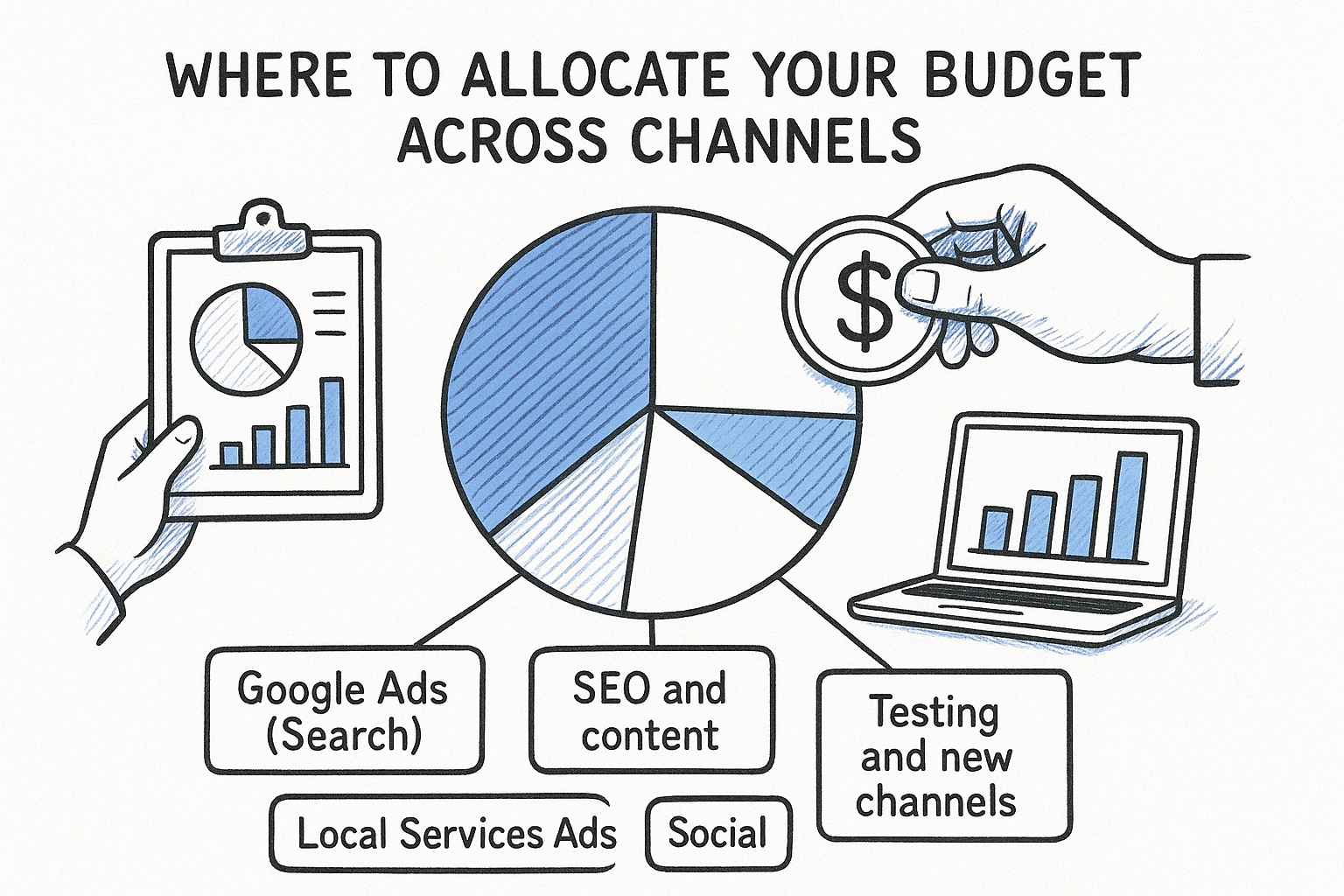
Start by funding Google Search Ads first because it captures demand that already exists. Someone typing "personal injury attorney near me" is ready to hire; your ad either intercepts that intent or a competitor's does. SEO takes longer to compound, but it reduces your long-term cost-per-signed-case as organic traffic grows.
Splitting budget between paid and organic channels can lower your cost per signed case over 12 to 18 months, as organic traffic starts carrying part of the load.
How to Measure ROI Without Guesswork
Measurement starts at the source, not in a spreadsheet at the end of the month. Every campaign needs a dedicated tracking number so you can tie calls to specific ads, and every intake form submission needs to fire a conversion event back to your ad platform. Without those two pieces in place, your ad accounts optimize for clicks rather than signed cases.
Use this three-step audit monthly:
- Pull cost-per-signed-case by campaign, not just total spend vs. total cases.
- Flag any campaign where cost-per-signed-case exceeds your target case value threshold (typically 15-20% of average case fee).
- Reallocate budget from underperforming campaigns to those hitting or beating your threshold.
GavelGrow's platform automates this loop by syncing Google Ads spend daily and mapping it against case outcomes, so your monthly audit takes minutes rather than hours of manual data work.
Frequently Asked Questions
The questions below reflect what managing partners and marketing directors ask most often when trying to figure out how much should a law firm spend on marketing. Each answer draws on GavelGrow's modelled benchmarks for U.S. law firms to give you a concrete, usable number rather than a vague range.
How Much Should a Law Firm Spend on Marketing in Its First Year?
New firms should budget 15-20% of projected gross revenue in year one, treating it as a capital investment rather than an operating expense. You are competing against firms with years of brand recognition, review volume, and referral networks already in place. Allocating less than 15% in a competitive market like personal injury or criminal defense makes it nearly impossible to build enough visibility and case volume to reach sustainable profitability within two to three years.
Does My Marketing Budget Include Staff Salaries?
Yes. Any internal role dedicated to marketing, such as a marketing coordinator or intake specialist, counts toward your total budget. Many published marketing-spend benchmarks count paid media and personnel together. Track these costs separately in your budget so you understand how much goes toward generating leads versus managing them after they arrive.
How Do I Know If My Current Budget Is Too Low?
The clearest signal is a rising cost-per-signed-case combined with flat or declining case volume. If you are spending the same amount each month and signing fewer cases than six months ago, your budget has not kept pace with market competition. Pull your campaign-level cost-per-signed-case by month for the past year and look for an upward trend.
A budget that looked right at $3,000 per month in 2023 may require $4,500 in 2026 to produce the same case volume in a competitive metro market.
What Percentage of My Budget Should Go to Google Ads?
Allocate 40-50% of your total marketing budget to Google Search Ads first. Search captures active buyer intent; someone already searching "DUI attorney near me" needs a lawyer now. Google's own data confirms that search ads drive higher purchase intent than social ads for service businesses, making it the safest channel to fund before testing others.
What Is a Realistic Cost Per Signed Case for a Personal Injury Firm?
A realistic target is $800 to $2,500 per signed case depending on your market size and case type. Firms in large metros like Los Angeles or Chicago typically land toward the higher end of that range. If your cost-per-signed-case exceeds 20% of your average case fee, that campaign is consuming more margin than it produces and needs immediate reallocation.
Bottom Line
The answer to how much should a law firm spend on marketing is not a single number; it is a calculation anchored to your gross revenue, adjusted for your practice area, and validated by your cost-per-signed-case data. Most established firms land in the 7-10% range, while growth-stage firms and those in high-competition markets like personal injury routinely need 15% or more to generate meaningful case volume. Setting a budget without tracking outcomes at the campaign level means you are flying without instruments.
The firms that scale profitably share one habit: they measure every dollar from the first ad click to the signed retainer and cut anything that does not convert. If you want a clear picture of where your current marketing budget stands before committing to a number for 2026, run a free law firm marketing scorecard and see exactly where you are leaving signed cases on the table.
Frequently Asked Questions
How Much Should a Law Firm Spend on Marketing in Its First Year?
New firms should budget 15-20% of projected gross revenue in year one, treating it as a capital investment rather than an operating expense. You are competing against firms with years of brand recognition, review volume, and referral networks already in place. Allocating less than 15% in a competitive market like personal injury or criminal defense makes it nearly impossible to build enough visibility and case volume to reach sustainable profitability within two to three years.
Does My Marketing Budget Include Staff Salaries?
Yes. Any internal role dedicated to marketing, such as a marketing coordinator or intake specialist , counts toward your total budget. Many published marketing-spend benchmarks count paid media and personnel together. Track these costs separately in your budget so you understand how much goes toward generating leads versus managing them after they arrive.
How Do I Know If My Current Budget Is Too Low?
The clearest signal is a rising cost-per-signed-case combined with flat or declining case volume. If you are spending the same amount each month and signing fewer cases than six months ago, your budget has not kept pace with market competition. Pull your campaign-level cost-per-signed-case by month for the past year and look for an upward trend. A budget that looked right at $3,000 per month in 2023 may require $4,500 in 2026 to produce the same case volume in a competitive metro market.
What Percentage of My Budget Should Go to Google Ads?
Allocate 40-50% of your total marketing budget to Google Search Ads first. Search captures active buyer intent; someone already searching "DUI attorney near me" needs a lawyer now. Google's own data confirms that search ads drive higher purchase intent than social ads for service businesses, making it the safest channel to fund before testing others.
What Is a Realistic Cost Per Signed Case for a Personal Injury Firm?
A realistic target is $800 to $2,500 per signed case depending on your market size and case type. Firms in large metros like Los Angeles or Chicago typically land toward the higher end of that range. If your cost-per-signed-case exceeds 20% of your average case fee , that campaign is consuming more margin than it produces and needs immediate reallocation.