Personal Injury Marketing: 9 Strategies to Sign More Cases
Categories: Legal Marketing Strategies
 Abram Ninoyan
Founder & Senior Performance Marketer
Credentials: Google Partner, Google Ads Search Certified, Google Ads Display Certified, Google Ads Measurement Certified, Google Analytics (IQ) Certified, HubSpot Inbound Certified, HubSpot Social Media Marketing Certified, Conversion Optimization Certified
Expertise: Google Ads, Meta Ads, Conversion Rate Optimization, GA4 & Google Tag Manager, Lead Generation, Marketing Funnel Optimization, PPC Management
LinkedIn Profile
Most personal injury marketing budgets leak through the same crack: firms generate plenty of leads but sign too few cases. The American Bar Association's 2023 Legal Technology Survey found that firms...
Key Takeaways
- Personal Injury Marketing: 9 Strategies to Sign More Cases
- 1. Attribute every case with full-funnel tracking
- 2. Cut response time with intake automation
- 3. Win local searches with SEO and Google Business Profile
Personal Injury Marketing: 9 Strategies to Sign More Cases
Most personal injury marketing budgets leak through the same crack: firms generate plenty of leads but sign too few cases. The American Bar Association's 2023 Legal Technology Survey found that firms spending more on client acquisition tools still cite intake follow-up as their top conversion barrier, not lead volume. If your ad spend keeps climbing while your signed-case count stays flat, the problem usually sits in intake speed and attribution, not in your Google Ads budget.
The fix isn't one silver-bullet tactic. It's a combination of paid acquisition, conversion-focused intake, and measurement that traces every dollar to a signed retainer instead of a vanity click. Firms that pair aggressive campaigns with fast, TCPA-compliant intake consistently outperform competitors who only chase impressions and click-through rates.
This article walks through nine strategies personal injury firms use to turn marketing spend into signed cases, from Local Services Ads and mass-tort-specific SEO to call tracking and automated follow-up sequences that catch leads inside the first 60 seconds. You'll also see where a purpose-built legal marketing platform brings together the patchwork of call tracking, spreadsheets, and disconnected CRMs that quietly kill conversion rates. Each strategy includes a practical next step you can implement this month, whether you're running marketing in-house or evaluating an agency for your next campaign.
1. Attribute every case with full-funnel tracking
Personal injury firms often track cost-per-lead and call it a day, but that number hides the truth. A campaign generating cheap leads that never sign is worse than one producing fewer, pricier leads that close. Full-funnel tracking connects every ad click, form fill, and phone call to the moment a client signs a retainer, so you know which campaigns actually make money.
How it works
Full-funnel attribution tags each lead at the point of first contact, whether that's a Google Ads click, an organic search visit, or a referral link, and follows that lead through your pipeline until it either converts to a signed case or drops off. Instead of stopping at "lead captured," the system carries a unique identifier through intake, case evaluation, and signature. GavelGrow's marketing dashboard does this natively, calculating campaign-level cost-per-signed-case rather than the cost-per-lead number most agencies report.
Why it drives signed cases
Without full-funnel data, firms routinely overspend on channels that generate volume but underperform on quality. A mass-tort campaign might produce 200 leads a month at $40 each, while a targeted local campaign produces 30 leads at $150 each, but if the local campaign signs 12 cases and the mass-tort campaign signs 3, the "cheap" leads cost far more per case. Comparing raw lead counts across channels without this context leads firms to defund their best-performing campaigns.
If you can't trace a signed case back to its originating ad click, you're guessing with your marketing budget, not managing it.
How to get started
Most firms already have the pieces; they just aren't connected. Here's what to check first:
- Confirm your CRM or intake tool passes a lead ID from first contact through case status changes
- Set up conversion tracking that fires on "signed retainer," not just "form submitted," in Google Analytics 4 and Meta
- Pull a report comparing cost-per-lead against cost-per-signed-case for each active campaign
- Flag any campaign where signed-case cost is more than double your firm's average
If building this from scratch feels like another IT project, GavelGrow's pricing plans include full-funnel attribution as a baseline feature, not an add-on integration you have to configure yourself. Firms comparing their numbers against the platform'smodelled practice-area benchmarks often find their true cost-per-signed-case running 2 to 3 times higher than what their cost-per-lead reports suggested.
2. Cut response time with intake automation
Speed decides whether a personal injury lead becomes a client or calls the next firm on the search results page. The Lead Response Management Study found that leads contacted within five minutes were 21 times more likely to qualify than those first reached at 30 minutes. Intake automation removes the delay caused by lunch breaks, after-hours submissions, and staff juggling three other calls when a lead comes in.
How it works
Automated intake fires an SMS and email the moment a lead submits a form or hangs up from a missed call, confirming receipt and setting expectations for a callback. GavelGrow's intake automation triggers these sequences within minutes of capture, with CTIA-compliant STOP and HELP keyword handling built in so your firm never has to manually manage opt-outs.
Why it drives signed cases
Personal injury leads rarely wait around. Someone injured in a car accident is usually contacting two or three firms simultaneously, and whichever one responds first often wins the retainer. Automated follow-up buys your intake team the minutes they need to actually call back while keeping the lead warm.
The firm that responds first usually signs the case, not the firm with the better ad.
How to get started
Audit your current response time this week:
- Submit a test lead through your own intake form after hours
- Time how long it takes to receive any acknowledgment
- Compare that number against your published 5-minute response goal
- If automation isn't live, GavelGrow's platform ships intake sequencing standard on every plan tier
3. Win local searches with SEO and Google Business Profile
When someone searches "car accident lawyer near me" after a crash, they rarely scroll past the map pack. Ranking there matters more for personal injury marketing than almost any other channel, because these searchers are already looking for representation, not general information. A firm buried on page two of organic results loses that lead before the phone ever rings.
How it works
Local SEO combines an optimized Google Business Profile (accurate categories, service areas, photos, and consistent NAP data) with on-site content targeting practice-area and city-specific keywords like "Dallas motorcycle accident attorney." Google's guidelines on local ranking factors confirm that relevance, distance, and prominence, including review volume, drive who appears in the map pack.
Why it drives signed cases
Organic and map-pack traffic converts at a higher rate than most paid channels because searchers arrive with clear intent and no ad skepticism. Firms that neglect Google Business Profile upkeep, letting reviews go unanswered or hours go stale, quietly lose visibility to competitors who update theirs weekly.
A firm invisible in the map pack is invisible to the exact people ready to hire a lawyer today.
How to get started
Start with a quick audit this week:
- Verify your Google Business Profile categories match your actual practice areas
- Add 5 recent case-result photos or videos
- Respond to every unanswered review
- Publish one city-specific practice area page targeting a real search term
4. Capture high-intent clicks with Google Ads and LSAs
Someone searching "18-wheeler accident lawyer" minutes after a crash isn't browsing, they're ready to hire. Google Ads and Local Services Ads put your firm in front of that exact searcher before organic rankings ever have a chance to catch up, which matters most for practice areas with short shopping windows like personal injury.
How it works
Google Ads runs keyword-targeted search campaigns billed per click, while Local Services Ads (LSAs) appear above regular search ads, billed per lead, and require a Google Screened badge that verifies licensing and insurance. Google's Local Services Ads overview confirms the pay-per-lead model and screening requirements specific to legal advertisers. GavelGrow's daily Google Ads sync pulls campaign, spend, and conversion data straight into the marketing dashboard automatically.
Why it drives signed cases
Paid search captures leads at the exact moment of intent, which is why cost-per-click for competitive terms like "personal injury lawyer" often exceeds $100. That expense only pays off if intake converts fast.
Paid clicks are expensive rentals on attention, not owned assets, so intake speed decides whether the rent was worth paying.
How to get started
- Apply for Google Screened verification through LSAs if you haven't already
- Separate campaigns by practice area rather than running one broad "personal injury" campaign
- Set conversion tracking to fire on signed retainer, not just click or call
- Review your cost-per-signed-case weekly, not monthly, while budgets are still being tuned
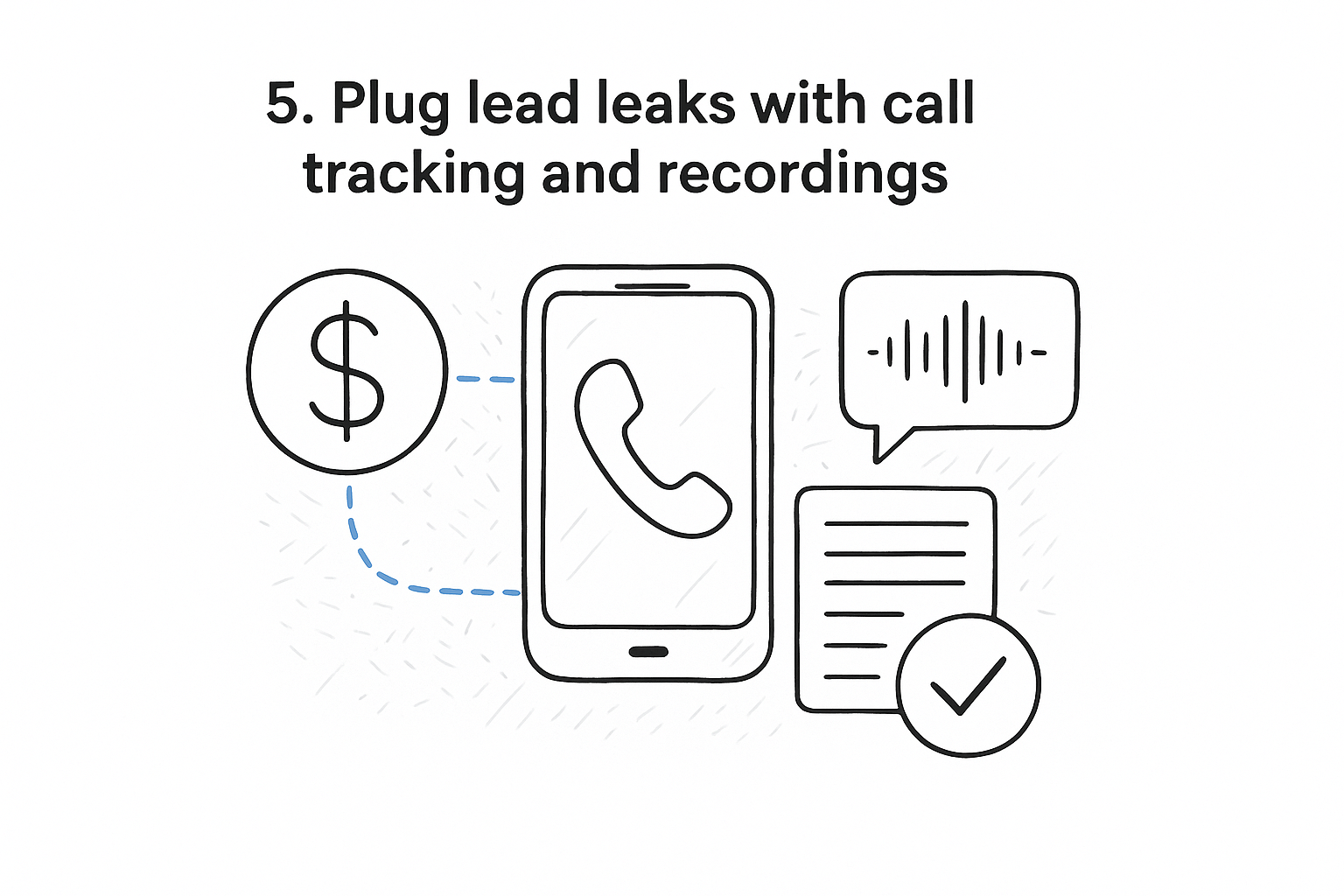
5. Plug lead leaks with call tracking and recordings
Phone calls still drive most personal injury signups, yet many firms have no idea which campaigns generate the calls that actually sign, or how many calls get missed entirely. Call tracking closes that blind spot by assigning trackable numbers to every marketing channel and recording what happens after someone picks up.
How it works
Each campaign, whether it's a Google Ads group, a billboard, or a referral partner, gets a unique tracking number that routes to your intake line while logging the call's source. GavelGrow's built-in call tracking means you don't need a separate call-tracking tool, pairing dedicated tracking numbers with recordings, outcome tagging (qualified, callback, unqualified, spam), and missed-call reporting so you see where calls go unanswered.
Why it drives signed cases
A campaign that generates 50 calls a month means little if 15 of them ring through to voicemail. Reviewing recordings also exposes intake staff who rush qualification questions or fail to schedule a follow-up, patterns that never show up in a lead-count spreadsheet.
A call you can't trace back to a campaign, or a call nobody answered, is marketing spend you're throwing away twice.
How to get started
- Assign a unique tracking number to every active campaign, including offline sources
- Pull last month's miss-rate report and flag any number above 10%
- Spot-check 10 recorded calls for intake script adherence
- Consolidate tracking into GavelGrow's platform if you're currently paying for CallRail separately
6. Build trust with educational content marketing
Injury victims research before they call, often reading three or four firm websites while still in the ER waiting room. Educational content marketing, blog posts, FAQ pages, and practice-area guides that answer real questions about claims, deadlines, and settlement ranges, positions your firm as the obvious choice before that first phone call ever happens.
How it works
Content marketing means publishing articles that answer specific questions your prospects search for, like "what is my slip and fall case worth in Ohio" or "how long do I have to file after a car accident." Each piece links back to a practice-area landing page with a clear intake form, turning search traffic into leads rather than just page views.
Why it drives signed cases
Someone who reads three of your articles before calling arrives already trusting your expertise, which shortens the sales conversation and raises close rates. Firms relying only on paid ads skip this trust-building step entirely, competing on price and speed alone instead of demonstrated knowledge.
Content that answers a prospect's exact question builds more trust than any ad they'll scroll past.
How to get started
- List the ten questions your intake team hears most often on first calls
- Publish one article answering each question in plain language, not legalese
- Link every article to the relevant practice-area page with a visible intake form
- Track which articles generate leads inside your marketing dashboard to see what's actually converting
7. Show your firm's story through video marketing
Injury victims want to know who's handling their case before they ever step into an office, and text alone rarely closes that gap. Video marketing lets prospects see your attorneys, hear your voice, and watch real client testimonials, which builds a level of trust that a static bio page can't match. For personal injury marketing specifically, video shortens the emotional distance between a scared prospect and an unfamiliar law firm.

How it works
Firms record short videos covering attorney introductions, case-result explanations, and client testimonials, then place them on practice-area pages, Google Business Profile, YouTube, and social channels. Client testimonial videos carry the most weight because they show a real person describing the exact fear and outcome a prospective client is currently imagining.
Why it drives signed cases
Visitors who watch a video before calling arrive with fewer objections and less price sensitivity, since they've already seen your team and heard proof of results. Firms without video rely entirely on written copy, which leaves anxious prospects guessing about who will actually answer the phone.
A face and a voice close more skepticism than any paragraph of website copy ever will.
How to get started
- Record three testimonials this quarter from recently settled clients willing to go on camera
- Add one 60-second attorney introduction video to your homepage
- Embed video on your top three practice-area landing pages
- Track video page performance inside your marketing dashboard alongside other lead sources
8. Grow 5-star reviews with reputation management
People hiring a personal injury lawyer check star ratings before they check practice areas. Reputation management turns satisfied clients into public proof, and it directly affects whether your Google Business Profile shows up in the map pack at all, since review volume is one of Google's confirmed local ranking signals.
How it works
Structured reputation management means requesting reviews at the right moment, usually right after a case settles, then monitoring and responding to every review that comes in, good or bad. Automated review requests, sent by text or email within days of a signed settlement, catch clients while the relief of a resolved case is still fresh, which produces far higher response rates than asking months later.
Why it drives signed cases
Few injury victims call a firm with a 3.8-star rating when a competitor down the street sits at 4.9. Star ratings act as a trust shortcut for someone who has never needed a lawyer before and has no other way to judge quality. Firms that ignore negative reviews, or worse, never respond, signal neglect to every future prospect scrolling past.
Your star rating decides which firm gets the call before your attorneys ever get the chance to prove themselves.
How to get started
- Send a review request text within 48 hours of every signed settlement
- Respond to all reviews, including negative ones, within 24 hours
- Set a monthly target, like 10 new reviews per office location
- Route review requests through GavelGrow's intake automation so timing never depends on staff remembering
9. Expand referrals through networking and sponsorships
Not every signed case starts with an ad click. Some of the highest-value personal injury cases still arrive through a referring attorney, a former client, or a chiropractor who trusts your firm to treat their patients well. Referral networking costs far less than paid acquisition once it's built, and it tends to produce clients who already trust you before the first call.
How it works
Building a referral pipeline means cultivating relationships with attorneys in adjacent practice areas (family law, criminal defense, immigration) who don't handle injury cases themselves, along with medical providers, body shops, and community organizations. Local sponsorships, like youth sports teams or bar association events, keep your name visible among the professionals most likely to send a referral.
Why it drives signed cases
Referred leads convert at higher rates because someone the prospect already trusts vouched for your firm first. Unlike a paid click, a referral rarely gets shopped against three competitors, which shortens your sales cycle and raises average case value, especially for the complex cases other attorneys don't want to handle themselves.
A referral arrives pre-sold on your reputation, which is exactly why it closes faster than any ad ever will.
How to get started
- List every attorney and medical provider who has referred a case in the past two years
- Send a handwritten thank-you or small gift after each referral
- Sponsor one local event or team this quarter tied to your practice area
- Track referral-source cases inside your marketing dashboard alongside paid channels
Where to focus next
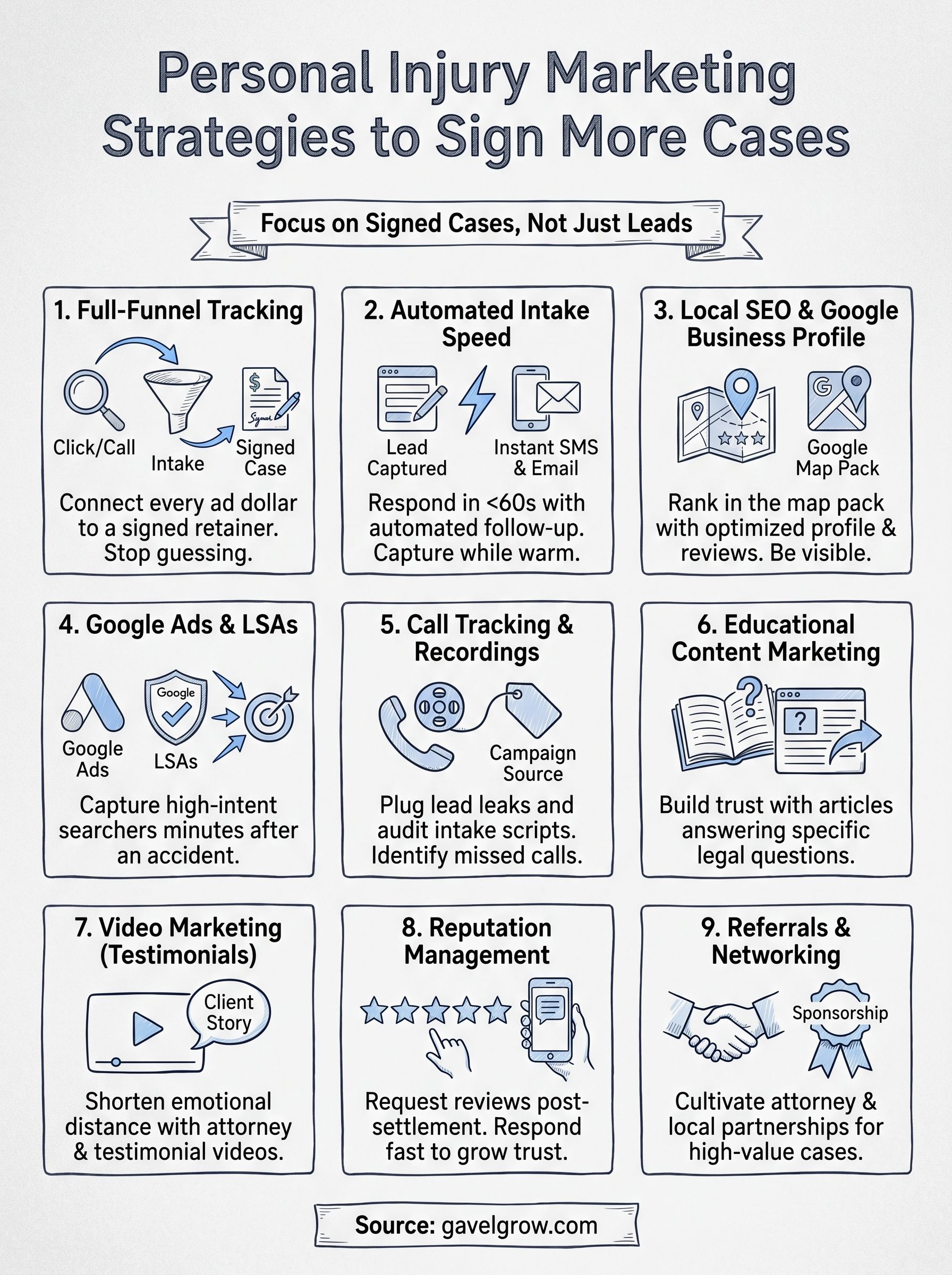
Nine strategies is a lot to tackle at once, so don't try to launch all of them this month. Start with attribution and intake speed, since those two fixes expose whether your existing ad spend is actually working before you add new channels on top of a broken funnel. Once you can see cost-per-signed-case by campaign and your leads get a text back within 60 seconds, everything else, SEO, video, reviews, referrals, compounds on a foundation that actually converts.
Personal injury marketing rewards firms that measure signed cases, not clicks. If you're running marketing in-house and want call tracking, intake automation, and full-funnel attribution in one dashboard instead of three disconnected tools, book a free 45-minute strategy call and we'll show you exactly where your funnel is leaking cases.
Frequently Asked Questions
How do personal injury law firms market themselves?
The highest-return PI marketing combines full-funnel attribution (tracking every lead from click or call to signed case), fast intake, local SEO and a strong Google Business Profile, and paid search and Local Services Ads for immediate leads, plus disciplined reputation management. The firms that sign the most cases treat marketing as one measured system tied to signed retainers, not a set of disconnected tactics.
How much do personal injury firms spend on marketing?
PI is the most competitive legal vertical, so spend runs high — from several thousand a month for a small firm to well into six figures for firms competing in major metros. Rather than a flat number, budget from case value: with cases worth tens of thousands, PI firms can afford aggressive acquisition costs as long as they track cost per signed case and stay profitable per matter.
What is the best marketing channel for personal injury lawyers?
Google Ads and Local Services Ads deliver the highest-intent leads, because they reach people searching for a lawyer right after an accident, while local SEO and reviews build durable, lower-cost visibility over time. Most successful PI firms run paid channels for immediate case flow and invest in SEO and reputation for compounding pipeline — and track every channel to signed cases.
Why do personal injury firms lose leads even with good marketing?
Usually speed-to-lead and intake, not the ads. PI leads contact several firms at once and often call rather than fill out a form, so the firm that answers fastest and qualifies well tends to sign the case. Slow follow-up, missed after-hours calls, and disorganized intake quietly waste the budget that generated the lead in the first place.
How do you track ROI on personal injury marketing?
Track the full path from click or call to signed case, not vanity metrics like traffic or impressions. The numbers that matter are cost per lead, lead-to-consultation rate, intake-to-retainer conversion, and cost per signed case by channel and campaign. Attribution that connects each lead source through intake to a signed retainer is the only way to know which marketing actually funds the firm.
Are there compliance rules for personal injury marketing?
Yes. State bar advertising rules govern claims, testimonials, case-result statements, and required disclaimers, and PI marketing draws extra scrutiny. Avoid outcome guarantees and unqualified superlatives, include required disclaimers on results and any fee statements, and keep claims substantiated. Compliant marketing protects your license and tends to convert better by setting honest expectations.
How long does personal injury marketing take to produce cases?
Paid channels like Google Ads and Local Services Ads can generate cases within days, which is why PI firms rely on them for immediate flow. SEO, content, and reputation take three to twelve months to compound but lower your long-term cost per case. The fastest-growing firms run paid ads for speed while building organic visibility for durable, lower-cost pipeline.
Frequently Asked Questions
How do personal injury law firms market themselves?
The highest-return PI marketing combines full-funnel attribution (tracking every lead from click or call to signed case), fast intake, local SEO and a strong Google Business Profile, and paid search and Local Services Ads for immediate leads, plus disciplined reputation management. The firms that sign the most cases treat marketing as one measured system tied to signed retainers, not a set of disconnected tactics.
How much do personal injury firms spend on marketing?
PI is the most competitive legal vertical, so spend runs high — from several thousand a month for a small firm to well into six figures for firms competing in major metros. Rather than a flat number, budget from case value: with cases worth tens of thousands, PI firms can afford aggressive acquisition costs as long as they track cost per signed case and stay profitable per matter.
What is the best marketing channel for personal injury lawyers?
Google Ads and Local Services Ads deliver the highest-intent leads, because they reach people searching for a lawyer right after an accident, while local SEO and reviews build durable, lower-cost visibility over time. Most successful PI firms run paid channels for immediate case flow and invest in SEO and reputation for compounding pipeline — and track every channel to signed cases.
Why do personal injury firms lose leads even with good marketing?
Usually speed-to-lead and intake, not the ads. PI leads contact several firms at once and often call rather than fill out a form, so the firm that answers fastest and qualifies well tends to sign the case. Slow follow-up, missed after-hours calls, and disorganized intake quietly waste the budget that generated the lead in the first place.
How do you track ROI on personal injury marketing?
Track the full path from click or call to signed case, not vanity metrics like traffic or impressions. The numbers that matter are cost per lead, lead-to-consultation rate, intake-to-retainer conversion, and cost per signed case by channel and campaign. Attribution that connects each lead source through intake to a signed retainer is the only way to know which marketing actually funds the firm.
Are there compliance rules for personal injury marketing?
Yes. State bar advertising rules govern claims, testimonials, case-result statements, and required disclaimers, and PI marketing draws extra scrutiny. Avoid outcome guarantees and unqualified superlatives, include required disclaimers on results and any fee statements, and keep claims substantiated. Compliant marketing protects your license and tends to convert better by setting honest expectations.
How long does personal injury marketing take to produce cases?
Paid channels like Google Ads and Local Services Ads can generate cases within days, which is why PI firms rely on them for immediate flow. SEO, content, and reputation take three to twelve months to compound but lower your long-term cost per case. The fastest-growing firms run paid ads for speed while building organic visibility for durable, lower-cost pipeline.