Attorney SEO: What It Is and Why It Drives More Signed Cases
Categories: Legal Marketing Strategies
 Abram Ninoyan
Founder & Senior Performance Marketer
Credentials: Google Partner, Google Ads Search Certified, Google Ads Display Certified, Google Ads Measurement Certified, Google Analytics (IQ) Certified, HubSpot Inbound Certified, HubSpot Social Media Marketing Certified, Conversion Optimization Certified
Expertise: Google Ads, Meta Ads, Conversion Rate Optimization, GA4 & Google Tag Manager, Lead Generation, Marketing Funnel Optimization, PPC Management
LinkedIn Profile
Attorney SEO is the practice of optimizing your law firm's website, Google Business Profile, and content so potential clients find you first when they search for help in your practice area and city. D...
Key Takeaways
- Attorney SEO: What It Is and Why It Drives More Signed Cases
- Why does attorney SEO matter for law firm growth?
- How do you build an attorney SEO strategy?
- What are the core components of attorney SEO?
Attorney SEO: What It Is and Why It Drives More Signed Cases
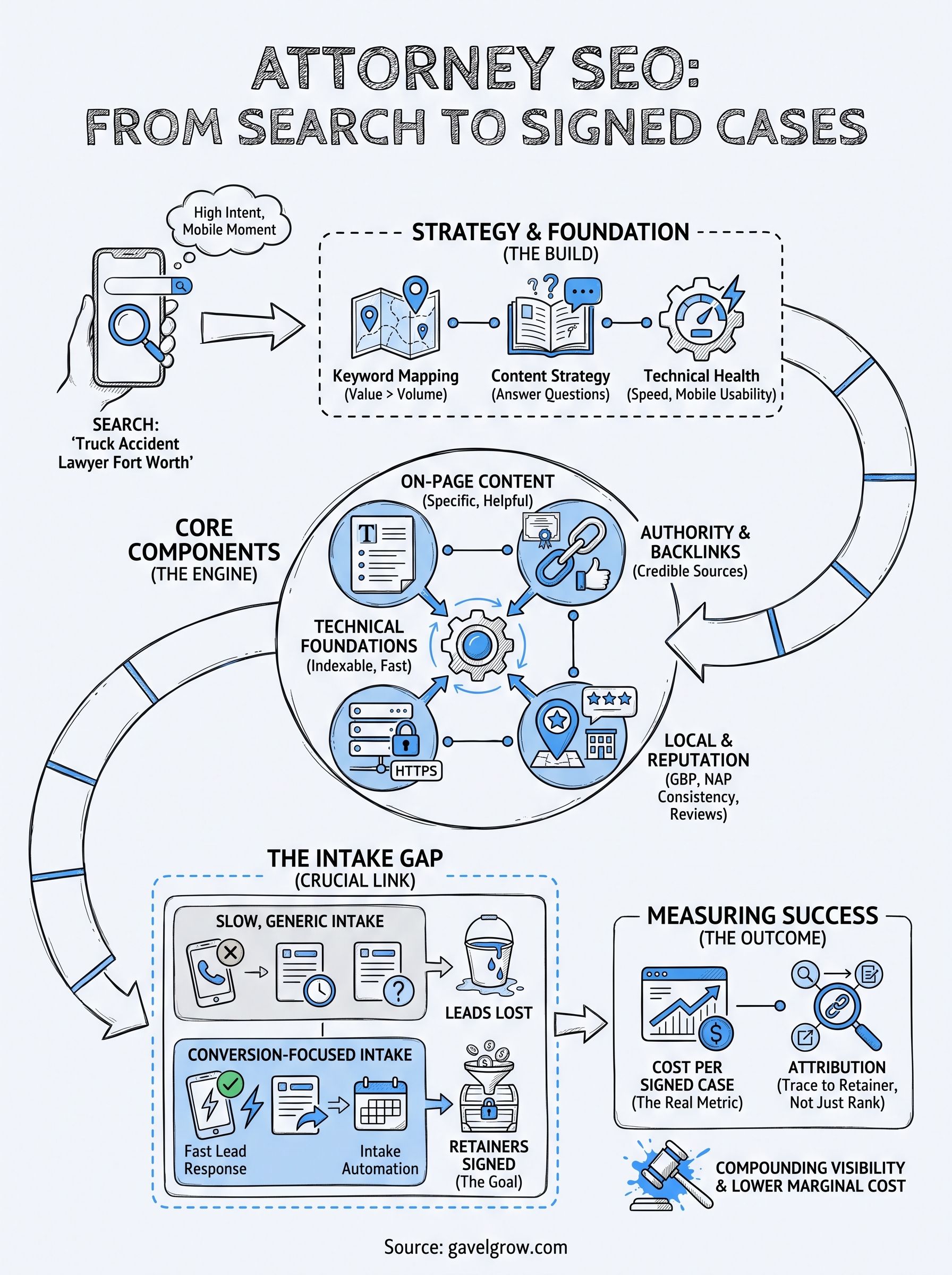
Attorney SEO is the practice of optimizing your law firm's website, Google Business Profile, and content so potential clients find you first when they search for help in your practice area and city. Done right, it turns organic search into a steady source of signed cases instead of just website traffic.
Most articles on this topic stop at rankings. That misses the point. A firm ranking #1 for "personal injury lawyer Dallas" with a slow, generic contact form is still losing cases to a competitor ranking #4 with a mobile-optimized intake process. Real attorney SEO connects search visibility to what actually matters: retainers signed. That means pairing keyword and content strategy with conversion-focused intake, fast lead response, and attribution that tracks a searcher from click to signed case, not just to a form submission.
This article breaks down what attorney SEO actually involves, how it differs from generic SEO, what it costs, and how to measure whether it's working. You'll also see where tools like GavelGrow's marketing dashboard fit once traffic starts arriving, because ranking well only pays off if your intake system converts that traffic into clients.
Why does attorney SEO matter for law firm growth?
Search is where the client relationship starts for most practice areas. Google's own research on local search behavior shows that a large share of "near me" and service-related searches happen on mobile, often at the exact moment someone needs a lawyer, after an accident, an arrest, or a served divorce complaint. If your firm doesn't show up in that moment, a competitor does. Attorney SEO matters because it puts your firm in front of people actively looking for legal help, not passively scrolling social media hoping to notice an ad. That intent gap is why organic search leads convert at a higher rate than most other acquisition channels for law firms, and why the visibility you build compounds instead of resetting every month the way paid ads do.
Attorney SEO doesn't just get you noticed, it gets you noticed by people who already decided they need a lawyer.
The cost advantage over paid ads
Paid search still has a role, but it's expensive and temporary. The moment you stop paying, the leads stop coming. SEO works differently: once a page ranks, it keeps generating leads without a per-click cost attached to every new visitor. That doesn't mean it's free, you're paying for the content, technical work, and time it takes to get there, but the marginal cost per lead drops as that work keeps paying off month after month. Here's how the two compare over time:
Growing a firm entirely on paid channels means renting attention. Building organic visibility means owning an asset that keeps producing leads even during months when the ad budget gets cut.
Why rankings alone don't grow a firm
Ranking on page one means nothing if that traffic doesn't turn into signed cases. Most legal marketing advice stops at the ranking, treating a top-three spot as the finish line. It isn't. A firm can rank well for its target keywords and still leak most of that traffic through a slow callback, a clunky contact form, or a phone line that rolls to voicemail after 5 p.m. Firms without a structured, fast intake process lose qualified leads regardless of how well they rank. That's the gap GavelGrow's marketing dashboard is built to close, pairing the traffic your SEO work generates with built-in call tracking and intake automation, so leads get worked before they go cold instead of sitting in an inbox.
The compounding effect in competitive practice areas
Practice areas like personal injury and mass torts carry some of the highest paid-ad costs in legal, sometimes well over $100 per click before a lead ever fills out a form. SEO shifts a portion of that acquisition cost away from a strict pay-per-click model. Building organic visibility in a competitive market takes longer, six to twelve months is typical, but once you rank, you're capturing case volume that competitors are still paying full price for through ads. Firms in less crowded practice areas, like estate planning or family law in a mid-sized metro, often see meaningful ranking movement within three to four months. You can see how this plays out across practice areas in GavelGrow's client portfolio, where firms show measurable ranking and case-volume gains tracked over time, not just vanity traffic increases.
How do you build an attorney SEO strategy?
Building an attorney SEO strategy starts with knowing exactly who you're trying to rank for, not just what keywords look attractive. A firm chasing "lawyer near me" without narrowing to practice area, city, and even neighborhood ends up competing against every generalist in the state. Start narrower: "truck accident lawyer Fort Worth" beats "personal injury lawyer" because it matches how someone searches right after a real event, and it faces less competition from national directory sites and lead-gen aggregators.
A strategy built around your actual caseload beats one built around whatever keyword tool spits out the highest search volume.
Map keywords to practice areas and case value
Group your target terms by practice area, then weight your effort toward the ones tied to your highest case value, not just the highest search volume. A mass tort firm might get more traffic from a broad injury term, but a narrower, high-intent phrase tied to a specific drug or device often converts at a much higher rate. Prioritize based on:
- Case value: which practice areas produce the retainers worth the most to your firm
- Search intent: informational queries ("how long does a divorce take") versus transactional ones ("divorce lawyer near me")
- Local competition: how many firms already dominate page one in your metro
- Content gap: what competitors haven't covered well yet
Build content around the client's actual decision path
After mapping keywords, build out content that mirrors how someone actually moves from "I need help" to "I'm calling this firm." That usually means practice-area pages that answer specific questions, location pages for each city or county you serve, and supporting blog content that captures the research phase, like "what to do after a car accident in Texas." Skip thin, templated pages that just swap a city name; Google's own guidance on helpful content warns against exactly that kind of scaled, low-value publishing.
Set a realistic timeline and review cadence
Attorney SEO isn't a set-it-and-forget-it project. Plan on a quarterly review cycle where you check rankings, traffic, and, more importantly, which pages are actually producing signed cases. Firms that skip this step often keep publishing content in areas that rank fine but never convert, while under-investing in the pages quietly driving retainers. If you're already tracking leads through GavelGrow's marketing dashboard, you can see which organic pages tie directly to signed cases, not just form fills, and adjust the content plan around what's actually working rather than guessing from ranking reports alone.
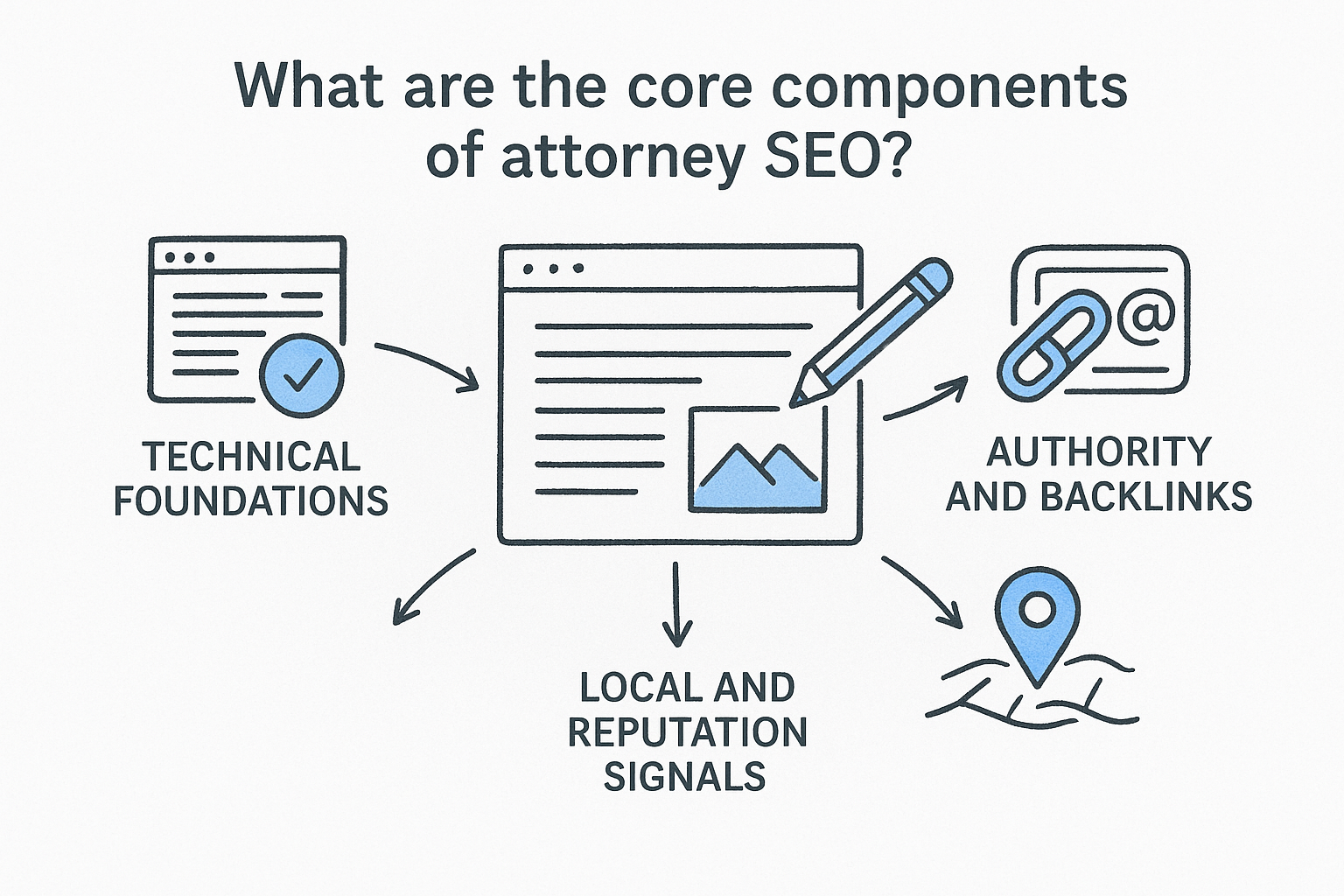
What are the core components of attorney SEO?
Attorney SEO breaks down into four working parts: technical health, on-page content, authority signals, and local presence. Skip any one of them and the others underperform, a technically fast site with no backlinks still struggles against established competitors, and a well-linked site with broken mobile forms still bleeds leads. Treat these as a checklist, not a menu you pick from.
Technical foundations
Google can't rank what it can't crawl or load quickly. Site speed, mobile usability, clean URL structure, and proper indexing form the base layer everything else sits on. Google's own Core Web Vitals guidance ties page experience directly to ranking potential, and a slow practice-area page loses visitors before they ever read your content. Run a technical audit before investing in new content:
- Confirm mobile page speed loads in under 3 seconds
- Fix broken links and redirect chains on practice-area and location pages
- Verify your site uses HTTPS and has a clean XML sitemap
- Check that intake forms render and submit correctly on mobile, not just desktop
On-page content and keyword targeting
Every practice-area page and city page needs to answer the specific question someone typed into Google, not a vague overview of "our services." Practice-area pages should cover case types, typical outcomes, fee structure, and what happens in the first consultation. Thin pages that repeat the same paragraph with a swapped city name get flagged by Google's helpful content systems rather than rewarded.
A page written to answer one specific client question always outperforms a page written to rank for one specific keyword.
Authority and backlinks
Search engines weigh how many other credible sites link to yours as a signal of trust. For law firms, that means bar association directories, local news mentions, guest contributions to legal publications, and citations from organizations you sponsor or partner with. A single link from a respected state bar page often carries more weight than a dozen low-quality directory listings, so prioritize quality over volume when building this piece of the strategy.
Local and reputation signals
Your Google Business Profile, NAP consistency (name, address, phone number matching across every listing), and client reviews all feed into local ranking algorithms. A firm with 150 recent, detailed reviews and a fully optimized profile beats a firm with a nicer website but a neglected profile almost every time. Review velocity matters too, a steady trickle of new reviews signals an active, trustworthy practice better than a burst of 20 reviews from three years ago.
These four components don't operate independently. A technically sound site with strong content still needs the authority and local signals to outrank established competitors, and GavelGrow's managed services team builds all four in tandem rather than optimizing one piece while the others lag behind.
How does local SEO affect law firm rankings?
Local SEO controls whether your firm appears in the three-pack map results that show above organic listings for searches like "car accident lawyer Phoenix." Google's own guidance on local ranking factors lists relevance, distance, and prominence as the three inputs that decide who shows up in that map pack, and prominence weighs heavily on your Google Business Profile completeness and review count. For most practice areas, the map pack captures more clicks than the organic listings below it, so ignoring local SEO in favor of blog content and backlinks leaves the highest-visibility real estate on the page to competitors.
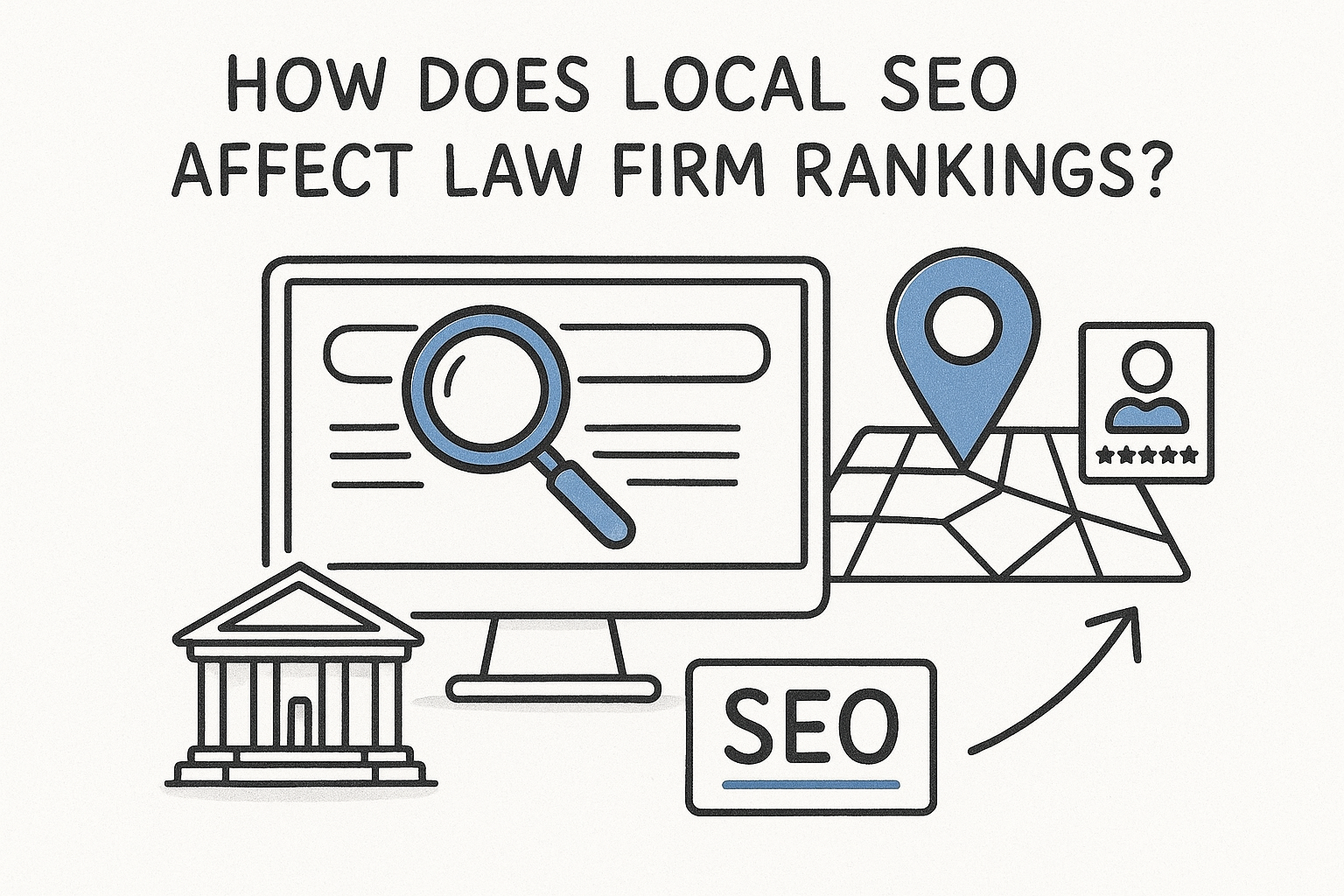
If your firm isn't showing up in the map pack for your core practice area and city, you're invisible to most local searchers before they ever scroll to organic results.
Google Business Profile drives most of the local ranking weight
Your Google Business Profile needs a correct primary category, complete service list, current hours, and location-tagged photos, not just a name and phone number. Firms that update their profile regularly, respond to every review, and post updates monthly tend to outrank firms that set one up in 2019 and never touched it again. Run through this checklist for a profile that actually competes:
- Primary category matches your main practice area exactly (not "Lawyer" when "Personal Injury Attorney" fits better)
- Service area or physical address matches every other listing of your firm online
- At least one new review added most months, with a response from the firm on each
- Photos of the office, attorneys, and team updated at least twice a year
NAP consistency and citations still matter
Name, address, and phone number, known as NAP consistency, need to match exactly across your website, Google Business Profile, Avvo, Justia, and every legal directory that lists your firm. A mismatched suite number or an old phone number still floating on a directory site confuses Google's local algorithm and can suppress rankings even when everything else on your site looks strong. Citation cleanup is tedious work, but it's a one-time fix that keeps paying off, unlike content that needs ongoing updates to stay relevant.
Local content still needs to answer local questions
Location pages for each city or county you serve only help if they contain real, specific information, court names, local statutes, typical case timelines in that jurisdiction, rather than a templated paragraph with the city name swapped out. Search engines and searchers both recognize the difference between a page built for a real local audience and one built purely to capture a keyword. GavelGrow's managed services team builds these pages around what a local searcher actually needs to know, then ties the resulting leads back to signed cases through the platform's call tracking and attribution, so you can see which city pages are producing retainers instead of just impressions and clicks that never convert.
How do you measure attorney SEO success?
Rankings feel like progress, but they're a proxy metric, not a business outcome. Tracking position for "divorce lawyer Denver" tells you nothing about revenue unless you connect that ranking to a lead, then to a signed retainer. Attorney SEO success should be measured the same way you'd measure any other acquisition channel: cost per signed case, not cost per click or cost per lead. Firms that stop at rankings and traffic reports end up defending SEO spend in budget meetings with numbers that don't actually prove anything to a managing partner focused on revenue.
If you can't trace an organic ranking to a signed retainer, you're measuring activity, not results.
Metrics that matter versus metrics that mislead
Separate vanity numbers from the ones tied to actual case volume. A page can generate thousands of visits and zero retainers, and a page can rank on page two but quietly produce your highest-value cases through phone calls that never touch a contact form.
Connect organic pages to signed retainers
Getting from traffic to a real answer requires attribution that survives the handoff from your website to your intake team. That means tagging leads by source page at the point of form submission or call, then following that lead through triage, contact, and signature. GavelGrow's marketing dashboard does this by tracking cost-per-signed-case at the campaign level, including organic, so you can see which practice-area pages and city pages are actually producing retainers instead of just impressions. Built-in call tracking matters here too, since a large share of legal leads come in by phone, and a page driving calls that never get logged looks like it's underperforming when it's actually your best converter.
Set a review cadence that catches problems early
Check performance monthly for traffic and lead volume, but review cost-per-signed-case quarterly, since case cycles in personal injury or mass torts can take months to close. Compare your numbers against peers when you can. GavelGrow's modelled benchmark shows whether your organic conversion rate and cost-per-signed-case are in line with comparable firms in your practice area, rather than leaving you guessing whether a 3% conversion rate is strong or weak for a family law site in a mid-sized metro.
Should your firm handle SEO in-house or hire help?
The honest answer depends on how many hours a week someone at your firm can realistically dedicate to content production, technical maintenance, and link building without letting client work slip. A solo practitioner with a full caseload rarely has that time, while a 10-attorney firm with a dedicated marketing coordinator might. In-house SEO works when someone owns it as a real job function, not a side task squeezed between depositions and client calls.

The firms that fail at in-house SEO usually didn't lack skill, they lacked hours.
Signs your firm can handle SEO in-house
Handling SEO internally makes sense when you already have marketing staff who understand content strategy, or when your practice area faces light local competition and doesn't require aggressive link building to compete. Look for these signals before committing to a DIY approach:
- Someone on staff can commit at least 10-15 hours a week to content, technical fixes, and outreach
- Your practice area and city face limited competition on page one
- You have budget for a decent SEO tool stack (rank tracking, technical auditing, keyword research)
- Leadership is comfortable waiting 6-12 months before seeing meaningful ranking movement
When outsourcing makes more sense
Outsourcing fits firms competing in expensive, high-volume practice areas like personal injury or mass torts, where established competitors already have years of backlinks and content depth built up. Generic marketing agencies that treat legal like any other local business, using the same templates for a plumber and a personal injury firm, tend to produce weak results because they miss the compliance requirements and the long sales cycle specific to legal work. Managed services solve this by pairing SEO with intake systemization and reputation management, so the traffic generated actually turns into signed cases rather than just higher rankings on a report. GavelGrow's managed-services team works exclusively with law firms and offers market exclusivity on managed engagements: GavelGrow does not run marketing for two direct competitors in the same market.
Comparing the two paths
Weighing the tradeoffs before deciding matters, since switching strategies mid-stream wastes months of momentum either way.
Ultimately, the right call comes down to bandwidth and competition level, not personal preference. Firms that try to run SEO in-house without dedicated time usually end up with a stalled blog and a Google Business Profile nobody's touched since last year, which costs more in lost cases than hiring help would have in the first place.
What mistakes commonly derail attorney SEO results?
Even a well-planned attorney SEO campaign can stall when a firm falls into a handful of predictable traps. Most of these mistakes don't show up in a ranking report until months later, which is exactly why they're so costly, the damage compounds silently while everyone assumes the strategy is working. Watching 500+ firms run SEO campaigns over the years, the same handful of errors show up again and again, regardless of practice area or market size.
Treating rankings as the finish line
Focusing on position instead of case outcomes is the single biggest mistake firms make. A firm celebrates hitting the top three for a competitive keyword, then never checks whether that traffic converts into calls, form fills, or signed retainers. Ranking obsession without a matching intake process means you're generating visibility that quietly evaporates the moment a visitor hits a slow form or an unanswered phone line.
Chasing rankings without tracking conversions is like counting foot traffic into a store that has no cash register.
Publishing thin, templated location pages
Generating a city page for every county in the state by swapping one name in a template used to work years ago. It doesn't anymore. Google's helpful content guidance specifically calls out this kind of scaled, low-value publishing, and firms that keep doing it often see entire sections of their site drop out of rankings at once rather than gradually. Duplicate content patterns across location pages signal to search engines that the pages exist for search engines, not for the person searching.
Ignoring the intake side of the funnel
Hiring a strong SEO team while leaving intake untouched wastes half the investment. A common pattern: leads increase 40% after six months of SEO work, but signed cases barely move because response times still average hours instead of minutes. Speed matters enormously here, contacting a lead within 5 minutes converts at a far higher rate than waiting even 30 minutes, based on widely cited response-time research in the industry. This is where fast intake automation through a platform like GavelGrow's closes the gap between traffic and retainers.
Other recurring mistakes worth flagging
A short list covers the remaining issues that show up often enough to name directly:
- Neglecting the Google Business Profile after the initial setup, letting reviews and hours go stale
- Building low-quality backlinks from directory farms instead of legitimate legal and local sources
- Skipping mobile testing on intake forms, even though most legal searches happen on a phone
- Abandoning a strategy after 90 days because rankings haven't moved yet, when 6-12 months is typical
- Failing to track which pages produce signed cases, not just leads, through proper attribution and call tracking
Avoiding these mistakes doesn't require a bigger budget, mostly it requires discipline and a willingness to measure past the ranking report.
Frequently asked questions about attorney SEO
How much does attorney SEO cost per month?
Costs vary widely based on whether you go in-house or hire help. A firm handling SEO in-house typically spends $1,500-$4,000 per month on tools, freelance writers, and technical fixes. Managed services from a legal-specific agency typically start around $10,000 per month, covering content, technical work, local optimization, and link building together. GavelGrow's managed-services pricing is scoped on a strategy call because it bundles SEO with intake systemization, not just rankings. Budget more in competitive practice areas like personal injury or mass torts, where established competitors have years of backlink history to overcome.
How long does attorney SEO take to show results?
Most firms see measurable ranking movement within 3-4 months for low-competition practice areas like estate planning, and 6-12 months for competitive ones like personal injury. Search visibility builds gradually because Google needs time to trust new or updated content, especially on a site with limited authority. Firms that abandon a strategy after 90 days almost always quit right before momentum builds. Track leading indicators like indexed pages and impressions in Google Search Console during the early months, since rankings often lag behind those signals by several weeks.
What's the difference between attorney SEO and general SEO?
Attorney SEO requires state-bar compliance awareness, TCPA-safe intake forms, and content built around a 6-12 month sales cycle that generic e-commerce or local-business SEO doesn't account for. A plumber's SEO strategy rarely needs to worry about advertising rules or two-party consent for recorded calls. Legal also carries higher cost-per-click benchmarks and denser competition from national directory sites like Avvo and Justia, which changes how you prioritize keywords and backlinks compared to most other industries.
The tactics overlap with general SEO, but the compliance and conversion requirements make legal a different game entirely.
Can attorney SEO work for a solo practice?
Yes, and often faster than for larger firms competing in crowded metros. A solo practitioner targeting a specific practice area in a mid-sized city can outrank bigger firms by publishing deeper, more specific content and maintaining a tightly optimized Google Business Profile. The tradeoff is time: without a marketing coordinator, most solo attorneys need at least 8-10 hours a week to keep momentum, or they need to outsource the work entirely.
What's a good organic conversion rate for a law firm?
Benchmarks vary by practice area. GavelGrow’s modelled benchmark puts a healthy organic conversion rate for law firm websites between 3% and 6% of visitors becoming leads, and shows family law and estate planning sites often outperform personal injury sites on conversion rate — since the search intent tends to be less price-shopped and more decision-ready.
Putting attorney SEO into practice
Attorney SEO works when you stop treating rankings as the goal and start treating them as the entry point. Technical health, practice-area content, local signals, and backlinks get you found. What happens after that click, how fast you respond, whether your intake form works on a phone, whether you can trace a lead back to the page that brought it in, decides whether that visibility turns into a signed retainer. Firms that win at this long-term build both sides at once instead of optimizing one and hoping the other keeps up.
If you're ranking well but can't say which pages produce actual cases, that's an attribution problem, not an SEO problem. Start by seeing where your funnel leaks. Book a free strategy call with GavelGrow and walk through your current SEO and intake setup with someone who's done this for over 500 law firms since 2015.
Frequently Asked Questions
How much does attorney SEO cost per month?
Costs vary widely based on whether you go in-house or hire help. A firm handling SEO in-house typically spends $1,500-$4,000 per month on tools, freelance writers, and technical fixes. Managed services from a legal-specific agency typically start around $10,000 per month, covering content, technical work, local optimization, and link building together. GavelGrow's managed-services pricing is scoped on a strategy call because it bundles SEO with intake systemization, not just rankings. Budget more in competitive practice areas like personal injury or mass torts, where established competitors have years of backlink history to overcome.
How long does attorney SEO take to show results?
Most firms see measurable ranking movement within 3-4 months for low-competition practice areas like estate planning, and 6-12 months for competitive ones like personal injury. Search visibility builds gradually because Google needs time to trust new or updated content, especially on a site with limited authority. Firms that abandon a strategy after 90 days almost always quit right before momentum builds. Track leading indicators like indexed pages and impressions in Google Search Console during the early months, since rankings often lag behind those signals by several weeks.
What's the difference between attorney SEO and general SEO?
Attorney SEO requires state-bar compliance awareness, TCPA-safe intake forms, and content built around a 6-12 month sales cycle that generic e-commerce or local-business SEO doesn't account for. A plumber's SEO strategy rarely needs to worry about advertising rules or two-party consent for recorded calls. Legal also carries higher cost-per-click benchmarks and denser competition from national directory sites like Avvo and Justia, which changes how you prioritize keywords and backlinks compared to most other industries. The tactics overlap with general SEO, but the compliance and conversion requirements make legal a different game entirely.
Can attorney SEO work for a solo practice?
Yes, and often faster than for larger firms competing in crowded metros. A solo practitioner targeting a specific practice area in a mid-sized city can outrank bigger firms by publishing deeper, more specific content and maintaining a tightly optimized Google Business Profile. The tradeoff is time: without a marketing coordinator, most solo attorneys need at least 8-10 hours a week to keep momentum, or they need to outsource the work entirely.
What's a good organic conversion rate for a law firm?
Benchmarks vary by practice area. GavelGrow’s modelled benchmark puts a healthy organic conversion rate for law firm websites between 3% and 6% of visitors becoming leads, and shows family law and estate planning sites often outperform personal injury sites on conversion rate — since the search intent tends to be less price-shopped and more decision-ready.