SEO for Personal Injury Lawyers: A Step-by-Step Guide
Categories: Legal Marketing Strategies
 Abram Ninoyan
Founder & Senior Performance Marketer
Credentials: Google Partner, Google Ads Search Certified, Google Ads Display Certified, Google Ads Measurement Certified, Google Analytics (IQ) Certified, HubSpot Inbound Certified, HubSpot Social Media Marketing Certified, Conversion Optimization Certified
Expertise: Google Ads, Meta Ads, Conversion Rate Optimization, GA4 & Google Tag Manager, Lead Generation, Marketing Funnel Optimization, PPC Management
LinkedIn Profile
SEO for personal injury lawyers works differently than SEO for any other business, because you're not just competing for rankings, you're competing for the most expensive keywords on Google. "Car...
Key Takeaways
- SEO for Personal Injury Lawyers: A Step-by-Step Guide
- Why SEO matters for personal injury law firms
- Step 1. Audit your website's technical SEO health
- Step 2. Research the keywords injury clients search
SEO for Personal Injury Lawyers: A Step-by-Step Guide
SEO for personal injury lawyers works differently than SEO for any other business, because you're not just competing for rankings, you're competing for the most expensive keywords on Google. "Car accident lawyer" clicks can cost $150-$300 in Google Ads in major metros, per WordStream's 2024 industry benchmarks, which is exactly why organic rankings matter so much for firms trying to control cost-per-signed-case.
If you're asking how to actually do this, the short answer is: build topical authority around your practice areas, earn local citations and reviews, fix your technical foundation, and structure content around the questions injured people type into Google at 2 a.m. This guide walks through each step in order, starting with keyword research specific to personal injury and ending with measurement.
We'll cover on-page optimization for practice-area and location pages, local SEO tactics that actually move the needle for solo and small firms, link-building approaches that won't get you a manual penalty, and how to track which rankings convert into retained clients rather than just traffic. Along the way, we'll flag where tool sprawl and disconnected attribution quietly undercut SEO investments that should be paying off.
Why SEO matters for personal injury law firms
Personal injury sits squarely in Google's "Your Money or Your Life" category, the same bucket as medical and financial advice, because a bad decision here can cost someone a real settlement or a blown statute of limitations. Google's own search quality guidelines say YMYL pages face extra scrutiny for expertise, authoritativeness, and trust (see Google's creating helpful, reliable, people-first content guidance). That means thin attorney bios, stock photos, and copy-pasted practice area pages get filtered out of rankings faster than in almost any other niche. Personal injury law firm SEO isn't optional polish, it's the difference between showing up when someone searches "car accident lawyer near me" and never being found at all.
Organic traffic costs less per case over time
Organic rankings and paid ads solve the same problem at very different price points once you look past month one. A firm running $200 clicks on Google Ads pays that rate every single month, forever, with zero residual value if the budget stops. A ranking page built through solid on-page optimization keeps generating calls long after the writing and link-building work is done.
A ranking page keeps sending clients calls long after you stop paying for it; an ad stops the moment the budget does.
The local map pack decides who gets the phone call
Most injured people search on their phone within hours of an accident, and Google typically shows a three-listing local map pack above organic results for searches like "personal injury lawyer" plus a city name. If your Google Business Profile isn't optimized and stacked with recent reviews, you're invisible before the searcher even scrolls to organic listings. Firms that win the map pack capture a disproportionate share of calls simply because they're the first thing a scared, injured person taps.

SEO compounds while ad budgets reset to zero
Every blog post, practice area page, and earned backlink you publish adds to a growing asset that keeps working even during months when cash is tight. Six months of consistent content and citation building typically produces a noticeable jump in organic leads, and that traffic doesn't disappear if you pause spending for a quarter the way paid leads do. Reviewing how firms structure this kind of growth in GavelGrow's client portfolio shows the same pattern across practice areas: firms that treat SEO as infrastructure, not a campaign, end up with a lower blended cost-per-signed-case than firms relying on ads alone.
Competitive pressure keeps rising, not falling
Legal marketing budgets keep climbing every year as more firms fight for the same searches, which means the firms that build organic authority now will face less competition catching up later. Waiting to start SEO doesn't just delay results, it hands competitors a longer runway to earn the backlinks, reviews, and content depth that Google rewards. The next sections walk through exactly how to close that gap, starting with the technical foundation your site needs before any content or link-building work will pay off.
Step 1. Audit your website's technical SEO health
Before you touch a single keyword or blog post, confirm Google can actually crawl, render, and rank your site. A broken technical foundation quietly caps every other SEO effort you make, because Google won't rank pages it can't index cleanly or pages that load so slowly injured visitors bounce before the phone number even appears. Start here, or you'll spend months writing content that never surfaces.
Check Core Web Vitals and mobile speed
Run your homepage and top practice-area pages through Google's PageSpeed Insights tool and note your Largest Contentful Paint, Interaction to Next Paint, and Cumulative Layout Shift scores. Most personal injury sites fail on mobile speed because of bloated hero images, autoplay video, and third-party chat widgets stacked on top of each other. Since a majority of accident searches happen on a phone in the first hours after a crash, a slow mobile experience costs you calls before anyone reads your bio.
If your site takes more than three seconds to load on a phone, you're losing clients to whichever firm loads faster.
Fix crawlability and indexing issues
Pull up Google Search Console and check the Coverage and Pages reports for errors, redirect chains, and orphaned pages that no internal link points to. Duplicate practice-area content across multiple city pages, often left over from a template a web vendor reused for every client, triggers indexing problems that suppress rankings sitewide. Confirm your XML sitemap only lists canonical, indexable URLs, and submit it fresh inside Search Console once you clean it up.
Confirm your security and structured data are in order
Security and machine-readable markup round out the technical checklist:
- HTTPS everywhere with no mixed-content warnings, since Google has treated HTTPS as a ranking signal since 2014
- LegalService or Attorney schema markup on your homepage and location pages so Google understands your firm's name, address, and phone number
- Canonical tags set correctly on every practice-area and city page to prevent duplicate-content dilution
- Broken link cleanup, especially on older blog posts that link to a defunct CallRail integration or a retired intake form
Once these boxes are checked, you've earned the right to build on top of the site instead of around its problems, and every keyword you target next actually has a chance to rank.
Step 2. Research the keywords injury clients search
Keyword research for personal injury looks nothing like keyword research for a retail site, because injured people search in bursts of panic, not casual browsing. Search intent shifts hour by hour after a crash, from "what to do after a car accident" the same night to "best car accident lawyer [city]" once the shock wears off and someone starts comparing firms. Building your keyword strategy around that timeline, instead of guessing at generic terms, is what separates pages that convert from pages that just rank.
Map keywords to the injury timeline
Group every keyword you find into a stage of the client's decision, because a page written for someone still in the ER won't convert the same reader who's already talked to three lawyers. Early-stage searches like "do I need a lawyer for a fender bender" call for educational content, while late-stage searches like "top rated truck accident attorney near me" call for a conversion-focused practice area page with your phone number above the fold.
Rank for the wrong stage of the injury timeline and you'll get traffic that never picks up the phone.
Prioritize by intent, not volume
High-volume keywords like "personal injury lawyer" look tempting in a keyword tool, but they're brutally competitive and often mix in job seekers and law students researching the field. Chasing long-tail keywords tied to specific injuries, vehicles, and cities, such as "motorcycle accident lawyer [neighborhood]" or "Uber accident attorney fees," gets you closer to searchers ready to hire, even though the monthly search volume looks small on paper.
Mine questions from real searches
Google's own "People also ask" boxes and the autocomplete suggestions under your target terms are free research, updated daily by real searcher behavior. Pull questions directly from those boxes, plus from the questions your intake staff hear on every call, and build a running list you can turn into content.
- Questions from Google's "People also ask" for your top three keywords
- Questions intake staff log during initial consultations
- Questions competitors answer on their FAQ pages
Once you've got this list, GavelGrow's modelled practice-area benchmarks show typical conversion ranges by practice area and market size, so you're not guessing at which keyword clusters to tackle first.
Step 3. Optimize your Google Business Profile
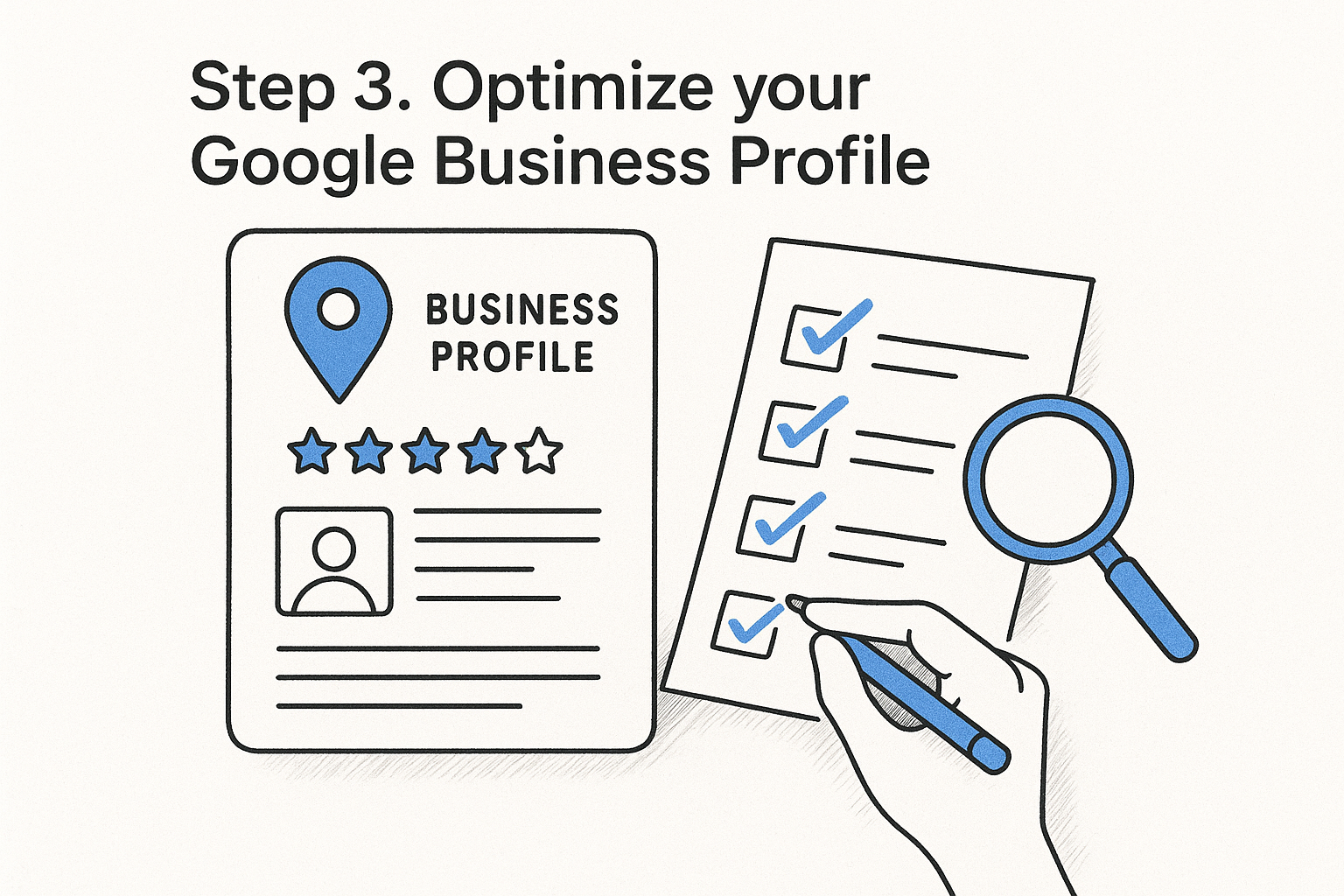
Your Google Business Profile (GBP) is the single highest-leverage asset in local personal injury SEO, because it controls whether you show up in the three-listing map pack that sits above every organic result for "personal injury lawyer near me" searches. Firms treat this listing as a set-and-forget task after claiming it once, then wonder why a competitor with fewer reviews outranks them. Getting this right takes an afternoon and pays off every month after.
Claim, verify, and lock down your listing details
Start by confirming you actually control the listing through Google's verification process, since unclaimed or unverified profiles rank worse and can be edited by anyone. Match your name, address, and phone number exactly across your website, GBP, and every citation site, because Google cross-checks this consistency as a trust signal before ranking you locally. Pick "Personal Injury Attorney" as your primary category, then add secondary categories like "Law Firm" only if they genuinely apply, since category-stuffing can trigger a suspension.
Fill out every field Google gives you
Sparse profiles lose to detailed ones even when the sparse firm has been practicing longer, so fill in every available field:
- Business description mentioning your core practice areas and service area
- Hours, including a 24/7 intake line if you run one
- Services list broken out by injury type (car accidents, slip and fall, wrongful death)
- Photos of your office, attorneys, and team, updated quarterly
- Q&A section seeded with the questions clients actually ask
Build a steady review pipeline, not a one-time push
Review volume and recency both factor into map pack rankings, and a firm with 12 reviews from the last two months often beats a firm with 80 reviews from three years ago. Automate the ask by sending a text or email review request the day a case closes, since GavelGrow's intake automation can fire that request within minutes of a case status change instead of relying on staff to remember weeks later.
A Google Business Profile with recent, five-star reviews beats a bigger firm's stale listing almost every time.
Respond to every review, good or bad, within a few days. That responsiveness signal, combined with fresh content, keeps your profile climbing while competitors' listings sit static.
Step 4. Build location and practice area pages
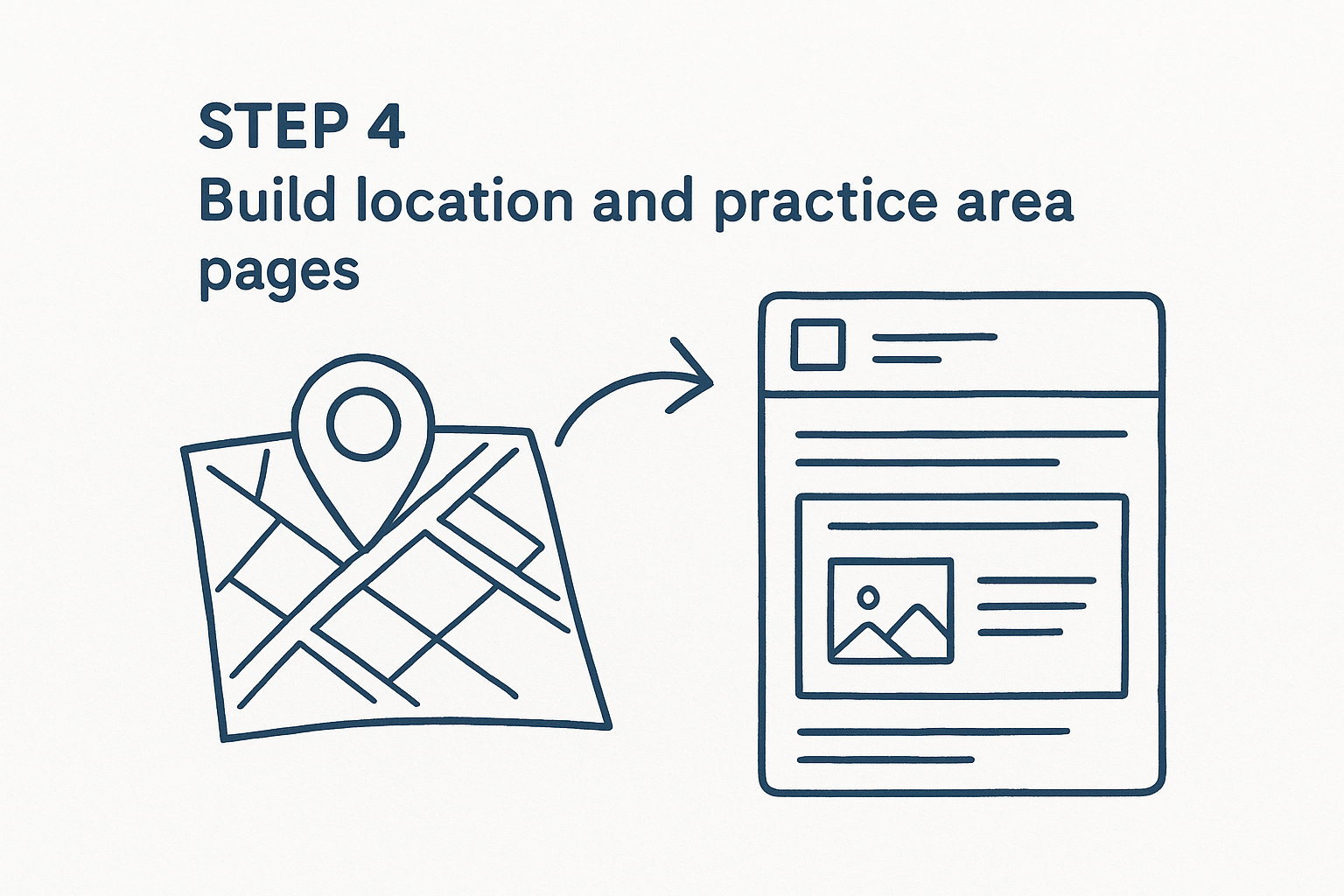
Every city you serve and every injury type you handle deserves its own page, because a single generic "Practice Areas" page can't rank for both "truck accident lawyer Dallas" and "dog bite attorney Fort Worth" at the same time. Location pages and practice area pages work together to signal to Google exactly which searches you deserve to win, and skipping this structure is one of the most common reasons small firms lose the map pack to competitors with fewer years in practice. Think of each page as a dedicated storefront for one specific search, not a subsection buried three clicks deep in a menu.
Separate practice area from location, then combine them
Build your site architecture so practice areas and locations exist as separate page types that intersect, similar to how a large e-commerce site structures product categories and regions. A firm serving Dallas, Fort Worth, and Arlington with car accident, truck accident, and slip-and-fall practices needs nine distinct combination pages, not three generic ones. Each page should answer the specific questions someone in that city with that injury actually asks, not a rewritten version of the citywide overview page.
Write unique content, not a find-and-replace template
Template pages that just swap the city name in an otherwise identical block of text get flagged as duplicate content by Google's algorithms, and they read as lazy to injured visitors comparing three firms in ten minutes. Reference the actual courthouse, local hospital trauma centers, or a specific highway interchange known for accidents in that city, because that specificity is what separates a page written by someone who actually practices there from a page a vendor cranked out for fifty firms using the same shell.
A city page that mentions the local courthouse by name beats a template swap every time Google compares expertise signals.
Include the proof elements that convert visitors into calls
Every combination page needs case results specific to that injury type, an attorney bio with real credentials, and a form above the fold that's actually built to convert on mobile. GavelGrow's hosted intake forms handle the mobile-first, multi-step design and TCPA consent logging automatically, so the page you spend weeks writing doesn't lose leads to a clunky contact form at the bottom of the scroll.
Step 5. Earn local citations and quality backlinks
Citations and backlinks tell Google that other trusted sources vouch for your firm, and personal injury sites need more of that trust than almost any other niche because of the YMYL scrutiny covered earlier. Local citations confirm your name, address, and phone number match everywhere your firm appears online, while backlinks from relevant, authoritative sites signal that real people and organizations consider you credible. Skipping this step leaves even a technically flawless site stuck behind competitors with weaker pages but stronger off-site signals.
Lock down consistent citations first
Before chasing links, audit every directory listing for mismatched suite numbers, old phone numbers, or a firm name that changed after a merger. Google treats inconsistent NAP data as a trust problem, not a formatting quibble, and it can quietly suppress your map pack ranking even when your GBP itself looks perfect.
Build backlinks that survive scrutiny, not ones that invite a penalty
Google's spam policies specifically flag link schemes, so a firm buying bulk guest posts from a link farm is gambling with rankings it took years to build. Earn links instead through local sponsorships, bar association memberships, press coverage from settlements or verdicts, and guest contributions to legitimate legal publications that actually vet their contributors.
One backlink from your state bar association's directory outweighs fifty links bought from a spam network.
Track which sources actually move rankings
Outsourcing citation and link work to a fragmented mix of freelancers, directory services, and ad-hoc PR pitches makes it nearly impossible to tell which effort produced which ranking gain. Firms that track their off-page progress month over month, rather than relying on a vendor's monthly PDF report, get a clearer read on whether their citation and backlink pace is actually improving. That visibility matters just as much for off-page work as it does for the on-page and technical fixes covered earlier, since a firm blind to its own progress tends to keep paying for tactics long after they stop working.
Step 6. Publish content that builds trust and rankings
Content is where E-E-A-T either gets built or gets exposed as thin, because Google reads every blog post and FAQ page as evidence of whether your firm actually knows personal injury law or just paid someone to sound like it does. A steady publishing habit also gives Google fresh material to crawl between the practice area and location pages you built in Step 4, which keeps your whole site looking active instead of stale. Skip this step and even a technically sound site plateaus once the initial pages finish ranking.
Answer the questions from your keyword research first
Go back to the question list you built in Step 2 and turn each one into a standalone page instead of burying the answer in a paragraph on your homepage. A post titled "What Happens If the Other Driver Has No Insurance in Texas" targets a specific, answerable question that Google can match directly to a searcher's intent, and it gives your intake staff something to text a hesitant caller. Build a simple content calendar so you're not scrambling for a topic every week:
- One post per month answering a top intake-call question
- One case result or settlement writeup per quarter, with real numbers where your bar rules allow disclosure
- One attorney-authored explainer per quarter on a recent law change or local court ruling
Put a named attorney's name on every page
Byline every substantive post with the attorney who reviewed or wrote it, and link that byline to a full bio page listing bar admissions, case results, and years of practice. Google's guidance on people-first content specifically calls out clear authorship as a trust signal, and for YMYL topics like personal injury, an anonymous "Staff Writer" byline undercuts everything else on the page.
A named attorney byline with real credentials tells Google, and injured readers, that a real expert stands behind the page.
Update old content instead of only publishing new content
Revisit posts older than 18 months and refresh statistics, state law citations, and settlement figures rather than letting them sit untouched. A stale post citing a repealed statute of limitations doesn't just hurt rankings, it risks giving an injured reader wrong information at the worst possible moment. Treat your content library as a living asset that needs maintenance, the same way you'd treat the technical foundation from Step 1.
Step 7. Track leads and measure signed cases
Rankings mean nothing if you can't connect them to a signed retainer, and this is where most personal injury firms lose the thread. Signed-case tracking matters more than traffic or keyword position because Google can send you plenty of visitors who never call, and a firm that only watches rankings ends up optimizing for vanity metrics instead of revenue. Close the loop here or every step above becomes a guess dressed up as a strategy.
Connect organic traffic to phone calls and form fills
Assign a dynamic tracking number to your organic traffic separate from the number on your paid ads and print materials, so every call gets attributed to the channel that actually generated it. GavelGrow's built-in call tracking means you don't need a separate call-tracking subscription, and it credits each call to the campaign behind its tracking number, along with outcome tagging so you can see which calls were qualified versus spam. Pair that with hosted intake forms that fire GA4 and Meta Pixel events on submission, and you get a full picture of which practice-area page is actually generating leads, not just visits.
Measure cost-per-signed-case, not cost-per-lead
Cost-per-lead flatters campaigns that generate a lot of low-quality inquiries, while cost-per-signed-case tells you what SEO actually costs against what it returns. Track leads all the way through intake to retainer signature, then divide your monthly SEO investment by cases signed that month, not leads captured.
If you can't trace a ranking back to a signed case, you're measuring effort, not results.
Review benchmarks quarterly, not just your own trend line
A month-over-month climb in leads can still be underperforming if comparable firms in your market are converting at a higher rate on similar traffic. GavelGrow's marketing dashboard shows campaign-level cost-per-signed-case alongside modelled practice-area benchmarks, so a managing partner has a reference point for whether a plateau looks like a market-wide slowdown or a firm-specific problem worth fixing. Check pricing tiers on the platform pricing page to see which plan matches the attribution depth your firm needs as case volume grows.
Keeping your SEO efforts on track
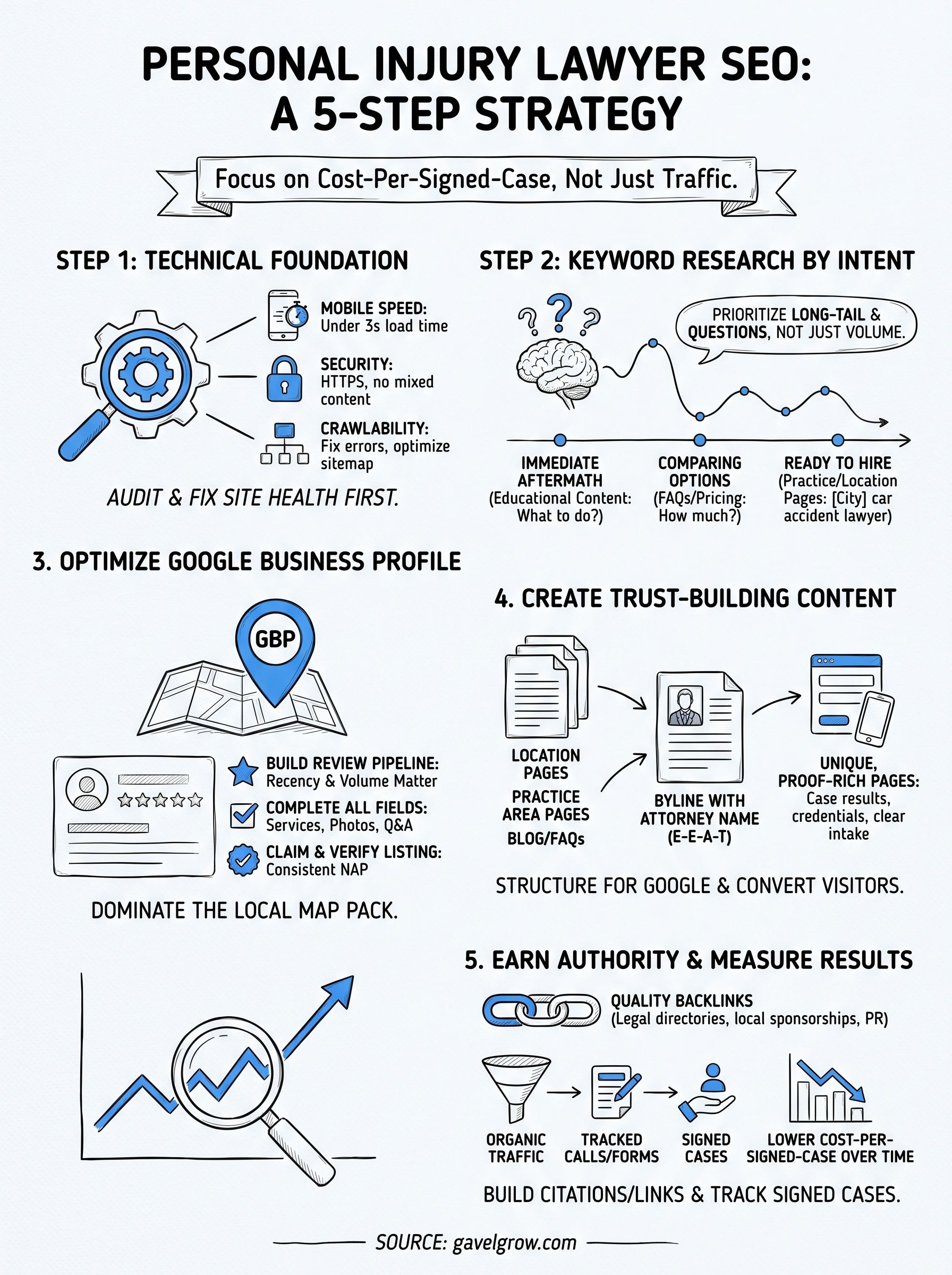
SEO for personal injury lawyers isn't a project with an end date, it's an ongoing practice that compounds when you stick with it and stalls the moment you stop feeding it. Technical fixes, location pages, citations, and content each build on the last step, which is why firms that treat this as infrastructure end up with a lower cost-per-signed-case than firms chasing quick wins one quarter at a time.
Getting the tracking piece right matters as much as the rankings themselves. Without clean attribution from click to signed retainer, you're guessing at what's actually working. Signed-case attribution turns your SEO work from a hopeful expense into a measurable investment you can defend to every partner in the firm.
If you'd rather talk through your specific market and practice areas than piece this together alone, book a free strategy call with GavelGrow and get a plan built around your firm's numbers, not generic benchmarks.
Frequently Asked Questions
What is SEO for personal injury lawyers?
SEO for personal injury lawyers is the practice of optimizing your website, Google Business Profile, and content so your firm ranks for the searches accident victims use — like "car accident lawyer near me." It combines technical health, local SEO (the map pack), practice-specific content, and reviews and links to turn organic search into a steady, lower-cost source of signed PI cases.
How long does SEO take to work for a personal injury firm?
PI is one of the most competitive SEO verticals, so expect early movement within a few months and meaningful case flow in roughly six to twelve months, longer in major metros. SEO compounds — the longer it runs, the lower your cost per case tends to fall — which is why PI firms pair it with paid ads for immediate leads while the organic channel matures.
How much does personal injury SEO cost?
It varies widely by market competitiveness and scope — competing for PI keywords in a major metro costs far more than a suburban market. Rather than a flat monthly figure, judge it by cost per signed case, since a single PI case can be worth tens of thousands. Track that number so you can compare SEO against paid ads and referrals on equal footing.
Is local SEO or national SEO better for personal injury lawyers?
Local SEO matters most for the vast majority of PI firms, because injury clients search locally and the Google map pack often decides who gets the call. A strong Google Business Profile, local reviews, and location-relevant content drive it. National SEO only makes sense for firms handling mass tort or nationwide claims; most should dominate their local market first.
What are the most important ranking factors for personal injury SEO?
A technically sound, fast, mobile-friendly site; a fully optimized Google Business Profile with steady reviews; content that answers the questions injury clients actually search through their case timeline; and authoritative local links. In competitive PI markets, reviews and links tend to be the hardest-won differentiators once the technical and content basics are in place.
Can a personal injury firm do SEO in-house or should it hire an agency?
Small firms can start in-house on the basics — Google Business Profile, reviews, and a few practice-area pages. But PI SEO is fiercely competitive, and technical SEO, content at scale, and link building take specialized time and tools, so most firms serious about ranking in a contested market get more from an agency — ideally one that reports on signed cases, not just rankings.
How do you measure ROI on personal injury SEO?
Track past vanity metrics like traffic to the numbers tied to revenue: rankings for buyer-intent keywords, qualified organic leads (including calls), intake-to-retainer conversion, and cost per signed case. Full-funnel attribution that connects an organic search through intake to a signed retainer is the only way to prove SEO is actually funding the firm.
Frequently Asked Questions
What is SEO for personal injury lawyers?
SEO for personal injury lawyers is the practice of optimizing your website, Google Business Profile, and content so your firm ranks for the searches accident victims use — like "car accident lawyer near me." It combines technical health, local SEO (the map pack), practice-specific content, and reviews and links to turn organic search into a steady, lower-cost source of signed PI cases.
How long does SEO take to work for a personal injury firm?
PI is one of the most competitive SEO verticals, so expect early movement within a few months and meaningful case flow in roughly six to twelve months, longer in major metros. SEO compounds — the longer it runs, the lower your cost per case tends to fall — which is why PI firms pair it with paid ads for immediate leads while the organic channel matures.
How much does personal injury SEO cost?
It varies widely by market competitiveness and scope — competing for PI keywords in a major metro costs far more than a suburban market. Rather than a flat monthly figure, judge it by cost per signed case, since a single PI case can be worth tens of thousands. Track that number so you can compare SEO against paid ads and referrals on equal footing.
Is local SEO or national SEO better for personal injury lawyers?
Local SEO matters most for the vast majority of PI firms, because injury clients search locally and the Google map pack often decides who gets the call. A strong Google Business Profile, local reviews, and location-relevant content drive it. National SEO only makes sense for firms handling mass tort or nationwide claims; most should dominate their local market first.
What are the most important ranking factors for personal injury SEO?
A technically sound, fast, mobile-friendly site; a fully optimized Google Business Profile with steady reviews; content that answers the questions injury clients actually search through their case timeline; and authoritative local links. In competitive PI markets, reviews and links tend to be the hardest-won differentiators once the technical and content basics are in place.
Can a personal injury firm do SEO in-house or should it hire an agency?
Small firms can start in-house on the basics — Google Business Profile, reviews, and a few practice-area pages. But PI SEO is fiercely competitive, and technical SEO, content at scale, and link building take specialized time and tools, so most firms serious about ranking in a contested market get more from an agency — ideally one that reports on signed cases, not just rankings.
How do you measure ROI on personal injury SEO?
Track past vanity metrics like traffic to the numbers tied to revenue: rankings for buyer-intent keywords, qualified organic leads (including calls), intake-to-retainer conversion, and cost per signed case. Full-funnel attribution that connects an organic search through intake to a signed retainer is the only way to prove SEO is actually funding the firm.