How to Manage a Small Law Firm: A Practical Guide
Categories: Legal Marketing Strategies
 Abram Ninoyan
Founder & Senior Performance Marketer
Credentials: Google Partner, Google Ads Search Certified, Google Ads Display Certified, Google Ads Measurement Certified, Google Analytics (IQ) Certified, HubSpot Inbound Certified, HubSpot Social Media Marketing Certified, Conversion Optimization Certified
Expertise: Google Ads, Meta Ads, Conversion Rate Optimization, GA4 & Google Tag Manager, Lead Generation, Marketing Funnel Optimization, PPC Management
LinkedIn Profile
Managing a small law firm well means running three businesses at once: the legal work, the client acquisition, and the back office that keeps everyone paid and on schedule. How to manage a small law f...
Key Takeaways
- How to Manage a Small Law Firm: A Practical Guide
- What does it take to manage a small law firm well?
- Step 1. Build systems and standard operating procedures
- Step 2. Speed up lead response and intake
How to Manage a Small Law Firm: A Practical Guide
Managing a small law firm well means running three businesses at once: the legal work, the client acquisition, and the back office that keeps everyone paid and on schedule. How to manage a small law firm comes down to building repeatable systems for intake, case tracking, and marketing spend, then reviewing the numbers weekly instead of scrambling at year end. Most owners never trained for this part of the job, which is why operational chaos creeps in even at firms with strong attorneys.
If you're searching for real answers, you want a framework, not motivational fluff. This guide gives you the specific systems, staffing decisions, and weekly review habits that separate firms growing 20% a year from ones stuck treading water on referrals alone.
Below, you'll find a practical breakdown of client intake, team structure, financial controls, and marketing accountability so leads don't die in your inbox. We'll also cover where tools like GavelGrow's dashboard fit into daily management, so you can see cost-per-signed-case instead of guessing which marketing dollars actually turned into retainers.
What does it take to manage a small law firm well?
Managing a small law firm well means treating it like a business first, not just a practice where legal work happens to generate revenue. Firm management rests on four pillars: repeatable intake systems, fast lead response, marketing accountability, and financial discipline. Skip any one of these and the others start to wobble. A firm with great attorneys but no intake process still loses cases to competitors who call back faster.
Start by asking yourself whether you can answer these four questions right now, without pulling reports for a week:
- What's your cost-per-signed-case by practice area and marketing channel?
- How long does it take your team to respond to a new lead, on average?
- What percentage of signed retainers came from referrals versus paid marketing?
- Which attorney or paralegal is closest to capacity this month?
If you hesitated on more than one of those, you're managing by instinct instead of data. That's common, but it's expensive. The American Bar Association's 2023 Legal Technology Survey Report found that firms using integrated practice management tools reported higher client satisfaction and fewer missed deadlines than firms relying on spreadsheets and email alone.
The firms that grow fastest are the ones that measure everything and guess at nothing.
Small firm owners often try to hold all of this in their head because the firm started with just them and maybe one paralegal. That works until you hit five or six employees, at which point informal tracking breaks down completely. The rest of this guide walks through the four steps that fix this, starting with the systems that make everything else possible: documented procedures for intake, case handling, and billing that don't depend on you remembering every detail.
Step 1. Build systems and standard operating procedures
Write down every recurring task before you try to fix it. Standard operating procedures turn tribal knowledge into something a new hire can follow on day one, whether that's opening a new matter, sending a fee agreement, or closing out a file. If a task happens more than five times a month, it belongs in a document, not in your head.
Start with these three SOPs, since they touch the most revenue:
- Intake-to-signed-retainer workflow - every step from first contact to executed engagement letter.
- Case status update cadence - who updates the client, how often, and through which channel.
- Billing and trust accounting checklist - so nothing slips during a busy month.
Use a shared tool like Google Docs or a practice management system such as Clio, but the tool matters less than the discipline of actually writing procedures down and reviewing them quarterly.
A firm that depends on one person's memory isn't a business, it's a liability waiting to happen.
Once procedures exist, delegation gets easier and mistakes get rarer. This foundation also makes the next step, faster lead response, possible because your team already knows what to do the moment a new lead lands.
Step 2. Speed up lead response and intake
Leads don't wait for you to finish a deposition. Speed-to-lead determines whether a prospective client signs with you or the firm that called back first. The Lead Response Management Study found that leads contacted within five minutes were 21 times more likely to qualify than those first reached at 30 minutes.

Why response time controls conversion
Every hour a lead sits untouched, it cools off and gets called by a competing firm. Missed calls and unread form submissions are the single biggest leak in small firm revenue, and most owners never measure it because they don't track it.
The firm that calls back in five minutes wins the case the slower firm never knew it lost.
How to close the gap without hiring more staff
Automation closes this gap cheaper than a new hire:
- Route every web form and call through one intake dashboard, not scattered inboxes.
- Trigger instant SMS and email auto-replies the moment a lead submits a form.
- Flag leads with no contact after ten minutes for manager review.
GavelGrow's platform fires these sequences within minutes of capture, which is exactly the kind of intake automation this step demands.
Step 3. Track your numbers with a marketing dashboard
Guessing which ads produce cases instead of clicks wastes money every single month. Cost-per-signed-case matters more than cost-per-lead, because a channel that generates cheap leads but zero retainers is bleeding your budget, not growing your firm. Most small firms track spend in one place, calls in another, and case outcomes in a third system that never talks to the other two.
If you can't trace a signed case back to the ad that produced it, you're marketing blind.
What to track weekly
Pull these numbers every Monday, not once a quarter:
- Cost-per-signed-case by practice area and campaign
- Lead-to-retainer conversion rate by source
- Missed-call rate on your tracking numbers
- Referral share versus paid marketing share
GavelGrow's marketing dashboard pulls this from ad click through signed retainer automatically, and the built-in call tracking means no separate call-tracking subscription, while tagging outcomes as qualified, callback, or spam. You also get modelled practice-area benchmarks, so you know if your numbers are actually good or just familiar.
Once you can see the full funnel weekly, budget decisions stop being arguments and start being math.
Step 4. Manage your team and finances for growth
Growth stalls when the owner is still the bottleneck for every decision, big or small. Capacity planning means knowing, at a glance, which attorney or paralegal can take on another case this week and which one is already stretched thin. Track billable hours against case load monthly, not annually, so you catch burnout before it costs you a good employee.

Financial discipline matters just as much as staffing. Review these numbers every month, not just at tax time:
A firm that doesn't know its numbers can't tell growth from a slow-motion cash crunch.
Set a weekly leadership huddle, even 20 minutes, to review capacity, cash, and pipeline together instead of in separate silos. Firms that connect staffing decisions to marketing performance data hire ahead of demand instead of scrambling after it. This is also where your dashboard earns its keep, since attorney capacity signals sit next to case attribution instead of in a separate spreadsheet nobody updates.
Building a firm that runs without you
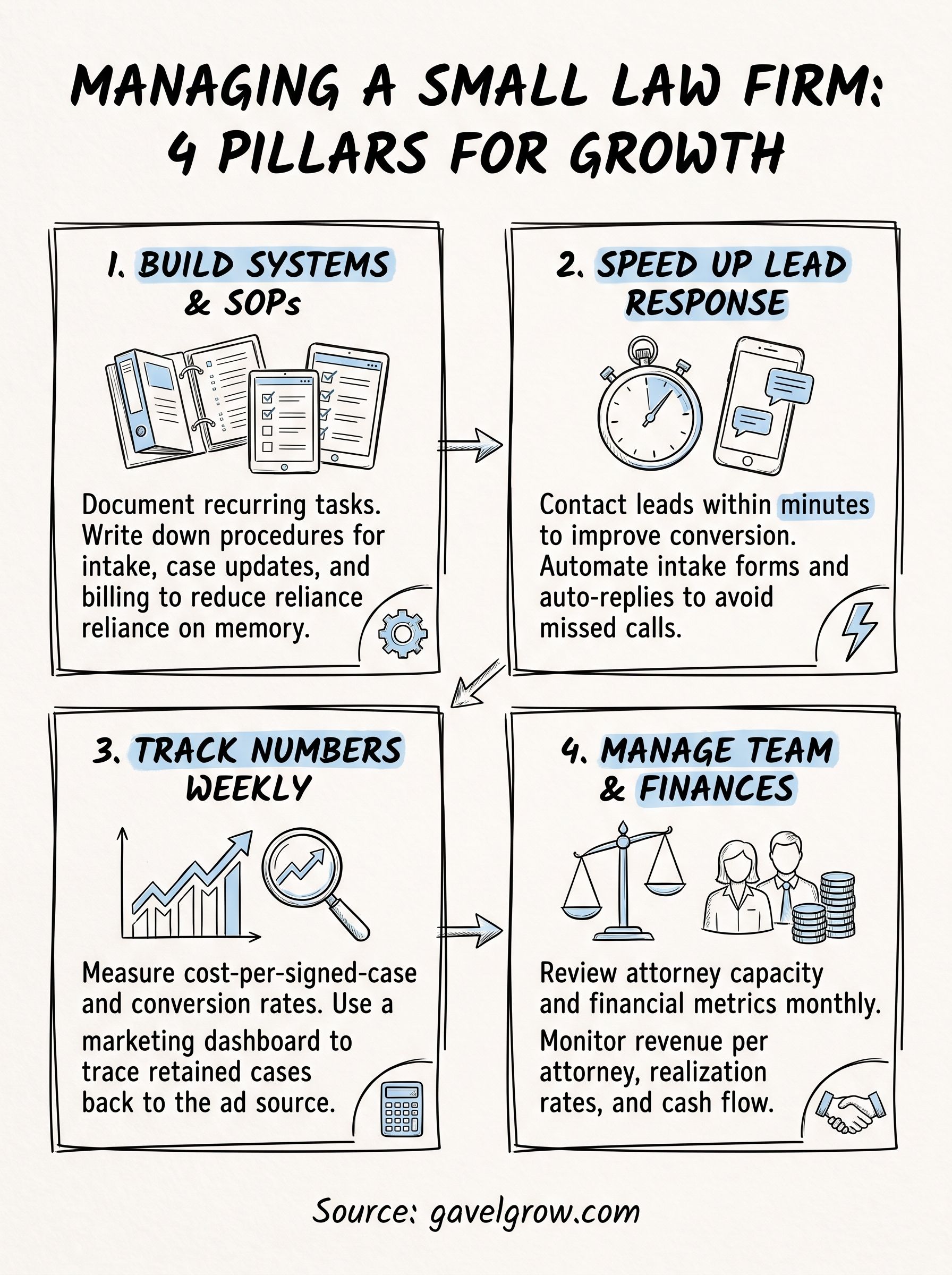
A well-managed firm doesn't depend on you answering every phone call or remembering every deadline. Systems, speed, data, and financial discipline work together so cases move forward whether you're in court, on vacation, or reviewing next quarter's budget. Skip one pillar and the others start absorbing the strain, usually as missed leads or burned-out staff.
Building this takes months, not a weekend, but every SOP you write and every number you start tracking weekly moves you closer to a firm that scales past you as the bottleneck. Owner-dependent firms stay small by definition, because growth requires decisions the owner can't make fast enough alone.
You don't have to build this alone either. If you want help turning marketing spend into signed cases with the systems this guide describes, book a free strategy call with GavelGrow and we'll walk through what's actually holding your firm back.
Frequently Asked Questions
How do you manage a small law firm effectively?
Managing a small firm well means running three businesses at once — the legal work, client acquisition, and the back office — without letting any one consume the others. The firms that scale build repeatable systems and SOPs, respond to leads fast, track their numbers weekly, and manage team and cash flow deliberately. The goal is a firm that runs on process rather than the owner’s constant attention.
What are the biggest challenges of running a small law firm?
The hardest part is that the owner is usually the best lawyer, the head of sales, and the operations manager all at once, so bottlenecks form fast. Common pain points are slow lead response, inconsistent intake, no clear view of which marketing works, and cash flow that swings with case timing. Systematizing each of these is what frees the owner from being the constraint.
How can a small law firm grow without hiring more staff?
Leverage systems and automation before headcount. Standard operating procedures let existing staff handle more without dropping quality, intake automation ensures no lead goes unanswered even after hours, and a marketing dashboard shows where to spend so you are not wasting money. Most small firms can meaningfully increase capacity by fixing process and speed-to-lead before adding people.
Why does lead response time matter for a small law firm?
Because prospects contact several firms, and the one that responds first usually earns the consultation. A prospect’s interest fades fast, so a firm that answers in minutes rather than hours signs more of the leads it already pays to generate. For a small firm, fixing response time is often the cheapest way to grow.
What should a small law firm track to manage growth?
Track the numbers tied to revenue, not vanity metrics: leads by source, cost per lead, lead-to-consultation and consultation-to-retainer conversion, cost per signed case, and cash flow against case timelines. A simple weekly dashboard beats a complex one nobody looks at — most small firms grow fastest once they can see which marketing and intake steps actually produce cases.
What software does a small law firm need?
At minimum, a system for intake and lead follow-up, case or practice management, billing, and a way to see marketing performance in one place. The trap is stitching together too many disconnected tools, which creates manual work and blind spots. Small firms tend to do best consolidating around a few platforms that cover intake, marketing attribution, and case management without constant re-entry.
How do you build a law firm that runs without you?
Document how the work gets done so it does not live only in your head, delegate against those SOPs, automate the repetitive steps (intake, follow-up, reporting), and review the numbers on a set cadence instead of reacting. The owner’s job shifts from doing every task to designing and improving the systems — which is what lets a small firm grow without the founder as the bottleneck.
Frequently Asked Questions
How do you manage a small law firm effectively?
Managing a small firm well means running three businesses at once — the legal work, client acquisition, and the back office — without letting any one consume the others. The firms that scale build repeatable systems and SOPs, respond to leads fast, track their numbers weekly, and manage team and cash flow deliberately. The goal is a firm that runs on process rather than the owner’s constant attention.
What are the biggest challenges of running a small law firm?
The hardest part is that the owner is usually the best lawyer, the head of sales, and the operations manager all at once, so bottlenecks form fast. Common pain points are slow lead response, inconsistent intake, no clear view of which marketing works, and cash flow that swings with case timing. Systematizing each of these is what frees the owner from being the constraint.
How can a small law firm grow without hiring more staff?
Leverage systems and automation before headcount. Standard operating procedures let existing staff handle more without dropping quality, intake automation ensures no lead goes unanswered even after hours, and a marketing dashboard shows where to spend so you are not wasting money. Most small firms can meaningfully increase capacity by fixing process and speed-to-lead before adding people.
Why does lead response time matter for a small law firm?
Because prospects contact several firms, and the one that responds first usually earns the consultation. A prospect’s interest fades fast, so a firm that answers in minutes rather than hours signs more of the leads it already pays to generate. For a small firm, fixing response time is often the cheapest way to grow.
What should a small law firm track to manage growth?
Track the numbers tied to revenue, not vanity metrics: leads by source, cost per lead, lead-to-consultation and consultation-to-retainer conversion, cost per signed case, and cash flow against case timelines. A simple weekly dashboard beats a complex one nobody looks at — most small firms grow fastest once they can see which marketing and intake steps actually produce cases.
What software does a small law firm need?
At minimum, a system for intake and lead follow-up, case or practice management, billing, and a way to see marketing performance in one place. The trap is stitching together too many disconnected tools, which creates manual work and blind spots. Small firms tend to do best consolidating around a few platforms that cover intake, marketing attribution, and case management without constant re-entry.
How do you build a law firm that runs without you?
Document how the work gets done so it does not live only in your head, delegate against those SOPs, automate the repetitive steps (intake, follow-up, reporting), and review the numbers on a set cadence instead of reacting. The owner’s job shifts from doing every task to designing and improving the systems — which is what lets a small firm grow without the founder as the bottleneck.