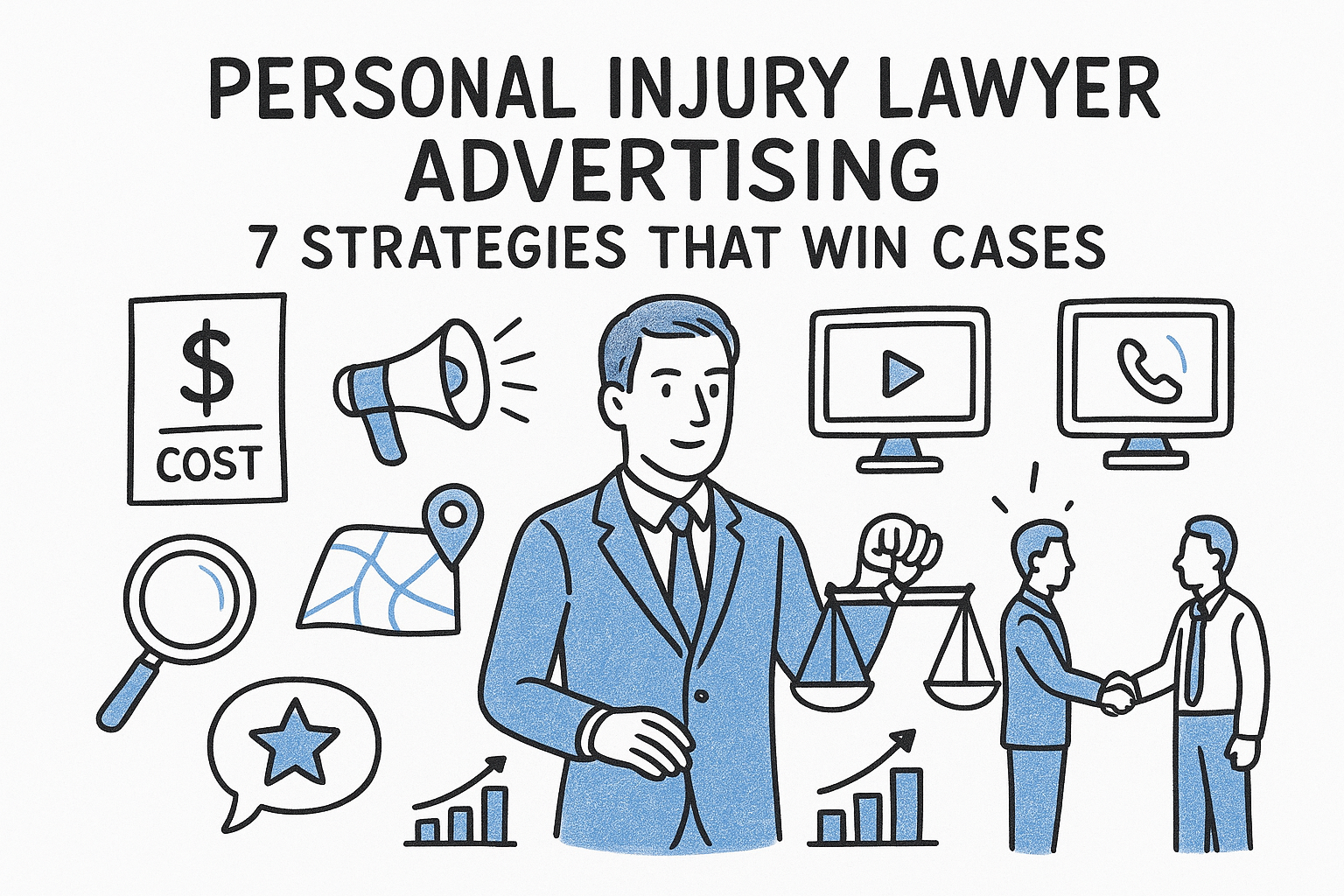
Personal Injury Lawyer Advertising: 7 Strategies That Win Cases
Categories: Legal Marketing Strategies
 Abram Ninoyan
Founder & Senior Performance Marketer
Credentials: Google Partner, Google Ads Search Certified, Google Ads Display Certified, Google Ads Measurement Certified, Google Analytics (IQ) Certified, HubSpot Inbound Certified, HubSpot Social Media Marketing Certified, Conversion Optimization Certified
Expertise: Google Ads, Meta Ads, Conversion Rate Optimization, GA4 & Google Tag Manager, Lead Generation, Marketing Funnel Optimization, PPC Management
LinkedIn Profile
Personal injury lawyer advertising is a crowded, expensive fight. The American Bar Association's 2023 Legal Technology Survey found that personal injury firms spend more per lead than almost any other...
Key Takeaways
- Personal Injury Lawyer Advertising: 7 Strategies That Win Cases
- 1. Track every lead from click to signed case
- 2. Run Google Ads and Local Services Ads
- 3. Optimize local SEO and your Google Business Profile
Personal Injury Lawyer Advertising: 7 Strategies That Win Cases
Personal injury lawyer advertising is a crowded, expensive fight. The American Bar Association's 2023 Legal Technology Survey found that personal injury firms spend more per lead than almost any other practice area, and Google Ads costs for terms like "car accident lawyer" routinely top $100 per click in major metros. If your ads are generating clicks but not signed retainers, the problem usually isn't your budget. It's your funnel.
This article answers the question directly: winning personal injury advertising combines aggressive, memorable creative with fast, compliant intake systems that turn calls into cases. The billboard or TV spot gets someone to pick up the phone. What happens in the next 60 seconds, whether you have speed-to-lead infrastructure and TCPA-compliant intake forms, determines whether that call becomes revenue.
Below you'll find seven strategies pulled from firms actually winning cases, not just impressions. We'll cover notable ad campaigns worth studying, mass-tort versus local PI messaging differences, call tracking setups, and the intake automation that separates firms with a 21% conversion edge from everyone else still losing leads to slow follow-up.
1. Track every lead from click to signed case
Before you spend another dollar on personal injury lawyer advertising, fix your measurement. Most firms track cost-per-lead, but a lead that never signs is worthless. What matters is cost-per-signed-case, the number that tells you which campaigns actually fund your practice and which ones just generate phone calls that go nowhere.
How it works
Full-funnel attribution connects three data points that most firms keep in separate tools: the ad click, the phone call or form fill, and the signed retainer. You need a dedicated tracking number for every campaign, a form that logs where the lead originated, and a case management system that reports back which leads converted. Without that closed loop, you're guessing which channels work. GavelGrow's marketing dashboard does away with the call-tracking-plus-spreadsheet patchwork most firms run, showing campaign-level cost-per-signed-case instead of vanity click metrics.
If you can't trace a signed case back to the ad that generated it, you're not measuring marketing, you're measuring noise.
Who it's for
This strategy applies to every personal injury firm, regardless of size, but it matters most for firms running multiple channels at once, think Google Ads, Local Services Ads, and TV simultaneously. Solo practitioners spending $2,000 a month need it just as badly as mass-tort shops spending $50,000, because the math on wasted spend scales with budget.
Typical cost
Standalone call tracking tools like CallRail run $45 to $150 per month before you add a separate CRM and reporting tool. A consolidated platform with built-in call tracking, intake forms, and attribution typically runs $199 to $599 per month depending on seat count and features, which is often cheaper than stitching together three tools that don't talk to each other. Managed-services clients get this attribution work baked into their monthly retainer, which starts at $10,000.
Compliance considerations
Call recording laws vary by state, and 11 states require two-party consent before you record a call, according to the Federal Communications Commission's guidance on call recording. Your tracking system needs to handle consent disclosures automatically and keep an audit trail. TCPA rules also apply to any automated follow-up you trigger after a lead calls in, so your intake process needs consent logging built in, not bolted on after a complaint.
2. Run Google Ads and Local Services Ads
Paid search puts your firm in front of someone the moment they type "car accident lawyer near me," which is exactly when intent peaks. Google Ads and Local Services Ads (LSA) are the two paid channels that dominate personal injury client acquisition, and most competitive firms run both at once.
How it works
Google Ads places your firm above organic results for keywords you bid on, while LSAs show a Google Screened badge and charge per lead instead of per click. Pairing them means you capture searchers at different trust levels: LSA for the cautious clicker who wants a vetted badge, standard search ads for the one ready to call immediately. A daily Google Ads sync into your marketing dashboard keeps spend and conversion data current without manual exports.
The ad gets the click. Your intake speed decides whether that click ever becomes a client.
Who it's for
Firms with budget to compete in expensive markets benefit most here. Solo practitioners in smaller metros can start with LSA alone, since it's cheaper per lead, while mass-tort and high-volume PI firms typically run both channels across multiple cities.
Typical cost
Personal injury keywords on Google Ads regularly cost $50 to $150 per click in major metros, and LSA leads run $20 to $150 depending on practice area and market density.
Compliance considerations
State bar advertising rules govern claims about results, guarantees, and testimonials in ad copy. LSA's Google Screened badge also requires background checks and license verification, so keep bar numbers and insurance documentation current to avoid losing your badge mid-campaign.
3. Optimize local SEO and your Google Business Profile
Searchers rarely scroll past the map pack when they search "personal injury lawyer near me," which means your Google Business Profile often matters more than your website ranking. Firms that ignore local SEO in favor of paid ads alone are leaving free, high-intent traffic on the table every single day.
How it works
Local SEO combines an optimized Google Business Profile with location-specific landing pages, consistent name-address-phone data across directories, and locally relevant backlinks. Update your profile weekly with:
- Fresh photos of your office and team
- Posts about recent case results or firm news
- Accurate practice areas and service locations
- Prompt responses to every review, positive or negative
Google's own guidance on improving local ranking confirms that relevance, distance, and prominence drive map pack placement, and prominence comes largely from reviews and citations.
A firm with 200 reviews and a complete profile will usually outrank a firm with a fancier website and five reviews.
Who it's for
Single-location firms competing for neighborhood or city-level searches benefit most. Multi-office firms need a profile and landing page for each location, since Google treats them as separate entities.
Typical cost
Hiring an SEO specialist or agency runs $1,500 to $5,000 per month for ongoing optimization; DIY profile management costs only staff time.
Compliance considerations
Review solicitation must follow state bar rules on client testimonials, and some states require disclaimers on case-result language even in Google posts.
4. Create trust-building TV and video commercials
Personal injury lawyer advertising still runs through local television in most mid-size and large metros, and the memorable ones stick for a reason. Think of the attorney who says the same phone number in every spot for a decade, or the firm whose jingle outlasts three rebrands. That repetition builds brand recall, and recall is what makes an injured person dial your number instead of searching cold after a crash.

How it works
Effective commercials pair a recognizable face, usually the named attorney, with a specific promise: fast response, no fee unless you win, or a direct cell number. Production runs from a single 30-second spot to a rotating library of testimonial-driven ads placed across local news, YouTube pre-roll, and connected TV. The best campaigns route every call through a dedicated tracking number so you know which spot, station, and time slot actually produced signed cases.
A commercial without call tracking is just an expensive guess about what's working.
Who it's for
This strategy suits firms with the budget for sustained frequency, since one airing rarely moves the needle. Mass-tort and high-volume PI firms lean on TV heavily; solo practitioners usually start with cheaper video ads on YouTube or social instead.
Typical cost
Local TV production runs $5,000 to $50,000 for a polished spot, plus $10,000 to $100,000+ monthly in media buys depending on market size.
Compliance considerations
State bar rules restrict dramatizations, guarantees, and testimonial language, so scripts need legal review before filming.
5. Build a reputation management and review system
A five-star average with 300 reviews beats a slick website every time an injured person compares two firms side by side. Reviews function as social proof at the exact moment someone decides whether to trust you with a case worth six figures, and firms that ignore this leave a huge conversion lever untouched.
How it works
Systematic review generation means asking every closed case for a review, not hoping happy clients remember on their own. The best setups trigger an automated SMS and email request the day a case settles, escalate unhappy clients to a partner for direct follow-up, and post a template response to every public review within 48 hours. GavelGrow's reputation and intake automation can fire these requests automatically once a case status changes to closed-won, so nothing depends on a paralegal remembering.
A firm that responds to every review, good or bad, signals more competence than one that simply has the highest star count.
Who it's for
Every personal injury firm needs this, but it matters most for firms competing in the local map pack, where review volume and recency directly influence Google ranking.
Typical cost
Dedicated reputation tools run $100 to $300 per month standalone; bundled into a full marketing platform, it's typically included in the $199 to $599 monthly tiers rather than billed separately.
Compliance considerations
Most state bars prohibit paying for reviews or offering incentives tied to review content, and several require disclaimers when quoting case results in testimonials.
6. Publish content that answers real client questions
Someone who just got rear-ended at a red light doesn't search for "personal injury lawyer." They search "do I need a lawyer if the other driver's insurance already called me." Content marketing wins that search, and it costs far less than paid ads once you build a library that ranks.
How it works
Effective content answers the specific questions injured people type into Google after an accident: what to say to an adjuster, how long a claim takes, whether a low settlement offer is normal. Blog posts, FAQ pages, and short videos built around these queries capture searchers before they know they need representation. Pair each piece with a clear next step, a click-to-call number or an intake form that logs the source, so content spend shows up in your attribution data instead of disappearing into a black box.
Content that answers the question someone actually has beats content written to please a keyword tool.
Who it's for
Firms playing a long game benefit most, since organic content takes months to rank. Solo and mid-size firms with limited ad budgets often get the best return here, because content compounds while paid clicks stop the moment you stop paying.
Typical cost
A freelance legal writer runs $150 to $500 per article; agencies managing a full content calendar charge $2,000 to $6,000 monthly.
Compliance considerations
Every post discussing case outcomes needs a results disclaimer, and most state bars require language clarifying that past results don't guarantee future outcomes.
7. Sponsor local events and community programs
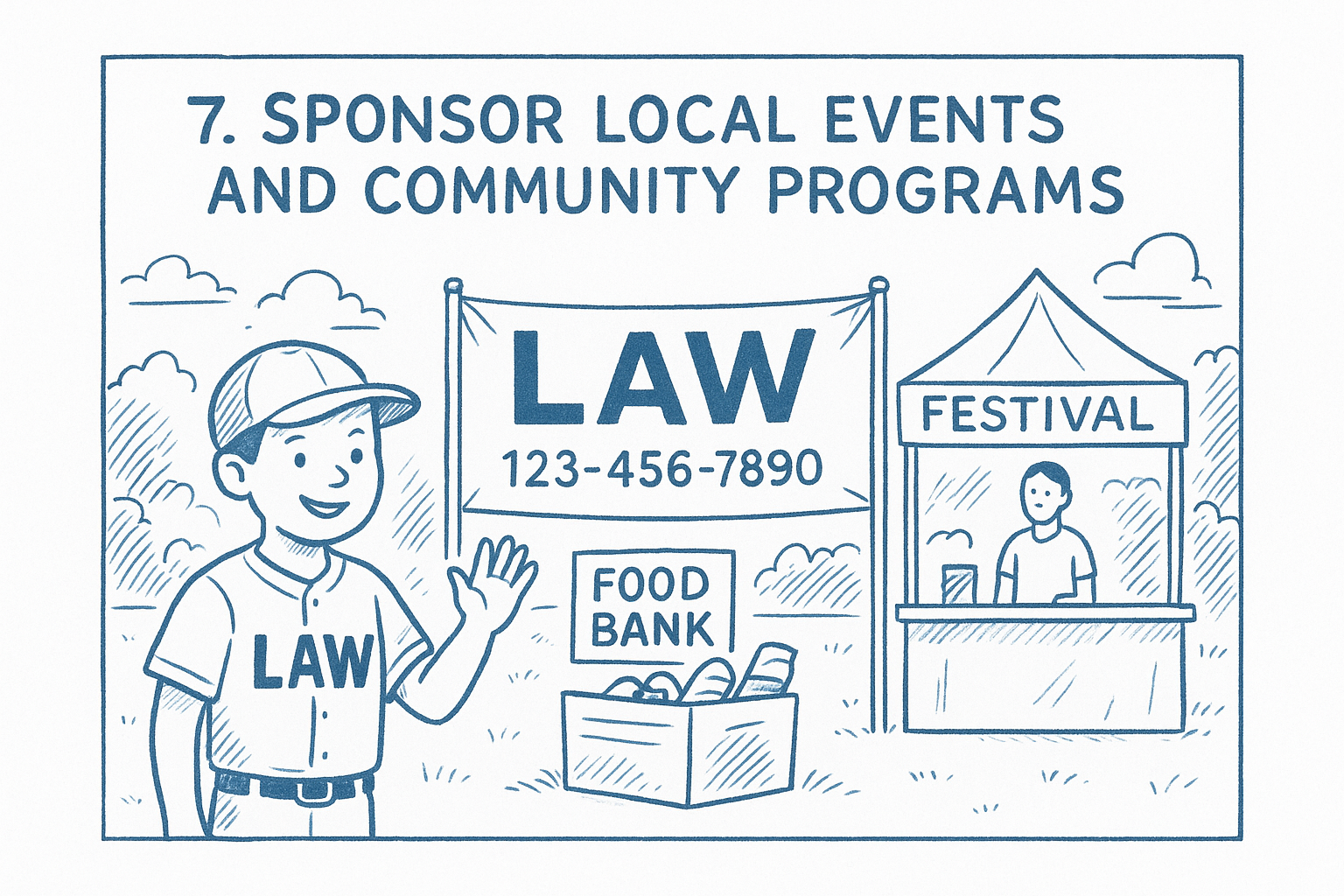
Sponsorship builds the kind of trust that a banner ad never will. Little league jerseys, food bank drives, and county fair booths put your firm's name in front of the same people who'll search for a personal injury lawyer after a car wreck six months later, and they'll recognize the name because they saw it on their kid's team shirt first.
How it works
Effective sponsorship pairs a recognizable local presence with a consistent call to action, your firm name, logo, and phone number on jerseys, event signage, or a booth at a community festival. Track results with a dedicated phone number or a landing page URL printed only on sponsorship materials, so calls and form fills tie back to that specific program instead of blending into your general traffic.
Sponsorship works when someone remembers your name months later, not when they click an ad today.
Who it's for
Single-location firms competing on local trust benefit most, especially in smaller and mid-size markets where word of mouth still drives referrals. Mass-tort shops running national campaigns rarely see the same return, since community sponsorship trades scale for local credibility.
Typical cost
Little league or youth sports sponsorships run $500 to $5,000 annually; larger community events or festival booths can run $5,000 to $25,000 depending on market size and visibility.
Compliance considerations
State bar rules on advertising still apply to sponsorship materials, including logo placement and any language implying results or guarantees, so route event signage through the same review process as your other ads.
Building an advertising mix that actually converts
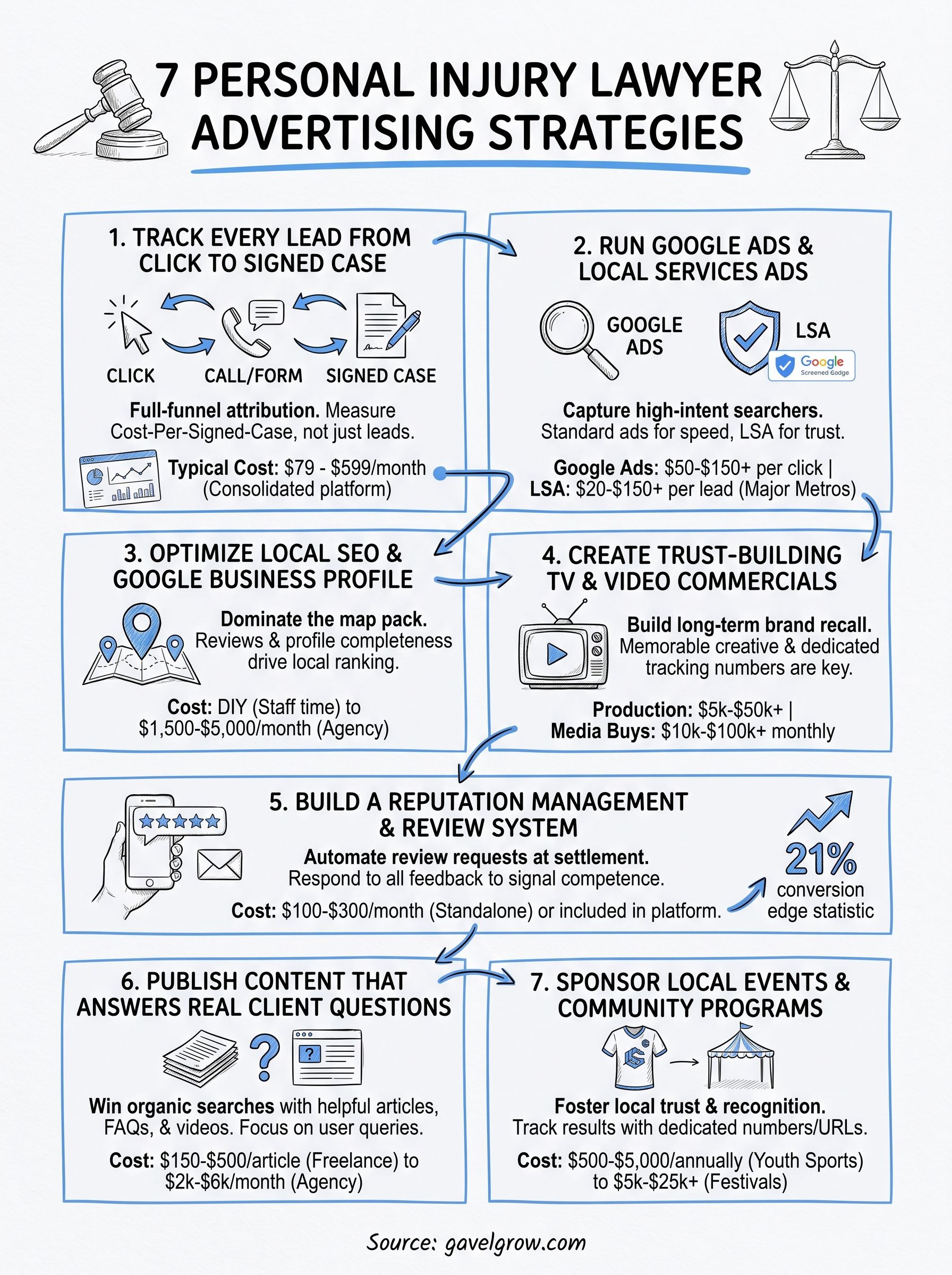
None of these seven strategies works alone. A memorable TV spot without fast intake wastes the call it generates, and flawless attribution means nothing if you're not spending on channels that reach injured people in the first place. Winning firms layer paid search, local SEO, reputation management, and content together, then measure every dollar against signed cases instead of clicks or impressions.
Start by fixing measurement first. You can't optimize a mix you can't see clearly, and cost-per-signed-case data tells you which of these seven levers deserves more budget next quarter. Once you know that, doubling down on the right channel gets a lot less risky.
If you want a second set of eyes on your current setup before you shift another dollar of ad spend, book a free strategy call with GavelGrow and walk through what's actually working.
Frequently Asked Questions
How much does personal injury lawyer advertising cost?
PI is the most competitive and expensive legal advertising vertical — Google Ads clicks routinely run well over $100 in major metros, and what matters is cost per signed case, since a single case can be worth tens of thousands. Rather than fixate on cost per click, budget from case value: a $300 click that produces a $50,000 case is a bargain, while cheap clicks that never sign are the real waste.
What is the best advertising channel for personal injury lawyers?
Google Ads and Local Services Ads usually deliver the highest-intent leads, because they reach people actively searching for a PI lawyer right after an accident. LSAs charge per lead with a Google Screened badge; Search gives you more control over keywords and copy. Most PI firms run both, backed by strong local SEO and reviews, and track every channel to signed cases.
Are there compliance rules for personal injury lawyer ads?
Yes, and they are strict. State bar advertising rules govern claims, testimonials, case-result statements, and required disclaimers, and PI advertising draws extra scrutiny. Avoid unqualified superlatives and outcome guarantees like "we always win," include required disclaimers on results and any "no fee unless we win" language, and keep every claim substantiated. Compliant ads protect your license and often convert better by setting honest expectations.
How do you lower cost per case on personal injury advertising?
Focus on high-intent keywords (accident type plus location), tighten negative keywords to cut tire-kicker clicks, and improve landing pages and Quality Score. But the biggest lever is intake: PI leads contact several firms, so responding in minutes and qualifying fast lowers your effective cost per signed case more than any bidding tweak. Track cost per signed case by campaign, not just cost per lead.
Do personal injury lawyers need call tracking?
Yes — most PI leads call rather than fill out a form, so without call tracking you cannot tell which ads and keywords actually produce signed cases. Call tracking ties each call back to the campaign that generated it, letting you cut wasted spend and double down on what works. The goal is attribution all the way to a signed retainer, not just counting calls.
How long does personal injury advertising take to produce cases?
Paid channels like Google Ads and Local Services Ads can generate leads within days, which is why PI firms lean on them for immediate case flow. SEO and reputation-building take three to twelve months to compound but lower your long-term cost per case. The firms that grow fastest run paid ads for speed while building organic visibility for durable, lower-cost pipeline.
How do you measure ROI on personal injury lawyer advertising?
Track the full path from click or call to signed case, not vanity metrics like impressions or clicks. The numbers that matter are cost per lead, lead-to-consultation rate, intake-to-retainer conversion, and cost per signed case by campaign and keyword. Full-funnel attribution — connecting each lead source through intake to a signed retainer — is the only way to know which advertising actually funds the firm.
Third-party pricing (e.g., CallRail) reflects estimates based on publicly available information as of July 2026, not official quotes — verify current pricing directly with each vendor. Company names and trademarks are the property of their respective owners.
Frequently Asked Questions
How much does personal injury lawyer advertising cost?
PI is the most competitive and expensive legal advertising vertical — Google Ads clicks routinely run well over $100 in major metros, and what matters is cost per signed case, since a single case can be worth tens of thousands. Rather than fixate on cost per click, budget from case value: a $300 click that produces a $50,000 case is a bargain, while cheap clicks that never sign are the real waste.
What is the best advertising channel for personal injury lawyers?
Google Ads and Local Services Ads usually deliver the highest-intent leads, because they reach people actively searching for a PI lawyer right after an accident. LSAs charge per lead with a Google Screened badge; Search gives you more control over keywords and copy. Most PI firms run both, backed by strong local SEO and reviews, and track every channel to signed cases.
Are there compliance rules for personal injury lawyer ads?
Yes, and they are strict. State bar advertising rules govern claims, testimonials, case-result statements, and required disclaimers, and PI advertising draws extra scrutiny. Avoid unqualified superlatives and outcome guarantees like "we always win," include required disclaimers on results and any "no fee unless we win" language, and keep every claim substantiated. Compliant ads protect your license and often convert better by setting honest expectations.
How do you lower cost per case on personal injury advertising?
Focus on high-intent keywords (accident type plus location), tighten negative keywords to cut tire-kicker clicks, and improve landing pages and Quality Score. But the biggest lever is intake: PI leads contact several firms, so responding in minutes and qualifying fast lowers your effective cost per signed case more than any bidding tweak. Track cost per signed case by campaign, not just cost per lead.
Do personal injury lawyers need call tracking?
Yes — most PI leads call rather than fill out a form, so without call tracking you cannot tell which ads and keywords actually produce signed cases. Call tracking ties each call back to the campaign that generated it, letting you cut wasted spend and double down on what works. The goal is attribution all the way to a signed retainer, not just counting calls.
How long does personal injury advertising take to produce cases?
Paid channels like Google Ads and Local Services Ads can generate leads within days, which is why PI firms lean on them for immediate case flow. SEO and reputation-building take three to twelve months to compound but lower your long-term cost per case. The firms that grow fastest run paid ads for speed while building organic visibility for durable, lower-cost pipeline.
How do you measure ROI on personal injury lawyer advertising?
Track the full path from click or call to signed case, not vanity metrics like impressions or clicks. The numbers that matter are cost per lead, lead-to-consultation rate, intake-to-retainer conversion, and cost per signed case by campaign and keyword. Full-funnel attribution — connecting each lead source through intake to a signed retainer — is the only way to know which advertising actually funds the firm. Third-party pricing (e.g., CallRail) reflects estimates based on publicly available information as of July 2026, not official quotes — verify current pricing directly with each vendor. Company names and trademarks are the property of their respective owners.