9 Ways Immigration Firms Turn Marketing Into Signed Cases
Categories: Legal Marketing Strategies
 Abram Ninoyan
Founder & Senior Performance Marketer
Credentials: Google Partner, Google Ads Search Certified, Google Ads Display Certified, Google Ads Measurement Certified, Google Analytics (IQ) Certified, HubSpot Inbound Certified, HubSpot Social Media Marketing Certified, Conversion Optimization Certified
Expertise: Google Ads, Meta Ads, Conversion Rate Optimization, GA4 & Google Tag Manager, Lead Generation, Marketing Funnel Optimization, PPC Management
LinkedIn Profile
Most immigration law firm marketing plans stall for one reason: the firm is buying leads, not signed cases. You can run Google Ads for family-based petitions, asylum, or employment visas and still wat...
Key Takeaways
- 9 Ways Immigration Firms Turn Marketing Into Signed Cases
- 1. Track leads from click to signed case
- 2. Build a website that turns visitors into clients
- 3. Target immigration keywords by case type
9 Ways Immigration Firms Turn Marketing Into Signed Cases
Most immigration law firm marketing plans stall for one reason: the firm is buying leads, not signed cases. You can run Google Ads for family-based petitions, asylum, or employment visas and still watch your caseload flatten because nobody tracked which calls turned into retained clients versus which ones were wrong numbers, unqualified, or lost to a competitor who called back first.
This article gives you nine strategies that immigration firms are actually using to sign more cases, not just generate more inquiries, building on the core immigration lawyer marketing strategies every firm should have running. That means speed to lead on multilingual intake, Google Business Profile work built around the practice areas clients actually search for, and call tracking that tells you which campaign produced a retainer instead of a voicemail. Every tactic here ties back to a number you can measure: cost per signed case, not cost per click.
We'll walk through paid search and Local Services Ads, community and referral-based outreach that immigration clients trust more than a cold ad, intake automation for the leads who call after hours, and how modelled benchmark ranges for immigration by market size can tell you whether your numbers are competitive. Skip to whichever strategy fits the gap in your current pipeline. If you want the foundational overview first, start with our guide to immigration law firm marketing and come back here for the tactics.
1. Track leads from click to signed case
Every immigration firm we've worked with runs paid ads, SEO, or both. Almost none of them can tell you which campaign actually produced a signed retainer versus a lead that ghosted after the free consult. That gap is the single biggest waste in immigration law firm marketing, and it's the first thing to fix before you spend another dollar on ads.
How it works
Start by connecting every lead source, Google Ads, Local Services Ads, your website contact form, and every phone number you publish, to a system that follows the lead all the way to case status. That means assigning a unique tracking number to each campaign, tagging every form submission with its source, and logging outcomes (consultation booked, retainer signed, case declined) against the original click. Without this chain, you're stuck comparing cost per lead across channels that produce very different quality of leads. A platform like GavelGrow's marketing dashboard does this automatically: it ties ad spend to campaign-level cost per signed case, not just cost per click, and built-in call tracking numbers log recordings, transcripts, and outcome tags without a separate subscription.
Why it matters for immigration clients
Immigration cases vary wildly in how they close. A straightforward green card renewal might sign the same week. An asylum case or a complex removal defense matter can take months of back-and-forth before the client actually retains you. If you're only measuring cost per lead, you'll systematically overvalue campaigns that generate quick, low-value inquiries and undervalue the ones quietly filling your caseload with higher-fee matters. Full-funnel attribution, meaning tracking from the first ad click through to the signed case, is what separates a firm that's actually growing its caseload from one that's just generating call volume.
If you can't trace a signed case back to the ad that produced it, you're guessing at your marketing budget, not managing it.
Multilingual intake adds another wrinkle. A call answered in Spanish or Haitian Creole that gets marked "unqualified" because the intake staff couldn't understand it isn't actually a bad lead, it's a process failure that tracking will surface if you tag calls by outcome and language.
How to measure results
The metric that matters is cost per signed case, broken out by campaign and by practice area (family-based, employment, asylum, removal defense). Compare that against modelled benchmark ranges for immigration firms by market size to see whether your numbers are in a reasonable range or badly out of line. Track these three numbers monthly at minimum:
- Cost per signed case by campaign, not just cost per lead
- Call-to-retainer rate, using outcome tags on every tracking number
- Time from first contact to signed retainer, since a slow intake process quietly kills conversion regardless of how good the ad was
Once these numbers are visible, budget decisions stop being a guess. You'll know within a month whether that Local Services Ads spend is producing retainers or just ringing your phone.
2. Build a website that turns visitors into clients
A lot of immigration firm websites read like a law school brochure: broad practice-area lists, generic stock photos, no clear next step, and none of the website design choices that actually sign clients. That approach loses cases before the phone ever rings, because a visitor searching for help with a specific problem, like a marriage-based green card denial or a DACA renewal, needs to see their situation reflected back at them fast.

How it works
Build your site around the specific problems clients are searching for, not a single "Immigration Law" page trying to cover everything. Each major case type (family-based petitions, employment visas, asylum, removal defense, naturalization) should get its own page with plain-language explanations, realistic timelines, and a clear call to action. Mobile-first design matters more here than in most practice areas since a huge share of immigration searches happen on a phone, often during a moment of urgency. Pair that with a hosted or embedded intake form that's short, mobile-friendly, and multi-step rather than one long wall of fields, so a nervous visitor doesn't abandon it halfway through.
Why it matters for immigration clients
Immigration clients are often searching under real stress: a denial letter just arrived, a visa is expiring, a family member was detained. They don't have patience for a slow-loading site or a form that doesn't work on their phone. Contact forms tend to underperform on mobile compared to desktop, and for a practice area where mobile search is this dominant, that gap costs you retained clients directly, not just traffic.
A website that's hard to use on a phone loses immigration clients before your intake team ever gets the chance to call them back.
Language matters just as much as speed. If a meaningful share of your inquiries come in Spanish, Haitian Creole, or another language, your site and forms need to work in that language too, not just your intake calls.
How to measure results
Track form completion rate by device, time-on-page for your case-type pages, and how many form submissions actually convert to booked consultations. GavelGrow's hosted intake forms log TCPA consent and validate phone numbers at submission, so you can see exactly where mobile visitors drop off and fix that specific step.
3. Target immigration keywords by case type
Generic keywords like "immigration lawyer" pull in a flood of searchers who are still researching, not ready to hire. The clients most likely to sign are searching for something far more specific: "K-1 visa attorney," "U visa lawyer for domestic violence victims," "I-601 waiver attorney near me." Case-type keyword targeting, the backbone of SEO for immigration lawyers, puts your firm in front of people who already know what they need and are close to picking up the phone.
How it works
Build keyword lists around each practice area you actually handle using keyword strategies that attract high-value cases, then split them further by client intent. A person searching "green card renewal cost" is comparing options. Someone searching "emergency attorney visa expiring tomorrow" needs to talk to someone now. Map both intents to separate landing pages instead of funneling everyone to one general immigration page, and use those same case-type terms in your page titles, headers, and Google Business Profile services list so paid and organic search reinforce each other.
Why it matters for immigration clients
Immigration law covers dozens of distinct legal problems with almost nothing in common, from employment-based visas to removal defense to naturalization. A firm ranking only for "immigration attorney" competes against every other generalist in the metro area, while a firm ranking for "employer H-1B sponsorship attorney" competes against almost nobody and reaches a client who's already qualified.
Narrow keywords bring in fewer clicks, but they bring in the clicks that actually retain.
This specificity also filters out tire-kickers before they reach your intake team, which saves your staff hours every week on calls that were never going to convert.
How to measure results
Track conversion rate by case-type landing page, not just by overall site traffic, and watch which keyword groups produce signed retainers versus consultations that go nowhere.
- Click-through rate on case-type ad groups versus broad terms
- Cost per signed case for each practice-area page
- Ranking position for your top 10 case-type keywords, checked monthly
GavelGrow's marketing dashboard ties each of these keyword groups back to signed cases, so you can see exactly which practice-area terms are worth the spend.
4. Run paid ads for high-urgency immigration searches
Some immigration searches signal a deadline, not casual research: a visa expiring next week, a Notice to Appear just received, a detained family member. Paid search and Local Services Ads put your firm in front of that person within minutes, which is exactly the window a slower organic ranking can't fill.
How it works
Structure your Google Ads campaigns for law firms around urgency-driven queries separately from general research terms, since the two need different messaging and different bids. A search for "attorney visa expiring this week" should land on a page with a phone number above the fold and same-day availability, not a general practice-area overview. Layer in Local Services Ads for your metro area, since they surface above standard search ads and carry a Google-verified badge that immigration clients often trust more when they're vetting a firm quickly. Feed both channels into the same tracking system you set up in strategy one, so you know which platform actually produces retainers.
Why it matters for immigration clients
A client searching under deadline pressure isn't comparing five firms over a week, they're calling whoever answers first with a clear answer. Paid ads targeting these high-urgency terms put you in that narrow window, but only if your intake team can actually pick up and qualify the call fast.
An ad that wins the click still loses the case if nobody answers the phone in time.
General awareness ads still have a place for building your pipeline over time, but urgency campaigns are where cost per signed case tends to look best, because the searcher already knows they need a lawyer now.
How to measure results
Compare cost per signed case between urgency campaigns and general awareness campaigns, and track missed-call rate on your Local Services Ads number specifically. GavelGrow's call tracking tags each call by outcome and campaign, so you can see whether a high-cost urgent click actually turned into a retainer or a missed call nobody followed up on.
5. Publish content that answers real client questions
Immigration clients search for answers long before they search for a lawyer. "Can I travel while my green card is pending," "what happens if I miss my asylum interview," "how long does an I-130 take in 2026": these are the questions filling your prospects' browser tabs at midnight. Content marketing for immigration attorneys works when it answers those exact questions instead of publishing generic legal updates nobody searched for.
How it works
Build your content calendar from the questions your intake team actually hears every week, not from a list of trending legal news. Ask your paralegals and intake staff to log the five questions they answer most often, then write a page for each one in plain language, with realistic timelines and next steps. Cover process questions (how long does a case take, what documents do I need), eligibility questions (do I qualify for a U visa, can I apply for asylum after one year), and situational questions (what happens if my visa expires while my case is pending). Publish this content in every language your clients search in, not just English.
Why it matters for immigration clients
Immigration law changes often enough that clients are anxious about outdated information, and they're searching for a firm that clearly understands their specific situation before they'll trust you with it. A detailed page answering "what happens if I miss my asylum interview" signals first-hand expertise in a way a generic services page never can.
A prospective client who finds the exact answer to their question on your site is already halfway to calling you.
This content also builds organic rankings for the case-type keywords covered in strategy three, compounding your paid search results rather than competing with them.
How to measure results
Track organic traffic to each question-based page, then follow how many of those visitors submit an intake form or call. GavelGrow's marketing dashboard shows which content pages actually produce signed cases, not just pageviews, so you can double down on the topics that convert.
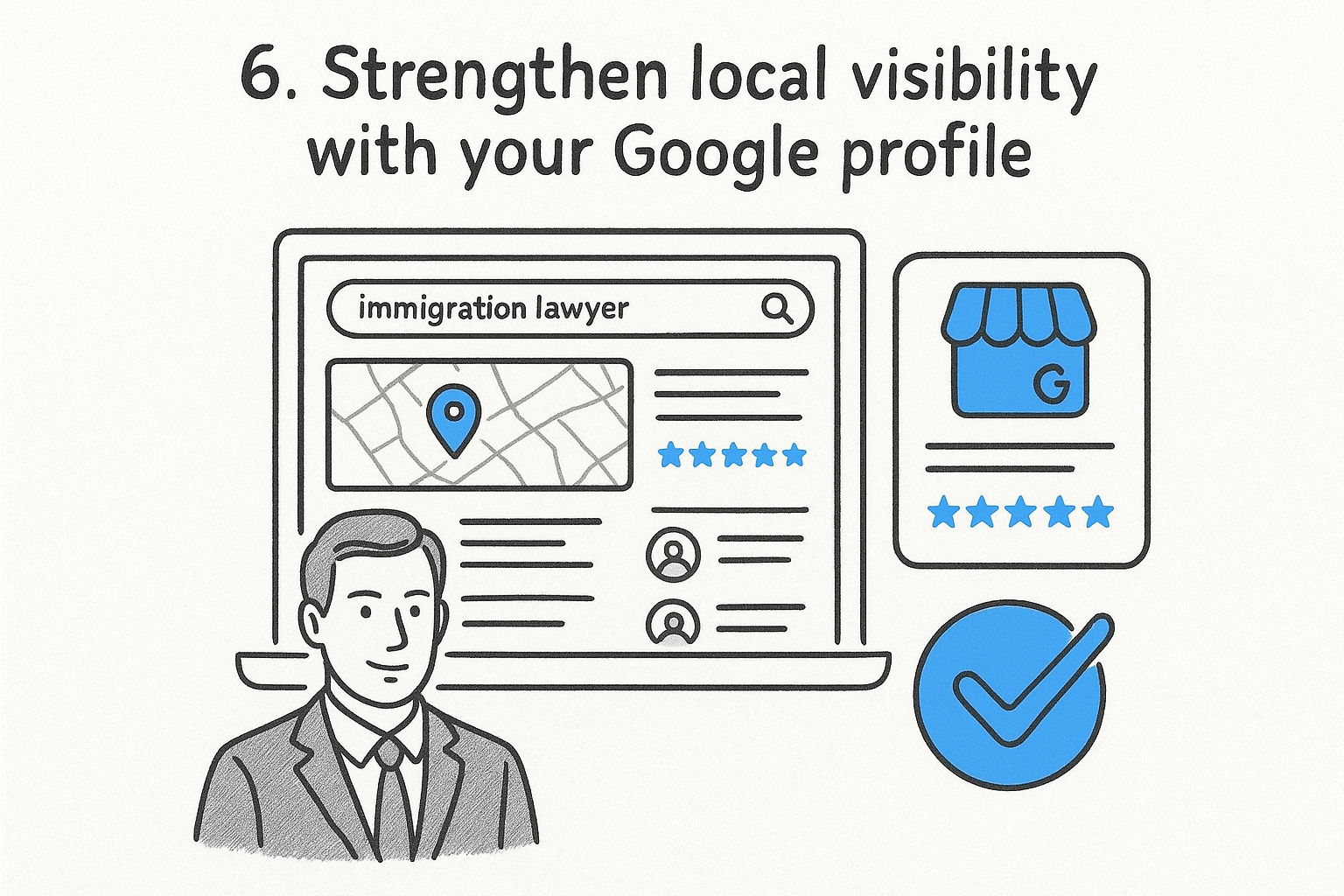
6. Strengthen local visibility with your Google profile
When someone searches "immigration lawyer near me" or "immigration attorney [city]," the first thing they see isn't your website, it's the map pack: three firms with a photo, a rating, and a phone number. If your Google Business Profile isn't optimized, you're invisible in that spot no matter how good your ads or your site are.
How it works
Claim and fully complete your profile: accurate practice areas listed as services (family-based petitions, asylum, employment visas, removal defense), business hours, a local phone number, and photos of your actual office and team, not stock images. List the languages your staff speaks directly in the profile description, since immigration clients often filter by that before anything else. Post updates regularly, respond to every review, and keep your categories specific rather than defaulting to a single generic "Lawyer" tag.
Why it matters for immigration clients
Immigration clients frequently search locally because they want an attorney they can meet in person, sometimes with family members translating or accompanying them. A complete, active profile signals a firm that's established and responsive, while a sparse one with no reviews and outdated hours reads as risky to someone about to hand over sensitive documents and a retainer fee.
A weak Google profile costs you cases in the map pack before a single click ever reaches your website.
On reviews specifically: ask every client for one, not just the ones you're confident are happy, and resolve any complaint directly with the client rather than routing them somewhere private first. Respond professionally to every public review you get, good or bad, and treat reputation management as part of intake rather than an afterthought. Google's own guidelines prohibit gating or incentivizing reviews, and violations can get your profile suspended entirely.
How to measure results
Track calls and direction requests generated directly from your profile in Google's own insights panel, then match those calls against your call tracking outcomes to see how many turned into signed retainers rather than just phone traffic.
7. Offer multilingual support across every channel
A prospective client who can't get a straight answer in their own language will hang up and call the next firm on the list, even if you're the better attorney. Multilingual support isn't a nice extra for immigration firms, it's a baseline requirement, since most of your caseload likely speaks a language other than English at home, at least for the initial call.
How it works
Build language coverage into every touchpoint, not just your intake line. That means bilingual staff answering calls, website pages translated by a person rather than a plugin, intake forms available in Spanish, Haitian Creole, or whatever languages your market demands, and automated intake workflows that send SMS and email replies in the language the lead used to reach you. Tag every lead by preferred language at first contact so nothing gets lost when it's handed from intake to an attorney. Platforms like GavelGrow's intake automation can fire language-specific auto-replies within seconds of a form submission, so a Spanish-speaking lead isn't waiting on an English-only sequence.
Why it matters for immigration clients
Most of your business, family-based petitions, asylum cases, DACA renewals, involves clients who are more comfortable discussing sensitive personal history in their first language. Making them switch to English, or wait for a translator to become available, adds friction at the exact moment you need to build trust fast.
A firm that answers in the client's own language wins the retainer before a competitor even calls back.
This also affects who books the consultation in the first place. A family member often does the initial search on behalf of a relative, and if the site and forms only work in English, that referral dies at the browser tab.
How to measure results
Tag every lead and call by language at intake, then compare call-to-retainer rate across language groups. If leads in one language convert noticeably worse, that's a staffing or translation gap to fix, not a sign those leads were low quality to begin with.
8. Nurture leads with email and SMS follow-up
Not every immigration lead signs on the first call. Someone might request a consultation, get scared off by the retainer fee, or need to gather documents before committing, and if you never follow up again, that lead quietly goes to whichever firm called them back. Automated follow-up sequences keep your firm in front of that person without requiring a staff member to remember to check in three weeks later.
How it works
Set up SMS and email drip campaigns that convert automatically based on where a lead stalls in your pipeline: consultation booked but no show, consultation completed but no retainer signed, or a form submitted with no answered call. Each sequence should feel personal, not like a mass blast, referencing the specific case type and next step ("still need help with your I-130 petition?"). Speed matters at every stage, not just the first contact. GavelGrow's intake automation sends the first email within minutes of a lead capture (texts follow once US carriers approve your firm's number) and keeps sending scheduled follow-ups afterward, with STOP and HELP opt-out keywords handled automatically so you stay compliant without manual monitoring.
Why it matters for immigration clients
Immigration matters often involve months of waiting, gathering evidence, or deciding whether to spend money on a case that feels uncertain. A lead who didn't sign in week one isn't necessarily gone, they may just need a nudge once a deadline gets closer or a document arrives. Without a nurture sequence, that lead sits cold in your pipeline until they either forget about you or find another attorney.
A lead that goes quiet for three weeks isn't dead, it's just waiting on the follow-up you never sent.
For a practice built on immigration law firm marketing, that patience is exactly where a well-timed message earns back a case an ad campaign already paid for once.
How to measure results
Track how many stalled leads reactivate and sign after a follow-up sequence, plus response rate by message and by day-in-sequence, so you can see which touch actually moves someone to book.
9. Build referral partnerships with attorneys and partners
Some of the best immigration cases never touch a Google ad at all. They arrive through a criminal defense attorney whose client needs a U visa, a family law attorney whose divorce case has an immigration wrinkle, or a community organization that trusts your firm enough to hand you their members directly. Referral partnerships cost almost nothing to build and often produce clients who arrive pre-qualified and ready to sign, which is why they rank among the strongest lead sources for law firms.

How it works
Start with attorneys in adjacent practice areas who regularly run into immigration issues they can't handle themselves: criminal defense, family law, employment law, and personal injury firms all see this constantly. Add community touchpoints too, churches, cultural associations, language schools, and small business groups serving immigrant communities. Formalize the relationship with a simple process: a direct contact for warm handoffs, a shared understanding of what you handle, and a habit of reporting back on outcomes so the referral source knows their trust paid off. Track every referral source the same way you track a paid campaign, tagging leads by origin in your intake system.
Why it matters for immigration clients
Immigration clients often make decisions based on trust passed from someone they already know, not a stranger's ad. A referral from a trusted attorney or community leader arrives with built-in credibility that a cold click can't replicate, which usually means a shorter path to a signed retainer and less price sensitivity along the way.
A single strong referral partnership can outproduce a month of paid ads, at a fraction of the cost.
This channel also diversifies your immigration law firm marketing mix, so a change in ad costs or algorithm behavior doesn't threaten your entire pipeline.
How to measure results
Tag every lead by referral source at intake and track it through to signed case, exactly as you would a Google Ads campaign. GavelGrow's lead pipeline lets you filter by source, so you can see which attorney relationships or community partners are quietly producing your highest-value cases and worth investing more time in maintaining.
Turning strategy into signed cases
Nine strategies won't fix a firm that's still measuring cost per lead instead of cost per signed case. That's the thread running through all of this: immigration law firm marketing only works when you can trace a click, a call, or a referral all the way to a retainer, in whatever language the client first reached out in. Pick the two or three gaps costing you the most cases right now, whether that's slow follow-up, a website that fails on mobile, or referral sources you've never bothered to track, and fix those before adding another channel.
You don't have to rebuild this from scratch on your own. If you want a clear read on where your current numbers stand and which of these nine levers would move the needle fastest for your firm, book a free strategy call with GavelGrow and walk through your pipeline with someone who's done this for immigration firms before.
Frequently asked questions about immigration law firm marketing
What is the most important immigration law firm marketing metric?
Cost per signed case, broken out by campaign and by practice area. Cost per lead overvalues campaigns that produce quick, low-value inquiries and undervalues the ones quietly filling the caseload with higher-fee matters. Immigration cases close on very different timelines, since a green card renewal may sign the same week while an asylum matter can take months, so a blended lead cost says almost nothing about which spend is working.
How should an immigration firm handle leads in other languages?
As a process to build, not a filter to apply. A call answered in Spanish or Haitian Creole that gets marked unqualified because intake could not understand it is not a bad lead, it is a process failure. Tag calls by outcome and by language so those show up in your numbers, and staff or route intake so the languages your caseload actually arrives in get answered.
Do Google Local Services Ads work for immigration firms?
They can, particularly for high-urgency searches where someone needs a lawyer this week. The ads sit above standard results and charge per lead rather than per click, which changes the math. The caveat is the same as any channel: track which of those leads become signed cases, because a cheap lead that never retains costs more than an expensive one that does.
How fast should an immigration firm respond to a new inquiry?
The Lead Response Management Study found leads contacted within five minutes are far more likely to qualify than those first reached after thirty minutes. Immigration prospects commonly contact several firms in one sitting, and many inquiries arrive after hours, so response time often decides who gets the consultation regardless of who ran the better ad.
How do you tell whether your immigration marketing numbers are competitive?
Compare cost per signed case against modelled benchmark ranges for immigration firms by market size, rather than against a single national figure. Market size, practice-area mix and how many firms compete for the same searches all move the number, so a figure that is high in one metro can be normal in another. Treat benchmarks as a range to check against, not a target to hit.
Frequently Asked Questions
What is the most important immigration law firm marketing metric?
Cost per signed case, broken out by campaign and by practice area. Cost per lead overvalues campaigns that produce quick, low-value inquiries and undervalues the ones quietly filling the caseload with higher-fee matters. Immigration cases close on very different timelines, since a green card renewal may sign the same week while an asylum matter can take months, so a blended lead cost says almost nothing about which spend is working.
How should an immigration firm handle leads in other languages?
As a process to build, not a filter to apply. A call answered in Spanish or Haitian Creole that gets marked unqualified because intake could not understand it is not a bad lead, it is a process failure. Tag calls by outcome and by language so those show up in your numbers, and staff or route intake so the languages your caseload actually arrives in get answered.
Do Google Local Services Ads work for immigration firms?
They can, particularly for high-urgency searches where someone needs a lawyer this week. The ads sit above standard results and charge per lead rather than per click, which changes the math. The caveat is the same as any channel: track which of those leads become signed cases, because a cheap lead that never retains costs more than an expensive one that does.
How fast should an immigration firm respond to a new inquiry?
The Lead Response Management Study found leads contacted within five minutes are far more likely to qualify than those first reached after thirty minutes. Immigration prospects commonly contact several firms in one sitting, and many inquiries arrive after hours, so response time often decides who gets the consultation regardless of who ran the better ad.
How do you tell whether your immigration marketing numbers are competitive?
Compare cost per signed case against modelled benchmark ranges for immigration firms by market size, rather than against a single national figure. Market size, practice-area mix and how many firms compete for the same searches all move the number, so a figure that is high in one metro can be normal in another. Treat benchmarks as a range to check against, not a target to hit.