Small Law Firm Marketing: A Budget Plan That Signs Cases
Categories: Legal Marketing Strategies
 Abram Ninoyan
Founder & Senior Performance Marketer
Credentials: Google Partner, Google Ads Search Certified, Google Ads Display Certified, Google Ads Measurement Certified, Google Analytics (IQ) Certified, HubSpot Inbound Certified, HubSpot Social Media Marketing Certified, Conversion Optimization Certified
Expertise: Google Ads, Meta Ads, Conversion Rate Optimization, GA4 & Google Tag Manager, Lead Generation, Marketing Funnel Optimization, PPC Management
LinkedIn Profile
You don't need a six-figure budget to build a small law firm marketing plan that consistently signs cases, you need the right channels, tight intake, and a way to measure what actually works. Most sma...
Key Takeaways
- Small Law Firm Marketing: A Budget Plan That Signs Cases
- What drives signed cases for small firms?
- Step 1. Set goals and a sustainable budget
- Step 2. Build an intake system that responds fast
Small Law Firm Marketing: A Budget Plan That Signs Cases
You don't need a six-figure budget to build a small law firm marketing plan that consistently signs cases, you need the right channels, tight intake, and a way to measure what actually works.
Most small firms spend between $2,000 and $10,000 per month on marketing, according to the 2025 ABA TechReport, yet fewer than half can connect that spend to a single signed retainer. The money goes out. Leads trickle in. And without attribution from click to signed case, nobody knows which dollars pulled their weight. That gap is exactly why we built GavelGrow, a platform (and optional managed service) purpose-built to help law firms track cost-per-signed-case, not just cost-per-lead.
This guide breaks down a realistic, budget-conscious marketing plan for solo practitioners and small firms with up to 15 attorneys. You'll get specific channel recommendations, GavelGrow's modelled practice-area benchmarks, monthly budget frameworks, and step-by-step priorities so you can stop guessing and start measuring what signs cases.
What drives signed cases for small firms?
Three variables determine whether your marketing spend converts to signed retainers or evaporates: how fast you respond to a lead, how easy you make the intake process, and whether you can trace every signed case back to the channel that generated it. Most small firms focus on generating leads and then lose them before a retainer ever gets signed. Understanding these three levers is the foundation of any small law firm marketing plan that produces measurable results.
Speed to lead is your biggest conversion variable
When a prospect submits a form or calls your firm, the clock starts immediately. Research published by Harvard Business Review found that responding to a lead within the first hour makes you seven times more likely to qualify that prospect than responding even one hour later. For law firms specifically, that window compresses further: a person searching for a personal injury or criminal defense attorney is often contacting three to five firms at the same time. The first firm to respond with a clear, competent message usually wins the consultation.
Speed-to-lead under five minutes can produce conversion rates 21 times higher than waiting 30 minutes or more, according to studies on B2C lead response.
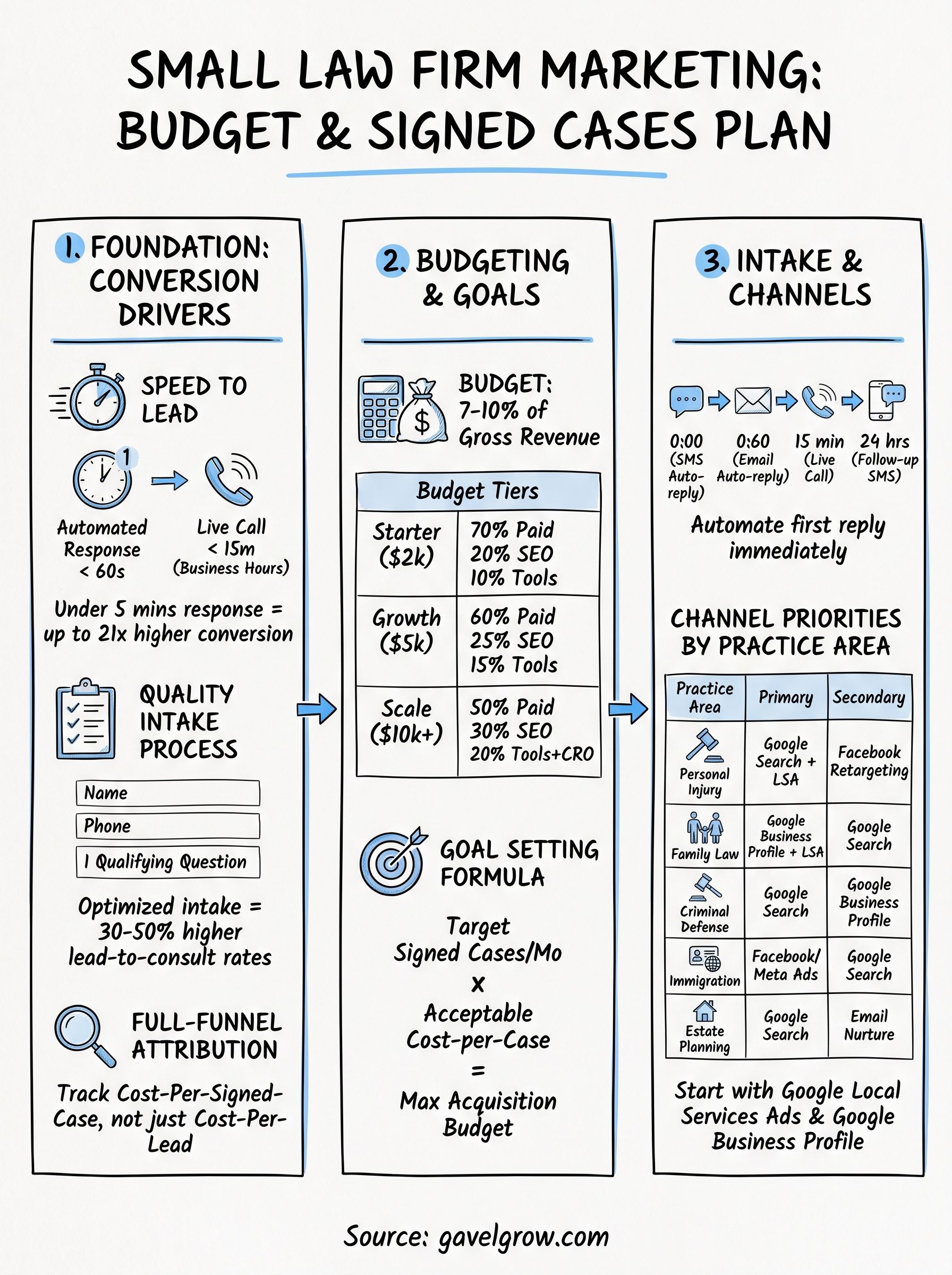
Your goal is an automated acknowledgment within 60 seconds of form submission, followed by a live or scheduled callback within 15 minutes during business hours. GavelGrow's intake automation fires both an SMS and an email to the prospect within 60 seconds of capture, so your firm stays in the conversation even when your intake coordinator is on another call.
The quality of your intake process determines close rate
A slow website form that asks for 12 fields, requires a CAPTCHA, and sends the prospect a generic "we'll be in touch" message loses cases before your attorneys ever hear a name. Multi-step, mobile-first intake forms that validate the phone number in real time, confirm TCPA consent, and trigger an instant reply perform significantly better. In GavelGrow's modelled benchmarks, firms using optimized intake forms see 30% to 50% higher lead-to-consultation rates compared to firms using basic contact forms.
Concrete changes that move the needle:
- Keep the first step to three fields: name, phone, and a single qualifying question (such as "When did the incident occur?")
- Add carrier-level phone validation to filter disconnected numbers before they hit your pipeline
- Send an SMS auto-reply that names your firm, confirms receipt, and tells the prospect when to expect a call
- Use duplicate detection to prevent the same lead from creating two separate records and confusing your intake team
Attribution shows you which channels actually sign cases
You cannot improve what you cannot measure. If your reporting stops at cost-per-lead, you are flying blind on the most important decision in your marketing budget: which channels produce signed retainers at an acceptable cost. A Google Ads campaign with a $400 CPL that closes at 20% is far more profitable than a $150 CPL campaign that closes at 4%. Without full-funnel attribution tied to your case management data, you will keep funding the wrong channels.
The fix is campaign-level tracking that follows each lead from first ad click through signed retainer. That means call tracking numbers assigned per campaign, form submissions tagged with UTM parameters, and a dashboard that shows cost-per-signed-case alongside cost-per-lead for every active channel.
Step 1. Set goals and a sustainable budget
Before you pick a single channel, you need two numbers in front of you: how many signed cases you want per month and how much you can spend to acquire each one. Without those anchors, every marketing decision becomes a guess. Start there, and the rest of your small law firm marketing plan becomes significantly easier to build and defend.
How much should a small firm spend on marketing?
The American Bar Association's 2025 TechReport found that small firms typically allocate 7% to 10% of gross revenue to marketing. For a firm generating $600,000 annually, that puts your monthly budget between $3,500 and $5,000. That range is workable, but the exact number matters less than how you split it across channels and whether you track what each dollar produces.
A practical starting point is to reserve 60% of your budget for paid acquisition (Google Ads, Local Services Ads), 25% for organic and content, and 15% for tools and intake infrastructure.
Use this budget framework as a baseline and adjust based on what your attribution data shows after 90 days:
Set a measurable goal before you commit spend
Vague goals like "get more clients" produce vague results. Instead, set a specific cost-per-signed-case target for each practice area. For personal injury, many GavelGrow firms target a cost-per-signed-case between $800 and $1,500. For family law, that number often runs $400 to $700.
Write your goal as a formula: target signed cases per month x acceptable cost-per-case = maximum monthly acquisition budget. If you want 8 new personal injury clients per month at $1,200 each, your acquisition ceiling is $9,600. That single calculation tells you exactly how much you can bid on keywords, how aggressive your ad spend can be, and when a channel is underperforming before it drains your budget.
Step 2. Build an intake system that responds fast
Your marketing budget funds the lead. Your intake system determines whether that lead becomes a signed retainer. Small law firm marketing fails far more often at the intake stage than at the advertising stage, yet most firms invest heavily in ad spend and almost nothing in the process that converts those ads into clients. Fix intake first, and every marketing dollar you spend produces a better return.
What your intake sequence should look like
Most prospects who fill out a legal intake form are also contacting two or three competing firms at the same time. Your intake sequence needs to beat your competitors to the reply and immediately establish credibility. The sequence below is the baseline that GavelGrow's intake automation fires for every new form submission:
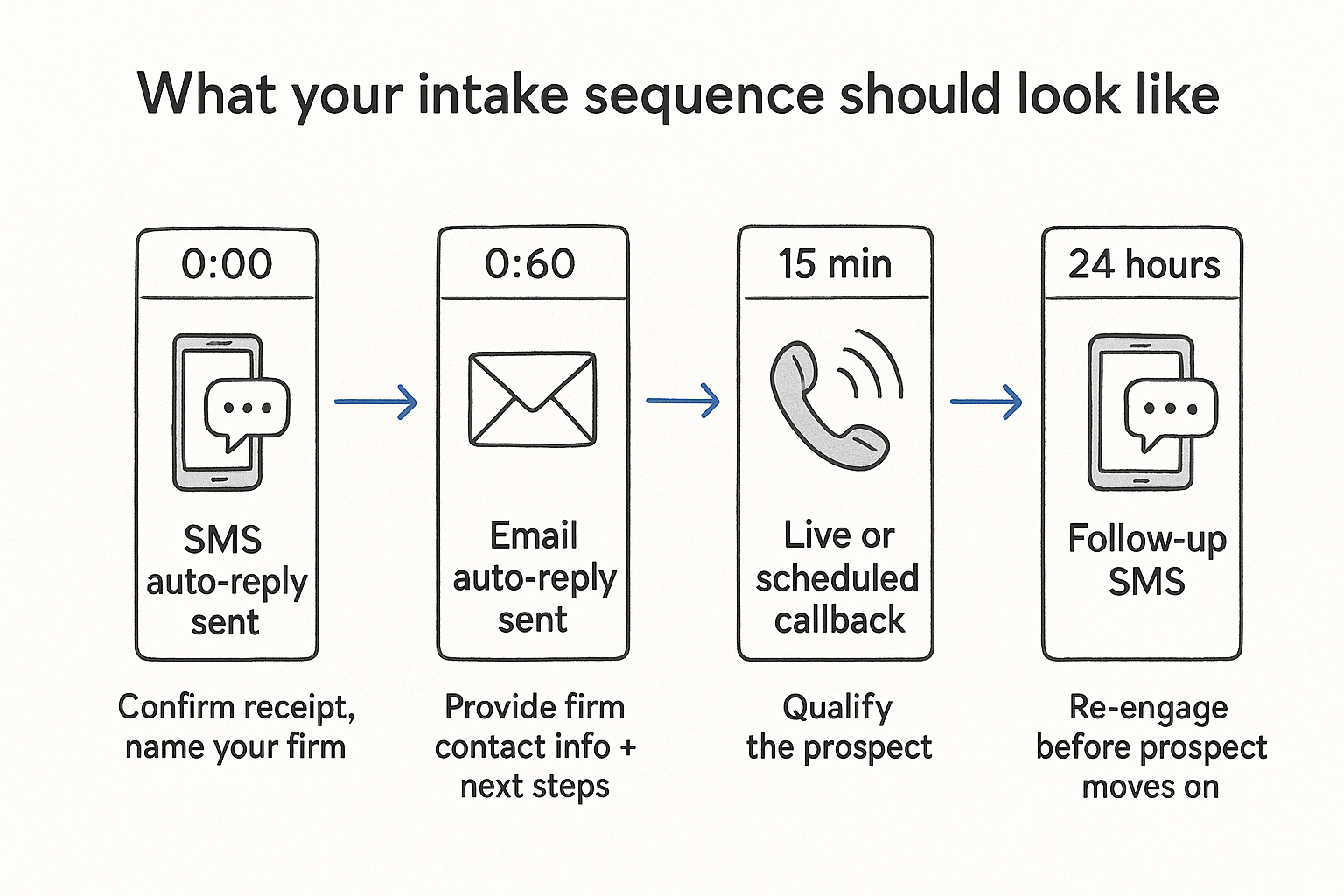
If you only make one change to your intake process, automate an SMS reply within 60 seconds of every form submission. That single step separates your firm from the majority that reply hours later or not at all.
Keep your SMS auto-reply short and direct. Here is a working template your firm can use today:
Hi [First Name], this is [Firm Name]. We received your message and
will call you within 15 minutes. If this is urgent, call us now
at [Phone Number]. Reply STOP to opt out.
How to qualify leads without slowing intake down
A common mistake is stuffing your intake form with 10 or more fields in an attempt to pre-qualify every lead before your team talks to them. That approach kills conversion rates. Instead, collect only three fields on the first step: name, phone number, and one practice-area-specific qualifying question such as "When did the incident occur?" or "Which state are you located in?" Your intake coordinator handles deeper qualification on the call, where conversion rates are significantly higher than on a form.
How do you pick channels that fit your market?
The right channel mix for your small law firm marketing plan depends on three factors: your practice area, your geographic competition level, and how quickly you need signed cases versus how much you can invest in long-term visibility. Spreading a limited budget across every available channel produces mediocre results everywhere. Concentrating spend on two or three channels that fit your specific market produces measurable results faster.
Which two channels should you start with?
For most small firms, Google Local Services Ads (LSA) and a Google Business Profile form the most cost-efficient starting point. LSA charges you only when a prospect calls or messages directly through the ad, and Google's 2024 advertiser data shows that legal LSA ads average a cost-per-lead 30% to 50% lower than standard Google Search campaigns for the same practice areas. Your Google Business Profile costs nothing beyond the time you invest in it, and it drives a significant share of local queries for practice areas like family law, criminal defense, and estate planning.
Start with LSA and a fully optimized Google Business Profile before you commit any budget to paid search or social. Both channels are intent-driven, which means the people contacting you are already looking for an attorney.
Add standard Google Search campaigns once your LSA account has 60 days of data and you can see which query types convert. That data prevents you from overbidding on keywords that attract unqualified leads.
How does practice area change your channel priorities?
Different practice areas attract clients through different channels, and ignoring that mismatch burns budget. Use this framework to match channels to what your prospects actually do when they need legal help:
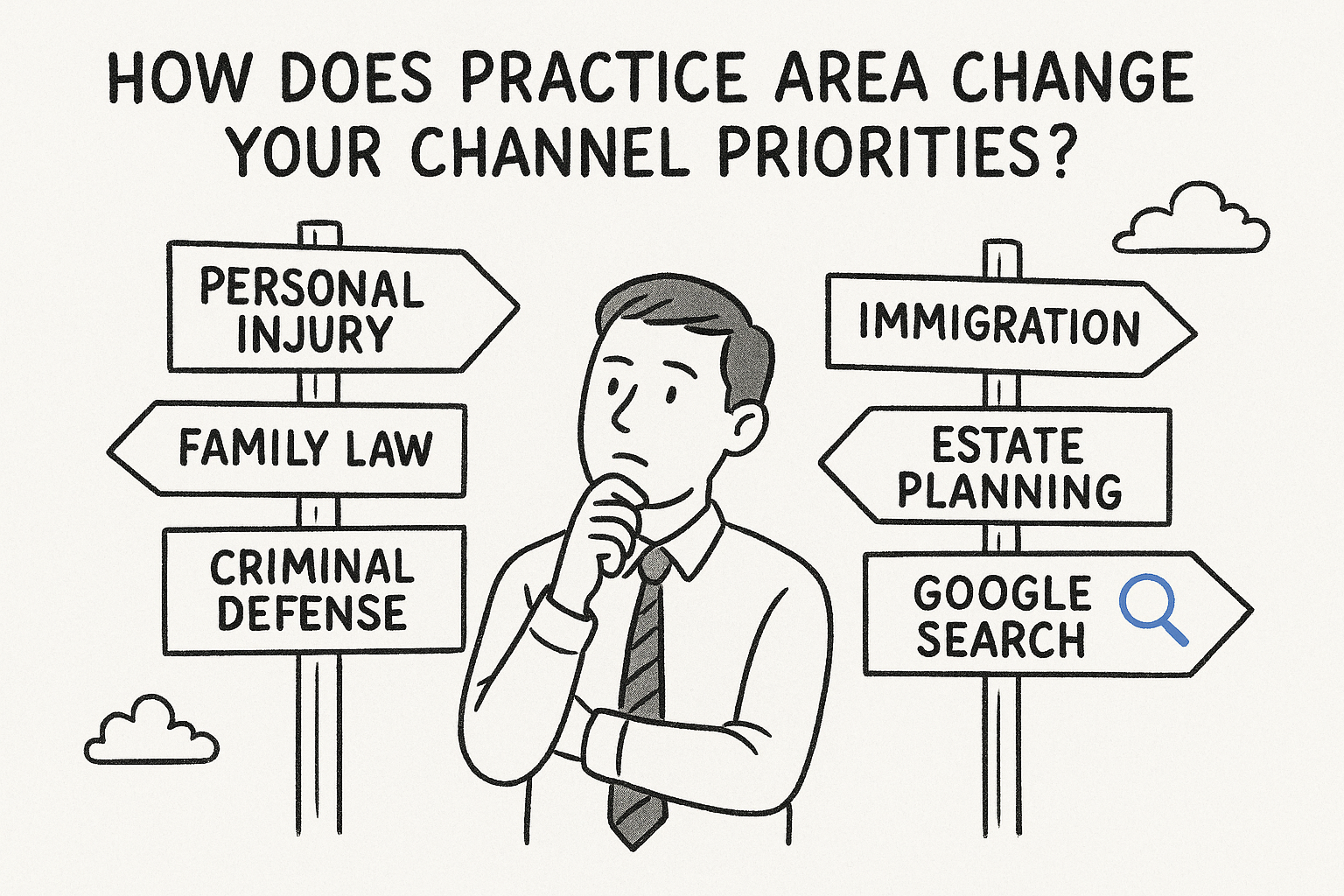
Personal injury and criminal defense clients search immediately, so paid search and LSA dominate. Immigration and estate planning clients often need more education before they contact a firm, which makes social ads and email more effective for those practice areas.
Frequently Asked Questions
This section answers the most common questions managing partners and marketing directors ask when building a small law firm marketing plan from the ground up.
How much should a small law firm spend on marketing per month?
Your firm should target 7% to 10% of gross annual revenue as your marketing budget, based on the ABA's 2025 TechReport. For a firm earning $500,000 annually, that translates to roughly $2,900 to $4,200 per month. Start at the lower end if your intake process is not yet optimized, because increasing ad spend before fixing conversion will reliably drain your budget without producing proportional results.
What is a good cost-per-signed-case benchmark for small firms?
Benchmarks vary by practice area, but GavelGrow's modelled practice-area benchmarks show personal injury firms typically target $800 to $1,500 per signed case, while family law firms often land between $400 and $700. If your cost-per-signed-case exceeds 10% of your average case revenue, revisit your intake sequence before increasing ad spend. Improving close rate almost always costs less than buying more leads.
How fast should your firm respond to a new lead?
Your firm should send an automated SMS reply within 60 seconds of every form submission and attempt a live call within 15 minutes during business hours. Research shows contacting a lead within five minutes produces conversion rates 21 times higher than waiting 30 minutes or more. Most firms lose prospective clients simply because a competitor called first, not because their legal services were inferior.
Automating your first reply costs almost nothing to set up and is the single highest-return change most small firms can make today.
Which channel works best for personal injury firms?
Google Local Services Ads combined with standard Google Search campaigns produce the strongest results for most personal injury firms. Google's 2024 advertiser data shows legal LSA campaigns average a cost-per-lead 30% to 50% lower than standard search for the same practice areas. Run LSA for 60 days before layering in search campaigns so you have real conversion data guiding your bidding decisions.
Does your firm need call tracking to measure marketing ROI?
Call tracking is not optional if you want accurate attribution across your marketing channels. Without per-campaign tracking numbers, your firm cannot determine whether signed cases came from Google Ads, LSA, organic search, or referrals. GavelGrow's built-in call tracking assigns a dedicated Twilio number to each campaign, records calls, and tags outcomes so your cost-per-signed-case reporting reflects actual results rather than estimates.
Put the plan into action
Small law firm marketing doesn't require a massive budget or a large team. It requires the right sequence: set a cost-per-signed-case goal, fix your intake before you scale ad spend, and concentrate your budget on two or three channels that match your practice area and market. Every step in this guide feeds the next. You can't improve attribution if your intake isn't capturing clean data, and you can't justify ad spend if you have no target cost-per-signed-case to measure against.
Start this week by auditing your current lead response time and intake form. Those two fixes will produce results before you change a single thing about your advertising. Once your intake runs cleanly, layer in the channel mix and budget framework from the steps above. If you want a faster path to measurable results, book a free 45-minute strategy call with GavelGrow and we'll map out exactly where your current plan is leaking cases.
Frequently Asked Questions
How much should a small law firm spend on marketing per month?
Your firm should target 7% to 10% of gross annual revenue as your marketing budget , based on the ABA's 2025 TechReport. For a firm earning $500,000 annually, that translates to roughly $2,900 to $4,200 per month. Start at the lower end if your intake process is not yet optimized, because increasing ad spend before fixing conversion will reliably drain your budget without producing proportional results.
What is a good cost-per-signed-case benchmark for small firms?
Benchmarks vary by practice area, but GavelGrow's modelled practice-area benchmarks show personal injury firms typically target $800 to $1,500 per signed case, while family law firms often land between $400 and $700. If your cost-per-signed-case exceeds 10% of your average case revenue, revisit your intake sequence before increasing ad spend. Improving close rate almost always costs less than buying more leads.
How fast should your firm respond to a new lead?
Your firm should send an automated SMS reply within 60 seconds of every form submission and attempt a live call within 15 minutes during business hours. Research shows contacting a lead within five minutes produces conversion rates 21 times higher than waiting 30 minutes or more. Most firms lose prospective clients simply because a competitor called first, not because their legal services were inferior. Automating your first reply costs almost nothing to set up and is the single highest-return change most small firms can make today.
Which channel works best for personal injury firms?
Google Local Services Ads combined with standard Google Search campaigns produce the strongest results for most personal injury firms. Google's 2024 advertiser data shows legal LSA campaigns average a cost-per-lead 30% to 50% lower than standard search for the same practice areas. Run LSA for 60 days before layering in search campaigns so you have real conversion data guiding your bidding decisions.
Does your firm need call tracking to measure marketing ROI?
Call tracking is not optional if you want accurate attribution across your marketing channels. Without per-campaign tracking numbers, your firm cannot determine whether signed cases came from Google Ads, LSA, organic search, or referrals. GavelGrow's built-in call tracking assigns a dedicated Twilio number to each campaign , records calls, and tags outcomes so your cost-per-signed-case reporting reflects actual results rather than estimates.