10 Law Firm Marketing Benchmarks for Budget and Conversion
Categories: Legal Marketing Strategies
 Abram Ninoyan
Founder & Senior Performance Marketer
Credentials: Google Partner, Google Ads Search Certified, Google Ads Display Certified, Google Ads Measurement Certified, Google Analytics (IQ) Certified, HubSpot Inbound Certified, HubSpot Social Media Marketing Certified, Conversion Optimization Certified
Expertise: Google Ads, Meta Ads, Conversion Rate Optimization, GA4 & Google Tag Manager, Lead Generation, Marketing Funnel Optimization, PPC Management
LinkedIn Profile
Most law firms spend between 7% and 15% of gross revenue on marketing, based on commonly cited industry benchmarks. But spending within that range tell...
Key Takeaways
- 10 Law Firm Marketing Benchmarks for Budget and Conversion
- 1. Cost per signed case with full-funnel attribution
- 2. Marketing budget as a percent of gross revenue
- 3. Budget mix across SEO, PPC, social, and traditional
10 Law Firm Marketing Benchmarks for Budget and Conversion
Most law firms spend between 7% and 15% of gross revenue on marketing, based on commonly cited industry benchmarks. But spending within that range tells you almost nothing unless you know what results that spend should produce. That's where law firm marketing benchmarks become essential, they give you concrete numbers to measure against, not gut feelings.
The problem is that most benchmark data floating around online mixes law firms in with dentists, HVAC companies, and e-commerce brands. A personal injury firm's cost-per-signed-case has zero relevance to a roofer's cost-per-lead. You need legal-specific numbers. Every range in this article is a modelled benchmark for U.S. law firms, covering the path from ad click through signed retainer. The same benchmark view is built into GavelGrow's platform, so firms can compare their own campaigns against it.
Below, you'll find 10 specific benchmarks covering budget allocation and conversion performance that managing partners and marketing directors can use right now. Each one includes a target range, context on where the number comes from, and guidance on what to do if you're falling short.
1. Cost per signed case with full-funnel attribution
Cost per signed case is the single most important number in legal marketing, and it's the one most firms don't actually track. Instead, they stop at cost per lead (CPL), which tells you what you paid to get a phone number but not what you paid to sign a client.
What to track and why it matters
Full-funnel attribution means connecting every dollar of ad spend to the retainers that actually get signed. You need to follow the originating campaign, channel, and keyword all the way through intake, consultation, and retainer signing.
Without this chain, you can't tell whether your Google Ads are producing cases at $800 each or $8,000 each. You'll keep funding campaigns that generate lead volume without revenue, which is the most expensive mistake a firm can make.
Benchmark ranges and what influences them
In GavelGrow's modelled benchmarks, cost per signed case varies significantly by practice area. Personal injury firms running Google Ads typically see $500 to $2,500 per signed case, while mass tort campaigns can reach $5,000 or more depending on case type and market competition. Family law and criminal defense generally land between $300 and $1,200.
If your cost per lead looks healthy but your cost per signed case is high, the problem is almost always your intake process, not your ad spend.
How to calculate it in your firm
Take your total marketing spend for a defined period and divide it by the number of cases signed that originated from marketing during that same period. The hard part is attribution: you need campaign-level tracking numbers, form submissions tied to UTM parameters, and a system that links each lead record to a closed case.
How to improve it without adding spend
Intake speed is the fastest lever available. A widely cited Lead Response Management study found that leads contacted within 5 minutes are far more likely to qualify than those contacted after 30 minutes. Tighten these three areas first:
- Send SMS auto-replies within 60 seconds of every form submission
- Replace long single-page forms with mobile-first, multi-step intake flows
- Route qualified leads directly to a dedicated intake person, not a shared inbox
Where to track it in one dashboard
GavelGrow's marketing dashboard shows campaign-level cost per signed case in a single view, pulling together ad spend, call tracking, and retainer data without requiring manual exports. This is how law firm marketing benchmarks stop being theoretical and start driving real budget decisions at your firm.
2. Marketing budget as a percent of gross revenue
Marketing budget as a percentage of gross revenue is one of the most referenced law firm marketing benchmarks, but firms almost always misapply it by measuring against gross billings instead of collected revenue, which inflates the base and distorts the ratio.
What to track and why it matters
Track your total annual marketing spend divided by total cash collected, not billed revenue. Billed revenue makes your marketing ratio look smaller than it actually is. Every dollar counted here should include agency fees, ad spend, software subscriptions, and content production costs.
Benchmark ranges and what influences them
Commonly cited industry benchmarks put most firm budgets at 7% to 15% of gross revenue. Higher-competition practice areas like personal injury and mass torts typically run 10% to 20% because paid acquisition costs are steeper and case values justify the investment. Estate planning and business law firms often spend closer to 5% to 8%.
Practice area competition drives your budget percentage more than firm size does.
How to calculate it in your firm
Divide your total marketing spend by total collected revenue from the same calendar year. Multiply by 100 for your percentage. Run this quarterly, not annually, so you catch budget drift before it compounds.
How to improve it without adding spend
Before raising your budget, eliminate waste in existing channels. Pause campaigns with zero signed cases attached. Reallocating even 15% of an underperforming channel budget to your top-converting source can improve your ratio without increasing total spend.
Where to track it in one dashboard
GavelGrow connects your ad spend and retainer revenue in one view, so your marketing-to-revenue ratio updates automatically rather than waiting for a quarterly spreadsheet.
3. Budget mix across SEO, PPC, social, and traditional
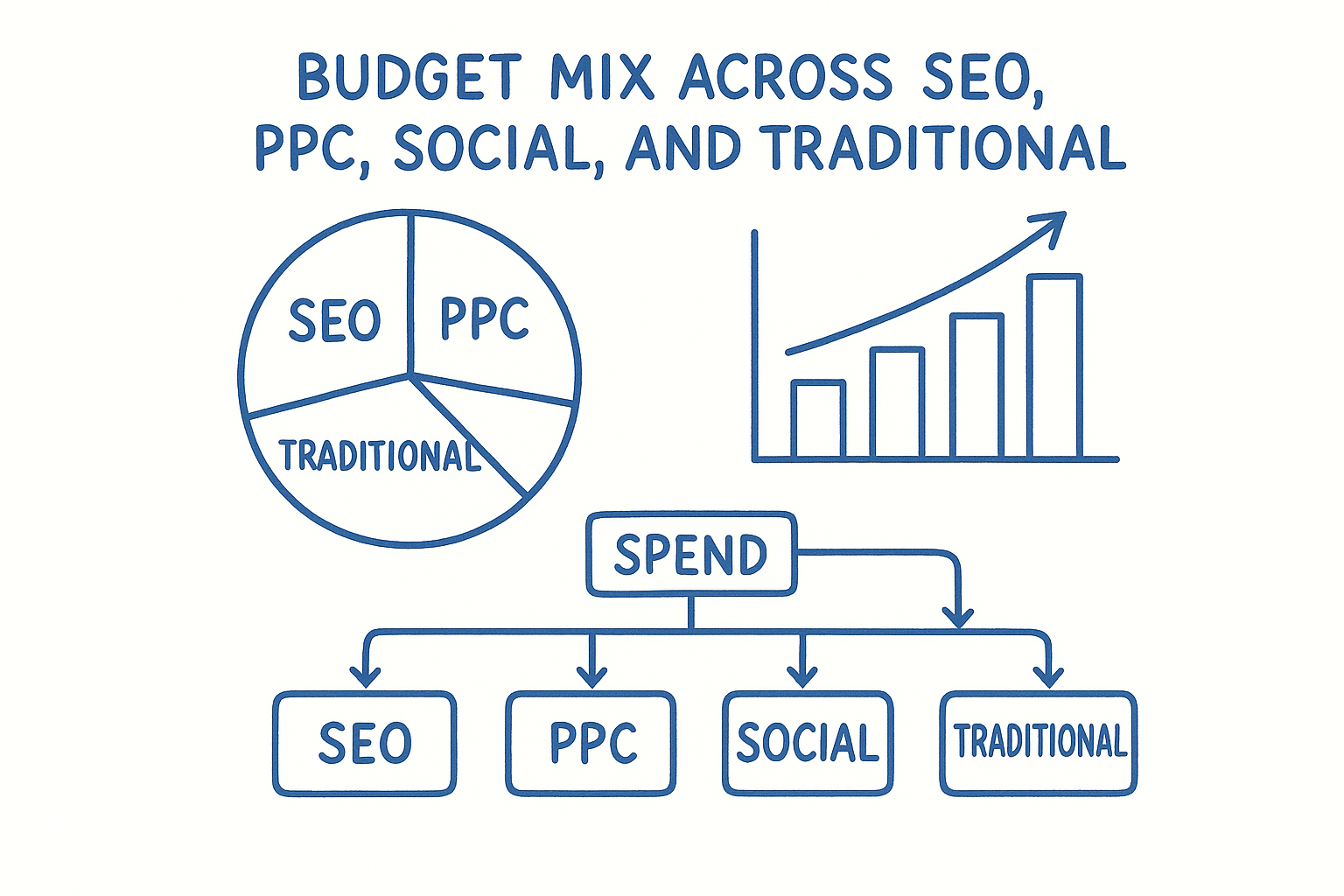
Knowing your total marketing spend as a percentage of revenue is a starting point, but it won't tell you whether you're allocating that budget across channels in a way that actually produces signed cases. The split between SEO, paid search, social, and traditional advertising is one of the more instructive law firm marketing benchmarks to review each quarter.
What to track and why it matters
Track your spend per channel as a percentage of total marketing budget, then map each channel to its share of signed cases. A firm pouring 60% of its budget into TV ads that close zero attributed cases is over-invested in one channel regardless of what the raw spend looks like.
Benchmark ranges and what influences them
In practice, most plaintiff-side firms allocate 40% to 60% of their budget to paid search (Google Ads and Local Services Ads), 20% to 30% to SEO and content, and the remainder split across social and traditional. Defense and transactional firms skew harder toward SEO and referral programs because their clients research rather than click ads in crisis moments.
Practice area purchase behavior, not firm preference, should drive your channel split.
How to calculate it in your firm
Pull your total spend per channel for the last 12 months and divide each by your total marketing budget. Compare those percentages against channel-level signed case counts to see which channels carry their weight.
How to improve it without adding spend
Shift budget from channels with high CPL and low close rates to channels with proven retainer conversions, even if the lead volume is lower.
Where to track it in one dashboard
GavelGrow's marketing dashboard breaks down spend and signed cases by channel, so you can reallocate budget based on actual retainer data rather than estimated attribution.
4. Speed to lead and lead follow-up coverage
Speed to lead measures how fast your firm responds after a prospect submits a form or leaves a voicemail. It is one of the highest-leverage law firm marketing benchmarks you can track because it directly controls how many of your paid leads actually convert, regardless of which channel generated them.
What to track and why it matters
Track two separate numbers: your median first-response time (in minutes) and your follow-up coverage rate, meaning the percentage of inbound leads that receive at least three contact attempts before being marked unresponsive. Both numbers matter. A fast first response with no follow-up still loses cases.
Benchmark ranges and what influences them
A widely cited Lead Response Management study found that leads contacted within 5 minutes are up to 21 times more likely to qualify than leads contacted after 30 minutes. In modelled benchmarks, top-performing intake teams respond within a few minutes during business hours using automated SMS sequences, while firms relying on manual follow-up typically take dramatically longer.
Your first-response time is a multiplier on every dollar you spend acquiring leads. Fix it before you raise your ad budget.
How to calculate it in your firm
Pull your lead creation timestamps and first outbound contact timestamps from your CRM or intake system. Subtract to get response time per lead, then calculate the median across all leads for the period.
How to improve it without adding spend
Deploy an automated SMS reply that fires within 60 seconds of every form submission. This single change holds the lead engaged while your intake team queues up a live call.
Where to track it in one dashboard
GavelGrow's intake automation fires SMS and email sequences within 60 seconds of lead capture and logs every outbound contact attempt, so you can see your median response time and follow-up coverage rate without digging through multiple tools.
5. Inbound call conversion rate and missed call rate
Phone calls remain the highest-intent contact method for most practice areas, which makes your inbound call conversion rate and missed call rate two of the most actionable law firm marketing benchmarks you can monitor each month.
What to track and why it matters
Track the percentage of inbound calls that result in a qualified lead or booked consultation, and separately track the percentage of calls your firm never answers. These two numbers together reveal whether your ad spend is generating real opportunities or simply ringing a phone nobody picks up.
Benchmark ranges and what influences them
In GavelGrow's modelled benchmarks, well-performing firms convert 50% to 65% of qualified inbound calls into a next step, whether that is a booked consult or a form completion. Missed call rates above 15% are a warning sign, particularly for personal injury and criminal defense practices where callers move on to the next firm within minutes.
A missed call from a paid search campaign is not a saved cost. It is a paid lead you already spent money to generate.
How to calculate it in your firm
Divide your total qualified calls by total inbound calls to get your conversion rate. Divide unanswered calls by total inbound calls to get your missed call rate. Both calculations require call outcome tagging at the individual call level.
How to improve it without adding spend
Add after-hours call routing to a live answering service so calls outside business hours reach a real person rather than voicemail.
Where to track it in one dashboard
GavelGrow's built-in call tracking assigns per-campaign tracking numbers, records every call, and logs outcome tags so your missed call rate surfaces automatically without a separate tool.
6. Intake form conversion rate and completion rate
Your intake form is often the first direct interaction a prospect has with your firm after clicking an ad. How many visitors start it, how many finish it, and how many become qualified leads are among the most telling law firm marketing benchmarks you can monitor each month.

What to track and why it matters
Track two separate numbers: form start rate (the percentage of page visitors who begin the form) and form completion rate (the percentage who submit it). A high start rate paired with a low completion rate points to friction inside the form itself, not a traffic or targeting problem.
Benchmark ranges and what influences them
Well-optimized legal intake forms on mobile devices achieve completion rates of 35% to 55%. Generic single-page contact forms typically convert at 1% to 3%. Multi-step, mobile-first forms consistently outperform single-step forms because they reduce perceived effort at each stage by breaking questions into smaller chunks.
If your form completion rate sits below 20%, your form design is losing cases before intake even begins.
How to calculate it in your firm
Divide total form submissions by total form views for your measurement period. Track a form-start event and a form-submit event as two distinct conversions in your analytics platform so you capture both numbers separately.
How to improve it without adding spend
Cut your form to three to five fields on the first step. Collect name, phone number, and case type before asking for any detailed information. Each additional required field drops completion rates measurably, especially on mobile.
Where to track it in one dashboard
GavelGrow's hosted intake forms fire GA4 and Meta Pixel conversion events on every submission automatically, so your completion rate data stays current without manual tracking configuration.
7. Consult booked rate and consult show-up rate
Getting a prospect on the phone is progress. Turning that call into a booked consultation, and then having that prospect actually show up, determines whether your intake process produces signed retainers or just scheduled appointments that evaporate. Both numbers belong in any serious review of law firm marketing benchmarks.
What to track and why it matters
Track the percentage of qualified leads that book a consultation and separately track the percentage of booked consultations where the prospect actually attends. A high book rate paired with a low show-up rate means your intake team is filling calendars with people who aren't committed, which wastes attorney time and makes your conversion funnel look worse than your marketing actually performs.
Benchmark ranges and what influences them
In GavelGrow's modelled benchmarks, top-performing firms book consultations from 55% to 70% of qualified leads. Show-up rates for those booked consultations average 65% to 80% when firms send automated reminders 24 hours and 1 hour before the appointment. Firms without reminders see show-up rates fall closer to 45%.
Your consult show-up rate is a direct function of how consistently your firm communicates between booking and appointment time.
How to calculate it in your firm
Divide booked consultations by total qualified leads to get your book rate. Divide attended consultations by total booked consultations to get your show-up rate. Both calculations require consistent outcome tagging in your CRM or intake system so you capture whether each scheduled consultation was attended, cancelled, or a no-show.
How to improve it without adding spend
Send automated SMS and email reminders 24 hours and 1 hour before every scheduled consultation. This single workflow change consistently lifts show-up rates by 15 to 25 percentage points without adding headcount.
Where to track it in one dashboard
GavelGrow's task and calendar system logs every scheduled consultation, fires automated reminders via SMS and email, and records attendance outcomes so your book rate and show-up rate update without manual data entry across separate tools.
8. Lead to first payment timeline and sales cycle length
The gap between a prospect's first contact and their first payment is one of the more undertracked law firm marketing benchmarks, yet it directly affects cash flow forecasting and how you allocate budget across channels with very different cycle lengths.
What to track and why it matters
Track two numbers: days from lead creation to signed retainer and days from signed retainer to first payment collected. Together they reveal where prospects stall, whether in the consultation phase or the agreement and billing phase.
Knowing your average cycle length also helps you forecast revenue more accurately from any given month's lead volume instead of guessing.
Benchmark ranges and what influences them
Personal injury firms typically see sales cycles of 14 to 45 days from first contact to signed retainer, while family law and estate planning firms often run 30 to 90 days. Criminal defense cases frequently close within 48 to 72 hours because urgency compresses the timeline significantly.
Practice area urgency, not marketing channel, is the primary driver of your sales cycle length.
How to calculate it in your firm
Pull lead creation dates and retainer-signed dates from your CRM for a rolling 90-day period. Calculate the median number of days between the two events because outlier cases with unusually long delays skew a straight average.
How to improve it without adding spend
Send retainer agreements immediately after a consult using e-signature tools rather than waiting until the next business day. This single change removes 24 to 48 hours of unnecessary delay from your cycle.
Where to track it in one dashboard
GavelGrow's case management module links originating lead records to signed retainer dates automatically, so your sales cycle length updates in real time without manual reporting.
Frequently asked questions
These law firm marketing benchmarks questions come up most often when managing partners review their numbers against peers. The answers below give you specific figures and named sources so you can act on them directly.
What is a good marketing budget for a small law firm?
Most small firms should target 7% to 10% of collected revenue as a starting point. In higher-competition practice areas like personal injury, firms typically require 10% to 15% to stay competitive in paid search markets.
What benchmarks matter most for personal injury marketing?
Cost per signed case and speed-to-lead are the two most critical numbers for PI firms. Personal injury leads move fast, and responding within 5 minutes dramatically increases your close rate compared to firms that call back hours later.
What is a good conversion rate for law firm leads?
A well-run intake process converts 30% to 50% of qualified leads into signed retainers. If your rate falls below 25%, the problem typically sits in your follow-up coverage or show-up rate, not your lead quality.
Fix your intake process before you increase your ad budget.
How fast should your firm respond to a new lead?
Your firm should respond within 5 minutes of every inbound lead. Lead-response research consistently shows contact rates drop sharply after that window. Automated SMS replies let you hit that threshold around the clock without adding staff.
What is a good cost per lead for legal PPC?
Google Ads CPL for legal keywords ranges from $50 to $300 per lead depending on practice area and market. Personal injury in major metros consistently lands at the higher end due to advertiser competition.
How do you track which channel produced a signed retainer?
You need campaign-level tracking numbers and UTM-tagged form submissions tied to a CRM that links each lead to a closed case. GavelGrow's platform connects ad spend directly to signed retainers across every channel in one dashboard without manual exports.
Next Steps
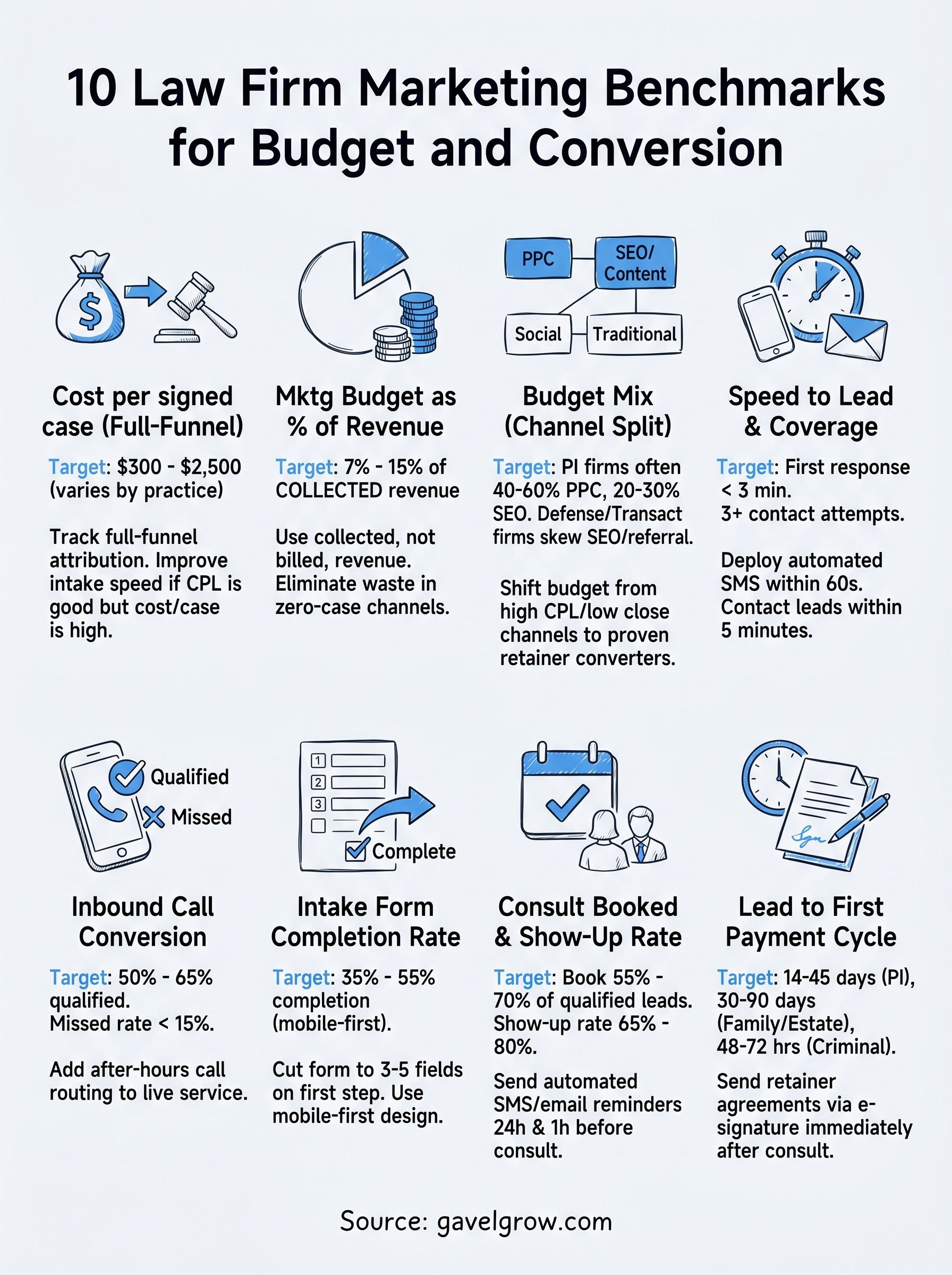
You now have eight law firm marketing benchmarks with specific target ranges, calculation methods, and improvement tactics you can apply without increasing your budget. The gap between firms that grow their caseload and those that plateau almost always comes down to which numbers they actually track, not how much they spend.
Start by picking the two or three benchmarks where your firm is furthest from the target ranges in this article. Fix your speed-to-lead and intake form completion rate first since both directly multiply the return on ad spend you are already committed to. Then build toward full-funnel attribution so every campaign you run ties back to signed retainers rather than leads alone.
If you want to see how your firm stacks up against these benchmark ranges, run your free law firm marketing scorecard and get a custom breakdown of where your biggest gaps are.
Frequently Asked Questions
What is a good marketing budget for a small law firm?
Most small firms should target 7% to 10% of collected revenue as a starting point. In higher-competition practice areas like personal injury, firms typically require 10% to 15% to stay competitive in paid search markets.
What benchmarks matter most for personal injury marketing?
Cost per signed case and speed-to-lead are the two most critical numbers for PI firms. Personal injury leads move fast, and responding within 5 minutes dramatically increases your close rate compared to firms that call back hours later.
What is a good conversion rate for law firm leads?
A well-run intake process converts 30% to 50% of qualified leads into signed retainers. If your rate falls below 25%, the problem typically sits in your follow-up coverage or show-up rate , not your lead quality. Fix your intake process before you increase your ad budget.
How fast should your firm respond to a new lead?
Your firm should respond within 5 minutes of every inbound lead. Lead-response research consistently shows contact rates drop sharply after that window. Automated SMS replies let you hit that threshold around the clock without adding staff.
What is a good cost per lead for legal PPC?
Google Ads CPL for legal keywords ranges from $50 to $300 per lead depending on practice area and market. Personal injury in major metros consistently lands at the higher end due to advertiser competition.
How do you track which channel produced a signed retainer?
You need campaign-level tracking numbers and UTM-tagged form submissions tied to a CRM that links each lead to a closed case. GavelGrow's platform connects ad spend directly to signed retainers across every channel in one dashboard without manual exports.