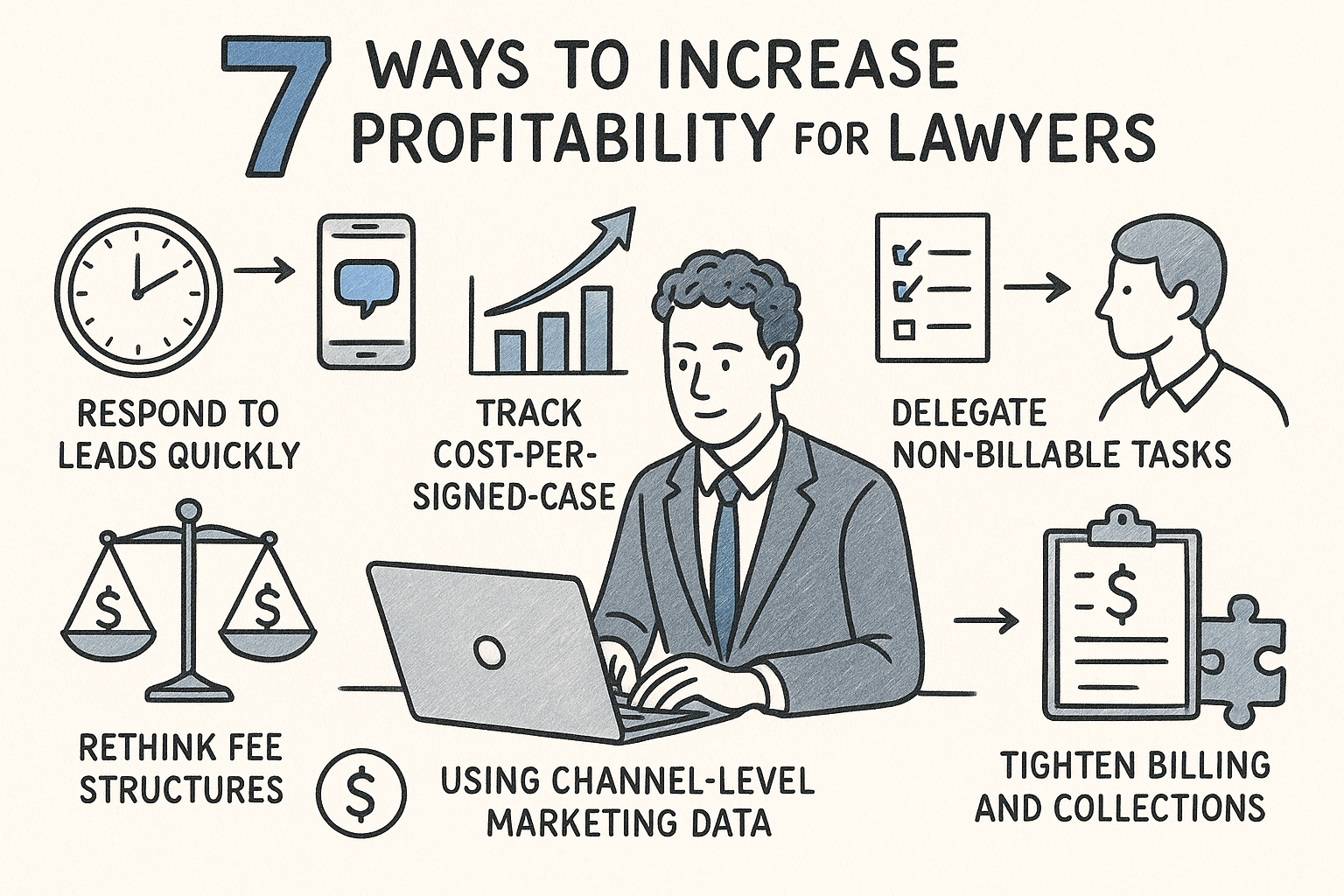
7 Ways to Increase Profitability for Lawyers
Categories: Legal Marketing Strategies
 Abram Ninoyan
Founder & Senior Performance Marketer
Credentials: Google Partner, Google Ads Search Certified, Google Ads Display Certified, Google Ads Measurement Certified, Google Analytics (IQ) Certified, HubSpot Inbound Certified, HubSpot Social Media Marketing Certified, Conversion Optimization Certified
Expertise: Google Ads, Meta Ads, Conversion Rate Optimization, GA4 & Google Tag Manager, Lead Generation, Marketing Funnel Optimization, PPC Management
LinkedIn Profile
Your firm can bring in $2 million a year in revenue and still barely turn a profit if your cost per signed case keeps climbing. That's the trap most managing partners fall into: they chase more leads...
Key Takeaways
- 7 Ways to Increase Profitability for Lawyers
- 1. Speed up lead response and automate client intake
- 2. Track the profitability metrics that actually matter
- 3. Rethink your pricing and fee structures
7 Ways to Increase Profitability for Lawyers
Your firm can bring in $2 million a year in revenue and still barely turn a profit if your cost per signed case keeps climbing. That's the trap most managing partners fall into: they chase more leads instead of fixing the leaks that quietly drain margin. If you're searching for ways to increase profitability lawyers actually rely on, the answer isn't a bigger ad budget. It's tighter control over intake speed, case selection, and where every marketing dollar ends up.
Profitability comes down to a simple ratio: what you spend to sign a case versus what that case is worth. The fastest gains usually come from fixing intake bottlenecks and cutting spend on channels that generate leads but not retainers, not from adding new services or hiring more staff.
This article walks through seven concrete moves, from speed-to-lead fixes to renegotiating vendor contracts, that firms in personal injury, family law, and mass torts have used to lower cost-per-signed-case. Each one includes the metric to track and a benchmark comparison so you know whether your numbers are actually competitive or just look fine on paper.
1. Speed up lead response and automate client intake
Most firms lose signed cases before an attorney ever sees the lead. A prospect fills out a contact form, waits four hours for a callback, and by then has already talked to two other firms. Speed-to-lead isn't a nice-to-have metric, it's the difference between a signed retainer and a wasted ad dollar.
How it works
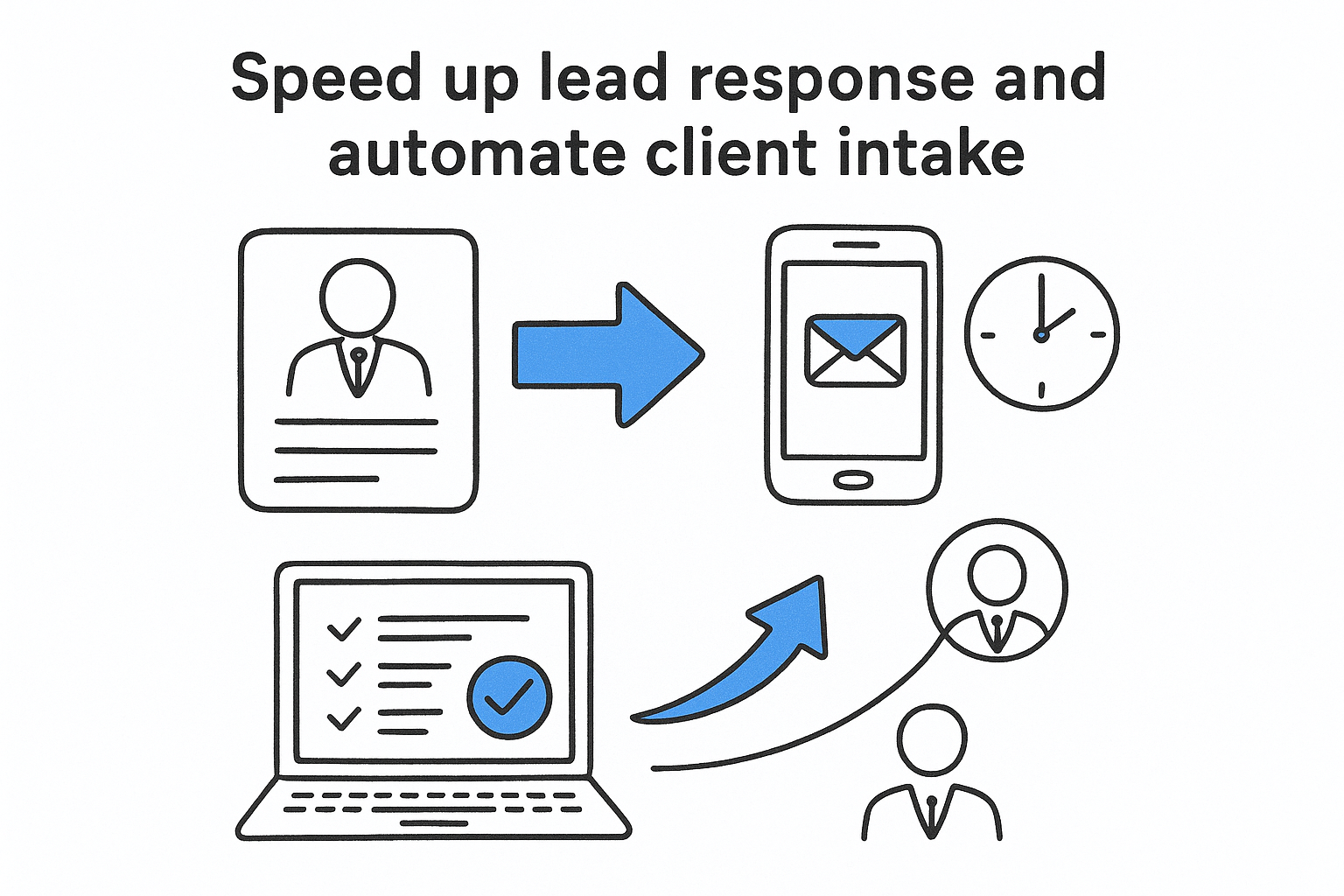
The fix is mechanical, not motivational: remove the human delay between lead capture and first contact. That means auto-replies firing within 60 seconds by SMS and email, mobile-first intake forms that don't ask for 15 fields before submitting, and carrier-level phone validation so your team isn't chasing dead numbers. The Lead Response Management Study found that leads contacted within five minutes were 21 times more likely to qualify than those first reached at 30 minutes. Manual intake processes almost never hit that window consistently, especially outside business hours or on weekends when a big share of personal injury and family law inquiries come in.
Every hour you wait to respond to a lead is an hour a competitor has to sign your client instead.
This is where intake automation does the heavy lifting. GavelGrow's platform fires SMS (once US carriers approve your number) and email sequences within minutes of lead capture, logs TCPA consent automatically, and flags duplicate submissions within 10 minutes so your staff isn't wasting time on the same lead twice.
Who it's for
This matters most for practice areas with short decision windows: personal injury, DUI/DWI, and criminal defense clients often call three or four firms in the same afternoon. Solo practitioners and small firms without a dedicated intake coordinator benefit the most, since automation replaces work a $45,000-a-year employee would otherwise do manually and inconsistently.
Impact on profitability
Faster response doesn't just add signed cases, it lowers your cost-per-signed-case on the exact same ad spend, because you stop paying for leads that convert nowhere. Firms that move from a same-day response standard to a sub-5-minute standard typically see conversion rate jumps of 20-30% without spending another dollar on ads. That's pure margin, not top-line growth funded by higher acquisition costs.
2. Track the profitability metrics that actually matter
Most firms track leads and revenue but skip the number that actually predicts profit: cost-per-signed-case. A campaign can generate 200 cheap leads and still lose money if only three turn into retainers. Tracking cost-per-lead alone hides that math completely.
How it works
You need full-funnel visibility from ad click to signed retainer, not just a CRM report showing raw lead counts. GavelGrow's marketing dashboard attaches cost-per-signed-case to every campaign, and its modelled practice-area benchmarks show whether your number is competitive for your practice area and market size, not just whether it went down from last quarter.
If you're only measuring cost-per-lead, you're optimizing for the wrong outcome.
Who it's for
Firms running multiple campaigns across Google Ads, referrals, and organic search need this most, especially mass tort and personal injury shops where a single bad channel can burn six figures before anyone notices.
Impact on profitability
Once you isolate which channels actually produce signed cases, you can cut the ones that don't and reallocate spend, often improving margin by double digits without increasing your marketing budget at all.
3. Rethink your pricing and fee structures
Pure hourly billing punishes efficiency. The faster and better you get at a case type, the less you earn per matter, which is backwards for any firm trying to grow margin instead of just headcount. Fee structure is one of the few profitability levers you control entirely in-house, with no ad spend or vendor involved.
How it works
Start by auditing which matters are profitable under your current model and which ones you're subsidizing. Flat fees work well for predictable matters like uncontested divorces, simple estate plans, or standard immigration filings, since you capture the upside when you finish faster than expected. Contingency cases need a hard look at case-value thresholds, because signing every personal injury lead regardless of severity quietly drags down your average recovery per case. Hybrid models, a reduced hourly rate plus a success fee, work well in business and employment law where outcomes are harder to predict.
A firm that signs fewer, better-fit cases at the right fee structure almost always out-earns one that signs everything that walks in the door.
Who it's for
This applies hardest to contingency-fee practices: personal injury, mass torts, and workers' comp firms where case selection discipline directly determines annual revenue per attorney.
Impact on profitability
Tightening case-acceptance criteria and matching fee models to matter type typically raises average case value 10-15% without adding a single new client, since the firm stops spending intake and attorney hours on low-yield matters.
4. Delegate non-billable work to the right people
Every hour a partner spends on scheduling, data entry, or chasing a signature is an hour not spent on billable work or case strategy. Attorney hours are the most expensive resource in the building, and most firms waste a shocking share of them on tasks a paralegal, intake coordinator, or piece of software could handle just as well.
How it works
Start by auditing a two-week calendar for every partner and senior associate, then flag anything that isn't legal analysis, client counsel, or court appearance. Common candidates for reassignment include:
- Calendar and court-date management
- Client intake and initial screening calls
- Document collection and file organization
- Basic status updates to clients
- Invoice generation and follow-up
GavelGrow's platform automates several of these directly, syncing court dates to calendars, sending status updates through the unified inbox, and flagging attorney capacity so reassignment decisions aren't guesswork.
If a task doesn't require a law degree, it shouldn't sit on a lawyer's desk.
Who it's for
This hits hardest at mid-size firms with 5-15 attorneys, where partners still handle intake and administrative work out of habit from the firm's early years, long after headcount justified hiring support staff.
Impact on profitability
Reassigning even 5 non-billable hours per week per attorney to lower-cost staff or automation can free up capacity worth tens of thousands of dollars annually in recovered billable time, without hiring a single new lawyer.
5. Lower client acquisition costs with data-driven marketing
Marketing spend without channel-level data is a guessing game, and guessing games are expensive when a single Google Ads click in personal injury can run $150 or more. Client acquisition cost only drops when you know which channels produce signed cases, not just clicks or form fills.

How it works
Start by pulling cost-per-signed-case for every channel separately: paid search, Local Services Ads, referrals, and organic. GavelGrow's platform syncs daily with Google Ads and fires conversion events (GA4, Meta Pixel, GTM) so spend and signed-case data live in the same dashboard instead of three disconnected spreadsheets.
You can't fix acquisition cost until you can see it broken down by channel, not just by campaign name.
Who it's for
Firms spending $10,000 or more monthly across multiple platforms need this most, especially those running both paid search and referral programs without a shared reporting layer.
Impact on profitability
Reallocating spend away from underperforming channels toward the ones actually producing retainers routinely cuts blended acquisition cost by 15-25%, freeing that budget to scale the channels already working.
6. Tighten billing and collections to protect cash flow
A firm can bill flawlessly and still run into cash-flow trouble if invoices sit unpaid for 90 days. Realization rate, the gap between what you bill and what you actually collect, quietly erodes profit at firms that never look past total revenue on the P&L.
How it works
Start by measuring three numbers separately: hours worked, hours billed, and dollars collected. A wide gap between billed and collected points to a collections process, not a rate, problem. Tighten it with a few concrete moves:
- Send invoices within 48 hours of work completion, not at month-end
- Require a retainer or deposit before opening contingency-adjacent matters
- Automate payment reminders instead of relying on staff to remember
- Offer card and ACH payment options directly on the invoice
Revenue you've billed but never collected isn't profit, it's an unpaid invoice pretending to be an asset.
Many practice management tools, including Clio and MyCase, already support automated reminders and online payment links, so this rarely requires new software, just enforcement.
Who it's for
This matters most for hourly-billing practices: business law, family law, and estate planning firms where slow-paying clients are common and there's no contingency payout to fall back on.
Impact on profitability
Moving realization rate from a typical 80% up to 90% or higher can add tens of thousands of dollars in annual collected revenue without billing a single additional hour, and it shortens the cash conversion cycle enough to fund growth without a line of credit.
7. Cut overhead with legal-specific technology
Many firms pay for CallRail, Clio Grow, and AgencyAnalytics separately, plus a handful of spreadsheets stitching the data together. That's three to five vendor invoices, three logins, and zero unified view of what any campaign actually cost you per signed case. Overhead isn't just rent and payroll, it's software sprawl that nobody audits.
How it works
Start by listing every tool touching marketing, intake, or case tracking, then check for overlap. Call tracking, lead pipeline, intake forms, and calendar sync often live in four different platforms billing separately when a legal-specific system can run all four. GavelGrow's platform consolidates call tracking, intake automation, case management, and benchmarking into one subscription starting at $199 a month, replacing tools that individually can cost more than that combined.
Paying for five disconnected tools to do one connected job is overhead disguised as infrastructure.
Who it's for
This hits solo practitioners and small firms hardest, since vendor sprawl eats a much bigger share of a smaller budget. Firms already juggling three or more point solutions for intake and tracking are the clearest candidates for consolidation.
Impact on profitability
Consolidating onto one legal-built platform typically cuts software spend by 20-40% while adding attribution data those separate tools never shared. Check the pricing page to compare tiers against what you're currently paying across separate vendors.
Bringing these strategies together
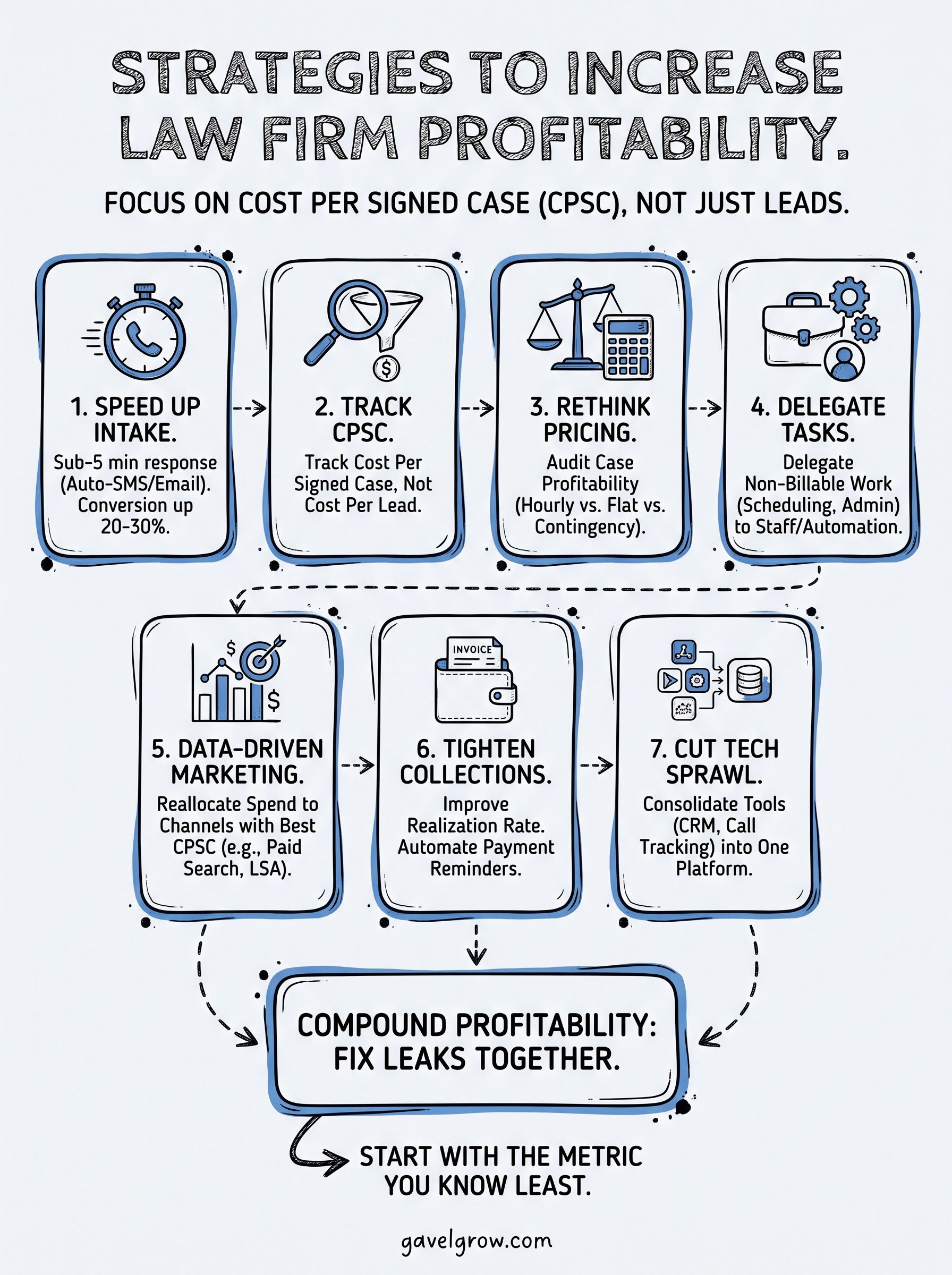
None of these seven moves work in isolation. Faster intake means nothing if you're still spending on channels that don't convert, and a cleaner fee structure won't save a firm bleeding cash through slow collections. Profitability compounds when you fix the leaks together: tighter intake feeds better data, better data sharpens acquisition spend, and lower overhead protects whatever margin you just recovered.
Start with the metric you're least confident in right now. If you don't know your true cost-per-signed-case by channel, that's the first gap to close, not the last. Most firms find that one or two of these fixes account for the bulk of their margin loss once they actually measure it instead of guessing.
You don't have to rebuild your whole marketing stack to see the impact. Book a free 45-minute strategy call and walk through your numbers with someone who's done this for 500+ law firms since 2015.
Frequently Asked Questions
How do law firms increase profitability?
Profitability rises when you lower the cost of acquiring each case and raise the value of the work you keep. The highest-leverage moves are speeding up lead response and intake so you sign more of the leads you already pay for, tracking cost per signed case, rethinking pricing, delegating non-billable work, and cutting wasted marketing spend. Revenue growth alone does not help if your cost per case keeps climbing.
What is a good profit margin for a law firm?
It varies widely by practice area, firm size, and structure, so there is no single benchmark. What matters more than a target percentage is the trend — whether your margin improves as you grow. Many firms grow revenue while margin shrinks because cost per signed case and overhead rise faster than fees, which is why tracking profitability per matter beats chasing a headline margin number.
Why is my law firm not profitable despite high revenue?
Usually because cost per signed case and overhead are climbing as fast as, or faster than, revenue. A firm can bill millions and barely profit if it overspends to acquire cases, loses leads to slow intake, underprices its work, or has partners doing work a paralegal could handle. Profitability is about the gap between what a case costs to win and what it is worth — not top-line revenue.
What metrics should lawyers track to improve profitability?
The ones tied to margin, not vanity: cost per lead, lead-to-signed-case conversion, cost per signed case by channel, realization and collection rates, revenue per matter, and non-billable time. Cost per signed case is the single most revealing number, because it ties your marketing spend directly to the cases that actually pay — and most firms have never calculated it precisely.
How does lead response time affect law firm profitability?
Directly. You have already paid to generate a lead, so every one that goes cold from slow follow-up is wasted acquisition cost. Prospects contact multiple firms and tend to hire whoever responds first, so answering in minutes rather than hours raises your conversion rate — which lowers your effective cost per signed case without spending another dollar on marketing.
Should a law firm cut marketing to increase profitability?
Rarely — the fix is usually to spend smarter, not less. Cutting marketing blindly can starve your pipeline; the profitable move is to measure cost per signed case by channel and shift budget toward what produces cases while cutting what does not. A firm that can see which campaigns are profitable can often raise both case volume and margin at the same time.
How can a small firm improve profitability without hiring?
Fix process before adding headcount: automate intake and follow-up so no paid-for lead is lost, delegate non-billable tasks to existing staff or software, tighten pricing, and cut marketing waste using real cost-per-case data. Most small firms can lift margin meaningfully by converting more of their current leads and reclaiming billable hours, long before they need to hire.
Frequently Asked Questions
How do law firms increase profitability?
Profitability rises when you lower the cost of acquiring each case and raise the value of the work you keep. The highest-leverage moves are speeding up lead response and intake so you sign more of the leads you already pay for, tracking cost per signed case, rethinking pricing, delegating non-billable work, and cutting wasted marketing spend. Revenue growth alone does not help if your cost per case keeps climbing.
What is a good profit margin for a law firm?
It varies widely by practice area, firm size, and structure, so there is no single benchmark. What matters more than a target percentage is the trend — whether your margin improves as you grow. Many firms grow revenue while margin shrinks because cost per signed case and overhead rise faster than fees, which is why tracking profitability per matter beats chasing a headline margin number.
Why is my law firm not profitable despite high revenue?
Usually because cost per signed case and overhead are climbing as fast as, or faster than, revenue. A firm can bill millions and barely profit if it overspends to acquire cases, loses leads to slow intake, underprices its work, or has partners doing work a paralegal could handle. Profitability is about the gap between what a case costs to win and what it is worth — not top-line revenue.
What metrics should lawyers track to improve profitability?
The ones tied to margin, not vanity: cost per lead, lead-to-signed-case conversion, cost per signed case by channel, realization and collection rates, revenue per matter, and non-billable time. Cost per signed case is the single most revealing number, because it ties your marketing spend directly to the cases that actually pay — and most firms have never calculated it precisely.
How does lead response time affect law firm profitability?
Directly. You have already paid to generate a lead, so every one that goes cold from slow follow-up is wasted acquisition cost. Prospects contact multiple firms and tend to hire whoever responds first, so answering in minutes rather than hours raises your conversion rate — which lowers your effective cost per signed case without spending another dollar on marketing.
Should a law firm cut marketing to increase profitability?
Rarely — the fix is usually to spend smarter, not less. Cutting marketing blindly can starve your pipeline; the profitable move is to measure cost per signed case by channel and shift budget toward what produces cases while cutting what does not. A firm that can see which campaigns are profitable can often raise both case volume and margin at the same time.
How can a small firm improve profitability without hiring?
Fix process before adding headcount: automate intake and follow-up so no paid-for lead is lost, delegate non-billable tasks to existing staff or software, tighten pricing, and cut marketing waste using real cost-per-case data. Most small firms can lift margin meaningfully by converting more of their current leads and reclaiming billable hours, long before they need to hire.