Law Firm Marketing Platform Comparison: 8 Top Picks
Categories: Legal Marketing Strategies
 Abram Ninoyan
Founder & Senior Performance Marketer
Credentials: Google Partner, Google Ads Search Certified, Google Ads Display Certified, Google Ads Measurement Certified, Google Analytics (IQ) Certified, HubSpot Inbound Certified, HubSpot Social Media Marketing Certified, Conversion Optimization Certified
Expertise: Google Ads, Meta Ads, Conversion Rate Optimization, GA4 & Google Tag Manager, Lead Generation, Marketing Funnel Optimization, PPC Management
LinkedIn Profile
You've got a shortlist of tabs open, three demo calls booked, and no clear way to tell which platform actually moves the needle on signed cases instead of just raw leads. That's the real problem with...
Key Takeaways
- Law Firm Marketing Platform Comparison 2026: 8 Top Picks
- 1. GavelGrow: all-in-one platform for signed-case attribution
- 2. FirmPilot: AI-driven SEO and PPC for law firms
- 3. Clio Grow: intake built for the Clio ecosystem
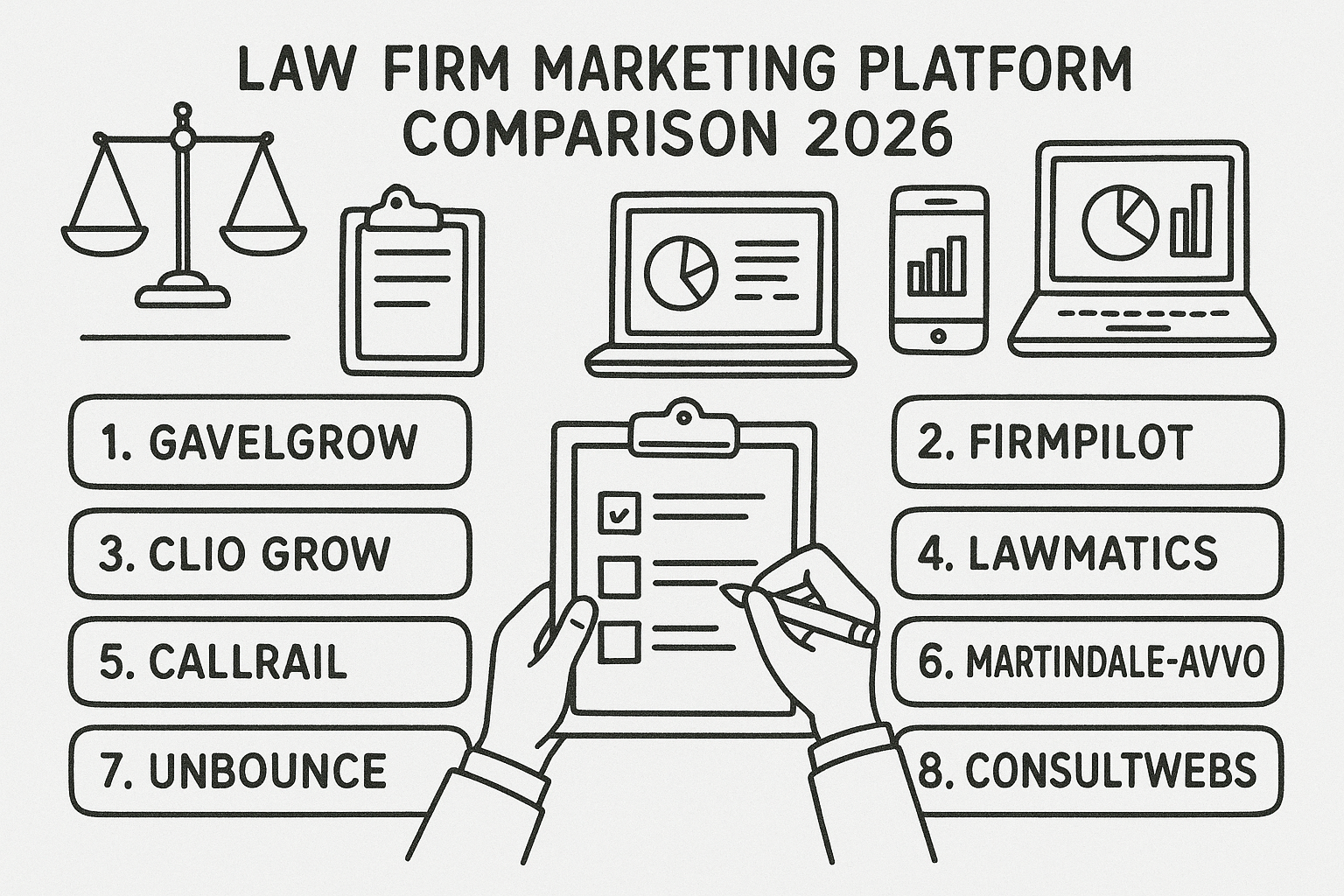
Law Firm Marketing Platform Comparison 2026: 8 Top Picks
You've got a shortlist of tabs open, three demo calls booked, and no clear way to tell which platform actually moves the needle on signed cases instead of just raw leads. That's the real problem with most law firm marketing platform comparison 2026 guides: they rank tools by feature checklists, not by what happens after a lead clicks your ad. This one is different.
If you need a straight answer, here it is: the right platform depends on whether you're running marketing in-house or outsourcing it, and whether the vendor was built for legal or retrofitted from a generic CRM. Firms juggling CallRail, Clio Grow, and AgencyAnalytics as separate subscriptions are usually the ones bleeding budget on tool sprap and blind spots in attribution. A platform built for legal from day one handles TCPA compliance and case-level ROI natively, instead of bolting it on.
Below, you'll find eight platforms worth evaluating in 2026, including GavelGrow, scored on intake speed, call tracking, attribution accuracy, and pricing transparency. We'll flag where each tool fits your firm size and practice area, so you can stop guessing and start comparing cost-per-signed-case, not vanity metrics.
1. GavelGrow: all-in-one platform for signed-case attribution
GavelGrow was built exclusively for law firms in 2015, and that focus shows in how the platform measures success. Instead of stopping at cost-per-lead, GavelGrow tracks cost-per-signed-case, connecting every ad click to the intake form, the call, and the retainer that eventually gets signed. Over 500 U.S. law firms use it today, with a 4.9/5 rating, and the platform ships with state-bar compliance defaults and TCPA-compliant SMS baked in rather than added later through a third-party integration.
If you can't trace a signed retainer back to the ad that generated it, you're optimizing for the wrong number.
Key features
The dashboard replaces the CallRail-plus-Clio-Grow-plus-AgencyAnalytics stack that a lot of firms cobble together. Built-in call tracking assigns a Twilio number per campaign, records calls, and tags outcomes as qualified, callback, unqualified, or spam. Hosted and embeddable intake forms come with carrier-level phone validation, invisible bot protection, and a 10-minute duplicate check, so your lead pipeline doesn't fill up with junk.
- Full-funnel attribution: from first ad click through signed case, no Zapier required
- 60-second intake automation: SMS and email sequences fire before the lead goes cold
- modelled practice-area benchmarks: compare your CPL and close rate against peers in your practice area
- Native GA4 and Meta Pixel conversion tracking, so your own ad accounts optimize on real case data
Pricing
GavelGrow's self-serve platform runs from $199 to $599 per month, with a Managed option for larger firms. There's a 7-day free trial with no credit card required, and annual billing includes two months free. Firms that want to hand off execution entirely can move to managed services scoped on a strategy call, plus ad spend, covering Google Ads, SEO, and reputation management. Details on both tiers live on the pricing page.
Best for
GavelGrow fits solo practitioners up through 15-seat firms handling marketing in-house, plus mid-market firms ready to outsource without losing visibility into attribution. Personal injury, mass tort, and family law practices tend to see the fastest payoff, since those verticals live or die on speed-to-lead and lead quality. Check the platform page for a full capability breakdown.
2. FirmPilot: AI-driven SEO and PPC for law firms
FirmPilot positions itself as a marketing agency wrapped around software, leaning heavily on AI-generated content and automated bid management for Google Ads. Unlike GavelGrow, FirmPilot doesn't offer a self-serve dashboard for firms that want hands-on control. You get a managed relationship where the AI drafts blog posts, service pages, and ad copy, then a strategist reviews and publishes. It's a fit for firms that want SEO output without hiring an in-house writer or agency team.
AI can draft your content fast, but someone still has to check it against your state bar's advertising rules.
Key features
FirmPilot's core strength is content velocity. Its AI engine produces practice-area pages, blog posts, and FAQ schema markup at a pace most solo marketers can't match manually. The platform also runs Google Ads campaigns with automated keyword expansion and negative-keyword pruning, aiming to lower cost-per-click over time.
- AI-drafted SEO content with human review before publishing
- Automated PPC bid adjustments across Google Ads
- Basic rank tracking and monthly performance reports
- Limited intake or call-tracking tools compared to purpose-built legal platforms
Pricing
FirmPilot doesn't publish flat-rate pricing; packages are quoted per firm based on practice area and market competitiveness, typically landing in the low-to-mid thousands per month plus ad spend.
Best for
FirmPilot suits solo attorneys and small firms that want SEO and PPC managed for them without the cost of a full agency retainer, and who don't need built-in call tracking or case-level attribution.
3. Clio Grow: intake built for the Clio ecosystem
Clio Grow is the intake and CRM module that sits next to Clio Manage, the practice management software already running in thousands of firms. If your firm already lives in Clio's ecosystem, Grow feels like a natural extension rather than another login to manage. It handles lead capture, e-signature engagement letters, and basic automated follow-up, but it was built as a legal CRM first, not a full marketing attribution platform.
A CRM that talks to your case files beats a CRM that only talks to itself.
Key features
Grow's biggest strength is its native sync with Clio Manage, so a signed lead becomes a matter without re-entering data. It includes customizable intake forms, automated email and text sequences, and a basic pipeline view for tracking leads from inquiry to retainer.
- Direct integration with Clio Manage for matter creation
- Document automation and e-signature for engagement letters
- Simple email and SMS follow-up sequences
- Limited call tracking and no built-in ad-spend attribution
Pricing
Clio Grow is sold as an add-on to Clio's practice management suite, typically priced per user per month, with exact rates depending on your Clio Manage tier and firm size. It's not a standalone marketing platform, so budget for both subscriptions if you're not already a Clio customer.
Best for
Clio Grow suits firms already committed to Clio Manage who want tighter intake-to-matter handoff more than they want campaign-level ROI. Firms comparing tools purely on law firm marketing platform comparison 2026 criteria like attribution depth will find Grow thinner than GavelGrow's full-funnel view on the platform page.
4. Lawmatics: automation for complex intake workflows
Lawmatics markets itself as a legal CRM and marketing automation tool built for firms with layered intake processes, think immigration or estate planning shops juggling dozens of document requests per matter. Where Clio Grow feels lightweight, Lawmatics leans into visual workflow building, letting you map out branching sequences based on practice area, referral source, or how a lead answers your intake questionnaire. It's not a marketing platform in the ad-spend sense; it's an automation engine for what happens after the click.
Complex intake deserves a workflow builder, not a spreadsheet full of manual follow-up tasks.
Key features
The standout feature is Lawmatics' drag-and-drop automation builder, which lets non-technical staff design multi-step sequences without a developer. Custom intake forms, e-signature engagement letters, and a built-in scheduling tool round out the core toolkit.
- Visual workflow automation for email, SMS, and task triggers
- Custom, conditional intake forms based on practice area
- Built-in scheduling and document generation
- No native call tracking or ad-spend attribution
Pricing
Lawmatics does not publish public pricing — it is quote-based, scaling from smaller teams into custom enterprise plans for firms needing advanced automation and reporting. Most firms need a demo call to get exact numbers, since pricing shifts based on user count and add-on modules.
Best for
Lawmatics fits firms with intricate, document-heavy intake, particularly immigration, estate planning, and business law practices where the workflow matters more than the ad channel. Firms chasing cost-per-signed-case visibility alongside automation will still need to pair it with a call-tracking and attribution layer.
5. CallRail: call tracking for phone-driven practices
CallRail built its name on call tracking before legal marketing ever became its niche, and plenty of firms still run it as a standalone subscription alongside their CRM. It assigns tracking numbers per campaign, records calls, and uses keyword-level attribution to show which ad or landing page generated the ring. For practices where the phone still closes more cases than a web form, that visibility matters. But CallRail wasn't built exclusively for legal, so you won't find state-bar consent defaults or TCPA-specific SMS handling out of the box.
Call tracking tells you who called, not whether that call turned into a signed retainer.
Key features
CallRail's dynamic number insertion swaps tracking numbers per visitor source, so you see which channel, keyword, or even specific ad drove the call before you pick up.
- Call recording and transcription with keyword spotting
- Form tracking alongside call tracking in one dashboard
- Integrations with Google Ads, Google Analytics, and major CRMs
- No native case management or signed-case attribution
Pricing
Plans start around $50 per month for a single number and limited minutes, scaling to several hundred dollars monthly as firms add numbers, users, and call minutes. Multi-location firms with heavy call volume often land in the $300-plus range once add-ons stack up.
Best for
CallRail suits firms that already have a CRM and intake process they like but need dedicated call attribution layered on top. Firms tired of paying for CallRail as one more disconnected tool should compare it against GavelGrow's built-in call tracking, which ties recordings directly to signed-case outcomes.
6. Martindale-Avvo: directory leads and reputation
Martindale-Avvo runs two of the oldest attorney directories online, and for a lot of firms it's still the first place a prospective client searches before they ever hit Google. The platform sells directory placement, peer and client review management, and paid lead packages where Avvo forwards inquiries directly to your inbox. It's less a marketing platform than a lead-generation marketplace, and firms that rely on it heavily often supplement with a real attribution layer to see what those leads actually cost per signed case.
A directory listing builds trust, but it won't tell you which lead turned into a retainer.
Key features
Martindale-Avvo's core value sits in reputation and visibility, not funnel tracking. Attorney profiles pull in peer endorsements, client reviews, and Avvo's own rating system, which shows up in Google search results and carries weight with prospects doing due diligence.
- Directory listings on Avvo, Martindale, and Lawyers.com
- Paid lead packages by practice area and ZIP code
- Review collection and reputation monitoring tools
- No built-in call tracking or signed-case attribution
Pricing
Basic profiles are free, but competitive placement and paid lead packages run from a few hundred to several thousand dollars monthly depending on practice area and market. Personal injury and family law markets tend to cost more per lead than niche practice areas.
Best for
Martindale-Avvo suits solo attorneys and small firms building initial visibility and reputation before investing in paid campaigns elsewhere. Firms already running Google Ads or SEO should treat it as a supplemental channel, not a replacement for platforms that track leads through to signed retainers.
7. Unbounce: landing pages for paid campaigns
Unbounce is a landing page builder, not a legal-specific platform, but plenty of firms running heavy Google Ads spend use it to build and test pages faster than their website CMS allows. It's the tool you reach for when your main site takes two weeks to publish a new page and your ad campaign needs one live tomorrow. Unbounce doesn't touch intake, call tracking, or case attribution at all; it exists purely to get a visitor from click to form submission at the highest possible conversion rate.
A fast landing page wins the click, but it still needs a real intake system behind it to turn that click into a case.
Key features
Unbounce's draw is speed and testing, not legal-specific compliance. The drag-and-drop builder ships with hundreds of templates, AI-assisted copy suggestions, and built-in A/B testing so you can run two headline variants against the same ad traffic.
- Drag-and-drop page builder with mobile-responsive templates
- Built-in A/B testing and dynamic text replacement matching search-ad keywords
- Popups and sticky bars for secondary conversion offers
- No call tracking, TCPA consent logging, or case-level attribution
Pricing
Plans start around $99 per month for a single domain and limited conversions, moving up toward $300-plus monthly for firms running multiple domains or higher traffic volumes. There's no legal-specific tier or bundled compliance layer, so you're paying purely for page-building infrastructure.
Best for
Unbounce suits firms running aggressive Google Ads or paid social campaigns that need pages built and tested faster than their main site allows. Pair it with a platform that captures the form submission properly, since Unbounce alone won't tell you which page variant actually produced a signed retainer.
8. Consultwebs: full-service agency for outsourced growth
Consultwebs has run legal marketing campaigns since 1995, making it one of the longest-standing full-service legal agencies in the space. Firms hire Consultwebs when they want someone else running SEO, paid ads, and web design end to end, without hiring an in-house marketing manager. It's an agency relationship, not a software login, so you're paying for strategists and account managers rather than a dashboard you check daily.
Outsourcing execution only pays off if your agency shows you signed-case numbers, not just traffic charts.
Key features
Consultwebs builds and manages full websites alongside its SEO and PPC campaigns, which sets it apart from tools that only touch one channel. Video production and content marketing round out the offering for firms wanting a stronger brand presence beyond paid search.
- Custom website design and development for law firms
- SEO, Google Ads, and paid social management
- Video production and content marketing services
- No self-serve dashboard or built-in call tracking; reporting comes through account managers
Pricing
Consultwebs doesn't publish flat rates. Engagements typically start in the $5,000 to $10,000-plus monthly range depending on scope, on top of any managed ad spend, with exact pricing set after a discovery call.
Best for
Consultwebs suits mid-market and larger firms that want a long-term agency partner handling everything from website design to ad management. Firms that also want case-level attribution built into that relationship, not just monthly PDF reports, should compare it against GavelGrow's managed services.
9. How to compare these platforms for your firm
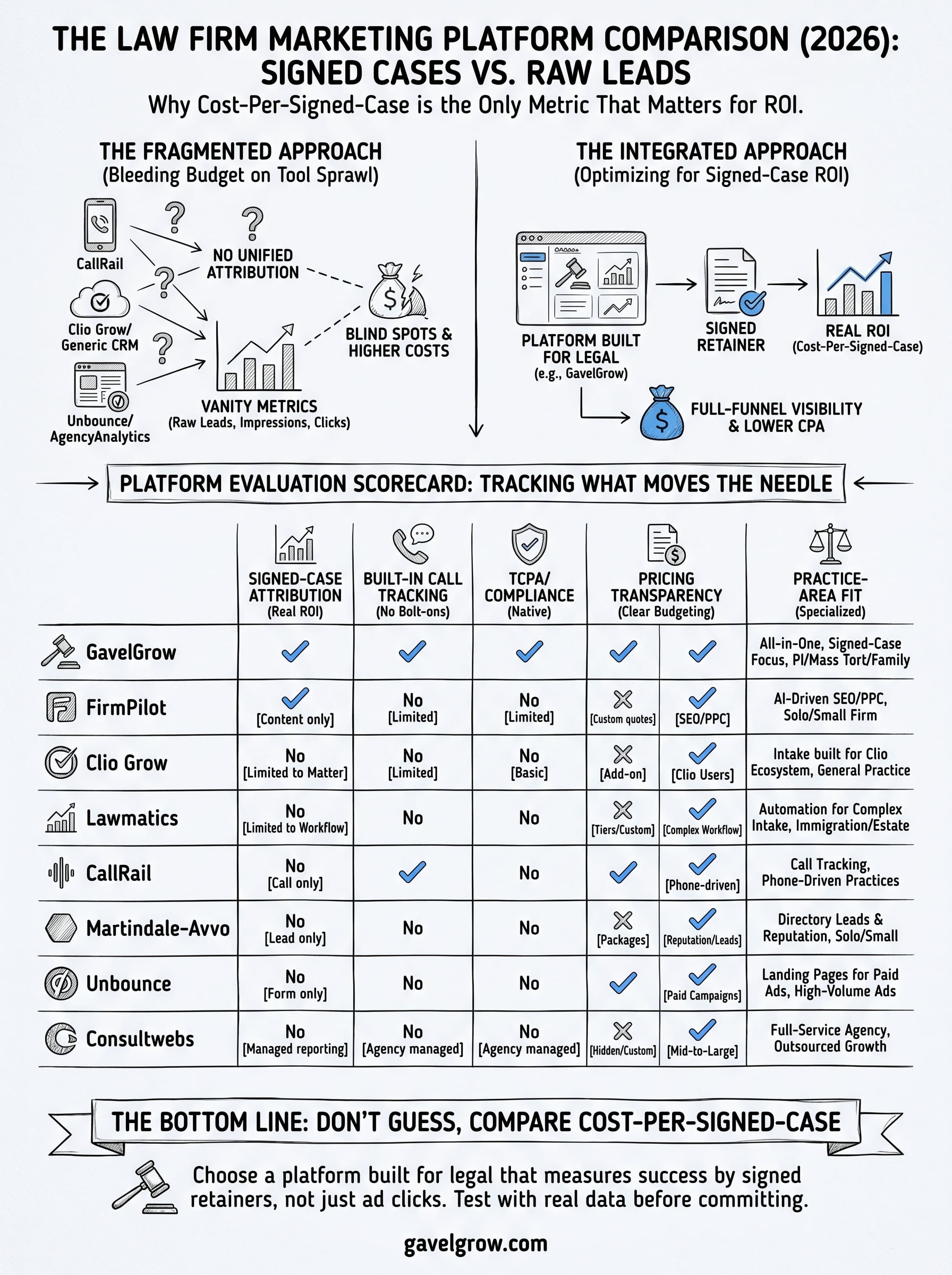
Start by asking what each platform actually measures. Some tools stop at cost-per-lead, others track cost-per-signed-case, and that gap explains most of the confusion when you're running a legal marketing software comparison across vendors with wildly different pricing models. Before you sign anything, map your current stack against what you'd replace, since tool sprawl is usually more expensive than the platform itself once you add up separate CallRail, CRM, and reporting subscriptions.

The platform that wins isn't the one with the most features, it's the one that shows you which lead became a client.
Next, weigh compliance depth against your practice area. Firms running paid ads in personal injury or mass tort need TCPA-compliant SMS and consent logging built in, not patched on later, since a compliance gap costs more than a bad ad spend month. Generic CRMs and landing-page tools rarely carry that natively.
Here's a quick scorecard to run each vendor through:
Finally, run the free trial or discovery call before committing annually. A week of real data tells you more than any spec sheet.
Which platform fits your firm right now
Most firms don't need eight tools, they need one that answers a simple question: which lead became a client. If you're still stitching together CallRail, Clio Grow, and a landing-page builder, you're paying three invoices to get half an attribution picture. Directories and agencies like Martindale-Avvo and Consultwebs have their place, but they work best as one channel inside a bigger system, not the system itself.
Run the scorecard from the last section against your current stack before you renew anything. If signed-case attribution and built-in TCPA compliance matter more to you than a longer feature list, GavelGrow was built to close that gap for legal specifically, not retrofitted from a generic CRM. Test it against your own numbers instead of taking a vendor's word for it. Book a free 45-minute strategy call and find out where your current setup is actually leaking cases.
Frequently Asked Questions
What is a law firm marketing platform?
A law firm marketing platform is software that centralizes the tools a firm uses to attract and convert clients — typically lead intake, marketing attribution, campaign tracking, reviews, and reporting — in one place instead of a patchwork of disconnected tools. The best platforms tie marketing spend all the way to signed cases, not just leads or clicks.
How do you choose a law firm marketing platform?
Match the platform to what your firm is actually missing. Look for legal-specific features, attribution that connects spend to signed cases (not just leads), fast intake and speed-to-lead, transparent pricing, and clear ownership of your data. Avoid buying features you will not use, and prefer month-to-month terms over long lock-ins so you can switch if it underdelivers.
How much does a law firm marketing platform cost?
It ranges widely — self-serve platforms can start under $100 a month, while full managed or enterprise plans run into the thousands, and several vendors are quote-based and require a demo. Rather than compare monthly fees alone, judge a platform by whether it lowers your cost per signed case; a tool that helps you sign more of the leads you already pay for often pays for itself.
What is the difference between a marketing platform and a legal CRM?
A legal CRM manages contacts, intake, and client relationships; a marketing platform focuses on generating and attributing leads — SEO, ads, campaign tracking, and cost-per-case reporting. Some tools do both, but many firms end up stitching a CRM to separate marketing and analytics tools. Platforms that combine intake with marketing attribution remove that manual glue.
Do I need a law-firm-specific platform or a general marketing tool?
Legal-specific platforms understand bar advertising rules, legal keyword economics, and how injury or family-law clients search and hire — context a general tool misses. General marketing tools can be cheaper and more flexible, but for most firms the legal specialization, compliance awareness, and case-level reporting are worth more than a generalist’s lower price.
How do you measure ROI from a law firm marketing platform?
Track past leads and traffic to the numbers tied to revenue: cost per lead, lead-to-consultation and consultation-to-retainer conversion, and cost per signed case by channel. A good platform reports these and connects each signed case to its source. If your platform only shows rankings, clicks, or lead counts without tying them to retained clients, you cannot tell if it is working.
Should a small firm use a marketing platform or hire an agency?
It depends on whether you want to run marketing yourself or have it done for you. A self-serve platform suits firms with someone to manage campaigns; an agency (often built on a platform) suits firms that want results without the hands-on work. Some providers offer both, letting you start self-serve and move to managed as you grow.
Third-party pricing reflects estimates based on publicly available information as of July 2026, not official quotes — several of these platforms are quote-based, so verify current pricing directly with each vendor. All company names and trademarks are the property of their respective owners, and the platforms named here are not affiliated with GavelGrow, which is included among the platforms above.
Frequently Asked Questions
What is a law firm marketing platform?
A law firm marketing platform is software that centralizes the tools a firm uses to attract and convert clients — typically lead intake, marketing attribution, campaign tracking, reviews, and reporting — in one place instead of a patchwork of disconnected tools. The best platforms tie marketing spend all the way to signed cases, not just leads or clicks.
How do you choose a law firm marketing platform?
Match the platform to what your firm is actually missing. Look for legal-specific features, attribution that connects spend to signed cases (not just leads), fast intake and speed-to-lead, transparent pricing, and clear ownership of your data. Avoid buying features you will not use, and prefer month-to-month terms over long lock-ins so you can switch if it underdelivers.
How much does a law firm marketing platform cost?
It ranges widely — self-serve platforms can start under $100 a month, while full managed or enterprise plans run into the thousands, and several vendors are quote-based and require a demo. Rather than compare monthly fees alone, judge a platform by whether it lowers your cost per signed case; a tool that helps you sign more of the leads you already pay for often pays for itself.
What is the difference between a marketing platform and a legal CRM?
A legal CRM manages contacts, intake, and client relationships; a marketing platform focuses on generating and attributing leads — SEO, ads, campaign tracking, and cost-per-case reporting. Some tools do both, but many firms end up stitching a CRM to separate marketing and analytics tools. Platforms that combine intake with marketing attribution remove that manual glue.
Do I need a law-firm-specific platform or a general marketing tool?
Legal-specific platforms understand bar advertising rules, legal keyword economics, and how injury or family-law clients search and hire — context a general tool misses. General marketing tools can be cheaper and more flexible, but for most firms the legal specialization, compliance awareness, and case-level reporting are worth more than a generalist’s lower price.
How do you measure ROI from a law firm marketing platform?
Track past leads and traffic to the numbers tied to revenue: cost per lead, lead-to-consultation and consultation-to-retainer conversion, and cost per signed case by channel. A good platform reports these and connects each signed case to its source. If your platform only shows rankings, clicks, or lead counts without tying them to retained clients, you cannot tell if it is working.
Should a small firm use a marketing platform or hire an agency?
It depends on whether you want to run marketing yourself or have it done for you. A self-serve platform suits firms with someone to manage campaigns; an agency (often built on a platform) suits firms that want results without the hands-on work. Some providers offer both, letting you start self-serve and move to managed as you grow. Third-party pricing reflects estimates based on publicly available information as of July 2026, not official quotes — several of these platforms are quote-based, so verify current pricing directly with each vendor. All company names and trademarks are the property of their respective owners, and the platforms named here are not affiliated with GavelGrow, which is included among the platforms above.