Email Subject Line Best Practices: 9 Tips for Law Firms
Categories: Legal Marketing Strategies
 Abram Ninoyan
Founder & Senior Performance Marketer
Credentials: Google Partner, Google Ads Search Certified, Google Ads Display Certified, Google Ads Measurement Certified, Google Analytics (IQ) Certified, HubSpot Inbound Certified, HubSpot Social Media Marketing Certified, Conversion Optimization Certified
Expertise: Google Ads, Meta Ads, Conversion Rate Optimization, GA4 & Google Tag Manager, Lead Generation, Marketing Funnel Optimization, PPC Management
LinkedIn Profile
Your firm sends a client update, a case status email, or a new lead follow-up, and it sits unopened in an inbox for three days. That's not a content problem. It's a subject line problem. Email subject...
Key Takeaways
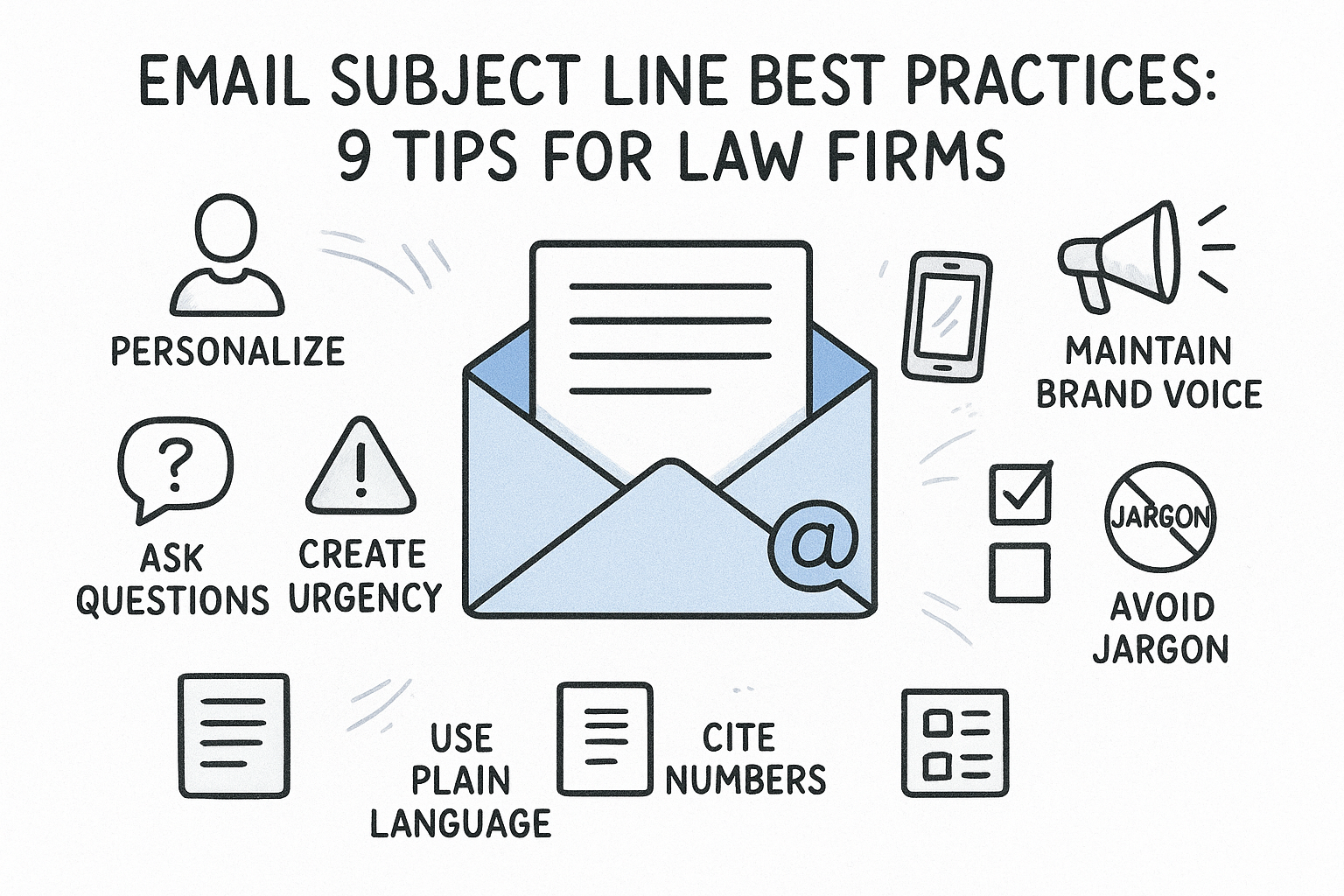
- Email Subject Line Best Practices: 9 Tips for Law Firms
- 1. How does personalization boost subject line conversions?
- 2. Keep subject lines short for mobile inboxes
- 3. Why does urgency work without tripping spam filters?
Email Subject Line Best Practices: 9 Tips for Law Firms
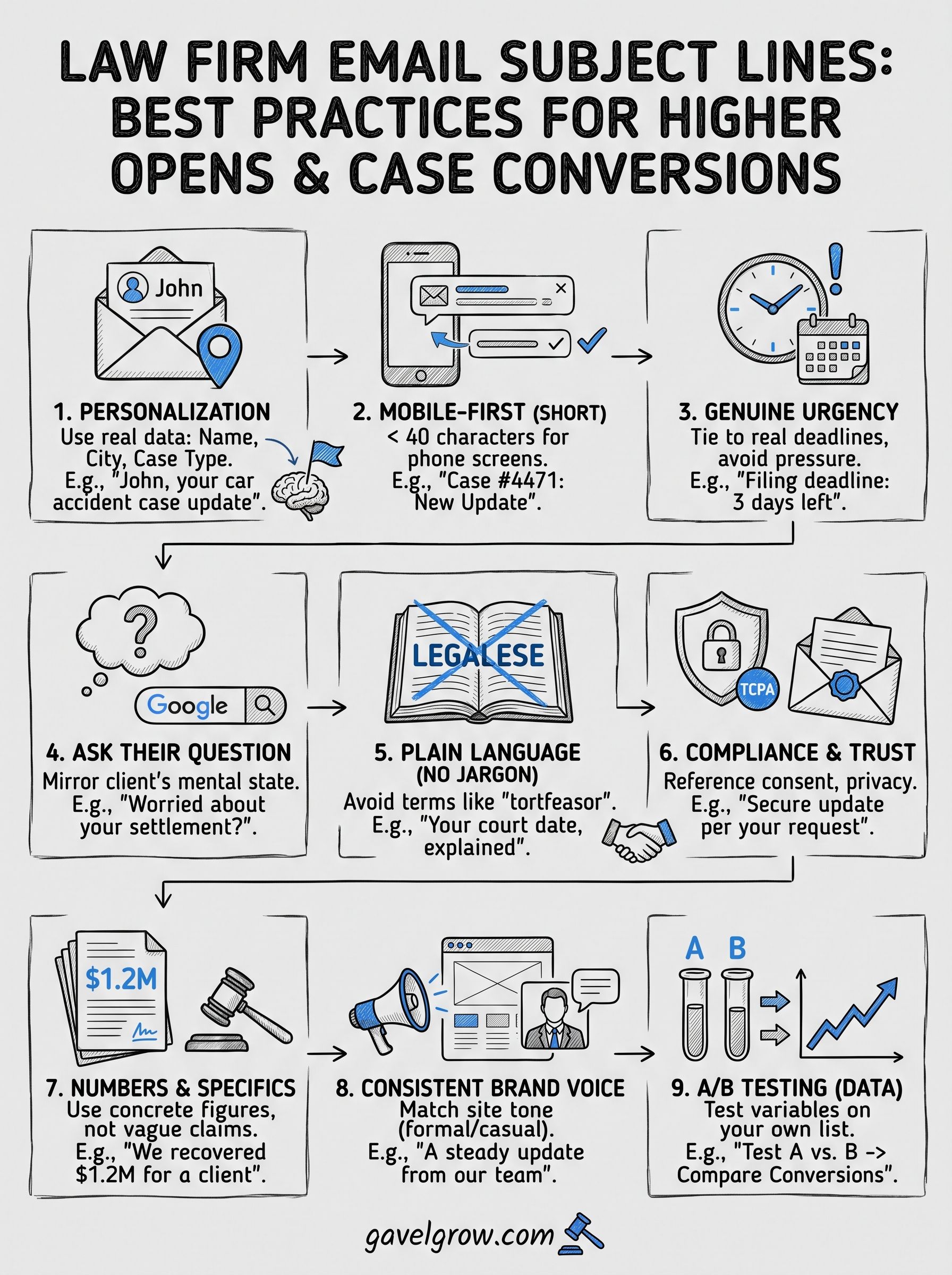
Your firm sends a client update, a case status email, or a new lead follow-up, and it sits unopened in an inbox for three days. That's not a content problem. It's a subject line problem. Email subject line best practices matter more for law firms than most industries because your open rates directly affect whether a prospective client ever hears about their case update, their intake confirmation, or your monthly newsletter. Get the subject line wrong and even a perfectly drafted email becomes invisible.
This article gives you nine specific, testable tactics for writing subject lines that get opened, not generic marketing advice repurposed from e-commerce brands. You'll learn word count sweet spots, personalization tricks that don't feel robotic, and how to avoid spam-filter triggers that state-bar advertising rules make especially risky for legal marketing.
Each tip below is something you can apply to your next campaign today, whether that's a mass-tort outreach blast or a routine client check-in. If you're running email sequences through a system without intake automation or open-rate tracking, pair these tips with a platform like GavelGrow's marketing dashboard so you can actually measure which subject lines convert into signed cases, not just opens.
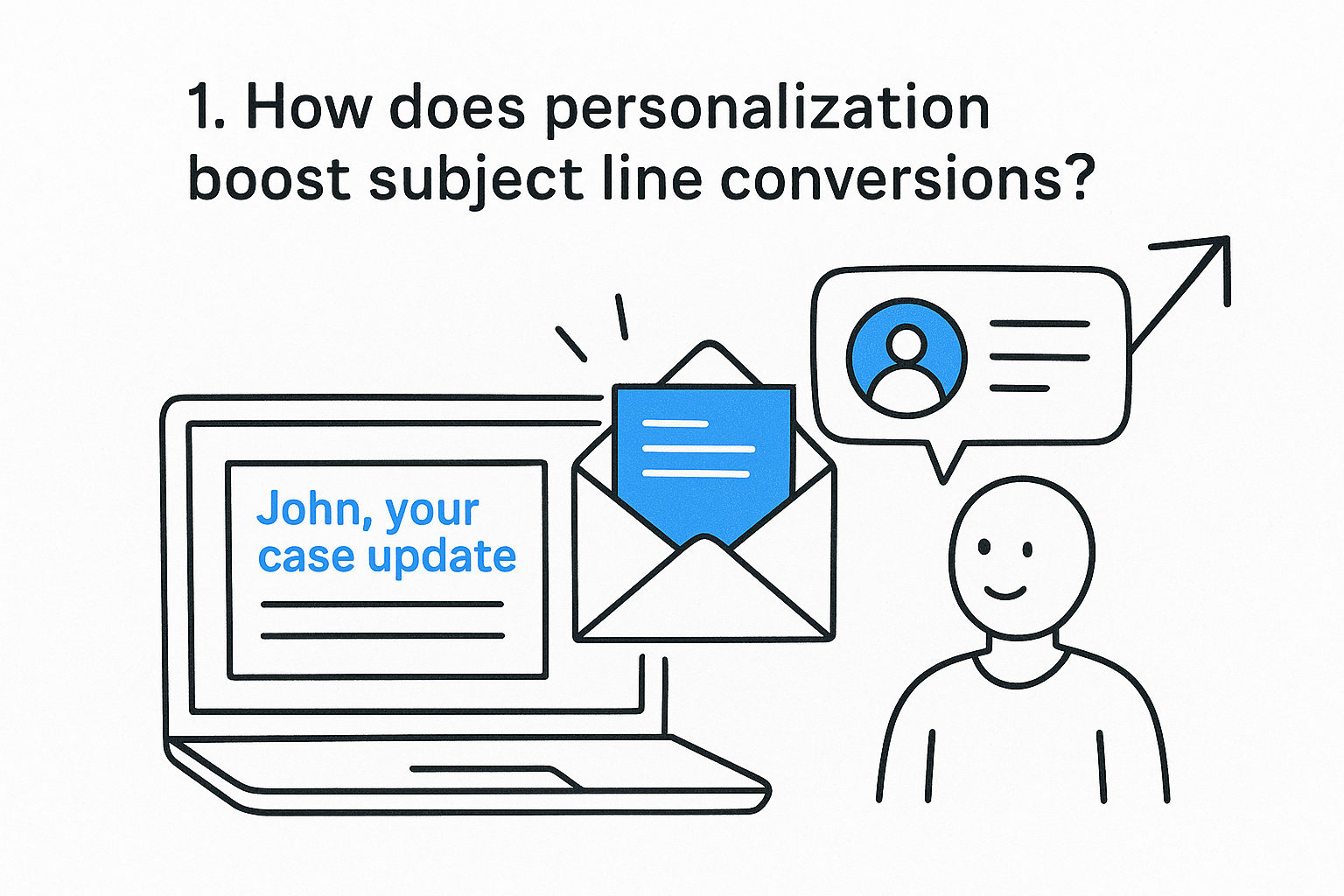
1. How does personalization boost subject line conversions?
Personalized subject lines beat generic ones because a recipient's brain flags their own name, city, or situation as relevant before they even open the email. Experian's 2022 email benchmark study found personalized subject lines drive a 26% higher open rate than non-personalized ones, and that gap widens for transactional and legal-adjacent emails where the recipient expects something specific to their case. For a law firm, that's the difference between a client update getting read the day it lands and it rotting in an inbox until a phone call becomes necessary.
Why it matters for law firm emails
Law firm email lists mix cold leads, active clients, and past clients waiting on referral nudges, and each group reads subject lines differently. A prospective client scanning intake confirmations wants to see their own name or the specific injury type they searched for, not "Thank You for Contacting Our Firm." An active client waiting on a settlement wants their case number or attorney's name in the subject line, because that signals the email is worth opening immediately instead of during lunch. Weak personalization here doesn't just cost an open, it erodes the trust a client needs during an already stressful legal process.
Personalized subject lines don't just get opened faster, they get opened by the right person for the right reason.
Example subject lines for legal audiences
- "John, your car accident case update from Smith & Associates"
- "Maria, here's your custody hearing checklist"
- "Your DUI consultation with Attorney Reyes is confirmed"
- "Update on your workers' comp claim, Case #4471"
How to put it into practice
Start with fields you already collect at intake: first name, practice area, and assigned attorney. Most email platforms support merge tags, so pulling a lead's name or case type into the subject line takes minutes to set up once your data is clean. If your intake forms and email tool live in separate systems, that mismatch is exactly what causes broken merge tags and "Hi {FirstName}" disasters. Running intake through a platform that ties lead data directly to email automation, like GavelGrow's hosted intake forms, keeps names, case types, and attorney assignments accurate from the first form submission through every follow-up sequence you send.
2. Keep subject lines short for mobile inboxes
Short subject lines win because most of your recipients read email on a phone screen that truncates anything past 30 to 40 characters. Litmus's 2023 email client market share report found that over 60% of law firm and professional services emails get opened on mobile devices first, which means a clever 80-character subject line often shows up as a half-finished sentence. Mobile-first formatting isn't a nice-to-have anymore, it's how most of your audience actually sees your work.
Why it matters for law firm emails
Clients checking case updates from their phone during a lunch break or between meetings never see the second half of a long subject line. If the important detail, like a deadline or a case number, sits at the end, it disappears entirely on smaller screens.
If your subject line gets cut off on a phone, the most important word in it might never get read.
Example subject lines for legal audiences
- "Your hearing date is set"
- "Deadline: sign your retainer by Friday"
- "Case #4471: new update"
- "Quick question about your accident"
How to put it into practice
Aim for 40 characters or fewer, and always preview on an actual phone before sending. Put the key word, deadline, name, or action, in the first six words, since that's what survives truncation across Gmail, Outlook, and Apple Mail apps.
3. Why does urgency work without tripping spam filters?
Urgency works because deadlines trigger action, but law firm emails walk a tighter line than retail promotions since state-bar rules and spam filters both flag manufactured pressure. Words like "URGENT," excessive punctuation, and ALL CAPS push emails straight into promotions or spam folders, according to Mailchimp's own guidance on subject line best practices. Genuine urgency built around real dates, like a filing deadline or a statute of limitations, gets opened without setting off those filters because the language stays factual instead of manipulative.
Why it matters for law firm emails
Legal deadlines are real and often severe, so a subject line that flags one honestly serves the client instead of pressuring them. A statute of limitations, a court date, or a document due tomorrow deserves a subject line that says so plainly, because that urgency is earned, not invented for a marketing metric.
Real deadlines don't need exclamation points, they need clarity.
Example subject lines for legal audiences
- "Your filing deadline is in 3 days"
- "Sign your documents before Friday's hearing"
- "Time-sensitive: statute of limitations update"
- "Action needed before your court date"
How to put it into practice
Reserve urgency language for actual deadlines tied to a case, not recurring newsletters or generic promotions. Test each subject line against a spam checker before sending, and skip symbols like exclamation points or dollar signs that trigger filters across Gmail and Outlook.
4. Ask a question that mirrors your client's intent
Questions in subject lines work because they mimic the exact phrase a prospect typed into Google before they ever found your firm. Someone searching "do I need a lawyer for a car accident" opens an email titled the same way faster than one titled "Free Consultation Available," because the question format matches the mental state they're already in. That match is what separates a subject line that feels like it's reading the recipient's mind from one that feels like every other firm's blast.
Why it matters for law firm emails
Prospective clients rarely arrive at your firm confident about next steps. They're scared, confused, or comparing three firms at once, and a subject line phrased as the same question they're silently asking cuts through that noise. Existing clients respond to questions too, especially ones tied to their case status, because a question implies the email contains an answer worth opening for.
A subject line phrased as your client's own question feels like an answer, not an ad.
Example subject lines for legal audiences
- "Worried about your workers' comp deadline?"
- "Not sure if you have a case?"
- "What happens after you sign your retainer?"
- "Still deciding on legal representation?"
How to put it into practice
Pull real language from intake call transcripts or your first-line staff, since those are the exact questions leads ask before they ever become clients. Match that phrasing word for word in your subject line rather than paraphrasing it into formal legal language, and test it against a benefit-driven alternative to see which one your list actually opens.
5. Should you avoid legal jargon in subject lines?
Yes, drop the jargon, because terms like "tortfeasor," "voir dire," or "interlocutory appeal" mean nothing to a scared client scanning their inbox for news about their case. Plain language subject lines consistently outperform legalese because they respect the reader's time and comprehension level instead of making them decode terminology before deciding whether to open. A prospective client googling "can I sue after a slip and fall" doesn't think in legal terms, and your subject line shouldn't either.
Why it matters for law firm emails
Clients already feel intimidated by the legal process, and jargon in a subject line reinforces that distance instead of closing it. Everyday phrasing signals that the email inside will be just as accessible, which matters most for practice areas like personal injury, family law, and immigration where clients are often first-time legal consumers under real stress.
If a client needs a law dictionary to understand your subject line, they'll close the email instead of opening it.
Example subject lines for legal audiences
- "Your accident claim: what happens next"
- "Update on your divorce paperwork"
- "Good news about your immigration case"
- "Your court date, explained simply"
How to put it into practice
Read every subject line out loud before sending, and if it sounds like something you'd only say to another attorney, rewrite it. Ask a non-lawyer on your staff, like a paralegal or front-desk coordinator, to flag anything that sounds like it belongs in a brief instead of an inbox.
6. How do compliance cues build trust in subject lines?
Compliance cues work because they signal to a wary recipient that your firm follows the rules, which matters more in legal marketing than almost any other industry. A subject line referencing consent, opt-out language, or a state-bar-approved disclosure doesn't scream "marketing email," it reads as a firm that takes client privacy seriously. That distinction shapes whether a lead trusts the email enough to open it, especially on a first contact where trust hasn't been established yet.
Why it matters for law firm emails
Firms operate under TCPA rules and state-bar advertising restrictions that most industries never touch, and clients pick up on that context even subconsciously. A subject line that mentions "secure update" or references an existing consent relationship reassures a recipient that the email came through a legitimate channel, not a scraped list. Trust signals like these matter most for practice areas handling sensitive information, like family law or immigration, where a client's guard is already up.
A subject line that respects the rules is also a subject line that earns the open.
Example subject lines for legal audiences
- "Secure update on your case, per your consent"
- "Your requested consultation confirmation"
- "Following up per your opt-in request"
- "Your privacy-protected case status"
How to put it into practice
Reference the actual action that triggered the email, like a form submission or a scheduled call, instead of vague marketing phrases. Run your sequences through a platform with a TCPA-compliant consent audit trail, so every subject line you send matches a documented opt-in and holds up if a recipient ever questions it.
7. Use numbers and specifics to boost credibility
Numbers cut through vague marketing language because they give a recipient something concrete to evaluate before they even open the email. Specific details like a dollar figure, a case count, or a percentage signal that the email contains real information, not filler copy recycled from a template. Backblaze and other email marketing benchmarks consistently show subject lines with numerals outperform spelled-out or generic phrasing, and legal audiences respond even more strongly since they're evaluating outcomes, not just interest.
Why it matters for law firm emails
Clients comparing firms or deciding whether to open a case update want proof, not adjectives. A subject line citing "$1.2M settlement" or "Case #4471" reads as verifiable, while "Great news about your case" reads as filler a recipient has seen from every other sender. Credibility signals like specific numbers matter most in mass-tort and personal injury campaigns, where prospects are actively comparing settlement track records across multiple firms before choosing one.
A number in your subject line tells the reader you have something to prove, not just something to promise.
Example subject lines for legal audiences
- "We recovered $1.2M for a client like you"
- "3 documents needed before your Friday hearing"
- "Case #4471: your settlement offer is ready"
- "[First name], the exact next step in your injury claim"
How to put it into practice
Pull real figures from closed cases, case numbers, or deadline counts rather than inventing round numbers for effect. Keep every claim verifiable, since a number that can't be substantiated undermines the trust you're trying to build.
One caveat before you lean on result-based subject lines: follow your state bar's advertising rules. Most bars require a disclaimer such as “prior results do not guarantee a similar outcome” whenever you reference a specific settlement or verdict, and you should never word a subject line so it implies a prospective client already has an offer or a guaranteed result. Reserve case-number and settlement-figure lines for the actual client they belong to, and save result claims for opt-in audiences that expect them.
8. Does your subject line match your firm's brand voice?
Consistency builds recognition, and a subject line that sounds nothing like your website or your attorney bios creates a small moment of doubt before a recipient even opens the email. Brand voice consistency matters because law firm clients are already vetting whether they can trust you, and a jarring shift in tone, from formal on your site to overly casual in email, reads as inconsistent rather than approachable. A firm built around calm, methodical guidance shouldn't suddenly sound like a flash sale in someone's inbox.
Why it matters for law firm emails
Different practice areas call for different tones, and your subject lines should reflect that. A criminal defense firm handling someone's worst day needs a steadier, more measured voice than a personal injury firm celebrating a settlement win. Mismatched tone doesn't just look sloppy, it makes recipients question whether the email actually came from the firm they hired.
Your subject line is often the first sentence a client reads from your firm that day, so it should sound like you wrote it.
Example subject lines for legal audiences
- "A steady update on your case, from our team"
- "Here's what's next, straight from Attorney Reyes"
- "Your case, your timeline: this week's update"
- "We're on it: your claim's next step"
How to put it into practice
Write a one-line voice guide, three adjectives that describe how your firm communicates, and check every subject line against it before sending. Have the same person who approves your website copy review email subject lines periodically, since voice drift happens gradually and rarely gets caught mid-campaign.
9. Why should you A/B test subject lines with lead data?
Guessing which subject line works better wastes opens you can't get back, and A/B testing replaces that guesswork with actual data from your own lead list instead of borrowed benchmarks from unrelated industries. Splitting a campaign into two versions, one testing personalization and one testing urgency, tells you which tactic your specific audience responds to, since a family law list and a mass-tort list rarely behave the same way.
Why it matters for law firm emails
Every practice area attracts a different type of reader, so a subject line style that doubles open rates for personal injury leads might flop with estate planning clients. Lead-source data matters here too, since a lead from a Google Ads click often responds differently than one referred by a past client. Testing against your own numbers, not generic industry averages, is the only way to know what actually moves your list.
The only subject line data worth trusting is the data your own leads generate.
Example subject lines for legal audiences
- "John, your case update is ready" vs. "Case #4471: update ready"
- "Your filing deadline is in 3 days" vs. "3 days left to file"
- "Worried about your settlement?" vs. "Your settlement, explained"
How to put it into practice
Run one variable at a time, personalization, length, or urgency, across a large enough segment to get a reliable read, then track opens against signed cases, not just clicks. A marketing dashboard that ties campaign data to signed retainers shows which subject lines actually convert, not just which ones get opened.
10. Frequently asked questions
What's the ideal email subject line length for law firms?
Aim for 40 characters or fewer, since Litmus's 2023 email client data shows most legal emails open on mobile first. Anything longer risks truncation on an iPhone or Android lock screen, which means your deadline or case number never gets seen at all.
How often should you change your subject line style?
Test every campaign, but don't rotate style for its own sake. Run one A/B test per send, personalization against urgency, for example, and let results from your own list, not generic benchmarks, decide when a style shift is warranted.
Do emojis help or hurt law firm subject lines?
Skip them. A checkmark or scale emoji next to "Case #4471" can look unprofessional to a client dealing with a divorce or injury claim, and some spam filters flag emoji-heavy subject lines from unfamiliar senders.
Can personalization backfire in legal marketing emails?
Yes, if the data behind it is wrong. A subject line with the wrong name or case type damages trust faster than generic copy ever would, so verify your intake data before scaling personalized sequences.
What open rate should a law firm expect?
Benchmarks vary by practice area, but Mailchimp's legal-services industry average sits in the low-to-mid 20% range. Compare your own numbers against a peer benchmark database, like GavelGrow's 500-firm dataset, rather than a generic cross-industry average.
The bottom line on legal email subject lines
None of these nine tactics work in isolation. Personalization without brevity gets truncated on mobile. Urgency without compliance cues risks the spam folder. The firms that see real gains treat subject lines as a testable system tied to signed cases, not a creative exercise judged on opens alone. That's the shift that separates firms guessing at email marketing from firms measuring it.
Start with one tip this week, probably personalization or length since both take minutes to implement, then track how it moves your open rates against your own historical baseline. Consistent testing beats copying a competitor's style, because your list, your practice area, and your leads behave differently than anyone else's.
If you want help connecting subject line performance to actual signed retainers instead of vanity opens, book a free 45-minute strategy call with GavelGrow and we'll walk through your numbers together.
Frequently Asked Questions
What's the ideal email subject line length for law firms?
Aim for 40 characters or fewer, since Litmus's 2023 email client data shows most legal emails open on mobile first. Anything longer risks truncation on an iPhone or Android lock screen, which means your deadline or case number never gets seen at all.
How often should you change your subject line style?
Test every campaign, but don't rotate style for its own sake. Run one A/B test per send, personalization against urgency, for example, and let results from your own list, not generic benchmarks, decide when a style shift is warranted.
Do emojis help or hurt law firm subject lines?
Skip them. A checkmark or scale emoji next to "Case #4471" can look unprofessional to a client dealing with a divorce or injury claim, and some spam filters flag emoji-heavy subject lines from unfamiliar senders.
Can personalization backfire in legal marketing emails?
Yes, if the data behind it is wrong. A subject line with the wrong name or case type damages trust faster than generic copy ever would, so verify your intake data before scaling personalized sequences.
What open rate should a law firm expect?
Benchmarks vary by practice area, but Mailchimp's legal-services industry average sits in the low-to-mid 20% range. Compare your own numbers against a peer benchmark database, like GavelGrow's 500-firm dataset, rather than a generic cross-industry average.