Law Firm Social Media Marketing: How to Plan and Grow It
Categories: Legal Marketing Strategies
 Abram Ninoyan
Founder & Senior Performance Marketer
Credentials: Google Partner, Google Ads Search Certified, Google Ads Display Certified, Google Ads Measurement Certified, Google Analytics (IQ) Certified, HubSpot Inbound Certified, HubSpot Social Media Marketing Certified, Conversion Optimization Certified
Expertise: Google Ads, Meta Ads, Conversion Rate Optimization, GA4 & Google Tag Manager, Lead Generation, Marketing Funnel Optimization, PPC Management
LinkedIn Profile
Most law firm social media accounts post inconsistently, chase vanity likes, and never track whether a single follower turned into a signed case. That's the gap this guide closes. Law firm social medi...
Key Takeaways
- Law Firm Social Media Marketing: How to Plan and Grow It
- Why social media marketing matters for law firms
- Step 1. Define your audience and marketing goals
- Step 2. Choose the right platforms for your practice
Law Firm Social Media Marketing: How to Plan and Grow It
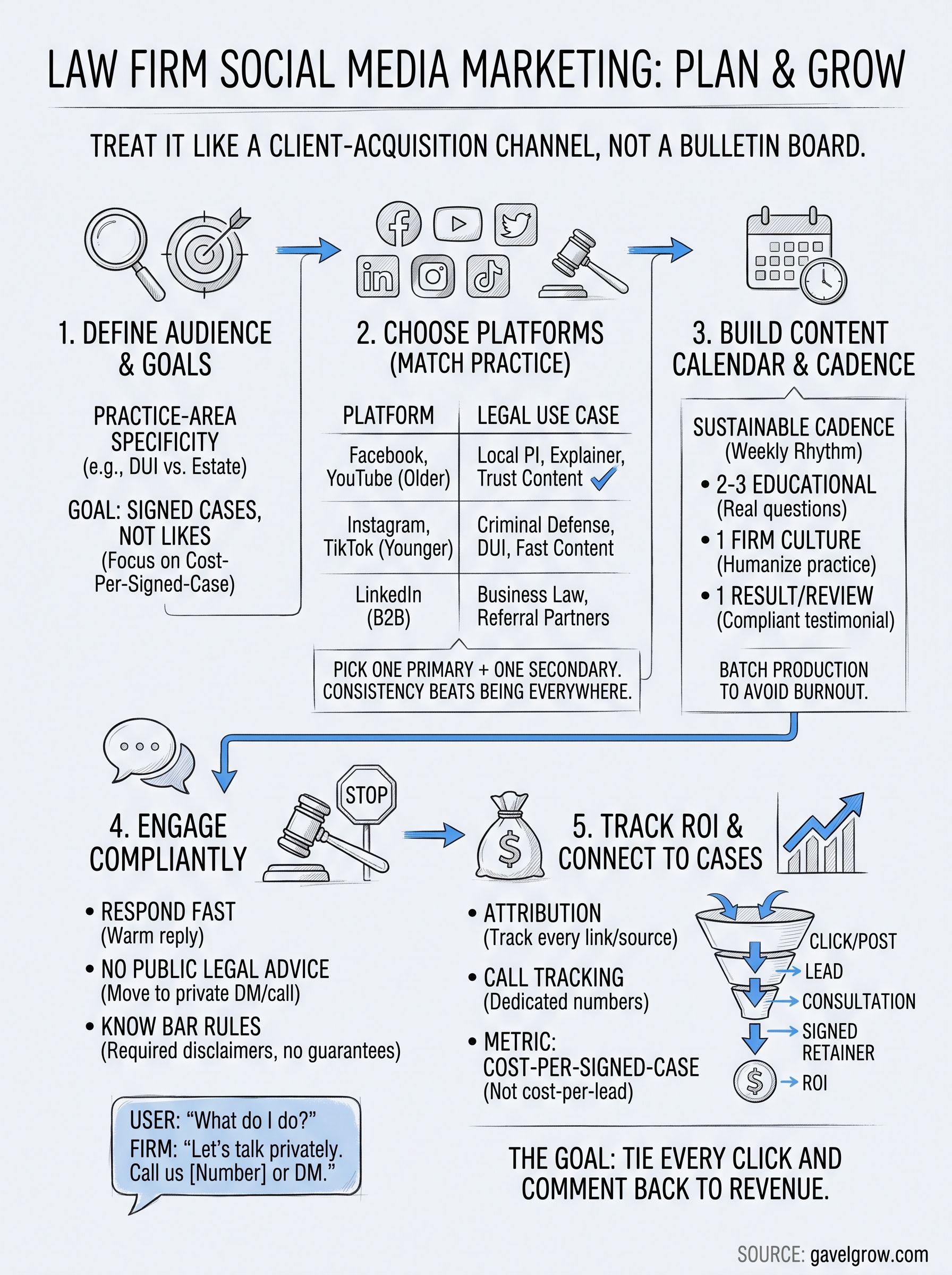
Most law firm social media accounts post inconsistently, chase vanity likes, and never track whether a single follower turned into a signed case. That's the gap this guide closes. Law firm social media marketing works only when you treat it like a client-acquisition channel with a funnel, not a digital bulletin board, and that means planning content around practice-area intent, posting on a schedule you can actually sustain, and staying inside state-bar advertising rules that vary by jurisdiction.
If you're asking how to actually plan and grow a law firm's social presence, the direct answer is: pick one or two platforms where your practice area's clients already spend time, publish consistently with a content calendar tied to real case questions, and route every inquiry into a system that tracks it from comment to consultation. Skip the follower-count vanity metrics and focus on cost-per-signed-case, the number that tells you whether social is actually paying for itself.
Below, you'll get a step-by-step plan covering platform selection by practice area, compliant content ideas, a realistic posting cadence, paid social options, and how to connect your social leads to intake so nothing falls through the cracks.
Why social media marketing matters for law firms
Clients don't wait until they need a lawyer to start looking for one. They scroll past attorney content for months, sometimes years, before an accident, arrest, or divorce forces the decision. Pew Research Center's 2024 Social Media Fact Sheet found that roughly seven in ten U.S. adults use at least one social platform, with YouTube (83%) and Facebook (68%) leading usage among adults 18 and older. That's a massive pool of future clients forming impressions of your firm long before they ever call.
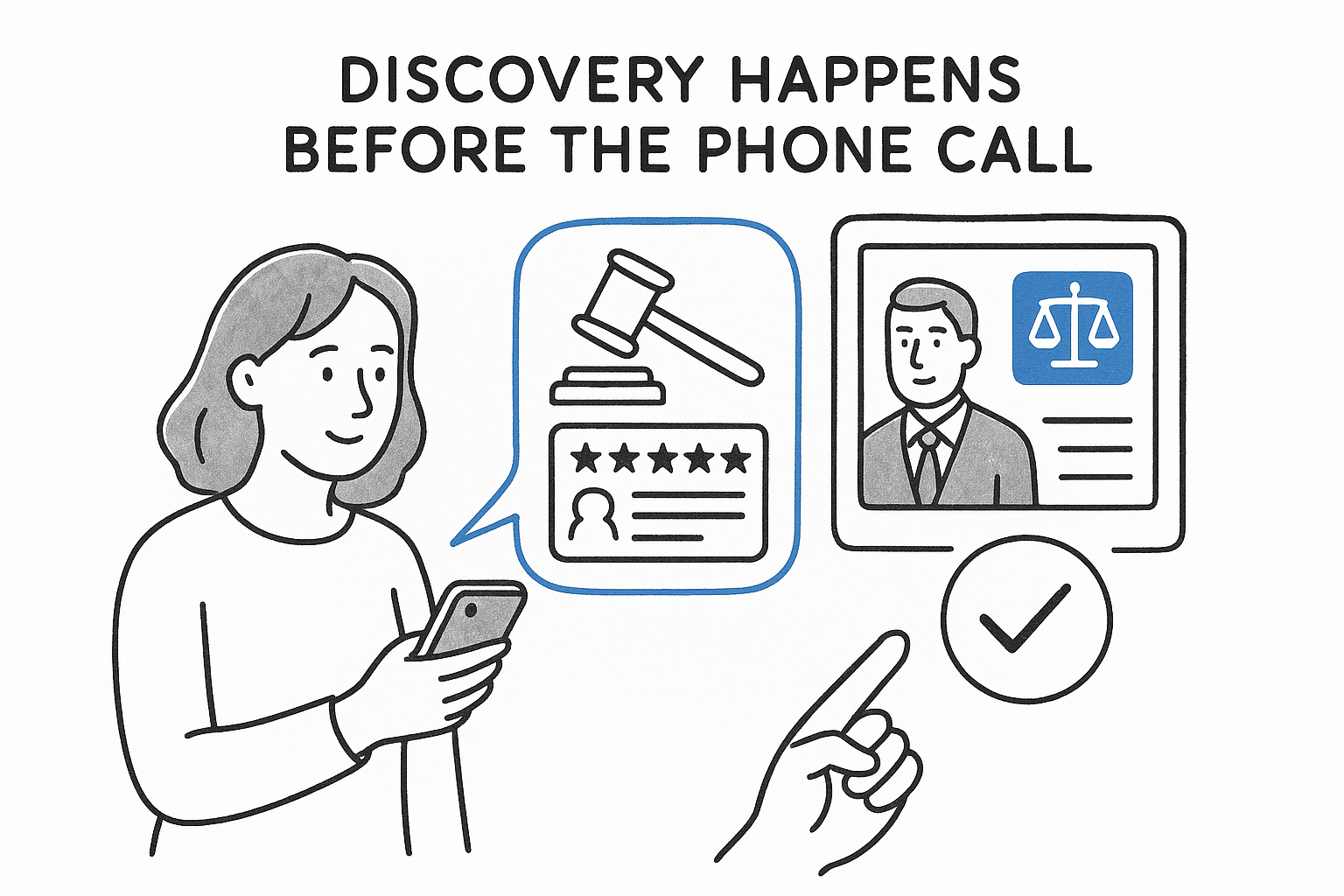
Discovery happens before the phone call
Social profiles function as a pre-consultation screening tool. A prospective client sees your firm's video explaining what to do after a rear-end collision, checks your reviews, skims a few comments, and decides whether you sound competent and approachable. Skip that step and you're invisible during the exact window when trust gets built. This is also where practice-area fit matters most, since a criminal defense attorney's audience behaves nothing like a mass-tort intake team's audience.
Referrals still happen, but they get verified online
Word-of-mouth hasn't died, it just gets a background check now. Someone's cousin recommends a personal injury attorney, and the first thing that person does is search the name and land on a thin, outdated Facebook page. A weak or abandoned profile can undo a warm referral in seconds. Consistent posting signals that the firm is active, responsive, and still practicing, which matters more than most firms realize when a referral is on the fence.
A dormant social profile can quietly cancel out a warm referral before the phone ever rings.
Compliance stakes are higher than in most industries
Unlike a roofing company or a dentist, your firm's posts fall under state-bar advertising rules and the ABA Model Rules of Professional Conduct, specifically Rules 7.1 through 7.3 governing communications about legal services. A boastful case result post, an implied guarantee, or a testimonial without required disclaimers can trigger a bar complaint, not just a bad look. That risk is part of why generic marketing agencies that treat legal like any other vertical get firms into trouble, and why a platform built with legal-specific compliance defaults matters more here than in most industries.
The competition isn't waiting for you
Firms in your practice area and market are already posting, and GavelGrow's modelled benchmarks show a real gap between firms that treat social as a funnel and firms that treat it as an afterthought. If you're not showing up in the scroll, a competing firm in your city almost certainly is. That's the practical case for social media marketing: it's not about chasing trends, it's about not ceding a discovery channel to the firm down the street that's already using GavelGrow's marketing dashboard to tie every post and comment back to a signed case.
Step 1. Define your audience and marketing goals
Guessing who you're talking to is the fastest way to waste a posting schedule. Before you write a single caption, nail down which practice area you're marketing and what that specific client is worried about at 11pm the night before they finally search for a lawyer. A mass-tort intake team needs national reach and volume; a solo family law attorney needs local trust and a face people recognize at the grocery store. Those are two entirely different social strategies wearing the same label.
Get specific about your ideal client
Skip broad statements like "people who need a lawyer." Instead, write a one-paragraph profile for each practice area you handle: their age range, the moment that triggered their search, and the question they'd type into Google at 2am. A DUI defense client Googling "what happens after a first arrest" behaves nothing like an estate planning client researching "how to update a will after remarriage." Practice-area specificity should drive every content decision that follows, including which platform you choose in the next step.
Set goals tied to signed cases, not likes
Follower counts and engagement rates feel good in a monthly report, but they don't pay overhead. Set goals around the metrics that actually predict revenue: consultation requests generated, qualified leads per month, and eventually, cost-per-signed-case once you can trace a post back to a retainer. GavelGrow's marketing dashboard exists specifically because most firms can see likes and comments but have no idea which post produced their last three signed cases.
If a metric doesn't eventually connect to a signed retainer, it's a vanity number, not a goal.
Write your goals down in a format you can actually check against reality every 30 days:
- Audience: Which practice area and which specific client situation are you targeting first?
- Platform priority: Where does that client already spend time, based on the table in the section above?
- Lead target: How many consultation requests per month justify the time invested?
- Conversion target: What percentage of those leads should turn into signed cases within your typical intake timeline?
- Review cadence: When will you check actual numbers against these targets, monthly or quarterly?
Without this baseline, every later step, from platform choice to posting cadence to ROI tracking, is guesswork dressed up as strategy.
Step 2. Choose the right platforms for your practice
Picking every platform at once guarantees you'll do all of them poorly. Platform selection should follow directly from the audience profile you just wrote, not from whatever app your marketing coordinator personally enjoys using. A firm handling mass torts needs national reach and shareable video; a solo estate planning attorney needs local trust signals and a face people recognize. Match the platform to the client's search behavior, not to internal preference.
Match platform to practice area
Different practice areas cluster on different platforms because the clients themselves are different ages, in different moods, and searching for different things.
Resist the urge to be everywhere
Spreading a two-person marketing team across five platforms produces five thin, inconsistent feeds instead of one strong one. Choose one primary platform where your practice area's clients already spend time, plus one secondary platform for repurposed content, and stop there for the first six months. Firms that concentrate effort on one channel post more consistently, which matters more to the algorithm and to prospective clients than being technically present everywhere.
One platform posted consistently beats five platforms posted sporadically.
Weigh organic reach against paid social options
Organic posts build long-term trust, but paid social, particularly Facebook and Instagram ads targeted by geography and life event, generates faster consultation volume for practice areas like personal injury and family law. LinkedIn ads work well for business and employment law targeting company decision-makers directly. Firms running paid campaigns without in-house media buyers often move that spend into GavelGrow's managed services, where a strategist handles targeting, creative, and budget pacing while the firm keeps oversight through the same dashboard used for organic performance.
Whichever mix you choose, revisit it every quarter, comparing your cost-per-lead with modelled benchmark ranges for your practice area and market size.
Step 3. Build a content calendar and posting cadence
Consistency beats frequency every time. A content calendar turns random posting into a system, and it doesn't need to be complicated: a spreadsheet with a date, platform, topic, and status column covers most firms through their first year. What matters is that you commit to a cadence you can sustain for months, not a burst of daily posts that dies out after three weeks when the person managing it gets busy with actual casework.
Pick a cadence you can actually keep
Realistic beats ambitious here. Most solo and small firms do better posting three times a week on one primary platform than trying for daily content across three. Build your calendar around this rhythm:
- 2-3 educational posts per week answering real client questions ("What happens at a DUI arraignment?")
- 1 firm-culture or team post per week to humanize the practice
- 1 case-result or testimonial post per week, reviewed against your state bar's disclaimer requirements before it goes live
- 1 review or client-feedback repost when you have a fresh five-star review to share
A sustainable three-post-a-week cadence beats a daily posting streak that quits after a month.
Build content around real client questions
Source topics from your own intake calls and past consultations, not from generic content lists. If three prospective clients asked your intake staff the same question about medical bills after an accident last month, that's your next video script. This ties directly back to the audience profile from Step 1, since the questions a DUI client asks differ completely from what an estate planning client wants to know.
Batch production to avoid burnout
Record four or five short videos in one afternoon instead of scrambling for content the morning a post is due. Batching also makes it easier to review everything for compliance risk at once, rather than approving posts one at a time under deadline pressure. Set a recurring monthly block, even 90 minutes, where the attorney records answers to five common questions, then have your marketing coordinator schedule them across the following weeks. Firms using GavelGrow's marketing dashboard can log which batch of content drove which leads, so you know within a month whether the topics you picked are actually working.
Step 4. Engage with your audience while staying compliant
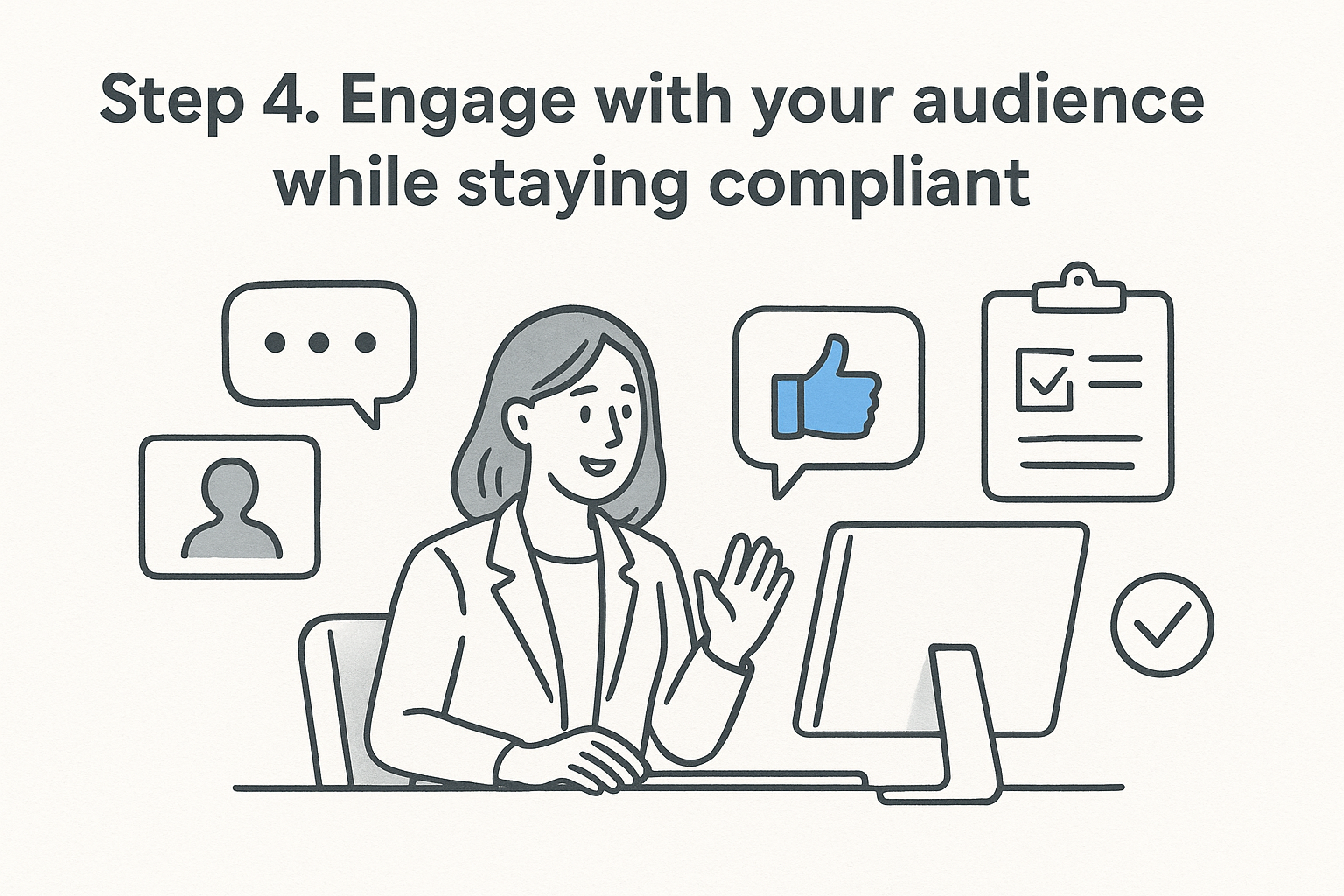
Posting content is only half the job. Engagement is where prospective clients decide whether your firm actually cares or just broadcasts. Someone comments "this happened to my brother, what should he do?" under your DUI explainer video, and your response time and tone tell them more about your firm than the original post did. Treat every comment section as a live extension of your intake process, not an afterthought your marketing coordinator checks once a week.
Respond fast, but never give legal advice publicly
Every comment or DM asking about a specific situation deserves a quick, warm reply that moves the conversation to a private channel: "Sorry to hear that, send us a DM or call [number] so we can look at the details." Never answer case-specific questions in a public comment thread. Doing so risks forming an unintended attorney-client relationship and can violate ABA Model Rule 1.18 on prospective clients, which applies even to a casual reply on Instagram. Build a short response template library so whoever manages your account isn't improvising under pressure:
Template - specific case question in comments:
"Really sorry you're dealing with this. Every case is different, so let's talk
privately: call/text us at [phone] or send a DM with a good time to talk."
Template - general question in comments:
"Great question! [Short factual answer]. If you want to talk about your
specific situation, we're happy to do a free consultation: [link]."
Train whoever manages the account on advertising rules
Whoever posts and replies on your behalf needs to know your state bar's rules on testimonials, case results, and comparative claims before they touch the keyboard, not after a complaint arrives. Many state bars, including California and Texas, require specific disclaimers on any post mentioning a settlement amount or past result. Keep a one-page compliance cheat sheet next to your content calendar covering banned words, required disclaimers, and who signs off before a post goes live.
The fastest reply loses if it's the one that gets you a bar complaint.
Turn comments into tracked leads, not lost opportunities
A DM that goes unanswered for three days is a lead you paid to generate and then let go cold. GavelGrow's unified inbox pulls social messages alongside SMS, email, and voicemail into one conversation view, so a comment that turns into a DM that turns into a phone call stays attached to the same lead record instead of scattering across four apps nobody checks consistently.
Step 5. Track ROI and connect posts to signed cases
Most firms can tell you their follower count but not which post produced their last signed case. That gap is exactly what breaks social media budgets year after year. Tracking ROI means building a chain from ad click or organic post, to lead, to consultation, to signed retainer, and checking that chain regularly instead of trusting platform-native analytics that stop at "engagement."
Set up attribution before you post, not after
Instagram and Facebook's built-in insights tell you reach and clicks, but they have no idea whether that click became a client. Before launching a campaign, make sure every link in your bio, every ad, and every intake form carries a trackable source tag. GavelGrow's intake forms capture that source automatically and pass it straight into the lead record, so a lead from a TikTok bio link doesn't get lumped in with one from a Google search ad.
Use call tracking for the leads who skip the form
A lot of social leads don't fill out a form. They see your video, then just call the number in your profile. Without a dedicated number, that call looks like organic traffic with no source at all. Call tracking assigns a unique number per campaign, so a call from your Facebook bio link is tagged separately from one off your Google Business Profile. GavelGrow's built-in call tracking replaces the CallRail subscription most firms already pay for, and it tags each call qualified, callback, unqualified, or spam, right inside the same dashboard used for your posting calendar.
Calculate cost-per-signed-case, not cost-per-lead
Cost-per-lead is a comfortable number because it's usually low. Cost-per-signed-case is the number that actually matters, and it's often five or ten times higher once you filter out spam, unqualified inquiries, and leads who never answer a callback.
Cost-per-lead flatters a campaign; cost-per-signed-case tells you the truth.
Run the math monthly:
- Total social spend (ad budget plus staff time, if managed in-house)
- Divide by number of leads generated from social sources
- Multiply by the inverse of your lead-to-signed-case conversion rate
- Compare the result against your other channels and against GavelGrow's modelled practice-area benchmarks
If social's cost-per-signed-case beats your paid search number, put more budget there. If it doesn't, you've saved yourself months of guessing.
Building a strategy you can sustain
Social media marketing for a law firm isn't complicated once you strip away the vanity metrics. Pick one or two platforms your practice area's clients actually use, post on a cadence you can keep for a year rather than a month, stay inside your state bar's rules on testimonials and case results, and never let a comment or DM sit unanswered while a competitor's firm answers first. The firms winning this channel aren't posting more, they're tracking better, tying every click and comment back to a signed retainer instead of a follower count.
If you're still guessing which posts actually produce clients, that's the exact gap GavelGrow's platform closes, from call tracking to unified inbox to full attribution. Book a free 45-minute strategy call and we'll walk through what your social funnel could look like with real numbers attached.
Frequently Asked Questions
Is social media marketing worth it for law firms?
Yes, when you treat it as a client-acquisition channel rather than a vanity project. Prospects research firms on social before they call, and referrals get verified online — so an active, compliant presence builds trust that converts. It only pays off when you tie posts to signed cases with real attribution, not likes and follower counts.
Which social media platform is best for a law firm?
Match the platform to your practice area and audience rather than trying to be everywhere. LinkedIn suits business law and B2B; Facebook and Instagram reach consumer-facing practices like personal injury and family law; and short-form video on TikTok or Instagram Reels can work for firms comfortable with that format. Pick one or two you can post to consistently.
How often should a law firm post on social media?
Pick a cadence you can actually sustain — a consistent two or three posts a week beats a daily burst that fizzles out in a month. Batch-produce content in blocks to avoid burnout, and build posts around the real questions clients ask, since consistency and relevance matter far more than raw volume.
What are the compliance risks of law firm social media?
The stakes are higher than in most industries. Bar advertising rules govern claims, testimonials, and disclaimers, and replying to a comment with specific guidance can look like giving legal advice or forming an attorney-client relationship. Respond quickly but never give case-specific advice publicly, and route real questions to a private, tracked intake channel.
Should a law firm use organic social media or paid social ads?
Both have a place. Organic builds long-term trust and authority but reaches slowly; paid social buys targeted reach and speed but costs money per result. Most firms use organic to establish credibility and paid social to accelerate qualified leads — and track both to cost-per-signed-case so you know which is actually working.
How do I measure ROI from law firm social media?
Set up attribution before you post, not after. Use tracked links and call tracking so leads who skip the form still get credited, connect those leads to your intake system, and calculate cost-per-signed-case rather than cost-per-lead or cost-per-like. The signed-case number is the only one that tells you whether the channel funds itself.
How do I turn social media followers into clients?
Followers convert when every post has a clear next step and every inbound comment or message becomes a tracked lead instead of a lost opportunity. Respond fast, move the conversation to a private intake channel, and measure which content produces consultations — then make more of what actually signs cases.
Frequently Asked Questions
Is social media marketing worth it for law firms?
Yes, when you treat it as a client-acquisition channel rather than a vanity project. Prospects research firms on social before they call, and referrals get verified online — so an active, compliant presence builds trust that converts. It only pays off when you tie posts to signed cases with real attribution, not likes and follower counts.
Which social media platform is best for a law firm?
Match the platform to your practice area and audience rather than trying to be everywhere. LinkedIn suits business law and B2B; Facebook and Instagram reach consumer-facing practices like personal injury and family law; and short-form video on TikTok or Instagram Reels can work for firms comfortable with that format. Pick one or two you can post to consistently.
How often should a law firm post on social media?
Pick a cadence you can actually sustain — a consistent two or three posts a week beats a daily burst that fizzles out in a month. Batch-produce content in blocks to avoid burnout, and build posts around the real questions clients ask, since consistency and relevance matter far more than raw volume.
What are the compliance risks of law firm social media?
The stakes are higher than in most industries. Bar advertising rules govern claims, testimonials, and disclaimers, and replying to a comment with specific guidance can look like giving legal advice or forming an attorney-client relationship. Respond quickly but never give case-specific advice publicly, and route real questions to a private, tracked intake channel.
Should a law firm use organic social media or paid social ads?
Both have a place. Organic builds long-term trust and authority but reaches slowly; paid social buys targeted reach and speed but costs money per result. Most firms use organic to establish credibility and paid social to accelerate qualified leads — and track both to cost-per-signed-case so you know which is actually working.
How do I measure ROI from law firm social media?
Set up attribution before you post, not after. Use tracked links and call tracking so leads who skip the form still get credited, connect those leads to your intake system, and calculate cost-per-signed-case rather than cost-per-lead or cost-per-like. The signed-case number is the only one that tells you whether the channel funds itself.
How do I turn social media followers into clients?
Followers convert when every post has a clear next step and every inbound comment or message becomes a tracked lead instead of a lost opportunity. Respond fast, move the conversation to a private intake channel, and measure which content produces consultations — then make more of what actually signs cases.