Personal Injury Attorney Advertising: 8 Strategies and Examples
Categories: Legal Marketing Strategies
 Abram Ninoyan
Founder & Senior Performance Marketer
Credentials: Google Partner, Google Ads Search Certified, Google Ads Display Certified, Google Ads Measurement Certified, Google Analytics (IQ) Certified, HubSpot Inbound Certified, HubSpot Social Media Marketing Certified, Conversion Optimization Certified
Expertise: Google Ads, Meta Ads, Conversion Rate Optimization, GA4 & Google Tag Manager, Lead Generation, Marketing Funnel Optimization, PPC Management
LinkedIn Profile
Personal injury is the most competitive practice area in legal marketing, and generic ads get buried fast. Personal injury attorney advertising works only when it's built around speed-to-lead and a me...
Key Takeaways
- Personal Injury Attorney Advertising: 8 Strategies and Examples
- 1. Use a legal marketing platform for full-funnel attribution
- 2. Run local TV and streaming video ads
- 3. Invest in Google search and Local Services ads
Personal Injury Attorney Advertising: 8 Strategies and Examples
Personal injury is the most competitive practice area in legal marketing, and generic ads get buried fast. Personal injury attorney advertising works only when it's built around speed-to-lead and a message that separates you from the ten other firms bidding on the same "car accident lawyer near me" keyword. If your cost-per-lead keeps climbing while signed cases stay flat, the problem usually isn't your budget, it's the strategy behind the spend.
This article answers the real question firm owners ask: which advertising strategies actually turn clicks into signed retainers, not just phone calls. You'll see eight proven approaches, from Google Local Services Ads to mass-tort-specific campaigns, each with real examples from firms doing it well. We also flag the compliance traps unique to personal injury advertising, since state bars scrutinize this practice area more than most.
Whether you're running ads in-house or evaluating an agency, you'll walk away with tactics you can test this month. We'll also point out where tracking and intake automation determine whether a strategy actually pays off, because the best ad in the world fails if a lead sits unanswered for 30 minutes.
1. Use a legal marketing platform for full-funnel attribution
Most personal injury firms track cost-per-lead, but that number lies to you. A campaign can generate cheap leads that never sign, while a pricier campaign quietly delivers your best cases. A legal marketing platform fixes this by tracking every lead from the ad click all the way to the signed retainer, so you know which channels actually make you money instead of which ones just fill your pipeline with tire-kickers.
How it works
A platform like GavelGrow's marketing dashboard connects your intake forms, call tracking, and case management into one attribution chain. Every lead gets tagged with the campaign that produced it, then followed through triage, intake, and signature. Instead of guessing, you see cost-per-signed-case by campaign, not just cost-per-lead. Built-in call tracking replaces a separate tool like CallRail, and intake automation fires SMS and email within 60 seconds of capture, which matters because leads contacted in under 5 minutes are 21 times more likely to qualify than those contacted after 30, according to a widely cited Lead Response Management Study.
The firms winning at personal injury advertising aren't spending more, they're the only ones who can actually see which dollar produced which case.
Who it's best for
This approach suits solo practitioners up through 15-seat firms running marketing in-house who are tired of stitching together CallRail, a CRM, and a spreadsheet just to answer one question: what's working? It also fits firms juggling multiple practice areas or locations, where campaign-level clarity separates a profitable market from a money pit.
Typical cost
GavelGrow's platform runs $199 to $599 per month depending on tier, with a 7-day free trial and no credit card required. Compare that to paying separately for call tracking, an intake CRM, and reporting software, which often runs $500 to $1,500 monthly before you've spent a dollar on ads. See the full breakdown on the pricing page.
What to watch out for
A platform only helps if your team actually acts on the data. Firms that install attribution tools but keep the same slow follow-up habits see no improvement in signed cases, only better visibility into the problem. You also need clean UTM tagging on every campaign, or the attribution chain breaks before it starts.
2. Run local TV and streaming video ads
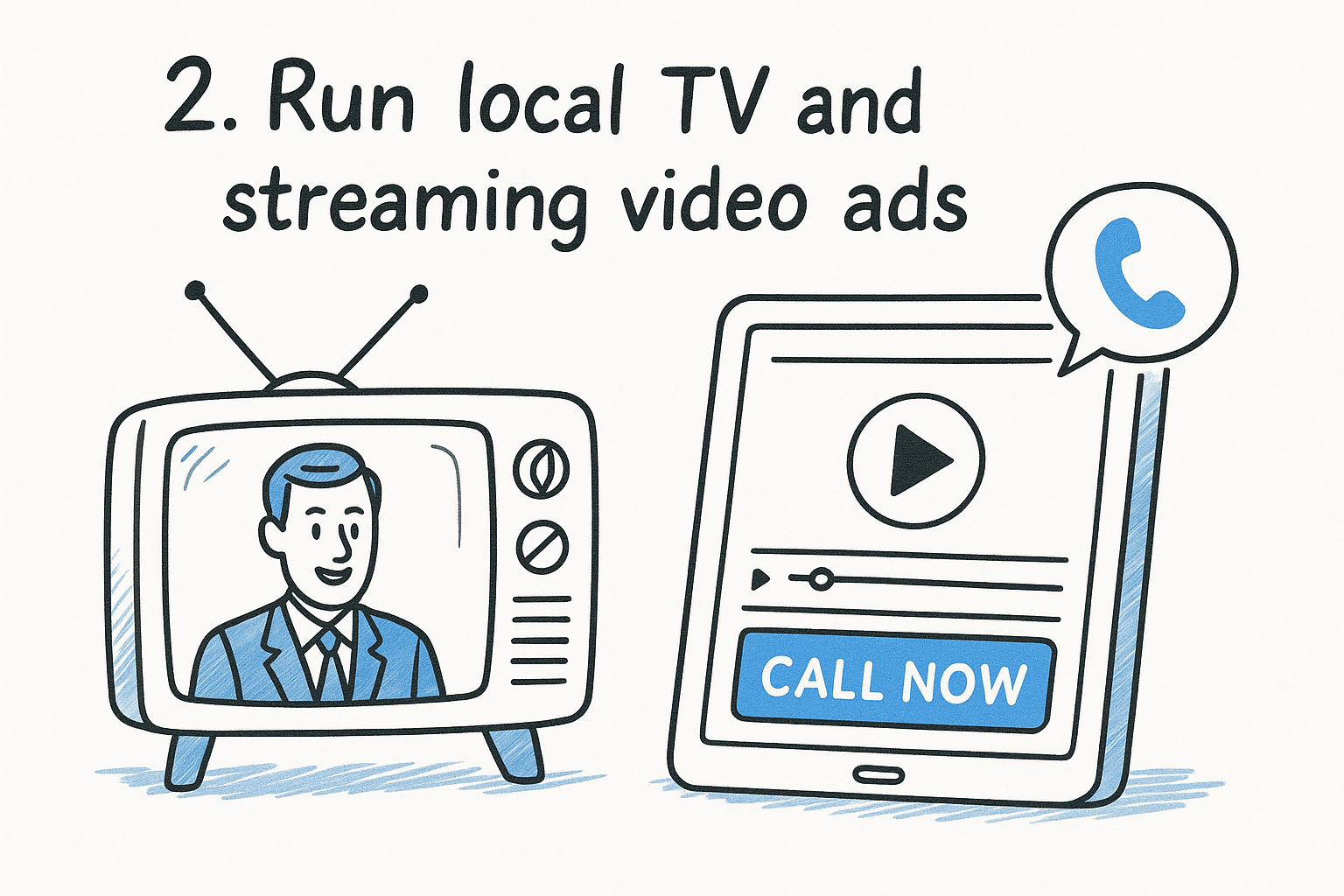
Personal injury firms built their reputations on TV long before Google existed, and local spots still work when the message is memorable. Think of the billboard lawyers who became local celebrities. That same recognition now extends to connected TV and streaming platforms like Hulu and YouTube TV, where firms buy targeted spots instead of blanket local cable buys.
How it works
Buying works two ways: traditional local broadcast slots during news or daytime programming, or programmatic streaming ads targeted by zip code and household demographics. Streaming lets you target injury-prone demographics, think construction workers or commuters, without paying for the entire viewing area. Either way, the ad needs a phone number and a simple message repeated often enough that it sticks.
A memorable 30-second spot only pays off if the phone gets answered on the first ring.
Who it's best for
This channel fits mass tort and high-volume personal injury firms with the budget to sustain months of frequency. It rarely works for solo practitioners testing their first ad dollars, since brand recall takes repetition most small firms can't afford yet.
Typical cost
Local TV spots run $500 to $5,000 per airing depending on market size and time slot, according to typical local broadcast rate cards. Streaming CPMs run lower, often $20 to $40 per thousand impressions, but require higher volume to move the needle.
What to watch out for
TV drives calls, not always qualified leads. Without call tracking tied to each spot, you can't tell which airing produced signed cases versus wrong-number dials.
3. Invest in Google search and Local Services ads
When someone types "car accident lawyer near me" right after a crash, they're ready to hire, not browse. Google search advertising puts your firm in front of that intent immediately, and it remains the highest-converting channel for personal injury attorney advertising because you're paying for demand that already exists.
How it works
Google Ads runs on keyword auctions, so you bid on terms like "personal injury lawyer" or "slip and fall attorney [city]" and pay per click. Local Services Ads work differently: Google vets your bar license and insurance, then charges per lead instead of per click, and your listing carries a Google Screened badge that builds instant trust. Most firms run both side by side, since LSAs catch bottom-funnel searchers while search ads cover broader terms.
Search ads sell intent, and intent converts faster than any other traffic source in personal injury marketing.
Who it's best for
This fits any firm with a defined service area, from solo practitioners to regional mass-tort shops, because both formats scale with budget. LSAs especially suit firms new to paid ads, since Google's pay-per-lead model limits downside risk while you test messaging.
Typical cost
Personal injury keywords rank among the most expensive in Google Ads, often $100 to $500 per click in competitive metros, based on commonly reported legal-vertical cost-per-click benchmarks. LSA leads typically run $20 to $150 depending on practice area and market.
What to watch out for
Without carrier-level phone validation and duplicate detection, you'll pay premium prices for spam clicks and bot-filled forms that never should have counted as leads.
4. Strengthen local SEO and your Google Business Profile
Paid clicks stop the moment you stop paying, but local SEO keeps working long after you build it. For personal injury attorney advertising, ranking in the map pack for "[city] personal injury lawyer" puts you in front of searchers without a per-click bill attached, and that compounding visibility is why firms that invest early pull ahead of competitors still renting their traffic.
How it works
Google ranks local results using proximity, relevance, and prominence, so you need a fully optimized Google Business Profile with accurate categories, consistent name-address-phone data, and regular posts. Beyond the profile, you need location-specific landing pages, citations on legal directories like Avvo and Justia, and backlinks from local news or bar associations. Review volume and recency also factor heavily into map pack rankings, according to Google's own local ranking guidance.
Local SEO is the only channel where yesterday's work still pays you today.
Who it's best for
This strategy suits single-location firms and solo practitioners competing in a defined geographic market, since local pack visibility matters far more than national search volume for them. Firms with multiple offices benefit too, but need a separate profile and page strategy for each location.
Typical cost
Agencies typically charge $1,500 to $5,000 monthly for ongoing local SEO management, while DIY efforts cost only time, roughly 5 to 10 hours a month for profile updates, citation cleanup, and review requests.
What to watch out for
Inconsistent business listings across directories confuse Google's algorithm and tank rankings. Duplicate or suspended profiles from franchise-style firms are a common, avoidable mistake.
5. Publish educational content and video marketing
Injury victims research before they call, often googling their diagnosis, their state's statute of limitations, or "what's my case worth" at 11pm from a hospital bed. Educational content answers those questions and positions your firm as the obvious call when they're ready to hire. Video works especially well here, since seeing an attorney explain a process builds trust faster than any block of text.
How it works
Build a library of short videos and articles answering the exact questions injury victims type into Google: what to do after a car accident, how insurance adjusters lowball claims, how long a case takes. Post them on YouTube, embed them on service pages, and repurpose clips for social. Pair this with schema markup and clear headings so search engines can surface answers directly. This content also feeds your Google Business Profile posts and answers PAA boxes, extending your local SEO work from strategy four.
The firm that answers the question first usually gets the call, not the firm with the biggest ad budget.
Who it's best for
Solo and small firms with limited ad budgets benefit most, since content compounds without a per-click cost. Firms handling niche practice areas, like specific medical device or rideshare accident cases, also gain outsized traction because competition for that content is thinner.
Typical cost
Producing a solid video costs $300 to $2,000 depending on production quality, while written content runs $150 to $500 per article if outsourced. A consistent monthly cadence, four to six pieces, typically runs $1,500 to $4,000.
What to watch out for
Content without a conversion path, meaning a clear phone number, chat widget, or intake form, wastes traffic. Stale content that never gets updated also loses rankings within a year or two.
6. Advertise on billboards and in print
Drive any interstate near a mid-size city and you'll spot a personal injury lawyer's face on a billboard within a few miles. Billboard and print advertising feels old-fashioned next to Google Ads, but it still builds the brand recognition that makes someone type your firm's name into Google instead of searching "car accident lawyer" and clicking whoever bids highest.
How it works
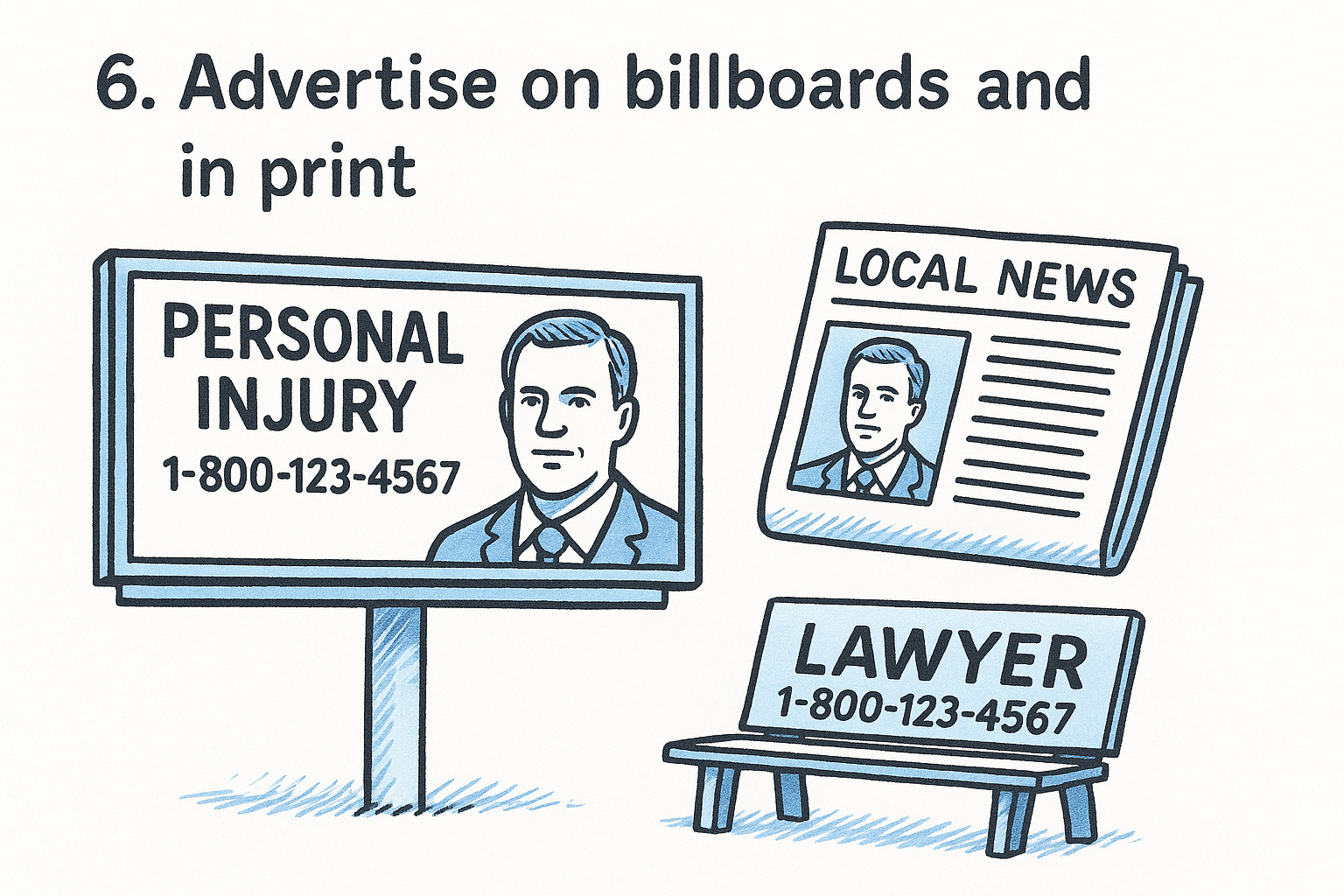
Billboards work through repetition and placement, so you want high-traffic highways, routes near hospitals, or spots close to courthouses where jury pools and referral sources see your name daily. Print ads in local newspapers, community magazines, or bus benches reinforce that same recognition at a lower cost per impression. The message needs to be simple: a phone number, a memorable slogan, and a face people recognize when they need help.
Billboards don't generate leads directly, they make your other ads convert better because the name already feels familiar.
Who it's best for
This channel suits established firms with a local reputation to protect and enough case volume to justify brand spend that doesn't show up in a lead tracker. It rarely makes sense for a solo attorney's first advertising dollar.
Typical cost
Billboard space runs $1,500 to $10,000 per month depending on location and traffic count, while local print placements typically cost $200 to $1,500 per run, according to standard outdoor advertising rate cards.
What to watch out for
Billboards are nearly impossible to attribute directly to signed cases. Track branded search volume and direct phone lines separately, or you'll never know if the spend is working.
7. Build a presence on social media
Accident victims and their families check a firm's Facebook and Instagram presence before they call, often looking for proof that real clients trusted you and got results. Social media won't replace search ads as a lead source, but it builds the credibility that makes someone click your ad instead of a competitor's when both show up in the same search.
How it works
Post a mix of case results (redacted for confidentiality), client testimonials, community involvement, and short educational clips explaining things like fault determination or medical lien basics. Paid social campaigns on Facebook and Instagram can also retarget website visitors who didn't convert, showing them a testimonial or free consultation offer a few days later. LinkedIn matters too, but mainly for referral relationships with other attorneys, not direct client acquisition.
Social proof closes the trust gap that a paid ad alone can't close.
Who it's best for
This fits firms of any size that already generate client success stories and want a low-cost way to reinforce trust across every other channel. It's especially valuable for firms handling emotionally sensitive cases, like wrongful death or catastrophic injury, where families research extensively before reaching out.
Typical cost
Organic posting costs only staff time, roughly 3 to 5 hours weekly for content creation and community management. Paid retargeting campaigns typically run $500 to $2,500 monthly, far less than cold prospecting campaigns on the same platforms.
What to watch out for
Posting client details without signed consent risks state bar violations and confidentiality breaches. Inconsistent posting also hurts more than not posting at all, since an abandoned profile signals a firm that's stopped growing.
8. Generate and showcase client reviews
A five-star Google review often carries more weight than any ad you'll run, because injury victims trust past clients over a firm's own marketing copy. Client reviews shape which firm gets the call when someone compares three attorneys side by side after a crash, and they directly influence your local map pack ranking from strategy four.
How it works
Build a systematic review generation process into your intake workflow: a text or email requesting feedback fires automatically once a case closes. Ask every client, not just the happy ones, since Google prohibits selectively soliciting positive reviews. When a client is unhappy, resolve it with them directly and still reply professionally to any public review. Showcase strong reviews on your website, in ads, and on your Google Business Profile, since fresh, specific reviews (naming the injury type or outcome) convert better than generic five-star ratings.
A firm with 200 recent five-star reviews beats a firm with a bigger ad budget almost every time.
Who it's best for
Every personal injury firm benefits here, but it matters most for solo and small firms competing against established names with decades of reputation. Reviews level that playing field faster than almost any other tactic on this list.
Typical cost
Review management software runs $100 to $300 monthly, though many case management platforms include basic request automation for free. Agencies charge $500 to $1,000 monthly to manage the full outreach and response cycle.
What to watch out for
Offering incentives for reviews violates most state bar rules and Google's own policies. Ignoring negative reviews publicly also damages trust more than the review itself.
Turning advertising into signed cases
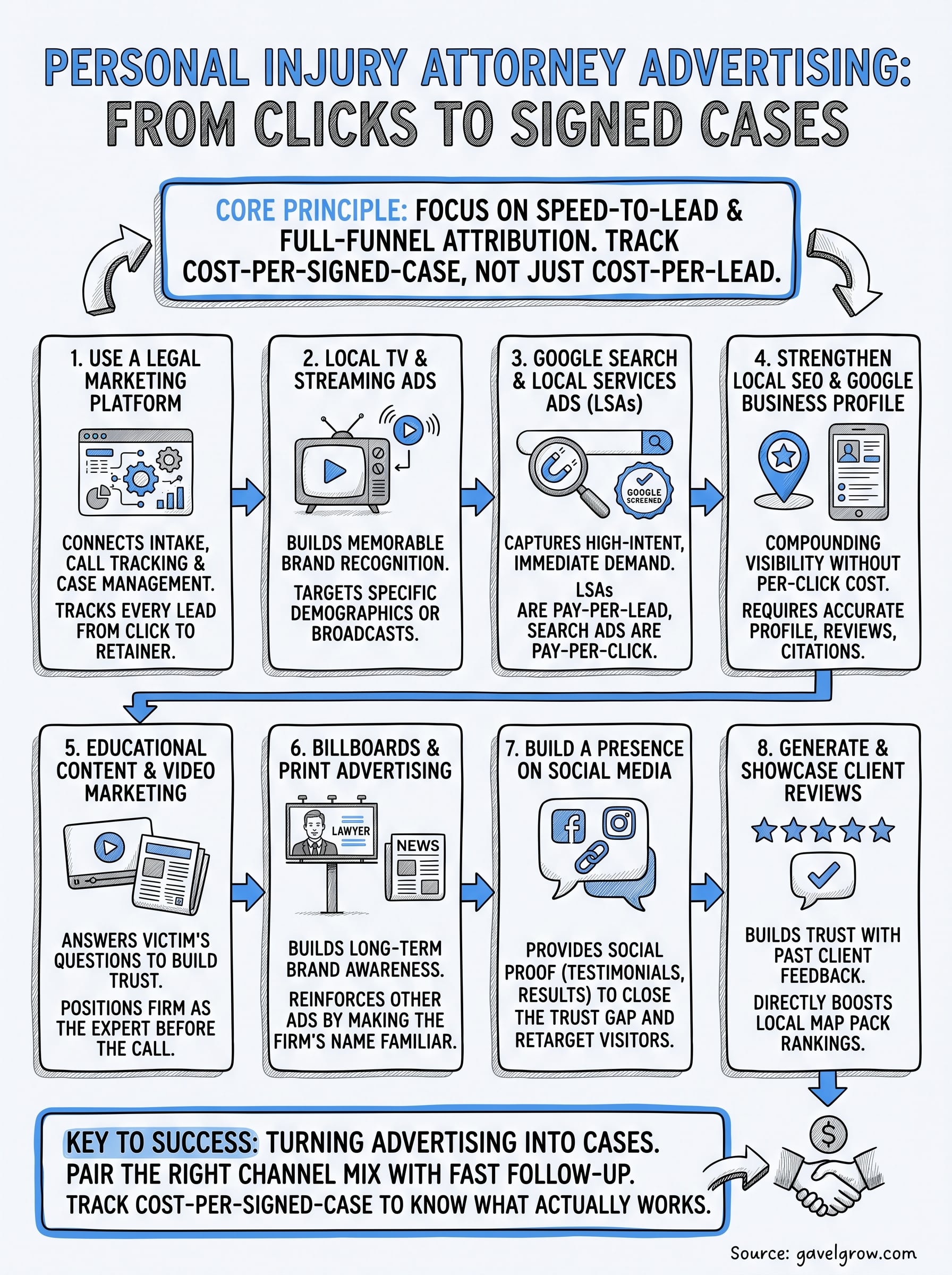
None of these eight strategies work in isolation. Personal injury attorney advertising succeeds when you pair the right channel mix with fast, tracked follow-up, because a brilliant campaign still fails if a lead sits unanswered for 20 minutes. Billboards build the name recognition, Google Ads and LSAs capture ready-to-hire searchers, and local SEO plus reviews keep compounding long after you stop paying for clicks.
What separates firms that grow from firms that just spend more is visibility into which dollar produced which signed case. Guessing at attribution wastes budget on channels that only look productive. If you're still tracking cost-per-lead instead of cost-per-signed-case, that's the gap to close first.
Ready to see where your current campaigns actually stand? Book a free 45-minute strategy call and we'll walk through your funnel, your numbers, and what to fix first.
Frequently Asked Questions
Is personal injury advertising restricted by state bar rules?
Yes, and more heavily than most practice areas. State bars regulate claims about past results, testimonials, and anything that could mislead. You generally cannot guarantee outcomes, and many bars require a disclaimer when you advertise a settlement or verdict. Before running any campaign, check your state bar’s advertising rules and keep records of what you ran, since personal injury is one of the most scrutinized areas in legal advertising.
How much should a personal injury firm spend on advertising?
There is no universal number. Most firms treat advertising as a percentage of revenue and scale it to how competitive their market is. What matters more than the total is the mix and the measurement: a smaller budget tracked to cost per signed case usually outperforms a larger one spread across channels you cannot attribute. Start with the channels closest to hiring intent, search and Local Services Ads, prove the return, then expand.
What is the best advertising channel for a personal injury law firm?
For most firms, Google Search and Local Services Ads convert fastest because they reach people actively looking to hire after an injury. But the best channel depends on your goal and budget: SEO and reviews compound over time, TV and billboards build the name recognition that makes every other channel convert better, and educational content earns trust with researchers. The firms that win run a tracked mix, not a single channel.
How do you measure ROI on personal injury advertising?
Track past clicks and calls to cost per signed case by channel, not just cost per lead. A campaign that produces cheap leads that never sign is more expensive than a pricier one that delivers retained clients. That requires connecting every lead, including phone calls, back to the campaign that produced it, then following it through intake to signature, which is exactly where most firms lose visibility.
How fast should you follow up with a personal injury lead?
As close to immediately as possible. Injury victims often contact several firms at once, and the one that answers first usually wins the case. Widely cited lead-response research found that reaching a new lead within five minutes makes you many times more likely to qualify it than waiting even half an hour, so automating an instant call, text, or email the moment a lead arrives protects the ad spend that produced it.
Do billboards and TV ads still work for personal injury firms?
Yes, but as brand-builders more than direct lead sources. Billboards, local TV, and streaming spots make your name familiar, so when someone later searches, they are more likely to pick you over a firm they have never seen. The catch is attribution: these channels are hard to tie directly to signed cases, so track branded search volume and dedicated phone lines separately, and expect them to make your other channels convert better rather than generate leads on their own.
Third-party product names, including CallRail, and all company names and trademarks are the property of their respective owners, referenced here for identification only and not affiliated with or endorsing GavelGrow. Advertising cost figures are general market estimates as of August 2026, not quotes; verify current pricing directly with each provider.
Frequently Asked Questions
Is personal injury advertising restricted by state bar rules?
Yes, and more heavily than most practice areas. State bars regulate claims about past results, testimonials, and anything that could mislead. You generally cannot guarantee outcomes, and many bars require a disclaimer when you advertise a settlement or verdict. Before running any campaign, check your state bar’s advertising rules and keep records of what you ran, since personal injury is one of the most scrutinized areas in legal advertising.
How much should a personal injury firm spend on advertising?
There is no universal number. Most firms treat advertising as a percentage of revenue and scale it to how competitive their market is. What matters more than the total is the mix and the measurement: a smaller budget tracked to cost per signed case usually outperforms a larger one spread across channels you cannot attribute. Start with the channels closest to hiring intent, search and Local Services Ads, prove the return, then expand.
What is the best advertising channel for a personal injury law firm?
For most firms, Google Search and Local Services Ads convert fastest because they reach people actively looking to hire after an injury. But the best channel depends on your goal and budget: SEO and reviews compound over time, TV and billboards build the name recognition that makes every other channel convert better, and educational content earns trust with researchers. The firms that win run a tracked mix, not a single channel.
How do you measure ROI on personal injury advertising?
Track past clicks and calls to cost per signed case by channel, not just cost per lead. A campaign that produces cheap leads that never sign is more expensive than a pricier one that delivers retained clients. That requires connecting every lead, including phone calls, back to the campaign that produced it, then following it through intake to signature, which is exactly where most firms lose visibility.
How fast should you follow up with a personal injury lead?
As close to immediately as possible. Injury victims often contact several firms at once, and the one that answers first usually wins the case. Widely cited lead-response research found that reaching a new lead within five minutes makes you many times more likely to qualify it than waiting even half an hour, so automating an instant call, text, or email the moment a lead arrives protects the ad spend that produced it.
Do billboards and TV ads still work for personal injury firms?
Yes, but as brand-builders more than direct lead sources. Billboards, local TV, and streaming spots make your name familiar, so when someone later searches, they are more likely to pick you over a firm they have never seen. The catch is attribution: these channels are hard to tie directly to signed cases, so track branded search volume and dedicated phone lines separately, and expect them to make your other channels convert better rather than generate leads on their own. Third-party product names, including CallRail, and all company names and trademarks are the property of their respective owners, referenced here for identification only and not affiliated with or endorsing GavelGrow. Advertising cost figures are general market estimates as of August 2026, not quotes; verify current pricing directly with each provider.