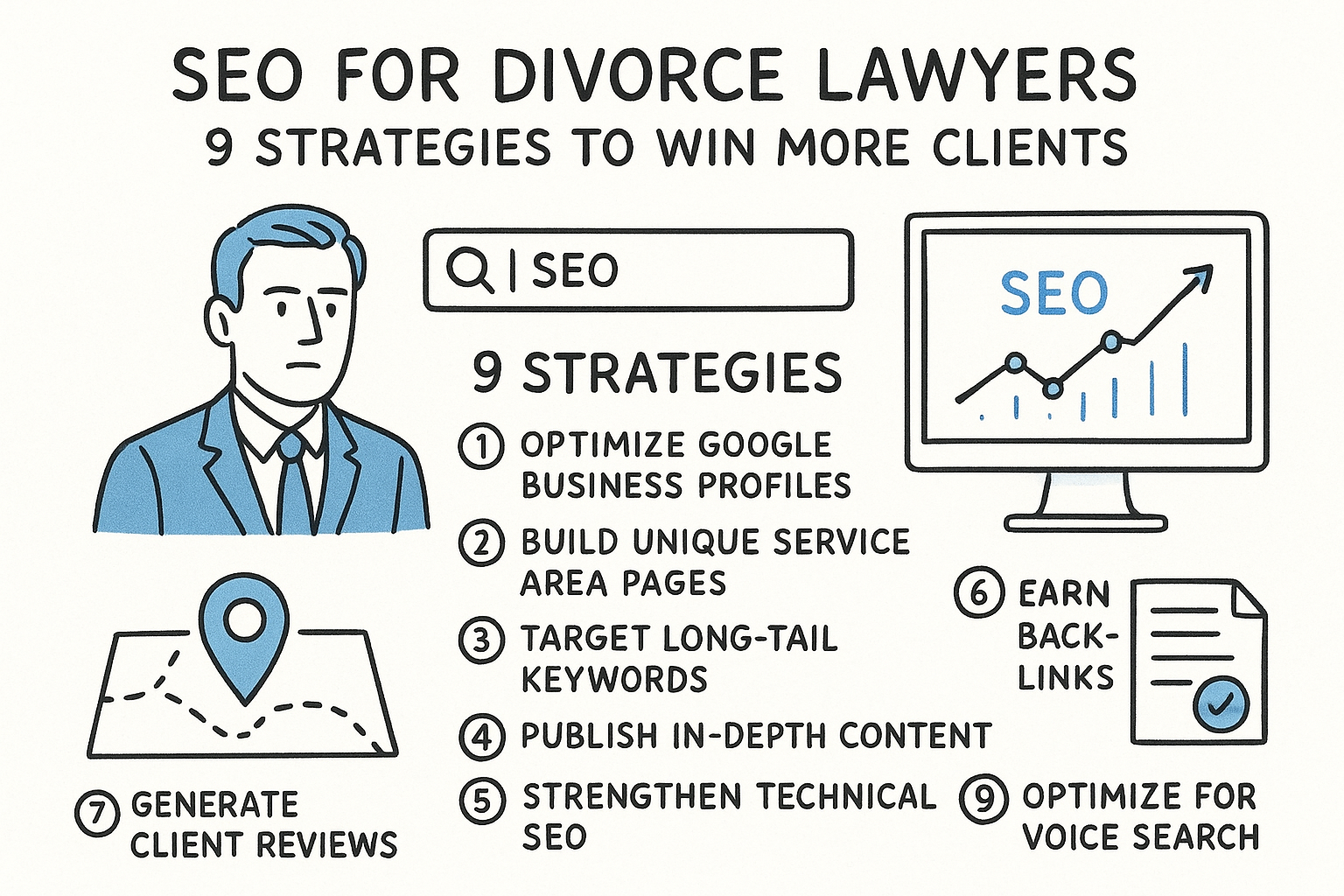
SEO for Divorce Lawyers: 9 Strategies to Win More Clients
Categories: Legal Marketing Strategies
 Abram Ninoyan
Founder & Senior Performance Marketer
Credentials: Google Partner, Google Ads Search Certified, Google Ads Display Certified, Google Ads Measurement Certified, Google Analytics (IQ) Certified, HubSpot Inbound Certified, HubSpot Social Media Marketing Certified, Conversion Optimization Certified
Expertise: Google Ads, Meta Ads, Conversion Rate Optimization, GA4 & Google Tag Manager, Lead Generation, Marketing Funnel Optimization, PPC Management
LinkedIn Profile
A potential client searching "divorce lawyer near me" at 11 p.m. rarely calls 20 firms and picks one at random. She Googles, scans the first page, and clicks two or three sites before fillin...
Key Takeaways
- SEO for Divorce Lawyers: 9 Strategies to Win More Clients
- 1. Track leads and revenue to prove your SEO ROI
- 2. Claim and optimize your Google Business Profile
- 3. Build location-specific service area pages
SEO for Divorce Lawyers: 9 Strategies to Win More Clients
A potential client searching "divorce lawyer near me" at 11 p.m. rarely calls 20 firms and picks one at random. She Googles, scans the first page, and clicks two or three sites before filling out a form. If your firm isn't on that first page, you're invisible during the exact moment someone needs you most. Seo for divorce lawyers isn't about chasing generic rankings, it's about showing up for the specific searches people run during one of the hardest decisions of their lives.
This article gives you nine concrete strategies that actually move the needle for family law practices, from local search optimization built around county-specific keywords to content that answers the questions divorcing spouses type into Google at 2 a.m. You'll also see where conversion tracking matters just as much as rankings, because traffic that never turns into a signed retainer isn't worth much.
Each strategy below includes what to do, why it works for divorce and family law specifically, and how to measure whether it's paying off. If you're tired of guessing whether your marketing spend is producing cases or just clicks, this is your starting point.
1. Track leads and revenue to prove your SEO ROI
Before you touch a single keyword or backlink, you need a way to know whether your seo for divorce lawyers work actually produces signed cases. Most firms track rankings and traffic, then stop there, which tells you almost nothing about whether that traffic pays your mortgage.
How it works
End-to-end tracking connects every organic visit to a specific lead, then follows that lead through intake to a signed retainer. That means tagging organic sessions in Google Analytics 4, tying phone calls and form fills back to the page and keyword that generated them, and recording what happened after your intake team picked up the phone. Full-funnel attribution requires more than a Google Analytics dashboard; you need call tracking tied to campaign source, a CRM or case management tool that logs outcomes, and a way to reconcile the two without manual spreadsheet work. GavelGrow's dashboard handles this natively, firing GA4 events with transaction values and linking every lead through to a signed case, so you can calculate cost-per-signed-case by channel instead of guessing from cost-per-lead alone.
If you can't tie a Google ranking to a signed retainer, you're marketing on faith, not data.
Why it matters for divorce lawyers
Divorce cases have a long, emotionally charged sales cycle, and a huge share of leads come in outside business hours. A 2011 Lead Response Management study led by MIT researcher James Oldroyd found leads contacted within 5 minutes are 21 times more likely to qualify than leads contacted after 30 minutes. That gap matters more in family law than almost any other practice area, because a prospective client Googling at midnight will move to the next firm on the list if nobody responds fast. Without conversion tracking that shows which keywords and pages generate leads who actually sign, you can't tell if your SEO investment is bringing in serious cases or just curious browsers who never book a consultation.
How to get started
Start with a simple audit of what you're currently measuring versus what you need:
From there, set up call tracking numbers on your key landing pages, connect your intake forms to a system that logs consent and outcome, and review the cost-per-signed-case report monthly rather than obsessing over ranking positions. If you're currently stitching together CallRail, a separate CRM, and a reporting tool that don't talk to each other, look at GavelGrow's platform to consolidate that into one view, or check pricing if you're ready to stop guessing and start measuring.
2. Claim and optimize your Google Business Profile
Google shows a map pack above the organic results for nearly every "divorce lawyer near me" search, and that map pack often gets more clicks than the listings below it. Google Business Profile optimization is the fastest lever you have for showing up there, and it costs nothing but time.
How it works
Your Google Business Profile (GBP) is the free listing that powers your map pack placement, showing your name, address, phone number, hours, reviews, and photos directly in search results. Google ranks these listings based on relevance, distance, and prominence, which includes review volume, review recency, and how completely you've filled out the profile. That means adding your practice areas as services, writing a keyword-rich business description, uploading real photos of your office, and posting updates regularly all feed the algorithm signals Google uses to decide who shows up first. You can verify and manage your profile directly through Google's Business Profile help center, which walks through verification and category selection in detail.
A complete, active Google Business Profile often outranks a firm with a better website but a neglected listing.
Why it matters for divorce lawyers
Divorce searches are almost always local, someone in your county wants a lawyer who can appear in family court there, not a national brand. The map pack is where that local intent gets satisfied first, before a searcher ever clicks through to a website. A profile with outdated hours, no photos, or a two-year-old review sitting alone signals neglect, and prospective clients scanning for a lawyer during a stressful moment will skip past it for a competitor with 40 recent five-star reviews and a filled-out profile.
How to get started
Work through these steps in order:
- Claim and verify your listing if you haven't already
- Select "Divorce Lawyer" or "Family Law Attorney" as your primary category
- List each practice area (custody, alimony, mediation) as a separate service
- Add at least 10 real photos of your office, team, and signage
- Post a short update or FAQ answer at least twice a month
- Respond to every review, positive or negative, within 48 hours
GavelGrow's platform can help you track which GBP-driven leads actually convert, so you're not just watching profile views climb without knowing if they turn into signed cases.
3. Build location-specific service area pages
A firm covering three counties needs more than one homepage to rank for each of them. Location-specific service area pages give Google a dedicated page to match against each geographic search, instead of forcing one generic page to compete for "divorce lawyer" in five different cities at once.
How it works
Each page targets one city or county combined with your core service, like "Fairfax County divorce lawyer" or "custody attorney in Round Rock." The page needs unique content, not a copy-paste template with the city name swapped out. That means naming local courthouses, referencing county-specific filing procedures, and mentioning judges or mediators by role if not by name. Google's own guidance on creating helpful content warns against thin, duplicate pages built primarily for search engines rather than people, and a stack of near-identical city pages is exactly the pattern that guidance flags. Family law SEO built on service area pages only works when each page earns its place with real, distinct information.
A location page that could swap city names with zero other edits won't rank, and it won't convert either.
Why it matters for divorce lawyers
Divorce and custody cases are filed in specific county courts, so a searcher in Travis County wants a lawyer who knows that courthouse, not a firm three hours away with a statewide website. Ranking separately for each county you serve means capturing intent-matched traffic instead of relying on one page to rank everywhere and nowhere. Mass tort and immigration firms can sometimes compete nationally, but family law is almost entirely local, and your local search optimization strategy needs to reflect that reality page by page.
How to get started
List every county or city where you actually appear in court, then build one page per location with these elements:
- Local courthouse name and address
- County-specific filing quirks or mediation requirements
- A client testimonial from that area, if you have one
- Embedded map and local phone number
- Internal links to your relevant platform or solutions pages for context
Skip any location you don't genuinely serve; thin pages built for keywords you can't back up hurt more than they help.
4. Target long-tail and informational divorce keywords
Most divorce searches aren't "divorce lawyer," they're specific questions like "how is alimony calculated in Texas" or "can I keep my house in a divorce." Long-tail keyword targeting captures these searches, which carry less competition and often signal someone closer to hiring a lawyer than someone typing a two-word generic phrase.
How it works
Long-tail keywords are longer, more specific phrases, usually four or more words, that match a precise question or situation rather than a broad category. Someone searching "divorce lawyer near me" might be browsing casually, but someone searching "how to file for divorce with kids in Ohio" is deep into research mode and much closer to picking up the phone. Family law SEO built around these phrases means mapping out the actual questions your intake team hears every week, then building pages or blog posts that answer each one directly, using the exact phrasing a worried spouse would type.
The searcher typing a full question into Google is often closer to hiring you than the one typing two words.
Why it matters for divorce lawyers
Divorce is a research-heavy decision. People spend weeks reading before they ever call a firm, and every question they type along the way is a chance for your content to show up first. Ranking for "how long does divorce mediation take in California" puts you in front of someone actively weighing options, not just window shopping. Competing head-on for "divorce lawyer" against every firm in your metro area is expensive and slow; long-tail terms let smaller firms win visibility without a six-figure ad budget.
How to get started
Build your long-tail list from real client language, not guesswork:
- Pull the top 20 questions your intake team hears on discovery calls
- Check Google's "People also ask" boxes for your core practice areas
- Review your GavelGrow lead pipeline for recurring phrases prospects use in form submissions
- Write one page or post per question, answering it directly in the first two sentences
- Add a clear next step, like a consultation link, at the end of each page
Each piece should stand on its own as a complete answer, not a teaser that forces the reader to search again.
5. Publish content that answers real client questions
A single FAQ page won't cut it once you're competing for dozens of long-tail terms. Content marketing for divorce lawyers means building a library of pages, each tackling one real question in depth, so your site becomes the resource people bookmark instead of a landing page they bounce from.
How it works
Every piece starts with a question your intake team actually hears, not a keyword tool's suggestion. Write a direct answer in the first two or three sentences, then expand with the nuance a general answer skips, state-specific timelines, cost ranges, or how mediation differs from litigation in your jurisdiction. Structure matters here: use H2 and H3 headings that mirror how someone would ask the question out loud, add a short FAQ block at the end for related follow-ups, and link out to your service area pages so readers can move from research to consultation without hunting for a contact page.
Content that reads like it was written for search engines instead of a scared, confused client won't earn trust or rankings.
Why it matters for divorce lawyers
Someone researching divorce reads far more than they call. A firm that answers their questions clearly, without jargon or scare tactics, earns trust before the first phone call ever happens. This matters even more in family law than in most practice areas, because clients are making decisions about custody, money, and their living situation under real emotional strain, and they remember which firm made things clearer instead of more confusing. Google's helpful content guidance rewards exactly this kind of depth over thin, generic pages, which means good client-first content and good SEO point in the same direction here.
How to get started
Build a content calendar around these categories:
- Process questions (filing steps, timelines, required documents)
- Financial questions (alimony, asset division, child support calculations)
- Custody questions (parenting plans, relocation, modification)
- Emotional and practical questions (telling kids, temporary housing, first steps)
Publish one thorough page per topic monthly rather than five thin ones weekly, and track which pages actually generate consultation requests through your platform dashboard, not just pageviews.
6. Strengthen on-page and technical SEO
Great content on a slow, broken site never gets the chance to rank. On-page SEO for law firms covers the technical foundation Google needs to crawl, understand, and trust your pages before it ever weighs the quality of what you wrote.
How it works
On-page SEO means optimizing title tags, meta descriptions, header structure, and internal links on every page so both Google and visitors immediately understand what the page covers. Technical SEO sits underneath that layer: page speed, mobile responsiveness, secure HTTPS, clean URL structure, and schema markup that tells Google you're a legal service, not a blog about legal topics. Google's own Core Web Vitals guidance ties page experience directly to ranking signals, so a bloated homepage with unoptimized images works against you even if the copy is excellent. Technical SEO audit work also includes fixing broken links, removing duplicate content, and making sure your service area pages don't cannibalize each other for the same keywords.
A slow, unindexed page can't rank no matter how well it's written.
Why it matters for divorce lawyers
Mobile matters more here than in most industries. Someone searching for a divorce attorney at night is almost certainly on a phone, often mid-crisis, and a page that loads slowly or renders a broken intake form on mobile loses that lead immediately. Generic contact forms tend to convert far worse on mobile than on desktop, and a clunky, unoptimized site widens that gap further. Family law firms competing in crowded metro markets can't afford technical drag when every second of load time pushes a stressed visitor back to the search results.
How to get started
Run through this checklist quarterly:
- Test every core page with Google's PageSpeed Insights and fix anything scoring below 70 on mobile
- Confirm HTTPS is active sitewide, with no mixed-content warnings
- Add LegalService schema markup to your homepage and location pages
- Check that intake forms render and submit correctly on mobile
- Fix duplicate title tags and thin meta descriptions across service area pages
Embeddable intake forms built for legal, like the ones inside GavelGrow's platform, solve the mobile-form problem directly rather than leaving it to a generic website builder.
7. Earn backlinks from legal directories and local sites
Google treats links from other sites as a vote of confidence, and not all votes count the same. Backlinks for law firms from a respected legal directory or your local bar association carry far more weight than ten links from random blogs nobody in your market reads.
How it works
A backlink is simply another site linking to yours, and search engines use the quantity and quality of those links as a trust signal when deciding how to rank a page. For divorce attorneys, the highest-value links come from sources Google already trusts in a legal or local context: state bar directories, Avvo, Justia, local chamber of commerce sites, and news outlets covering your community. Legal directory listings work because they combine a relevant backlink with direct referral traffic from people already searching for an attorney, so the link itself is only half the benefit.
One link from your state bar association usually outweighs a dozen links from unrelated blogs.
Why it matters for divorce lawyers
Family law is a crowded, competitive niche in nearly every metro area, and link authority is one of the harder signals for a new or smaller firm to build quickly. A profile heavy with legal-specific and local links tells Google you're a real, established practice in your community, not a thin site chasing keywords. It also protects you from algorithm volatility, since sites propped up by manipulative link schemes tend to lose rankings fast when Google updates its detection methods, while earned, relevant links hold steady.
How to get started
Work through these sources methodically rather than chasing volume:
- Claim and complete profiles on Avvo, Justia, FindLaw, and your state bar directory
- Join your local chamber of commerce and request a website link from their member directory
- Pitch a short expert commentary to a local news outlet on a recent family law trend
- Sponsor a local nonprofit or youth sports team that links back to sponsors
- Ask past clients' referral sources, like financial advisors or therapists, for a reciprocal link where appropriate
Avoid paid link networks entirely. A handful of relevant, earned links will outperform hundreds of low-quality ones every time.
8. Generate and manage client reviews
Reviews double as a trust signal for prospective clients and a ranking factor Google weighs heavily in local results. Client review management isn't a side task for whoever has spare time, it's core to how your firm shows up in the map pack and how a stressed searcher decides whether to call.

How it works
A steady flow of recent, detailed reviews tells Google your listing is active and tells prospective clients your firm actually delivers. Google's guidance on reviews confirms that review count, rating, and recency all factor into local ranking. The strongest reviews mention specifics: a custody outcome, how fast someone got a callback, or how an attorney explained a confusing process in plain terms. Generic five-star ratings with no text help less than three or four sentences describing an actual experience.
A firm with 60 detailed, recent reviews will consistently outrank one with 200 old, generic star ratings.
Why it matters for divorce lawyers
Divorce clients research harder than almost any other legal buyer because they're choosing someone to guide them through a painful, high-stakes decision. They read reviews looking for signs of empathy, responsiveness, and results, not just star counts. A pattern of reviews mentioning quick callbacks and clear communication directly answers the anxiety a searcher feels at 11 p.m. wondering if anyone will actually pick up the phone.
How to get started
Build review generation into your intake and case-closing workflow instead of hoping clients remember on their own:
- Send a review request by text within 48 hours of a case closing, while the outcome is still fresh
- Ask a specific question in the request, like "How was your experience with our communication during the case?"
- Respond to every review within 48 hours, thanking positive reviewers by first name and addressing negative ones professionally
- Never offer incentives for reviews, which violates Google's policies and most state bar rules
- Track which intake source produces clients likely to leave reviews, using your platform pipeline data to time requests around case milestones
Automating the request through SMS, timed to fire right after a case closes, gets far more responses than a one-off email nobody opens.
9. Prepare for AI overviews and voice search
Google now answers many searches directly on the results page through AI Overviews, and a growing share of "divorce lawyer near me" style queries get spoken into a phone instead of typed. AI overview optimization means structuring your content so these systems can pull an accurate answer from your site and, ideally, cite you as the source.
How it works
AI Overviews and voice assistants both favor content that answers a question in plain, complete sentences near the top of a page, rather than content buried under marketing copy. Write a direct answer in the first two sentences, then support it with specifics, structured lists, and clear headings that match how someone would phrase the question aloud, like "how long does divorce take in [state]." Schema markup, especially FAQ and LegalService schema, helps these systems understand what your page covers. Google's own guidance on AI features in Search confirms that the same fundamentals behind ranking well, clear structure and genuinely helpful answers, are what feed these newer surfaces too.
If an AI system can't lift a clean answer from your page, it won't cite you, and voice search works the same way.
Why it matters for divorce lawyers
Someone asking a smart speaker "do I need a lawyer for an uncontested divorce" isn't scrolling through ten blue links; they're getting one spoken answer. If that answer comes from a competitor's page because yours buries the point in paragraph four, you lose the visibility entirely, not just a ranking spot. Voice search for lawyers matters more every year as more people search this way while driving, cooking, or lying awake worrying about a filing deadline.
How to get started
Audit your top long-tail pages with this in mind:
- Move the direct answer to the first two sentences on every FAQ-style page
- Add FAQ schema to pages already structured as question-and-answer
- Rewrite headers as natural spoken questions instead of keyword fragments
- Keep answers specific: cite your state, county, or typical timeline instead of vague generalities
Pages built this way tend to perform well in traditional rankings too, so this isn't a separate strategy from the rest of your SEO work, it's the next layer on top of it.
Making SEO work for your practice
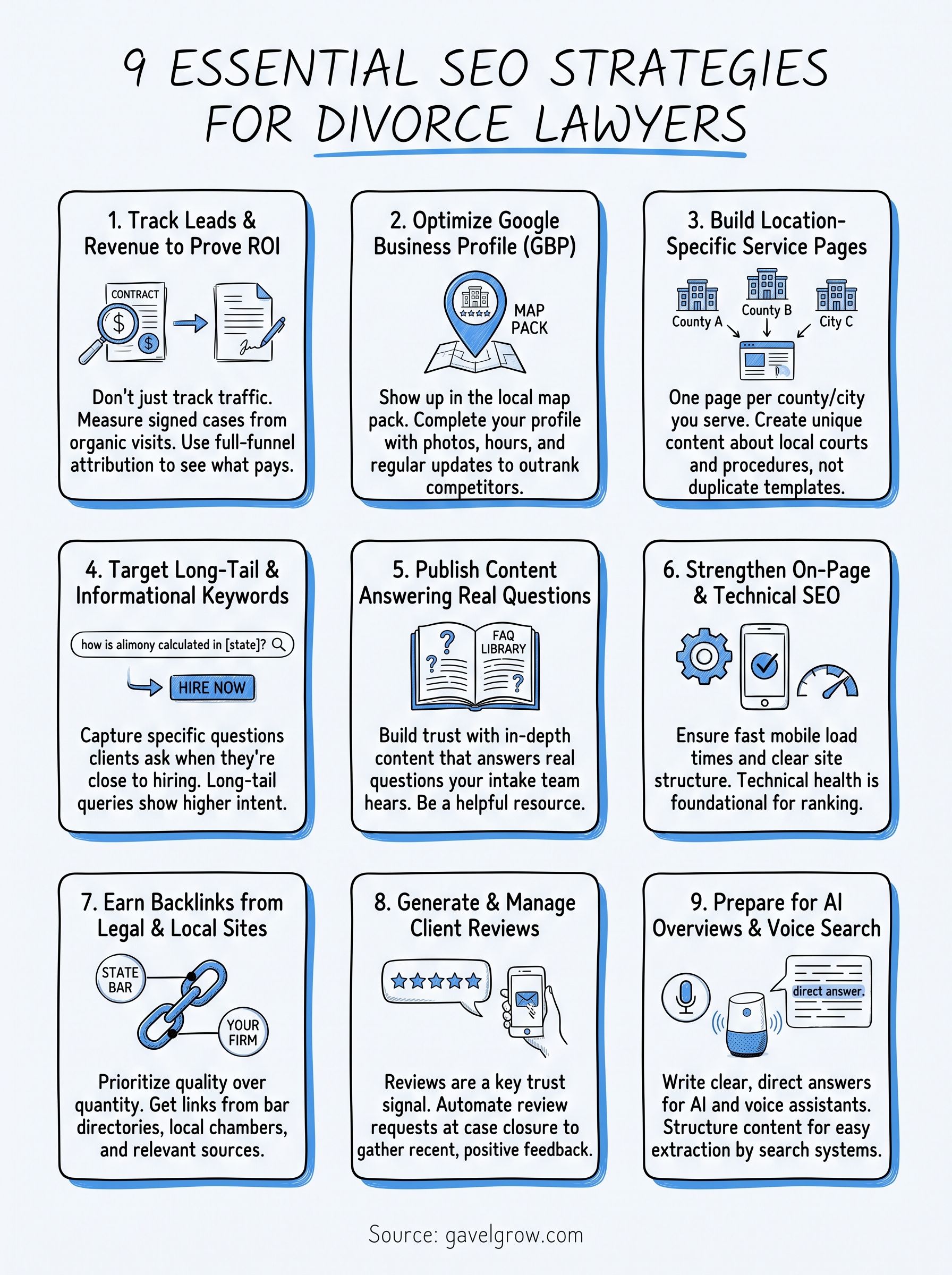
Nine strategies won't fix your rankings overnight, but each one compounds. Google Business Profile optimization and location pages get you found; content and backlinks build trust; reviews and technical fixes convert that trust into a phone call. Skip the tracking piece in section one, though, and you'll never know which of the other eight are actually paying off.
Start small if you have to. Pick two strategies from this list, fix them properly, and measure the result before moving to the next. SEO for divorce lawyers rewards firms that treat it as ongoing maintenance, not a one-time project you check off and forget.
If you'd rather not build this attribution system from scratch, GavelGrow already tracks leads from first click to signed case, with call tracking and intake automation built for family law firms specifically. Book a free strategy call and we'll show you exactly where your current marketing is leaking cases.
Frequently Asked Questions
How long does SEO take to work for a divorce law firm?
Most family law firms see early local-ranking movement within three to six months, with competitive metro markets taking six to twelve months of consistent work. Google Business Profile and review improvements can show up faster, while content and backlinks compound over time. SEO is ongoing maintenance, not a one-time project, so be skeptical of anyone promising page-one divorce rankings in a few weeks.
How much does SEO cost for a divorce or family law firm?
It varies widely by market and scope. Doing local SEO yourself costs mainly time, while agency retainers for family law typically start in the low thousands per month and climb with how competitive your county is and how much content and link work you need. Rather than compare monthly fees, judge the spend by cost per signed case, since a smaller budget tracked to retainers usually beats a bigger one you cannot attribute.
Can a divorce lawyer do SEO in-house, or is an agency worth it?
You can handle a lot yourself: claiming and optimizing your Google Business Profile, gathering reviews, and answering common client questions in content are all within reach for a motivated firm. The harder parts, technical SEO, competitive link building, and especially attribution that ties rankings to signed cases, are where most firms either invest serious time or bring in help. The honest test is whether the in-house work is actually getting done or just sitting on a someday list.
Does local SEO matter more than national SEO for divorce lawyers?
Yes. Divorce and custody cases are filed in specific county courts, so almost every searcher wants a lawyer who practices in their local court, not a statewide brand. That makes the map pack, your Google Business Profile, county-specific service pages, and local reviews far more important than broad national rankings. Family law is one of the most local practice areas in all of legal marketing.
How do I know if my divorce firm's SEO is actually working?
Look past rankings and traffic to whether SEO is producing signed cases. Rankings and clicks are leading indicators, but the number that matters is cost per signed case by page and keyword, not cost per lead or form fills. That requires connecting each organic lead, including phone calls, back to the page that produced it and following it through intake to a signed retainer, which is exactly where most firms lose visibility.
Is SEO or Google Ads better for a divorce law firm?
They solve different problems, and many firms use both. Google Ads buys visibility instantly but stops the moment you pause the budget, while SEO builds an asset that keeps generating leads long after the work is done. For a local, research-heavy decision like divorce, SEO tends to deliver a lower blended cost per signed case over time, but ads can fill the gap while your organic rankings build. With either, the key is tracking each channel to signed cases, not just leads.
Frequently Asked Questions
How long does SEO take to work for a divorce law firm?
Most family law firms see early local-ranking movement within three to six months, with competitive metro markets taking six to twelve months of consistent work. Google Business Profile and review improvements can show up faster, while content and backlinks compound over time. SEO is ongoing maintenance, not a one-time project, so be skeptical of anyone promising page-one divorce rankings in a few weeks.
How much does SEO cost for a divorce or family law firm?
It varies widely by market and scope. Doing local SEO yourself costs mainly time, while agency retainers for family law typically start in the low thousands per month and climb with how competitive your county is and how much content and link work you need. Rather than compare monthly fees, judge the spend by cost per signed case, since a smaller budget tracked to retainers usually beats a bigger one you cannot attribute.
Can a divorce lawyer do SEO in-house, or is an agency worth it?
You can handle a lot yourself: claiming and optimizing your Google Business Profile, gathering reviews, and answering common client questions in content are all within reach for a motivated firm. The harder parts, technical SEO, competitive link building, and especially attribution that ties rankings to signed cases, are where most firms either invest serious time or bring in help. The honest test is whether the in-house work is actually getting done or just sitting on a someday list.
Does local SEO matter more than national SEO for divorce lawyers?
Yes. Divorce and custody cases are filed in specific county courts, so almost every searcher wants a lawyer who practices in their local court, not a statewide brand. That makes the map pack, your Google Business Profile, county-specific service pages, and local reviews far more important than broad national rankings. Family law is one of the most local practice areas in all of legal marketing.
How do I know if my divorce firm's SEO is actually working?
Look past rankings and traffic to whether SEO is producing signed cases. Rankings and clicks are leading indicators, but the number that matters is cost per signed case by page and keyword, not cost per lead or form fills. That requires connecting each organic lead, including phone calls, back to the page that produced it and following it through intake to a signed retainer, which is exactly where most firms lose visibility.
Is SEO or Google Ads better for a divorce law firm?
They solve different problems, and many firms use both. Google Ads buys visibility instantly but stops the moment you pause the budget, while SEO builds an asset that keeps generating leads long after the work is done. For a local, research-heavy decision like divorce, SEO tends to deliver a lower blended cost per signed case over time, but ads can fill the gap while your organic rankings build. With either, the key is tracking each channel to signed cases, not just leads.