Attorney Lead Generation: 15 Tactics To Win Signed Cases
Categories: Legal Marketing Strategies
 Abram Ninoyan
Founder & Senior Performance Marketer
Credentials: Google Partner, Google Ads Search Certified, Google Ads Display Certified, Google Ads Measurement Certified, Google Analytics (IQ) Certified, HubSpot Inbound Certified, HubSpot Social Media Marketing Certified, Conversion Optimization Certified
Expertise: Google Ads, Meta Ads, Conversion Rate Optimization, GA4 & Google Tag Manager, Lead Generation, Marketing Funnel Optimization, PPC Management
LinkedIn Profile
Effective attorney lead generation requires more than buying clicks, it demands a system that turns ad spend into signed retainers, not just form fills sitting in a spreadsheet. Most law firms already...
Key Takeaways
- Attorney Lead Generation: 15 Tactics To Win Signed Cases
- What counts as a qualified legal lead?
- Step 1. Fix intake speed and tracking first
- Step 2. Build local visibility that converts
Attorney Lead Generation: 15 Tactics To Win Signed Cases
Effective attorney lead generation requires more than buying clicks, it demands a system that turns ad spend into signed retainers, not just form fills sitting in a spreadsheet.
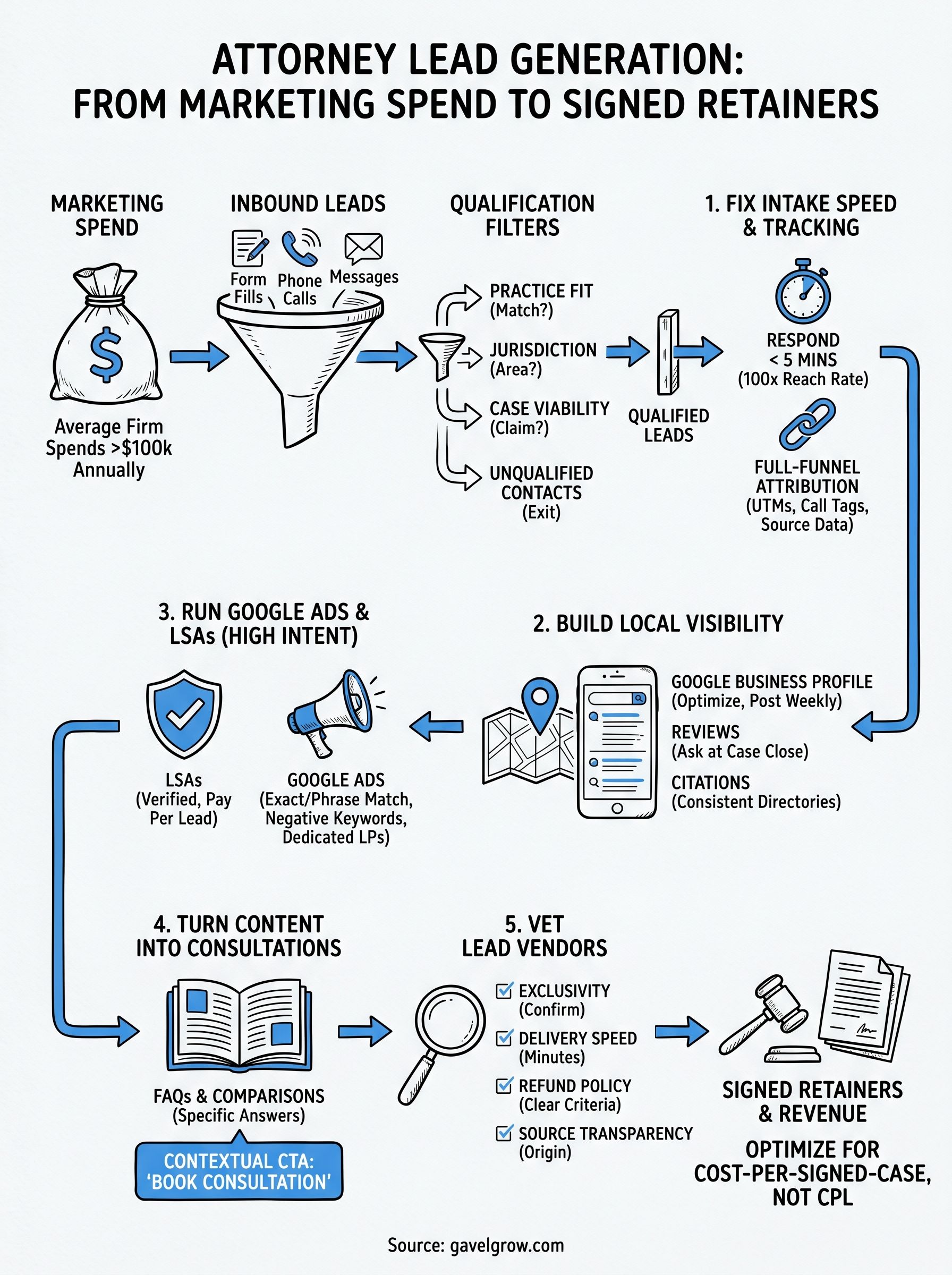
Most law firms already spend money on marketing. The problem isn't budget. According to the 2025 Clio Legal Trends Report, the average firm spends over $100,000 annually on marketing, yet nearly half can't attribute a single signed case back to a specific campaign. That gap between spending and knowing what works is where firms bleed cash, paying for leads that never pick up the phone, filling pipelines with prospects who ghost after the first call, or losing viable cases because intake response took hours instead of minutes.
This guide breaks down 15 lead generation tactics built specifically for law firms, from paid search and LSAs to intake automation and referral systems. Each one focuses on the metric that actually matters: signed cases. No vanity metrics, no "brand awareness" fluff, just strategies that connect marketing dollars to revenue.
At GavelGrow, we've helped over 500 U.S. law firms build exactly this kind of click-to-retainer attribution into their marketing. Whether you run campaigns yourself using our platform or hand everything off to our managed team, the tactics below reflect what we see working across 14 practice areas and every market size right now.
Key Takeaways:
- Lead generation without intake speed kills conversion, respond in under 5 minutes.
- Signed cases, not cost-per-lead, is the only metric worth optimizing around.
- Google LSAs and Ads remain the highest-intent channels for law firms.
- Full-funnel attribution from click to retainer eliminates wasted ad spend.
- Benchmark your numbers against peer firms to spot underperformance fast.
What counts as a qualified legal lead?
Not every form fill or phone call belongs in your pipeline. A qualified legal lead is a prospective client who has a case that fits your practice area, the ability to move forward, and the intent to hire an attorney in the near term. Treating unqualified contacts as leads inflates your cost-per-lead figures, distorts your conversion data, and wastes your intake team's time on cases that will never sign.
The three filters every legal lead must pass
Before a contact enters your case pipeline, it should clear three qualification gates. Skipping this step is one of the most common reasons firms in attorney lead generation programs see high lead volume but low signed-case rates.
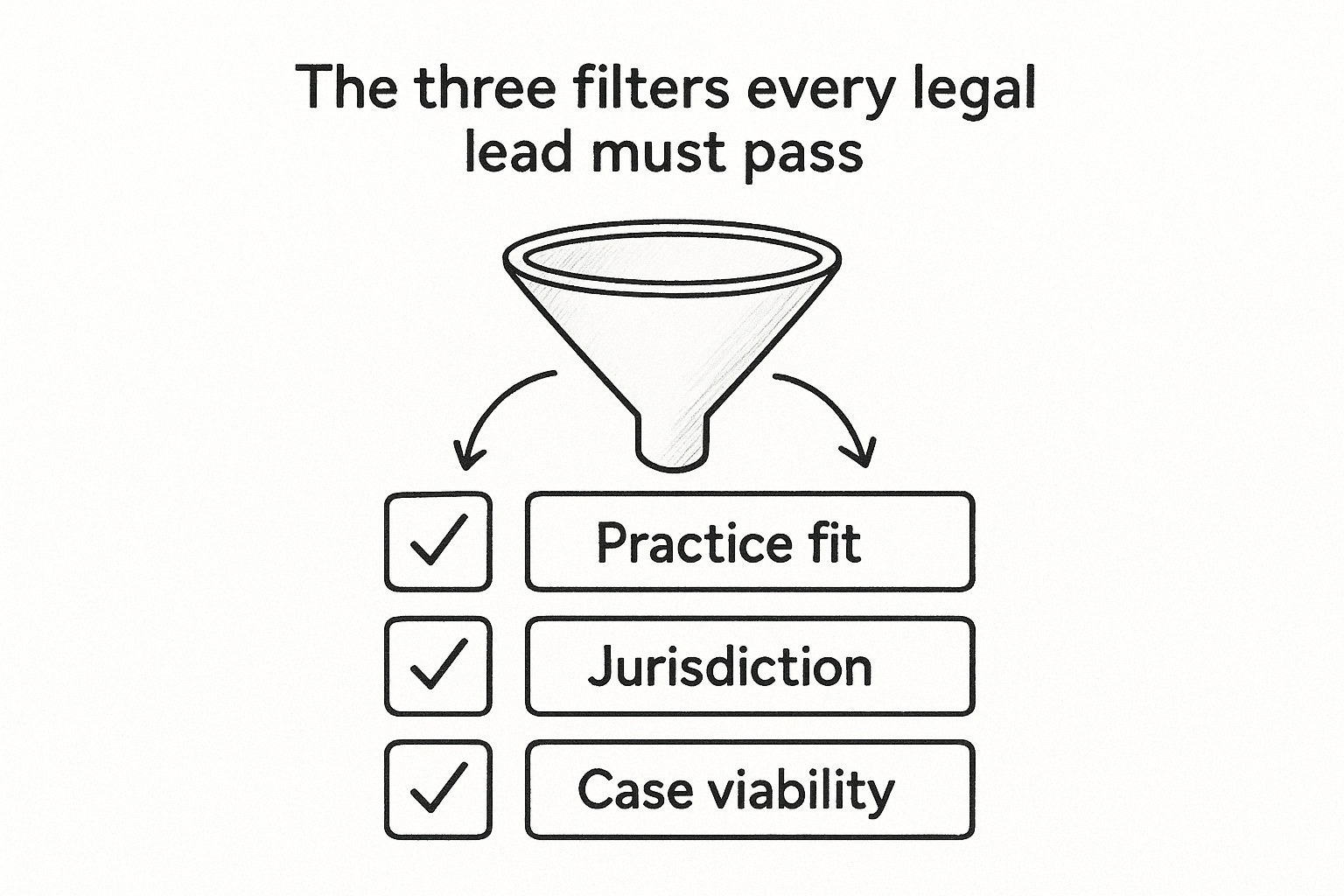
Apply these filters at the intake form level, not after a 20-minute consultation call. Multi-step intake forms let you ask disqualifying questions early, so unviable contacts exit the funnel before they reach your team.
A lead that passes all three filters but never gets a response within the first five minutes is still a lost opportunity. Speed and qualification work together, not in sequence.
How to define "qualified" for your specific practice area
The definition shifts depending on what your firm handles. A personal injury firm might qualify on liability, insurance coverage, and statute of limitations. A family law practice might qualify on whether the prospect has retained counsel before, the presence of children or significant assets, and county of residence.
Write out your qualification criteria as a checklist and share it with everyone involved in intake. Here is a simple template you can adapt:
Intake qualification checklist (personal injury example):
- Incident occurred within the statute of limitations for your state
- Liability can be attributed to a third party
- Prospective client has not already signed with another firm
- Injuries required medical treatment (documented or ongoing)
- Geographic location falls within your service area
Using a checklist like this inside your intake process gives you consistent, comparable data across every lead source. When you review campaign performance, you can then segment by qualified vs. unqualified and calculate a true cost-per-qualified-lead, which is far more useful than raw CPL.
Why confusing leads with cases costs you real money
Many firms count a lead the moment a form is submitted or a call connects. That number looks good in a report, but it hides the actual performance of each channel. A paid search campaign generating 50 leads per month at $120 each looks worse than a referral network producing 15 leads at $400 each, until you realize the paid leads convert at 3% and the referral leads convert at 40%.
Your tracking system needs to follow each contact from first touch through signed retainer, not just to the first callback. Without that full-funnel view, you're optimizing spend based on incomplete information, and you will consistently over-invest in channels that fill your pipeline with noise rather than cases.
Step 1. Fix intake speed and tracking first
Before you spend another dollar on attorney lead generation, fix the two things that destroy ROI before a campaign even has a chance: slow response and broken attribution. You can run perfect Google Ads and still lose every case to a competitor who picks up the phone faster and knows which channel sent the lead.
Why response time is your highest-leverage variable
Speed is not a nice-to-have. A 2023 study published by Harvard Business Review found that responding to an inbound lead within five minutes makes you 100 times more likely to actually reach that prospect compared to waiting 30 minutes. For law firms, where a prospective client often contacts three to five firms simultaneously, whoever calls back first wins a disproportionate share of the signed cases.
The first firm to respond sets the frame for the entire consultation. If you're second, you're already defending against a comparison.
Set up automated SMS and email responses that fire within 60 seconds of every form submission. The message does not need to be complex. It should confirm receipt, set a specific callback window (for example, "an attorney will call you within 15 minutes"), and give the prospect an option to reply with a good time. This alone keeps prospects from calling the next firm on the list while your intake coordinator is finishing another call.
How to build attribution before your first campaign goes live
Running campaigns without tracking is the same as running them blind. Before you launch anything, connect your intake forms, phone numbers, and CRM so that every lead carries a source tag from first click through signed retainer.
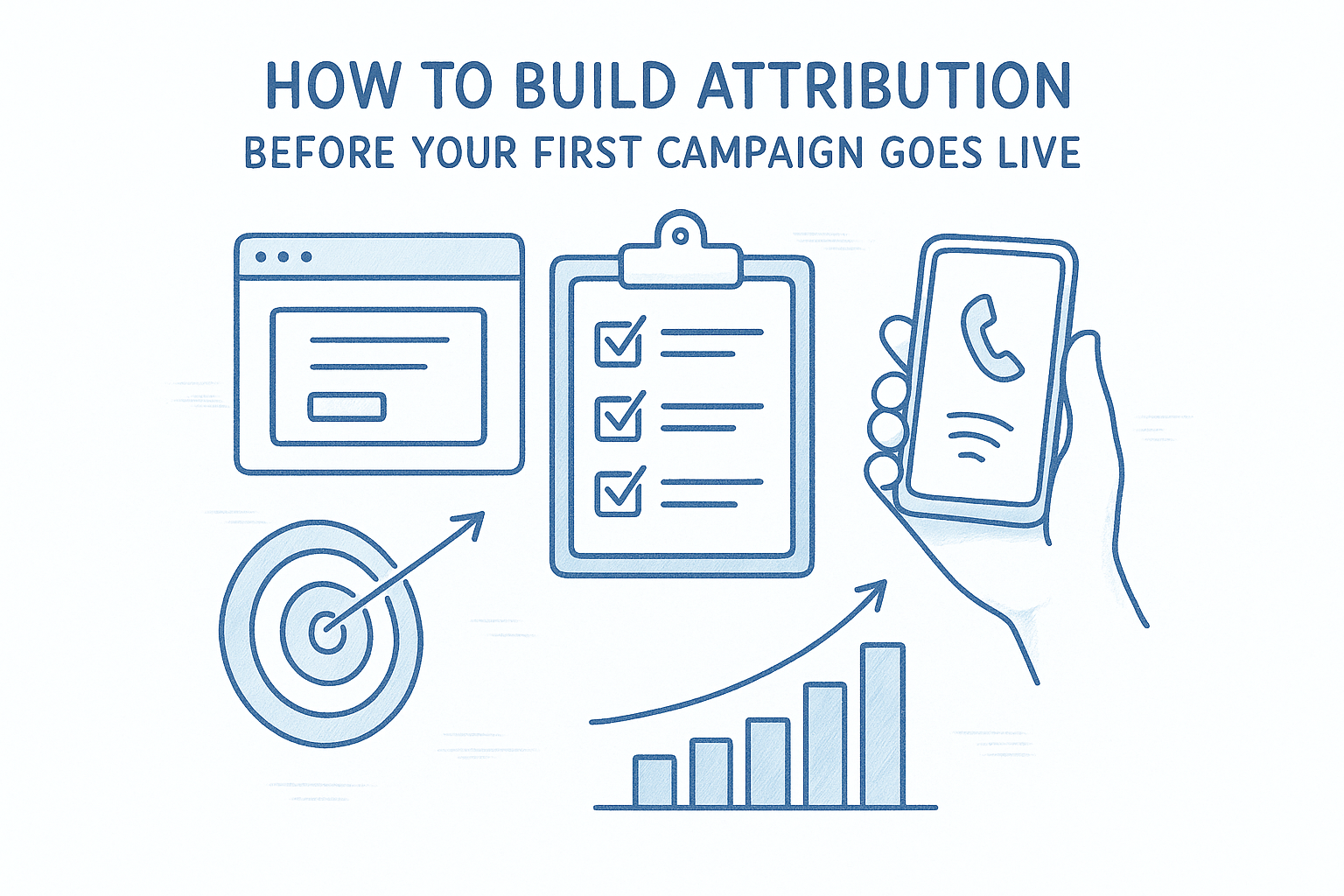
Here is the minimum tracking setup your firm needs before spending on paid channels:
- Unique tracking phone numbers per campaign (paid search, organic, referral, LSA) so you can compare call volume by source
- UTM parameters on every ad and landing page URL to pass source data into your intake form submissions
- Outcome tagging on calls (qualified, callback needed, unqualified, spam) so you calculate conversion rate by channel, not just call volume
- GA4 and Meta Pixel conversion events firing on form submissions with a transaction ID to prevent duplicate attribution
With this foundation in place, every tactic in the rest of this guide produces measurable, comparable data instead of guesswork.
Step 2. Build local visibility that converts
Local search is where the majority of high-intent legal prospects find their next attorney. Google's own data shows that searches with local intent (phrases like "personal injury attorney near me" or "divorce lawyer in [city]") have grown consistently year over year. Your firm's local visibility is not a passive outcome of having a website, it requires deliberate, maintained optimization across your Google Business Profile, citation directories, and review strategy to consistently appear in front of people who are ready to hire.
Optimize your Google Business Profile for legal searches
Your Google Business Profile is often the first piece of content a prospective client sees before they ever visit your website. Treating it like a one-time setup is a mistake. Active attorney lead generation at the local level depends on a profile that signals relevance, trust, and accessibility to both Google and the searcher.

A complete, actively managed Google Business Profile can increase the number of direction requests and calls your firm receives without spending a dollar on ads.
Follow this optimization checklist to get maximum visibility from your profile:
- Primary category: Set it to the most specific legal category that matches your main practice area (for example, "Personal Injury Attorney" rather than just "Lawyer")
- Service area: List every city and county you serve, not just your office location
- Business description: Write 700+ characters that naturally include your practice area and city name in the first sentence
- Photos: Upload at least 10 original photos including your office exterior, interior, and team headshots
- Services section: Add each distinct practice area as a separate service with a short description
- Weekly posts: Publish at least one Google Post per week featuring a recent case result, FAQ answer, or legal tip
- Q&A section: Pre-populate five common client questions with detailed answers before Google generates them automatically
Build a consistent review acquisition system
Reviews are the single most visible trust signal on your profile, and inconsistency here directly costs you consultations. Firms that ask every client for a review at case close outperform those that ask occasionally by a significant margin. Set up a post-matter review request sequence that sends an automated SMS and email within 24 hours of case resolution, includes a direct link to your Google review page, and follows up once if the first message goes unanswered. Track your monthly review count and average rating as a formal KPI alongside your lead metrics, because your review velocity influences how often Google surfaces your profile in the local pack.
Step 3. Run Google Ads and LSAs without waste
Google Ads and Local Services Ads are the two highest-intent paid channels available for attorney lead generation, but they burn budget fast without the right structure. Both platforms charge you whether a click converts or not, so your campaign architecture, bidding strategy, and negative keyword list determine whether you end up with signed cases or an expensive report full of unqualified contacts.
Why LSAs should come before standard Google Ads
Local Services Ads sit above standard paid search results and above organic listings. Google's own data shows that LSA placements drive calls directly, because the ad format shows your firm name, star rating, and a call button without requiring a click to a landing page. For most practice areas, LSAs produce a lower cost-per-qualified-lead than standard Google Ads because you only pay for leads Google verifies as connected calls or messages, not for raw clicks.
Start your LSA profile with a complete Google Screened or Google Guaranteed badge, because unverified profiles appear lower in the LSA stack and convert at a fraction of the rate of verified ones.
Set your LSA budget to cover your target practice areas by day-parting. If your intake team works 8am to 7pm, pause LSA delivery outside those hours so you pay only for leads you can actually respond to within five minutes.
How to structure Google Ads campaigns without wasting budget
Standard Google Ads give you more control over landing pages and bidding, but legal keywords are among the most expensive in any industry. A poorly structured campaign with broad match keywords and no negative list will spend $5,000 in a week on searches that have nothing to do with hiring an attorney.
Follow this campaign structure to protect your spend from day one:
Review your search term report weekly during the first 30 days and add irrelevant queries as negatives. This single habit typically cuts wasted spend by 20 to 35 percent within the first month.
Step 4. Turn content into booked consultations
Content marketing for law firms fails when it stops at publishing and never connects the reader to a next step. Attorney lead generation through content works only when each piece you publish carries a clear conversion path, meaning a reader who finds your article on Google should be able to book a consultation without hunting for a contact form. The gap between traffic and booked calls is almost always a structural problem, not a content quality problem.
Which content formats produce consultation requests
Not all content types generate the same downstream action. FAQ-style articles that answer a specific legal question ("What happens if I miss a court date in Texas?") attract readers who already have a problem and are close to hiring. Comparison pages ("hiring a DUI attorney vs. going alone") attract readers evaluating their options, which places them one step away from a consultation decision. Both formats outperform generic "about our firm" posts because they match a specific search query with a specific answer, and then give the reader an obvious reason to contact you.
A piece of content that answers a question fully but never tells the reader what to do next is a missed intake opportunity.
Avoid publishing content just to fill a calendar. Every article your firm publishes should target a keyword phrase with clear legal intent (indicating the reader needs an attorney, not just legal information) and should end with a direct call to action tied to a specific next step.
How to build a content-to-consultation conversion path
Place a contextual call-to-action inside the body of every article, not just at the bottom. If someone reads halfway through your post on workers' compensation claims and leaves before reaching the footer, you still want them to see an offer. Insert a short conversion block after the second or third section using this template:
Have a [practice area] situation in [state]? Schedule a free 15-minute consultation with our team. [Book your call] (link to intake form)
After embedding this block, connect your intake form to an automated SMS and email sequence that fires within 60 seconds of submission. Combine that with tracked source data on every submission so you can measure which articles produce qualified consultations, not just page views, and allocate future content effort toward the formats that actually sign cases.
Step 5. Use lead vendors without getting burned
Lead vendors can fill your pipeline quickly, but most firms that buy from them lose money without realizing it. The problem is not that vendor leads never convert. The problem is that shared leads, slow delivery, and no outcome tracking make it nearly impossible to calculate a real cost-per-signed-case. Before you sign anything, you need a system to evaluate vendors the same way you evaluate any paid channel.
What to check before signing a vendor contract
Every attorney lead generation vendor will show you impressive CPL figures, but those numbers only tell you what you paid per contact, not what you paid per signed retainer. Before committing to any vendor, run through this checklist to protect your budget from day one.
Vendor vetting checklist:
- Exclusivity: Confirm in writing whether leads are sold exclusively to your firm or shared with other firms in your market
- Delivery speed: Ask exactly how many minutes pass between a prospect submitting their information and your firm receiving the notification
- Refund policy: Get the credit criteria in writing, specifically what qualifies as a returnable lead (wrong jurisdiction, disconnected number, duplicate contact)
- Contract length: Avoid contracts longer than 30 days until you have 60 days of data on qualified-lead rate and close rate from that specific vendor
- Lead source: Ask where the leads originate (paid search, organic, content, aggregators) because source affects intent level significantly
A vendor who refuses to disclose their lead source or exclusivity terms before you sign is telling you something important.
How to measure whether a vendor is worth keeping
Once leads start arriving, track every contact through the same pipeline you use for your own campaigns. Tag each vendor lead with a unique source label in your CRM and record every outcome: contacted, qualified, consulted, retained. After 30 days, calculate your cost-per-signed-case by dividing total vendor spend by the number of retainers that originated from that source.
Compare that number directly against your Google Ads and LSA cost-per-signed-case from the same period. If the vendor's number is more than 40 percent higher than your best-performing owned channel, reallocate the budget toward the channel you control. Vendors who consistently deliver at or below your internal benchmark are worth scaling. Everyone else is a line item you should cut.
Frequently asked questions
These questions come up consistently across the law firms we work with building their first serious attorney lead generation system. The answers below reflect patterns from 500+ U.S. firms across 14 practice areas, not generic marketing advice.
How much should a law firm spend on lead generation?
Your budget depends on your practice area and market, but a practical starting point is 5 to 12 percent of your target gross revenue. The 2025 Clio Legal Trends Report found the average firm already spends over $100,000 per year on marketing. The real issue is rarely budget size, it is the inability to attribute spend to specific signed cases. Fix your tracking before adding to your budget.
What is a good cost-per-lead for attorneys?
Cost-per-lead varies significantly by practice area. Personal injury firms in competitive markets often see CPLs between $200 and $600 on Google Ads, while family law and immigration tend to run $80 to $200. The more actionable metric for your firm is cost-per-signed-case, because a $150 lead converting at 2% costs far more per retainer than a $400 lead converting at 25%.
How fast should my firm respond to new leads?
Respond within five minutes of every inbound inquiry. Research published by Harvard Business Review found that contacting a lead within five minutes makes you 100 times more likely to reach them compared to waiting 30 minutes. Set up automated SMS and email replies that fire within 60 seconds of form submission so your firm stays in front of the prospect while your intake team prepares to call.
Five minutes is the threshold. Every minute after that, you lose ground to the next firm on the prospect's call list.
Do legal lead vendors actually work?
Vendors can produce signed cases when you track every contact through to signed retainer and compare the result against your own channels. The problem is that most firms only track CPL from vendors, which hides poor close rates. Demand exclusivity in writing and cut any vendor whose 60-day cost-per-retainer exceeds your Google Ads benchmark by more than 40 percent.
Which channel produces the most signed cases for law firms?
Google Local Services Ads consistently rank as the top-performing paid channel for high-intent legal searches, largely because prospects call directly without visiting a landing page first. Your organic content and referral network typically produce the lowest cost-per-signed-case over 12 months, but require sustained effort before they generate consistent volume.
Next Steps
The 15 tactics in this guide cover every layer of attorney lead generation, from fixing intake speed and local visibility to running paid campaigns and vetting lead vendors. None of them require a complete overhaul before you see results. Pick the two or three that match your biggest current gap and build from there.
Start with tracking. If you cannot connect a signed retainer back to the channel that produced it, every other tactic runs blind. Full-funnel attribution from first click to signed case is the foundation that makes every other investment measurable and comparable.
GavelGrow's platform gives your firm call tracking, intake automation, and click-to-retainer attribution in one dashboard built exclusively for law firms, backed by data from 500+ U.S. firms. Start your free 7-day trial on the GavelGrow platform or book a free 45-minute strategy call to map out a plan specific to your practice area and market.
Frequently Asked Questions
How much should a law firm spend on lead generation?
Your budget depends on your practice area and market, but a practical starting point is 5 to 12 percent of your target gross revenue . The 2025 Clio Legal Trends Report found the average firm already spends over $100,000 per year on marketing. The real issue is rarely budget size , it is the inability to attribute spend to specific signed cases. Fix your tracking before adding to your budget.
What is a good cost-per-lead for attorneys?
Cost-per-lead varies significantly by practice area. Personal injury firms in competitive markets often see CPLs between $200 and $600 on Google Ads , while family law and immigration tend to run $80 to $200. The more actionable metric for your firm is cost-per-signed-case , because a $150 lead converting at 2% costs far more per retainer than a $400 lead converting at 25%.
How fast should my firm respond to new leads?
Respond within five minutes of every inbound inquiry . Research published by Harvard Business Review found that contacting a lead within five minutes makes you 100 times more likely to reach them compared to waiting 30 minutes. Set up automated SMS and email replies that fire within 60 seconds of form submission so your firm stays in front of the prospect while your intake team prepares to call. Five minutes is the threshold. Every minute after that, you lose ground to the next firm on the prospect's call list.
Do legal lead vendors actually work?
Vendors can produce signed cases when you track every contact through to signed retainer and compare the result against your own channels. The problem is that most firms only track CPL from vendors, which hides poor close rates. Demand exclusivity in writing and cut any vendor whose 60-day cost-per-retainer exceeds your Google Ads benchmark by more than 40 percent.
Which channel produces the most signed cases for law firms?
Google Local Services Ads consistently rank as the top-performing paid channel for high-intent legal searches, largely because prospects call directly without visiting a landing page first. Your organic content and referral network typically produce the lowest cost-per-signed-case over 12 months, but require sustained effort before they generate consistent volume.