Attorney Online Marketing: How To Turn Clicks Into Cases
Categories: Legal Marketing Strategies
 Abram Ninoyan
Founder & Senior Performance Marketer
Credentials: Google Partner, Google Ads Search Certified, Google Ads Display Certified, Google Ads Measurement Certified, Google Analytics (IQ) Certified, HubSpot Inbound Certified, HubSpot Social Media Marketing Certified, Conversion Optimization Certified
Expertise: Google Ads, Meta Ads, Conversion Rate Optimization, GA4 & Google Tag Manager, Lead Generation, Marketing Funnel Optimization, PPC Management
LinkedIn Profile
Attorney online marketing works when every dollar you spend on ads, SEO, and content maps directly to signed retainers, not just clicks, impressions, or form fills that never pick up the phone. The ga...
Key Takeaways
- Attorney Online Marketing: How To Turn Clicks Into Cases
- Why does attorney online marketing break down?
- Step 1. How do you build a conversion-first foundation?
- Step 2. How do you get qualified traffic without wasting spend?
Attorney Online Marketing: How To Turn Clicks Into Cases
Attorney online marketing works when every dollar you spend on ads, SEO, and content maps directly to signed retainers, not just clicks, impressions, or form fills that never pick up the phone.
The gap between "getting traffic" and "signing clients" is where most law firms bleed budget. Clio's 2024 Legal Trends Report secret-shopper study found that nearly half of firms (48%) were unreachable by phone, which means paid clicks rot in an inbox while potential clients hire the firm that answered first. Layer on generic agency reporting that counts leads instead of cases, and you're left guessing whether your marketing actually generated revenue or just activity that felt productive.
This guide breaks down exactly how to build an online marketing system that tracks a prospect from their first Google search through a signed retainer agreement. We'll cover paid search, SEO, intake automation, and conversion optimization, all through the lens of what actually matters to a law firm's bottom line. Where relevant, we'll show how GavelGrow's legal marketing platform handles specific pieces of this puzzle, from call tracking and lead attribution to modelled practice-area benchmarks. Whether you run campaigns in-house or work with an agency, you'll leave with a concrete framework for turning marketing spend into cases on your docket.
Why does attorney online marketing break down?
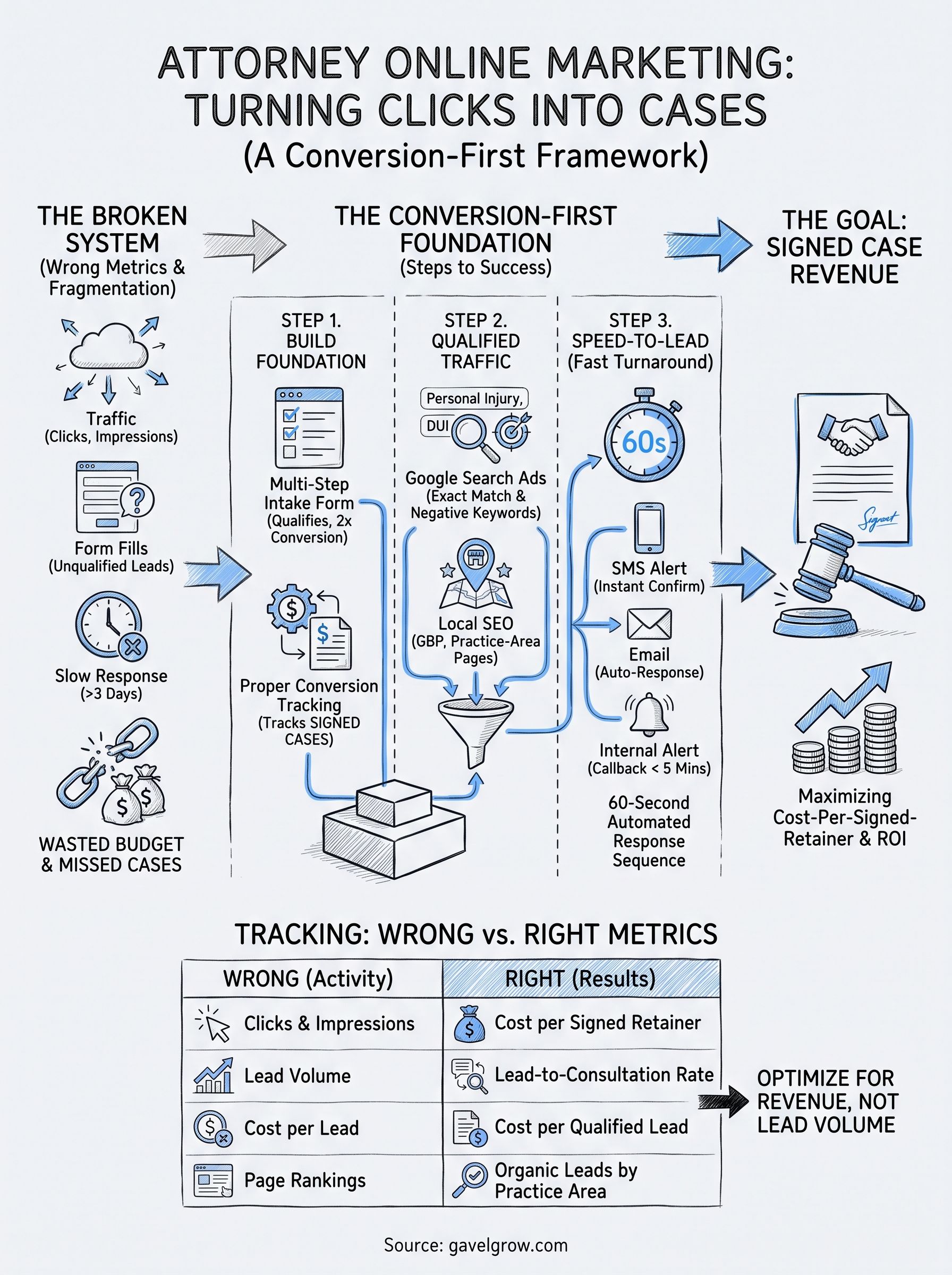
Most attorney online marketing programs fail not because the ads are bad or the SEO is wrong, but because the measurement system stops at the wrong point. Firms track clicks, impressions, and form fills, then assume those numbers represent business growth. They don't. A click is a cost, and a form fill is a possibility. A signed retainer is the only metric that tells you whether your marketing budget generated a return.
The single biggest reason legal marketing fails is that firms optimize for lead volume when they should be optimizing for signed cases.
Why does measuring the wrong metric cost you money?
When your agency reports "200 leads this month," that number hides everything important. How many of those 200 leads were qualified for your practice area? How many turned into consultations? How many signed? If you can't answer those questions, you're making budget decisions blind. A personal injury firm spending $15,000 a month on Google Ads needs to know its cost-per-signed-case, not its cost-per-click. Firms with structured intake processes tend to close more of their leads, yet many firms never connect their ad data to their case management system.
Here's what the measurement gap looks like in practice:
How does tool fragmentation kill attribution?
The second breakdown is structural. Most firms run five or more disconnected tools: a separate call tracking platform, a standalone intake form, a CRM that doesn't talk to their ad accounts, and a reporting dashboard someone updates manually each month. When a prospect clicks your Google Ad, fills out a form on your website, receives an SMS follow-up, and then books a consultation, that journey lives across four separate systems. None of them share data automatically, which means your ad accounts never learn which campaigns actually produce signed cases.
Fragmentation forces your marketing decisions on incomplete information. You end up pausing campaigns that actually work and scaling ones that generate unqualified volume, purely because the attribution chain broke somewhere between the ad click and the signed retainer. Fixing that chain is the foundation everything else in this guide builds on.
Step 1. How do you build a conversion-first foundation?
Before you spend a dollar on ads or an hour on SEO, your website and intake process need to convert the traffic you already have. The conversion-first foundation covers three things: a fast-loading mobile site, an intake form that qualifies leads immediately, and conversion tracking that fires every time a prospect submits a form or calls your office. Skip any one of these and every campaign you run is building on sand.
What should your intake form include?
Your intake form is the first point of contact for most online prospects, and a generic "Name, Email, Message" form kills conversion. Mobile users, who represent over 60% of legal search traffic according to Google's 2024 Search Insights, abandon long forms at a much higher rate than desktop users. Build a multi-step form that asks one question at a time, confirms TCPA consent explicitly, and validates the phone number before submission so you are not following up with bad data.
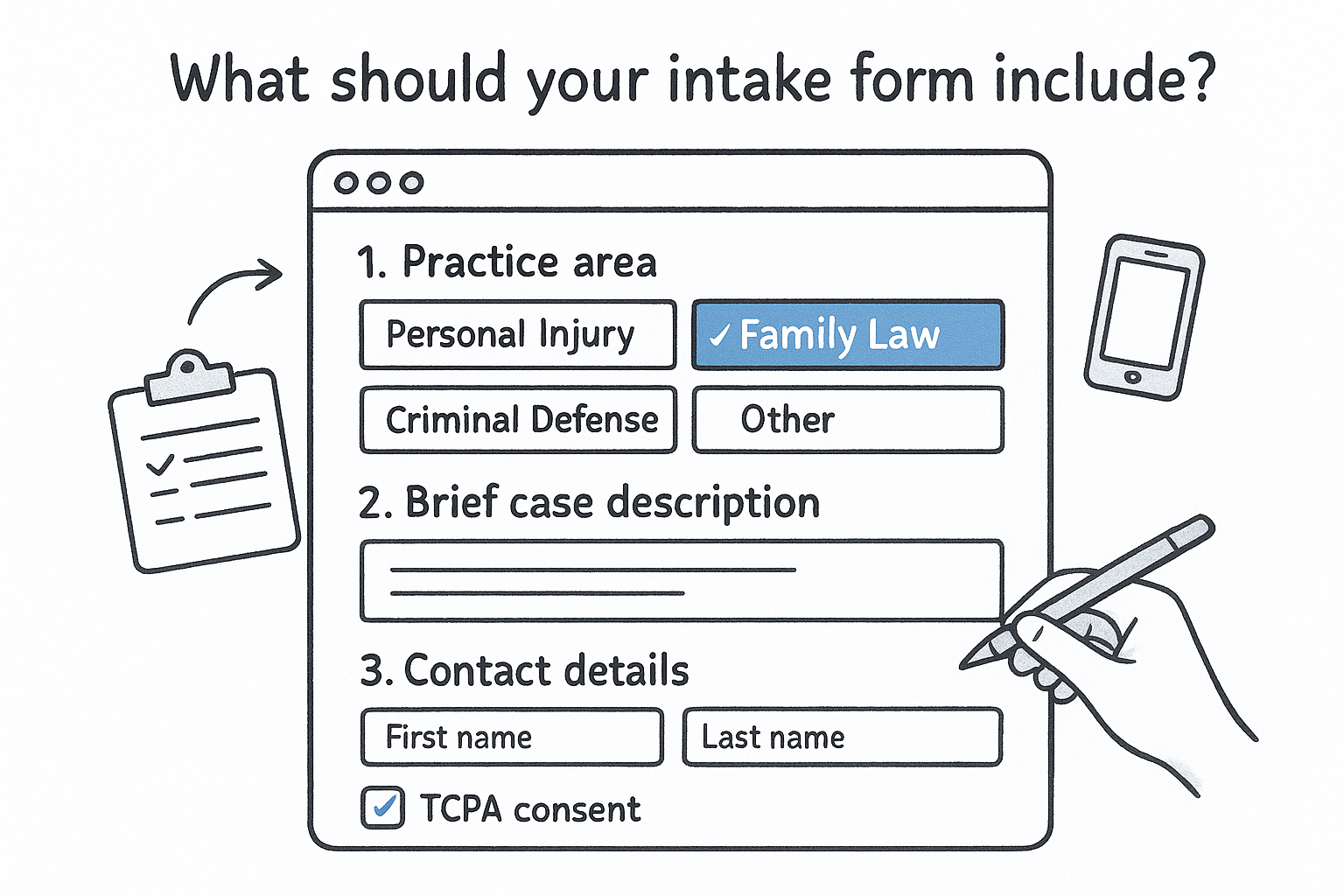
Here is a proven intake form structure for attorney online marketing:
- Step 1: Practice area selection (Personal Injury / Family Law / Criminal Defense / Other)
- Step 2: Brief case description (2-3 sentence text box, 500-character limit)
- Step 3: Contact details (first name, last name, phone with carrier validation, email)
- Step 4: TCPA consent checkbox with explicit opt-in language and a timestamp audit log
A multi-step form typically converts at 2x the rate of a single-page form because each completed step creates psychological commitment to finish.
How do you set up conversion tracking correctly?
Your ad accounts need to know which campaigns produce signed cases, not just form fills. Fire a GA4 generate_lead event with a unique transaction_id on every form submission, and mirror that event to your Meta Pixel using the Conversions API to eliminate browser-side deduplication errors. Connect your call tracking numbers to the same campaign attribution layer so phone calls and form fills roll into one cost-per-lead figure per campaign.
Step 2. How do you get qualified traffic without wasting spend?
Generating traffic is easy. Generating qualified traffic from people who can actually hire your firm is where most attorney online marketing budgets get burned. The two channels that deliver the highest-intent prospects for law firms are Google Search Ads and local SEO, and they work best when you treat them as a system rather than separate line items.
How do you run Google Ads that attract the right cases?
Google Search Ads let you bid on the exact moment a prospect types a query like "personal injury lawyer Chicago" or "DUI attorney near me." The problem most firms have is bidding on broad, generic terms that attract researchers, not people ready to hire. Use exact match and phrase match keywords tied to your practice area and geography, then add negative keywords aggressively to filter out students, journalists, and people looking for free legal advice.
Negative keyword lists are where legal ad spend is saved, not in bid adjustments.
Here is a starter negative keyword list for a personal injury firm:
- free lawyer
- law school
- pro bono
- how to file lawsuit yourself
- legal aid
- paralegal jobs
- attorney salary
Add these before your campaign goes live, not after you have spent money learning they were needed.
How does local SEO compound your paid traffic investment?
Organic search and Google Business Profile rankings bring in clicks you do not pay for every time someone hits your ad budget ceiling. Optimize your Google Business Profile by uploading photos monthly, responding to every review within 48 hours, and selecting the most specific primary category available. Practice-area landing pages with unique content for each city or county you serve tell Google exactly which searches your firm should rank for, multiplying your visibility without multiplying your ad spend.
Step 3. How do you turn leads into signed cases fast?
Traffic converts, the form gets submitted, and then the lead sits in an inbox for four hours. That single gap kills more cases than bad ads ever will. The Lead Response Management Study found that contacting a lead within five minutes made a firm 100 times more likely to reach the lead than calling at 30 minutes. In attorney online marketing, that window is everything.
Speed-to-lead is not a nice-to-have feature; it is the variable that separates firms that sign cases from firms that generate reports.
Why does speed-to-lead determine whether you sign the case?
Prospects searching for legal help are usually in a heightened emotional state. They fill out your form, then immediately search for the next attorney on the results page. If your competitor calls first, the conversation is over before yours begins. You need an automated response firing within 60 seconds of form submission, confirming receipt via SMS and email while your intake team picks up the phone.
What does a 60-second intake sequence look like?
Your automated follow-up sequence should run in this order immediately after form submission:
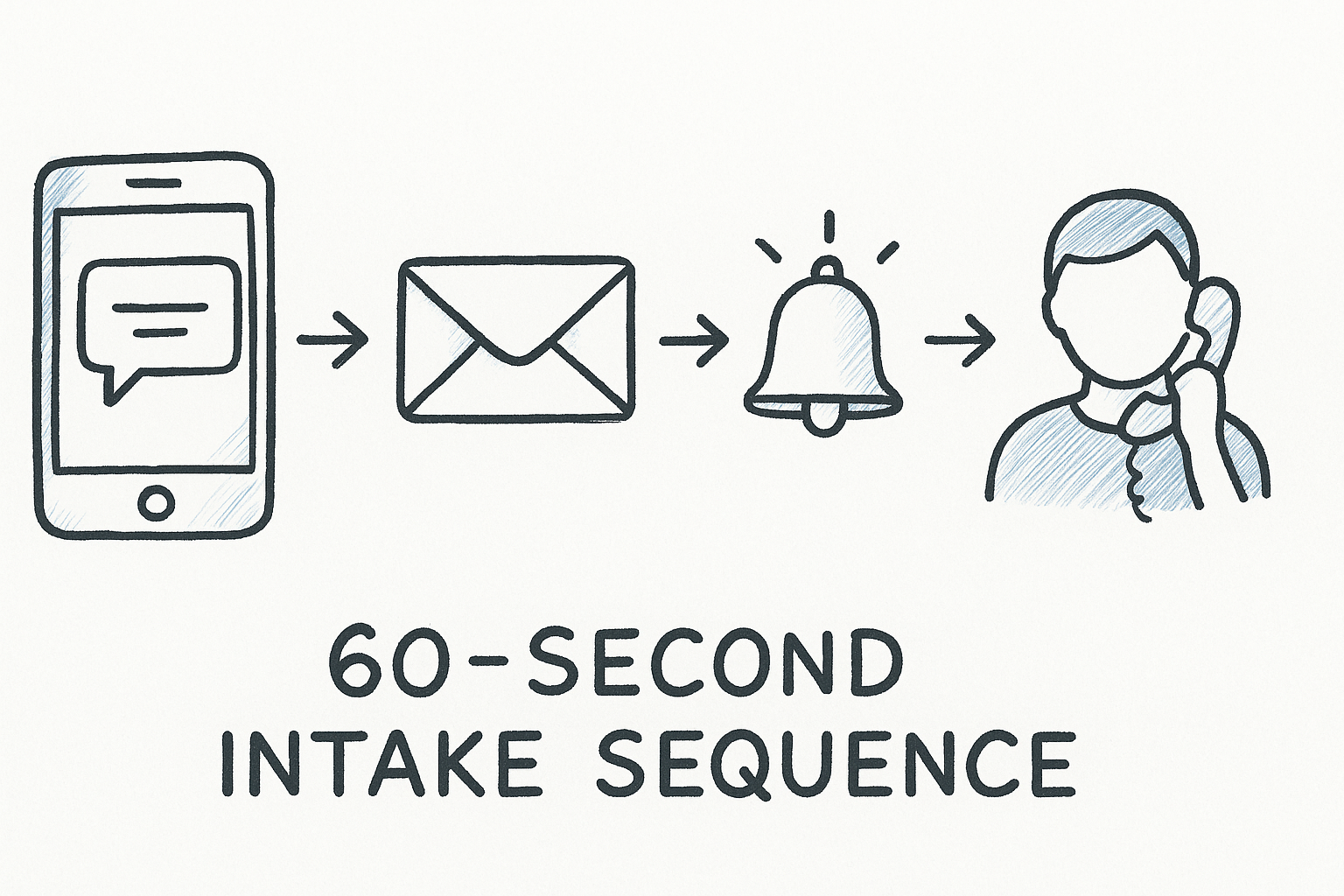
- SMS (0-60 seconds): "Hi [First Name], [Firm Name] received your message. We're reviewing your case and will call you within 15 minutes. Reply STOP to opt out."
- Email (0-60 seconds): Confirmation email with your firm name, a direct callback number, and business hours.
- Internal alert (0-60 seconds): Push notification or SMS to your intake coordinator with the lead's name, practice area, and phone number.
- Callback attempt (within 5 minutes): Your intake coordinator dials the number before the prospect moves on.
GavelGrow's intake automation fires SMS and email sequences within 60 seconds of capture and handles CTIA opt-out keywords automatically, so your team focuses on the conversation rather than the setup.
Frequently Asked Questions About Attorney Online Marketing
These are the questions managing partners and marketing directors ask most often when building a serious attorney online marketing program. Each answer draws on real data where available.
How much should a law firm spend on online marketing?
A common benchmark is 7-12% of gross revenue allocated to marketing, according to the American Bar Association's 2023 Law Firm Marketing Survey. For competitive practice areas like personal injury or mass torts, that number often runs higher. Your specific spend depends on your market size, practice area, and whether you combine paid ads with organic SEO or run them separately.
How long does SEO take to generate cases?
Most law firms see meaningful organic ranking improvements within 4-6 months, but competitive markets like personal injury in major metros can take 9-12 months to reach page one. Google's own documentation confirms that new or recently updated pages take time to accumulate authority. Running paid ads while SEO builds keeps your intake pipeline active during that gap.
What is a good cost per lead for a law firm?
Cost per lead varies significantly by practice area. Personal injury firms on Google Ads typically pay $150-$400 per lead, while family law averages $50-$150. The more useful number is cost per signed retainer, which factors in your consultation-to-close rate. A $300 lead that closes one in three times costs $900 per case, and whether that's profitable depends entirely on your average case value.
How do I know if my agency is performing?
If your agency reports primarily on impressions and clicks, they're measuring activity, not results.
Ask for a monthly report showing campaign-level cost-per-signed-case alongside consultation-to-close rates. If your agency cannot connect ad spend to signed retainers, they lack the attribution depth your firm needs to make sound budget decisions.
Should your firm run Google Ads or SEO first?
Run Google Ads first if you need cases within 30-60 days, since paid campaigns activate the moment you fund them. Start SEO simultaneously so organic visibility builds in the background. Google Ads quickly reveals which keywords convert in your specific market, and that data directly informs your SEO content priorities.
Next steps for turning clicks into cases
Attorney online marketing produces signed cases when you fix three things in order: measurement, traffic quality, and intake speed. Build conversion tracking that fires on every form submission and call before you scale any campaign. Then run Google Ads to generate high-intent traffic while your SEO compounds in the background. Finally, automate your intake response so every lead gets a reply within 60 seconds, because the firm that responds first wins the case the majority of the time.
Your next action is concrete. Pull last month's campaign data and identify your actual cost per signed retainer by practice area. If you cannot calculate that number today, your attribution is broken and fixing it is the highest-leverage task on your list. Use GavelGrow's free law firm marketing scorecard to pinpoint exactly where your system leaks revenue, then build from there.
Frequently Asked Questions
How much should a law firm spend on online marketing?
A common benchmark is 7-12% of gross revenue allocated to marketing, according to the American Bar Association's 2023 Law Firm Marketing Survey. For competitive practice areas like personal injury or mass torts, that number often runs higher. Your specific spend depends on your market size, practice area, and whether you combine paid ads with organic SEO or run them separately.
How long does SEO take to generate cases?
Most law firms see meaningful organic ranking improvements within 4-6 months , but competitive markets like personal injury in major metros can take 9-12 months to reach page one. Google's own documentation confirms that new or recently updated pages take time to accumulate authority. Running paid ads while SEO builds keeps your intake pipeline active during that gap.
What is a good cost per lead for a law firm?
Cost per lead varies significantly by practice area. Personal injury firms on Google Ads typically pay $150-$400 per lead , while family law averages $50-$150. The more useful number is cost per signed retainer , which factors in your consultation-to-close rate. A $300 lead that closes one in three times costs $900 per case, and whether that's profitable depends entirely on your average case value.
How do I know if my agency is performing?
If your agency reports primarily on impressions and clicks, they're measuring activity, not results. Ask for a monthly report showing campaign-level cost-per-signed-case alongside consultation-to-close rates. If your agency cannot connect ad spend to signed retainers , they lack the attribution depth your firm needs to make sound budget decisions.
Should your firm run Google Ads or SEO first?
Run Google Ads first if you need cases within 30-60 days, since paid campaigns activate the moment you fund them. Start SEO simultaneously so organic visibility builds in the background. Google Ads quickly reveals which keywords convert in your specific market, and that data directly informs your SEO content priorities.