10 Best Call Tracking Software Tools for Law Firms
Categories: Legal Marketing Strategies
 Abram Ninoyan
Founder & Senior Performance Marketer
Credentials: Google Partner, Google Ads Search Certified, Google Ads Display Certified, Google Ads Measurement Certified, Google Analytics (IQ) Certified, HubSpot Inbound Certified, HubSpot Social Media Marketing Certified, Conversion Optimization Certified
Expertise: Google Ads, Meta Ads, Conversion Rate Optimization, GA4 & Google Tag Manager, Lead Generation, Marketing Funnel Optimization, PPC Management
LinkedIn Profile
The best call tracking software for law firms goes beyond logging phone calls, it connects every ring to the campaign that generated it and follows that lead all the way to a signed retainer. Without...
Key Takeaways
- 10 Best Call Tracking Software Tools for Law Firms (2026)
- 1. GavelGrow
- 2. CallRail
- 3. CallTrackingMetrics
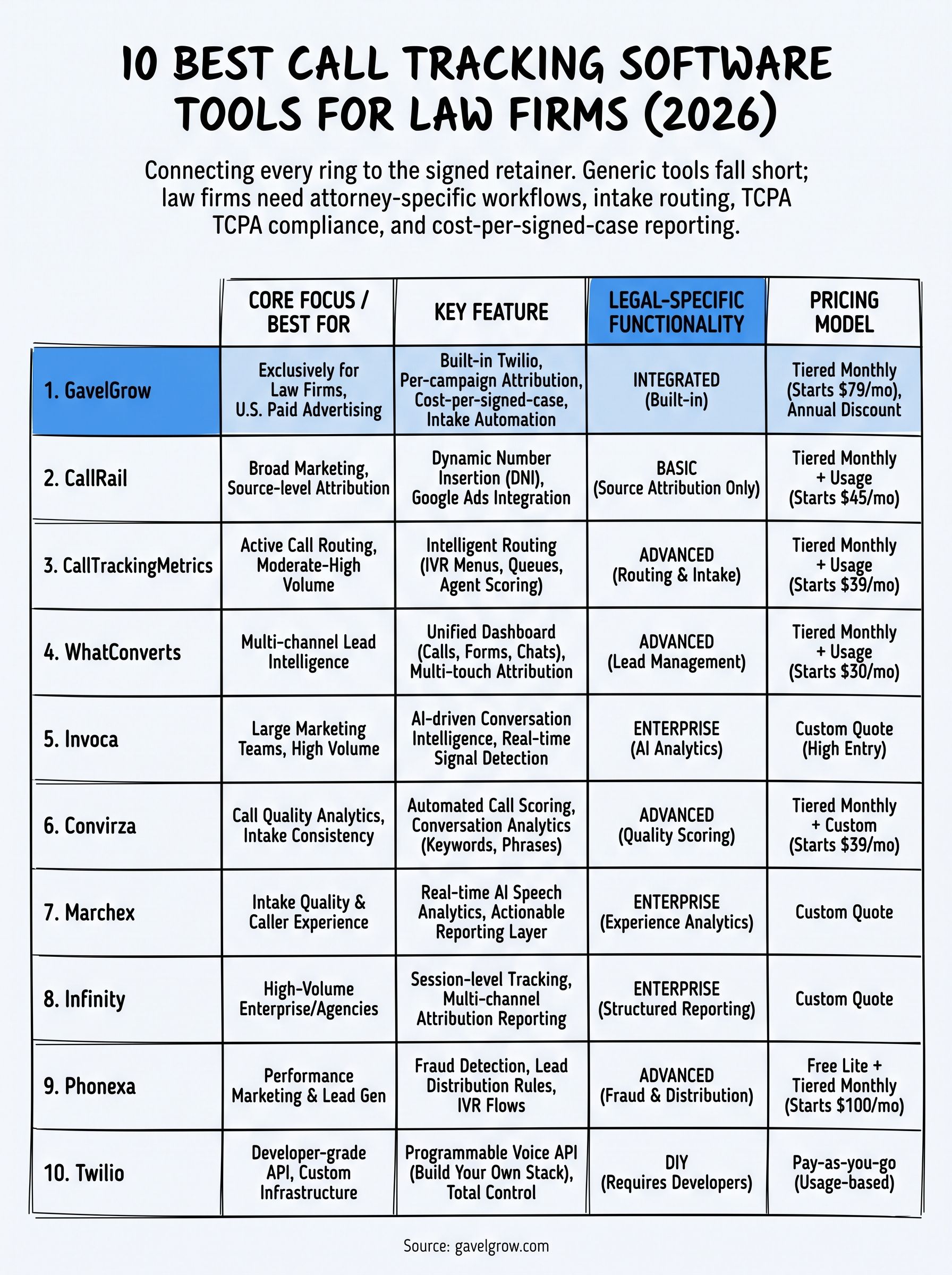
10 Best Call Tracking Software Tools for Law Firms (2026)
The best call tracking software for law firms goes beyond logging phone calls, it connects every ring to the campaign that generated it and follows that lead all the way to a signed retainer. Without that level of attribution, you're guessing which marketing dollars actually produce revenue and which ones just produce noise.
Pricing figures in this article reflect each vendor’s publicly listed rates as of July 2026 and are subject to change — always confirm current pricing on the vendor’s own site.
Here's the problem most firms run into: generic call tracking tools built for plumbers, dentists, and e-commerce brands don't account for the realities of legal intake. A personal injury case might take six months from first call to signed client. If your tracking platform can't connect that timeline, your cost-per-case data is worthless. You need software that handles attorney-specific workflows, intake routing, TCPA-compliant recording disclosures, campaign-level cost-per-signed-case reporting, and integration with your practice management system.
We built GavelGrow's call tracking specifically to solve this gap, replacing tools like CallRail with built-in Twilio tracking numbers, per-campaign attribution, outcome tagging, and miss-rate reporting, all inside a platform designed exclusively for law firms. But GavelGrow isn't the only option worth evaluating, and the right choice depends on your firm's size, budget, and how much of your marketing stack you want consolidated under one roof.
This guide breaks down 10 call tracking platforms that serve law firms well in 2026, comparing each on features, pricing, legal-specific functionality, and where they fall short. Whether you're a solo practitioner spending $2K a month on Google Ads or a mid-market firm managing six-figure ad budgets across multiple practice areas, you'll walk away knowing exactly which tool fits.
1. GavelGrow
GavelGrow sits at the top of this list because it is built exclusively for law firms, combining call tracking with intake automation, case attribution, and modelled practice-area benchmarks inside one dashboard. Rather than asking you to stitch together CallRail, a separate CRM, and an analytics tool, GavelGrow replaces all three under one roof.
How GavelGrow call tracking works for law firms
GavelGrow uses Twilio-powered tracking numbers assigned at the campaign level, so every inbound call maps directly to the Google Ads campaign, Local Services Ad, or organic source that generated it. When a call comes in, the platform records the conversation with two-party consent disclosures handled automatically, lets your intake team tag the outcome as qualified, callback, unqualified, or spam, and rolls that data into campaign-level cost-per-signed-case reporting.
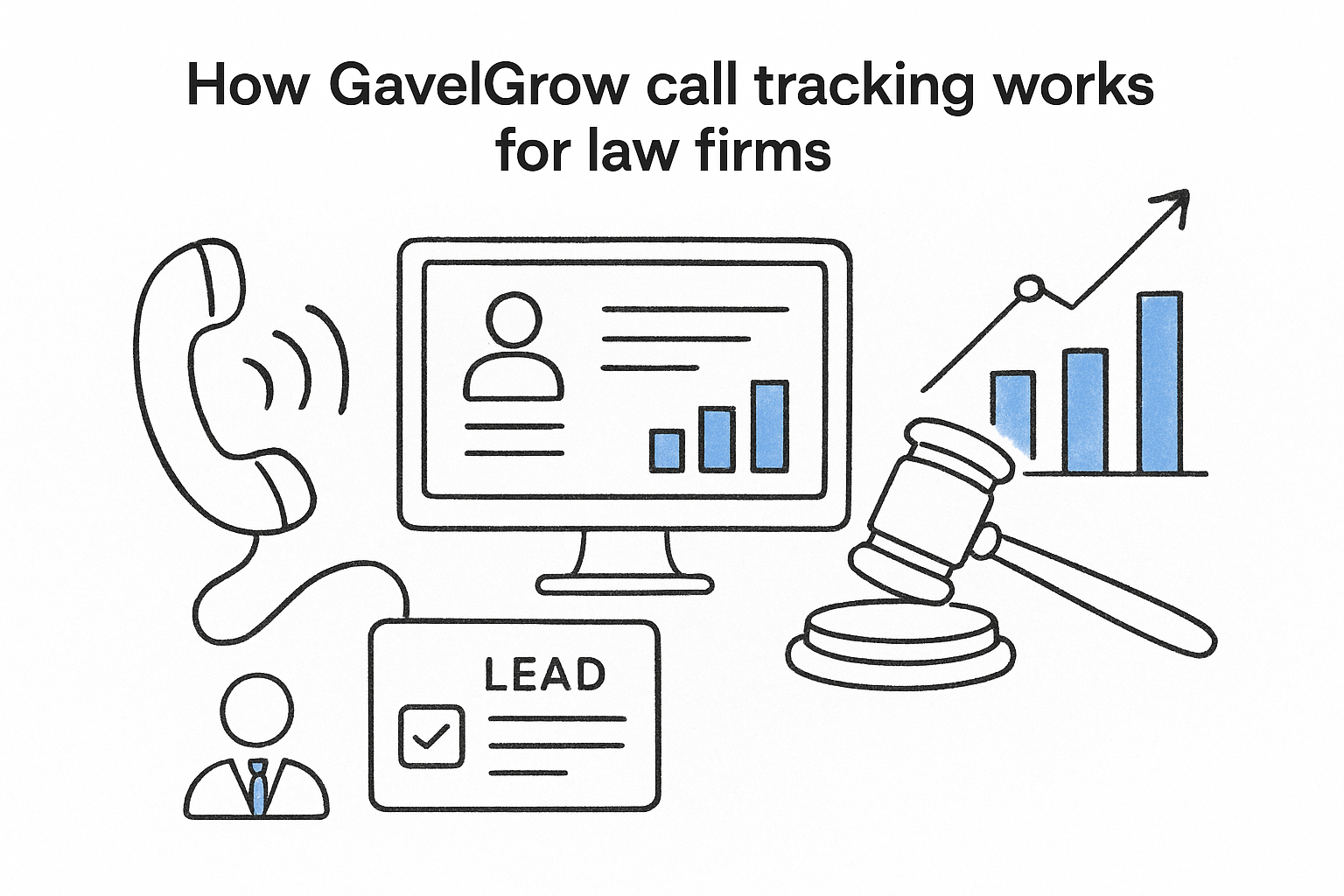
Every call connects to a lead record, and every lead record connects forward to a signed retainer, giving your firm attribution data that most call tracking tools simply cannot produce.
Miss-rate reporting is built in as well. If your intake team is missing calls after hours or during peak volume, GavelGrow surfaces that breakdown by tracking number, so you can address a real revenue leak rather than guess at one. A unified inbox pulls each call recording, SMS thread, and voicemail into a single conversation view per lead, which eliminates the tab-switching that buries qualified prospects.
Who should use GavelGrow
GavelGrow works best for U.S. law firms that run paid advertising and need attribution extending beyond cost-per-lead to cost-per-signed-case. Firms already paying separately for call tracking, a CRM, and an analytics dashboard will typically consolidate those costs under one GavelGrow tier. Practice areas that see the strongest fit include:
- Personal injury and mass tort firms managing high call volume across multiple campaigns
- Family law and criminal defense firms where intake speed directly affects close rates
- Mid-market firms comparing performance against peer firms using the benchmark database
GavelGrow pricing
GavelGrow's platform starts at $199 per month for the Track tier and reaches $599 per month for Optimize, with Managed pricing quoted per firm. Annual billing includes two months free. A 7-day free trial requires no credit card and includes full access to Optimize-tier features. Firms that prefer complete outsourcing can add managed services scoped on a strategy call, on top of the platform fee.
2. CallRail
CallRail is one of the most widely recognized call tracking platforms in digital marketing, and many law firms already have it connected to their Google Ads accounts. It handles dynamic number insertion competently, though it was designed for broad industry use rather than legal-specific intake workflows.
How CallRail works for marketing attribution
CallRail assigns unique tracking numbers to each traffic source and swaps the phone number a visitor sees based on how they arrived at your site. When a call comes in, the platform records it and sends conversion data back to Google Ads and Google Analytics 4 so your campaigns optimize toward actual calls. This approach works well for short sales cycles, but legal intake rarely closes that fast.
CallRail connects call volume to traffic sources reliably, but it has no native path to link calls to signed clients, which matters most for personal injury or family law firms with 6-month intake timelines.
Who should use CallRail
CallRail suits firms that need basic source-level attribution without a complex setup. It is a practical starting point if you're evaluating the best call tracking software on a limited budget and don't yet need cost-per-signed-case reporting. Firms that see the strongest fit include:
- Solo practitioners running single-channel Google Ads campaigns
- Small firms testing paid search before committing to a full marketing stack
CallRail pricing
CallRail's base plan starts at $50 per month, which covers five local numbers and 250 minutes.
Adding conversation intelligence or form tracking raises the monthly cost to $95 or $145, with usage-based overages for additional numbers and minutes beyond those plan limits.
3. CallTrackingMetrics
CallTrackingMetrics is a strong contender among the best call tracking software options for firms that need both attribution and active call routing in one platform. Unlike CallRail, which focuses primarily on source attribution, CallTrackingMetrics layers in IVR menus, call queues, and agent scoring alongside the standard tracking number setup.
How CallTrackingMetrics handles tracking and routing
CallTrackingMetrics assigns dynamic tracking numbers to traffic sources and captures keyword-level data from paid search, then routes inbound callers through configurable IVR flows before they reach your intake team. You can build routing rules based on time of day, caller location, or campaign, which helps firms with multiple practice areas direct calls to the right attorney or intake specialist without manual screening.
The combination of source attribution and intelligent routing means fewer calls hit the wrong person, which directly reduces your missed-lead rate during peak volume hours.
Who should use CallTrackingMetrics
CallTrackingMetrics fits firms that handle moderate-to-high inbound call volume across multiple practice areas or office locations. It works well for firms that already use a separate CRM and need a dedicated tracking layer that connects to it cleanly. If your primary frustration is calls reaching the wrong team member rather than missing attribution data, CallTrackingMetrics addresses that routing gap more directly than most competitors on this list.
CallTrackingMetrics pricing
CallTrackingMetrics starts at $39 per month for the Lite plan, which includes five numbers and 100 minutes. The Performance plan runs $99 per month and adds conversation intelligence features. Usage overages apply to both numbers and minutes beyond your plan limits.
4. WhatConverts
WhatConverts takes a broader view of lead attribution than most call tracking tools, pulling phone calls, form submissions, and live chat conversations into a single lead intelligence dashboard. For law firms running multi-channel marketing, that unified view matters because prospective clients often visit your site multiple times and convert through different channels before picking up the phone.
How WhatConverts ties calls to forms and chats
WhatConverts uses dynamic number insertion to attribute inbound calls to their originating traffic source, then connects those call records to form fills and chat conversations from the same visitor session. When a prospective client submits a contact form and calls three days later, WhatConverts links both touchpoints to a single lead record rather than counting them as two separate conversions.
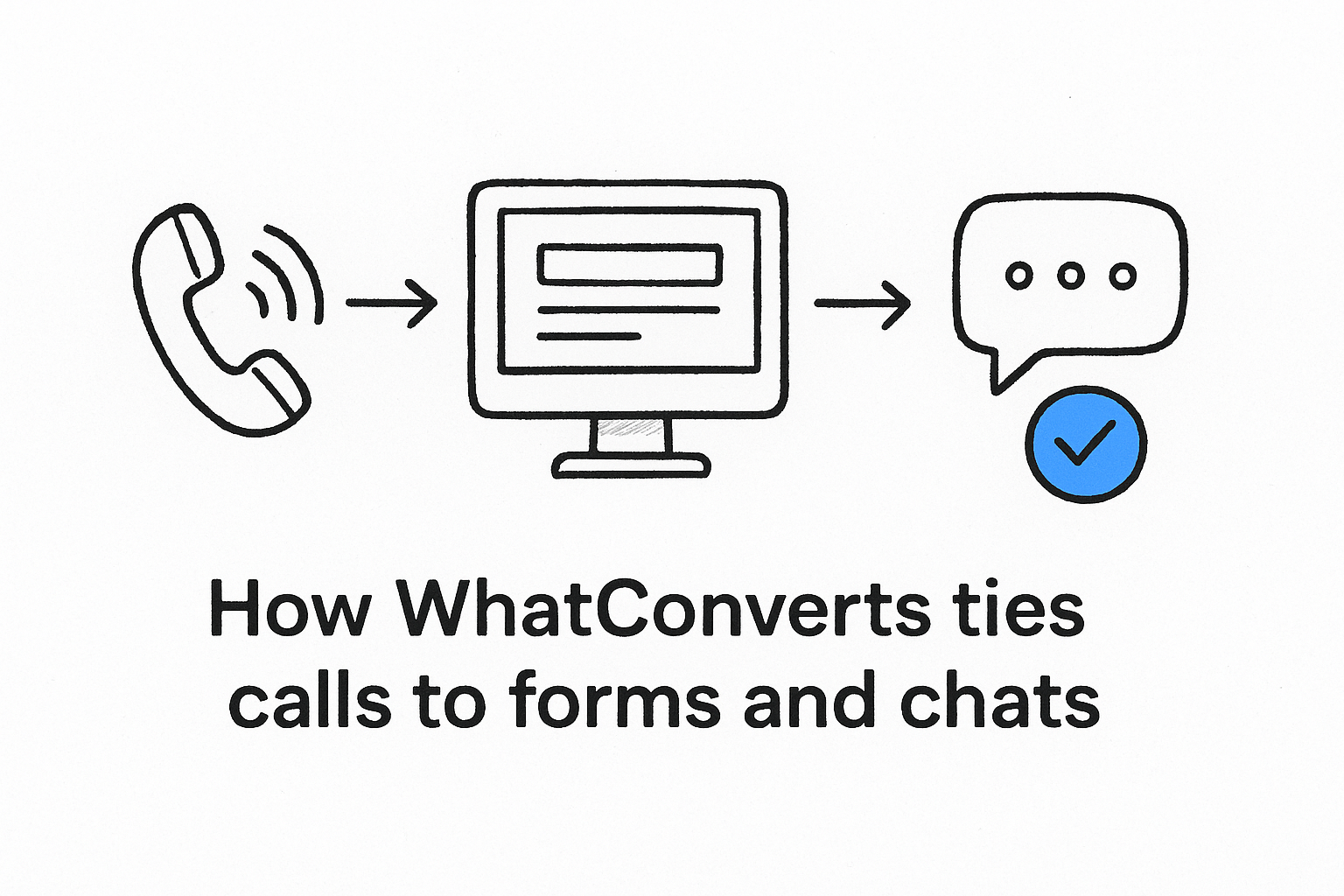
This multi-touch tracking removes the double-counting problem that inflates your lead volume metrics and distorts your cost-per-lead calculations.
Your team can mark each lead as qualified or unqualified directly inside the platform, which filters reported ROI down to only the leads that actually match your intake criteria rather than including every spam inquiry in the numbers.
Who should use WhatConverts
If you're looking for the best call tracking software to reconcile attribution across simultaneous paid search, organic, and chat campaigns, WhatConverts is worth a close look. It fits marketing managers who need to present clean, channel-level ROI data to partners without exporting reports from three separate tools.
WhatConverts pricing
WhatConverts starts at $30 per month for the Starter plan, which includes one tracking number and 50 minutes. The Plus plan runs $100 per month and adds form and chat tracking alongside expanded minute pools, with overage fees applying to additional numbers and minutes beyond your plan limits.
5. Invoca
Invoca is an enterprise-grade conversation intelligence platform that targets large marketing teams running high call volumes across multiple channels. It goes further than most tools on this list by applying AI-driven analysis to call recordings, surfacing what callers actually say and how intake staff respond, rather than just logging that a call occurred.
How Invoca uses conversation intelligence at scale
Invoca captures inbound calls through dynamic tracking numbers and then runs automatic transcription and signal detection on every conversation. The platform identifies whether a caller mentioned a specific injury type, requested a consultation, or ended the call without scheduling, then pushes those behavioral signals into your Google Ads or Meta campaigns so your bidding algorithms optimize toward calls that convert, not just calls that come in.
This distinction matters for personal injury firms where a high call volume can mask a low qualification rate, and where optimizing toward raw calls wastes budget fast.
Who should use Invoca
Invoca fits large or multi-location firms that run national or regional campaigns and have a marketing operations team comfortable working inside an enterprise software contract. If you're looking for the best call tracking software at a solo or small-firm budget, Invoca's pricing and implementation complexity will likely disqualify it. It works best for firms spending $50,000 or more per month in managed ad spend who need AI-level call quality data feeding back into campaign optimization in real time.
Invoca pricing
Invoca does not publish standard pricing publicly. Custom quotes are available through their sales team, and industry reports consistently place entry-level contracts above $1,000 per month, with enterprise agreements running significantly higher based on call volume and feature set.
6. Convirza
Convirza positions itself as a call analytics platform focused on measuring call quality rather than just call volume. Where most tracking tools tell you how many calls a campaign generated, Convirza goes deeper by scoring each conversation against a set of defined quality criteria, helping you identify whether your intake team is handling calls effectively or letting qualified leads slip through.
How Convirza scores calls for quality and outcomes
Convirza uses a feature called Conversation Analytics to automatically score inbound calls based on keywords, phrases, and outcomes detected in the recording. You can configure scoring criteria around whether intake staff asked for contact information, confirmed the caller's case type, or moved toward scheduling a consultation. The platform then assigns a numeric quality score to each call and flags low-scoring conversations for manager review.
This automated scoring surfaces coaching opportunities your team would otherwise miss when reviewing hundreds of call recordings manually.
Who should use Convirza
Convirza suits firms where intake quality consistency is the primary gap rather than attribution gaps. If you already know which campaigns generate calls but your conversion rate from call to signed client is lower than your benchmark, Convirza helps you diagnose whether the problem sits with intake staff performance rather than campaign targeting. It is a practical middle-ground option for firms shopping the best call tracking software at a mid-market price point.
Convirza pricing
Convirza's published plans start at $39 per month for basic tracking and scale upward based on call volume and analytics features. Enterprise pricing is available by custom quote for firms exceeding standard plan limits.
7. Marchex
Marchex is a call analytics platform that concentrates on improving what happens during a phone conversation rather than simply measuring which campaign produced it. The platform targets industries with high inbound call volume and long customer interactions, making it a relevant option for law firms focused on intake quality and caller experience as much as attribution.
How Marchex improves call handling and customer experience
Marchex applies AI-driven speech analytics to call recordings, analyzing both what callers say and how your intake team responds in real time. The platform detects friction points in conversations, such as long hold times, missed callbacks, or callers who expressed interest but never received a follow-up. Those signals feed into an actionable reporting layer that your intake manager can use to coach staff without listening to every recording manually.
Identifying friction inside the call itself, rather than just tracking whether the call occurred, directly improves your conversion rate from inbound inquiry to scheduled consultation.
Who should use Marchex
Marchex suits firms where intake team performance is the core bottleneck. If you run enough call volume to justify a dedicated intake manager and you're looking for the best call tracking software to support ongoing staff coaching, Marchex delivers structured conversation data for that use case. Smaller firms spending under $5,000 per month in ad spend will likely find the platform's complexity exceeds what they need at their current volume.
Marchex pricing
Marchex does not publish standard pricing on its website. Custom quotes are available through their sales team, and pricing scales based on call volume and the specific analytics modules your firm activates.
8. Infinity
Infinity is a UK-based call tracking platform that has expanded into enterprise markets in the United States, positioning itself as a high-volume attribution solution for teams managing large call datasets across multiple channels. It brings solid analytics reporting and clean integrations with major ad platforms, though it is built with marketing agencies and enterprise advertisers in mind rather than law firms specifically.
How Infinity supports high-volume tracking and analytics
Infinity assigns dynamic tracking numbers to each traffic source and captures session-level data so you can see which campaigns, keywords, and pages drove each inbound call. The platform then processes call recordings through its Conversation Analytics engine, detecting outcomes and flagging conversations based on pre-set criteria. That data feeds into dashboards your marketing team can use to report on call quality and campaign performance without exporting raw recordings manually.
For firms running campaigns across Google Ads, organic search, and paid social simultaneously, Infinity's session-level tracking removes the guesswork from multi-channel attribution reporting.
Who should use Infinity
Infinity works best for larger firms or agency-managed accounts that need structured call reporting connected to multiple ad platforms. If you are actively shopping the best call tracking software for a small to mid-size firm and your primary goal is cost-per-signed-case attribution, Infinity's feature set goes broader than most firms at that stage actually need.
Infinity pricing
Infinity does not list standard pricing on its website. Custom quotes are available through their sales team, and pricing scales based on call volume, the number of tracking numbers required, and which analytics add-ons your account activates.
9. Phonexa
Phonexa is a multi-channel performance marketing platform that includes call tracking as one component inside a broader suite covering email, SMS, lead distribution, and fraud detection. It targets performance marketers and lead generation operations rather than the direct advertiser audience that most tools on this list serve, which makes it a distinct choice among the best call tracking software options available in 2026.
How Phonexa combines tracking, routing, and fraud controls
Phonexa assigns dynamic tracking numbers to each campaign and routes inbound calls through configurable IVR flows before connecting callers to your intake team. What separates Phonexa from simpler tracking tools is its built-in fraud detection layer, which flags suspicious call patterns such as duplicate numbers, short-duration calls, and abnormal geographic clusters before those calls inflate your reported lead counts.
Catching fraudulent calls before they reach your billing report prevents inflated CPL figures from distorting your campaign decisions.
The platform also supports lead distribution rules, which allows firms buying calls from third-party lead sources to apply quality filters and route only verified inquiries to available intake staff.
Who should use Phonexa
Phonexa fits firms that purchase leads or calls from external networks and need automated quality controls to filter out low-value traffic before it reaches your intake team. If your firm generates all its own leads through direct advertising, Phonexa's fraud and distribution features add complexity your operation does not need.
Phonexa pricing
Phonexa offers a free Lite plan with limited call volume. Paid plans start at $100 per month, with pricing scaling based on call volume, the feature modules your account activates, and the number of users included.
10. Twilio
Twilio is not a packaged call tracking product in the way other tools on this list are. It is a developer-grade communications API that gives your engineering team the raw infrastructure to build a fully custom call tracking stack from scratch. If you want total control over how numbers are provisioned, how calls are routed, and how attribution data flows into your systems, Twilio provides the building blocks to make that happen.
How Twilio lets you build a custom call tracking stack
Twilio's Programmable Voice API lets developers provision local and toll-free tracking numbers, record calls, transcribe audio, and pass call data to any downstream system your firm uses. You write the routing logic, set the recording rules, and define exactly how call events feed into your analytics pipeline. GavelGrow's own call tracking infrastructure runs on Twilio, which is why the platform can offer per-campaign tracking numbers, outcome tagging, and miss-rate reporting without depending on a third-party product in between.
Building on Twilio gives you full data ownership, but it requires developer resources that most law firms do not have in-house.
Who should use Twilio
Twilio suits firms with in-house development capacity that need call tracking behavior no packaged tool currently supports. If you are evaluating the best call tracking software and your firm does not employ a developer who can maintain a custom integration, a packaged platform will save you significant time and ongoing maintenance cost.
Twilio pricing
Twilio charges on a pay-as-you-go model. Local tracking numbers cost approximately $1.15 per month each, with inbound call minutes billed at around $0.0085 per minute as of 2026. Costs scale directly with your call volume and the number of active tracking numbers your firm maintains.
Next Steps
Choosing the best call tracking software for your firm comes down to one question: do you need attribution data that stops at the phone call, or do you need it to follow the lead all the way to a signed retainer? Generic tools like CallRail and Invoca handle the first part competently. Only GavelGrow connects that call record forward through intake, case management, and revenue attribution inside a platform built exclusively for law firms.
Your next move depends on where your biggest gap sits. If you're losing revenue to missed calls, slow intake responses, or campaigns you can't measure past the lead stage, the platform addresses all three. Start with a 7-day free trial and see your call attribution data in a live dashboard before committing to a plan. If you'd rather talk through your firm's specific situation first, book a free 45-minute strategy call with the GavelGrow team.
Frequently Asked Questions
What is call tracking software for law firms?
Call tracking software assigns unique phone numbers to each of your marketing campaigns, records inbound calls, and reports which campaigns generated which calls. For law firms, the most useful platforms go further by connecting call records to lead intake, case status, and signed retainer data, giving you cost-per-signed-case reporting rather than just cost-per-call. GavelGrow uses Twilio-powered tracking numbers to provide that full-funnel view inside a single dashboard built for legal intake workflows.
How much does call tracking software cost for a law firm?
Prices range from $30 per month for entry-level tools like WhatConverts to custom enterprise contracts exceeding $1,000 per month for platforms like Invoca. GavelGrow's Optimize plan, which includes call tracking, intake automation, and attribution, runs $599 per month. Firms that currently pay separately for CallRail, a CRM, and an analytics tool typically consolidate those costs under a single GavelGrow tier and spend less overall.
Does call tracking software record phone calls automatically?
Most platforms on this list record calls automatically once you enable the feature, but two-party consent requirements vary by state. In states like California, Florida, and Illinois, both parties must consent before recording begins. GavelGrow handles consent disclosures automatically at the start of each recorded call, reducing your compliance exposure without requiring manual configuration from your intake team.
Can call tracking software integrate with Google Ads?
Yes. Platforms including GavelGrow, CallRail, CallTrackingMetrics, and WhatConverts all offer native Google Ads sync that pushes call conversion data back into your campaigns so your bidding algorithms optimize toward calls that match your intake criteria. GavelGrow also fires GA4 events with value parameters so your campaigns can optimize toward leads that actually convert, not just any call that comes in.
What is dynamic number insertion and why does it matter?
Dynamic number insertion swaps the phone number a website visitor sees based on how they arrived at your site. A visitor from a Google Ads click sees a different number than a visitor from organic search, which lets your tracking platform attribute each call to its exact source. Without dynamic number insertion, you can count total calls but you cannot determine which campaigns or keywords produced them.

How does call tracking connect to cost-per-signed-case reporting?
Standard call tracking stops at the call. Cost-per-signed-case reporting requires connecting that call record forward through intake qualification, retainer signing, and case outcome data. GavelGrow links every inbound call to a lead record, tracks that lead through your intake pipeline, and reports campaign-level cost-per-signed-case inside the same dashboard. Most standalone call tracking tools, including CallRail and Convirza, require a separate CRM integration to get anywhere close to that level of attribution.
Is TCPA compliance built into call tracking software?
TCPA compliance features vary significantly across platforms. GavelGrow includes an append-only consent audit log, CTIA opt-out keyword handling for SMS, and automatic two-party consent disclosures on call recordings. Generic tools like CallRail and Twilio leave most compliance configuration to your team, which creates risk if your intake staff misses a required disclosure. Before selecting any platform, confirm how it handles consent documentation for both call recordings and SMS follow-up sequences.
Frequently Asked Questions
What is call tracking software for law firms?
Call tracking software assigns unique phone numbers to each of your marketing campaigns, records inbound calls, and reports which campaigns generated which calls. For law firms, the most useful platforms go further by connecting call records to lead intake, case status, and signed retainer data , giving you cost-per-signed-case reporting rather than just cost-per-call. GavelGrow uses Twilio-powered tracking numbers to provide that full-funnel view inside a single dashboard built for legal intake workflows.
How much does call tracking software cost for a law firm?
Prices range from $30 per month for entry-level tools like WhatConverts to custom enterprise contracts exceeding $1,000 per month for platforms like Invoca. GavelGrow's Optimize plan, which includes call tracking, intake automation, and attribution, runs $599 per month . Firms that currently pay separately for CallRail, a CRM, and an analytics tool typically consolidate those costs under a single GavelGrow tier and spend less overall.
Does call tracking software record phone calls automatically?
Most platforms on this list record calls automatically once you enable the feature, but two-party consent requirements vary by state. In states like California, Florida, and Illinois, both parties must consent before recording begins. GavelGrow handles consent disclosures automatically at the start of each recorded call, reducing your compliance exposure without requiring manual configuration from your intake team.
Can call tracking software integrate with Google Ads?
Yes. Platforms including GavelGrow, CallRail, CallTrackingMetrics, and WhatConverts all offer native Google Ads sync that pushes call conversion data back into your campaigns so your bidding algorithms optimize toward calls that match your intake criteria. GavelGrow also fires GA4 events with value parameters so your campaigns can optimize toward leads that actually convert, not just any call that comes in.
What is dynamic number insertion and why does it matter?
Dynamic number insertion swaps the phone number a website visitor sees based on how they arrived at your site. A visitor from a Google Ads click sees a different number than a visitor from organic search, which lets your tracking platform attribute each call to its exact source. Without dynamic number insertion, you can count total calls but you cannot determine which campaigns or keywords produced them.
How does call tracking connect to cost-per-signed-case reporting?
Standard call tracking stops at the call. Cost-per-signed-case reporting requires connecting that call record forward through intake qualification, retainer signing, and case outcome data. GavelGrow links every inbound call to a lead record, tracks that lead through your intake pipeline, and reports campaign-level cost-per-signed-case inside the same dashboard. Most standalone call tracking tools, including CallRail and Convirza, require a separate CRM integration to get anywhere close to that level of attribution.