15 Family Law Marketing Strategies To Sign More Cases
Categories: Legal Marketing Strategies
 Abram Ninoyan
Founder & Senior Performance Marketer
Credentials: Google Partner, Google Ads Search Certified, Google Ads Display Certified, Google Ads Measurement Certified, Google Analytics (IQ) Certified, HubSpot Inbound Certified, HubSpot Social Media Marketing Certified, Conversion Optimization Certified
Expertise: Google Ads, Meta Ads, Conversion Rate Optimization, GA4 & Google Tag Manager, Lead Generation, Marketing Funnel Optimization, PPC Management
LinkedIn Profile
The most effective family law marketing strategies in 2026 focus on one metric that actually matters: signed retainers, not clicks, not impressions, not "brand awareness." Family law sits in...
Key Takeaways
- 15 Family Law Marketing Strategies To Sign More Cases (2026)
- 1. Use GavelGrow to measure ROI and automate intake
- 2. Choose a clear family law niche and positioning
- 3. Build practice area pages that convert divorce and custody leads
15 Family Law Marketing Strategies To Sign More Cases (2026)
The most effective family law marketing strategies in 2026 focus on one metric that actually matters: signed retainers, not clicks, not impressions, not "brand awareness."
Family law sits in a strange spot. Prospective clients are going through some of the worst moments of their lives, divorce, custody battles, protective orders, and they're searching for an attorney at 11 p.m. on their phone, often in tears. That means your marketing has to do two things simultaneously: show up at the exact right moment and communicate trust fast enough that someone in crisis picks you over the three other firms on the page. Speed matters too: the Lead Response Management Study found that leads contacted within five minutes were 21 times more likely to qualify than those first reached at thirty minutes. In family law, where urgency runs higher than almost any other practice area, a slow callback is often a case lost to a competitor.
This guide breaks down 15 strategies that family law firms are using right now to generate and convert more consultations, from Google Ads and local SEO to intake automation and review generation. Each one is built around the realities of family law specifically, not recycled advice from generic marketing blogs. Where relevant, we'll show how GavelGrow's legal marketing platform helps firms track every lead from first click through signed case, so you can see exactly which strategies are pulling their weight and which ones are burning budget.
1. Use GavelGrow to measure ROI and automate intake
Most family law firms run their marketing spend through at least three or four disconnected tools: a call tracking service, a CRM, an intake form, and a reporting dashboard, none of which talk to each other cleanly. That fragmentation means you never really know which campaigns are producing signed retainers versus which ones are generating consultations that go nowhere.
How it works
GavelGrow connects every touchpoint in your client acquisition funnel, from the first Google Ad click through signed retainer, inside a single dashboard built exclusively for law firms. When a prospective divorce or custody client fills out your intake form, the platform fires GA4, Meta Pixel, and GTM conversion events simultaneously, so your ad accounts attribute the lead natively without you manually reconciling spreadsheets. The platform also assigns per-campaign tracking numbers so you know exactly which keywords, ads, or landing pages drove each call.
Most family law marketing fails not because the ads are bad, but because firms can't trace a signed case back to its source.
Implementation steps
Start with a 7-day free trial on GavelGrow's Track plan (no credit card required). Embed the hosted intake form on your existing website using the provided script snippet or iframe. Connect your Google Ads account for daily campaign sync, then configure your SMS (once US carriers approve your number) and email auto-reply sequences so every new lead gets a response within minutes of form submission. Once your tracking numbers are live, tag every inbound call as qualified, callback, unqualified, or spam so your cost-per-signed-case data stays accurate.
Compliance and risk notes
TCPA compliance is non-negotiable in family law intake. GavelGrow's forms include an append-only consent audit log and CTIA opt-out handling (STOP and HELP keywords) baked in by default. Call recordings use two-party-consent disclosure language automatically, and all data is encrypted at rest with AES-256. You still need to verify your state bar's specific rules on testimonials and fee disclosures, but the consent infrastructure is handled at the platform level.
Metrics to track
Focus on cost per signed case by campaign, not just cost per lead. Track your consultation-to-retainer close rate, your speed-to-lead average (target under five minutes), and your miss rate per tracking number. GavelGrow's modelled practice-area benchmarks let you compare these metrics with modelled ranges for your market size and practice area, so you can see whether your numbers look competitive or are bleeding budget.
2. Choose a clear family law niche and positioning
Family law covers a wide range of services, and firms that try to market everything to everyone tend to convert fewer leads than those that stake out a specific position. Focusing your family law marketing on a defined niche, such as high-asset divorce, military divorce, or fathers' rights, lets you speak directly to the emotional state and practical concerns of a specific client type.
How it works
When you narrow your positioning, your ads, landing pages, and intake forms can all use language that mirrors exactly what your ideal client is searching for. Generic messaging like "experienced family law attorney" blends into every other firm on the page. Niche-specific copy like "protecting business owners in high-asset divorce" signals immediately that you understand the problem.
The firms that dominate a single niche almost always out-convert the firms trying to serve every family law case in their market.
Implementation steps
Start by reviewing your last 12 months of signed cases and identifying where your close rate was highest. Then build your positioning around that sub-type. Update your homepage headline, Google Business Profile description, and primary landing pages to reflect that niche before pushing any new ad spend.
Compliance and risk notes
Avoid language that implies a guaranteed outcome or creates unrealistic client expectations. Most state bars prohibit specific outcome claims in attorney advertising, so phrases like "we win fathers' rights cases" require review before publishing.
Metrics to track
Watch your consultation-to-retainer rate by lead source. A tighter niche typically raises this metric because the leads arriving are already better qualified for your specific services.
3. Build practice area pages that convert divorce and custody leads
A single "Family Law" page on your website is not enough to compete in local search. Prospective clients searching "divorce attorney [city]" or "child custody lawyer near me" want a firm that specifically handles their situation, not a page listing every service you offer. Dedicated practice area pages give search engines a clear signal and give visitors immediate confidence that you understand their exact problem.

A focused practice area page converts better than a broad services page in every family law marketing audit.
How it works
Each practice area page targets a distinct service: divorce, child custody, child support, spousal support, adoption, and domestic violence restraining orders. These pages rank for specific long-tail queries that a general homepage never captures on its own.
They also let you speak the emotional language of each situation. Someone in a custody dispute has entirely different fears and questions than someone filing for uncontested divorce, and your copy should reflect that difference directly.
Implementation steps
Build a dedicated URL for each service (for example, /divorce-attorney-[city] and /child-custody-lawyer-[city]). Each page should include:
- A headline naming the service and your city
- Answers to the three questions clients ask most about that issue
- Practice-specific social proof where bar rules allow
- A single call-to-action pointing to your intake form
Compliance and risk notes
Avoid outcome-specific language on any page. Most state bars prohibit claims that imply a guaranteed result.
Review every new page against your bar's advertising guidelines before it goes live, particularly pages targeting high-emotion sub-niches like fathers' rights or domestic violence cases.
Metrics to track
Monitor organic sessions per page alongside the form submission rate for each URL. A page drawing strong traffic but few form fills signals a trust or copy problem, not a traffic problem.
- Organic sessions per practice area page (monthly)
- Form submission rate per page (target 3% or higher)
- Click-to-call rate per page
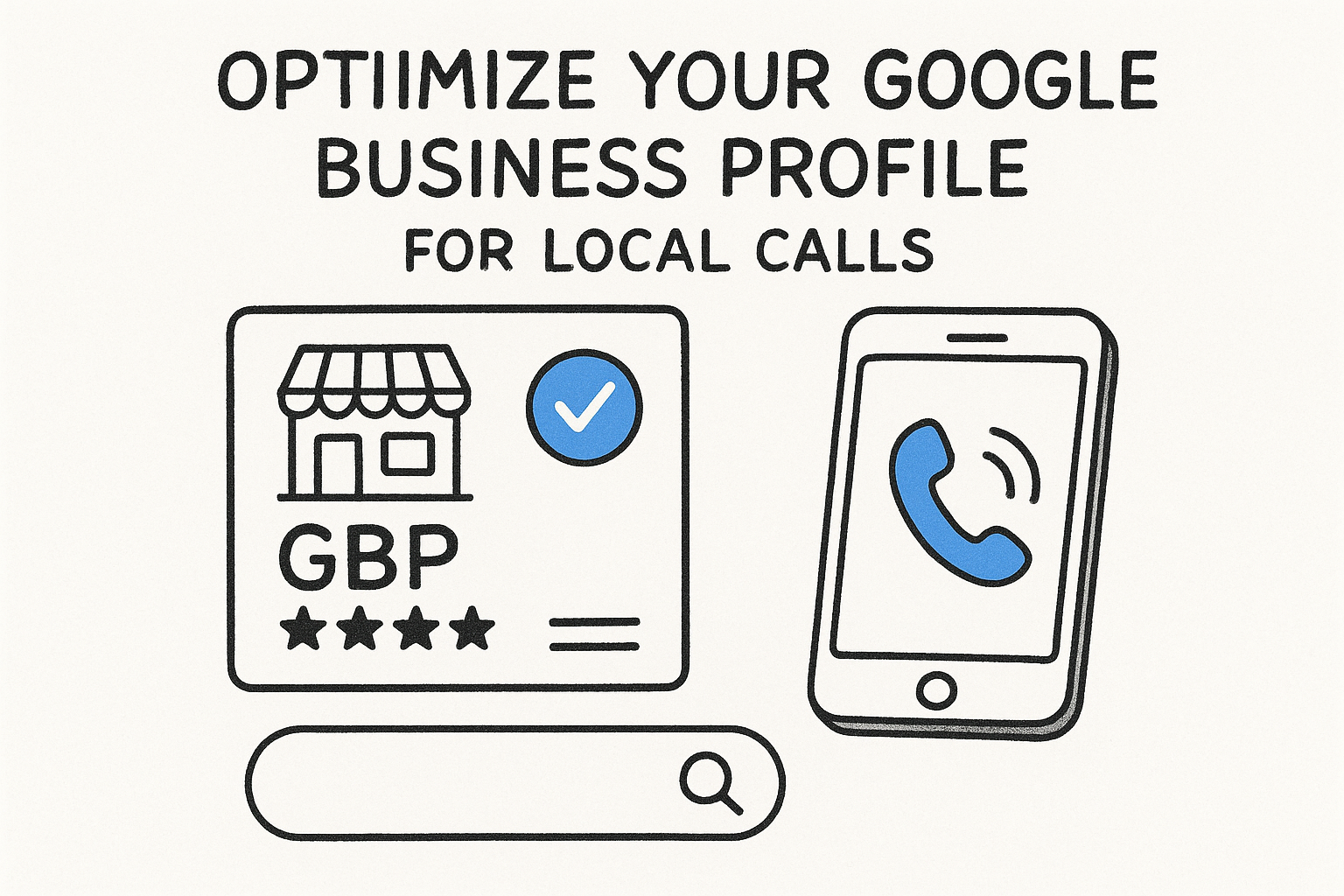
4. Optimize your Google Business Profile for local calls
Your Google Business Profile (GBP) is often the first place a prospective client sees your firm before they ever visit your website. For family law practices, where most clients search with high-urgency queries like "divorce attorney near me," a fully optimized profile can drive direct calls without any ad spend attached.
How it works
Google uses your GBP signals, including category accuracy, review volume, post frequency, and NAP consistency, to decide whether your firm appears in the Local Pack, the three-result map block that sits above all organic listings. Appearing there means visibility to clients who are ready to call within minutes of searching.
A well-optimized Google Business Profile routinely delivers more inbound calls than a firm's entire paid search budget for family law marketing.
Implementation steps
Set your primary category to "Family Law Attorney" and add relevant secondary categories like Divorce Lawyer or Child Custody Attorney. Upload at least 10 photos including your office exterior and headshots. Publish a new Google Post every week covering a timely family law topic or firm update. Enable the messaging feature and respond to every question within 24 hours.
Compliance and risk notes
Your GBP description cannot include specific outcome claims or language that implies guaranteed results. Review your state bar's advertising rules before publishing any case result summaries or client outcome references in posts or the Q&A section.
Metrics to track
Check your GBP Insights monthly for calls, direction requests, and website clicks broken out by direct versus discovery searches. Track call volume trends week over week to spot drops that signal a listing issue.
5. Build a bar-compliant review and reputation system
Online reviews are the closest thing to a referral that a stranger can give your firm. For family law marketing, where trust drives every hiring decision, your Google review count and average rating directly influence whether a prospective client calls you or scrolls to the next listing. A consistent review generation process is not optional at this point.
How it works
When a client closes their case with a positive outcome, they are typically willing to leave a review if you make it easy and ask at the right moment. Most firms lose reviews simply because they never ask. A repeatable system tied to your case closure workflow ensures that no satisfied client slips through without receiving a direct, personal request.
Review volume compounds over time, and firms with 50 or more Google reviews consistently outrank competitors with fewer than 20, even when other signals are similar.
Implementation steps
Send a personalized SMS or email within 24 hours of a case closing successfully. Include a direct link to your Google Business Profile review form. For firms using GavelGrow, you can trigger this message automatically through the intake automation sequences tied to case status changes, removing the need for manual follow-up.
Compliance and risk notes
Never offer incentives in exchange for reviews, as most state bars prohibit this and Google's own policies forbid it. Avoid asking clients to describe specific case outcomes in their reviews, which can raise confidentiality concerns depending on your jurisdiction.
Metrics to track
Track your total Google review count monthly alongside your average star rating. A healthy family law firm should target adding at least four to six new reviews per month.
6. Fix speed-to-lead with calls, SMS, and scheduling
Speed-to-lead is the single most measurable conversion lever in family law marketing. A prospective client searching for a divorce attorney at 10 p.m. is comparing multiple firms simultaneously, and the first one to respond captures a disproportionate share of consultations.
How it works
When a lead submits a form or calls your firm, a response delay of more than five minutes dramatically reduces your odds of converting that person into a consultation. Research from Harvard Business Review found that firms responding within one minute are 60 times more likely to qualify a lead than those responding 24 hours later. In family law, where the emotional urgency is high, a slow response often reads as disinterest.
Leads contacted within five minutes are 21 times more likely to qualify than those contacted after 30 minutes, regardless of ad spend or brand recognition.
Implementation steps
Set up automated SMS replies that fire within 60 seconds of every form submission, confirming receipt and offering a direct scheduling link. Use a tool like GavelGrow's intake automation to trigger both SMS and email simultaneously. Add a self-scheduling calendar link to your auto-reply so prospects can book a consultation without waiting for a callback. For calls, configure call routing so after-hours inquiries reach a backup line or answering service trained on your intake script.
Compliance and risk notes
Your auto-reply SMS messages must include TCPA-compliant opt-in language captured at the point of form submission. Make sure your intake form logs consent timestamps, not just the checkbox state.
Metrics to track
Monitor your average speed-to-lead time weekly and your miss rate per tracking number monthly. Target a median first response under five minutes across all lead sources.
7. Standardize intake scripts and lead qualification
Even if you fix your speed-to-lead time, inconsistent intake conversations will still bleed qualified leads from your pipeline. Without a defined script, different staff members ask different questions, miss critical disqualifying factors, and leave prospective clients with varying impressions of your firm's competence. This gap costs you more in wasted consultations than most family law marketing spend ever recovers.
How it works
A standardized intake script ensures every staff member asks the same qualifying questions in the same order, regardless of how busy the day gets. For family law, that means capturing jurisdiction, the specific issue (divorce, custody, support modification), opposing party status, and whether the caller has prior attorney involvement. This data lets you triage leads accurately before a consultation is ever scheduled.
Firms that qualify leads at intake report significantly lower wasted consultation rates and higher consultation-to-retainer close rates.
Implementation steps
Build a two-page intake script covering your top five to seven qualifying questions. Train every staff member on it, then record calls using GavelGrow's built-in call tracking to audit adherence weekly. Tag each call as qualified, callback, unqualified, or spam inside the platform so your pipeline data stays clean and your cost-per-signed-case numbers reflect reality.
Compliance and risk notes
Intake staff cannot provide legal advice during qualification calls, even casually. Establish a clear boundary in your script between information gathering and attorney consultation. Review this boundary with your malpractice carrier annually to confirm your intake process stays within permissible scope.
Metrics to track
Track your qualification rate (qualified leads divided by total inbound contacts) alongside your no-show rate per consultation type. A rising no-show rate often signals that your intake script is approving leads that do not meet your actual case criteria.
8. Publish SEO content for high-intent family law questions
Writing blog content for its own sake rarely moves a client acquisition needle. The firms that win on organic search publish answers to the specific legal questions their ideal clients type into Google at the moment they decide to hire an attorney. This is where family law marketing gains compounding value over time.
How it works
Prospective clients searching "how is property divided in a divorce in Texas" or "can I modify a custody agreement without a lawyer" are signaling real intent, not casual curiosity. Ranking for these queries positions your firm as the authority before the person ever picks up a phone, which lowers resistance during the intake call significantly.
Content targeting specific procedural questions consistently outperforms generic "what is divorce" posts for driving consultation requests.
Implementation steps
Start by building a list of 25 to 30 questions your intake team hears repeatedly. Group them by sub-topic: divorce procedure, custody standards, support calculations, and modification requests. Publish one 800 to 1,200 word post per question, with a clear answer in the first paragraph and a call-to-action at the bottom linking directly to your intake form. Update each post annually with any relevant statutory changes in your state.
Compliance and risk notes
Every post must include a disclaimer clarifying that the content is general information, not legal advice, and does not create an attorney-client relationship. Most state bars require this on any public-facing legal content.
Metrics to track
Track organic sessions per post monthly alongside the form submission rate per page. A post generating traffic but zero form fills typically needs a stronger call-to-action or a more prominent intake form placement.
9. Strengthen local SEO with citations and legal directories
Your local search rankings depend on more than just your Google Business Profile. Search engines use citation consistency across directories, review sites, and legal platforms to verify your firm's legitimacy and geographic relevance. For family law marketing specifically, inconsistent name, address, and phone number data across the web actively suppresses your visibility in local results.
How it works
When Google finds your firm listed with the same NAP data across dozens of authoritative directories, it treats that consistency as a trust signal and rewards you with stronger local rankings. Legal-specific directories like Avvo, FindLaw, Justia, and Martindale-Hubbell also pass domain authority signals back to your website through backlinks, which strengthens your organic search position over time.
Citation building is one of the few local SEO tactics that compounds in value the longer you maintain it consistently.
Implementation steps
Audit your existing listings first using a tool like Google Search to spot any conflicting address or phone formats. Then claim and complete your profiles on the top legal directories, prioritizing those with the highest domain authority. Make sure your firm name, address, phone number, and website URL match exactly across every listing, including punctuation and suite number formatting. Refresh these listings whenever your firm moves, adds a location, or changes its primary phone number.
Compliance and risk notes
Some directories auto-generate attorney profiles without your consent. Claim those profiles proactively to control the content, since unclaimed listings can display outdated information that harms both rankings and client trust.
Metrics to track
Monitor your local pack rankings for your top five target keywords monthly. Track the number of directory listings with fully consistent NAP data as a separate benchmark.
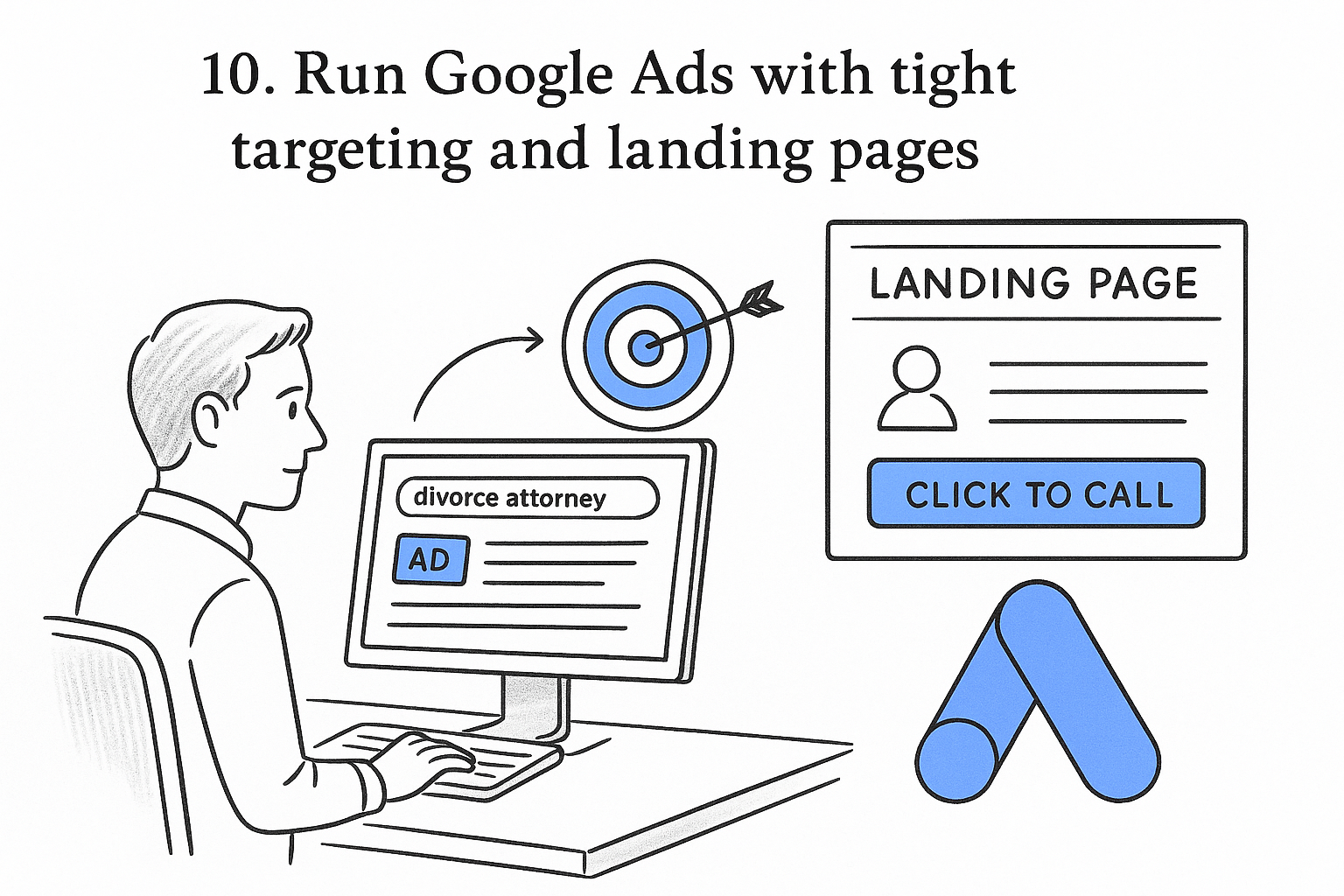
10. Run Google Ads with tight targeting and landing pages
Google Ads gives family law firms a way to appear at the top of search results the same day a campaign goes live. The challenge is that family law keywords are among the most expensive in legal advertising, sometimes exceeding $50 per click in major metros, so undisciplined targeting burns through budget without producing signed cases.
How it works
Paid search campaigns work because you only pay when someone actively searches for what you offer. In family law marketing, that means bidding on phrases like "divorce attorney [city]" or "child custody lawyer near me" and sending those clicks to a dedicated landing page that mirrors the ad's language. A mismatch between ad copy and landing page content is one of the most common reasons family law Google Ads campaigns underperform.
The firms that get the best return from Google Ads send clicks to single-purpose landing pages, not their homepage.
Implementation steps
Build a separate landing page for each ad group: one for divorce, one for custody, one for support modifications. Each page should carry a single headline matching the ad, a short form, and a click-to-call button above the fold. Use negative keywords aggressively to filter out searches for legal aid, pro se help, or other non-qualifying queries.
Compliance and risk notes
Your landing page copy must follow state bar advertising rules in every jurisdiction you target. Avoid outcome guarantees or superlatives like "best divorce attorney" without substantiation.
Metrics to track
Track cost per consultation booked and cost per signed case by campaign, not just click-through rate or cost per click. Also monitor your Quality Score per keyword, since a higher score lowers your cost per click over time.
11. Use Google Local Services Ads if your firm qualifies
Google Local Services Ads (LSAs) place your firm at the very top of search results, above both standard Google Ads and organic listings, with a Google Screened badge that signals immediate trust to prospective clients. For family law marketing, this placement matters because high-urgency searchers often click the first credible result they see.
How it works
LSAs operate on a pay-per-lead model rather than pay-per-click, meaning you only pay when a prospective client calls or messages your firm directly through the ad. Google verifies your license, insurance, and background checks before granting the Google Screened status, which distinguishes your listing from competitors who have not completed that process.
Firms with a Google Screened badge consistently report higher call-through rates than standard text ads in the same search position.
Implementation steps
Apply through Google's Local Services Ads platform and submit your state bar license number and malpractice insurance documentation during the verification process. Set your weekly budget based on your target consultation volume, and mark any leads that do not match your practice areas as disputed to receive a credit against future charges. Respond to every LSA message within 24 hours, since slow response times lower your ranking within the LSA unit.
Compliance and risk notes
Your LSA profile description must follow the same state bar advertising rules that govern all attorney marketing. Avoid any language that implies a guaranteed outcome or uses superlatives without substantiation.
Metrics to track
Track your cost per booked consultation from LSAs separately from your standard Google Ads campaigns. Compare your LSA close rate against your paid search close rate monthly to confirm the lead quality justifies the spend.
12. Retarget consultation shoppers with paid social ads
Most prospective family law clients visit your website, look at your practice area pages, and leave without contacting you. Retargeting campaigns on Facebook and Instagram allow you to serve ads specifically to those visitors after they leave, keeping your firm visible while they continue comparing their options. This is one of the most cost-efficient tactics in family law marketing because you are spending money on people who already expressed interest.
How it works
Retargeting works by placing a tracking pixel on your website that builds a custom audience of everyone who visited specific pages, like your divorce or custody landing pages, without submitting a form. Your ads then follow those visitors across Facebook and Instagram with messaging that addresses common hesitations, such as cost concerns or timeline questions.
Retargeting audiences convert at two to five times the rate of cold traffic because they already have baseline familiarity with your firm.
Implementation steps
Install the Meta Pixel on your website and create separate custom audiences for each major practice area page. Build ads that address one specific objection per audience, for example, affordability messaging for visitors who viewed your fee information page. Set a frequency cap of three to five impressions per week per person to avoid overexposure, and refresh your creative every 30 days.
Compliance and risk notes
Your retargeting ads must follow state bar advertising rules in every jurisdiction you target. Avoid copy that implies a specific outcome or exploits the emotional vulnerability of someone in a family crisis.
Metrics to track
Track cost per retargeted consultation separately from your cold-traffic campaigns. Also monitor your frequency rate per ad set to confirm you are not spending budget showing the same ad to the same person repeatedly without action.
13. Send a monthly newsletter that drives referrals
A monthly email newsletter keeps your firm in front of former clients, referral partners, and professional contacts who already trust you. Most family law practices ignore this channel entirely, which means a simple, consistent newsletter becomes a meaningful competitive advantage in your local market.
How it works
Former clients rarely need another family law attorney themselves, but they know people who do. A newsletter keeps your name and expertise top of mind so that when a friend, coworker, or family member mentions a divorce or custody issue, your former client thinks of you immediately. Referral attorneys, financial planners, and therapists who work with divorcing clients can also become consistent lead sources when you stay visible to them monthly.
A newsletter built for referrals outperforms one built for self-promotion in every measurable family law marketing context.
Implementation steps
Send one email per month on a predictable schedule, such as the first Tuesday of every month. Each issue should include one practical article answering a common family law question, one brief firm update, and a direct line to schedule a consultation. Keep it under 400 words total. Use a platform like Mailchimp or a comparable tool that tracks open rates and click activity so you know which topics generate the most engagement.
Compliance and risk notes
Your newsletter must include an unsubscribe link in every send, per CAN-SPAM requirements. Avoid referencing specific client outcomes without explicit written consent, and include your firm's physical address in every footer.
Metrics to track
Track your monthly open rate (target 25% or higher for legal audiences) alongside the number of consultation requests attributed to newsletter clicks each month.
14. Use short-form video to build trust before the consult
Short-form video on YouTube Shorts and Instagram Reels gives prospective clients a way to see and hear you before they ever call, which reduces the anxiety that comes with reaching out to an attorney during one of the most stressful periods of their lives. Firms that publish consistent video content report higher consultation show rates because the prospect already feels a baseline level of familiarity before the first conversation.

How it works
When someone watches a 60-second clip of you explaining how property division works in their state, you have answered their question and demonstrated competence at the same time. This pre-consult familiarity shortens the trust-building phase inside the consultation itself, meaning your attorneys spend less time convincing and more time qualifying. In family law marketing, that shift translates directly into a higher consultation-to-retainer close rate.
Video content that answers a specific procedural question consistently outperforms general "meet the firm" introductions for driving consultation requests.
Implementation steps
Record three to five short videos per month addressing the questions your intake team hears most often. Useful starting topics include:
- How long divorce takes in your state
- What courts weigh when making custody decisions
- How child support calculations work
Publish each video on YouTube and cross-post to Instagram Reels. Add a direct scheduling link in the description of every video so viewers can book immediately.
Compliance and risk notes
Every video must include a verbal or on-screen disclaimer stating that the content is general information and does not constitute legal advice. Avoid referencing specific case results unless your state bar explicitly permits that under its advertising rules.
Metrics to track
Track view count and click-through rate to your scheduling link per video monthly. A rising view count paired with low clicks signals that your call-to-action needs to be more prominent or more direct.
15. Track cost per signed case and rebalance monthly
Most family law marketing budgets get allocated once at the start of the year and then left alone. That approach guarantees you will keep funding campaigns that stopped working months ago while starving the ones that are actually producing retainers. A monthly rebalancing discipline fixes that problem before it compounds.
How it works
Cost per signed case divides your total campaign spend by the number of retainers that originated from that campaign. It is the only metric that tells you whether a channel is actually profitable, since a campaign generating cheap leads but low close rates can cost more per signed case than a campaign with expensive clicks and a strong close rate.
Cost per signed case is the number that connects your marketing spend directly to your revenue, and every other metric in your funnel exists to explain it.
Implementation steps
Pull your cost per signed case by campaign at the end of every month. Rank every active channel from lowest to highest cost per signed case. Shift budget from the bottom two performers toward the top two, and set a 90-day review window before cutting any channel entirely. Use GavelGrow's attribution dashboard to pull these numbers automatically rather than reconciling them across separate tools.
Compliance and risk notes
Your reporting process does not create direct bar compliance exposure, but client data used in attribution reporting must stay within your firm's documented data retention and privacy policies.
Metrics to track
Track cost per signed case, cost per consultation, and consultation-to-retainer close rate by channel each month. Review your benchmark comparison quarterly to confirm your numbers stay competitive within your practice area and market size.
Wrap-up and FAQs
These 15 family law marketing strategies work best when you run them together, not in isolation. Start with attribution and intake, then layer in SEO, paid ads, and video. Book a free 45-minute strategy call to map out which channels fit your firm's budget and market.
Frequently Asked Questions
What is the fastest way to get more family law clients?
Google Ads combined with a fast intake response produces the quickest results. Fix your speed-to-lead first; leads contacted within five minutes are 21 times more likely to qualify than those reached after 30.
How much should a family law firm spend on marketing in 2026?
Most competitive markets require $3,000 to $8,000 per month in combined ad spend and platform costs. Scale based on your cost-per-signed-case target.
Should your firm focus on SEO or Google Ads for family law?
Run both. Google Ads delivers immediate consultations while SEO builds compounding organic traffic. Neither alone covers the full buyer journey.
What should you track besides cost per lead for family law marketing?
Track cost per signed case and consultation-to-retainer close rate. Cost per lead without close rate data tells you nothing useful about actual revenue.
How do you improve family law intake without hiring staff?
Automated SMS replies within 60 seconds and a self-scheduling calendar link handle most of the load without additional headcount.
What marketing tactics create the most bar-compliant trust?
Consistent Google reviews and educational video content build trust without risking advertising rule violations, since neither requires outcome claims.
Frequently Asked Questions
What is the fastest way to get more family law clients?
Google Ads combined with a fast intake response produces the quickest results. Fix your speed-to-lead first; leads contacted within five minutes are 21 times more likely to qualify than those reached after 30.
How much should a family law firm spend on marketing in 2026?
Most competitive markets require $3,000 to $8,000 per month in combined ad spend and platform costs. Scale based on your cost-per-signed-case target.
Should your firm focus on SEO or Google Ads for family law?
Run both. Google Ads delivers immediate consultations while SEO builds compounding organic traffic. Neither alone covers the full buyer journey.
What should you track besides cost per lead for family law marketing?
Track cost per signed case and consultation-to-retainer close rate . Cost per lead without close rate data tells you nothing useful about actual revenue.
How do you improve family law intake without hiring staff?
Automated SMS replies within 60 seconds and a self-scheduling calendar link handle most of the load without additional headcount.