Law Firm Marketing: What It Is and How It Works
Categories: Legal Marketing Strategies
 Abram Ninoyan
Founder & Senior Performance Marketer
Credentials: Google Partner, Google Ads Search Certified, Google Ads Display Certified, Google Ads Measurement Certified, Google Analytics (IQ) Certified, HubSpot Inbound Certified, HubSpot Social Media Marketing Certified, Conversion Optimization Certified
Expertise: Google Ads, Meta Ads, Conversion Rate Optimization, GA4 & Google Tag Manager, Lead Generation, Marketing Funnel Optimization, PPC Management
LinkedIn Profile
Most managing partners think law firm marketing means running Google Ads and hoping the phone rings. That's only a fraction of it, and treating it that way is why so many firms pour money into campaig...
Key Takeaways
- Law Firm Marketing: What It Is and How It Works
- Why law firm marketing matters for client acquisition
- How to build a law firm marketing strategy that works
- Which marketing channels work best for law firms?
Law Firm Marketing: What It Is and How It Works
Most managing partners think law firm marketing means running Google Ads and hoping the phone rings. That's only a fraction of it, and treating it that way is why so many firms pour money into campaigns and still can't tell you what a signed case actually cost them.
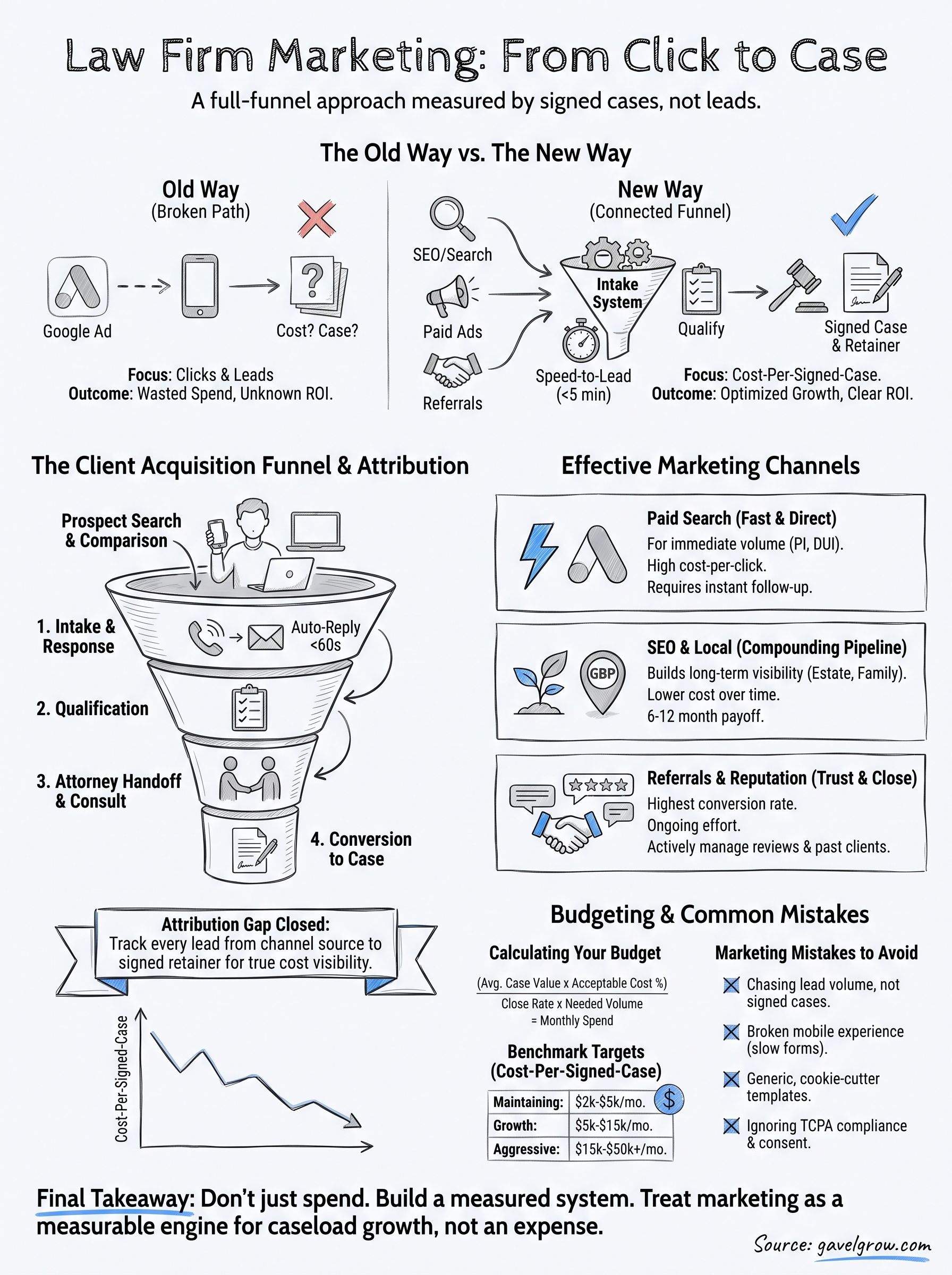
Law firm marketing is the full set of activities a firm uses to attract, convert, and retain clients, spanning paid ads, SEO, content, referrals, and reputation management, all measured against signed retainers rather than clicks or form fills. It works as a funnel: a prospect finds your firm, submits an intake form or calls, your team responds and qualifies them, and that lead either becomes a case or gets lost somewhere in the handoff. The Lead Response Management Study found that leads contacted within five minutes were 21 times more likely to qualify than those first reached at thirty minutes, which tells you the marketing spend is only half the equation.
This article breaks down what law firm marketing actually includes, the channels worth your budget, how attribution from click to signed case should work, and how to decide between building an in-house system or hiring help.
Why law firm marketing matters for client acquisition
Clients don't wait for a recommendation anymore. They search, they compare three or four firms in the same afternoon, and they call whoever answers first. Law firm marketing matters because it determines whether your firm even shows up in that search, and whether the lead that finds you turns into a signed retainer or goes to the competitor down the street who called back faster. Firms that treat marketing as an afterthought are competing against firms that treat it as a system, and systems win.
The referral well is drying up
Referrals used to carry most solo and small firms, but that pipeline has gotten thinner every year. The American Bar Association's 2023 Legal Technology Survey Report found that a majority of consumers now start their attorney search online rather than by asking a friend or another lawyer for a name. That shift means firms without a digital presence are invisible to a growing share of the exact people who need them. Word-of-mouth still matters, especially in family law and estate planning, but it no longer scales fast enough to fill a caseload on its own.
Speed-to-lead determines who wins the case
Here's the number that should worry every managing partner: leads contacted within five minutes were 21 times more likely to qualify than those first reached at thirty minutes, according to the Lead Response Management Study. Most firms lose cases not because their marketing was weak, but because a lead sat in an inbox overnight while a competitor's intake team called back in four minutes.
The fastest firm to respond usually signs the case, not the firm with the best ad.
This is exactly why intake automation matters as much as the ad spend that generates the lead in the first place. A firm running SMS and email sequences that fire within 60 seconds of form submission is playing a different game than a firm relying on a paralegal to check a shared inbox between hearings.
Why attribution gaps hide the real cost of a case
Most firms can tell you what they spent on Google Ads last month. Fewer can tell you which of those campaigns actually produced a signed case, because the tracking stops at the lead and never follows through to the retainer. Without that connection, a partner might cut a campaign that's quietly generating your best mass-tort intakes, or keep funding one that fills your pipeline with unqualified calls. Legal marketing budgets get wasted every year on exactly this blind spot, not because the ads were bad, but because nobody measured them against the outcome that pays the bills.
GavelGrow's marketing dashboard exists to close that gap, tying every lead to a cost-per-signed-case figure instead of a raw cost-per-lead. Firms that can see the full path from ad click to retainer stop guessing which channels deserve more budget and which ones need to be cut. That visibility is the difference between marketing as an expense and marketing as a system you can actually optimize over time. It's also the foundation everything else in this article builds on, because a strategy you can't measure isn't really a strategy.
How to build a law firm marketing strategy that works
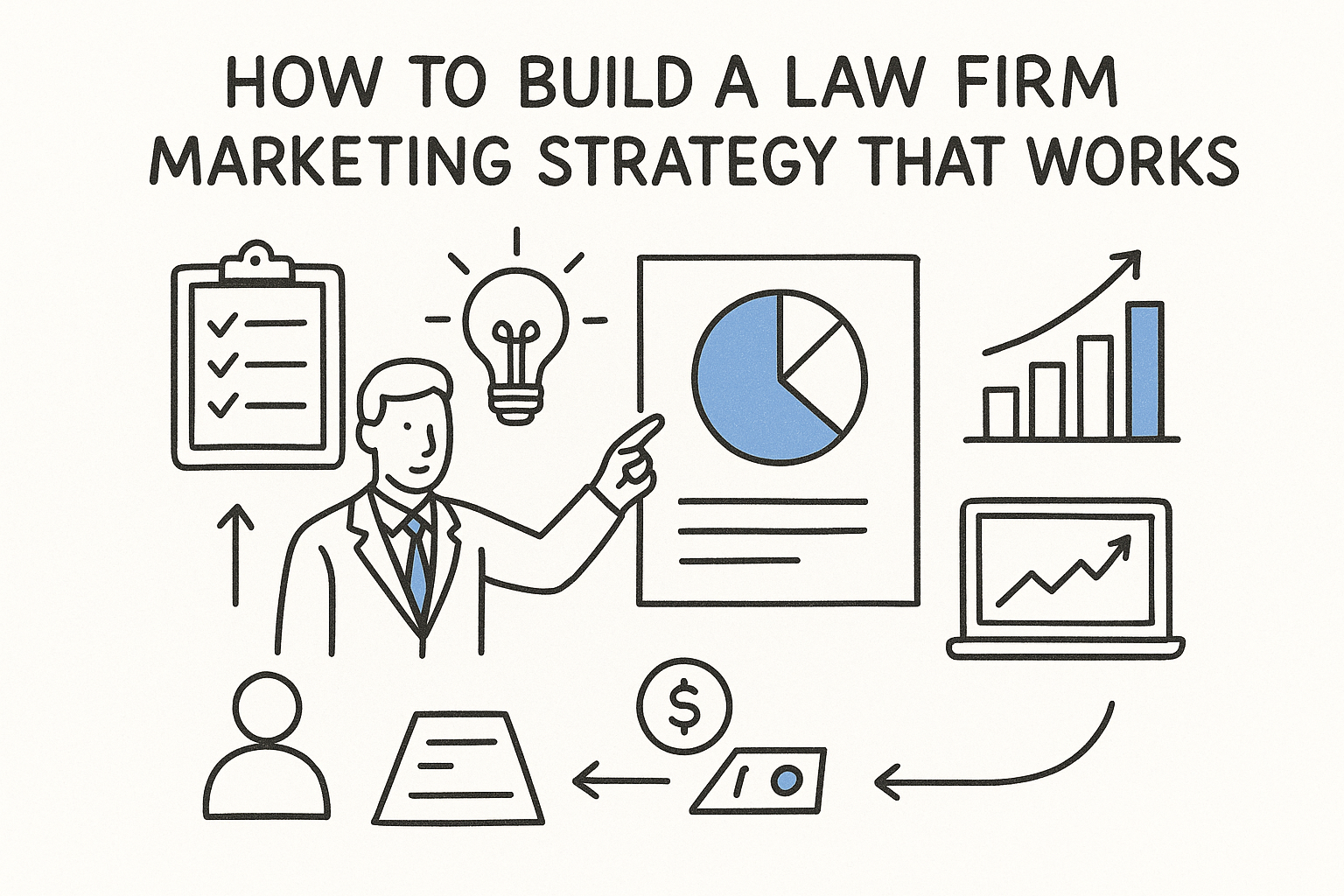
A real strategy starts before you ever touch a channel. Most firms skip straight to "let's run some Facebook ads" without answering the harder questions first: which practice area are you growing, who is the ideal client, and what does a win actually cost you. Skip that groundwork and you'll spend money efficiently on the wrong thing, which is worse than spending it slowly on the right one.
Start with your practice area and ideal client
Every practice area runs on a different sales cycle, and your strategy has to match it. A personal injury lead might sign within 48 hours, while an estate planning prospect could take three months of nurturing before they book a consultation. Mass tort campaigns need volume and national reach; family law needs trust signals and local presence. Build your channel mix and messaging around that cycle instead of copying whatever worked for a firm in a different practice area.
Set goals tied to signed cases, not leads
Lead volume is a vanity metric if it doesn't convert. Set your targets around cost-per-signed-case and close rate by campaign, not raw lead count or cost-per-click. GavelGrow's modelled practice-area benchmarks give you reference ranges for your practice area and market size, so you're setting goals against a consistent baseline instead of a guess pulled from a sales call with an agency.
A strategy built around signed cases will always outperform one built around lead count.
Build the intake funnel before you spend on ads
Don't turn on paid traffic until the funnel that catches it actually works. Confirm these pieces are in place first:
- Mobile-first intake form that loads in under two seconds
- Auto-reply firing within 60 seconds of submission
- Call tracking number assigned to every campaign
- Clear handoff process from intake to attorney
- TCPA-compliant consent language baked into every form
Ads pointed at a broken funnel just buy you a faster way to lose leads.
Review and adjust on a set schedule
Treat the plan as a living document, not a slide deck you write once a year. Pull cost-per-signed-case by channel monthly, compare it against your benchmark targets, and reallocate budget toward whatever is actually producing retainers. Quarterly, step back further and ask whether your practice area focus or ideal client profile still matches where the caseload is actually coming from.
Which marketing channels work best for law firms?
No single channel carries a law firm on its own. The right mix depends on your practice area, your market, and how fast you need cases in the door, but most successful firms run some combination of paid search, local SEO, and reputation-driven referrals working together rather than one channel doing all the lifting.

Paid search and Local Services Ads move fastest
Google Ads and Local Services Ads put your firm in front of someone actively searching for a lawyer right now, which makes them the fastest way to generate volume for personal injury, DUI, and mass tort work. The tradeoff is cost: competitive keywords like "car accident lawyer" routinely run $50 to $150 per click in major metros. That only makes sense if your intake funnel converts well, because a slow follow-up turns an expensive click into a wasted one.
SEO and local search build a pipeline that compounds
Organic search and a well-optimized Google Business Profile take longer to pay off, often 6 to 12 months, but the leads that come through them cost far less per case once the rankings hold. This channel favors estate planning, family law, and immigration, where prospects research for weeks before calling anyone. Firms that neglect it end up permanently dependent on rising ad costs.
The firms that win long-term run paid search for speed and SEO for durability, not one or the other.
Referrals and reputation still close the most cases
A strong Google review profile and a steady stream of attorney and past-client referrals remain the highest-converting source for many firms, because the trust is already built before the first call. Managing that reputation actively, responding to reviews, following up with past clients, tracking referral sources, turns a passive channel into a repeatable one.
Content and email nurture the slow deciders
Blog content, video, and email sequences don't generate immediate leads, but they keep prospects warm through a long decision cycle. This matters most for business law and estate planning clients who need months to commit, and it pairs well with the intake automation that keeps them engaged once they've raised a hand.
How much should a law firm spend on marketing?
Most growth-focused firms spend 7% to 12% of gross revenue on marketing, according to guidance echoed across legal industry benchmarking groups, though the right number depends heavily on how aggressively you want to grow and how competitive your market is. A solo estate planning attorney in a mid-size city needs a fraction of what a mass-tort shop bidding on national keywords requires. Total marketing spend should always include both the media budget and whatever you pay for tools or management, not just the ad account balance.
Benchmark spend by growth stage
Firms that are defending an existing book of business spend less than firms actively trying to double their caseload. Use these ranges as a starting point, then adjust against your own cost-per-signed-case data once you have a few months of history.
Ad spend and tool costs are separate line items
Outside of media spend, firms also pay for the software and services that turn clicks into cases. A self-serve platform typically runs $199 to $599 a month depending on seats and features, while a fully-managed arrangement, where an agency runs Google Ads, SEO, and reputation management for you, usually starts around $10,000 a month in management fees on top of ad spend. GavelGrow's pricing page breaks both models down so you can compare against your current stack, which for many firms means replacing separate bills for call tracking, a CRM, and reporting software with one subscription.
Spend is only meaningful when you know the cost-per-signed-case it produced, not just the invoice total.
How to land on your actual number
Rather than picking a percentage out of the air, work backward from what you can afford to pay for a signed case in your practice area. Compare that target against the benchmark data from similarly sized firms before locking in a budget:
- Calculate your average case value and acceptable cost-per-signed-case
- Divide that by your current close rate to get a target cost-per-lead
- Multiply by the lead volume needed to hit your caseload goal
- Add 10-15% buffer for testing new channels
That math gives you a defensible number instead of a guess borrowed from a sales call.
Marketing mistakes that cost law firms clients
Some mistakes don't show up as an obvious loss. They show up as a slightly worse close rate every month until a partner finally asks why the caseload feels thinner than the ad spend suggests. These are the patterns that show up again and again in firms that struggle to convert their marketing budget into signed cases.
Treating lead volume as the goal
Firms chase more leads instead of better ones, then wonder why the caseload doesn't grow to match the spend. Cost-per-lead looks great on a report and means nothing if half those leads never qualify. Optimizing toward volume instead of cost-per-signed-case rewards the channel that fills your pipeline with tire-kickers, not the one quietly producing your best retainers.
A cheap lead that never signs costs more than an expensive lead that does.
Letting the mobile experience break the funnel
A prospect finds you on their phone at 11pm, taps your contact form, and abandons it because the fields don't render right or the page takes six seconds to load. Generic contact forms built for desktop convert far worse on mobile than a mobile-first intake form does. That gap is pure waste, since the ad already did its job by getting the click.
Copying a cookie-cutter agency template
Generic marketing agencies often run the same playbook across dentists, roofers, and law firms, ignoring that a personal injury case and an estate planning matter convert on completely different timelines. That mismatch shows up as wasted spend on channels that never fit the practice area in the first place. A few warning signs to watch for:
- Reporting that stops at leads and never mentions signed cases
- No mention of your state bar's advertising rules
- The same campaign structure pitched regardless of practice area
- Vague answers when you ask about attribution from click to retainer
Ignoring compliance until it becomes a problem
TCPA violations and state-bar advertising missteps don't just risk fines, they can void an entire campaign's leads if consent wasn't captured properly. Firms that bolt compliance on after the fact, instead of baking consent language and opt-out handling into the form itself, end up rebuilding intake systems mid-campaign. That's exactly the kind of gap a purpose-built platform is designed to close before it costs you a case, or worse, a bar complaint.
Turning your marketing plan into signed cases
Everything in this article comes back to one idea: law firm marketing only works when you measure it against signed retainers, not clicks or leads. Get the funnel right, spend against real benchmarks, pick channels that fit your practice area, and fix the mobile and compliance gaps before you scale spend. Skip any of those steps and you're just funding a faster way to lose cases to the firm that called back first.
You don't have to rebuild this alone. Whether you want to run your own intake automation and call tracking in-house or hand the whole thing to GavelGrow, which has served 500+ law firms since 2015, the next move is the same: get a second set of eyes on what's actually happening between your ad spend and your caseload. Book a free 45-minute strategy call and find out exactly where your funnel is leaking cases.
Frequently Asked Questions
What is law firm marketing?
Law firm marketing is the full system a firm uses to attract, capture, and convert potential clients into signed matters — spanning search visibility (SEO and Google Business Profile), paid advertising, content and reputation, and the intake process that turns an inquiry into a retained client. It is not just running ads; it is connecting every channel to signed cases so you know what actually works.
How does law firm marketing actually work?
It works as a funnel with four stages: attraction (being found when someone searches for a lawyer), capture (turning a visitor into a lead), conversion (intake responding fast enough to sign them), and attribution (tracing which spend produced which case). A weak link anywhere breaks the chain — most firms lose more cases to slow intake than to poor ad targeting.
How much should a law firm spend on marketing?
There is no universal number — it depends on practice area, market competitiveness, and growth goals. Instead of a flat percentage, work backward from case value: estimate what a signed case is worth and what it costs to acquire one, then set a budget that produces cases profitably. Judge the spend by cost per signed case, not by traffic or lead volume.
Which marketing channels work best for law firms?
Paid search and Local Services Ads move fastest, producing leads within days from people actively searching for a lawyer. SEO and a strong Google Business Profile compound over months into lower-cost visibility. Reputation and content nurture the leads you already have. Most firms need a mix — ads for speed, SEO for durability, reviews for trust.
How long does law firm marketing take to work?
It depends on the channel. Paid ads and Local Services Ads can produce leads within days; SEO, content, and reputation-building typically take three to twelve months to compound into steady case flow. Firms that grow fastest run paid channels for immediate cases while investing in the long-game channels that lower cost per case over time.
Why do law firms lose leads even with good marketing?
Usually because of speed-to-lead and intake, not the ads. A prospect who fills out a form is often contacting several firms, so the one that responds in minutes tends to sign the case. Slow follow-up, missed calls after hours, and disorganized intake quietly waste the budget that generated the lead in the first place.
How do you measure whether law firm marketing is working?
Track past vanity metrics like traffic and impressions to the numbers tied to revenue: cost per lead, lead-to-consultation rate, intake-to-retainer conversion, and cost per signed case by channel. Attribution — connecting each lead source through intake to a retained client — is what closes the gap between marketing activity and actual case revenue.
Frequently Asked Questions
What is law firm marketing?
Law firm marketing is the full system a firm uses to attract, capture, and convert potential clients into signed matters — spanning search visibility (SEO and Google Business Profile), paid advertising, content and reputation, and the intake process that turns an inquiry into a retained client. It is not just running ads; it is connecting every channel to signed cases so you know what actually works.
How does law firm marketing actually work?
It works as a funnel with four stages: attraction (being found when someone searches for a lawyer), capture (turning a visitor into a lead), conversion (intake responding fast enough to sign them), and attribution (tracing which spend produced which case). A weak link anywhere breaks the chain — most firms lose more cases to slow intake than to poor ad targeting.
How much should a law firm spend on marketing?
There is no universal number — it depends on practice area, market competitiveness, and growth goals. Instead of a flat percentage, work backward from case value: estimate what a signed case is worth and what it costs to acquire one, then set a budget that produces cases profitably. Judge the spend by cost per signed case, not by traffic or lead volume.
Which marketing channels work best for law firms?
Paid search and Local Services Ads move fastest, producing leads within days from people actively searching for a lawyer. SEO and a strong Google Business Profile compound over months into lower-cost visibility. Reputation and content nurture the leads you already have. Most firms need a mix — ads for speed, SEO for durability, reviews for trust.
How long does law firm marketing take to work?
It depends on the channel. Paid ads and Local Services Ads can produce leads within days; SEO, content, and reputation-building typically take three to twelve months to compound into steady case flow. Firms that grow fastest run paid channels for immediate cases while investing in the long-game channels that lower cost per case over time.
Why do law firms lose leads even with good marketing?
Usually because of speed-to-lead and intake, not the ads. A prospect who fills out a form is often contacting several firms, so the one that responds in minutes tends to sign the case. Slow follow-up, missed calls after hours, and disorganized intake quietly waste the budget that generated the lead in the first place.
How do you measure whether law firm marketing is working?
Track past vanity metrics like traffic and impressions to the numbers tied to revenue: cost per lead, lead-to-consultation rate, intake-to-retainer conversion, and cost per signed case by channel. Attribution — connecting each lead source through intake to a retained client — is what closes the gap between marketing activity and actual case revenue.