GavelGrow vs Lawmatics: Which Legal CRM Fits Your Firm?
Categories: Legal Marketing Strategies
 Abram Ninoyan
Founder & Senior Performance Marketer
Credentials: Google Partner, Google Ads Search Certified, Google Ads Display Certified, Google Ads Measurement Certified, Google Analytics (IQ) Certified, HubSpot Inbound Certified, HubSpot Social Media Marketing Certified, Conversion Optimization Certified
Expertise: Google Ads, Meta Ads, Conversion Rate Optimization, GA4 & Google Tag Manager, Lead Generation, Marketing Funnel Optimization, PPC Management
LinkedIn Profile
You're comparing GavelGrow vs Lawmatics because your firm needs a system that turns marketing spend into signed cases, not just another CRM that stores contact records. Both platforms sit in the legal...
Key Takeaways
- GavelGrow vs Lawmatics: Which Legal CRM Fits Your Firm?
- Why the GavelGrow vs Lawmatics choice matters
- How to decide between GavelGrow and Lawmatics
- GavelGrow vs Lawmatics: features and pricing compared
GavelGrow vs Lawmatics: Which Legal CRM Fits Your Firm?
You're comparing GavelGrow vs Lawmatics because your firm needs a system that turns marketing spend into signed cases, not just another CRM that stores contact records. Both platforms sit in the legal tech stack, but they solve different problems, and picking the wrong one means paying for features you'll never use while still lacking the ones you need.
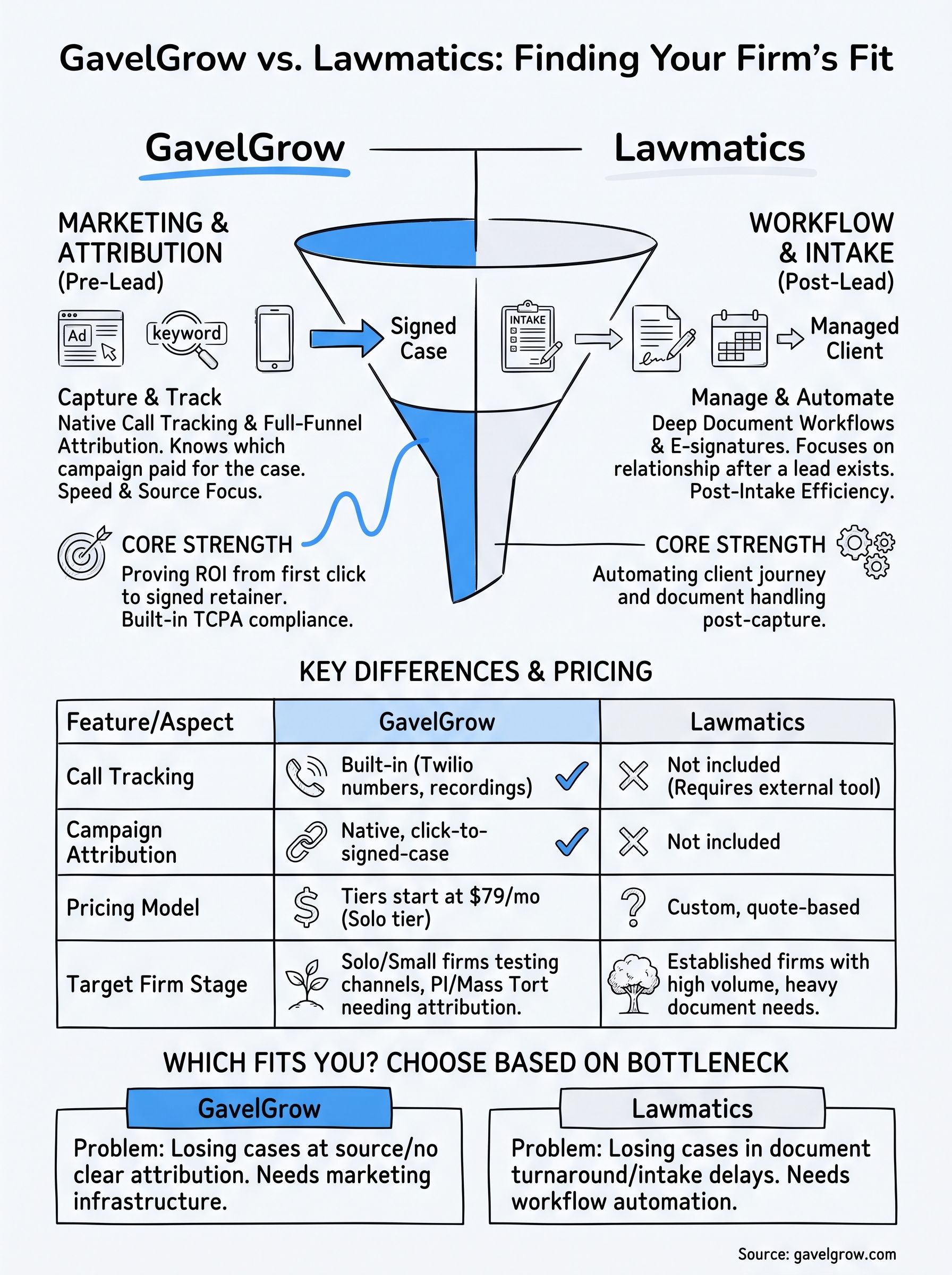
Here's the short answer: Lawmatics is a legal-specific CRM and intake automation tool built around workflows and client relationships after a lead exists. GavelGrow is a full-funnel marketing and attribution platform built to capture, track, and convert leads from the first ad click through the signed retainer, with built-in call tracking and TCPA-compliant intake forms baked in. If your firm's biggest gap is proving which campaigns actually produce paying clients, that distinction matters more than feature lists.
Below, you'll get a side-by-side breakdown of pricing, compliance tools, attribution capabilities, and which firm type each platform actually fits, so you can stop guessing and pick the tool that matches how your firm gets clients, not just how it manages them once they arrive.
Why the GavelGrow vs Lawmatics choice matters
Most firms don't fail because they picked a bad CRM. They fail because they picked a tool that solves the wrong problem. Lawmatics was built to manage client relationships once a lead exists, automating intake forms, e-signatures, and follow-up sequences inside a law firm's workflow. That's valuable, but it assumes you already know which marketing dollars produced that lead. If your firm can't answer "which campaign, which ad, which keyword" for every signed case, you're optimizing the wrong end of the funnel.
Speed and attribution decide who actually converts
Clio's 2024 Legal Trends Report secret-shopper study found that nearly half of firms (48%) were unreachable by phone, and the Lead Response Management Study found that leads contacted within five minutes were 21 times more likely to qualify than those first reached at 30 minutes. Neither tool fixes slow intake by itself, but only one of them was designed around the marketing side of that clock. GavelGrow fires SMS (once US carriers approve your number) and email sequences within minutes of lead capture and logs the originating campaign at the same moment, so speed and attribution happen together instead of in separate systems.
The firm that wins isn't the one with the fancier CRM, it's the one that knows which ad paid for the case and calls the lead first.
The real cost of picking the wrong platform
Here's where the GavelGrow vs Lawmatics decision gets expensive if you get it wrong. Firms that choose a client-management CRM expecting it to double as an attribution and call-tracking system usually end up bolting on CallRail, a separate analytics dashboard, and manual spreadsheet exports to reconcile ad spend against signed cases. That's three subscriptions and three login screens to answer one question: what did this campaign actually produce? GavelGrow's marketing dashboard was built to answer that question natively, tying campaign-level cost per lead to cost per signed case without a Zapier workaround.
Selecting between the two isn't about which brand has more features on a comparison chart. It's about matching the tool to the stage of the client journey where your firm actually loses money. If leads are plentiful but conversion tracking is a black box, that's a marketing-attribution problem, not a client-relationship problem, and it points toward a platform built around full-funnel measurement rather than post-intake workflow automation.
How to decide between GavelGrow and Lawmatics
Deciding between these two platforms starts with one question: where does your firm actually lose cases? If leads pile up with no clear campaign source, that's a marketing-attribution gap. If leads convert to intake but stall before signing, that's a client-management gap. Lawmatics answers the second problem. GavelGrow answers the first, and confusing the two is how firms end up paying for software that never touches their real bottleneck.
Run a quick self-audit before you commit
Before you sign a contract, pull the last 90 days of leads and check what you can actually answer today.
- Can you name the exact campaign, ad, or keyword behind every signed case?
- Do you know your cost-per-signed-case by practice area, not just cost-per-lead?
- Are your intake forms TCPA-compliant with a documented consent trail?
- Does your team call new leads inside five minutes, and can you prove it?
If you answered "no" to two or more, that's a signal you need marketing infrastructure before you need more workflow automation.
A CRM that manages leads well still can't tell you which ad paid for the case, and that gap costs more than the software itself.
Match the platform to your growth stage
Solo practitioners and small firms testing new practice areas usually need to see which channels actually produce cases before investing in deeper workflow automation, which points toward GavelGrow's platform tiers starting at $199/month. Firms with established intake volume that need better internal handoffs, document automation, and e-signature sequencing often lean toward Lawmatics instead. Growth stage, not brand reputation, should decide the choice, and firms that skip this step tend to re-buy software within a year.
GavelGrow vs Lawmatics: features and pricing compared
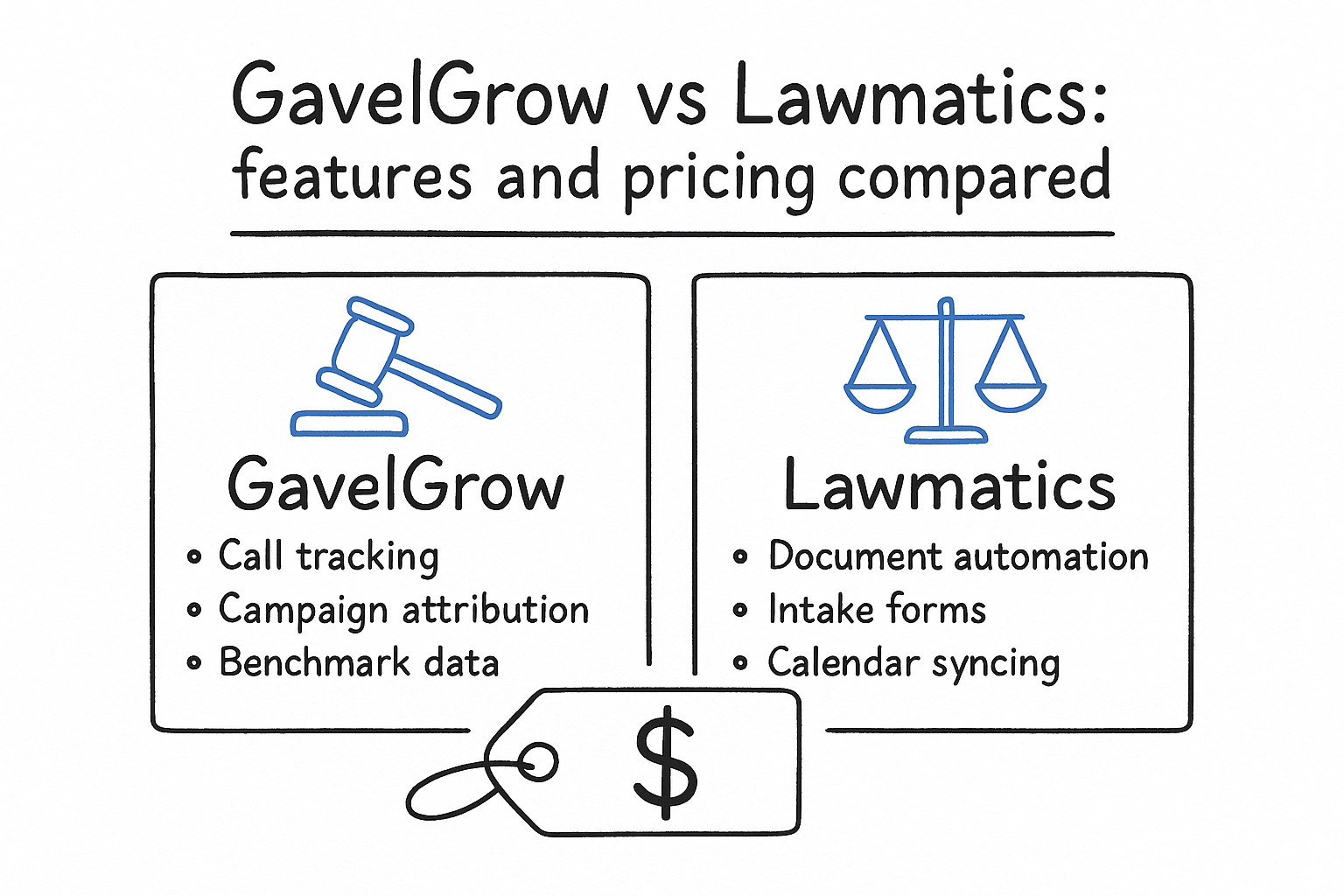
Numbers make the GavelGrow vs Lawmatics decision concrete once you stop comparing marketing pages and start comparing what you'd actually pay and use. Lawmatics prices around client-relationship depth: intake automation, document workflows, and e-signature sequencing, with plans that scale by contact volume and staff seats. GavelGrow prices around marketing infrastructure: call tracking, attribution, and benchmark data most CRMs don't touch at all.
Pricing breakdown
Here's how the entry points compare, based on published rates as of 2026.
If your comparison chart doesn't include call tracking and attribution, you're not actually comparing marketing platforms.
Where the feature sets genuinely overlap
Overlap exists mostly at the intake stage. Both platforms offer intake forms, automated follow-up sequences, and calendar syncing. Both claim TCPA-aware handling, though GavelGrow ships an append-only consent audit log and CTIA opt-out keyword handling by default rather than as a configured add-on. Lawmatics leans harder into legal-specific document workflows, which GavelGrow doesn't try to replicate.
Stripped down, the choice isn't about which tool has more line items. It's about which line items solve your firm's actual bottleneck, and whether you want full-funnel attribution built in or bolted on later through a third integration.
Which firms fit best with each platform
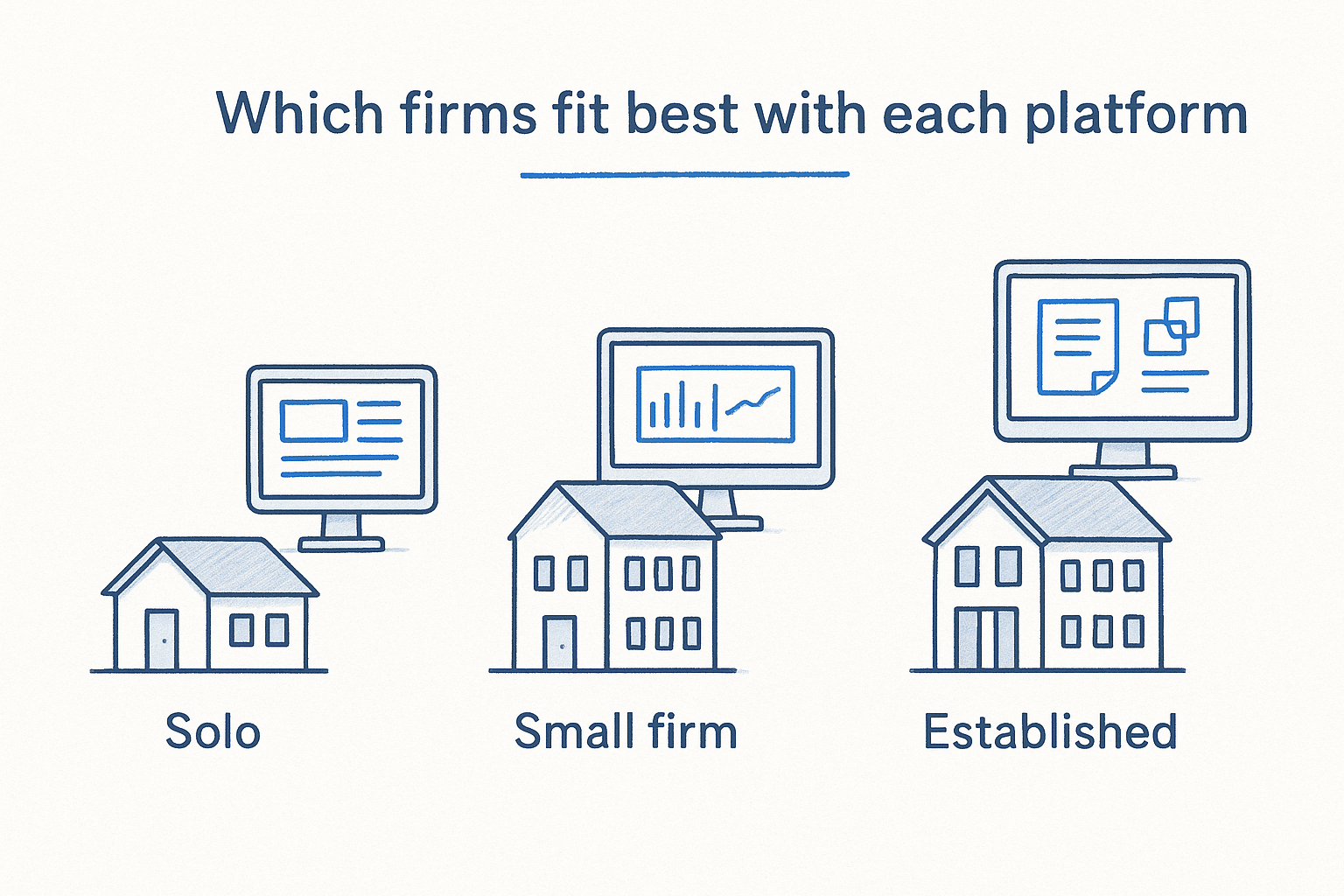
Fit depends on where your firm sits in its growth curve, not on which brand feels more polished. Personal injury and mass-tort firms running paid ad campaigns across multiple markets need to know which campaign, ad, or landing page produced a signed case, and that's exactly the gap GavelGrow closes with per-campaign attribution and built-in call tracking. Firms spending $5K to $25K a month on Google Ads or Local Services Ads without a clear cost-per-signed-case number are leaving money on a table they can't even see.
Solo and small-firm scenarios
A solo immigration attorney testing three practice areas at once doesn't need document-heavy workflow automation yet. She needs to know which of those three channels actually books consultations. GavelGrow's Track tier at $199/month gives her call tracking, intake forms, and campaign attribution without paying for enterprise document sequencing she won't use for another two years.
Established firms with heavier intake volume
A 12-attorney family law firm with steady referral and repeat-client volume faces a different problem. Leads already arrive reliably, but the bottleneck sits in document turnaround, e-signature delays, and staff handoffs between intake and case management. That's Lawmatics' strength, and it's a legitimate reason to choose it over a marketing-first platform.
Fit isn't about firm size, it's about which stage of the funnel is actually losing you cases.
Firms outgrowing both
Some firms need both problems solved and end up running a marketing platform alongside a workflow CRM, or they graduate to GavelGrow's managed services, where a dedicated team runs paid acquisition, SEO, and reputation management while the platform handles attribution underneath it.
Frequently asked questions about GavelGrow and Lawmatics
Can GavelGrow replace Lawmatics entirely?
For firms whose main bottleneck is marketing attribution, yes. GavelGrow's platform covers intake forms, pipeline tracking, and case management alongside call tracking and attribution. But if your firm depends heavily on document-heavy workflows, like complex e-signature sequencing across multiple practice groups, Lawmatics' deeper document automation may still earn a spot in your stack alongside GavelGrow's marketing layer.
Does Lawmatics offer call tracking?
No. Lawmatics focuses on client-relationship management, intake automation, and document workflows after a lead exists. It doesn't include built-in call tracking, per-campaign tracking numbers, or campaign-level attribution the way GavelGrow does, so firms using Lawmatics alone typically pair it with a separate tool like CallRail to see which ads produced calls.
Which platform is cheaper for a solo practitioner?
GavelGrow starts at $199/month for its Track tier with a 7-day free trial and no credit card required. Lawmatics doesn't publish flat pricing; it's quote-based and typically priced for firms with higher contact volume and staff seats, which usually puts it above GavelGrow's entry tier for solo and small-firm budgets.
Is GavelGrow TCPA-compliant out of the box?
Yes. GavelGrow ships with an append-only TCPA consent audit log, CTIA opt-out keyword handling (STOP/HELP), and carrier-level phone validation by default, not as a paid add-on. That's built specifically for legal marketing compliance rather than general CRM use.
Can I run both platforms together?
Some firms do exactly that, running GavelGrow for acquisition and attribution while using Lawmatics for post-intake document workflows. It works, but it means paying for two subscriptions and reconciling data across two systems, which is worth weighing against consolidating into one platform.
Choosing the right fit for your firm
The GavelGrow vs Lawmatics decision comes down to one honest question: where does your firm lose cases? If leads arrive but you can't trace them to a campaign, dollar, or ad, you need marketing infrastructure, not another CRM. If leads convert but stall in document turnaround and handoffs, workflow automation is the fix. Lawmatics handles the second problem well. GavelGrow handles the first, with call tracking and full-funnel attribution built in from day one, not bolted on later.
Don't let a feature checklist decide this for you. Match the tool to the stage of your funnel that's actually bleeding money, and revisit the choice as your firm grows past its current bottleneck.
If you're still not sure which side of that line your firm sits on, book a free 45-minute strategy call and we'll walk through your numbers together.
Comparison note: Lawmatics is a trademark of its respective owner and is not affiliated with GavelGrow. This comparison reflects GavelGrow’s own assessment based on publicly available information as of July 2026. Lawmatics does not publish flat pricing, so confirm current features and quotes directly with each vendor before deciding.
Frequently Asked Questions
Can GavelGrow replace Lawmatics entirely?
For firms whose main bottleneck is marketing attribution, yes. GavelGrow's platform covers intake forms, pipeline tracking, and case management alongside call tracking and attribution. But if your firm depends heavily on document-heavy workflows, like complex e-signature sequencing across multiple practice groups, Lawmatics' deeper document automation may still earn a spot in your stack alongside GavelGrow's marketing layer.
Does Lawmatics offer call tracking?
No. Lawmatics focuses on client-relationship management, intake automation, and document workflows after a lead exists. It doesn't include built-in call tracking, per-campaign tracking numbers, or campaign-level attribution the way GavelGrow does, so firms using Lawmatics alone typically pair it with a separate tool like CallRail to see which ads produced calls.
Which platform is cheaper for a solo practitioner?
GavelGrow starts at $199/month for its Track tier with a 7-day free trial and no credit card required. Lawmatics doesn't publish flat pricing; it's quote-based and typically priced for firms with higher contact volume and staff seats, which usually puts it above GavelGrow's entry tier for solo and small-firm budgets.
Is GavelGrow TCPA-compliant out of the box?
Yes. GavelGrow ships with an append-only TCPA consent audit log, CTIA opt-out keyword handling (STOP/HELP), and carrier-level phone validation by default, not as a paid add-on. That's built specifically for legal marketing compliance rather than general CRM use.
Can I run both platforms together?
Some firms do exactly that, running GavelGrow for acquisition and attribution while using Lawmatics for post-intake document workflows. It works, but it means paying for two subscriptions and reconciling data across two systems, which is worth weighing against consolidating into one platform.