The Complete Guide to Online Marketing for Law Firms
Categories: Legal Marketing Strategies
 Abram Ninoyan
Founder & Senior Performance Marketer
Credentials: Google Partner, Google Ads Search Certified, Google Ads Display Certified, Google Ads Measurement Certified, Google Analytics (IQ) Certified, HubSpot Inbound Certified, HubSpot Social Media Marketing Certified, Conversion Optimization Certified
Expertise: Google Ads, Meta Ads, Conversion Rate Optimization, GA4 & Google Tag Manager, Lead Generation, Marketing Funnel Optimization, PPC Management
LinkedIn Profile
Most law firm websites leak leads before a single ad dollar gets spent. Online marketing for law firms covers the full system: paid ads, SEO, your website, intake forms, and follow-up, working togethe...
Key Takeaways
- The Complete Guide to Online Marketing for Law Firms
- Why online marketing matters for law firms today
- How to build an online marketing strategy for your firm
- Which online marketing channels work best for law firms
The Complete Guide to Online Marketing for Law Firms
Most law firm websites leak leads before a single ad dollar gets spent. Online marketing for law firms covers the full system: paid ads, SEO, your website, intake forms, and follow-up, working together to turn strangers into signed clients, not just to fill your inbox with unqualified leads. If you're a managing partner or marketing director trying to figure out where your budget actually goes, this distinction matters more than any single tactic.
The honest answer to "how do I market my law firm online" isn't one channel. It's a coordinated funnel: Google Ads or SEO brings in the click, a fast, mobile-friendly intake form captures the lead, and automated follow-up within minutes closes the gap before a competitor's firm does. Speed and structure beat spend.
This guide walks through every piece of that funnel, paid acquisition, organic and local SEO, website conversion, intake automation, and reputation management, plus how to measure cost-per-signed-case instead of vanity metrics like clicks or form fills. You'll also see where GavelGrow's platform and managed services fit if you'd rather not build this stack from scratch.
Why online marketing matters for law firms today
Search has replaced the referral as the default way people find a lawyer. Many people now start their search for legal help online before they ever ask a friend or family member for a recommendation. That means your website, Google Business Profile, and paid ads are doing the job your old referral network used to do, except now a stranger with no context is deciding whether to call you based on a page that loads in three seconds or less.
Search has replaced the referral
Google's own research on mobile behavior shows that most local searches for services like "personal injury lawyer near me" happen on a phone, often in the middle of a stressful moment: after an accident, an arrest, or a divorce filing. Practice-area competition has also gotten more expensive. Google Ads cost-per-click for terms like "car accident lawyer" regularly runs $80 to $150 in major metros, based on aggregate PPC benchmark data agencies publish each year. If your funnel leaks leads after the click, you're paying premium prices for traffic that never converts.
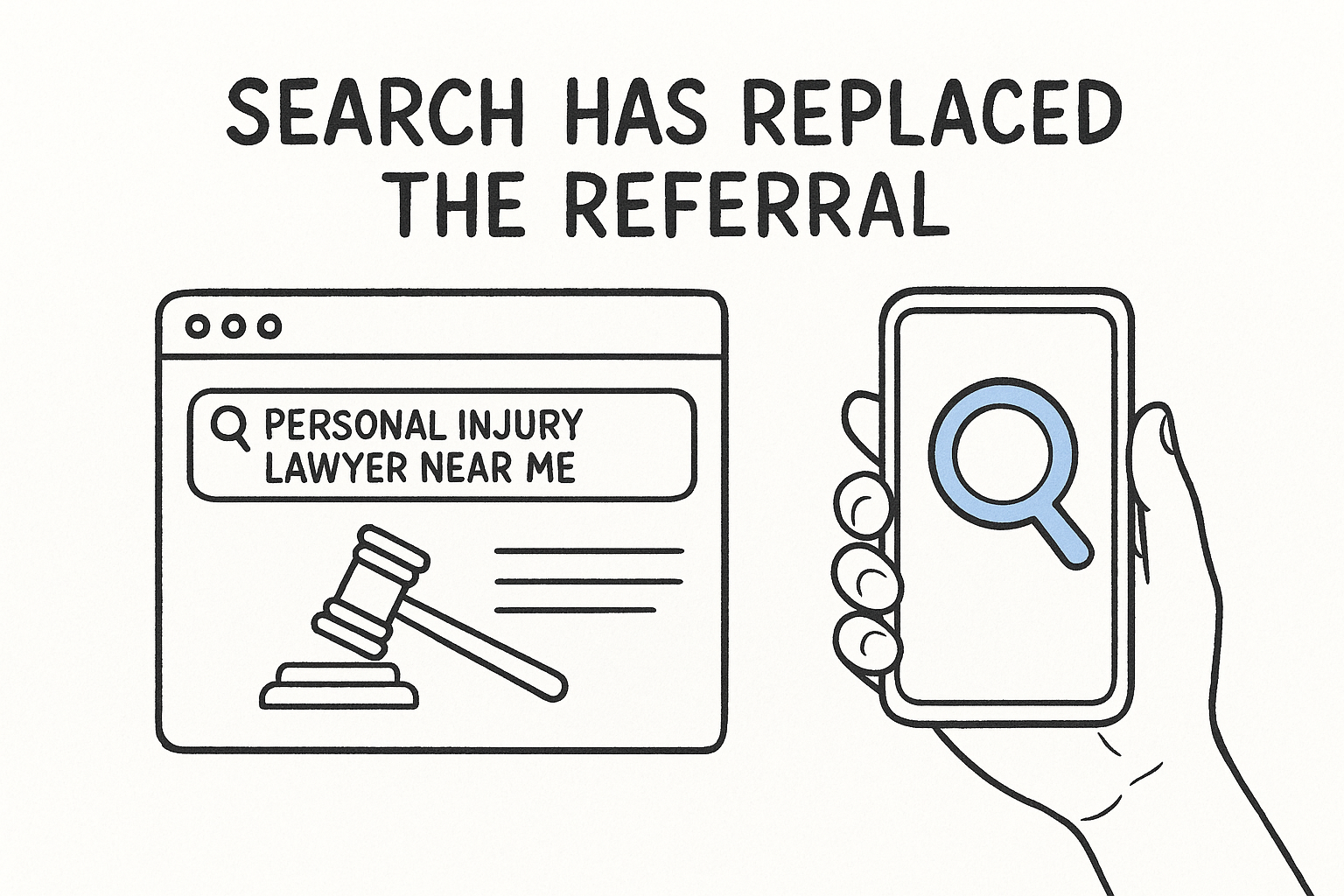
A law firm's website is now the first impression, and the first impression is almost always on a phone screen.
Speed and intake decide who wins the case, not just the ad
The Lead Response Management Study found that leads contacted within five minutes were 21 times more likely to qualify than those first reached at 30 minutes. That single number explains why so many firms with decent ad budgets still struggle to fill their calendar. The ad worked. The intake process didn't. A mobile-friendly intake form with an instant email auto-reply (texts follow once US carriers approve your number) closes that gap automatically, which is exactly the kind of speed-to-lead problem GavelGrow's intake automation was built to solve.
What breaks when firms skip this
Here's what typically goes wrong when a firm treats its website and ads as a checkbox instead of a system:
- Slow forms: Long, desktop-style intake forms drop mobile conversion well below the desktop range, a pattern documented repeatedly in conversion-rate studies across service industries.
- No call tracking: Without per-campaign tracking numbers, firms can't tell which ad, keyword, or landing page actually produced a signed case versus a wrong number.
- Delayed follow-up: Leads sit in a shared inbox for hours while a competitor's automated text already landed.
- Compliance gaps: TCPA violations from unmonitored SMS outreach can trigger statutory damages per violation, a risk the Federal Communications Commission has enforced aggressively in recent years.
- No benchmark: Firms have no way to know if their $200 cost-per-lead is great or terrible for their practice area and market.
Why this is a firm-wide problem, not just a marketing one
Every one of those failure points touches intake, not just advertising. That's the real shift happening in legal marketing right now: the firms winning cases online aren't necessarily spending the most on ads, they're the ones with the tightest funnel from click to signed retainer. Once you accept that online marketing for law firms is a full-funnel discipline rather than a media-buying exercise, the next question is how to actually structure a strategy around it, which is where we go next.
How to build an online marketing strategy for your firm
Building a strategy starts with a number most firms never calculate: cost-per-signed-case. Not cost-per-click, not cost-per-lead, but the actual dollar amount you spend to land a client who signs a retainer. Without that figure, you can't tell whether a $150 Google Ads click is a bargain or a loss. Cost-per-signed-case is the metric that should drive every budget decision from here forward.
Start with a practice-area audit
Every practice area behaves differently online. A mass-tort campaign might run nationally and take months to convert, while a DUI case might close within days of the arrest. Before you touch a single ad platform, map out your typical case value, sales cycle length, and current intake-to-signed ratio. GavelGrow's modelled practice-area benchmarks exists specifically for this step: it tells you whether your numbers are normal for your practice area and market size, or whether something in your funnel needs fixing first.
Set goals around signed cases, not clicks
Once you know your baseline, set a target that ties directly to revenue. "Get more traffic" isn't a strategy. "Reduce cost-per-signed-case from $1,800 to $1,200 in personal injury within six months" is. That kind of goal forces you to look at the whole funnel, not just the ad account.
If your marketing goal doesn't mention signed cases, it isn't a marketing goal yet.
Build the funnel in this order
Sequence matters. Firms that buy traffic before fixing intake waste money twice, once on the ad and again on the lead that never gets a callback. Work through the stack in this order:
- Fix the intake form first: mobile-first, under 8 fields, instant auto-reply.
- Add call tracking: per-campaign numbers so you know which channel produces signed cases, not just calls.
- Turn on automated follow-up: SMS and email within 60 seconds of capture.
- Layer in paid and organic acquisition: Google Ads, Local Services Ads, SEO.
- Measure and rebalance monthly: shift spend toward the channels with the lowest cost-per-signed-case.
Decide who runs it
Solo and small firms usually run this in-house with a purpose-built dashboard like GavelGrow's platform, starting around $199/mo. Larger firms with bigger ad budgets often hand the whole stack to a managed-services partner instead. Either path works, but the sequence above stays the same regardless of who's executing it.
Which online marketing channels work best for law firms
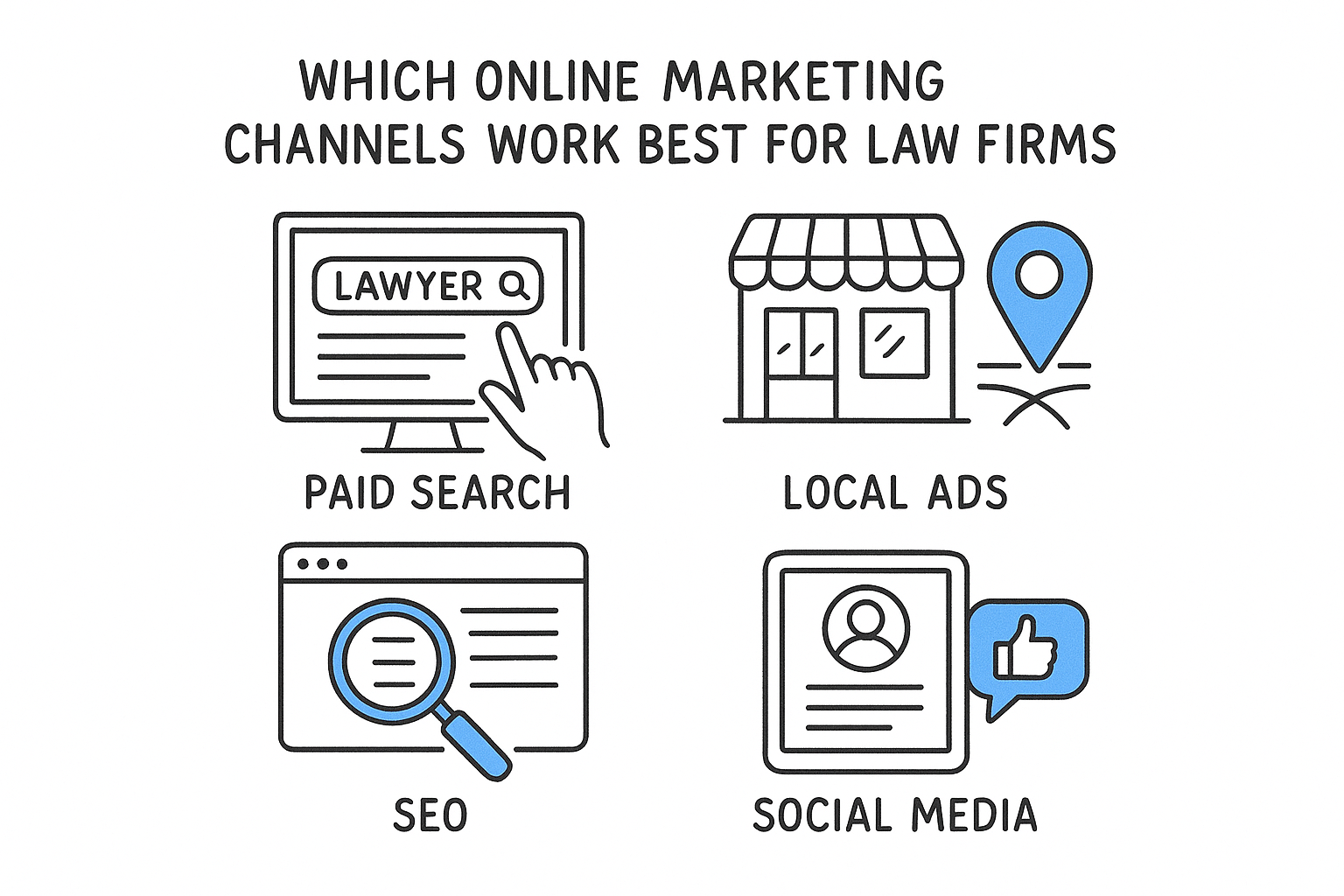
No single channel wins for every practice area, but the data shows a clear pattern. Google Ads and Local Services Ads produce the fastest signed cases for high-intent, urgent practice areas like DUI defense and personal injury, while SEO and content compound slowly and pay off over years, not weeks. Channel selection should follow your sales cycle, not whatever platform your last agency pitched you.
Paid search and Local Services Ads
Google Ads and Local Services Ads (LSA) put your firm in front of someone actively typing "car accident lawyer near me." LSA charges per lead instead of per click and displays a Google Screened badge, which builds trust fast for a stranger who's never heard of your firm. Both channels demand tight intake, though, because a $100+ click that sits unanswered for an hour is money burned twice.
SEO and Google Business Profile
Organic search and local SEO take three to six months to show movement, based on typical ranking timelines agencies report for competitive legal keywords, but the leads cost far less per case once you rank. A fully optimized Google Business Profile with recent reviews, accurate categories, and consistent citations often drives more calls than a firm's homepage for local practice areas like family law or estate planning.
Paid social and referral-driven channels
Facebook, Instagram, and LinkedIn work best for practice areas with longer consideration windows, estate planning, business law, employment law, where you're building awareness before someone has an urgent legal need. Referral programs and review generation still matter too; a steady stream of 5-star reviews feeds both your Google Business Profile ranking and the trust signal a paid ad alone can't provide.
The channel that converts fastest for a DUI firm will bankrupt a mass-tort campaign, and vice versa.
Whatever mix you choose, GavelGrow's Google Ads sync pulls daily spend and conversion data straight into the same dashboard as your call tracking and intake pipeline, so you're comparing channels on signed cases, not platform-reported clicks.
How much should your firm budget for online marketing
Budgeting for legal marketing isn't a single number, it's two separate budgets that firms often confuse: the platform or agency fee, and the actual ad spend that fuels your campaigns. Skimp on either one and the whole funnel stalls, whether you're a solo practitioner running your own Google Ads account or a 20-attorney firm handing the whole stack to a managed-services partner.
Typical spend ranges by firm size and stage
Solo and small firms usually start lean, testing one or two channels before committing serious ad dollars. Larger firms with established case volume tend to spend more on both software and ad spend simultaneously, because they've already proven which channels produce signed cases.
Self-serve vs managed-services costs
Self-serve platform pricing runs $199 to $599 per month depending on tier, with GavelGrow's pricing page breaking down the Track and Optimize plans plus a Managed option for firms running multiple offices. Managed services flip the model: instead of paying for software and running campaigns yourself, you pay a $10K+/mo management fee on top of the ad spend an agency places on your behalf, typically $15K to $100K+ depending on practice area and market. Neither path is inherently cheaper, the right choice depends on whether your team has the bandwidth to run campaigns day-to-day or would rather hand that work to a dedicated strategist.
How to know your budget is working
A budget only means something next to a result, which is why cost-per-signed-case has to sit at the center of every spending decision you make. Firms that only track cost-per-lead routinely overspend on channels that produce plenty of leads and almost no signed retainers.
A marketing budget without a cost-per-signed-case target is just a spending limit, not a strategy.
GavelGrow's modelled practice-area benchmarks give you a reference point here: instead of guessing whether $1,800 per signed personal injury case is reasonable, you can compare your number with modelled ranges for similar markets and adjust spend accordingly, month by month, rather than waiting for an annual review to find out you overpaid.
Moving from strategy to signed cases
Everything in this guide points to one idea: online marketing for law firms only works when the funnel is judged by signed cases, not clicks or leads. Get the intake form fast and mobile-friendly, respond within minutes, track every call back to its campaign, and measure cost-per-signed-case instead of cost-per-lead. That sequence matters more than which channel or agency you pick first.
Getting there alone means stitching together call tracking, intake automation, and attribution across separate tools, which is exactly the tool sprawl most firms are trying to escape. GavelGrow's platform replaces that stack with one dashboard built for legal, with modelled practice-area benchmarks, so you can see what's actually working before you spend another dollar guessing.
If you'd rather talk through your specific practice area and budget before committing to a plan, book a free 45-minute strategy call and get a straight answer on where your funnel is leaking.
Frequently Asked Questions
What is online marketing for law firms?
Online marketing for law firms is the system of channels that attract, capture, and convert potential clients through the internet — search (SEO and Google Business Profile), paid ads, content, reputation, and the intake process that turns an inquiry into a signed matter. Done well, it replaces unpredictable referrals with a measurable pipeline where every dollar ties back to signed cases.
Why do law firms need online marketing?
Because search has replaced the referral as how most people find a lawyer, and competitors are already visible where clients look. Firms that skip it depend on an unpredictable referral stream and lose cases to faster-responding rivals. Online marketing puts your firm in front of people actively searching for legal help and, paired with fast intake, converts that visibility into signed cases.
Which online marketing channels work best for law firms?
The core mix is search — SEO and a strong Google Business Profile for compounding local visibility, plus paid search and Local Services Ads for immediate leads — supported by reputation (reviews) and content that builds trust. Most firms combine them: ads for speed, SEO for durable low-cost pipeline, and reviews and content to convert the leads they already have.
How much should a law firm spend on online marketing?
It varies by practice area, market, and goals — there is no universal figure. Instead of a flat percentage, work backward from case value: estimate what a signed case is worth and your cost to acquire one, then budget to produce cases profitably. Track cost per signed case so you can compare channels on equal footing rather than judging by traffic.
How do law firms turn online traffic into clients?
Traffic only becomes cases when intake converts it. That means a fast, mobile-first website, clear calls to action, and responding to inquiries in minutes rather than hours — since a prospect who fills out a form is often contacting several firms at once. The firm that follows up fastest usually signs the case, which is why speed and intake matter as much as the ad that generated the lead.
Should a law firm handle online marketing in-house or hire an agency?
Small firms with a marketing-minded partner can start in-house on the basics — Google Business Profile, reviews, and a few practice-area pages. But paid ads, technical SEO, and full-funnel attribution take specialized time and tools, so firms that want faster results or lack the bandwidth usually get more from an agency — ideally one that reports on signed cases, not just clicks.
How do you measure the ROI of online marketing for a law firm?
Track the full path from click to signed case, not vanity metrics like traffic or impressions. The numbers that matter are cost per lead, lead-to-consultation rate, intake-to-retainer conversion, and cost per signed case by channel. Full-funnel attribution — connecting each lead source through intake to a retained client — is the only way to know which marketing actually funds the firm.
Frequently Asked Questions
What is online marketing for law firms?
Online marketing for law firms is the system of channels that attract, capture, and convert potential clients through the internet — search (SEO and Google Business Profile), paid ads, content, reputation, and the intake process that turns an inquiry into a signed matter. Done well, it replaces unpredictable referrals with a measurable pipeline where every dollar ties back to signed cases.
Why do law firms need online marketing?
Because search has replaced the referral as how most people find a lawyer, and competitors are already visible where clients look. Firms that skip it depend on an unpredictable referral stream and lose cases to faster-responding rivals. Online marketing puts your firm in front of people actively searching for legal help and, paired with fast intake, converts that visibility into signed cases.
Which online marketing channels work best for law firms?
The core mix is search — SEO and a strong Google Business Profile for compounding local visibility, plus paid search and Local Services Ads for immediate leads — supported by reputation (reviews) and content that builds trust. Most firms combine them: ads for speed, SEO for durable low-cost pipeline, and reviews and content to convert the leads they already have.
How much should a law firm spend on online marketing?
It varies by practice area, market, and goals — there is no universal figure. Instead of a flat percentage, work backward from case value: estimate what a signed case is worth and your cost to acquire one, then budget to produce cases profitably. Track cost per signed case so you can compare channels on equal footing rather than judging by traffic.
How do law firms turn online traffic into clients?
Traffic only becomes cases when intake converts it. That means a fast, mobile-first website, clear calls to action, and responding to inquiries in minutes rather than hours — since a prospect who fills out a form is often contacting several firms at once. The firm that follows up fastest usually signs the case, which is why speed and intake matter as much as the ad that generated the lead.
Should a law firm handle online marketing in-house or hire an agency?
Small firms with a marketing-minded partner can start in-house on the basics — Google Business Profile, reviews, and a few practice-area pages. But paid ads, technical SEO, and full-funnel attribution take specialized time and tools, so firms that want faster results or lack the bandwidth usually get more from an agency — ideally one that reports on signed cases, not just clicks.
How do you measure the ROI of online marketing for a law firm?
Track the full path from click to signed case, not vanity metrics like traffic or impressions. The numbers that matter are cost per lead, lead-to-consultation rate, intake-to-retainer conversion, and cost per signed case by channel. Full-funnel attribution — connecting each lead source through intake to a retained client — is the only way to know which marketing actually funds the firm.