Klaviyo Vs Mailchimp: 9 Differences That Matter
Categories: Guide: Comparison, Marketing Tips for Law Firms
 Abram Ninoyan
Founder & Senior Performance Marketer
Credentials: Google Partner, Google Ads Search Certified, Google Ads Display Certified, Google Ads Measurement Certified, Google Analytics (IQ) Certified, HubSpot Inbound Certified, HubSpot Social Media Marketing Certified, Conversion Optimization Certified
Expertise: Google Ads, Meta Ads, Conversion Rate Optimization, GA4 & Google Tag Manager, Lead Generation, Marketing Funnel Optimization, PPC Management
LinkedIn Profile
Choosing between Klaviyo vs Mailchimp comes down to what your business actually needs from an email platform, not which one has the flashier homepage. Both tools have evolved significantly heading int...
Key Takeaways
- Klaviyo Vs Mailchimp: 9 Differences That Matter In 2026
- 1. Best fit by business model
- 2. Pricing and how contacts get counted
- 3. Setup and day-to-day usability
Klaviyo Vs Mailchimp: 9 Differences That Matter In 2026
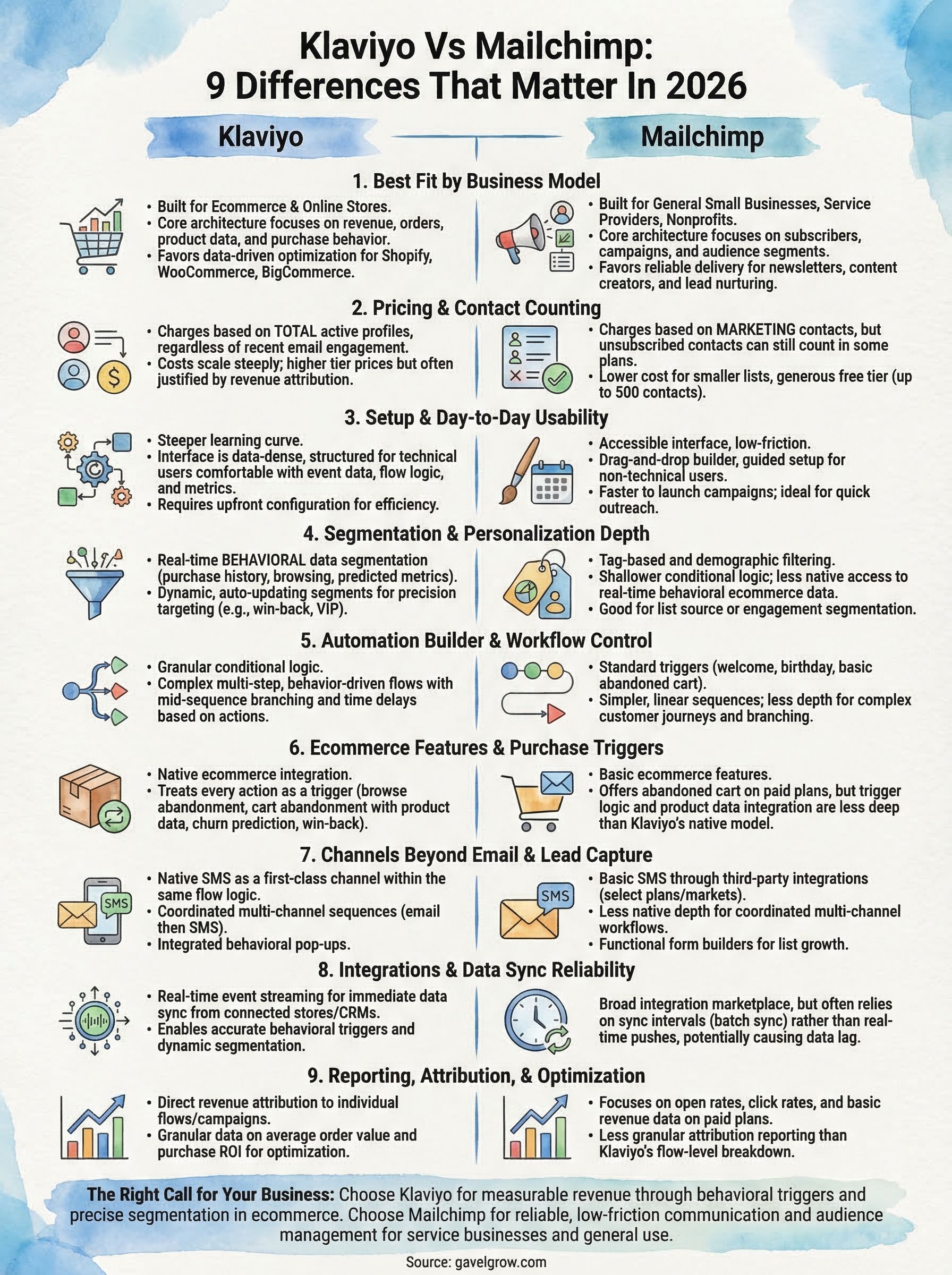
Choosing between Klaviyo vs Mailchimp comes down to what your business actually needs from an email platform, not which one has the flashier homepage. Both tools have evolved significantly heading into 2026, and the gap between them has shifted in ways that affect pricing, automation depth, and revenue tracking in real terms.
At GavelGrow, we build full-funnel marketing systems for law firms, and email is a critical piece of that puzzle. We've tested and deployed both platforms across client campaigns where every dollar spent needs to tie back to signed cases, not vanity open rates. That hands-on experience with both tools, specifically in high-stakes, conversion-focused environments, is what shaped this breakdown.
This comparison covers nine specific differences between Klaviyo and Mailchimp that go beyond surface-level feature lists. You'll get a clear look at where each platform excels, where it falls short, and which one makes more sense depending on your budget, technical comfort level, and growth goals. No filler, no affiliate-driven bias, just a straight read so you can make the right call for your business.
1. Best fit by business model
The most fundamental question in the Klaviyo vs Mailchimp debate isn't about feature checklists. It's about what type of business you're running and what you actually need the platform to accomplish on a daily basis. Each tool was built with a different user in mind, and no amount of workarounds or third-party integrations will fully bridge that gap if you're using the wrong foundation for your business model.
What's different
Klaviyo was built from the ground up for ecommerce businesses that sell physical or digital products online. Its core architecture assumes you have a product catalog, customer purchase history, and a need to trigger messages based on real shopping behavior. Mailchimp started as a general-purpose email tool for small businesses, nonprofits, bloggers, and service providers. It has layered in ecommerce features over the years, but those additions sit on top of a foundation designed for broad use rather than deep purchase-data analysis.
The practical result is that Klaviyo's default data model speaks the language of revenue, orders, and product interactions, while Mailchimp's speaks the language of subscribers, campaigns, and audience segments. That structural difference shapes every other comparison in this article.
If your business lives and dies by repeat purchase rates and cart recovery, Klaviyo's architecture gives you a measurable structural advantage from day one.
Who it favors and why
Klaviyo favors ecommerce store owners, particularly those running on Shopify, WooCommerce, or BigCommerce, who need their email platform to function as a direct revenue driver. If you track metrics like customer lifetime value, average order value, and purchase frequency, Klaviyo was specifically designed to optimize around those numbers at scale.
Mailchimp favors service-based businesses, content creators, and organizations that need reliable email delivery, straightforward campaign management, and basic audience tools without a steep learning curve. A law firm sending a monthly newsletter, a consultant nurturing a prospect list, or a nonprofit managing donor outreach will likely find Mailchimp's feature set more than sufficient and its interface significantly less frustrating to work in day-to-day.
Questions to decide fast
Before you spend time comparing pricing tiers or digging into automation templates, answer these three questions honestly. Your answers will cut through most of the noise in this comparison.
- Do you sell products online and need email to recover abandoned carts or trigger post-purchase sequences automatically? Klaviyo is almost certainly the better fit.
- Is your primary goal audience communication, lead nurturing, or event-based outreach rather than direct product sales? Mailchimp covers that ground reliably and at a lower cost.
- Does your team have the technical bandwidth to configure a data-rich platform, or do you need something running within the hour? Mailchimp's onboarding is noticeably faster for non-technical users who just need campaigns out the door.
2. Pricing and how contacts get counted
Pricing is where the Klaviyo vs Mailchimp comparison gets sharp fast. Both platforms charge based on the number of contacts in your account, but how they define and count those contacts produces very different bills as your list grows.
What's different
Klaviyo charges based on your total number of active profiles, which includes anyone in your account regardless of whether they've been emailed recently. Mailchimp, by contrast, has shifted its billing structure over time toward "marketing contacts," but unsubscribed contacts in certain plans can still count against your totals depending on your tier. The practical issue is that Klaviyo's costs scale steeply once you cross key thresholds, and unengaged subscribers you haven't cleaned out inflate your bill at the same rate as active buyers.
If you're not actively suppressing unengaged contacts, both platforms will charge you for audience weight you're not converting.
Who it favors and why
Mailchimp favors smaller lists and early-stage businesses because its free tier supports up to 500 contacts and 1,000 monthly sends, giving you real room to build before spending anything. Klaviyo's free plan covers up to 250 contacts, which works for initial testing but limits meaningful list growth without paying. At mid-to-large list sizes, Klaviyo's pricing runs noticeably higher than a comparable Mailchimp tier, but the revenue attribution tools often justify that gap for high-volume ecommerce stores that can track direct purchase ROI from individual email flows.
Questions to decide fast
Use these three questions to cut through the pricing noise before you commit to either platform:
- How large is your current list, and how fast is it growing? Klaviyo's costs accelerate quickly above 10,000 contacts.
- Do you regularly suppress unengaged subscribers? If not, both platforms will charge you for contacts that haven't opened an email in months.
- Can you directly tie email sends to revenue? If yes, Klaviyo's higher price point becomes easier to justify with real return data.
3. Setup and day-to-day usability
The learning curve on each platform is real, and underestimating it costs you time you don't have. In the Klaviyo vs Mailchimp comparison, setup speed and daily workflow friction are often what pushes people toward one tool or the other before they even evaluate advanced features.
What's different
Mailchimp's interface is built for accessibility first. The drag-and-drop email builder, guided campaign setup, and straightforward audience management tools mean most users can send their first campaign within an hour of creating an account. Klaviyo's interface is more data-dense and technically structured, which reflects its ecommerce focus but creates a steeper initial climb for users who aren't accustomed to working with customer event data, flow logic, and metric-driven dashboards from day one.
The platform that gets you moving faster isn't always the one that serves you better long-term, but wasted setup time is a real cost.
Who it favors and why
Mailchimp favors non-technical users and small teams who need a reliable, low-friction tool for consistent outreach. You can build templates, schedule campaigns, and manage your list without touching a single advanced setting. Klaviyo favors operators who are comfortable with data, or who have a marketing manager willing to invest setup time in exchange for stronger automation payoff down the road. Once Klaviyo is properly configured, its day-to-day workflow is efficient, but the initial configuration requires meaningful attention.
Questions to decide fast
Answering these three questions honestly will tell you which platform fits your team's actual capacity right now:
- Do you have dedicated marketing staff who can spend time learning a more complex platform, or does email need to be a quick task anyone on your team handles?
- How often do you send campaigns? High-frequency senders benefit more from Klaviyo's automation depth once it's set up correctly.
- Is a faster launch more valuable than long-term workflow power? If you need results this week, Mailchimp's setup speed is a genuine competitive advantage.
4. Segmentation and personalization depth
Segmentation determines whether your emails feel relevant or feel like noise. In the Klaviyo vs Mailchimp comparison, this is one of the sharpest dividing lines between the two platforms, and the difference in depth is significant enough to change campaign outcomes at scale.
What's different
Klaviyo builds segmentation around real-time behavioral data, pulling from purchase history, browsing activity, product interactions, and predictive metrics like expected next order date or churn risk. You can create a segment of customers who bought a specific product category, spent over a certain dollar threshold, and haven't purchased in 90 days, and Klaviyo updates that segment automatically as your customer data changes. Mailchimp's segmentation works well for tag-based and demographic filtering, but its conditional logic is shallower and doesn't natively pull predictive or behavioral ecommerce data at the same depth.
The more granular your segmentation, the more relevant your emails become, and relevance is what drives revenue, not send volume.
Who it favors and why
Klaviyo favors ecommerce operators who need precision targeting based on customer behavior and purchase patterns. If you're running win-back campaigns, VIP tiers, or product-specific upsells, Klaviyo's segmentation engine gives you the data hooks to build those audiences with real accuracy. Mailchimp favors service businesses and content-driven brands that primarily segment by list source, engagement level, or manually applied tags rather than live behavioral signals.
Questions to decide fast
Before settling on a platform, run through these questions to clarify what your segmentation needs actually look like:
- Do you need to segment by purchase behavior, predicted lifetime value, or product-specific actions? If yes, Klaviyo handles that natively without workarounds.
- Is your list segmentation mostly based on demographics or signup source? Mailchimp's tools are more than sufficient for that level of targeting.
- How often do your segments need to update automatically? Klaviyo refreshes segments in real time, while Mailchimp's segment updates run on a less immediate schedule.
5. Automation builder and workflow control
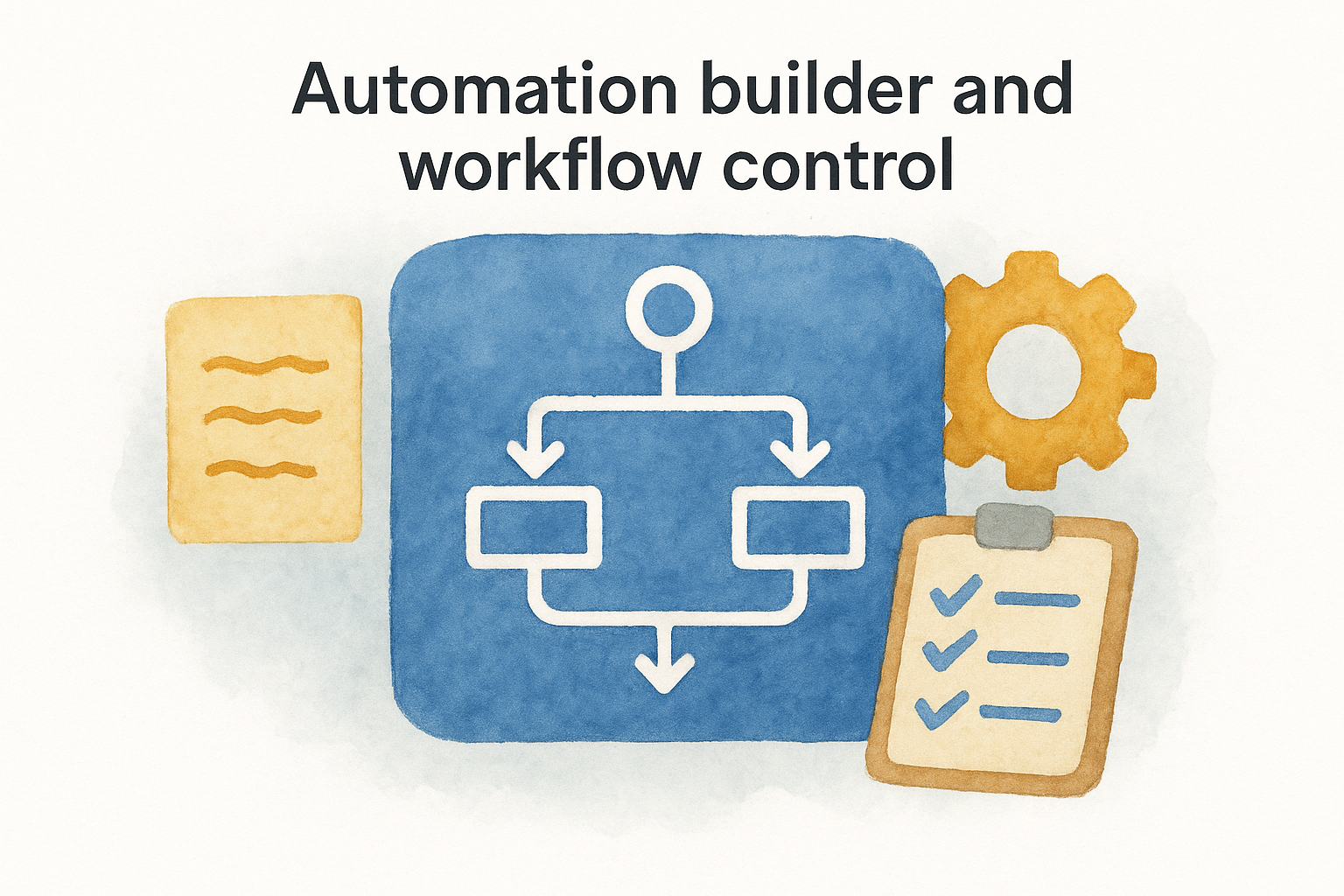
Automation is where the daily operational gap between these two platforms becomes most visible. If you send more than simple broadcast emails, the logic, flexibility, and trigger options built into each platform will directly affect how much time you spend managing workflows versus letting them run.
What's different
Klaviyo's flow builder gives you granular conditional logic, letting you branch sequences based on specific actions like viewing a product, starting a checkout, or hitting a purchase threshold. You can split paths mid-flow, add time delays tied to real events, and update a contact's path based on what they do after entering the sequence. Mailchimp's automation builder covers standard trigger points like welcome sequences, birthday emails, and basic abandoned cart reminders, but its branching logic is shallower and doesn't support the same depth of behavioral conditioning within a single workflow.
The more complex your customer journey, the more you'll feel the ceiling on Mailchimp's automation builder.
Who it favors and why
In the Klaviyo vs Mailchimp comparison, Klaviyo clearly favors businesses running multi-step, behavior-driven sequences that need to adapt based on what a contact does between emails. If you're managing post-purchase follow-up flows, re-engagement ladders with conditional exits, or product-specific drip campaigns, Klaviyo gives you the tools to build and maintain those without working around platform limitations. Mailchimp favors smaller operations running straightforward sequences where a welcome series, a one-step abandoned cart reminder, and a periodic newsletter cover most use cases.
Questions to decide fast
Three questions will tell you which automation builder matches your actual workflow needs:
- Do your customer journeys require branching paths based on behavior mid-sequence? Klaviyo handles that natively; Mailchimp does not at the same depth.
- Are your automations mostly linear sequences triggered by a single event like a signup or a purchase? Mailchimp covers that reliably and without extra configuration.
- How much time can you invest in building and maintaining flows? Klaviyo's depth requires real upfront configuration work before you see the payoff.
6. Ecommerce features and purchase triggers
In the Klaviyo vs Mailchimp comparison, ecommerce functionality is the clearest example of a purpose-built tool versus a general tool that added features over time. If your business model depends on converting browsers into buyers and buyers into repeat customers, the platform you choose here has a direct impact on your bottom line.
What's different
Klaviyo connects natively to your store and treats every customer action as a trigger for automated messaging. Browsed a product but didn't add to cart? That fires a browse abandonment flow. Added to cart but didn't complete checkout? That fires an abandoned cart sequence with product-specific images and pricing pulled automatically from your catalog. Purchased once but went quiet for 60 days? Klaviyo can predict when that customer is likely to churn and fire a win-back message before they're fully disengaged.
Mailchimp offers abandoned cart emails on paid plans, but the trigger logic and product data integration don't reach the same depth as Klaviyo's native ecommerce event model.
Who it favors and why
Klaviyo favors online retailers with a real product catalog and transactional data who need their email platform to function as a revenue layer, not just a communication tool. The deeper your product catalog and the more varied your customer purchase patterns, the more Klaviyo's ecommerce architecture pays off. Mailchimp favors businesses that sell occasionally or use ecommerce as a secondary channel, where standard cart reminders and post-purchase thank-you emails cover most of what you need without the cost or complexity of Klaviyo's setup.
Questions to decide fast
Three questions will tell you which platform actually fits your store's operational needs:
- Do you need purchase-triggered automation that pulls live product data? Klaviyo handles that out of the box; Mailchimp requires more manual setup to approximate it.
- Is abandoned cart recovery one of your primary revenue channels? If yes, Klaviyo's trigger depth and flow control give you a measurable edge.
- Does your store run on Shopify, WooCommerce, or BigCommerce? Klaviyo's native integrations with those platforms are tighter and require less configuration work to get running correctly.
7. Channels beyond email and lead capture
Email alone rarely closes the loop on modern customer communication, and both platforms have expanded beyond the inbox. In the Klaviyo vs Mailchimp comparison, the question of which channels each platform supports natively affects whether you're managing one unified system or stitching together separate tools to accomplish the same goal.
What's different
Klaviyo has built out SMS as a first-class channel alongside email, letting you trigger text messages from the same flow logic that powers your email sequences. You can coordinate a cart abandonment flow that starts with an email, then sends an SMS if the contact doesn't convert within a few hours, all within a single workflow. Mailchimp offers basic SMS capabilities through third-party integrations on select plans and in select markets, but it doesn't treat SMS with the same native depth as Klaviyo.
If you're running coordinated multi-channel sequences where timing and channel order matter, Klaviyo's native SMS integration removes a layer of operational complexity that third-party setups introduce.
Both platforms include signup form builders and pop-up tools for capturing leads directly on your website. Klaviyo's forms connect to its behavioral data layer, so you can show targeted pop-ups based on browsing activity or cart status. Mailchimp's form tools are functional and easier to configure, making them a solid option for straightforward list growth without advanced targeting.
Who it favors and why
Klaviyo favors businesses that want to coordinate email and SMS inside one platform without managing separate subscriptions or syncing two tools manually. The native channel coordination means your trigger logic and timing stay consistent across both channels without extra configuration overhead.
Mailchimp favors teams that primarily need email with basic lead capture and don't require native SMS workflows. If email is your dominant channel and SMS is either not part of your strategy or handled by a separate dedicated tool, Mailchimp's simpler channel setup keeps your stack clean.
Questions to decide fast
Three questions will clarify which platform fits your channel strategy and your team's actual operational capacity:
- Do you need SMS and email to trigger from the same behavioral events? Klaviyo handles that natively without third-party workarounds.
- Is SMS a core part of your current outreach, or a future consideration? That distinction changes how much the channel gap matters right now.
- Are your lead capture forms already managed by a separate tool? If yes, the form builder differences between platforms carry less practical weight in your decision.
8. Integrations and data sync reliability
The quality of your integrations determines how clean your data stays as your marketing stack grows. In the Klaviyo vs Mailchimp comparison, both platforms connect to hundreds of tools, but how they sync data and how reliably that sync holds under real operational load is where the two platforms diverge in meaningful ways.
What's different
Klaviyo's integration model is built around real-time event streaming, meaning customer actions from your connected store or CRM push into Klaviyo as they happen rather than on a scheduled batch sync. That live data pipeline is what enables its behavioral triggers and dynamic segmentation to function accurately. Mailchimp connects to a broad range of tools through its own marketplace and through Zapier, but many of those connections operate on sync intervals rather than real-time pushes, which can create lag between what a customer does and when your platform responds.
If your automation triggers depend on current customer behavior, a sync delay of even a few hours can cause the wrong message to fire at the wrong moment.
Who it favors and why
Klaviyo favors businesses running tightly connected ecommerce stacks where Shopify, WooCommerce, or a CRM feeds live data directly into email and SMS workflows. The tighter the data loop, the more Klaviyo's architecture pays off. Mailchimp favors teams with simpler integration needs, where syncing a contact list from a CRM or connecting a signup form to a Google Sheet covers most of what they actually require day to day.
Questions to decide fast
Run through these three questions before committing to either platform based on integration needs:
- Does your current tool stack require real-time data sync to power automation triggers? Klaviyo's event-based model is built for that; Mailchimp's batch-oriented connections are not.
- Are you already running on Shopify or WooCommerce? Klaviyo's native connectors for those platforms are more reliable and require less maintenance than Mailchimp's equivalents.
- Do most of your integrations just move contact data rather than behavioral events? If yes, Mailchimp's integration library covers that without the added complexity.
9. Reporting, attribution, and optimization
Knowing which emails drove revenue and which ones just generated opens is the difference between optimizing your marketing spend and guessing at it. In the Klaviyo vs Mailchimp comparison, reporting depth is a defining factor for any business that needs to connect marketing activity to actual outcomes.
What's different
Klaviyo ties revenue attribution directly to individual flows and campaigns, showing you exactly how much money each email sequence generated based on purchases that occurred within a configurable attribution window. You can see which specific automation triggered a conversion, what the average order value was from that send, and how different audience segments respond to the same message. Mailchimp provides open rates, click rates, and basic revenue data on paid plans, but its attribution reporting doesn't reach the same granularity as Klaviyo's flow-level revenue breakdowns.
If you can't see which specific email drove a purchase, you can't make an informed decision about where to invest next.
Who it favors and why
Klaviyo favors ecommerce operators who need to optimize campaigns based on revenue data rather than engagement metrics alone. When your reporting shows you that a specific win-back flow generates three times the revenue per send compared to a broadcast campaign, you can allocate your time and list accordingly. Mailchimp favors businesses where engagement metrics like open and click rates are sufficient performance indicators, such as service firms tracking newsletter readership or nonprofits measuring donor communication response without needing purchase-level attribution.
Questions to decide fast
Three questions will tell you which platform's reporting actually matches what your business needs to make better decisions:
- Do you need to tie email sends directly to revenue and individual purchases? Klaviyo's attribution model is built for that measurement out of the box.
- Are open and click rates sufficient to evaluate campaign performance for your goals? Mailchimp's reporting covers those metrics reliably without additional configuration.
- Do you run A/B tests to optimize subject lines, send times, or content? Both platforms support split testing, but Klaviyo's test outcomes connect to revenue data rather than engagement alone.
Next steps
The Klaviyo vs Mailchimp decision becomes straightforward once you match each platform's core strengths to your actual business model. If you sell products online and need email to drive measurable revenue through behavioral triggers and precise segmentation, Klaviyo earns its higher price point. If you run a service-based business, manage donor or client communications, or need a reliable tool your team can operate without a steep learning curve, Mailchimp covers your needs without the added complexity.
Neither platform is universally better. The right one is the one that fits how your business acquires and retains clients right now, not the one with the most impressive feature list on paper. Start with the "Questions to decide fast" sections in each category above, and let your actual use cases drive the choice rather than marketing claims.
If you want help building a full-funnel marketing system that converts leads into signed cases, talk to the team at GavelGrow.
Frequently Asked Questions
What's the core difference between Klaviyo and Mailchimp?
Klaviyo was built from the ground up for ecommerce, so its data model speaks in revenue, orders, and product interactions. Mailchimp started as a general-purpose email tool for small businesses, nonprofits, and service providers, and layered ecommerce features on later. That structural difference shapes pricing, segmentation, automation, and reporting across the entire comparison.
Which is better for a service business like a law firm?
For a firm sending newsletters, nurturing a prospect list, or running event-based outreach rather than selling products online, Mailchimp usually covers the need reliably with a less steep learning curve. Klaviyo's depth is aimed at ecommerce operators who need purchase-triggered automation and revenue attribution, which most service businesses don't require day to day.
How does pricing differ between Klaviyo and Mailchimp?
Both platforms charge based on the number of contacts, but they count them differently, which produces different bills as your list grows. Klaviyo bills on total active profiles, and unengaged subscribers inflate costs at the same rate as active ones. Regularly suppressing unengaged contacts controls spend on either platform. Each also offers a free tier for smaller lists.
Is Klaviyo or Mailchimp easier to set up?
Mailchimp's interface is built for accessibility, and most users can send their first campaign within an hour. Klaviyo is more data-dense and technically structured, reflecting its ecommerce focus, so it has a steeper initial climb but efficient day-to-day workflows once configured. If you need results this week, Mailchimp's setup speed is an advantage.
Which platform has deeper automation and segmentation?
Klaviyo offers deeper behavioral segmentation and branching automation, letting you split paths mid-flow based on actions like browsing a product or hitting a purchase threshold, and it updates segments in real time. Mailchimp handles standard triggers such as welcome series and basic cart reminders well, but its conditional logic is shallower. Match the depth to how complex your customer journeys actually are.
Frequently Asked Questions
What's the core difference between Klaviyo and Mailchimp?
Klaviyo was built from the ground up for ecommerce, so its data model speaks in revenue, orders, and product interactions. Mailchimp started as a general-purpose email tool for small businesses, nonprofits, and service providers, and layered ecommerce features on later. That structural difference shapes pricing, segmentation, automation, and reporting across the entire comparison.
Which is better for a service business like a law firm?
For a firm sending newsletters, nurturing a prospect list, or running event-based outreach rather than selling products online, Mailchimp usually covers the need reliably with a less steep learning curve. Klaviyo's depth is aimed at ecommerce operators who need purchase-triggered automation and revenue attribution, which most service businesses don't require day to day.
How does pricing differ between Klaviyo and Mailchimp?
Both platforms charge based on the number of contacts, but they count them differently, which produces different bills as your list grows. Klaviyo bills on total active profiles, and unengaged subscribers inflate costs at the same rate as active ones. Regularly suppressing unengaged contacts controls spend on either platform. Each also offers a free tier for smaller lists.
Is Klaviyo or Mailchimp easier to set up?
Mailchimp's interface is built for accessibility, and most users can send their first campaign within an hour. Klaviyo is more data-dense and technically structured, reflecting its ecommerce focus, so it has a steeper initial climb but efficient day-to-day workflows once configured. If you need results this week, Mailchimp's setup speed is an advantage.
Which platform has deeper automation and segmentation?
Klaviyo offers deeper behavioral segmentation and branching automation, letting you split paths mid-flow based on actions like browsing a product or hitting a purchase threshold, and it updates segments in real time. Mailchimp handles standard triggers such as welcome series and basic cart reminders well, but its conditional logic is shallower. Match the depth to how complex your customer journeys actually are.