Law Firm Marketing ROI: How To Calculate, Track & Improve
Categories: Legal Marketing Strategies
 Abram Ninoyan
Founder & Senior Performance Marketer
Credentials: Google Partner, Google Ads Search Certified, Google Ads Display Certified, Google Ads Measurement Certified, Google Analytics (IQ) Certified, HubSpot Inbound Certified, HubSpot Social Media Marketing Certified, Conversion Optimization Certified
Expertise: Google Ads, Meta Ads, Conversion Rate Optimization, GA4 & Google Tag Manager, Lead Generation, Marketing Funnel Optimization, PPC Management
LinkedIn Profile
Law firm marketing ROI measures how much revenue your firm earns for every dollar spent on marketing, and calculating it correctly means tracking all the way from ad click to signed retainer, not stop...
Key Takeaways
- Law Firm Marketing ROI: How To Calculate, Track & Improve
- What does law firm marketing ROI mean
- Step 1. Track leads and costs the right way
- Step 2. Calculate ROI and cost per signed case
Law Firm Marketing ROI: How To Calculate, Track & Improve
Law firm marketing ROI measures how much revenue your firm earns for every dollar spent on marketing, and calculating it correctly means tracking all the way from ad click to signed retainer, not stopping at leads generated.
Most firms get this wrong. They report on clicks, impressions, and even cost-per-lead, then call it a day. But a $50 lead that never converts is infinitely more expensive than a $300 lead that signs a $15,000 case. According to the 2024 Clio Legal Trends Report secret-shopper study, nearly half of firms (48%) were unreachable by phone, which means many firms are bleeding ROI at the intake stage, not the advertising stage. The real math starts after the lead comes in, and most marketing dashboards aren't built to show you that.
That gap between lead and signed case is exactly why we built GavelGrow. Our platform tracks attribution from the first ad click through the signed retainer, giving firms a true cost-per-signed-case instead of vanity metrics. Having worked with over 500 U.S. law firms since 2015, we've seen firsthand what separates firms earning 5:1 returns from those burning budget with nothing to show for it.
This guide walks you through the exact formulas to calculate your marketing ROI, the KPIs that actually matter for law firms, and practical strategies to improve your numbers quarter over quarter. Whether you're spending $2,000 or $100,000 a month on marketing, the framework is the same, and getting it right changes everything about how you allocate budget.
What does law firm marketing ROI mean
Law firm marketing ROI is the ratio of revenue generated from signed cases to the total dollars invested in marketing. On the surface, that sounds straightforward. In practice, most firms measure the wrong thing at the wrong stage, which is why their reported ROI rarely matches their actual revenue.
ROI in legal marketing is not the same as ROI in e-commerce, where a single ad click can produce a purchase in minutes. Legal has a 6-to-12-month sales cycle in many practice areas, multiple touchpoints before a retainer is signed, and a cost structure that includes intake staff, follow-up sequences, and consultation time. Every one of those factors affects your true return, and ignoring them gives you a number that looks good on a slide but does nothing for your bottom line.
The basic formula
The formula for law firm marketing ROI is simple, but the inputs have to be right:
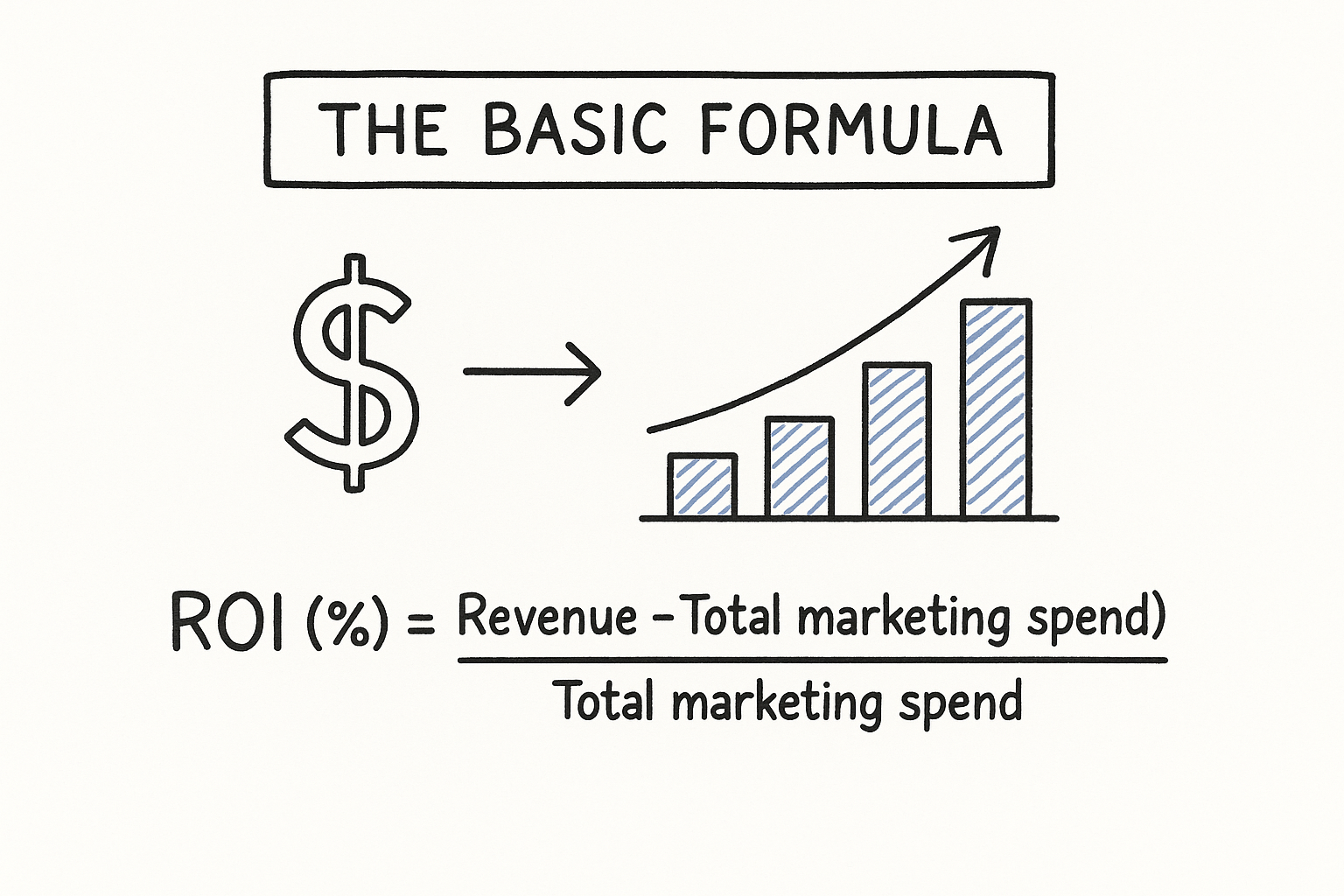
ROI (%) = [(Revenue from signed cases - Total marketing spend) / Total marketing spend] x 100
Here is what that looks like with real numbers:
A 300% ROI means you earned $3 for every $1 spent. That's a meaningful number. A cost-per-lead of $200 tells you almost nothing by comparison, because it doesn't account for how many of those leads actually signed.
Why leads and cases are not the same metric
Your intake process sits directly between your marketing spend and your revenue. A firm running great Google Ads can still post negative ROI if its intake team takes 48 hours to return calls. According to the Lead Response Management Study, leads called within five minutes were 100 times more likely to be reached than those called at 30 minutes. In legal, that gap is even more consequential because potential clients often contact multiple firms simultaneously.
Speed-to-lead is not a sales tactic. It is a direct multiplier on your marketing ROI.
This is why cost-per-signed-case is a more reliable KPI than cost-per-lead. Cost-per-lead rewards volume. Cost-per-signed-case rewards outcomes. If your Google Ads campaign delivers 40 leads at $150 each and 8 of them sign, your cost-per-signed-case is $750, which may be outstanding for a personal injury firm or unacceptable for a bankruptcy practice. Context by practice area is everything.
What a healthy ROI looks like for law firms
There is no universal benchmark, because average case value varies dramatically across practice areas. A workers' comp firm with $3,000 average case values needs a very different ROI target than a mass tort firm working $50,000+ cases. That said, modelled benchmarks from GavelGrow suggest that high-performing firms typically hit a 4:1 to 8:1 return on marketing spend, meaning $4 to $8 in signed case revenue for every $1 spent.
Below that range, the firm is either overpaying for media, losing leads in intake, closing at a below-average rate, or some combination of all three. Understanding which stage is breaking down is the entire purpose of measuring law firm marketing ROI correctly, and that is exactly what the next three steps will help you do.
Step 1. Track leads and costs the right way
Accurate law firm marketing ROI starts with accurate inputs, and most firms undercount both their costs and their lead sources. Before you can calculate a meaningful return, you need to know every dollar going out and every lead coming in, tagged to its specific source. Skipping this step means your ROI formula will produce a number that sounds good but doesn't reflect reality.
What costs to include in your total marketing spend
Most firms only log their ad spend, which makes their ROI look artificially strong. Your total marketing spend should include every cost that exists because you're trying to acquire clients. Use this table to audit your current cost tracking:
If you're not including agency fees and software costs, your cost-per-signed-case is likely understated by 20-40%.
Most firms are surprised by the labor row. If your intake coordinator spends eight hours a week following up on unqualified leads, that time has a real dollar cost that belongs in the denominator of your ROI calculation.
How to track where each lead comes from
Without source tracking, you can't separate a $50 organic lead from a $400 paid lead. Every lead that enters your pipeline needs a clear attribution tag tied to the campaign or channel that generated it. Here's how to set that up:
- Assign unique tracking phone numbers to each campaign (Google Ads, LSA, billboard, and organic each get their own number)
- Add UTM parameters to every paid URL so your analytics platform captures source, medium, and campaign on intake form submissions
- Add a hidden source field to your intake forms that auto-populates from the UTM data so attribution survives even when a lead calls instead of submitting the form
- Tag every inbound call with an outcome (qualified, callback, unqualified, spam) so you're measuring lead quality, not just lead volume
GavelGrow's platform handles call tracking and source attribution natively, so every lead row in your pipeline shows the originating campaign and its cost-per-lead inline, without any manual tagging or spreadsheet work.
Step 2. Calculate ROI and cost per signed case
With clean tracking in place, you can now run the numbers that actually drive decisions. The goal here is to produce two figures: your cost per signed case by channel, and your overall law firm marketing ROI for the period. Both are straightforward to calculate once you have sourced lead data and a complete cost total from Step 1.
How to calculate your cost per signed case
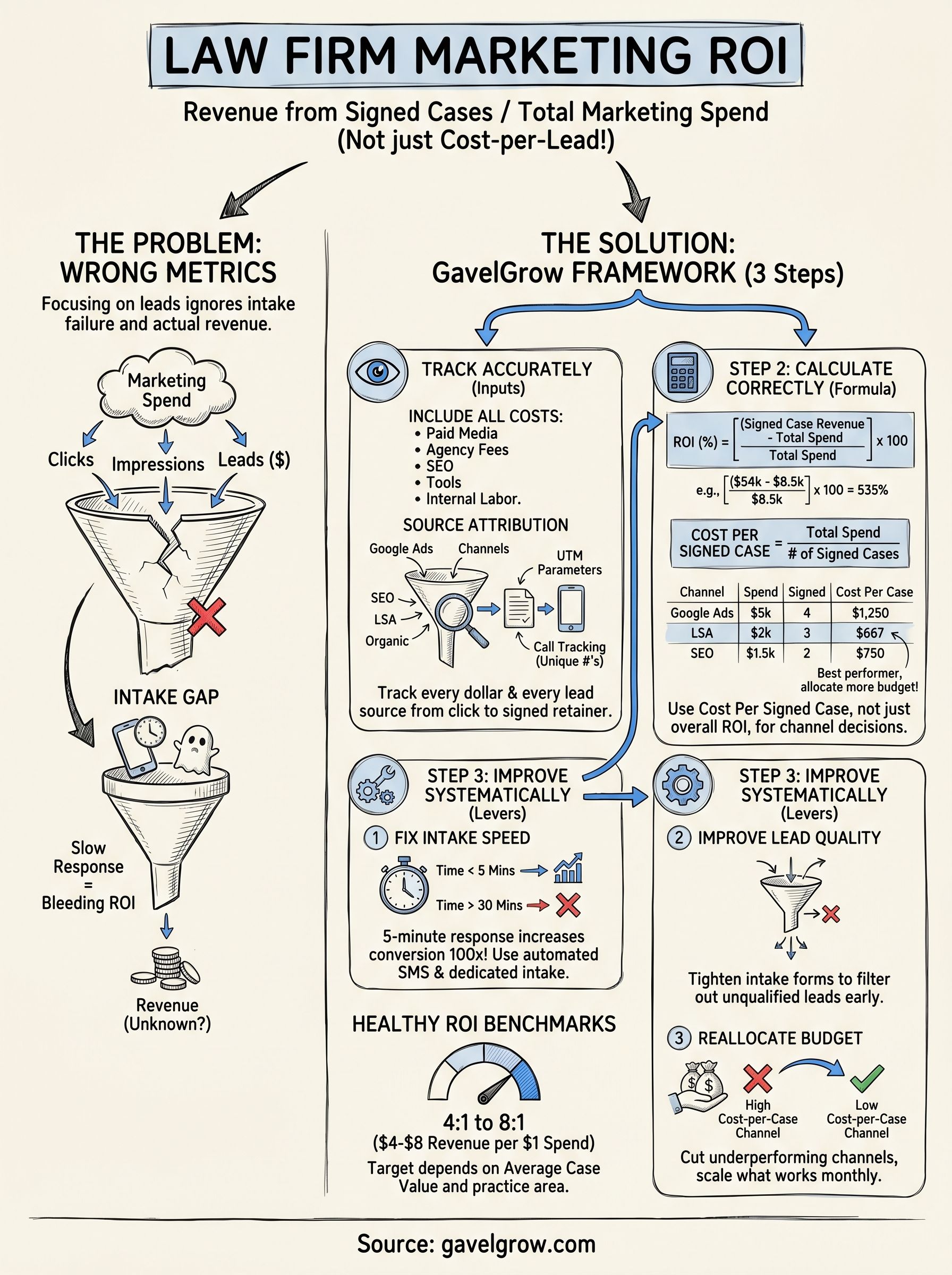
Cost per signed case is the single most useful metric in legal marketing because it accounts for everything, your ad spend, your intake conversion rate, and your close rate in one number. The formula is:
Cost Per Signed Case = Total Marketing Spend / Number of Cases Signed From That Spend
Run this formula separately for each channel. Your Google Ads campaign and your organic SEO investment should each produce their own figure. Here is a simple template you can fill in monthly:
That breakdown immediately shows you where your budget works hardest. In the example above, Local Services Ads produces the lowest cost per signed case, which tells you exactly where to allocate more budget next month.
How to calculate your overall marketing ROI
Once you have your signed case count and your total spend, plug those numbers into the ROI formula. You also need your average case value, which you can pull from your billing records as a 12-month rolling average.
Your average case value should reflect collected revenue, not billed fees, since uncollected revenue inflates your ROI and leads to bad budget decisions.
Use this template each quarter:
ROI (%) = [(Cases Signed x Average Case Value) - Total Spend] / Total Spend x 100
For example: 9 cases x $6,000 average value = $54,000 revenue. Subtract $8,500 in spend, divide by $8,500, multiply by 100. Your law firm marketing ROI is 535% for the period. That is a number you can actually present to a managing partner and use to justify next quarter's budget request.
Step 3. Improve ROI by fixing the funnel
Once you have accurate numbers from Steps 1 and 2, you'll see exactly where your law firm marketing ROI breaks down. For most firms, the problem isn't the advertising itself. It's what happens after the lead arrives. The funnel has three leverage points you can improve without increasing spend: intake speed, lead quality filtering, and budget reallocation.
Fix intake speed first
Your intake response time is the single fastest lever you can pull to improve ROI without touching your ad budget. The Lead Response Management Study found that leads called within five minutes were 100 times more likely to be reached than those called at 30 minutes. In legal, where a potential client contacts two or three firms before choosing one, being second means losing the case.

Here is a concrete checklist to reduce your response time to under five minutes:
- Set up an automated SMS reply that fires within 60 seconds of form submission, confirms receipt, and sets a callback expectation
- Route all new leads to a dedicated intake queue in your CRM, separate from general messages, so nothing sits unread
- Assign coverage hours and a backup contact so leads that arrive after 5 PM still get an acknowledgment that night
- Use outcome tagging on every call (qualified, callback, unqualified, spam) so you can measure your intake team's conversion rate by shift
Automating your first-touch response costs almost nothing to set up and pays back immediately in conversion rate.
Improve lead quality before raising budget
Bad lead quality silently destroys your cost-per-signed-case. If you're generating 50 leads a month but only five are genuinely qualified, you're paying intake staff to process 45 cases that will never sign. The fix isn't more leads. It's better filtering at the source.
Tighten your intake form to ask qualifying questions upfront. For a personal injury firm, that means asking about the incident date, injury type, and whether another attorney is already involved. Unqualified submissions drop significantly when your form requires specific answers rather than accepting any text in a "tell us about your case" box.
Cut underperforming channels, scale what works
Return to the channel-by-channel cost-per-signed-case table you built in Step 2 every single month. Any channel running more than twice your average cost-per-signed-case for three consecutive months deserves either a pause or a structural fix, not more patience. Shift that freed budget to the channel producing your lowest cost-per-signed-case and measure the impact over 60 days before drawing conclusions.
Frequently asked questions
These questions come up consistently from managing partners and marketing directors working through their numbers for the first time. Here are direct answers based on patterns from real law firm data.
What is a good ROI for law firm marketing?
Most high-performing firms hit a 4:1 to 8:1 return on marketing spend, meaning $4 to $8 in signed case revenue for every $1 invested. Your specific target depends on your average case value and practice area. A personal injury firm handling $25,000 cases can tolerate a higher cost-per-signed-case than a bankruptcy firm closing $2,500 matters. Use your average case value as your anchor, then work backward to a cost-per-signed-case ceiling that still leaves your firm profitable after overhead.
How do I calculate cost per signed case?
Divide your total marketing spend for a given period by the number of cases that signed from that same spend. If you spent $9,000 across all channels in a month and 6 clients signed retainers, your cost per signed case is $1,500. Run this calculation separately by channel, not just as a blended total, so you can see which campaigns justify more budget and which need to be cut.
What is the difference between cost-per-lead and cost-per-signed-case?
Cost-per-lead counts every form submission or call regardless of quality. Cost-per-signed-case counts only the leads that converted into paying clients, which means it captures your intake conversion rate and your close rate inside a single number. A channel delivering $80 leads sounds great until you realize only 2% of those leads ever sign. Law firm marketing ROI calculated from cost-per-signed-case gives you a number that reflects real revenue, not just pipeline activity.
Optimizing for cost-per-lead rewards volume. Optimizing for cost-per-signed-case rewards revenue.
How does intake response time affect my ROI?
Responding to a lead within 5 minutes versus 30 minutes makes a lead far more likely to qualify, according to the Lead Response Management Study. Because potential clients in most practice areas contact multiple firms before choosing one, a slow response hands the case to a competitor. Cutting your response time through automated SMS acknowledgment and a dedicated intake queue directly improves your signed case rate without adding a single dollar to your ad spend.
How often should I review my law firm marketing ROI numbers?
Review your channel-by-channel cost-per-signed-case monthly and your overall ROI quarterly. Monthly reviews let you catch a failing campaign before it burns three months of budget. Quarterly reviews give you enough data to spot seasonal patterns specific to your practice area, since personal injury and family law both show consistent intake fluctuations tied to calendar events and court schedules.
Make your ROI numbers actionable
Calculating law firm marketing ROI is only useful if you act on what the numbers tell you. You now have the formula, the tracking framework, and the funnel fixes. The next step is putting them into a consistent monthly routine: pull your channel-by-channel cost-per-signed-case, compare it against last month, cut what's failing, and reinvest in what's working.
Most firms that struggle with ROI aren't failing at advertising. They're failing at measurement and follow-through. Running these numbers once and then ignoring them for a quarter is how budget gets wasted. Building the habit of reviewing your data monthly is what separates firms that grow their caseload predictably from those that treat marketing as a recurring expense with no clear return.
If you want a faster path to clean attribution and automated intake tracking, explore GavelGrow's platform features or book a free 45-minute strategy call to map out your firm's specific numbers.
Frequently Asked Questions
What is a good ROI for law firm marketing?
Most high-performing firms hit a 4:1 to 8:1 return on marketing spend, meaning $4 to $8 in signed case revenue for every $1 invested. Your specific target depends on your average case value and practice area. A personal injury firm handling $25,000 cases can tolerate a higher cost-per-signed-case than a bankruptcy firm closing $2,500 matters. Use your average case value as your anchor, then work backward to a cost-per-signed-case ceiling that still leaves your firm profitable after overhead.
How do I calculate cost per signed case?
Divide your total marketing spend for a given period by the number of cases that signed from that same spend. If you spent $9,000 across all channels in a month and 6 clients signed retainers , your cost per signed case is $1,500. Run this calculation separately by channel, not just as a blended total, so you can see which campaigns justify more budget and which need to be cut.
What is the difference between cost-per-lead and cost-per-signed-case?
Cost-per-lead counts every form submission or call regardless of quality. Cost-per-signed-case counts only the leads that converted into paying clients, which means it captures your intake conversion rate and your close rate inside a single number. A channel delivering $80 leads sounds great until you realize only 2% of those leads ever sign. Law firm marketing ROI calculated from cost-per-signed-case gives you a number that reflects real revenue, not just pipeline activity. Optimizing for cost-per-lead rewards volume. Optimizing for cost-per-signed-case rewards revenue.
How does intake response time affect my ROI?
Responding to a lead within 5 minutes versus 30 minutes makes a lead far more likely to qualify, according to the Lead Response Management Study. Because potential clients in most practice areas contact multiple firms before choosing one, a slow response hands the case to a competitor. Cutting your response time through automated SMS acknowledgment and a dedicated intake queue directly improves your signed case rate without adding a single dollar to your ad spend.
How often should I review my law firm marketing ROI numbers?
Review your channel-by-channel cost-per-signed-case monthly and your overall ROI quarterly. Monthly reviews let you catch a failing campaign before it burns three months of budget. Quarterly reviews give you enough data to spot seasonal patterns specific to your practice area, since personal injury and family law both show consistent intake fluctuations tied to calendar events and court schedules.