9 Best Law Firm Marketing Software Tools for Intake & ROI
Categories: Legal Marketing Strategies
 Abram Ninoyan
Founder & Senior Performance Marketer
Credentials: Google Partner, Google Ads Search Certified, Google Ads Display Certified, Google Ads Measurement Certified, Google Analytics (IQ) Certified, HubSpot Inbound Certified, HubSpot Social Media Marketing Certified, Conversion Optimization Certified
Expertise: Google Ads, Meta Ads, Conversion Rate Optimization, GA4 & Google Tag Manager, Lead Generation, Marketing Funnel Optimization, PPC Management
LinkedIn Profile
Most law firm marketing software promises leads. Few actually track what happens after the lead comes in, and that gap between "new contact" and "signed retainer" is where firms qu...
Key Takeaways
- 9 Best Law Firm Marketing Software Tools for Intake & ROI
- 1. GavelGrow
- 2. Clio Grow and Clio Manage
- 3. Lawmatics
9 Best Law Firm Marketing Software Tools for Intake & ROI
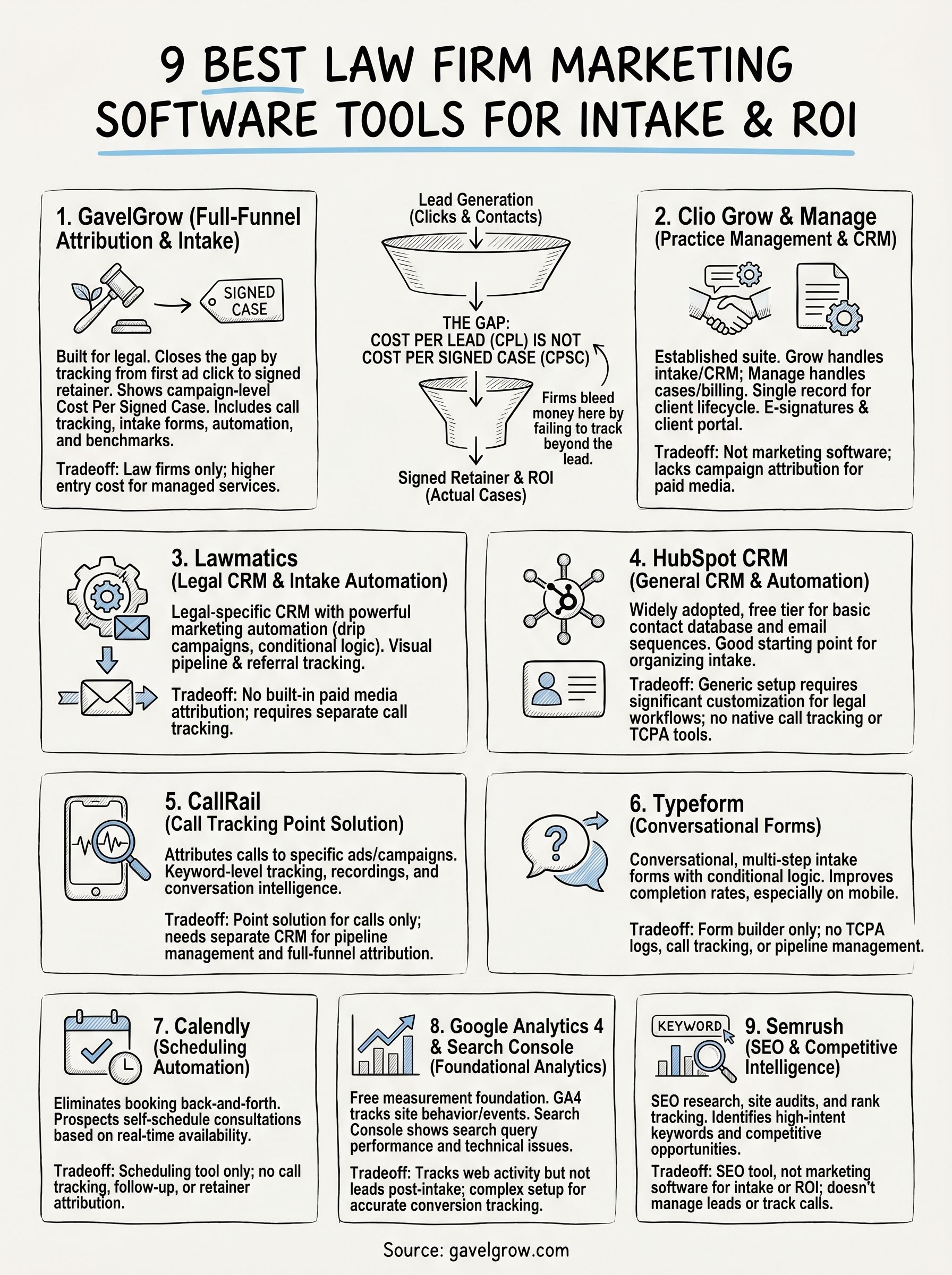
Most law firm marketing software promises leads. Few actually track what happens after the lead comes in, and that gap between "new contact" and "signed retainer" is where firms quietly bleed money. The right platform doesn't just generate clicks; it connects every dollar spent to cases your firm actually signs.
The problem is choosing from a crowded field. Some tools handle intake forms but ignore call tracking. Others nail SEO reporting but can't tell you which campaign produced your last five retained clients. Firms end up duct-taping three or four platforms together, CallRail for calls, Clio Grow for intake, AgencyAnalytics for dashboards, and still can't answer the basic question: what's my cost per signed case? That's the exact measurement gap we built GavelGrow to close, and it's the lens we used to evaluate every tool on this list.
Below, we break down nine platforms worth considering in 2026, covering everything from intake automation and CRM to full-funnel attribution and marketing dashboards. Each recommendation includes pricing, standout features, and honest trade-offs so you can match the right tool to your firm's size, budget, and technical comfort level. Whether you run marketing in-house or hand it off to a dedicated team, this list will help you stop guessing and start measuring what actually moves your caseload.
1. GavelGrow
GavelGrow is the only law firm marketing software built exclusively for legal, which means every feature, default setting, and benchmark is calibrated for how law firms acquire clients, not how e-commerce brands or dental practices do. Founded in 2015, the platform now serves over 500 U.S. firms across practice areas from personal injury to immigration, with a 4.9/5 customer rating.
What it helps you do
GavelGrow closes the attribution gap that breaks most firms' reporting. Instead of stopping at cost-per-lead, the platform tracks every contact from the first ad click through intake, follow-up, and signed retainer, so you know exactly which campaign produced each case and what it cost to acquire it. You can see campaign-level cost-per-signed-case inside a single dashboard without exporting spreadsheets or stitching together separate tools.
Most firms can tell you how many leads came in last month. GavelGrow tells you how many of those became paying clients and what you spent to acquire each one.
Standout features for law firms
The platform replaces several point solutions you might already be paying for separately. Built-in call tracking covers per-campaign tracking numbers, call recordings, outcome tagging, and miss-rate reporting, eliminating the need for a standalone CallRail subscription. Hosted intake forms include TCPA-consent audit logs, carrier-level phone validation, bot protection, and a 10-minute duplicate detection window, so junk submissions don't clog your pipeline. Intake automation fires SMS (once US carriers approve your number) and email follow-ups within minutes of a new lead capture, and modelled practice-area benchmarks lets you compare your CPL and close rate against firms in your practice area and market size.
Tradeoffs to know
GavelGrow is built for law firms only, which is its biggest advantage but also a hard boundary. If your firm shares a marketing budget with a non-legal business line, you will need a separate tool for that side. The managed-services tier is scoped on a strategy call, which prices out the smallest solo practices that want fully hands-off support.
Pricing and starting costs
Platform plans run from $199/month (Track) to $599/month (Optimize), with Optimize the most popular option. Annual billing includes two months free, and Track and Optimize include a 7-day free trial with no credit card required, giving you a preview of Optimize-tier features before you commit.
2. Clio Grow and Clio Manage
Clio is the most widely adopted legal practice management suite in the U.S., and the combination of Grow (intake and CRM) with Manage (case and matter management) gives you a connected workflow from first contact to closed case. It's a strong choice for firms that want established software with deep integrations across the legal ecosystem.
What it helps you do
Your intake pipeline gets dedicated tooling through Clio Grow, which lets you build intake forms, automate follow-up emails, and track prospect status before a retainer is signed. Clio Manage picks up after signing, covering billing, documents, and matter management in one place. Together, they give your firm a single record for each client's full lifecycle.
Standout features for law firms
E-signature on engagement letters, document templates, and a built-in client portal reduce back-and-forth with prospects. Clio Grow's visual pipeline view lets you spot where leads stall, and the platform's extensive third-party integration library connects to tools like Zoom, QuickBooks, and Outlook.
Slow responses to new inquiries are a conversion problem Grow's automation directly addresses.
Tradeoffs to know
Clio is not law firm marketing software in the advertising or attribution sense. It won't tell you which Google Ads campaign produced a lead or what your cost per signed case is across campaigns, so firms with active paid media need a separate attribution layer.
Pricing and starting costs
Clio Grow starts at $49 per user per month. Clio Manage plans start at $39 per user per month, with higher tiers unlocking additional features and integrations.
3. Lawmatics
Lawmatics is a legal CRM and intake automation platform built specifically for law firms, with a heavier emphasis on marketing automation than Clio Grow. If your firm runs drip campaigns, automated follow-up sequences, and referral tracking, Lawmatics gives you more native marketing horsepower within a legal-specific tool.
What it helps you do
Lawmatics centralizes your prospect and client communication in one place, from the first web form submission through signed retainer. You can build multi-step automated workflows that trigger emails and texts based on lead status changes, so prospects receive timely follow-ups without your staff manually tracking every contact. The platform also supports referral source tracking, which helps you understand which referral relationships are actually generating retained clients.
Standout features for law firms
The platform offers robust marketing automation with conditional logic, meaning you can build different follow-up sequences for different practice areas or lead types. Document templates, e-signature, and a client portal are included, and the visual pipeline view gives your intake team a clear picture of where each prospect stands.
Firms that use automated follow-up sequences contact leads faster and more consistently, which directly impacts conversion rates since speed-to-lead is one of the strongest predictors of intake success.
Tradeoffs to know
Lawmatics is not law firm marketing software in the paid-media attribution sense. It won't connect your Google Ads spend to signed cases, so firms running active advertising still need a separate attribution and call-tracking layer alongside it.
Pricing and starting costs
Lawmatics does not publish pricing publicly. Plans are quote-based, and you need to request a demo to get current pricing for your firm size and feature requirements.
4. HubSpot CRM
HubSpot is one of the most widely adopted CRM platforms across industries, and its free tier makes it a common starting point for law firms that want a structured contact database without an immediate software budget. It handles contact management, email sequences, and pipeline tracking, though it requires significant customization before it fits a legal intake workflow.
What it helps you do
The platform gives you a centralized contact and deal pipeline where you can track every prospect from first inquiry through conversion. You can set up automated email follow-up sequences, log calls, and manage tasks from a single dashboard. For firms without any CRM in place, it provides a solid foundation for organizing your intake pipeline and keeping staff aligned on each prospect's status.
Standout features for law firms
HubSpot's free CRM tier covers contact records, email tracking, and basic pipeline views at no cost, which is a meaningful advantage for smaller firms testing their first structured intake process. Paid tiers add marketing automation, landing pages, and more granular reporting. The platform also connects to hundreds of third-party tools, which helps if your firm already relies on specific software for scheduling or document management.
HubSpot's strength is breadth, but its generic setup means you'll spend real time configuring it before it resembles a functional legal intake workflow.
Tradeoffs to know
For firms running active paid media, HubSpot falls short as law firm marketing software. It has no built-in call tracking, no TCPA consent logging, and no practice-area benchmarks. Connecting ad spend to signed cases requires custom configuration and third-party integrations that add both cost and ongoing maintenance.
Pricing and starting costs
HubSpot's free CRM plan covers basic contact and pipeline management. Paid Marketing Hub plans start at $15 per user per month, with more advanced automation and reporting unlocked on higher tiers.
5. CallRail
CallRail is a dedicated call tracking platform that attributes phone calls to specific campaigns, ads, or landing pages. For law firms running Google Ads or Local Services Ads, knowing which campaign drives your phone inquiries is a critical piece of measuring true marketing ROI.
What it helps you do
CallRail assigns unique tracking phone numbers to each of your marketing channels, so when a prospect calls, the platform captures which ad, keyword, or source triggered that call. You can record calls, review transcripts, and tag outcomes, giving your team a structured record of every inbound phone inquiry and the marketing source behind it.
For firms where phone calls are the primary intake channel, CallRail fills a real attribution gap that generic CRMs and analytics tools leave open.
Standout features for law firms
The platform offers keyword-level call attribution, which means you can trace a retained client back to the exact search term that triggered their click. Call recording, automated transcription, and conversation intelligence features let you review call quality and spot exactly where your intake conversations break down before prospects convert.
Tradeoffs to know
CallRail is a point solution focused narrowly on call tracking, not a full law firm marketing software platform. It doesn't manage your intake pipeline, automate follow-up sequences, or connect call data to signed retainers. Your firm still needs a separate CRM and marketing dashboard to get full-funnel attribution, which adds both cost and complexity to your stack.
Pricing and starting costs
CallRail plans start at $45 per month, covering basic call tracking for up to five numbers and 250 minutes. Higher tiers unlock conversation intelligence, form tracking, and deeper analytics integrations.
6. Typeform
Typeform is a form-building tool known for its conversational, one-question-at-a-time interface that consistently produces higher completion rates than standard multi-field forms. Law firms use it to build intake questionnaires that feel less intimidating to prospective clients filling them out on a phone.
What it helps you do
The platform lets you create multi-step intake forms with conditional logic, so prospects only see questions relevant to their situation. A personal injury form can branch differently from a family law inquiry, keeping each experience short and focused. You can embed forms directly on your website or share them through a direct link for specific campaigns.
Standout features for law firms
The conversational form format reduces friction at the top of your intake funnel, and conditional logic means you can collect detailed case information without overwhelming prospects with irrelevant fields. Typeform also integrates with tools like Google Sheets and Slack, so responses flow into whatever system your team already uses to manage incoming leads.
For firms where web form completion rates are low, Typeform's format can meaningfully improve the number of prospects who actually finish your intake questionnaire.
Tradeoffs to know
Unlike dedicated law firm marketing software, Typeform has no TCPA consent logging, no call tracking, and no pipeline management. It collects form data and passes it elsewhere, so your firm needs additional tools to handle follow-up, attribution, and case conversion tracking.
Pricing and starting costs
A free plan is available with limited monthly responses. Paid plans start at $25 per month, with higher tiers unlocking more responses, deeper conditional logic, and additional integrations.
7. Calendly
Calendly is a scheduling automation tool that eliminates the back-and-forth of booking consultations. Law firms use it to let prospects self-schedule their initial intake calls or consultations directly from a website, a follow-up email, or a confirmation page after submitting a contact form.
What it helps you do
Calendly connects to your calendar and exposes your real-time availability to prospects, letting them pick a time that works without any staff involvement. You can set buffer times between appointments, cap daily bookings, and require prospects to answer qualifying questions before a slot is confirmed, which filters out low-quality inquiries before your team spends time on them.
Reducing friction between "interested prospect" and "scheduled consultation" is one of the fastest ways to improve your intake conversion rate without changing your advertising budget.
Standout features for law firms
The platform supports automated reminder emails and SMS messages before each scheduled meeting, which reduces no-shows without requiring manual follow-up from your intake team. Routing rules let you assign consultations to specific attorneys based on practice area or availability, making it useful for multi-attorney firms managing intake across departments.
Tradeoffs to know
Calendly is a scheduling tool, not law firm marketing software. It has no call tracking, no TCPA consent logging, and no pipeline reporting. You still need a separate platform to manage follow-up after the consultation and connect each booked appointment to a signed retainer.
Pricing and starting costs
A free plan covers basic one-event-type scheduling. Paid plans start at $10 per user per month, with team features and routing unlocked on higher tiers.
8. Google Analytics 4 and Search Console
Google Analytics 4 (GA4) and Search Console are free tools from Google that give you visibility into how visitors find your website and what they do once they arrive. Together, they form the measurement foundation that every other piece of law firm marketing software builds on top of.

What it helps you do
GA4 tracks user behavior across your website, from landing pages to form submissions, so you can see which pages drive inquiries and which ones lose visitors before they contact you. Search Console shows you which search queries surface your site in Google results and flags technical issues that hurt your rankings.
Standout features for law firms
GA4's event-based tracking model lets you measure specific conversion actions, including form completions and consultation bookings, rather than just page views. Search Console's performance report shows you impressions, clicks, and average position for every keyword your firm ranks for, which helps you identify content gaps and prioritize your SEO efforts.
For firms investing in organic search, Search Console is the most direct signal you have from Google on what is and is not working.
Tradeoffs to know
Neither tool tracks leads after they enter your intake pipeline, so you still need a dedicated platform to connect web traffic data to signed retainers. Setting up accurate conversion tracking in GA4 also requires technical configuration that many firms get wrong without outside help.
Pricing and starting costs
Both GA4 and Search Console are completely free through your Google account.
9. Semrush
Semrush is an SEO and competitive intelligence platform used by marketing teams across industries to research keywords, audit websites, and track organic search rankings. For law firms investing in content and local SEO, it gives you a structured way to identify search opportunities your competitors are already capturing.
What it helps you do
Semrush lets you research the keywords your target clients type into Google before they pick up the phone, so you can build content that intercepts them early in the decision process. You can audit your existing website for technical issues hurting your rankings, track your position for specific legal search terms over time, and analyze exactly which pages on a competitor's site are driving their organic traffic.
Standout features for law firms
The Keyword Magic Tool surfaces high-intent local searches like "personal injury attorney [city]" with monthly volume and difficulty scores, helping you prioritize which terms are worth pursuing. Semrush's site audit feature crawls your website and flags issues like slow load times, broken links, and missing metadata that quietly suppress your rankings.
Understanding which keywords your firm could realistically rank for saves you months of effort writing content that never surfaces in search results.
Tradeoffs to know
Semrush is an SEO research tool, not law firm marketing software for intake or attribution. It won't track calls, manage leads, or connect organic traffic to signed retainers, so it functions best as one layer within a broader marketing stack.
Pricing and starting costs
Semrush plans start at $139.95 per month for the Pro tier, with higher-tier plans unlocking more projects, tracked keywords, and team seats.
Next Steps
No single piece of law firm marketing software does everything, but your stack doesn't need to be complex to be effective. The firms that get the best return from their marketing tools share one habit: they measure cost per signed case, not just cost per lead, and they build their software choices around that number.
Start by identifying your biggest gap. If you can't trace a retained client back to the campaign that generated them, attribution is your problem. If leads go cold because nobody follows up within the first hour, intake automation is your priority. Both problems are solvable without adding more tools to your stack.
GavelGrow handles attribution, call tracking, intake automation, and pipeline reporting in one platform built specifically for law firms. You can test every feature before you pay anything. Start your free 7-day trial on the GavelGrow platform and see your full-funnel numbers by the end of the week.
Frequently Asked Questions
What should law firm marketing software actually track?
The right platform connects every dollar spent to cases your firm actually signs, not just clicks or leads. Many tools handle intake forms or SEO reporting but can't answer the basic question of cost per signed case. The firms that get the best return measure cost per signed case rather than cost per lead and build their software choices around that number.
What makes GavelGrow different from other law firm marketing software?
GavelGrow is built exclusively for law firms and tracks every contact from the first ad click through intake, follow-up, and signed retainer, so you see campaign-level cost-per-signed-case in one dashboard. It also replaces several point solutions with built-in call tracking, hosted intake forms with TCPA-consent audit logs, and intake automation that fires SMS (once US carriers approve your number) and email follow-ups within minutes of a new lead.
How much does GavelGrow cost for a law firm?
GavelGrow platform plans run from $199 per month (Track) to $599 per month (Optimize), with Optimize suited to firms with intake staff. Annual billing includes two months free, and Track and Optimize include a 7-day free trial with no credit card required. Fully managed services are a separate tier, scoped on a strategy call.
Do practice-management tools like Clio track marketing ROI?
Practice-management and CRM tools handle intake, billing, and matter management well, but most are not marketing software in the attribution sense. They typically won't tell you which Google Ads campaign produced a lead or your cost per signed case across campaigns. Firms running active paid media usually need a separate attribution and call-tracking layer alongside their case-management system.
Do I need multiple tools to measure law firm marketing ROI?
Not necessarily. Many firms duct-tape separate tools for call tracking, intake, and dashboards and still can't answer what their cost per signed case is. A consolidated platform that handles attribution, call tracking, intake automation, and pipeline reporting can close that measurement gap, though your stack doesn't need to be complex to be effective, just focused on the right number.
Frequently Asked Questions
What should law firm marketing software actually track?
The right platform connects every dollar spent to cases your firm actually signs, not just clicks or leads. Many tools handle intake forms or SEO reporting but can't answer the basic question of cost per signed case. The firms that get the best return measure cost per signed case rather than cost per lead and build their software choices around that number.
What makes GavelGrow different from other law firm marketing software?
GavelGrow is built exclusively for law firms and tracks every contact from the first ad click through intake, follow-up, and signed retainer, so you see campaign-level cost-per-signed-case in one dashboard. It also replaces several point solutions with built-in call tracking, hosted intake forms with TCPA-consent audit logs, and intake automation that fires SMS (once US carriers approve your number) and email follow-ups within minutes of a new lead.
How much does GavelGrow cost for a law firm?
GavelGrow platform plans run from $199 per month (Track) to $599 per month (Optimize), with Optimize suited to firms with intake staff. Annual billing includes two months free, and Track and Optimize include a 7-day free trial with no credit card required. Fully managed services are a separate tier, scoped on a strategy call.
Do practice-management tools like Clio track marketing ROI?
Practice-management and CRM tools handle intake, billing, and matter management well, but most are not marketing software in the attribution sense. They typically won't tell you which Google Ads campaign produced a lead or your cost per signed case across campaigns. Firms running active paid media usually need a separate attribution and call-tracking layer alongside their case-management system.
Do I need multiple tools to measure law firm marketing ROI?
Not necessarily. Many firms duct-tape separate tools for call tracking, intake, and dashboards and still can't answer what their cost per signed case is. A consolidated platform that handles attribution, call tracking, intake automation, and pipeline reporting can close that measurement gap, though your stack doesn't need to be complex to be effective, just focused on the right number.