Social Media for Lawyers: How to Market Your Firm Right
Categories: Legal Marketing Strategies
 Abram Ninoyan
Founder & Senior Performance Marketer
Credentials: Google Partner, Google Ads Search Certified, Google Ads Display Certified, Google Ads Measurement Certified, Google Analytics (IQ) Certified, HubSpot Inbound Certified, HubSpot Social Media Marketing Certified, Conversion Optimization Certified
Expertise: Google Ads, Meta Ads, Conversion Rate Optimization, GA4 & Google Tag Manager, Lead Generation, Marketing Funnel Optimization, PPC Management
LinkedIn Profile
Social media for lawyers works when it does two things at once: build the firm's reputation and actually produce signed cases, not just likes. Most firms get the first half right and never touch the s...
Key Takeaways
- Social Media for Lawyers: How to Market Your Firm Right
- Why does social media matter for your law firm's marketing?
- Step 1. Define your goals and target audience
- Step 2. Choose the right platforms for your practice
Social Media for Lawyers: How to Market Your Firm Right
Social media for lawyers works when it does two things at once: build the firm's reputation and actually produce signed cases, not just likes. Most firms get the first half right and never touch the second. You post a case win, a team photo, maybe a holiday message, and six months later you can't say whether any of it brought in a single client.
Doing this right means treating social the way you'd treat any paid channel: pick platforms where your practice area's clients actually spend time, post content that answers real questions instead of generic legal trivia, and track what happens after someone clicks through to your site or messages your page. It also means staying inside your state bar's advertising rules, which vary enough that a post fine in one state can draw a complaint in another.
This guide walks through choosing platforms by practice area, building a content calendar you can sustain, handling client reviews and testimonials without violating advertising rules, and connecting your social media leads to the rest of your intake process so you know which posts turn into retainers, not just comments.
Why does social media matter for your law firm's marketing?
Before anyone calls your office, they check you out online. That's not a guess, it's how referral behavior works now. Someone gets your name from a friend, a former client, or a Google search, and the next stop is your Facebook page or Instagram profile to see if the firm looks legitimate, active, and like it actually wins cases similar to theirs. If your last post is from 2022, that silence reads as inactivity, maybe worse. Social media marketing for law firms isn't about chasing viral posts. It's about not losing a warm referral at the exact moment they're deciding whether to pick up the phone.
Trust builds before the first phone call
People hire lawyers under stress. A DUI arrest, a custody dispute, a workplace injury, none of these are calm decisions. Social profiles let a nervous prospective client see real case results, hear how you talk about clients, and read comments from people who've been through the same thing. That's a different kind of proof than a polished website bio. A legal social media strategy that shows up consistently, answers questions in plain language, and responds to comments does more to build trust than another stock photo of a courthouse.
A firm's social media presence is often the last thing a prospective client checks before they decide to call, and the first thing that talks them out of it.
It's where referrals get vetted, not just generated
Most law firm marketing plans still treat social as a brand awareness exercise, separate from the numbers that matter: cost per lead, cost per signed case, intake conversion. That's a mistake specific to this channel. Referral traffic and organic search bring people to your profile, but what happens on that profile, whether they message you, call the number in your bio, or bounce, determines whether the referral converts. Firms that only track likes and follower counts have no way to answer the one question that matters: did this platform produce a signed case last month, or did it just produce engagement?
Speed still decides who wins the client
Once someone messages your Facebook page or comments asking about a case, the clock starts. The Lead Response Management Study found that leads contacted within five minutes are far more likely to be qualified than those first reached after thirty minutes. That finding was built on studying inbound leads generally, and it applies just as much to an Instagram DM as it does to a phone call. A firm that posts great content but takes two days to answer a message is handing that lead to whichever competitor answers first, which is part of the reason how many leads go unanswered entirely surprises most firms.
Where GavelGrow fits into the picture
This is exactly the gap most firms hit: social platforms generate interest, but nothing connects that interest to what happens next in your intake process. GavelGrow's platform for tracking social leads to signed cases gives you full-funnel visibility from the click on a social post through the signed retainer, so you're not guessing whether social media leads are worth the time you're spending on content. The rest of this guide walks through building that presence the right way, then wiring it into a system that tells you what actually converts.
Step 1. Define your goals and target audience
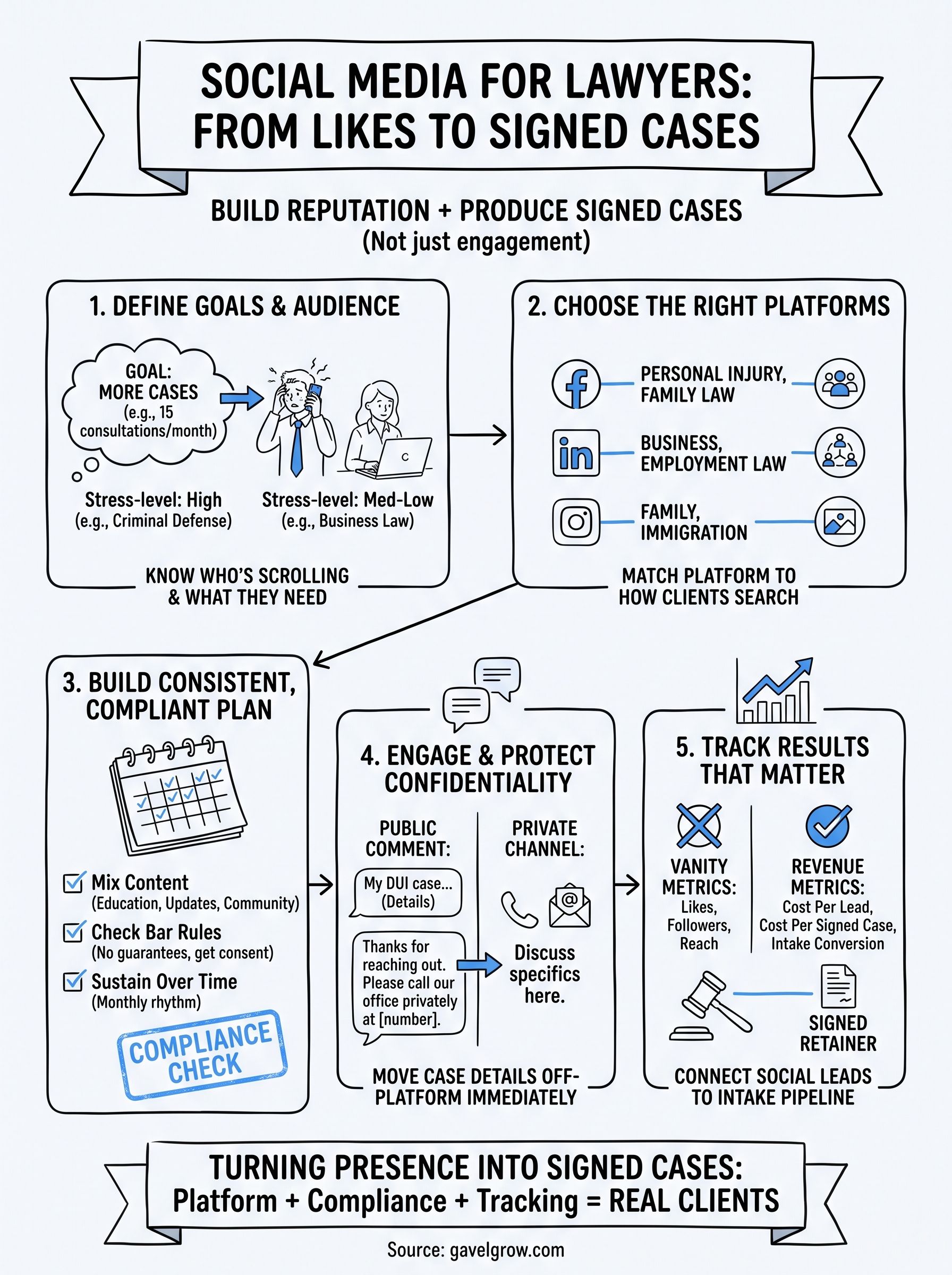
Skip the vague goal of "more engagement" and get specific before you post anything. A personal injury firm chasing car accident cases needs a different social presence than a family law practice building relationships with divorce attorneys who refer custody cases. Write down what you actually want: more consultation requests from a specific practice area, better review volume, or awareness in a new county you just opened an office in. Without that target, you'll post whatever feels easy that week, and easy content rarely produces signed cases.
Match your goal to a number you can track
Once you have a goal, attach a number to it. "Grow our Instagram following" tells you nothing about revenue. "Generate 15 qualified consultation requests per month from Facebook" tells you exactly what to build toward and what to measure against. Pull this from your intake data if you have it: how many leads came from social last quarter, how many turned into signed cases, and what practice area they clustered around. If you don't have that breakdown yet, that gap alone is worth fixing before you spend another dollar on content.
A social media goal without a number attached to it is just a hope, not a strategy.
Know who's actually scrolling before you post
Different clients search differently, and your target audience shapes almost every decision that follows, platform choice, tone, even posting time. A workers' comp client scrolling Facebook on a lunch break behaves nothing like a business owner researching contract disputes on LinkedIn during work hours. Build a short profile for each practice area you market:
- Age range and likely device: mobile-first audiences need shorter posts and faster-loading video
- Stress level at time of search: someone facing criminal charges needs reassurance, not humor
- Where they'd naturally ask questions: a Facebook group, a LinkedIn post, a review site
- What convinces them to message you: case results, client testimonials, or a clear explanation of the process
Running this exercise for each practice area you handle keeps you from posting one generic feed that speaks to nobody in particular. It also feeds directly into the platform decisions in the next step, since the audience you just defined determines where you should actually be spending your time.
Step 2. Choose the right platforms for your practice
Not every platform earns a spot in your marketing plan. A personal injury firm chasing referrals from past clients gets more out of Facebook, where people share their own stories and tag friends who might need a lawyer. A business law or employment attorney courting other professionals belongs on LinkedIn, where the audience expects industry commentary, not case-result photos. Picking platforms based on where competitors happen to post, instead of where your specific clients actually spend time, wastes the content budget you could be putting toward the one channel that actually produces leads.
Match platforms to how each practice area searches
Use the audience profile you built in Step 1 to narrow your list. A few patterns hold across most firms:
These are starting points, not rules. If your intake data shows a chunk of leads already coming from Instagram, don't abandon it because a table says LinkedIn fits better on paper.
Pick two platforms you can maintain well over five you'll neglect by month three.
Don't spread yourself thin across every network
A solo practitioner or a two-person marketing team can't run five platforms with any consistency, and a half-abandoned profile hurts more than having no profile at all. Choose one or two platforms tied directly to your top practice areas, get comfortable posting there weekly, then expand only once that rhythm is solid. Resist the pressure to join every new platform because a competitor firm did, and instead look at the channels law firms are actually doubling down on before you expand. Social media marketing for law firms works best as a focused effort, not a scattershot one, and GavelGrow's marketing dashboard can show you which platform is actually sending traffic that turns into consultations, so you're expanding based on data instead of a hunch.
Step 3. Build a consistent, compliant content plan
Planning content around a documented strategy beats a burst of enthusiasm every time. Firms that post ten times in January and nothing in February look worse to a prospective client than firms that post twice a month without fail. Build a content calendar around what you can actually sustain long-term: one case update, one client-education post, and one team or community post per month is a realistic floor for most firms with a small marketing team. Consistency signals an active, functioning firm; gaps signal the opposite, even if the firm behind the silence is doing fine.
A content calendar you can keep for a year beats a burst of posts you abandon after two months.
Check every post against your state bar's rules before it goes up
Every post needs a pass through the rules that govern how law firms advertise before it publishes, not after a complaint arrives. Rules differ enough by state that a caption fine in Texas can draw a bar complaint in Florida, so don't copy language from an out-of-state firm's feed and assume it's safe. A few checks worth running on every piece of content:
- Never guarantee an outcome or imply a result is typical for every case
- Avoid "best" or "top" superlatives applied to your firm or your attorneys
- Add required disclaimers on case results ("past results do not guarantee future outcomes" or your bar's exact required language)
- Get written client consent before posting any case detail, photo, or testimonial
- Confirm confidential case information stays out of captions, comments, and replies
Many bars publish these rules directly; check your own bar's website rather than relying on a competitor's posts as a template.
Mix content types so the feed doesn't read like a billboard
Rotate between practical explainer posts, client testimonials with consent on file, brief case updates, and community or team content so the feed reads like a firm, not an ad. A legal social media strategy built entirely on case wins gets tuned out fast; one built on answering the questions clients actually type into search bars gets shared. Plan a month at a time, assign someone to review each post against the checklist above, and keep a simple log of what you posted and when, so you can trace which content type actually produced a message or a call later on.
Step 4. Engage with clients while protecting confidentiality
Engagement is where most firms either build trust or accidentally create a compliance problem, sometimes in the same comment thread. Someone posts a question about their DUI charge in the comments section, tagging specifics about their arrest, and now that detail sits public on your page forever unless you catch it fast. Client confidentiality doesn't pause because the conversation happens on Facebook instead of in your office, and treating a public comment section like a private consultation is how firms end up explaining themselves to the bar.

Move specifics to a private channel immediately
Build a habit into whoever manages your page: the moment a comment or DM mentions case facts, names, or anything identifying, respond publicly with a short redirect and take the rest of the conversation to phone or email. A simple reply works: "Thanks for reaching out, we'd rather discuss case details privately, please call our office at [number] or send us a message." That protects the person asking the question as much as it protects your firm, since anything they post publicly could later resurface in a case they didn't expect scrutiny on.
Never let case specifics live in a public comment thread, no matter how minor the detail seems.
Handle reviews the way your bar actually allows
Reviews carry more weight than almost anything else on your profile, but managing your firm's online reviews is a process that matters as much as the content. Ask every client for a review, not just the ones you're confident were happy, and resolve complaints directly with the client rather than routing them anywhere before they post publicly. A few rules worth locking in:
- Never offer a discount, gift, or fee reduction in exchange for a review
- Respond to every public review, positive or negative, in a professional tone
- Address unhappy clients directly and privately, but only after they've had the chance to post if they choose to
- Never ask only satisfied clients, since selective solicitation violates most platforms' review policies
Assign someone to own the inbox
A legal social media strategy falls apart the moment nobody's clearly responsible for messages. Assign one person to check DMs and comments daily, ideally by managing messages in Meta Business Suite, even if posting only happens weekly, so a prospective client never waits three days for a reply. Speed matters here as much as it does on any other channel; a fast, careful response builds the trust that a slow one erases.
Step 5. Track the results that actually matter
Follower counts and like totals tell you nothing about whether social media is paying for itself. Cost per signed case is the number that matters, and most firms can't answer what a signed case actually costs them because nobody connected the Facebook message or Instagram DM to what happened after intake picked it up. Start by deciding which metrics actually inform a decision and which ones just feel good to report at a partner meeting.
Replace vanity metrics with ones tied to revenue
Swap out engagement-only reporting for numbers that trace a lead from click to retainer. A quick comparison of what most firms track versus what actually matters:
Once you're tracking the right column, you can tell a partner exactly which platform is paying its way and which one is just producing noise.
If you can't say what a platform cost you per signed case last month, you're not tracking social media, you're just posting to it.
Connect social leads to your intake pipeline
Getting this right means every message, comment, and click needs a path into your case management system, tracing a social click through to the signed retainer instead of a mental note that
Turning your social presence into signed cases
Social media only earns its place in your marketing budget when it does more than look active. Picking the right platforms, posting content that respects state bar advertising rules, protecting client confidentiality in every comment thread, and tracking cost per signed case instead of likes are the pieces that turn a feed into a source of real clients. Skip any one of them and you're left with a page that looks polished but produces nothing you can point to at a partner meeting.
Getting the tracking piece right is usually where firms stall, since most tools stop at the click and never show what happened after intake picked up the lead. If you want to see exactly which posts and platforms are producing signed cases instead of just comments, book a free 45-minute social media marketing strategy call and we'll walk through your numbers together.
Frequently asked questions about social media for lawyers
Which social platforms work best for law firms?
It depends on practice area rather than platform size. Family law, criminal defense and personal injury firms generally reach prospective clients on Facebook and Instagram, where people are reachable before a matter becomes urgent. Business-facing practices such as employment, corporate and intellectual property tend to get more from LinkedIn. Choose one or two you can post to consistently instead of opening an account everywhere.
How often should a law firm post on social media?
Often enough that the profile does not read as abandoned when a referral checks it. A weekly cadence you can actually sustain beats a burst of daily posting followed by months of silence, because the common failure here is a profile whose most recent post is years old at the exact moment someone is deciding whether to call.
Can lawyers post case results on social media?
Sometimes, and the rules are state-specific. Several states require a disclaimer making clear that past results do not predict future outcomes, and some limit how a result may be described at all. Client confidentiality applies regardless of whether the details are already public record. Check your own state bar's advertising rules before posting a result, because a post that is fine in one state can draw a complaint in another.
How do you measure whether social media produces clients?
Track what happens after the click rather than the engagement on the post. Tag links so social traffic is identifiable in analytics, capture lead source at intake, and match signed retainers back to the channel that produced them. Follower counts and likes cannot answer whether a platform produced a case last month.
Should a law firm respond to comments and direct messages?
Yes, and quickly, but never with case-specific advice in a public thread. Move anything factual about someone's situation to a private channel or an intake form. On timing, The Lead Response Management Study found leads contacted within five minutes are far more likely to qualify than those first reached after thirty minutes, so a message left unanswered for two days is usually a lead a faster firm has already taken.
Frequently Asked Questions
Which social platforms work best for law firms?
It depends on practice area rather than platform size. Family law, criminal defense and personal injury firms generally reach prospective clients on Facebook and Instagram, where people are reachable before a matter becomes urgent. Business-facing practices such as employment, corporate and intellectual property tend to get more from LinkedIn. Choose one or two you can post to consistently instead of opening an account everywhere.
How often should a law firm post on social media?
Often enough that the profile does not read as abandoned when a referral checks it. A weekly cadence you can actually sustain beats a burst of daily posting followed by months of silence, because the common failure here is a profile whose most recent post is years old at the exact moment someone is deciding whether to call.
Can lawyers post case results on social media?
Sometimes, and the rules are state-specific. Several states require a disclaimer making clear that past results do not predict future outcomes, and some limit how a result may be described at all. Client confidentiality applies regardless of whether the details are already public record. Check your own state bar's advertising rules before posting a result, because a post that is fine in one state can draw a complaint in another.
How do you measure whether social media produces clients?
Track what happens after the click rather than the engagement on the post. Tag links so social traffic is identifiable in analytics, capture lead source at intake, and match signed retainers back to the channel that produced them. Follower counts and likes cannot answer whether a platform produced a case last month.
Should a law firm respond to comments and direct messages?
Yes, and quickly, but never with case-specific advice in a public thread. Move anything factual about someone's situation to a private channel or an intake form. On timing, The Lead Response Management Study found leads contacted within five minutes are far more likely to qualify than those first reached after thirty minutes, so a message left unanswered for two days is usually a lead a faster firm has already taken.