7 Immigration Lawyer Marketing Strategies to Grow Your Firm
Categories: Legal Marketing Strategies
 Abram Ninoyan
Founder & Senior Performance Marketer
Credentials: Google Partner, Google Ads Search Certified, Google Ads Display Certified, Google Ads Measurement Certified, Google Analytics (IQ) Certified, HubSpot Inbound Certified, HubSpot Social Media Marketing Certified, Conversion Optimization Certified
Expertise: Google Ads, Meta Ads, Conversion Rate Optimization, GA4 & Google Tag Manager, Lead Generation, Marketing Funnel Optimization, PPC Management
LinkedIn Profile
Most immigration lawyer marketing budgets leak in the same place: leads come in from Google or a referral, then sit in an inbox while a paralegal juggles intake calls between hearings. The firms growi...
Key Takeaways
- 7 Immigration Lawyer Marketing Strategies to Grow Your Firm
- 1. Measure cost per signed case, not just leads
- 2. Build a website immigrant clients can trust
- 3. Optimize your Google Business Profile and local SEO
7 Immigration Lawyer Marketing Strategies to Grow Your Firm
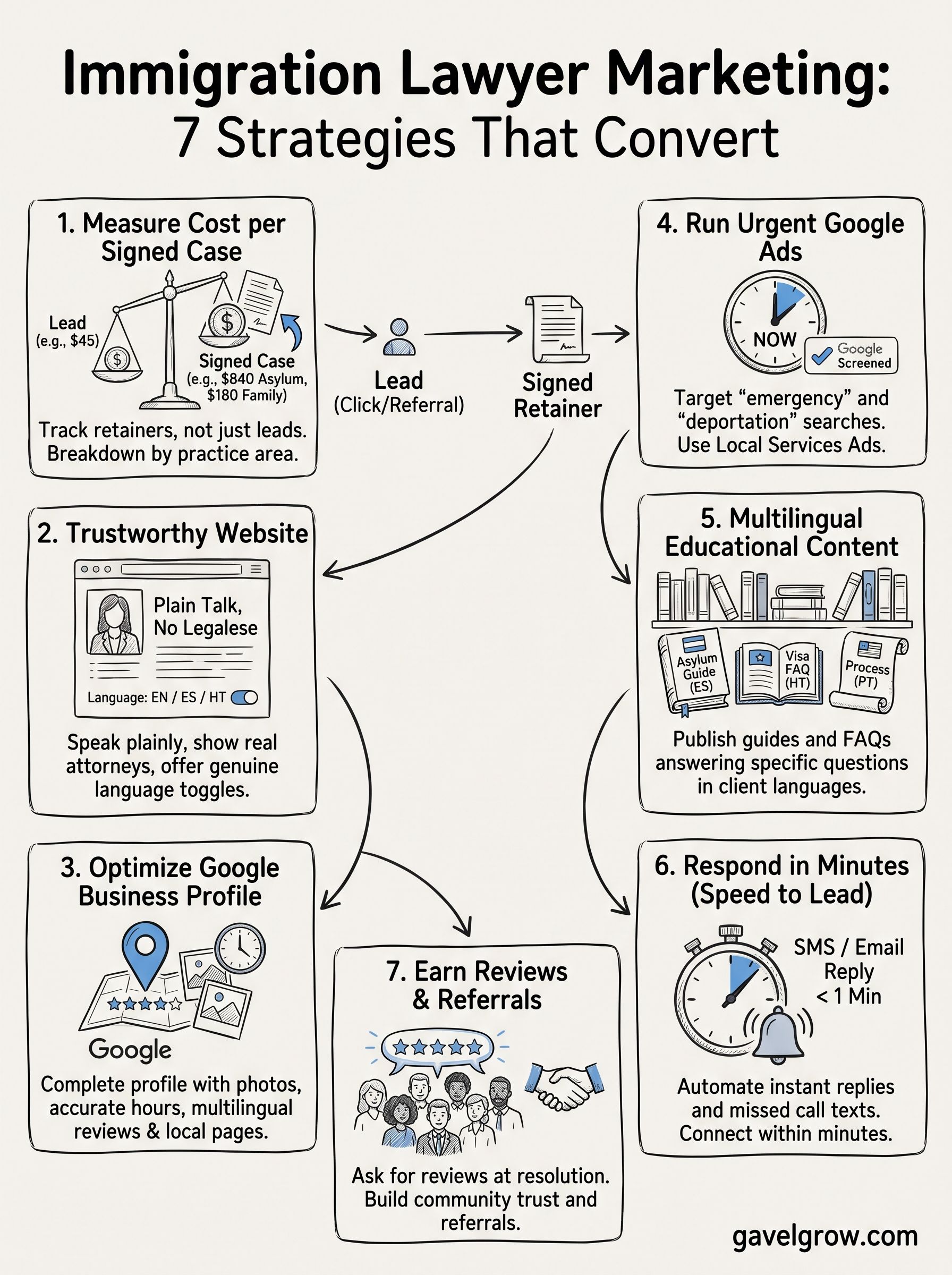
Most immigration lawyer marketing budgets leak in the same place: leads come in from Google or a referral, then sit in an inbox while a paralegal juggles intake calls between hearings. The firms growing fastest aren't necessarily spending more. They're closing the gap between the first click and the signed retainer, and they're doing it across multiple languages and case types without losing track of a single lead.
If you want a direct answer: the strategies that move the needle are targeted paid campaigns built around specific practice areas like family-based petitions or asylum, fast multilingual intake, and tracking cost per signed case instead of cost per lead. Immigration clients often compare three or four firms before calling, so speed and consistency in follow-up matter as much as where you advertise.
Below are seven strategies pulled from what actually works for immigration firms right now, from Google Local Services Ads to review generation to intake automation that catches leads the moment they submit a form or hang up the phone. Each one addresses a specific bottleneck between marketing spend and a client signing an agreement.
1. Measure cost per signed case, not just leads
How it works
Most immigration firms track cost per lead because that's the number every ad platform hands you by default. Google Ads reports it, Meta reports it, and it's easy to plug into a spreadsheet. The problem: a lead isn't a client. An asylum inquiry that never files, a family-petition call that goes to a competitor, or a duplicate form submission all count as leads, but none of them pay the bills. What a signed case actually costs your firm flips the math around. It ties every ad dollar to a retainer that actually got signed, not just a form that got submitted.
A cheap lead that never signs costs more than an expensive one that does.
Here's how the two numbers can diverge on the same ad spend:
Without that second row, a managing partner would assume asylum campaigns are underperforming when they might just have a longer, more consultative sales cycle.
Why it matters for immigration clients
Immigration matters range from a straightforward green card renewal to a multi-year asylum case with several hearings. That range means cost per lead comparisons across practice areas are close to meaningless on their own. A campaign generating cheap leads for consultations that rarely convert can quietly drain a budget while a pricier campaign for family petitions keeps the firm profitable. Firms that only watch lead volume tend to double down on the wrong channel and pull back from the one actually filling the calendar with signed retainers.
How to get started
Start by tagging every campaign, ad group, and even individual ad by practice area before you spend another dollar. Then connect your intake process so leads carry that tag all the way through to a signed case, not just through the first phone call, which is exactly what tracking a lead from ad click to signed retainer requires. A few practical steps:
- Set up call tracking numbers per campaign so you know which ad drove which call
- Match every signed retainer back to its original lead source and case type
- Review cost per signed case monthly, broken out by practice area, not blended together
- Feed signed-case outcomes back into your ad platforms' bidding so they learn what a real client looks like
GavelGrow's click-to-signed-retainer dashboard builds this attribution in from the first click, so you're not stitching together spreadsheets from three different tools to get the same answer.
2. Build a website immigrant clients can trust
How it works
Your website is often the first real interaction a prospective client has with your firm, and for many immigrants that first impression carries extra weight. A trustworthy immigration law firm website speaks plainly, skips legalese, and shows real attorney photos and bar numbers instead of stock imagery, the same design choices that turn visitors into signed clients in any practice area. It offers a language toggle instead of a Google Translate widget bolted onto the header, and it loads fast on the mid-range phones most visitors are actually using. A secure, TCPA-compliant intake form matters here too, and conversion optimization for law firm websites usually starts right there. Visitors filling out a form with sensitive case details want to see it's handled carefully, not routed through some third-party plugin nobody vetted.
Why it matters for immigration clients
Many immigration clients arrive already wary. Some have been burned by notarios or unlicensed "consultants" charging for advice they had no right to give. Others are simply navigating a legal system in a language that isn't their first. A site that feels rushed, generic, or hard to read in their preferred language reads as a red flag, not a convenience gap.
A confusing website doesn't just lose a click, it confirms a fear that's already there.
Firms that invest in clarity see fewer abandoned forms and more consultations booked directly, without a staff member chasing down half-finished submissions.
How to get started
Audit your site against a short checklist before your next redesign or ad push:
- Add full attorney bios with bar admission details and photos, not silhouettes
- Offer a genuine language toggle for Spanish, Haitian Creole, or whichever languages your caseload demands
- Replace legal jargon with plain descriptions of what each service actually involves
- Test your intake form on a mid-range Android phone, not just your laptop
- Confirm every form submission triggers an instant email or SMS confirmation so nobody wonders if it went through
3. Optimize your Google Business Profile and local SEO
How it works

A complete Google Business Profile puts your firm on the map, literally, when someone searches "immigration lawyer near me" or "abogado de inmigración cerca de mi." Google pulls from your profile to answer those searches directly, often before a searcher clicks a single website. That means your categories, service areas, hours, and photos need to be filled out fully, not left at whatever Google auto-generated when you first claimed the listing. Local SEO that ranks attorneys in the map pack also means building out location pages if you serve more than one office or metro area, so each community you serve has its own indexed page with relevant, specific content.
Why it matters for immigration clients
Immigration cases are personal and often urgent, and many clients search in their own neighborhood, in their own language, for someone they can meet face to face. A profile with recent photos, accurate hours, and reviews in multiple languages signals a firm that's actually present in the community, not a call center answering from three states away.
Local visibility earns trust before a prospective client ever reads a word on your website.
How to get started
Treat your profile as a living asset, not a one-time setup:
- Fill in every category Google offers for immigration and nationality law
- Upload fresh photos of your office, team, and community events regularly
- Post updates about visa changes, filing deadlines, or office hours around holidays
- Add location pages for every city or region you actively serve
- Keep your name, address, and phone number identical across your website and every directory listing
GavelGrow's done-for-you local SEO for law firms includes Google Business Profile optimization for firms that want this handled without adding it to an already full plate.
4. Run Google Ads for urgent immigration searches
How it works
Searches like "deportation defense lawyer" or "emergency visa attorney" come from people who need help now, not next month. Paid search for law firms puts your firm at the top of those results the same day you launch, unlike organic SEO, which can take months to rank for competitive terms. Pair standard search campaigns with Google Screened Local Services Ads for law firms, which show a verified badge and let a prospective client call directly from the search results page. Both formats let you bid by practice area, so a criminal-adjacent removal case doesn't compete for the same budget as a routine green card renewal.
Why it matters for immigration clients
Urgent immigration matters, like a detained family member or an approaching filing deadline, don't leave room for someone to browse three pages of search results. A firm running ads for these exact phrases catches the moment someone decides to act, rather than hoping they remember your name later.
The firm that shows up first when panic sets in is often the firm that gets the call.
Because these searchers are further along in deciding to hire someone, cost per click tends to run higher, but so does the rate of leads turning into signed cases.
How to get started
Build campaigns around the specific situations your clients search for, not just broad terms like "immigration lawyer":
- Create separate ad groups for detention, asylum, family petitions, and visa emergencies
- Use Local Services Ads for pay-per-lead visibility with the verified badge
- Write ad copy in the languages your caseload actually speaks
- Track cost per signed case per campaign, not just clicks
GavelGrow's managed services build and run these campaigns for firms that want the strategy handled without an in-house media buyer.
5. Publish multilingual educational content
How it works
Publishing content in the languages your clients actually speak means writing plain-language guides on topics like adjustment of status, work permit renewals, or what happens after an asylum interview, then translating them properly instead of running them through an automated tool. Each piece answers one specific question a prospective client is already typing into Google, in Spanish, Haitian Creole, Portuguese, or whatever mix your caseload demands. This is a slower play than paid ads, but a step-by-step content plan built to rank builds a library that keeps earning organic visits long after you publish it.
Why it matters for immigration clients
Many people researching immigration options are trying to understand a process that feels opaque and high stakes, often while worried about scams from unlicensed notarios. Content that explains a filing timeline or documentation checklist in their own language, written by a licensed attorney rather than a content farm, builds credibility before the first phone call happens.
A firm that explains the process for free earns trust before it ever asks for a retainer.
Searchers who find a clear answer to their exact question tend to remember which firm gave it to them, even if they don't call that same day.
How to get started
Pick a handful of high-intent topics and translate them properly rather than trying to cover everything at once:
- List the ten questions your intake team hears most often and write a short guide for each
- Have a native speaker, not a translation app, review every non-English version
- Publish practice-area FAQ pages alongside blog posts, since both get indexed
- Update content whenever visa rules or filing fees change
GavelGrow's content marketing services can help firms build this library without pulling attorneys away from casework.
6. Respond to new leads within minutes
How it works
Speed to lead means contacting a new lead within minutes of form submission or a missed call, not hours later once someone finally checks the inbox. The Lead Response Management Study found that leads contacted within five minutes are far more likely to be qualified than leads first reached at thirty minutes. That's not a conversion stat or a promise of more signed cases, it's about whether the lead is even still a real prospect by the time someone calls back. Automated SMS and email intake sequences that fire within seconds of a form submission close that gap without requiring a staff member to sit by the phone all day.
A lead that waits an hour has usually already called someone else.
Why it matters for immigration clients
Anxious clients rarely wait around. Someone facing a filing deadline or a detained relative is calling three or four firms back to back, and whichever one answers first often gets the consultation. Missed calls matter just as much as slow form replies, and a startling share of law firm leads never get a callback at all, because a prospective client who can't reach a human on the first try moves to the next name on their list. Immigration lawyer marketing spend gets wasted the moment a hot lead goes cold waiting on a callback.
How to get started
Build response time into your intake process, not just your marketing plan:
- Trigger an automatic SMS and email reply within 60 seconds of every form submission
- Set missed-call texts so nobody reaches a dead end
- Route after-hours leads to a bilingual answering option or a next-morning priority queue
- Track average response time per staff member monthly
GavelGrow's intake automation handles the sequencing and missed-call texts automatically, so a lead never sits untouched between hearings.
7. Earn reviews and build community referrals
Reviews carry outsized weight for immigration firms because prospective clients are often choosing someone to trust with a family's future, not just a legal filing. A steady stream of recent, detailed reviews on your Google Business Profile does more to convince a hesitant caller than any ad copy could. Community referrals work the same way but travel through churches, cultural associations, employers who sponsor visas, and other attorneys who don't handle immigration themselves. Both channels rely on the same thing: people who had a good experience telling someone else about it.

Why it matters for immigration clients
Immigrant communities tend to be tightly connected, and word travels fast about which firms actually deliver and which ones disappear after the retainer's signed. A client who felt heard through a multi-year asylum case will often send three or four family members your way without being asked. Reviews written in the client's own language, describing their specific situation, resonate more with future searchers than generic five-star praise ever could.
A community that trusts your firm will keep sending you clients long after the ad budget runs out.
How to get started
Build review generation and referral outreach into your standard closing process:
- Ask every client for a review at case resolution, not just the ones you expect to be happy
- Resolve complaints directly with the client rather than trying to keep them off your public profile
- Respond professionally to every review you receive, positive or critical
- Build relationships with community organizations, employers, and non-immigration attorneys who can refer cases
- Check your state bar's advertising rules before quoting testimonials in paid ads
GavelGrow's approach to building and protecting a law firm's online reputation helps firms keep this consistent instead of relying on staff to remember it during busy filing seasons.
Putting your marketing plan into action
None of these seven strategies work in isolation. A firm running sharp Google Ads campaigns but responding to leads in two hours still loses cases to slower competitors who happen to call back faster. Immigration lawyer marketing succeeds when attribution, speed, and trust-building all pull in the same direction, from the first search to the signed retainer.
Start with whichever bottleneck costs you the most cases right now. If you're not sure where that is, that's worth figuring out before you spend another dollar on ads. Most firms find it's either slow lead response or blended reporting that hides which practice area actually pays for itself.
If you want help mapping your specific gaps, book a free 45-minute immigration marketing strategy call with GavelGrow's team. We work exclusively with law firms, and we'll walk through your numbers with you directly, no generic playbook attached.
Frequently asked questions about immigration lawyer marketing
What is the most effective marketing channel for immigration lawyers?
There is no single answer, but search tends to carry the most weight because immigration clients look for a specific visa problem rather than a firm name. Referral and community relationships matter more in immigration than in most practice areas. The comparison worth making is cost per signed case by channel and case type, not cost per lead.
Why measure cost per signed case instead of cost per lead?
Because a lead is not a client. An inquiry that never files, a call that goes to a competitor and a duplicate form submission all count as leads. Immigration matters also range from a green card renewal to a multi-year asylum case, so a blended lead cost across practice areas tells you very little. Tying spend to signed retainers by case type is what shows which campaign is paying for itself.
Should an immigration firm market in languages other than English?
If a meaningful share of your caseload comes from speakers of another language, yes, and with real pages rather than a translation plugin. It applies to intake as much as to content. A prospective client who reaches a Spanish-language page and then cannot be answered in Spanish is a lead you paid for and lost at the final step.
How fast should an immigration firm respond to a new lead?
As close to immediately as the practice allows. The Lead Response Management Study found leads contacted within five minutes are far more likely to qualify than those first reached after thirty minutes. Immigration prospects commonly contact several firms in one sitting, so response time often decides who gets the consultation regardless of who has the better website.
How can immigration firms get more reviews without breaking bar rules?
Ask every client at a natural completion point, keep the request simple, and never offer anything of value in exchange for a review. Do not write, edit or filter reviews, and do not ask only the clients you expect to be positive. When replying, avoid confirming any detail of the person's matter, since acknowledging representation in a public response can itself create a confidentiality problem.
Frequently Asked Questions
What is the most effective marketing channel for immigration lawyers?
There is no single answer, but search tends to carry the most weight because immigration clients look for a specific visa problem rather than a firm name. Referral and community relationships matter more in immigration than in most practice areas. The comparison worth making is cost per signed case by channel and case type, not cost per lead.
Why measure cost per signed case instead of cost per lead?
Because a lead is not a client. An inquiry that never files, a call that goes to a competitor and a duplicate form submission all count as leads. Immigration matters also range from a green card renewal to a multi-year asylum case, so a blended lead cost across practice areas tells you very little. Tying spend to signed retainers by case type is what shows which campaign is paying for itself.
Should an immigration firm market in languages other than English?
If a meaningful share of your caseload comes from speakers of another language, yes, and with real pages rather than a translation plugin. It applies to intake as much as to content. A prospective client who reaches a Spanish-language page and then cannot be answered in Spanish is a lead you paid for and lost at the final step.
How fast should an immigration firm respond to a new lead?
As close to immediately as the practice allows. The Lead Response Management Study found leads contacted within five minutes are far more likely to qualify than those first reached after thirty minutes. Immigration prospects commonly contact several firms in one sitting, so response time often decides who gets the consultation regardless of who has the better website.
How can immigration firms get more reviews without breaking bar rules?
Ask every client at a natural completion point, keep the request simple, and never offer anything of value in exchange for a review. Do not write, edit or filter reviews, and do not ask only the clients you expect to be positive. When replying, avoid confirming any detail of the person's matter, since acknowledging representation in a public response can itself create a confidentiality problem.