Conversion Rate Optimization Services Pricing for Law Firms
Categories: Legal Marketing Strategies
 Abram Ninoyan
Founder & Senior Performance Marketer
Credentials: Google Partner, Google Ads Search Certified, Google Ads Display Certified, Google Ads Measurement Certified, Google Analytics (IQ) Certified, HubSpot Inbound Certified, HubSpot Social Media Marketing Certified, Conversion Optimization Certified
Expertise: Google Ads, Meta Ads, Conversion Rate Optimization, GA4 & Google Tag Manager, Lead Generation, Marketing Funnel Optimization, PPC Management
LinkedIn Profile
Conversion rate optimization services pricing for law firms typically runs from a few hundred dollars a month for a self-serve platform to $2,500 or more monthly when an agency builds and manages the...
Key Takeaways
- Conversion Rate Optimization Services Pricing for Law Firms
- Why does CRO pricing vary so much for law firms?
- How to budget for conversion rate optimization at your firm
- CRO pricing models and typical cost ranges
Conversion Rate Optimization Services Pricing for Law Firms
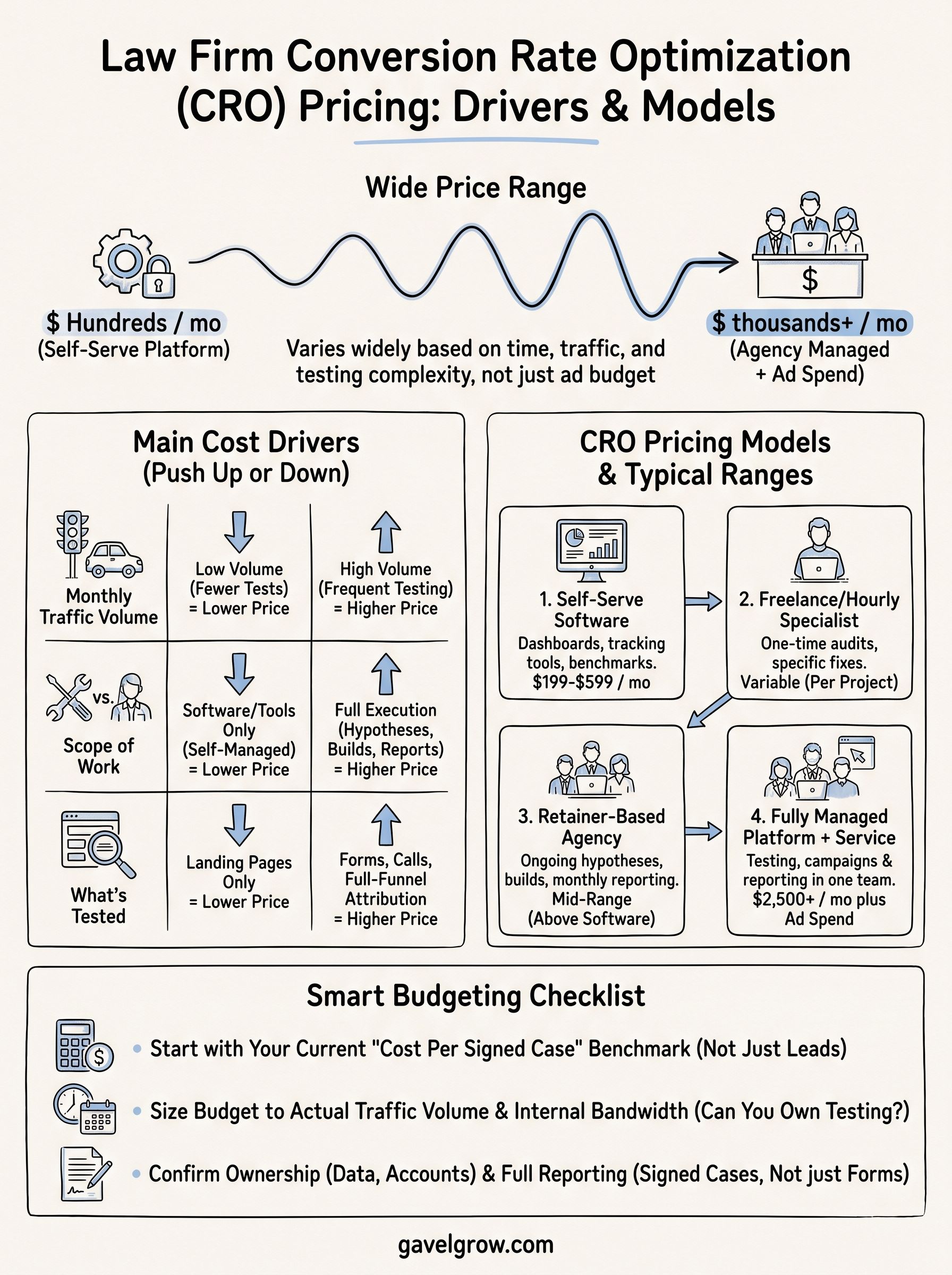
Conversion rate optimization services pricing for law firms typically runs from a few hundred dollars a month for a self-serve platform to $2,500 or more monthly when an agency builds and manages the testing for you, plus your ad spend. That range depends on whether you're paying for software, a dedicated CRO specialist, or a full-service team running your Google Ads and Local Services campaigns alongside form and page testing.
If you're trying to budget before you call an agency, you need to know what drives that price up or down: how many pages get tested, whether call tracking and intake forms are part of the scope, and whether you're buying tools only or hands-on execution. Firms searching for conversion rate optimization pricing usually want a straight answer on cost per month, not a sales pitch, and that's what this article gives you.
Below, we break down the typical pricing tiers, what each one actually includes, and the specific cost factors that push a law firm's CRO bill higher, so you can compare quotes with confidence. We'll also cover where platform pricing like GavelGrow's Optimize plan fits against a fully managed engagement.
Why does CRO pricing vary so much for law firms?
CRO pricing swings widely because law firms aren't buying a fixed product, they're paying for time, traffic, and testing complexity that looks completely different from firm to firm. A solo immigration attorney getting 400 site visits a month needs a different approach than a mass tort shop running six-figure ad spend across a dozen states. That gap in scale is the single biggest reason a conversion rate optimization price quote from one agency can be three times higher than another for what sounds like the same service.
Traffic volume changes how long tests take
Statistical significance requires a minimum number of visitors and conversions before you can trust a test result. A firm with low traffic simply can't run the same number of experiments per month as a high-volume mass tort campaign, so agencies either charge more to manually build workarounds (multivariate testing, longer test windows, qualitative research to fill the data gap) or they charge less because there's less to actively manage. This is why a conversion rate optimization services pricing quote almost always starts with a traffic and lead-volume question before a number gets mentioned.
A firm's traffic volume, not its ad budget, is usually what decides how much CRO actually costs per month.
Scope: software only versus full execution
The biggest lever on price is whether you're buying a tool or a team. A self-serve platform gives you the dashboards, form builders, and tracking data to run your own tests, and that typically runs a few hundred dollars a month. A managed engagement where specialists write hypotheses, build variants, run the tests, and report on signed-case impact costs more because you're paying for expert hours, not just software access. GavelGrow structures this exact split: the Optimize plan at $599 a month gives a firm the Smart Conversions tooling and benchmark data to run its own optimization work, while a managed engagement scoped on a strategy call hands the actual testing and campaign work to a legal-only team.
What's actually being tested
CRO for a law firm rarely means just a landing page headline test. It usually spans intake forms, phone call handling, and the path from an ad click to a signed retainer. Each of those adds cost differently:
- Landing page and headline testing is the cheapest and fastest to run, since it only touches on-page copy and layout.
- Intake form testing costs more because it involves TCPA consent language, mobile-first field design, and duplicate detection, all of which need legal-industry knowledge to get right.
- Call tracking and call outcome analysis adds cost because someone has to listen to recordings, tag outcomes as qualified or spam, and correlate that back to which campaign or page drove the call.
- Full-funnel attribution testing, tracing a click through to a signed case rather than stopping at "lead submitted," is the most expensive because it requires integrating ad platforms, call data, and case management data into one view.
Practice area and market competitiveness
Some practice areas simply have thinner margins for error. Personal injury and mass tort firms often run paid campaigns where a single signed case is worth tens of thousands of dollars, so agencies price CRO work assuming higher stakes and often build in more rigorous testing cadence. Family law, criminal defense, and estate planning firms usually see lower cost-per-case dynamics, so a lighter, cheaper testing cadence still makes financial sense. Market competitiveness matters too. A firm competing against a dozen other personal injury shops in a major metro area needs its intake forms and call handling dialed in tighter than a firm with little local competition, and that pushes agencies to recommend a heavier (and pricier) testing scope.
A quick comparison of what drives the number up or down
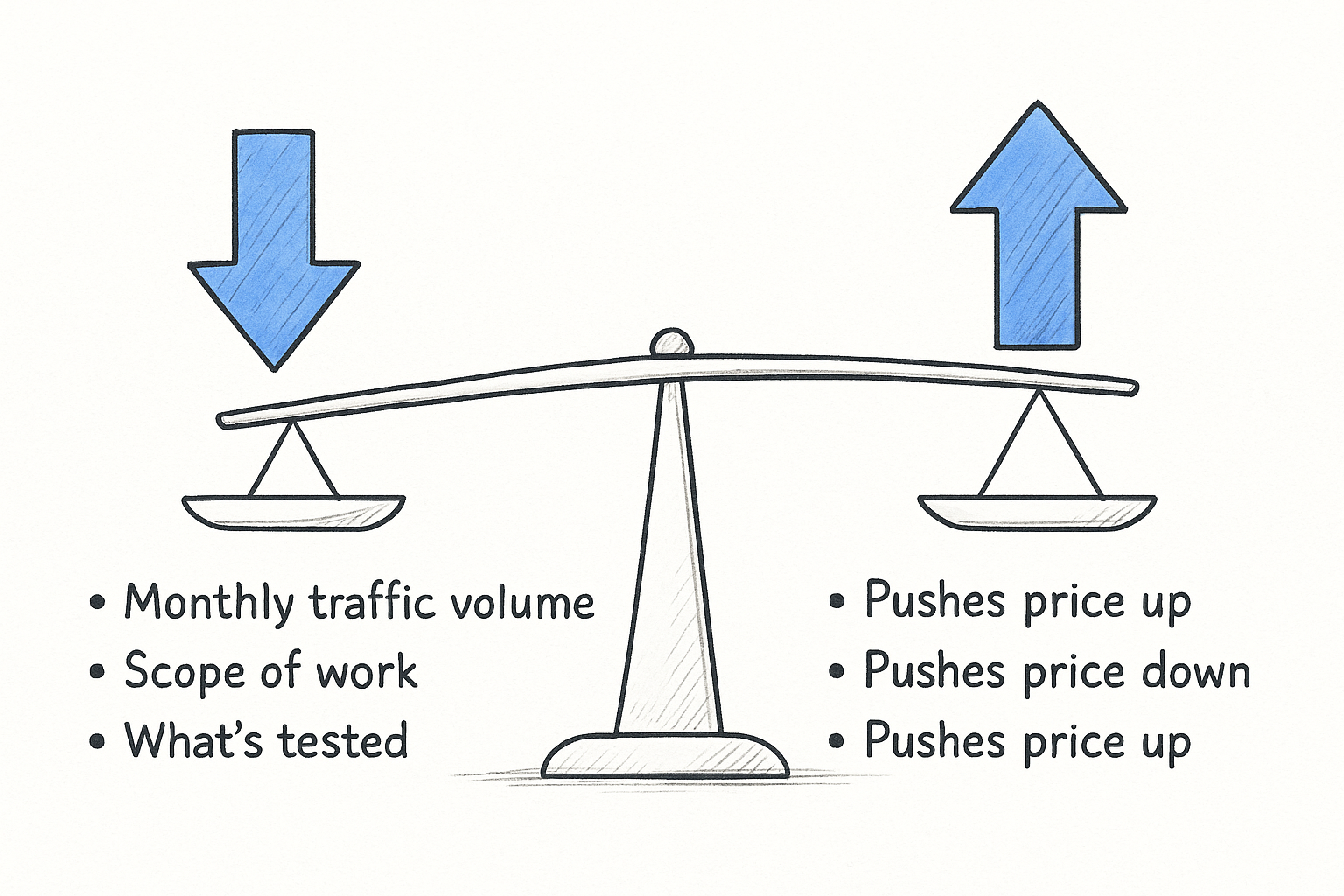
Understanding these drivers before you get on a call with an agency changes the conversation. Instead of asking "how much does CRO cost," you can ask which of these five factors is driving their specific number, and push back on any of them that don't apply to your firm's actual traffic and case mix.
How to budget for conversion rate optimization at your firm
Budgeting for CRO starts with a number you already have: your current cost per signed case benchmark. Before you call an agency or sign up for a platform, pull your last three months of ad spend and divide it by signed cases, not leads. That figure is your baseline, and every CRO investment should be judged against whether it moves that number down. Firms that skip this step end up comparing CRO quotes in a vacuum, with no way to tell if $600 a month or $3,000 a month is the right spend for their situation.
Size your budget to your traffic, not your ambition
Traffic volume should set your ceiling, not your goals for growth. A firm generating 300 leads a month doesn't need a $5,000 CRO retainer with weekly multivariate testing, because there simply isn't enough data to support that testing cadence yet. Spend that money instead on getting your intake form and call tracking set up correctly the first time, then scale the testing budget once volume grows. A realistic starting budget for a low-to-mid traffic firm usually lands closer to the self-serve software range, somewhere in the low hundreds per month, with room to add a managed engagement once lead volume justifies it.
Set your CRO budget based on how much traffic you actually have, not how much you wish you had.
Decide what you can realistically run in-house
Most firm marketing directors already juggle Google Ads, Local Services Ads, and reputation management. Adding hands-on CRO testing, writing hypotheses, building form variants, reviewing call recordings, on top of that workload usually means it doesn't get done consistently. Be honest about your team's bandwidth before you commit to a software-only plan. If nobody on staff has two or three hours a week to dedicate to reviewing test results and acting on them, a self-serve platform will sit unused, and you'll have paid for tools you never touched.
A simple framework for setting the number
Use this checklist to land on a starting budget before you talk to anyone:
- Calculate your current cost per signed case using the last 90 days of ad spend and case data, or run the numbers in a free CPA calculator.
- Count your monthly leads to figure out whether you have enough volume to support frequent testing.
- Audit your internal bandwidth and decide honestly whether someone can own testing week to week.
- List what's currently untested, forms, call scripts, landing pages, so you know where the first dollars should go.
- Set a review date, 90 days out, to check whether the spend actually moved your cost per signed case.
Where GavelGrow fits into the budget conversation
Once you've done that math, the platform-versus-agency decision usually answers itself. A firm with modest traffic and an in-house marketing coordinator often does fine starting with GavelGrow's self-serve platform for law firms, whose Track and Optimize plans include Smart Conversions and practice-area benchmark data without a five-figure monthly commitment. A firm with heavier traffic, thinner internal bandwidth, or a marketing director who's stretched across ten other priorities usually gets more value from a managed engagement, where a legal-only team builds and runs the testing alongside the ad campaigns. Neither path is automatically cheaper or more expensive, it depends entirely on the traffic and bandwidth math you just ran.
CRO pricing models and typical cost ranges
Law firms typically encounter four distinct ways CRO gets sold, and knowing which model you're looking at makes it much easier to compare an agency's quote against GavelGrow's published numbers or any other law firm marketing platform. Each model trades off flexibility, hands-on support, and total monthly cost differently, so the "right" one depends on the traffic and bandwidth math you worked through in the last section.
Self-serve software subscriptions
Software-only pricing covers the conversion optimization software a law firm can run itself, including dashboards, form builders, call tracking, and benchmark data, without anyone actively running tests for you. This is the cheapest entry point into structured CRO work, usually landing in the low hundreds per month. GavelGrow's Track plan starts at $199 a month for a single connected ad account and basic call tracking, while the Optimize plan at $599 a month adds Smart Conversions sending and full practice-area benchmark data for firms ready to run more sophisticated tests themselves.
Freelance or hourly CRO specialists
Some firms hire an independent CRO consultant to audit their intake funnel and recommend fixes on an hourly or project basis. This model works for a one-time audit or a specific fix, like rebuilding a slow intake form, but it rarely includes ongoing testing infrastructure. Because you're paying for a person's time rather than a subscription, costs swing with the specialist's experience and the scope of the project, and you're often left running the resulting recommendations yourself once the engagement ends.
Retainer-based agency CRO
Retainer pricing covers an agency team that writes hypotheses, builds test variants, and reports on results month over month, typically without also running your ad campaigns. This sits in the middle of the pricing spectrum, above software-only and below a fully managed engagement, because you're paying for dedicated hours from a small team rather than one person's time or pure software access. Retainers make sense for a firm that already has ad management handled internally or through a separate vendor but wants focused, ongoing testing work, and it helps to see how CRO consulting firms price that retainer before you sign.
The more of your funnel an agency actively runs for you, the higher the monthly number, and that trade is usually worth it once your traffic can support it.
Fully managed platform plus service
The most comprehensive model bundles the software, the testing, and the ad campaign management into a single relationship. GavelGrow's managed engagement is scoped on a strategy call rather than sold at a list price, because the right number depends on your traffic, your practice area, and how much of the campaign work you want handed over. It includes every platform feature along with a named contact who builds and runs your campaigns and testing together. This model removes the coordination problem you get when a separate CRO agency and a separate ad agency aren't talking to each other about what's actually converting.
Comparing the four models at a glance
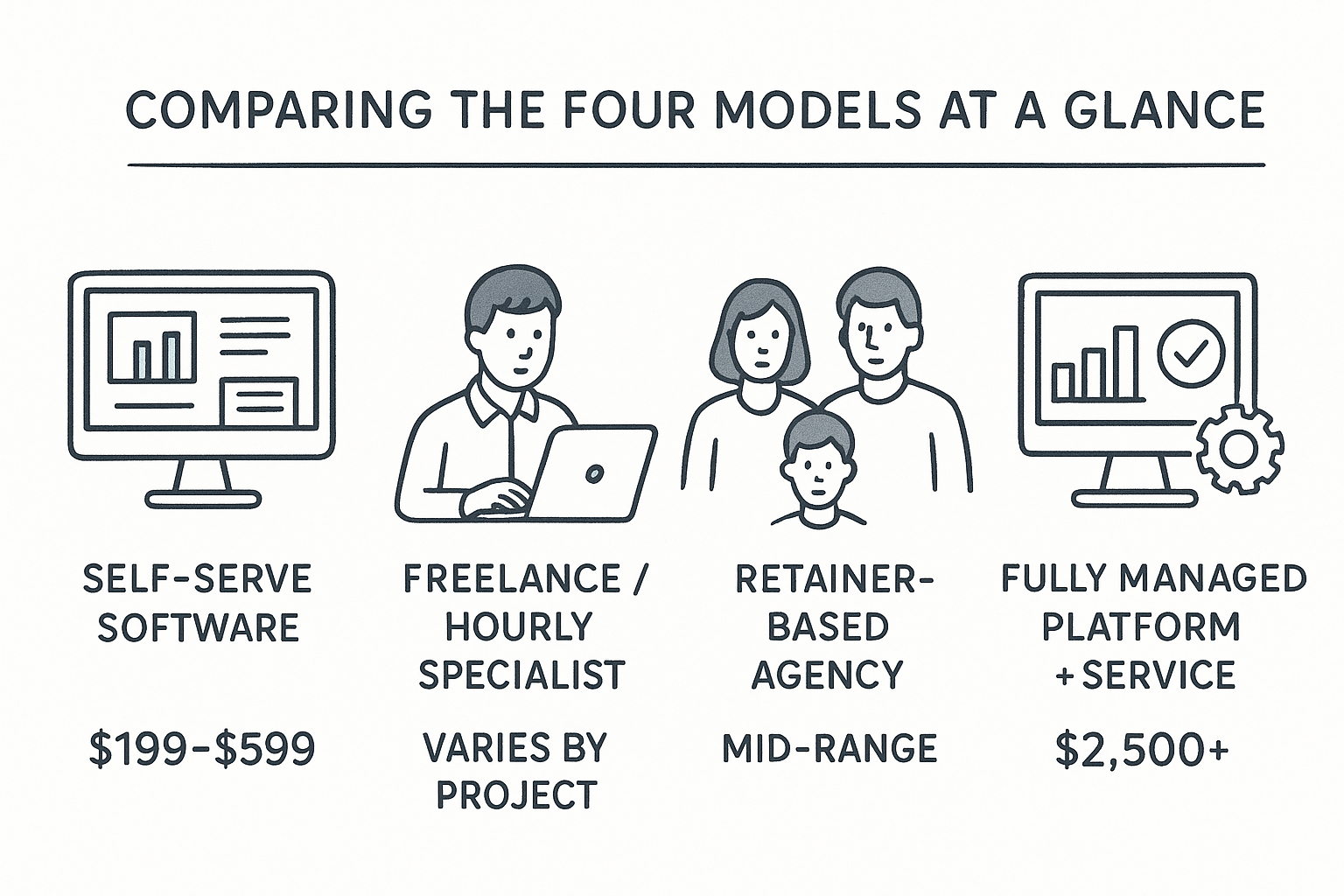
None of these models is inherently better than another. A firm doing $15,000 a month in Local Services Ads spend gets more value from a managed team catching intake leaks in real time than from a freelancer's one-time report, while a solo practitioner testing a single landing page headline doesn't need a retainer at all.
What should your CRO budget actually include?
A CRO quote that only lists “landing page tests” is missing most of the work that actually moves a law firm's cost per signed case. Before you sign a contract, check the quote against the line items below, because agencies routinely price the easy parts and leave the harder, higher-value work as an add-on you discover later. Knowing what belongs in a complete conversion rate optimization services pricing package keeps you from getting a stripped-down version of CRO at a full-service price.
Testing infrastructure, not just test ideas
Before anyone can run a valid test, you need the plumbing in place: call tracking numbers tied to each campaign (and it's worth knowing what call tracking software costs per month), form analytics that separate mobile from desktop performance, and consent tracking that logs how a lead agreed to be contacted. Some agencies charge separately for this setup phase, which can add weeks and dollars before testing even starts. Ask directly whether call tracking, form analytics, and TCPA consent logging are included in the base price or billed as a one-time setup fee, because that distinction alone can shift a quote by hundreds of dollars a month.
Reporting tied to signed cases, not just form fills
A test that raises your form submission rate but doesn't raise your signed-case rate hasn't actually made you money. Your budget should cover reporting that traces a lead through intake, through the case management pipeline, and to a signed retainer, not a dashboard that stops at “conversion” the moment someone hits submit. This is the gap that trips up firms comparing a cheap CRO subscription against a pricier one: the cheap option often reports on lead volume, while the pricier one reports on case value.
If your CRO reporting stops at the form submission, you're paying to optimize the wrong number.
Call handling, not just web pages
For most law firms, a meaningful share of qualified leads come in by phone, and a CRO budget that ignores call handling is only testing half the funnel. Your budget should account for reviewing call recordings, tagging outcomes as qualified, callback, or spam, and identifying which campaigns generate calls that actually convert versus calls that waste intake staff time. GavelGrow folds this into built-in call tracking with outcome tagging and call-to-lead matching, which is worth checking for before you pay extra for a separate call analytics tool on top of your CRO spend.
A checklist for evaluating any CRO quote
Use this list against any proposal before you sign:
- Setup and infrastructure: Is call tracking, form analytics, and consent logging included, or billed separately?
- Testing cadence: How many active tests run per month, and does that match your actual traffic volume?
- Attribution depth: Does reporting trace to signed cases, or stop at leads?
- Call handling: Are call recordings reviewed and tagged as part of the scope?
- Ownership: Do you own the ad accounts and tracking data if you switch vendors later?
Ownership matters more than most firms realize until they try to leave an agency and discover their tracking numbers and historical data don't travel with them. GavelGrow keeps ad accounts in the firm's own name on every plan, so a firm evaluating a conversion rate optimization price against this checklist isn't locked into a vendor to keep its own performance history. Running every quote through these five questions turns a vague monthly number into a budget you can actually defend to your partners.
Setting a CRO budget that fits your firm
The right CRO budget isn't a number you copy from a competitor's quote, it's the number that matches your actual traffic, your practice area's case value, and how much of the work your team can realistically run week to week. A solo firm testing one intake form doesn't need a $2,500 retainer, and a mass tort shop spending six figures on ads can't afford to skip full-funnel attribution just to save a few hundred dollars a month. Use the cost-per-signed-case math and the checklist from this article every time an agency sends you a proposal, and you'll know within minutes whether that conversion rate optimization services pricing actually fits your firm or just sounds reasonable on paper.
If you'd rather walk through your specific traffic, practice area, and current cost per signed case with someone who does this daily, see GavelGrow's conversion optimization service for law firms and get a straight answer on what your budget should look like.
Frequently asked questions about CRO pricing for law firms
How much do conversion rate optimization services cost for a law firm?
It depends far more on your traffic and the scope of work than on which agency you call. Self-serve platform access generally runs a few hundred dollars a month, while a managed engagement where specialists write hypotheses, build variants and run the tests costs more, because you are buying expert hours rather than software access. Ask any vendor what the number actually covers before comparing quotes, since CRO can mean a headline test or a rebuild of your whole intake path.
What does GavelGrow charge for conversion rate optimization?
The Optimize plan is $599 a month and gives a firm the Smart Conversions tooling and benchmark data to run its own optimization work. A fully managed engagement, where the testing and campaign work is handed to the team, is scoped on a strategy call rather than sold at a list price, because the right number depends on your traffic, your practice area, and how much of the work you want to keep in house.
Why do CRO quotes vary so much between agencies?
Because the work is priced on time, traffic and testing complexity rather than as a fixed product. A test needs a minimum number of visitors and conversions before the result means anything, so a low-traffic firm cannot run the same number of experiments as a high-volume campaign. That is why a serious quote usually starts with a question about your traffic and lead volume rather than a number.
Is conversion rate optimization worth it for a small firm?
It can be, as long as the scope matches the traffic. A firm testing a single intake form does not need weekly multivariate testing, and paying for it buys capacity the traffic cannot fill. Start with the parts that pay back at any volume: the intake form itself, how fast new leads get answered, and knowing which pages produce signed cases rather than form fills.
What should a law firm's CRO scope include?
More than landing pages. For a law firm the path runs from ad click to signed retainer, so the scope should cover intake form design including TCPA consent handling, call tracking with outcome tagging, and attribution that survives a phone call. A program that only tests headlines will miss the place most firms actually lose cases.
Frequently Asked Questions
How much do conversion rate optimization services cost for a law firm?
It depends far more on your traffic and the scope of work than on which agency you call. Self-serve platform access generally runs a few hundred dollars a month, while a managed engagement where specialists write hypotheses, build variants and run the tests costs more, because you are buying expert hours rather than software access. Ask any vendor what the number actually covers before comparing quotes, since CRO can mean a headline test or a rebuild of your whole intake path.
What does GavelGrow charge for conversion rate optimization?
The Optimize plan is $599 a month and gives a firm the Smart Conversions tooling and benchmark data to run its own optimization work. A fully managed engagement, where the testing and campaign work is handed to the team, is scoped on a strategy call rather than sold at a list price, because the right number depends on your traffic, your practice area, and how much of the work you want to keep in house.
Why do CRO quotes vary so much between agencies?
Because the work is priced on time, traffic and testing complexity rather than as a fixed product. A test needs a minimum number of visitors and conversions before the result means anything, so a low-traffic firm cannot run the same number of experiments as a high-volume campaign. That is why a serious quote usually starts with a question about your traffic and lead volume rather than a number.
Is conversion rate optimization worth it for a small firm?
It can be, as long as the scope matches the traffic. A firm testing a single intake form does not need weekly multivariate testing, and paying for it buys capacity the traffic cannot fill. Start with the parts that pay back at any volume: the intake form itself, how fast new leads get answered, and knowing which pages produce signed cases rather than form fills.
What should a law firm's CRO scope include?
More than landing pages. For a law firm the path runs from ad click to signed retainer, so the scope should cover intake form design including TCPA consent handling, call tracking with outcome tagging, and attribution that survives a phone call. A program that only tests headlines will miss the place most firms actually lose cases.